1
IMPLEMENTING AND EXECUTINGIMPLEMENTING AND EXECUTING
STRATEGY: BUDGETS, POLICIES,STRATEGY: BUDGETS, POLICIES,
BEST PRACTICES, SUPPORTBEST PRACTICES, SUPPORT
SYSTEMS, AND REWARDSSYSTEMS, AND REWARDS
2
Linking Budgets to Strategy
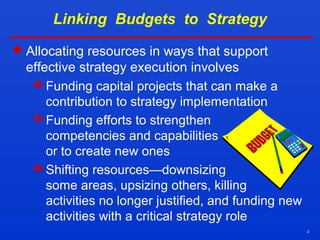
 Allocating resources in ways that support
effective strategy execution involves
 Funding capital projects that can make a
contribution to strategy implementation
 Funding efforts to strengthen
competencies and capabilities
or to create new ones
 Shifting resources—downsizing
some areas, upsizing others, killing
activities no longer justified, and funding new
activities with a critical strategy role
ESTABLISH STRATEGY-ESTABLISH STRATEGY-
SUPPORTIVE POLICIESSUPPORTIVE POLICIES
4
How Policies and Procedures
Aid Strategy Implementation
 Provide top-down guidance regarding
expected behaviors
 Help align internal actions with strategy,
channeling efforts along the intended path
 Enforce consistency in performance of
activities in geographically scattered units
 Serve as powerful lever for changing
corporate culture to produce stronger
fit with a new strategy
5
Creating Strategy-Supportive
Policies and Procedures
 Role of new policies
 Channel behaviors and decisions
to promote strategy execution
 Counteract tendencies of people
to resist chosen strategy
 Too much policy can be as stifling as
Wrong policy or as Chaotic as no policy
 Often, the best policy is empowering
employees and letting them operate between
the white lines anyway they think best
INSTITUTE BEST PRACTICESINSTITUTE BEST PRACTICES
AND MECHANISMS (FORAND MECHANISMS (FOR
CONTINUOUS IMPROVEMENT)CONTINUOUS IMPROVEMENT)
7
Instituting Best Practices
and Continuous Improvement
 Searching out and adopting best practices is
integral to effective implementation
 Benchmarking has created new approaches to
improve strategy execution
 Reengineering
 TQM
 Continuous improvement programs
8
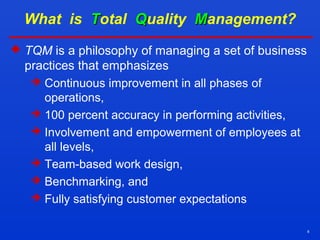
What is TTotal QQuality MManagement?
 TQM is a philosophy of managing a set of business
practices that emphasizes
 Continuous improvement in all phases of
operations,
 100 percent accuracy in performing activities,
 Involvement and empowerment of employees at
all levels,
 Team-based work design,
 Benchmarking, and
 Fully satisfying customer expectations
9
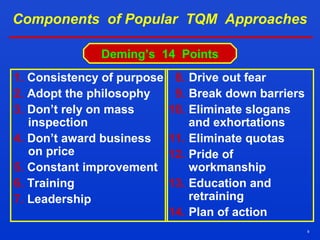
Components of Popular TQM Approaches
1. Consistency of purpose
2. Adopt the philosophy
3. Don’t rely on mass
inspection
4. Don’t award business
on price
5. Constant improvement
6. Training
7. Leadership
8. Drive out fear
9. Break down barriers
10. Eliminate slogans
and exhortations
11. Eliminate quotas
12. Pride of
workmanship
13. Education and
retraining
14. Plan of action
Deming’s 14 Points
10
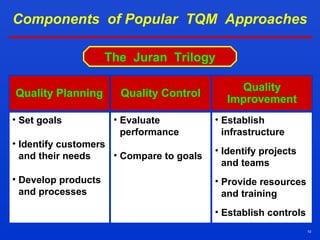
The Juran Trilogy
Quality Planning Quality Control
Quality
Improvement
• Set goals
• Identify customers
and their needs
• Develop products
and processes
• Evaluate
performance
• Compare to goals
• Establish
infrastructure
• Identify projects
and teams
• Provide resources
and training
• Establish controls
Components of Popular TQM Approaches
11
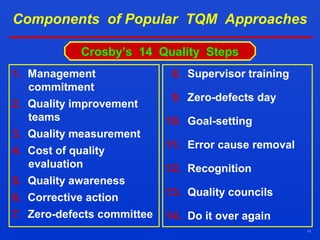
1. Management
commitment
2. Quality improvement
teams
3. Quality measurement
4. Cost of quality
evaluation
5. Quality awareness
6. Corrective action
7. Zero-defects committee
8. Supervisor training
9. Zero-defects day
10. Goal-setting
11. Error cause removal
12. Recognition
13. Quality councils
14. Do it over again
Crosby’s 14 Quality Steps
Components of Popular TQM Approaches
12
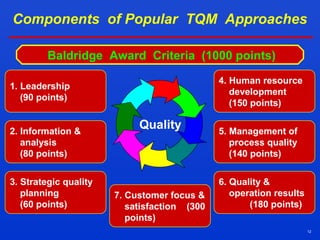
Baldridge Award Criteria (1000 points)
Quality
1. Leadership
(90 points)
2. Information &
analysis
(80 points)
3. Strategic quality
planning
(60 points)
4. Human resource
development
(150 points)
5. Management of
process quality
(140 points)
6. Quality &
operation results
(180 points)
7. Customer focus &
satisfaction (300
points)
Components of Popular TQM Approaches
13
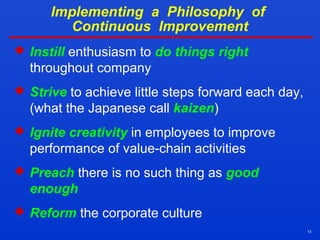
Implementing a Philosophy of
Continuous Improvement
 Instill enthusiasm to do things right
throughout company
 Strive to achieve little steps forward each day,
(what the Japanese call kaizen)
 Ignite creativity in employees to improve
performance of value-chain activities
 Preach there is no such thing as good
enough
 Reform the corporate culture
14
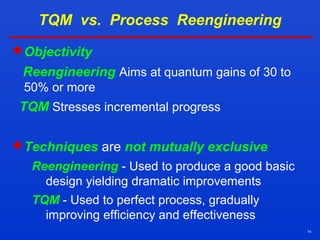
TQM vs. Process Reengineering
Objectivity
Reengineering Aims at quantum gains of 30 to
50% or more
TQM Stresses incremental progress
Techniques are not mutually exclusive
Reengineering - Used to produce a good basic
design yielding dramatic improvements
TQM - Used to perfect process, gradually
improving efficiency and effectiveness
15
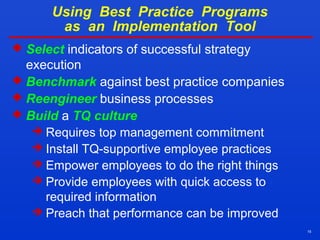
Using Best Practice Programs
as an Implementation Tool
 Select indicators of successful strategy
execution
 Benchmark against best practice companies
 Reengineer business processes
 Build a TQ culture
 Requires top management commitment
 Install TQ-supportive employee practices
 Empower employees to do the right things
 Provide employees with quick access to
required information
 Preach that performance can be improved
INSTALL SUPPORTINSTALL SUPPORT
SYSTEMSSYSTEMS
17
Installing Support Systems
 Essential to promote successful strategy
execution
 Types of support systems
 On-line data systems
 Internet and company intranets
 Electronic mail
 E-commerce systems
 Mobilizing information and creating systems to
use knowledge effectively can yield Competitive
advantage
18
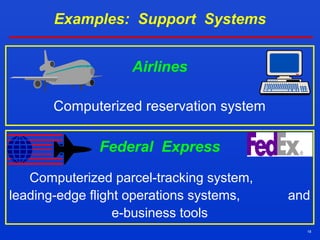
Examples: Support Systems
Airlines
Computerized reservation system
Federal Express
Computerized parcel-tracking system,
leading-edge flight operations systems, and
e-business tools
19
Examples: Support Systems
Otis Elevator
Sophisticated maintenance support system
Domino’s Pizza
Computerized systems at each outlet facilitate
ordering, inventory, payroll, cash flow, and
work flow functions
20
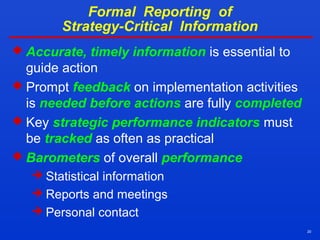
Formal Reporting of
Strategy-Critical Information
 Accurate, timely information is essential to
guide action
 Prompt feedback on implementation activities
is needed before actions are fully completed
 Key strategic performance indicators must
be tracked as often as practical
 Barometers of overall performance
 Statistical information
 Reports and meetings
 Personal contact
21
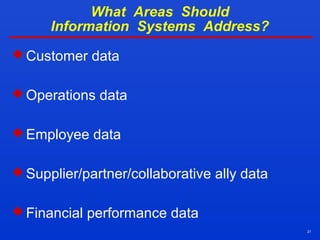
What Areas Should
Information Systems Address?
 Customer data
 Operations data
 Employee data
 Supplier/partner/collaborative ally data
 Financial performance data
DESIGN STRATEGY-DESIGN STRATEGY-
SUPPORTIVE REWARDSUPPORTIVE REWARD
SYSTEMSSYSTEMS
23
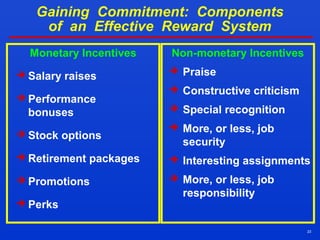
Gaining Commitment: Components
of an Effective Reward System
Monetary Incentives
 Salary raises
 Performance
bonuses
 Stock options
 Retirement packages
 Promotions
 Perks
Non-monetary Incentives
 Praise
 Constructive criticism
 Special recognition
 More, or less, job
security
 Interesting assignments
 More, or less, job
responsibility
24
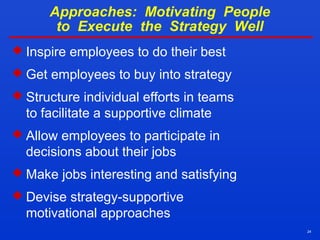
Approaches: Motivating People
to Execute the Strategy Well
 Inspire employees to do their best
 Get employees to buy into strategy
 Structure individual efforts in teams
to facilitate a supportive climate
 Allow employees to participate in
decisions about their jobs
 Make jobs interesting and satisfying
 Devise strategy-supportive
motivational approaches
25
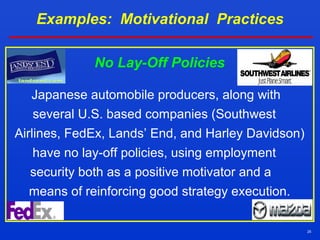
Examples: Motivational Practices
No Lay-Off Policies
Japanese automobile producers, along with
several U.S. based companies (Southwest
Airlines, FedEx, Lands’ End, and Harley Davidson)
have no lay-off policies, using employment
security both as a positive motivator and a
means of reinforcing good strategy execution.
26
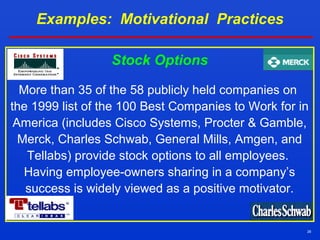
Examples: Motivational Practices
Stock Options
More than 35 of the 58 publicly held companies on
the 1999 list of the 100 Best Companies to Work for in
America (includes Cisco Systems, Procter & Gamble,
Merck, Charles Schwab, General Mills, Amgen, and
Tellabs) provide stock options to all employees.
Having employee-owners sharing in a company’s
success is widely viewed as a positive motivator.
27
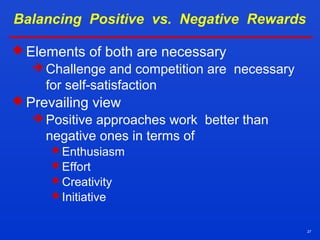
Balancing Positive vs. Negative Rewards
 Elements of both are necessary
 Challenge and competition are necessary
for self-satisfaction
 Prevailing view
 Positive approaches work better than
negative ones in terms of
Enthusiasm
Effort
Creativity
Initiative

Ch12 implementation

  • 1.
    1 IMPLEMENTING AND EXECUTINGIMPLEMENTINGAND EXECUTING STRATEGY: BUDGETS, POLICIES,STRATEGY: BUDGETS, POLICIES, BEST PRACTICES, SUPPORTBEST PRACTICES, SUPPORT SYSTEMS, AND REWARDSSYSTEMS, AND REWARDS
  • 2.
    2 Linking Budgets toStrategy  Allocating resources in ways that support effective strategy execution involves  Funding capital projects that can make a contribution to strategy implementation  Funding efforts to strengthen competencies and capabilities or to create new ones  Shifting resources—downsizing some areas, upsizing others, killing activities no longer justified, and funding new activities with a critical strategy role
  • 3.
  • 4.
    4 How Policies andProcedures Aid Strategy Implementation  Provide top-down guidance regarding expected behaviors  Help align internal actions with strategy, channeling efforts along the intended path  Enforce consistency in performance of activities in geographically scattered units  Serve as powerful lever for changing corporate culture to produce stronger fit with a new strategy
  • 5.
    5 Creating Strategy-Supportive Policies andProcedures  Role of new policies  Channel behaviors and decisions to promote strategy execution  Counteract tendencies of people to resist chosen strategy  Too much policy can be as stifling as Wrong policy or as Chaotic as no policy  Often, the best policy is empowering employees and letting them operate between the white lines anyway they think best
  • 6.
    INSTITUTE BEST PRACTICESINSTITUTEBEST PRACTICES AND MECHANISMS (FORAND MECHANISMS (FOR CONTINUOUS IMPROVEMENT)CONTINUOUS IMPROVEMENT)
  • 7.
    7 Instituting Best Practices andContinuous Improvement  Searching out and adopting best practices is integral to effective implementation  Benchmarking has created new approaches to improve strategy execution  Reengineering  TQM  Continuous improvement programs
  • 8.
    8 What is TTotalQQuality MManagement?  TQM is a philosophy of managing a set of business practices that emphasizes  Continuous improvement in all phases of operations,  100 percent accuracy in performing activities,  Involvement and empowerment of employees at all levels,  Team-based work design,  Benchmarking, and  Fully satisfying customer expectations
  • 9.
    9 Components of PopularTQM Approaches 1. Consistency of purpose 2. Adopt the philosophy 3. Don’t rely on mass inspection 4. Don’t award business on price 5. Constant improvement 6. Training 7. Leadership 8. Drive out fear 9. Break down barriers 10. Eliminate slogans and exhortations 11. Eliminate quotas 12. Pride of workmanship 13. Education and retraining 14. Plan of action Deming’s 14 Points
  • 10.
    10 The Juran Trilogy QualityPlanning Quality Control Quality Improvement • Set goals • Identify customers and their needs • Develop products and processes • Evaluate performance • Compare to goals • Establish infrastructure • Identify projects and teams • Provide resources and training • Establish controls Components of Popular TQM Approaches
  • 11.
    11 1. Management commitment 2. Qualityimprovement teams 3. Quality measurement 4. Cost of quality evaluation 5. Quality awareness 6. Corrective action 7. Zero-defects committee 8. Supervisor training 9. Zero-defects day 10. Goal-setting 11. Error cause removal 12. Recognition 13. Quality councils 14. Do it over again Crosby’s 14 Quality Steps Components of Popular TQM Approaches
  • 12.
    12 Baldridge Award Criteria(1000 points) Quality 1. Leadership (90 points) 2. Information & analysis (80 points) 3. Strategic quality planning (60 points) 4. Human resource development (150 points) 5. Management of process quality (140 points) 6. Quality & operation results (180 points) 7. Customer focus & satisfaction (300 points) Components of Popular TQM Approaches
  • 13.
    13 Implementing a Philosophyof Continuous Improvement  Instill enthusiasm to do things right throughout company  Strive to achieve little steps forward each day, (what the Japanese call kaizen)  Ignite creativity in employees to improve performance of value-chain activities  Preach there is no such thing as good enough  Reform the corporate culture
  • 14.
    14 TQM vs. ProcessReengineering Objectivity Reengineering Aims at quantum gains of 30 to 50% or more TQM Stresses incremental progress Techniques are not mutually exclusive Reengineering - Used to produce a good basic design yielding dramatic improvements TQM - Used to perfect process, gradually improving efficiency and effectiveness
  • 15.
    15 Using Best PracticePrograms as an Implementation Tool  Select indicators of successful strategy execution  Benchmark against best practice companies  Reengineer business processes  Build a TQ culture  Requires top management commitment  Install TQ-supportive employee practices  Empower employees to do the right things  Provide employees with quick access to required information  Preach that performance can be improved
  • 16.
  • 17.
    17 Installing Support Systems Essential to promote successful strategy execution  Types of support systems  On-line data systems  Internet and company intranets  Electronic mail  E-commerce systems  Mobilizing information and creating systems to use knowledge effectively can yield Competitive advantage
  • 18.
    18 Examples: Support Systems Airlines Computerizedreservation system Federal Express Computerized parcel-tracking system, leading-edge flight operations systems, and e-business tools
  • 19.
    19 Examples: Support Systems OtisElevator Sophisticated maintenance support system Domino’s Pizza Computerized systems at each outlet facilitate ordering, inventory, payroll, cash flow, and work flow functions
  • 20.
    20 Formal Reporting of Strategy-CriticalInformation  Accurate, timely information is essential to guide action  Prompt feedback on implementation activities is needed before actions are fully completed  Key strategic performance indicators must be tracked as often as practical  Barometers of overall performance  Statistical information  Reports and meetings  Personal contact
  • 21.
    21 What Areas Should InformationSystems Address?  Customer data  Operations data  Employee data  Supplier/partner/collaborative ally data  Financial performance data
  • 22.
    DESIGN STRATEGY-DESIGN STRATEGY- SUPPORTIVEREWARDSUPPORTIVE REWARD SYSTEMSSYSTEMS
  • 23.
    23 Gaining Commitment: Components ofan Effective Reward System Monetary Incentives  Salary raises  Performance bonuses  Stock options  Retirement packages  Promotions  Perks Non-monetary Incentives  Praise  Constructive criticism  Special recognition  More, or less, job security  Interesting assignments  More, or less, job responsibility
  • 24.
    24 Approaches: Motivating People toExecute the Strategy Well  Inspire employees to do their best  Get employees to buy into strategy  Structure individual efforts in teams to facilitate a supportive climate  Allow employees to participate in decisions about their jobs  Make jobs interesting and satisfying  Devise strategy-supportive motivational approaches
  • 25.
    25 Examples: Motivational Practices NoLay-Off Policies Japanese automobile producers, along with several U.S. based companies (Southwest Airlines, FedEx, Lands’ End, and Harley Davidson) have no lay-off policies, using employment security both as a positive motivator and a means of reinforcing good strategy execution.
  • 26.
    26 Examples: Motivational Practices StockOptions More than 35 of the 58 publicly held companies on the 1999 list of the 100 Best Companies to Work for in America (includes Cisco Systems, Procter & Gamble, Merck, Charles Schwab, General Mills, Amgen, and Tellabs) provide stock options to all employees. Having employee-owners sharing in a company’s success is widely viewed as a positive motivator.
  • 27.
    27 Balancing Positive vs.Negative Rewards  Elements of both are necessary  Challenge and competition are necessary for self-satisfaction  Prevailing view  Positive approaches work better than negative ones in terms of Enthusiasm Effort Creativity Initiative