EDUCATIONAL
PLACEMENT
A Continuum of Services
and Least Restrictive
Environment
Cascade system of Special Education
Services
Introduced by Evelyn Deno (1970)
Formulated a Cascade system of Special
Education Services with the adaptation
of Physical Education
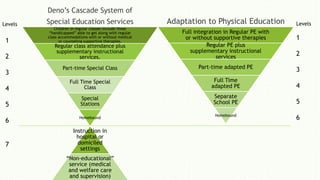
An inverted triangle diagram used to
depicit the idea of a series of downward
waterfalls beginning at the Top (Level 1)
top Bottom (Level 6)
Evelyn Dono
Deno’s Cascade System of
Special Education Services
Children in regular classes include those
“handicapped” able to get along with regular
class accommodations with or without medical
or counseling supportive therapies.
Regular class attendance plus
supplementary instructional
services.
Part-time Special Class
Full Time Special
Class
Special
Stations
Homebound
Adaptation to Physical Education
Full integration in Regular PE with
or without supportive therapies
Regular PE plus
supplementary instructional
services
Part-time adapted PE
Full Time
adapted PE
Separate
School PE
Homebound
1
2
3
4
5
6
7
Levels
1
2
3
4
5
6
Levels
Instruction in
hospital or
domiciled
settings
“Non-educational”
service (medical
and welfare care
and supervision)
 Today, levels 1,2 & 3 receives most attention,
regardless of how severely disabled a student is.
 Each level has a resource teacher (specialized in
Adapted PE) used in new and creative ways.
 Dual & Team-Teaching with regular and Adapted PE
teachers is viewed as a model for providing
supplementary instructional services
 Adapted Physical Educators are also used as
consultant teachers who instruct regular educators on
how to assess, teach and evaluate students with
disabilities.
Mainstreaming
Presence of supportive services helping students learn better
 The concept of creating the continuum of
educational services was created to help explain
the philosophy and practices of
mainstreaming.
 The process of placing students in settings
representing diff. degrees of integration,
depending on the students’ needs.
 Mainstreaming can only work when a wide variety
of settings and support services are available.
 Its goal is matching each students’ abilities with
clusters of services to see where he learns best.
Least Restrictive
Environment (LRE)
 Mainstreaming was not used in law instead, Least
Restrictive Environment (LRE) was used. Why? Because
mainstreaming was a concept not well understood.
 LRE requires two (2) decisions for every curricular
subjects:
1. What services are appropriate and;
2. Where and How can they be taught so that interaction
with regular children is greatest.
 LRE is determined individually for each student.
 LRE varies in terms of curriculum content and teaching
style.
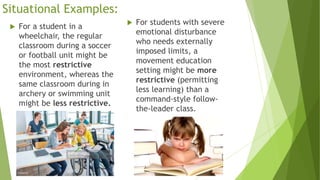
Situational Examples:
 For a student in a
wheelchair, the regular
classroom during a soccer
or football unit might be
the most restrictive
environment, whereas the
same classroom during in
archery or swimming unit
might be less restrictive.
 For students with severe
emotional disturbance
who needs externally
imposed limits, a
movement education
setting might be more
restrictive (permitting
less learning) than a
command-style follow-
the-leader class.
The Regular Education Initiative
 The term used to describe the goal of keeping as many
students in regular education as possible.
 To comply with IDEA, school districts split the placement of
students among several settings and name the placement
according to the location where most instruction is received.
 The US Department of Education has established the following
definitions:
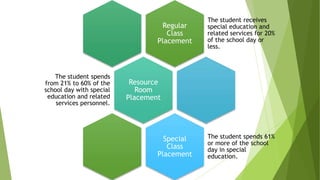
 Regular Class Placement
 Resource Room Placement
 Special Class Placement
Regular
Class
Placement
The student receives
special education and
related services for 20%
of the school day or
less.
Resource
Room
Placement
The student spends
from 21% to 60% of the
school day with special
education and related
services personnel.
Special
Class
Placement
The student spends 61%
or more of the school
day in special
education.
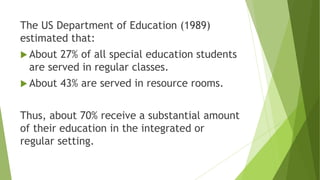
The US Department of Education (1989)
estimated that:
 About 27% of all special education students
are served in regular classes.
 About 43% are served in resource rooms.
Thus, about 70% receive a substantial amount
of their education in the integrated or
regular setting.
Special monetary incentives are
available to encourage administrators
to comply with the regular education
initiative.
Thus, when students need full or part-
time separate physical education
instruction, strong supportive evidence
is required to obtain such placement.
Evaluation Procedures in IDEA
IDEA; Individuals with Disabilities Educational Act
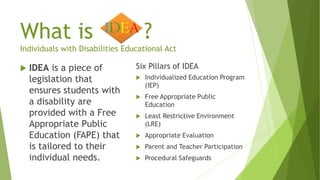
What is IDEA?
Individuals with Disabilities Educational Act
 IDEA is a piece of
legislation that
ensures students with
a disability are
provided with a Free
Appropriate Public
Education (FAPE) that
is tailored to their
individual needs.
Six Pillars of IDEA
 Individualized Education Program
(IEP)
 Free Appropriate Public
Education
 Least Restrictive Environment
(LRE)
 Appropriate Evaluation
 Parent and Teacher Participation
 Procedural Safeguards
Its relation to Educational Placement:
IDEA has contributed to the
improvement of evaluation/assessment
procedures, particularly as they pertain
to placement.
Physical Educators, because of their
potential role in placement decision
making, should know the legal bases for
evaluation. (121a532 Evaluation
Procedures)
121a532;
Evaluation Procedures:State and local educational agencies shall insure, at a minimum, that:
a) Tests and other evaluation materials:
1) Are provided and administered in the child's native language or
other mode of communication, unless it is clearly not feasible to
do so:
2) Have been validated for the specific purpose for which they are
used; and
3) Are administered by trained personnel in conformance with the
instructions provided by their producers;
b) Tests and other evaluation materials include those tailored to
assess specific areas of educational need and not merely those
which are designed to provide a single general intelligence
quotient;
c) Tests are selected and administered so as best to ensure that
when a test is administered to a child with impaired sensory,
manual, or speaking skills, the test results accurately reflect
the child's aptitude or achievement level the test purports to
measure, rather than reflecting the child's impaired sensory,
manual, or speaking skills
d) No single procedure is used as the sole criterion for determining
an appropriate educational program for a child: and
e) The evaluation is made by a multidisciplinary team or group of
persons, including at least c.ie teacher or other specialist with
knowledge in the area of suspected disability.
f) The child is assessed in all areas related to the suspected
disability, including, where appropriate, health, vision, hearing,
social and emotional status, general Intelligence, academic
performance, communicative status. and motor abilities.
The US Department of Education
reports that parents lodge more
complaints about the placement than
any other area.
Many of these complaints are related
to the evaluation procedures in
decision making.
Physical Educators lack of physical
education tests validated for the
specific purpose of placement.

Educational Placement in Special Education

  • 1.
  • 2.
    A Continuum ofServices and Least Restrictive Environment
  • 3.
    Cascade system ofSpecial Education Services Introduced by Evelyn Deno (1970) Formulated a Cascade system of Special Education Services with the adaptation of Physical Education An inverted triangle diagram used to depicit the idea of a series of downward waterfalls beginning at the Top (Level 1) top Bottom (Level 6) Evelyn Dono
  • 4.
    Deno’s Cascade Systemof Special Education Services Children in regular classes include those “handicapped” able to get along with regular class accommodations with or without medical or counseling supportive therapies. Regular class attendance plus supplementary instructional services. Part-time Special Class Full Time Special Class Special Stations Homebound Adaptation to Physical Education Full integration in Regular PE with or without supportive therapies Regular PE plus supplementary instructional services Part-time adapted PE Full Time adapted PE Separate School PE Homebound 1 2 3 4 5 6 7 Levels 1 2 3 4 5 6 Levels Instruction in hospital or domiciled settings “Non-educational” service (medical and welfare care and supervision)
  • 5.
     Today, levels1,2 & 3 receives most attention, regardless of how severely disabled a student is.  Each level has a resource teacher (specialized in Adapted PE) used in new and creative ways.  Dual & Team-Teaching with regular and Adapted PE teachers is viewed as a model for providing supplementary instructional services  Adapted Physical Educators are also used as consultant teachers who instruct regular educators on how to assess, teach and evaluate students with disabilities.
  • 6.
    Mainstreaming Presence of supportiveservices helping students learn better  The concept of creating the continuum of educational services was created to help explain the philosophy and practices of mainstreaming.  The process of placing students in settings representing diff. degrees of integration, depending on the students’ needs.  Mainstreaming can only work when a wide variety of settings and support services are available.  Its goal is matching each students’ abilities with clusters of services to see where he learns best.
  • 7.
    Least Restrictive Environment (LRE) Mainstreaming was not used in law instead, Least Restrictive Environment (LRE) was used. Why? Because mainstreaming was a concept not well understood.  LRE requires two (2) decisions for every curricular subjects: 1. What services are appropriate and; 2. Where and How can they be taught so that interaction with regular children is greatest.  LRE is determined individually for each student.  LRE varies in terms of curriculum content and teaching style.
  • 8.
    Situational Examples:  Fora student in a wheelchair, the regular classroom during a soccer or football unit might be the most restrictive environment, whereas the same classroom during in archery or swimming unit might be less restrictive.  For students with severe emotional disturbance who needs externally imposed limits, a movement education setting might be more restrictive (permitting less learning) than a command-style follow- the-leader class.
  • 9.
    The Regular EducationInitiative  The term used to describe the goal of keeping as many students in regular education as possible.  To comply with IDEA, school districts split the placement of students among several settings and name the placement according to the location where most instruction is received.  The US Department of Education has established the following definitions:  Regular Class Placement  Resource Room Placement  Special Class Placement
  • 10.
    Regular Class Placement The student receives specialeducation and related services for 20% of the school day or less. Resource Room Placement The student spends from 21% to 60% of the school day with special education and related services personnel. Special Class Placement The student spends 61% or more of the school day in special education.
  • 11.
    The US Departmentof Education (1989) estimated that:  About 27% of all special education students are served in regular classes.  About 43% are served in resource rooms. Thus, about 70% receive a substantial amount of their education in the integrated or regular setting.
  • 12.
    Special monetary incentivesare available to encourage administrators to comply with the regular education initiative. Thus, when students need full or part- time separate physical education instruction, strong supportive evidence is required to obtain such placement.
  • 13.
    Evaluation Procedures inIDEA IDEA; Individuals with Disabilities Educational Act
  • 14.
    What is IDEA? Individualswith Disabilities Educational Act  IDEA is a piece of legislation that ensures students with a disability are provided with a Free Appropriate Public Education (FAPE) that is tailored to their individual needs. Six Pillars of IDEA  Individualized Education Program (IEP)  Free Appropriate Public Education  Least Restrictive Environment (LRE)  Appropriate Evaluation  Parent and Teacher Participation  Procedural Safeguards
  • 15.
    Its relation toEducational Placement: IDEA has contributed to the improvement of evaluation/assessment procedures, particularly as they pertain to placement. Physical Educators, because of their potential role in placement decision making, should know the legal bases for evaluation. (121a532 Evaluation Procedures)
  • 16.
    121a532; Evaluation Procedures:State andlocal educational agencies shall insure, at a minimum, that: a) Tests and other evaluation materials: 1) Are provided and administered in the child's native language or other mode of communication, unless it is clearly not feasible to do so: 2) Have been validated for the specific purpose for which they are used; and 3) Are administered by trained personnel in conformance with the instructions provided by their producers; b) Tests and other evaluation materials include those tailored to assess specific areas of educational need and not merely those which are designed to provide a single general intelligence quotient;
  • 17.
    c) Tests areselected and administered so as best to ensure that when a test is administered to a child with impaired sensory, manual, or speaking skills, the test results accurately reflect the child's aptitude or achievement level the test purports to measure, rather than reflecting the child's impaired sensory, manual, or speaking skills d) No single procedure is used as the sole criterion for determining an appropriate educational program for a child: and e) The evaluation is made by a multidisciplinary team or group of persons, including at least c.ie teacher or other specialist with knowledge in the area of suspected disability. f) The child is assessed in all areas related to the suspected disability, including, where appropriate, health, vision, hearing, social and emotional status, general Intelligence, academic performance, communicative status. and motor abilities.
  • 18.
    The US Departmentof Education reports that parents lodge more complaints about the placement than any other area. Many of these complaints are related to the evaluation procedures in decision making. Physical Educators lack of physical education tests validated for the specific purpose of placement.