
Notetaking
Skills
USING NOTE CARDS FOR YOUR
RESEARCH PAPER
Learning Outcome
1. Identify and apply effective research note
taking strategies
Definition
Note taking
 is an indispensable part of writing a research paper.
 Your notes record information from the sources that you
will use in writing your paper.
 Therefore, it is necessary to critically evaluate the texts or
articles you are reading and to make reasonable choices
about what will and will not be useful for your paper.
Otherwise, you will overload yourself with information and
spend too much time sifting through notes.
Why Note Cards?
 Helps you to organize material
 Easier to identify
sources Information at your fingertips
 Good study tool
 Helps you to avoid plagiarism
Types of Note Cards
Cards for recording your sources
Cards for recording notes on your topic
Purposes of Source Cards
1. First, it enables you to find the source again.
2. Second, it enables you to prepare documentation for
your paper.
3. Third, it enables you to prepare the list of Works Cited
that will appear at the end of your paper.
Every time you find a source that might be useful for your
research paper, you need to prepare a SourceCardfor it.
A Source Card serves 3 purposes:
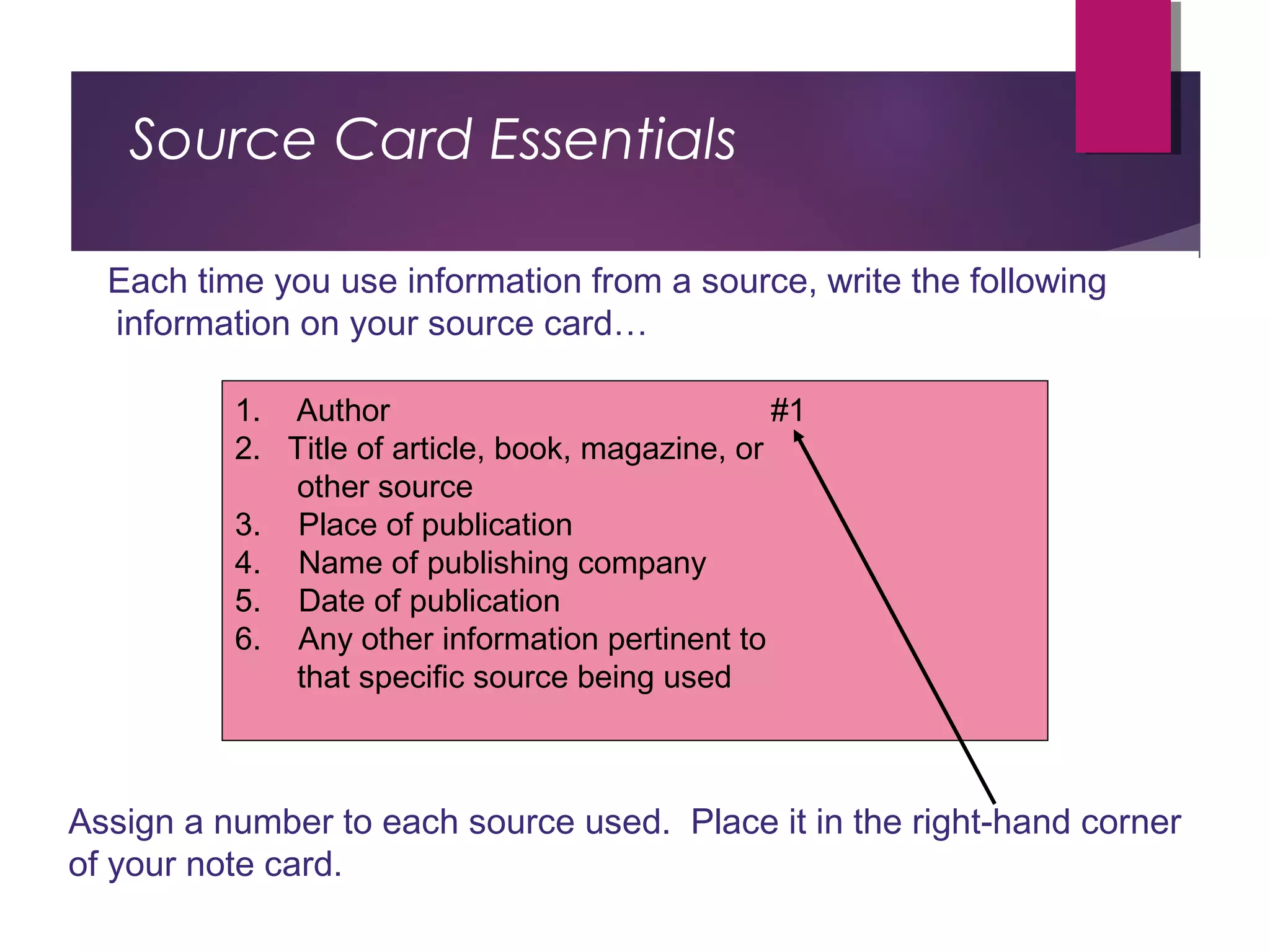
1. Author #1
2. Title of article, book, magazine, or
other source
3. Place of publication
4. Name of publishing company
5. Date of publication
6. Any other information pertinent to
that specific source being used
Source Card Essentials
Each time you use information from a source, write the following
information on your source card…
Assign a number to each source used. Place it in the right-hand corner
of your note card.
Kopel, David. “Arms and the Greeks.” Liberty. Aug. 1999.
4 Sept. 99. <http:www.libertysoft.com/liberty/features/
76Kopel.html>.
Example of a Source Card
Taken from an article in a MAGAZINE
#6
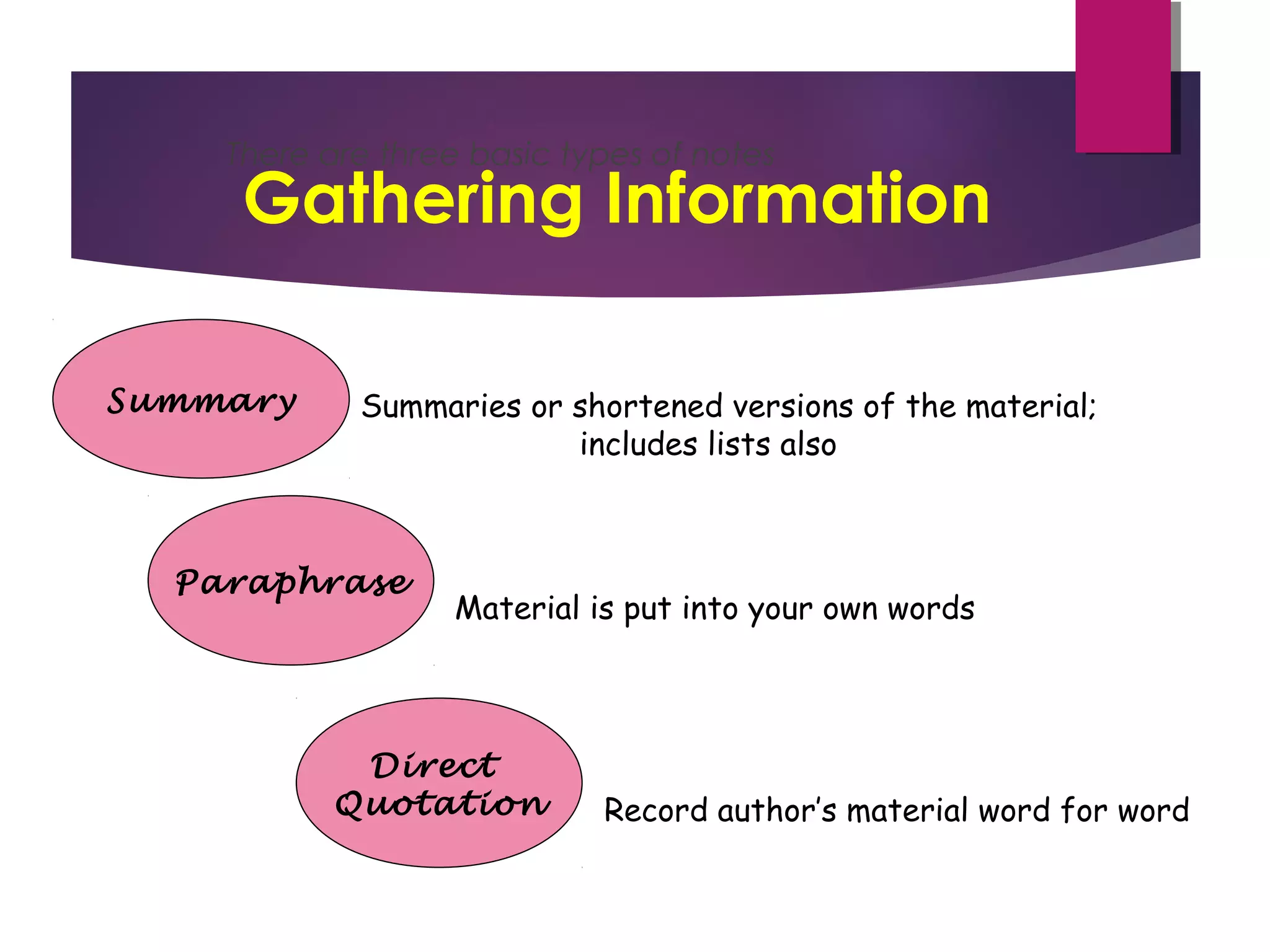
Gathering Information
There are three basic types of notes
Summary
Paraphrase
Direct
Quotation
Summaries or shortened versions of the material;
includes lists also
Material is put into your own words
Record author’s material word for word
Making Summary Cards
 Contains the main points of the particular
research in a nutshell
 Close your book and then write a summary
 No quotation marks (put in your own words)
 Use when the source runs too long to be
quoted or paraphrased
Making Cards for
Paraphrasing
 Writing the idea of another using your own
words and sentence structure
 Your most common note form
 Usually about the same length of the
original
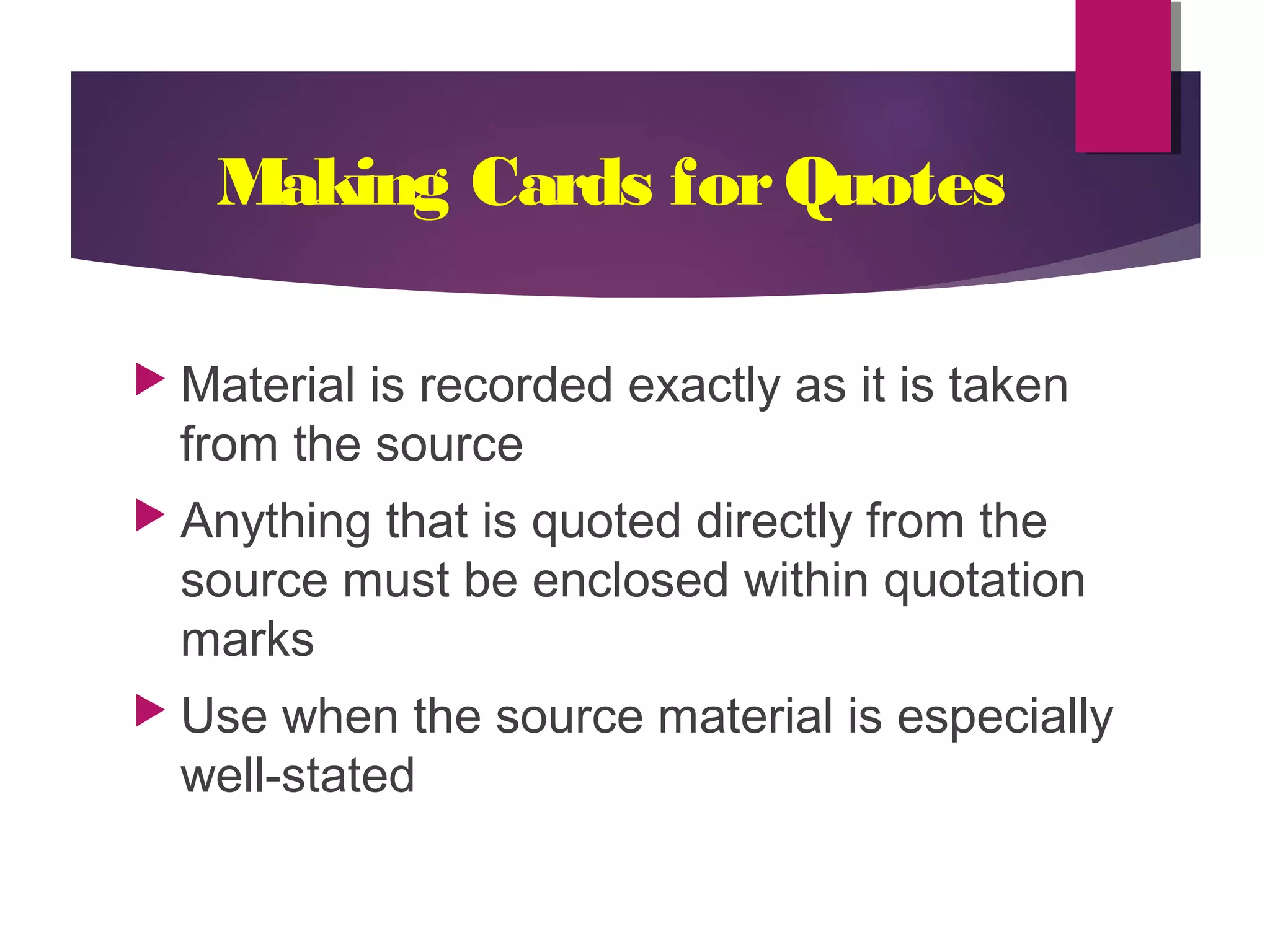
Making Cards forQuotes
 Material is recorded exactly as it is taken
from the source
 Anything that is quoted directly from the
source must be enclosed within quotation
marks
 Use when the source material is especially
well-stated
Parts of a Note Card
5
Reason famous
“…he was and is an everlasting glory to the
literature of his country.”
102
Describes the note’s information and keeps
you from having to read the entire note each
time you want to know what the note says
Information
Page reference
Source card
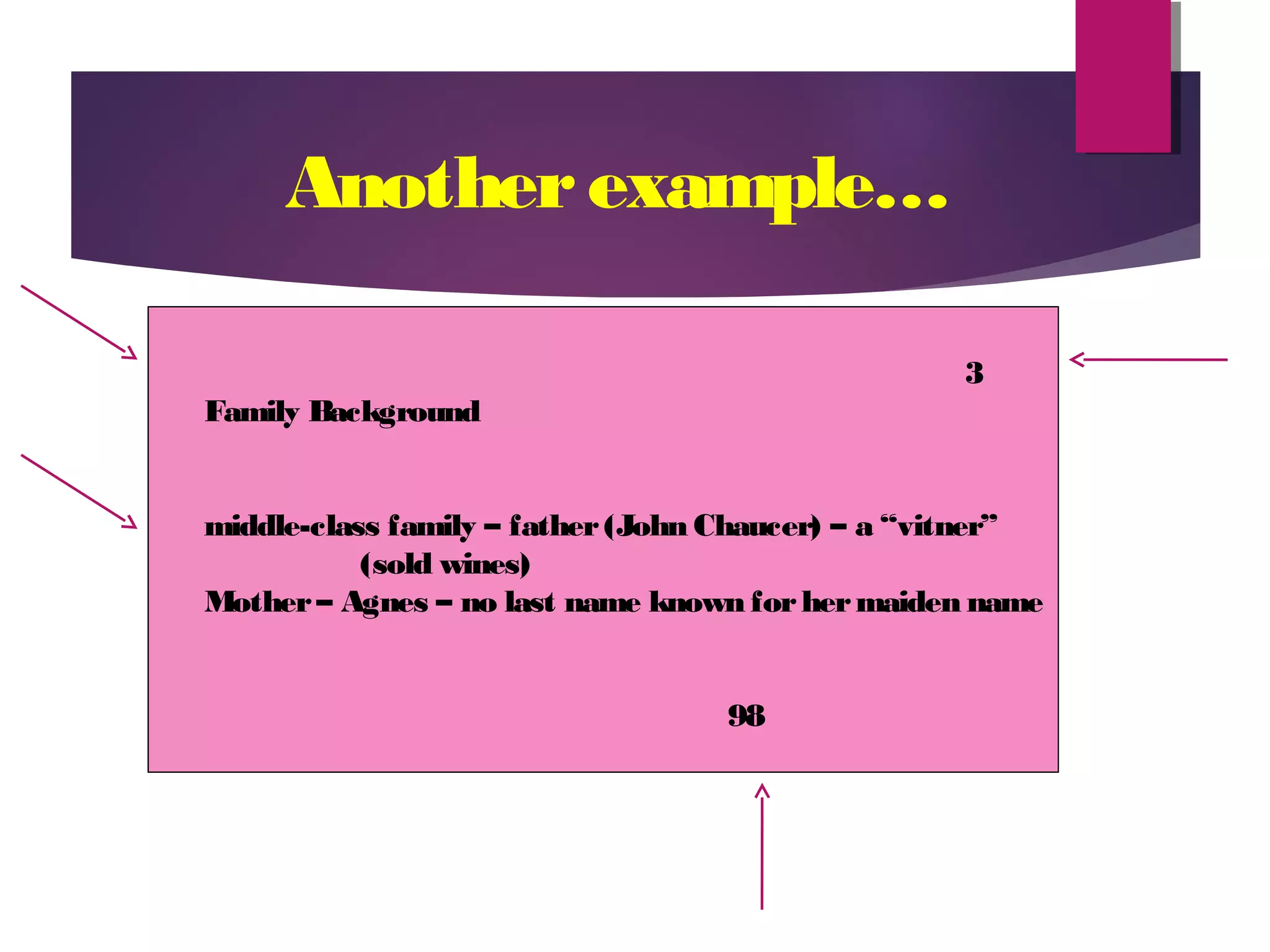
Anotherexample…
3
Family Background
middle-class family – father(John Chaucer) – a “vitner”
(sold wines)
Mother– Agnes – no last name known forhermaiden name
98
DO you have a good note-taking
system?
Please share your ideas.
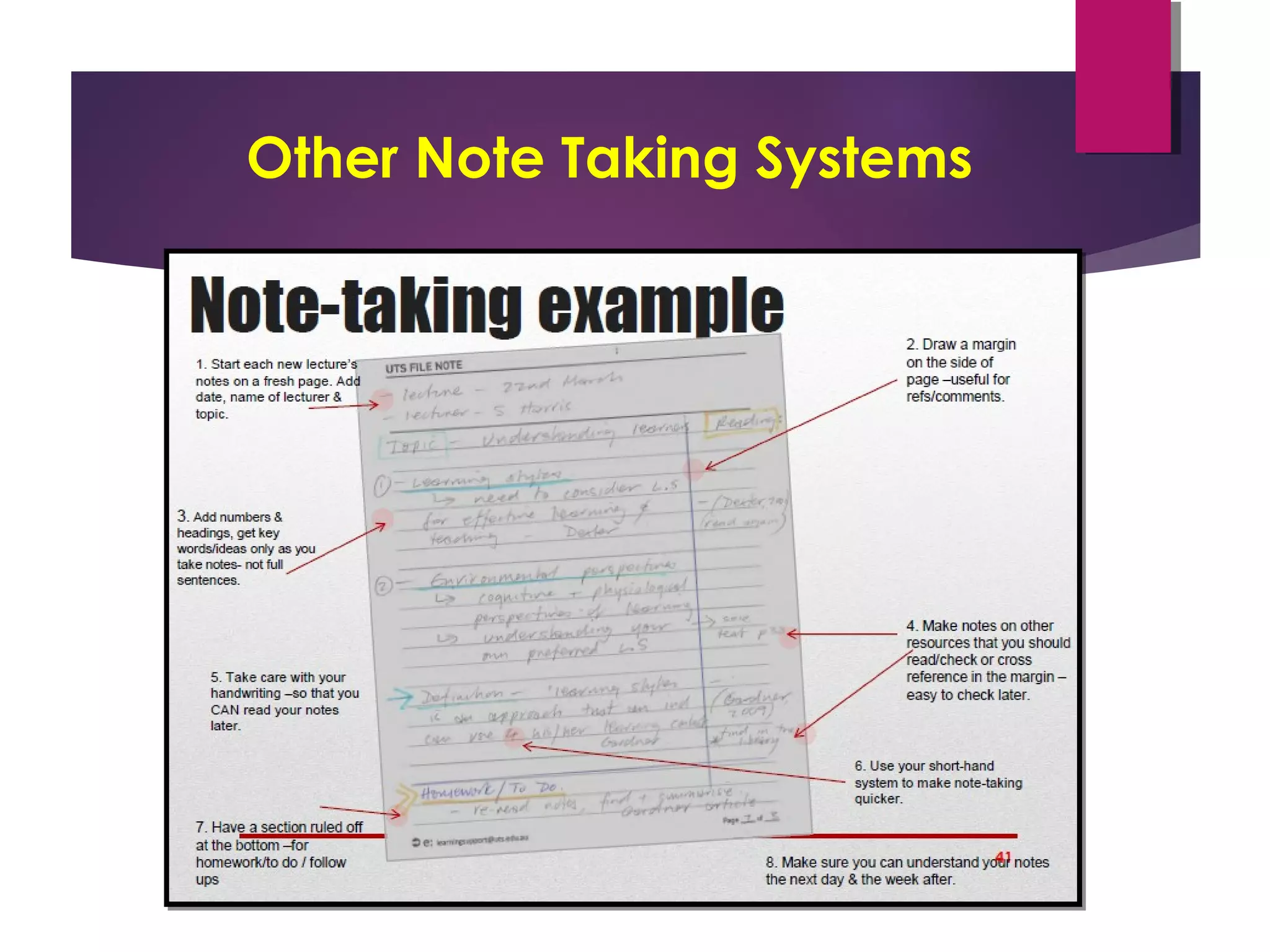
Other Note Taking Systems
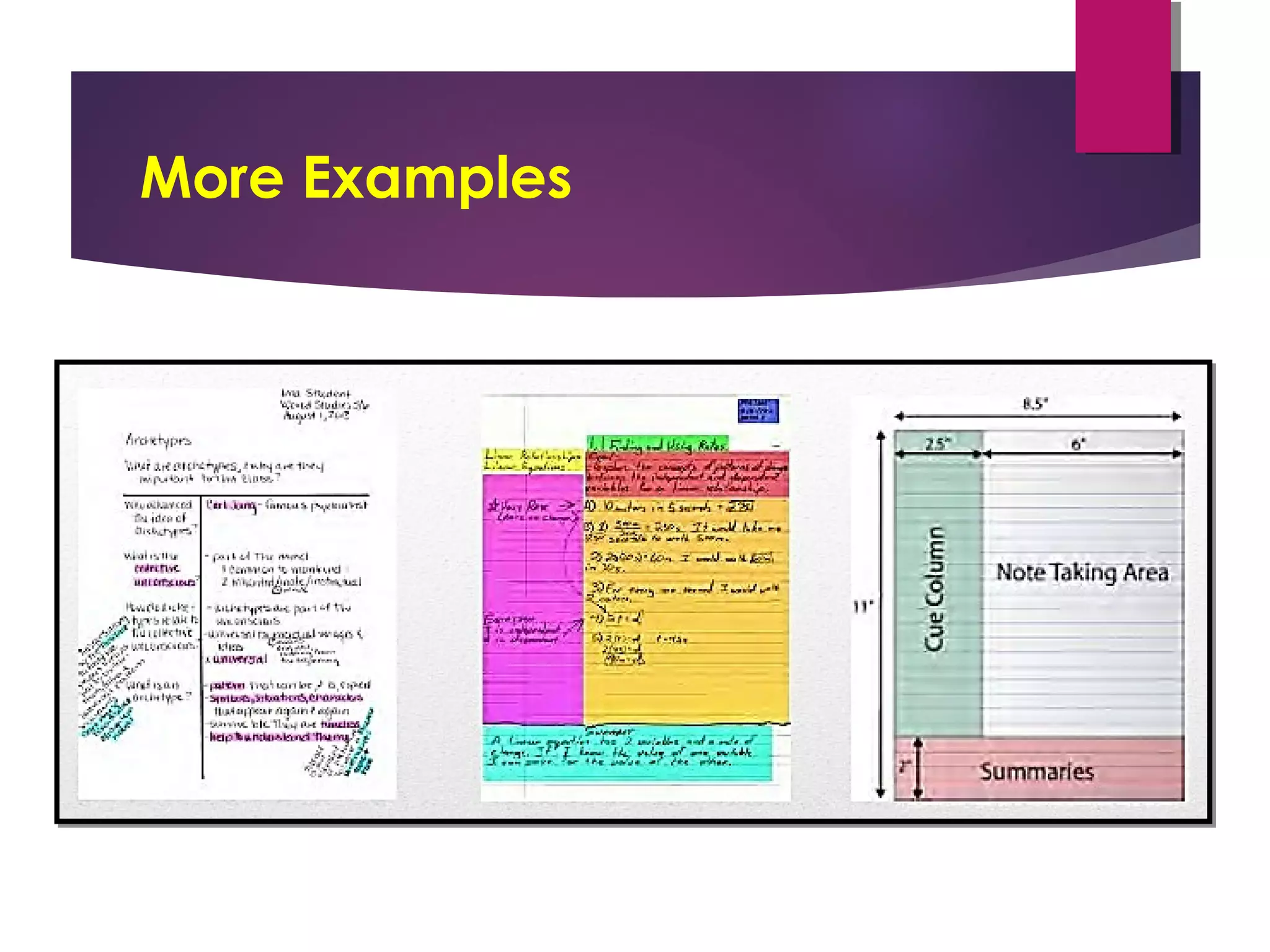
More Examples
Template
Useful note-taking software
 Microsoft OneNote (part of Microsoft Office; also available as iOS / Android
app)
 Evernote (free and paid versions; also available as iOS / Android app)
Descriptive VS Critical Analysis
Reflect on your Research
Once you have the relevant information:
What have you discovered and learnt?
•How does your new knowledge help your
understanding?
•What arguments or evidence have you discovered?
•How have your ideas/opinions been influenced?
•Do you now have a clearer understanding of the
topic/ task?
What can you do if you don’t
understand something?
 Ask in class
 Go see your lecturer personally (take a draft)
 Go see another member of faculty
 Ask peers/classmates
 Email your lecturer for help
 See a HELPS advisor (drop-in consultation)
 ALWAYS seek help if you need it!!
Effective Critical Reading +
Note-taking
Strategies for better critical reading.
Inspect text first
Scan rapidly / ascertain
Question / Question / Question /
Locate specifics quickly
Read at the right speed for the task
Recall / review / summarise through your notes
Note-take / note references accurately
Read SMART
Save time!
Achieve task
Note Taking Tips
 Keep your topic, controlling
purpose, and audience in mind at
all times. Do not record material
unrelated to your topic.
 Make sure that summaries or
paraphrases correctly reflect the
meaning of the original.
 Be accurate. Direct quotations
are picked up word-for-word.
Use quotation marks at the
beginning and end of quotation.
 Always double-check page
references. It’s easy to copy
these incorrectly.
 Double-check statistics and
facts.
 Nonessential parts of a
quotation can be cut if the
overall meaning of the quotation
is not changed. Indicate
omissions of nonessential
material from a quotation by
using ellipsis points, a series of
3 or 4 spaced dots. Use 3 dots
(. . .) when cutting material
within a single sentence; use 4
dots (. . . .) when cutting a full
sentence, a paragraph, or more
than a paragraph from a
quotation.
Plagiarism
One of the purposes of using note cards and
source cards is to help you avoid plagiarism.
Plagiarismis the act of intentionally or
uninte ntio nally treating work done by
someone else as though it were your own.
How to Avoid Plagiarism
 Is this information, idea, orstatement common
knowledge?
 Didthis information, idea, orstatement comefroma
sourceoutsidemyself, ordidit comefrommyown
experienceoras aresult of myowncreativeactivity?
Here is a simple test to determine whether
something is
plagiarized: Ask yourself…
If the information, idea, or statement is NOT common
knowledge, and if it came from an outside source, then
you must credit that source. Failure to do so constitutes
plagiarism.
Note Taking Practice
Sources
https://youreslactivities.wikispaces.com/Note+Taking
http://www.grammarbank.com/esl-reading-
comprehension-14.html
https://eu.lib.kmutt.ac.th/elearning/CourseOnDeman
Once you have written, sifted through, and
organized your note cards, then you are ready
to begin writing your outline.
 Extra references:
 https://rmitenglishworldwide.com/blog/note-taking-and-answering-qu
Practice
 Select one source for your research and
practice taking notes. Choose a method that
works best for you or use the template
provided.

2 research note taking

  • 1.
    Notetaking Skills USING NOTE CARDSFOR YOUR RESEARCH PAPER
  • 2.
    Learning Outcome 1. Identifyand apply effective research note taking strategies
  • 3.
    Definition Note taking  isan indispensable part of writing a research paper.  Your notes record information from the sources that you will use in writing your paper.  Therefore, it is necessary to critically evaluate the texts or articles you are reading and to make reasonable choices about what will and will not be useful for your paper. Otherwise, you will overload yourself with information and spend too much time sifting through notes.
  • 4.
    Why Note Cards? Helps you to organize material  Easier to identify sources Information at your fingertips  Good study tool  Helps you to avoid plagiarism
  • 5.
    Types of NoteCards Cards for recording your sources Cards for recording notes on your topic
  • 6.
    Purposes of SourceCards 1. First, it enables you to find the source again. 2. Second, it enables you to prepare documentation for your paper. 3. Third, it enables you to prepare the list of Works Cited that will appear at the end of your paper. Every time you find a source that might be useful for your research paper, you need to prepare a SourceCardfor it. A Source Card serves 3 purposes:
  • 7.
    1. Author #1 2.Title of article, book, magazine, or other source 3. Place of publication 4. Name of publishing company 5. Date of publication 6. Any other information pertinent to that specific source being used Source Card Essentials Each time you use information from a source, write the following information on your source card… Assign a number to each source used. Place it in the right-hand corner of your note card.
  • 8.
    Kopel, David. “Armsand the Greeks.” Liberty. Aug. 1999. 4 Sept. 99. <http:www.libertysoft.com/liberty/features/ 76Kopel.html>. Example of a Source Card Taken from an article in a MAGAZINE #6
  • 9.
    Gathering Information There arethree basic types of notes Summary Paraphrase Direct Quotation Summaries or shortened versions of the material; includes lists also Material is put into your own words Record author’s material word for word
  • 10.
    Making Summary Cards Contains the main points of the particular research in a nutshell  Close your book and then write a summary  No quotation marks (put in your own words)  Use when the source runs too long to be quoted or paraphrased
  • 11.
    Making Cards for Paraphrasing Writing the idea of another using your own words and sentence structure  Your most common note form  Usually about the same length of the original
  • 12.
    Making Cards forQuotes Material is recorded exactly as it is taken from the source  Anything that is quoted directly from the source must be enclosed within quotation marks  Use when the source material is especially well-stated
  • 13.
    Parts of aNote Card 5 Reason famous “…he was and is an everlasting glory to the literature of his country.” 102 Describes the note’s information and keeps you from having to read the entire note each time you want to know what the note says Information Page reference Source card
  • 14.
    Anotherexample… 3 Family Background middle-class family– father(John Chaucer) – a “vitner” (sold wines) Mother– Agnes – no last name known forhermaiden name 98
  • 15.
    DO you havea good note-taking system? Please share your ideas.
  • 16.
  • 17.
  • 18.
  • 19.
  • 20.
    Useful note-taking software Microsoft OneNote (part of Microsoft Office; also available as iOS / Android app)  Evernote (free and paid versions; also available as iOS / Android app)
  • 21.
  • 22.
    Reflect on yourResearch Once you have the relevant information: What have you discovered and learnt? •How does your new knowledge help your understanding? •What arguments or evidence have you discovered? •How have your ideas/opinions been influenced? •Do you now have a clearer understanding of the topic/ task?
  • 23.
    What can youdo if you don’t understand something?  Ask in class  Go see your lecturer personally (take a draft)  Go see another member of faculty  Ask peers/classmates  Email your lecturer for help  See a HELPS advisor (drop-in consultation)  ALWAYS seek help if you need it!!
  • 24.
    Effective Critical Reading+ Note-taking Strategies for better critical reading. Inspect text first Scan rapidly / ascertain Question / Question / Question / Locate specifics quickly Read at the right speed for the task Recall / review / summarise through your notes Note-take / note references accurately Read SMART Save time! Achieve task
  • 25.
    Note Taking Tips Keep your topic, controlling purpose, and audience in mind at all times. Do not record material unrelated to your topic.  Make sure that summaries or paraphrases correctly reflect the meaning of the original.  Be accurate. Direct quotations are picked up word-for-word. Use quotation marks at the beginning and end of quotation.  Always double-check page references. It’s easy to copy these incorrectly.  Double-check statistics and facts.  Nonessential parts of a quotation can be cut if the overall meaning of the quotation is not changed. Indicate omissions of nonessential material from a quotation by using ellipsis points, a series of 3 or 4 spaced dots. Use 3 dots (. . .) when cutting material within a single sentence; use 4 dots (. . . .) when cutting a full sentence, a paragraph, or more than a paragraph from a quotation.
  • 26.
    Plagiarism One of thepurposes of using note cards and source cards is to help you avoid plagiarism. Plagiarismis the act of intentionally or uninte ntio nally treating work done by someone else as though it were your own.
  • 27.
    How to AvoidPlagiarism  Is this information, idea, orstatement common knowledge?  Didthis information, idea, orstatement comefroma sourceoutsidemyself, ordidit comefrommyown experienceoras aresult of myowncreativeactivity? Here is a simple test to determine whether something is plagiarized: Ask yourself… If the information, idea, or statement is NOT common knowledge, and if it came from an outside source, then you must credit that source. Failure to do so constitutes plagiarism.
  • 28.
  • 29.
    Once you havewritten, sifted through, and organized your note cards, then you are ready to begin writing your outline.  Extra references:  https://rmitenglishworldwide.com/blog/note-taking-and-answering-qu
  • 30.
    Practice  Select onesource for your research and practice taking notes. Choose a method that works best for you or use the template provided.