1 
Preprint: To appear in The Learning Curve. 
Lowenthal, P. R., & Parscal, T. (2008). Teaching presence. The Learning Curve, 
3(4), 1-2, 4. 
Teaching Presence Online Facilitates Meaningful Learning 
Patrick Lowenthal 
Assistant Professor, School of Education and Counseling 
College for Professional Studies 
Regis University 
Tina Parscal 
Associate Professor, Learning Design and Development 
College for Professional Studies 
Regis University
2 
Abstract 
Faculty often describe the role of the online teacher as more of a “guide-on- the-side” 
rather than a “sage-on-the-stage.” However, this cliché can be taken to extremes; there is 
a fine line between being a guide on the side and being absent. Therefore, this article 
focuses on different strategies online faculty can use to improve their teaching and 
ultimately student learning by balancing their teaching presence when teaching online. 
Keywords: Teaching Presence, Teacher Immediacy, Social Presence, Community Of 
Inquiry, Online Teaching
3 
Teaching Presence Online Facilitates Meaningful Learning 
Introduction 
A teacher plays a central role in any formal learning environment. As those of you 
with online teaching experience know, teaching online involves a different skill set 
(Palloff & Pratt, 1999). Effective online teachers take on the role as a facilitator of 
learning rather than an instructor who conveys information through directed instruction. 
That is, they become more of a “guide-on- the-side” rather than the “sage-on-the-stage.” 
However, this cliché can be taken to extremes; there is a fine line between being a guide 
on the side and being absent (Anderson, 2004). Therefore, the focus of this article is on 
how to improve learning by balancing one’s teaching presence when teaching online. 
Teaching Presence 
The concept of teaching presence evolved out of the research on social presence 
and teacher immediacy. Short, Williams, and Christie (1976) initially described social 
presence as a quality of a communication medium that can affect the way people 
communicate. They claimed that some communication media had a higher degree of 
social presence (e.g., video) than others (e.g., audio). Mehrabian (1966, 1969, 1972) 
developed the concept of immediacy as non-verbal behaviors that can reduce the distance 
between two or more people. His work was later used to explain teacher behavior in the 
classroom (Anderson, 1979); Anderson illustrated that teacher immediacy is a predictor 
of teaching effectiveness. 
Influenced by the work of Short, et al., early research on computer mediated 
communication (CMC) suggested that CMC was antisocial and impersonal (Walther, 
1996; Walther, Anderson, & Park, 1994). However, over time, researchers experienced
4 
with CMC began to argue that a user’s personal perceptions of presence matters more 
than the medium capabilities (Garrison et al., 2000; Gunawardena, 1995, 1997; Swan, 
2003). Further, they claimed that CMC can be just as personal, if not more, than non-mediated 
communication. The literature on social presence suggests that students create 
and maintain a sense of social presence through the following strategies: 
1. Expression of emotions 
2. Self-Disclosure 
3. Continuing a Thread 
4. Quoting from Other Messages 
5. Referring explicitly to other messages 
6. Asking questions 
7. Complimenting, expressing appreciation, expressing agreement 
8. Expressing agreement 
9. Vocatives (i.e., referring to participants by name) 
10. Addresses or refers to the group using inclusive pronouns 
11. Phatics / Salutations (i.e., communication that is purely social) 
(Rourke et al., 2001) 
Further, research has shown that social presence is a predictor of student 
satisfaction in online environments (Gunawardena, 1995; Gunawardena & Zittle, 1997; 
Richardson & Swan, 2003), that it is directly related to learner to learner interaction (Tu, 
2000), that it plays a key role in collaborative learning (So, 2005), and finally that “there 
is a definite, consistent and strong relationship among student perceptions of interaction, 
social presence, and learning” (p. 30). 
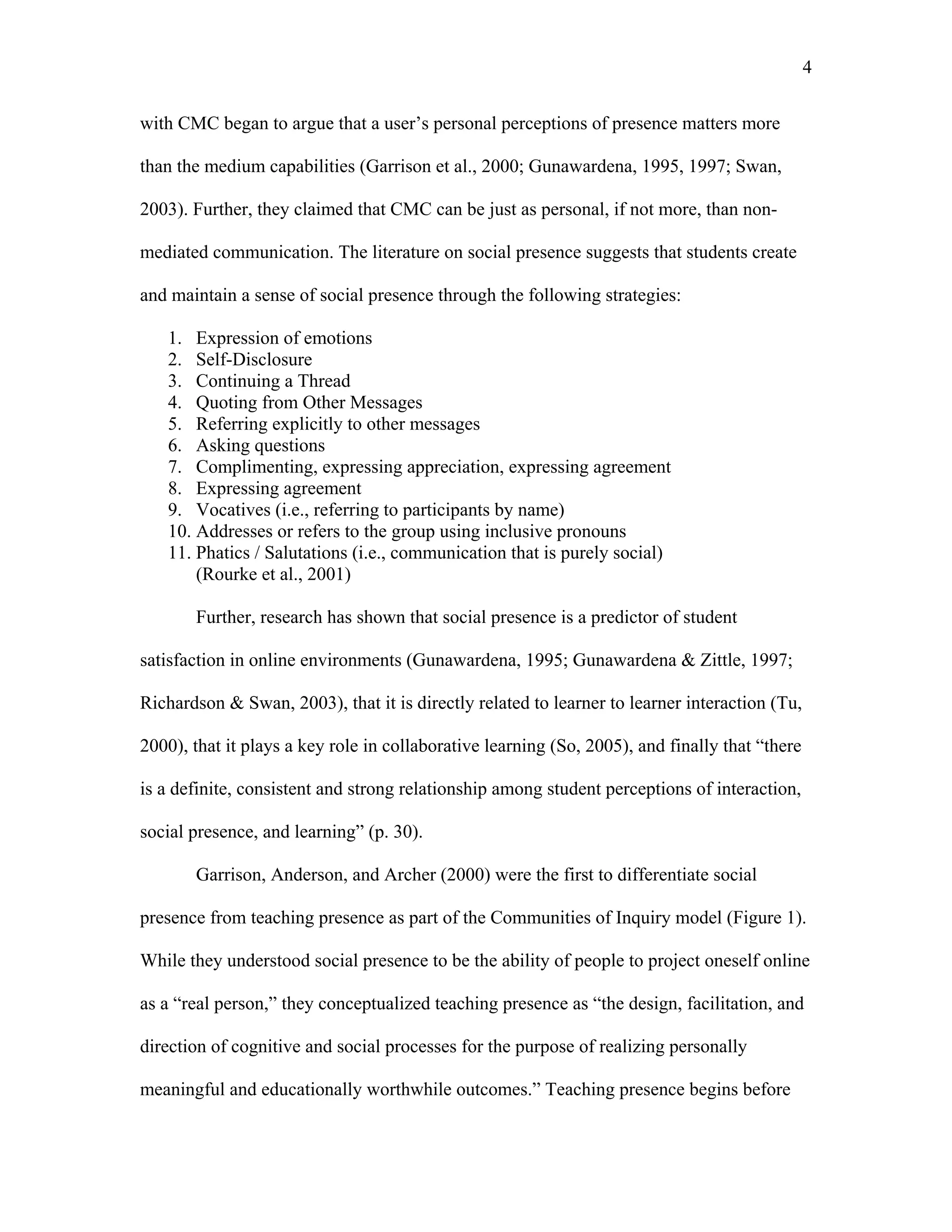
Garrison, Anderson, and Archer (2000) were the first to differentiate social 
presence from teaching presence as part of the Communities of Inquiry model (Figure 1). 
While they understood social presence to be the ability of people to project oneself online 
as a “real person,” they conceptualized teaching presence as “the design, facilitation, and 
direction of cognitive and social processes for the purpose of realizing personally 
meaningful and educationally worthwhile outcomes.” Teaching presence begins before
5 
the course commences through the instructional design process in which the course 
development team plans and prepares the course of studies and designs learning activities 
for active engagement and interaction. “It continues during the course, as the instructor 
facilitates the discourse and provides direct instruction when required. (Anderson, 
Rourke, Garrison, & Archer, 2001, p. 5). The central focus of teaching presence is to 
increase social presence and student learning. 
Figure 1. Community of Inquiry. ©2007. (Garrison, Anderson, & Archer, 2000). 
Reprinted with permission by Terry Anderson 
At Regis University, we take pride in the focus we place on the intentional and 
collaborative design and development of our online courses. Therefore, we feel confident 
that the first component of teaching presence (i.e., the design and development of 
courses) is regularly achieved. It is within the second component of teaching presence, 
the facilitation of the course, where Regis facilitators get their chance to focus on their 
own teaching presence and the social presence of the course.
6 
Strategies for Creating Teaching/Social Presence 
There are many strategies for creating teaching presence within an online course. 
The following table highlights strategies related to instructional design, teaching, and 
student learning for creating teaching and social presence. 
Instructional Design: Teaching: Student Learning: 
 Develop overviews 
 Provide opportunities 
for student and teacher 
profiles within the 
learning management 
system 
 Incorporate audio and 
video within the course 
content following best 
practices for teaching 
and learning and ADA 
compliance standards 
 Limit class size 
 Structure collaborative 
learning activities 
 Utilize group work 
strategies 
 Develop open-ended, 
critical thinking 
discussion questions 
 Incorporate reflective 
activities 
 Utilize continuous and 
authentic assessment 
strategies 
 Post introductions and 
expectations documents 
before the students are 
given access to the 
course. 
 Contribute to discussion 
forum throughout the 
week 
 Provide suggested due 
dates for initial postings 
that promote mid-week 
engagement as opposed 
to weekend only 
postings 
 Launch discussion 
threads and summarize 
each thread at the end 
of the week 
 Promptly answer e-mail 
 Provide frequent 
feedback 
 Send progress reports 
on participation and 
quality of postings 
 Strike up a conversation 
 Share personal stories 
and professional 
experiences 
 Use expressions of 
emotions, e.g. (smile) 
or (grin). 
 Address students by 
name 
 Allow students options 
for addressing the 
instructor 
 Contribute to discussion 
forum throughout the 
week as opposed to 
waiting for the weekend 
 Promptly answer e-mail 
 Strike up a conversation 
 Share personal stories 
and experiences 
 Ask open-ended 
questions that promote 
discussion and require 
critical thinking 
 Use expressions of 
emotions, e.g. (smile) 
or (grin). 
Adapted from Aragon (2003)
7 
Teaching Presence Strategies Used by CPS Faculty 
Barbara Getter, Assistant Professor, Organizational Leadership, School of Management 
I’m a big fan of Parker Palmer. He states, “In teaching, there’s a secret hidden in 
plain sight.” Each week in the project management courses, the students respond to a 
discussion question that asks them, in a very specific way, to examine how they, or their 
organization, perform topics such as risk management, scheduling, reporting project 
status, and conflict resolution. I expect the students to respond to at least three other 
student postings in a substantial way. From this, students build upon discussions and have 
told me about their “ah-ha” moments. The point is that they need to generate ideas or 
problem solutions freely and effectively while making good use of the differences in their 
knowledge and experience. This also gives me the ability to integrate information and 
additional self-directed resources, such as web sites, templates, and journal articles. I call 
the additional material “handouts” as they tend to be exactly what I would hand out in a 
ground-based class. 
John Lay, Online Lead Faculty, Core Studies, School of Humanities and Social Sciences 
I begin each week with a challenge as I present the assignments. By the middle of 
the next week, I post a “forum summary” of the previous week where I attempt to both 
affirm and challenge. After I post the “forum summary” I send each student an email with 
my reflections on their participation in the forum. My comments help me “conduct the 
score” that brings forth the student’s voices and, at times, changes the tempo. I also 
actively direct the forum: I praise some well written posts and, at times, redirect the focus 
or challenge more critical or complete postings when the group becomes “too chatty.” I
8 
affirm personal interpretation as well as critical application of the “music we play.” I 
have much to learn about teaching presence on line (and in the classroom) but, so far, my 
students and my colleagues indicate I’m moving in a good direction. Visit 
www.regisfacultyonline,org to read all of John Lay’s best practices. 
Mary Loftus, Affiliate Faculty, Master of Science in Software Information Systems with 
the National University of Ireland, Galway, School for Computer and Information 
Sciences 
Computer and information science students have a reputation for being 
uninterested in the social or interactive aspects of learning. But, if the space is made for 
social presence and interaction is modeled and encouraged, I think these students are just 
as interactive as any others! Throw some collaborative problem-solving into the mix and 
you will almost certainly experience some very potent learning interaction. 
Setting the scene in the “introductions and expectations” phase of a course is 
really important. I like to include in this a class brainstorming session on how best to 
manage our weekly online discussions. We talk about the approaches to online discussion 
that work best for us, agree ground rules, clarify expectations, and share resources. 
Feedback is another keystone of my approach to teaching presence. I offer regular 
feedback on process and on content where required. I will post something most days so 
that students know I'm there and at the end of the week, I email individual feedback to 
each student.
9 
Patrick Lowenthal, Assistant Professor, School of Education and Counseling 
Both as a student and as a teacher, I have always struggled with finding my voice 
online. When I teach online, I want people—especially my students—to see me not only 
as a “real person” but also as others see me face-to-face. However, I know, from 
student’s feedback, that one of my strengths teaching face-to-face is my energy and 
passion for my content area. I have struggled finding a way to replicate this online. So I 
began focusing on the use of storytelling online. I even developed a digital story about 
when I first began teaching to help introduce myself to my students online. The first time 
I shared the story was half way through an online course I was teaching; students 
remarked on how it changed their entire perception of me. I believe this is because the 
digital story helped students start to see me as a real person. To see Patrick’s digital story 
along with one by Dr. Suzie Perry, visit 
http://www.patricklowenthal.com/digitalstory.html
10 
References 
Aragon, S. R. (2003). Creating social presence in online environments. New Directions 
for Adult and Continuing Education, (100), 57-68. 
Andersen, J. F. (1979). Teacher immediacy as a predictor of teaching effectiveness. In D. 
Nimmo (Ed.), Communication Yearbook (Vol. 3, pp. 543-559). New Brunswick, 
NJ: Transaction. 
Anderson, T. (2004). Teaching in an online learning context. In T. Anderson & F. 
Elloumi (Eds.), Theory and practice of online learning (pp. 273-294). Athabasca: 
Athabasca University. 
Anderson, T., Rourke, L., Garrison, D. R., & Archer, W. (2001). Assessing teaching 
presence in a computer conferencing context. Journal of Asynchronous Learning 
Networks, 5(2), 1-17. 
Garrison, D. R., Anderson, T., & Archer, W. (2000). Critical inquiry in a text-based 
environment: Computer conferencing in higher education. The Internet and 
Higher Education, 2(2-3), 87-105. 
Gunawardena, C. N. (1995). Social presence theory and implications for interaction and 
collaborative learning in computer conferences. International Journal of 
Educational Telecommunications, 1(2/3), 147-166. 
Gunawardena, C. N., & Zittle, F. J. (1997). Social presence as a predictor of satisfaction 
within a computer-mediated conferencing environment. The American Journal of 
Distance Education, 11(3), 8-26. 
Mehrabian, A. (1966). Immediacy: An indicator of attitudes in linguistic communication. 
Journal of Personality, 34, 26-34. 
Mehrabian, A. (1969). Significance of posture and position in the communication of 
attitude and status relationships. Psychological Bulletin, 71, 359-372. 
Mehrabian, A. (1972). Nonverbal communication. New Brunswick, NJ: 
AldineTransaction. 
Palloff, R. N., & Pratt, K. (1999). Building learning communities in cyberspace. San 
Francisco: Jossey-Bass Inc. 
Richardson, J. C., & Swan, K. (2003). Examining social presence in online courses in 
relation to students' perceived learning and satisfaction. Journal of Asynchronous 
Learning Networks, 7(1), 68-88.
11 
Rourke, L., Anderson, T., Garrison, D. R., & Archer, W. (2001). Assessing social 
presence in asychronous text-based computer conferencing [Electronic Version]. 
Journal of Distance Education, 14 from http://cade.athabascau.ca/vol14.2/ 
rourke_et_al.html 
Short, J., Williams, E., & Christie, B. (1976). The social psychology of 
telecommunications. London: John Wiley & Sons. 
So, H. J. (2005). The content analysis of social presence and collaborative learning 
behavior patterns in a computer-mediated learning environment. In C.-K. Looi, D. 
Jonassen & M. Ikeda (Eds.), The 13th International Conference on Computers in 
Education (pp. 413-419). Amsterdam: IOS Press. 
Swan, K. (2003). Learning effectiveness online: What the research tells us. In J. Bourne 
& J. C. Moore (Eds.), Elements of quality online education, practice and direction 
(pp. 13-45). Needham, MA: Sloan Center for Online Education. 
Tu, C.-H. (2000). On-line learning migration: From social learning theory to social 
presence theory in a CMC environment. Journal of Network and Computer 
Applications, 2, 27-37. 
Walther, J. B. (1996). Computer-mediated communication: Impersonal, interpersonal, 
and hyperpersonal interaction. Communication Research, 23(1), 3-43. 
Walther, J. B., Anderson, J. F., & Park, D. W. (1994). Interpersonal effects in computer-mediated 
interaction: A meta-analysis of social and antisocial communication. 
Communication Research, 21(4), 460-487.

Teaching Presence Facilitates Learning

  • 1.
    1 Preprint: Toappear in The Learning Curve. Lowenthal, P. R., & Parscal, T. (2008). Teaching presence. The Learning Curve, 3(4), 1-2, 4. Teaching Presence Online Facilitates Meaningful Learning Patrick Lowenthal Assistant Professor, School of Education and Counseling College for Professional Studies Regis University Tina Parscal Associate Professor, Learning Design and Development College for Professional Studies Regis University
  • 2.
    2 Abstract Facultyoften describe the role of the online teacher as more of a “guide-on- the-side” rather than a “sage-on-the-stage.” However, this cliché can be taken to extremes; there is a fine line between being a guide on the side and being absent. Therefore, this article focuses on different strategies online faculty can use to improve their teaching and ultimately student learning by balancing their teaching presence when teaching online. Keywords: Teaching Presence, Teacher Immediacy, Social Presence, Community Of Inquiry, Online Teaching
  • 3.
    3 Teaching PresenceOnline Facilitates Meaningful Learning Introduction A teacher plays a central role in any formal learning environment. As those of you with online teaching experience know, teaching online involves a different skill set (Palloff & Pratt, 1999). Effective online teachers take on the role as a facilitator of learning rather than an instructor who conveys information through directed instruction. That is, they become more of a “guide-on- the-side” rather than the “sage-on-the-stage.” However, this cliché can be taken to extremes; there is a fine line between being a guide on the side and being absent (Anderson, 2004). Therefore, the focus of this article is on how to improve learning by balancing one’s teaching presence when teaching online. Teaching Presence The concept of teaching presence evolved out of the research on social presence and teacher immediacy. Short, Williams, and Christie (1976) initially described social presence as a quality of a communication medium that can affect the way people communicate. They claimed that some communication media had a higher degree of social presence (e.g., video) than others (e.g., audio). Mehrabian (1966, 1969, 1972) developed the concept of immediacy as non-verbal behaviors that can reduce the distance between two or more people. His work was later used to explain teacher behavior in the classroom (Anderson, 1979); Anderson illustrated that teacher immediacy is a predictor of teaching effectiveness. Influenced by the work of Short, et al., early research on computer mediated communication (CMC) suggested that CMC was antisocial and impersonal (Walther, 1996; Walther, Anderson, & Park, 1994). However, over time, researchers experienced
  • 4.
    4 with CMCbegan to argue that a user’s personal perceptions of presence matters more than the medium capabilities (Garrison et al., 2000; Gunawardena, 1995, 1997; Swan, 2003). Further, they claimed that CMC can be just as personal, if not more, than non-mediated communication. The literature on social presence suggests that students create and maintain a sense of social presence through the following strategies: 1. Expression of emotions 2. Self-Disclosure 3. Continuing a Thread 4. Quoting from Other Messages 5. Referring explicitly to other messages 6. Asking questions 7. Complimenting, expressing appreciation, expressing agreement 8. Expressing agreement 9. Vocatives (i.e., referring to participants by name) 10. Addresses or refers to the group using inclusive pronouns 11. Phatics / Salutations (i.e., communication that is purely social) (Rourke et al., 2001) Further, research has shown that social presence is a predictor of student satisfaction in online environments (Gunawardena, 1995; Gunawardena & Zittle, 1997; Richardson & Swan, 2003), that it is directly related to learner to learner interaction (Tu, 2000), that it plays a key role in collaborative learning (So, 2005), and finally that “there is a definite, consistent and strong relationship among student perceptions of interaction, social presence, and learning” (p. 30). Garrison, Anderson, and Archer (2000) were the first to differentiate social presence from teaching presence as part of the Communities of Inquiry model (Figure 1). While they understood social presence to be the ability of people to project oneself online as a “real person,” they conceptualized teaching presence as “the design, facilitation, and direction of cognitive and social processes for the purpose of realizing personally meaningful and educationally worthwhile outcomes.” Teaching presence begins before
  • 5.
    5 the coursecommences through the instructional design process in which the course development team plans and prepares the course of studies and designs learning activities for active engagement and interaction. “It continues during the course, as the instructor facilitates the discourse and provides direct instruction when required. (Anderson, Rourke, Garrison, & Archer, 2001, p. 5). The central focus of teaching presence is to increase social presence and student learning. Figure 1. Community of Inquiry. ©2007. (Garrison, Anderson, & Archer, 2000). Reprinted with permission by Terry Anderson At Regis University, we take pride in the focus we place on the intentional and collaborative design and development of our online courses. Therefore, we feel confident that the first component of teaching presence (i.e., the design and development of courses) is regularly achieved. It is within the second component of teaching presence, the facilitation of the course, where Regis facilitators get their chance to focus on their own teaching presence and the social presence of the course.
  • 6.
    6 Strategies forCreating Teaching/Social Presence There are many strategies for creating teaching presence within an online course. The following table highlights strategies related to instructional design, teaching, and student learning for creating teaching and social presence. Instructional Design: Teaching: Student Learning:  Develop overviews  Provide opportunities for student and teacher profiles within the learning management system  Incorporate audio and video within the course content following best practices for teaching and learning and ADA compliance standards  Limit class size  Structure collaborative learning activities  Utilize group work strategies  Develop open-ended, critical thinking discussion questions  Incorporate reflective activities  Utilize continuous and authentic assessment strategies  Post introductions and expectations documents before the students are given access to the course.  Contribute to discussion forum throughout the week  Provide suggested due dates for initial postings that promote mid-week engagement as opposed to weekend only postings  Launch discussion threads and summarize each thread at the end of the week  Promptly answer e-mail  Provide frequent feedback  Send progress reports on participation and quality of postings  Strike up a conversation  Share personal stories and professional experiences  Use expressions of emotions, e.g. (smile) or (grin).  Address students by name  Allow students options for addressing the instructor  Contribute to discussion forum throughout the week as opposed to waiting for the weekend  Promptly answer e-mail  Strike up a conversation  Share personal stories and experiences  Ask open-ended questions that promote discussion and require critical thinking  Use expressions of emotions, e.g. (smile) or (grin). Adapted from Aragon (2003)
  • 7.
    7 Teaching PresenceStrategies Used by CPS Faculty Barbara Getter, Assistant Professor, Organizational Leadership, School of Management I’m a big fan of Parker Palmer. He states, “In teaching, there’s a secret hidden in plain sight.” Each week in the project management courses, the students respond to a discussion question that asks them, in a very specific way, to examine how they, or their organization, perform topics such as risk management, scheduling, reporting project status, and conflict resolution. I expect the students to respond to at least three other student postings in a substantial way. From this, students build upon discussions and have told me about their “ah-ha” moments. The point is that they need to generate ideas or problem solutions freely and effectively while making good use of the differences in their knowledge and experience. This also gives me the ability to integrate information and additional self-directed resources, such as web sites, templates, and journal articles. I call the additional material “handouts” as they tend to be exactly what I would hand out in a ground-based class. John Lay, Online Lead Faculty, Core Studies, School of Humanities and Social Sciences I begin each week with a challenge as I present the assignments. By the middle of the next week, I post a “forum summary” of the previous week where I attempt to both affirm and challenge. After I post the “forum summary” I send each student an email with my reflections on their participation in the forum. My comments help me “conduct the score” that brings forth the student’s voices and, at times, changes the tempo. I also actively direct the forum: I praise some well written posts and, at times, redirect the focus or challenge more critical or complete postings when the group becomes “too chatty.” I
  • 8.
    8 affirm personalinterpretation as well as critical application of the “music we play.” I have much to learn about teaching presence on line (and in the classroom) but, so far, my students and my colleagues indicate I’m moving in a good direction. Visit www.regisfacultyonline,org to read all of John Lay’s best practices. Mary Loftus, Affiliate Faculty, Master of Science in Software Information Systems with the National University of Ireland, Galway, School for Computer and Information Sciences Computer and information science students have a reputation for being uninterested in the social or interactive aspects of learning. But, if the space is made for social presence and interaction is modeled and encouraged, I think these students are just as interactive as any others! Throw some collaborative problem-solving into the mix and you will almost certainly experience some very potent learning interaction. Setting the scene in the “introductions and expectations” phase of a course is really important. I like to include in this a class brainstorming session on how best to manage our weekly online discussions. We talk about the approaches to online discussion that work best for us, agree ground rules, clarify expectations, and share resources. Feedback is another keystone of my approach to teaching presence. I offer regular feedback on process and on content where required. I will post something most days so that students know I'm there and at the end of the week, I email individual feedback to each student.
  • 9.
    9 Patrick Lowenthal,Assistant Professor, School of Education and Counseling Both as a student and as a teacher, I have always struggled with finding my voice online. When I teach online, I want people—especially my students—to see me not only as a “real person” but also as others see me face-to-face. However, I know, from student’s feedback, that one of my strengths teaching face-to-face is my energy and passion for my content area. I have struggled finding a way to replicate this online. So I began focusing on the use of storytelling online. I even developed a digital story about when I first began teaching to help introduce myself to my students online. The first time I shared the story was half way through an online course I was teaching; students remarked on how it changed their entire perception of me. I believe this is because the digital story helped students start to see me as a real person. To see Patrick’s digital story along with one by Dr. Suzie Perry, visit http://www.patricklowenthal.com/digitalstory.html
  • 10.
    10 References Aragon,S. R. (2003). Creating social presence in online environments. New Directions for Adult and Continuing Education, (100), 57-68. Andersen, J. F. (1979). Teacher immediacy as a predictor of teaching effectiveness. In D. Nimmo (Ed.), Communication Yearbook (Vol. 3, pp. 543-559). New Brunswick, NJ: Transaction. Anderson, T. (2004). Teaching in an online learning context. In T. Anderson & F. Elloumi (Eds.), Theory and practice of online learning (pp. 273-294). Athabasca: Athabasca University. Anderson, T., Rourke, L., Garrison, D. R., & Archer, W. (2001). Assessing teaching presence in a computer conferencing context. Journal of Asynchronous Learning Networks, 5(2), 1-17. Garrison, D. R., Anderson, T., & Archer, W. (2000). Critical inquiry in a text-based environment: Computer conferencing in higher education. The Internet and Higher Education, 2(2-3), 87-105. Gunawardena, C. N. (1995). Social presence theory and implications for interaction and collaborative learning in computer conferences. International Journal of Educational Telecommunications, 1(2/3), 147-166. Gunawardena, C. N., & Zittle, F. J. (1997). Social presence as a predictor of satisfaction within a computer-mediated conferencing environment. The American Journal of Distance Education, 11(3), 8-26. Mehrabian, A. (1966). Immediacy: An indicator of attitudes in linguistic communication. Journal of Personality, 34, 26-34. Mehrabian, A. (1969). Significance of posture and position in the communication of attitude and status relationships. Psychological Bulletin, 71, 359-372. Mehrabian, A. (1972). Nonverbal communication. New Brunswick, NJ: AldineTransaction. Palloff, R. N., & Pratt, K. (1999). Building learning communities in cyberspace. San Francisco: Jossey-Bass Inc. Richardson, J. C., & Swan, K. (2003). Examining social presence in online courses in relation to students' perceived learning and satisfaction. Journal of Asynchronous Learning Networks, 7(1), 68-88.
  • 11.
    11 Rourke, L.,Anderson, T., Garrison, D. R., & Archer, W. (2001). Assessing social presence in asychronous text-based computer conferencing [Electronic Version]. Journal of Distance Education, 14 from http://cade.athabascau.ca/vol14.2/ rourke_et_al.html Short, J., Williams, E., & Christie, B. (1976). The social psychology of telecommunications. London: John Wiley & Sons. So, H. J. (2005). The content analysis of social presence and collaborative learning behavior patterns in a computer-mediated learning environment. In C.-K. Looi, D. Jonassen & M. Ikeda (Eds.), The 13th International Conference on Computers in Education (pp. 413-419). Amsterdam: IOS Press. Swan, K. (2003). Learning effectiveness online: What the research tells us. In J. Bourne & J. C. Moore (Eds.), Elements of quality online education, practice and direction (pp. 13-45). Needham, MA: Sloan Center for Online Education. Tu, C.-H. (2000). On-line learning migration: From social learning theory to social presence theory in a CMC environment. Journal of Network and Computer Applications, 2, 27-37. Walther, J. B. (1996). Computer-mediated communication: Impersonal, interpersonal, and hyperpersonal interaction. Communication Research, 23(1), 3-43. Walther, J. B., Anderson, J. F., & Park, D. W. (1994). Interpersonal effects in computer-mediated interaction: A meta-analysis of social and antisocial communication. Communication Research, 21(4), 460-487.