Revisiting Presence &
Community in the Online
Classroom
Patrick R. Lowenthal
@plowenthal
slides @ patricklowenthal.com
A Bit about Me
slides @ patricklowenthal.com
Associate Professor @ Boise State
educator
researcher
designer
developer
slides @ patricklowenthal.com
{ what are you working on these days? }
{ what are you most excited about? }
slides @ patricklowenthal.com
HISTORY OF SOCIAL PRESENCE
slides @ patricklowenthal.com
Social Presence Theory
• Communications Studies Group at the
University College in London in the 1970s
• Short, J.A., Williams, E., & Christie, B.
(1976). The social psychology of
telecommunications. New York: John
Wiley & Sons.
6
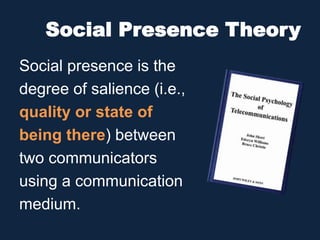
Social Presence Theory
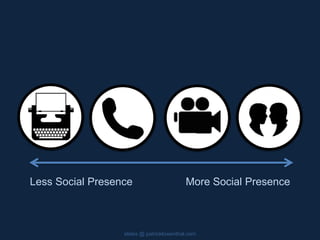
Social presence is the
degree of salience (i.e.,
quality or state of
being there) between
two communicators
using a communication
medium.
slides @ patricklowenthal.com
Less Social Presence More Social Presence
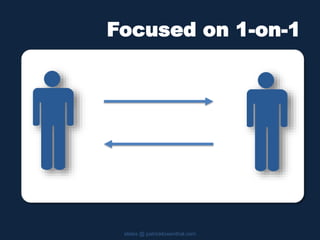
Focused on 1-on-1
slides @ patricklowenthal.com
1980’s & CMC
Cuelessness Theory
developed by Rutter (1984, 1987)
Media Richness Theory
developed by Daft & Lengel
(1984, 1986; Daft, Lengel, &
Trevino, 1987)
slides @ patricklowenthal.com
EVOLUTION OF SOCIAL PRESENCE
slides @ patricklowenthal.com
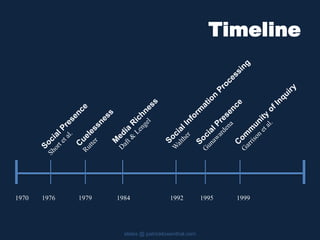
Timeline
slides @ patricklowenthal.com
1970 1976 1979 1984 1992 1995 1999
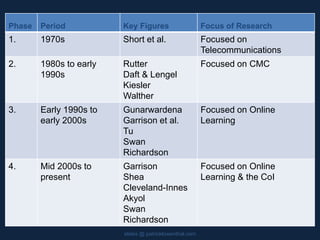
Phase Period Key Figures Focus of Research
1. 1970s Short et al. Focused on
Telecommunications
2. 1980s to early
1990s
Rutter
Daft & Lengel
Kiesler
Walther
Focused on CMC
3. Early 1990s to
early 2000s
Gunarwardena
Garrison et al.
Tu
Swan
Richardson
Focused on Online

Learning
4. Mid 2000s to
present
Garrison
Shea
Cleveland-Innes
Akyol
Swan
Richardson
Focused on Online

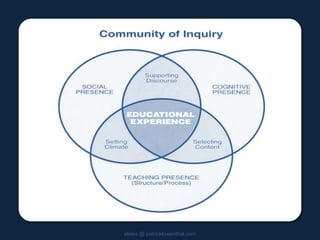
Learning & the CoI
slides @ patricklowenthal.com
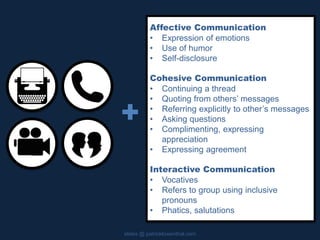
Affective Communication
• Expression of emotions
• Use of humor
• Self-disclosure
Cohesive Communication
• Continuing a thread
• Quoting from others’ messages
• Referring explicitly to other’s messages
• Asking questions
• Complimenting, expressing
appreciation
• Expressing agreement
Interactive Communication
• Vocatives
• Refers to group using inclusive
pronouns
• Phatics, salutations
+
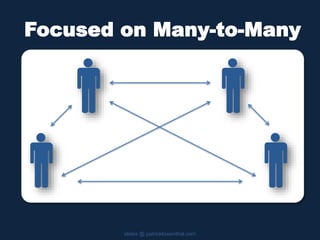
Focused on Many-to-Many
slides @ patricklowenthal.com
Problem
“Researchers of social presence cannot
agree upon a single definition of social
presence (Biocca & Harms, 7 2002; Biocca,
Harms, & Burgoon, 2003; Rettie, 2003;
Lane, 2011; Tu, 2002)
Instead, researchers continue to redefine
social presence (Lowenthal, 2010; Picciano,
2002)”
slides @ patricklowenthal.com
Examples
• “the ability of learners to project
themselves socially and emotionally as
well as their ability to perceive other
learners as “real people””(Boston et al.)
• “the degree to which participants in
computer-mediated communication feel
affectively connected one to another…
(Swan, Garrison, & Richardson, 2009).”
slides @ patricklowenthal.com
Definitions…
1. “the degree to which a person is perceived as a
‘real person’ in mediated communication”
(Gunawardena, 1995, p. 151)
2. the ability of learners to project themselves
socially and affectively into a community of inquiry
(Rourke et al., 1999)
3. “…the degree of feeling, perception, and reaction
of being connected by CMC” (Tu & McIsaac,
2002)
4. “…a student’s sense of being in and belonging in
a course and the ability to interact with other
students and an instructor” (Picciano, 2002, p. 22)
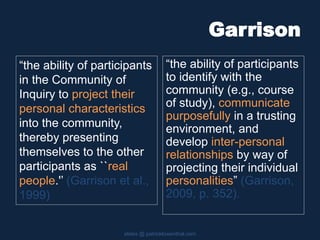
Garrison
“the ability of participants
to identify with the
community (e.g., course
of study), communicate
purposefully in a trusting
environment, and
develop inter-personal
relationships by way of
projecting their individual
personalities” (Garrison,
2009, p. 352).
slides @ patricklowenthal.com
“the ability of participants
in the Community of
Inquiry to project their
personal characteristics
into the community,
thereby presenting
themselves to the other
participants as ``real
people.'’ (Garrison et al.,
1999)
slides @ patricklowenthal.com
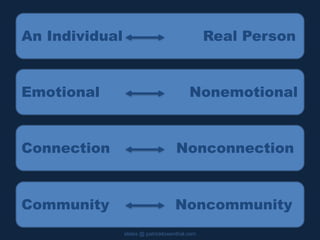
Emotional Nonemotional
Connection Nonconnection
Community Noncommunity
An Individual Real Person
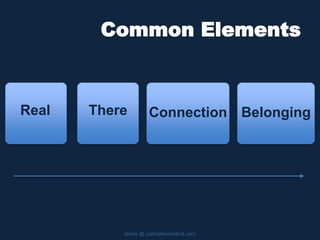
Common Elements
slides @ patricklowenthal.com
BelongingReal There Connection
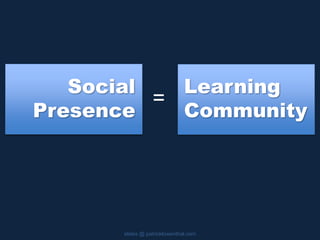
Social
Presence
slides @ patricklowenthal.com
Learning
Community
=
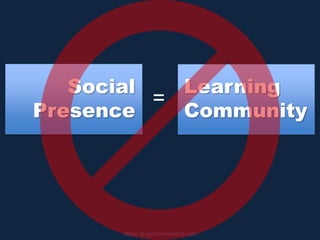
Social
Presence
slides @ patricklowenthal.com
Learning
Community
=
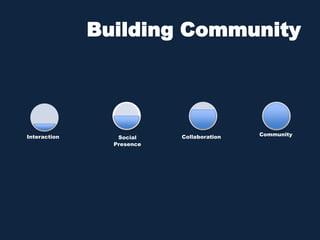
Building Community
Interaction Social
Presence
Collaboration Community
IMPORTANCE OF COMMUNITY
slides @ patricklowenthal.com
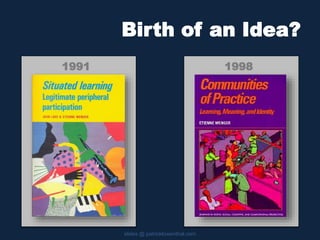
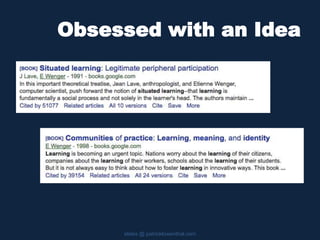
Birth of an Idea?
slides @ patricklowenthal.com
1991
1998
Birth of an Idea?
slides @ patricklowenthal.com
1991
slides @ patricklowenthal.com
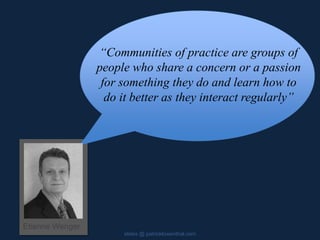
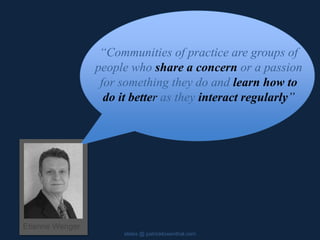
“Communities of practice are groups of
people who share a concern or a passion
for something they do and learn how to
do it better as they interact regularly”
Etienne Wenger
slides @ patricklowenthal.com
Etienne Wenger
“Communities of practice are groups of
people who share a concern or a passion
for something they do and learn how to
do it better as they interact regularly”
Obsessed with an Idea
slides @ patricklowenthal.com
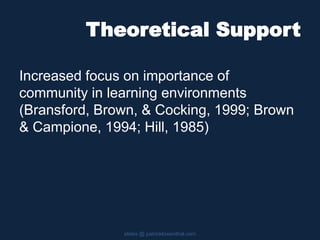
Theoretical Support
slides @ patricklowenthal.com
Increased focus on importance of
community in learning environments
(Bransford, Brown, & Cocking, 1999; Brown
& Campione, 1994; Hill, 1985)
ONLINE LEARNING COMMUNITIES
slides @ patricklowenthal.com
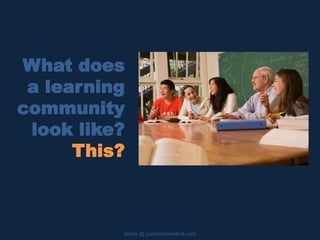
What does
a learning
community
look like?
slides @ patricklowenthal.com
What does
a learning
community
look like?
This?
slides @ patricklowenthal.com
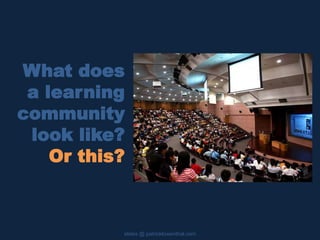
What does
a learning
community
look like?
Or this?
slides @ patricklowenthal.com
What does
an online
learning
community
look like?
slides @ patricklowenthal.com
What does
an online
learning
community
look like?
This?
slides @ patricklowenthal.com
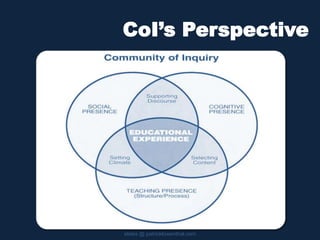
CoI’s Perspective
slides @ patricklowenthal.com
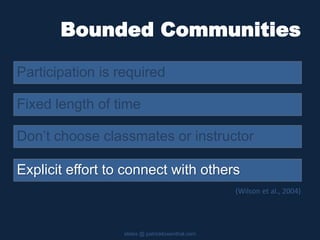
Bounded Communities
Participation is required
slides @ patricklowenthal.com
Don’t choose classmates or instructor
Fixed length of time
Explicit effort to connect with others
(Wilson et al., 2004)
Bounded Communities
Participation is required
slides @ patricklowenthal.com
Don’t choose classmates or instructor
Fixed length of time
Explicit effort to connect with others
(Wilson et al., 2004)
Bounded Communities
Participation is required
slides @ patricklowenthal.com
Don’t choose classmates or instructor
Fixed length of time
Explicit effort to connect with others
(Wilson et al., 2004)
Bounded Communities
Participation is required
slides @ patricklowenthal.com
Don’t choose classmates or instructor
Fixed length of time
Explicit effort to connect with others
(Wilson et al., 2004)
BENEFITS OF ONLINE COMMUNITY
slides @ patricklowenthal.com
Popular Books
slides @ patricklowenthal.com
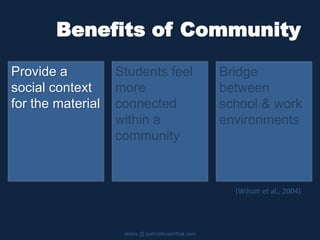
Benefits of Community
Provide a
social context
for the material
slides @ patricklowenthal.com
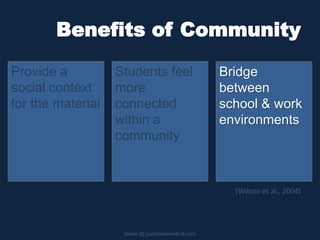
Bridge
between
school & work
environments
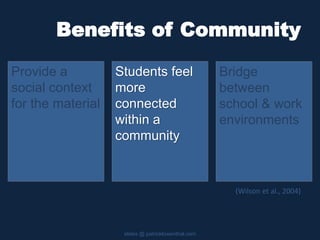
Students feel
more
connected
within a
community
(Wilson et al., 2004)
Benefits of Community
Provide a
social context
for the material
slides @ patricklowenthal.com
Bridge
between
school & work
environments
Students feel
more
connected
within a
community
(Wilson et al., 2004)
Benefits of Community
Provide a
social context
for the material
slides @ patricklowenthal.com
Bridge
between
school & work
environments
Students feel
more
connected
within a
community
(Wilson et al., 2004)
Where to Begin???
Student-to-student Interaction & presence
slides @ patricklowenthal.com
Student-to-teacher Interaction & presence
Collaboration
Learners Are Diverse
slides @ patricklowenthal.com
Privilege Certain Types
slides @ patricklowenthal.com
{ When is there too much? }
slides @ patricklowenthal.com
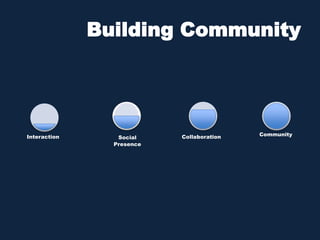
Building Community
Interaction Social
Presence
Collaboration Community
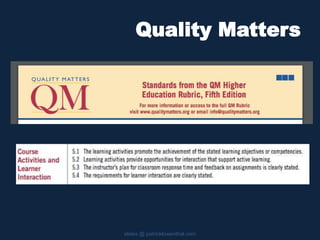
Quality Matters
slides @ patricklowenthal.com
{ When is there not enough? }
slides @ patricklowenthal.com
Good Instruction
Effective instruction meets established
learning goals and objectives;
Efficient instruction does so with minimal
expenditure of resources, particularly time;
Appealing instruction draws the sustained
attention and positive response of learners
(Wilson, Parrish, & Veletsianos, 2008)
slides @ patricklowenthal.com
Engagement
While appeal suggests merely the ability to
draw learners to the experience (a
unidirectional force), engagement suggests
a reciprocating relationship that changes the
nature of the experience. Rather than just
being sufficiently attracted to pay attention,
learners invest creative effort and emotional
commitment—and a willingness to risk in
anticipation of valued outcomes.
slides @ patricklowenthal.com
Good Instruction
• Effective
• Efficient
• Engaging
(Wilson, Parrish, & Veletsianos, 2008)
slides @ patricklowenthal.com
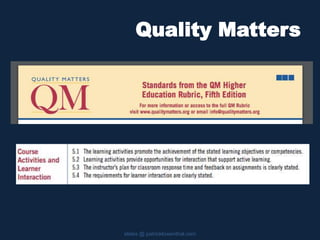
Quality Matters
slides @ patricklowenthal.com
{ Obsession w/ Outcomes }
slides @ patricklowenthal.com
{ Not enough focus on
engagement }
slides @ patricklowenthal.com
{ Be Better than QM }
slides @ patricklowenthal.com
CONTACT ME
Patrick Lowenthal
patricklowenthal@boisestate.edu
www.patricklowenthal.com

Northwest eLearn 2016 Keynote

Editor's Notes

  • #7 [BOOK] The Social Psychology of Telecommunications J Short, E Williams, B Christie - 1976 - John Wiley & Sons Cited by 1745 - Web Search - Library Search They were interested in how communications media, specifically telecommunications media, impact communication
  • #30 Adapted from http://elgg.jiscemerge.org.uk/nvdb/weblog/663.html
  • #31 Adapted from http://elgg.jiscemerge.org.uk/nvdb/weblog/663.html
  • #35 http://upload.wikimedia.org/wikipedia/commons/6/6c/College_Prep_Harkness_Table.jpg
  • #36 http://upload.wikimedia.org/wikipedia/commons/6/6c/College_Prep_Harkness_Table.jpg
  • #37 https://c1.staticflickr.com/3/2069/2814710002_711e3b2d82_z.jpg?zz=1
  • #38 https://c1.staticflickr.com/3/2069/2814710002_711e3b2d82_z.jpg?zz=1
  • #39 https://c1.staticflickr.com/3/2069/2814710002_711e3b2d82_z.jpg?zz=1
  • #41 http://www.irrodl.org/index.php/irrodl/article/view/204/286
  • #42 http://www.irrodl.org/index.php/irrodl/article/view/204/286
  • #43 http://www.irrodl.org/index.php/irrodl/article/view/204/286
  • #44 http://www.irrodl.org/index.php/irrodl/article/view/204/286
  • #47 See: http://www.irrodl.org/index.php/irrodl/article/view/204/286
  • #48 See: http://www.irrodl.org/index.php/irrodl/article/view/204/286
  • #49 See: http://www.irrodl.org/index.php/irrodl/article/view/204/286
  • #55 The Eight General Standards: Course Overview and Introduction Learning Objectives (Competencies) Assessment and Measurement Instructional Materials Course Activities and Learner Interaction Course Technology Learner Support Accessibility and Usability
  • #57 Brent G. Wilson Contributing Editor Patrick Parrish George Veletsianos Raising the Bar for Instructional Outcomes: Toward Transformative Learning Experiences http://citeseerx.ist.psu.edu/viewdoc/download?doi=10.1.1.162.1058&rep=rep1&type=pdf#page=40
  • #59 Brent G. Wilson Contributing Editor Patrick Parrish George Veletsianos Raising the Bar for Instructional Outcomes: Toward Transformative Learning Experiences http://citeseerx.ist.psu.edu/viewdoc/download?doi=10.1.1.162.1058&rep=rep1&type=pdf#page=40
  • #60 The Eight General Standards: Course Overview and Introduction Learning Objectives (Competencies) Assessment and Measurement Instructional Materials Course Activities and Learner Interaction Course Technology Learner Support Accessibility and Usability