What does electricity do for us?
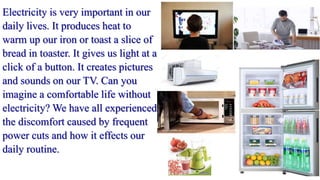
Electricity is very important in our
daily lives. It produces heat to
warm up our iron or toast a slice of
bread in toaster. It gives us light at a
click of a button. It creates pictures
and sounds on our TV. Can you
imagine a comfortable life without
electricity? We have all experienced
the discomfort caused by frequent
power cuts and how it effects our
daily routine.
What are the sources of electricity in Pakistan?
There are various sources of electricity. In Pakistan, we
produce most of the electricity through wind and water.
Thermal power stations produce electricity by burning
fuels such as coal.
Wind Electricity Water Electricity Thermal Electricity
List the important hydroelectric
power stations in Pakistan?
Hydroelectric power stations produce electricity with the force
of running water. There are three very important hydroelectric
power stations in Pakistan. They are at Tarbela, Mangla and
Warsak.
Tarbela Dam Mangla Dam Warsak Dam
What are other sources to produce electricity?
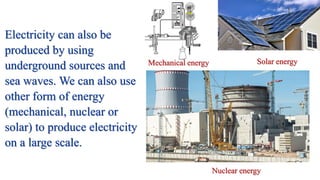
Electricity can also be
produced by using
underground sources and
sea waves. We can also use
other form of energy
(mechanical, nuclear or
solar) to produce electricity
on a large scale.
Mechanical energy Solar energy
Nuclear energy
How can electricity produce by magnet?
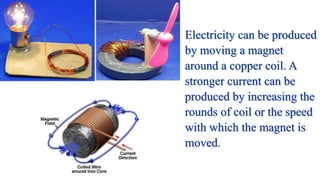
Electricity can be produced
by moving a magnet
around a copper coil. A
stronger current can be
produced by increasing the
rounds of coil or the speed
with which the magnet is
moved.
What happens when magnet
move around the coil?
Activity
Equipment: a copper wire, glass rod, magnet, galvanometer.
Method: Coil the copper wire two hundred times around the glass rod. Remove the
glass rod and join both the ends of the coil to the galvanometer (an instrument for
detecting and measuring small electric currents), and note the reading. Move the
magnet around the coil, and note the reading. Now place the magnet at the centre of
the coil, and note the reading again.
When the magnet is being moved around the coil, the needle of the galvanometer
moves, indicating the production of a current. When the magnet is placed at the
centre of the coil, the needle stops moving. That proves that electricity is produced
by the movement of the magnet.
Repeat the same activity keeping the magnet stationary and moving the coil around
the magnet. Note what happens.
How does domestic generator work?
Domestic generators work on a
similar pattern. A very powerful
magnet is placed inside the coil of
copper wire. The coil moves rapidly
to produce electricity.
How the dynamo works in bicycle?
One simple example of a
generator is the bicycle
dynamo. The dynamo has
a wheel that touches the
back tyre. As the bicycle
moves, the wheel turns the
magnet inside a coil. This
induces enough electricity
to run the bicycle’s lights.
The faster the bicycle
moves, the greater the
induced current and the
brighter the lights.
How does the electricity produce through heat energy?
Electricity can be produced
using conventional sources of
heat, i.e., burning coal, oil and
gas. In the following activity,
you will see how heat
produces a current.
Activity 2
Equipment: two copper wires, an iron wire, a candle, ice-cold
water, galvanometer.
Method: join the copper wires to the iron wire. Attach the loose
ends of the copper wire to the galvanometer, put one of the
points (between the copper and iron wires) in ice-cold water.
Heat the other joint with the candle flame. The needle of the
galvanometer will indicate the production of current in the wire
because of the change in temperature.
Thermal Power Station, Hyderabad
Thermal Power Station, Jamshoro
Explain production of
thermal electricity?
Coal, gas or petrol is
burnt in power
stations. The steam
produced as a result
of burning, is used
to move the turbines
which generate
electricity. Thermal
power stations in
Pakistan are at
Hyderabad,
Jamshoro, Karachi,
Multan, Sukkur and
other cities.
How does the electricity produce through solar energy?
Our main source of energy is the
sun. Many countries produce
electricity using heat and light from
the sun. This is an easy, cheap and
pollution-free method of producing
electricity. Light energy from the
Sun is collected, and converted into
electricity with the help of solar
cells. On a smaller scale, tiny cells
made of silicon or gallium arsenide
are used in cameras, watches and
calculators. These cells take in solar
energy and convert it into electrical
energy.
How electricity is generated from nuclear energy?
Nuclear energy is obtained by splitting the nucleus of an atom into parts. This
process is called nuclear fission. Very high amount of heat is liberated during this
process. This heat is used to produce steam which moves the turbines connected to
electrical generators. This is how electricity is produced. Electricity is being
generated through this principle at Karachi Nuclear Power Plant in Karachi and at
Chasma Nuclear Power Plant near Mianwali.
Battery
Cell battery
What are the safest means of producing electricity?
Batteries and cells are the safest means of producing
electricity through a chemical reaction.
What is voltaic cell? How it works?
Activity 3
Equipment: a zinc plate, a copper plate, two electric wires, diluted
sulphuric acid, a beaker, a bulb.
Method: fill the beaker with the diluted sulphuric acid. Dip the zinc and
copper plates into the acid. Attach the wire to the plates. Attach the
loose ends of the wires to the bulb. The bulb will light up as long as the
chemical reaction sustains.
A voltaic cell works in the same
way. Zinc and copper plates
work as electrodes while the
sulphuric acid acts as an
electrolyte. When the electrodes
are connected by a conductor i.e.
a copper wire, current begins to
flow in the circuit. The current
flow stops after some time
because the zinc plate dissolves
in the acid. Hydrogen gas is
produced in this process. The
bubbles of hydrogen collect on
the copper plate and finally break
the circuit.
Repeat this activity by inserting zinc and copper plates into a lemon, orange or
potato. Observe what happens.
Explain dry cell?
You use dry cells in toys, radios, clocks and cameras. Study the structure
of a dry cell.
Activity 4
Equipment: a used cell, knife.
Method: cut the wrapper of the used cell with a knife. Underneath the
cardboard, you will see a zinc container. The inside of the container is
coated with a jelly-like mixture of ammonium chloride and
carbohydrates. This mixture acts like and electrolyte. There is also a
layer of black powder inside the coating. This manganese dioxide. There
is a carbon rod in the centre of the container. The zinc container and the
carbon rod work as electrodes.
When a cell is put to use, the electrodes react to produce a current. This
current makes the bulb light up or the cassette recorder play.
What is direct current (DC)?
Direct current (DC) is an
electric current which flows
only in one direction. The
voltage of a DC supply
source remains constant.
Some sources of DC power
are dry cells, batteries,
thermocouples, solar cells
and dynamos.
thermocouple
solar cell
dynamo
dry cell
battery
What is alternating current (AC)?
Alternating current (AC) is an electric
current which periodically reverses
direction. Alternating current is the
form in which electric power is
supplied to our homes, offices and
factories from power stations. It is the
form of electrical energy that is used
when we plug kitchen appliances,
televisions and electric lamps into a
wall socket. The voltage of an
alternating current supply source keeps
varying between maximum and
minimum values.
State the function of
a converter?
Most of the electrical appliances in our
home work on AC however some of
the electrical devices like mobile
phones, iPod, and laptops need direct
current to function, therefore the AC
from the supply source must be
converted into DC for this purpose.
AC can be changed to DC by an
adopter that you use to power your
battery. DC can be stored in batteries
but AC cannot be stored.
A converter is a device that changes
alternative current to direct current or
vice versa.

Electricity in action

  • 2.
  • 3.
    Electricity is veryimportant in our daily lives. It produces heat to warm up our iron or toast a slice of bread in toaster. It gives us light at a click of a button. It creates pictures and sounds on our TV. Can you imagine a comfortable life without electricity? We have all experienced the discomfort caused by frequent power cuts and how it effects our daily routine.
  • 4.
    What are thesources of electricity in Pakistan?
  • 5.
    There are varioussources of electricity. In Pakistan, we produce most of the electricity through wind and water. Thermal power stations produce electricity by burning fuels such as coal. Wind Electricity Water Electricity Thermal Electricity
  • 6.
    List the importanthydroelectric power stations in Pakistan?
  • 7.
    Hydroelectric power stationsproduce electricity with the force of running water. There are three very important hydroelectric power stations in Pakistan. They are at Tarbela, Mangla and Warsak. Tarbela Dam Mangla Dam Warsak Dam
  • 8.
    What are othersources to produce electricity?
  • 9.
    Electricity can alsobe produced by using underground sources and sea waves. We can also use other form of energy (mechanical, nuclear or solar) to produce electricity on a large scale. Mechanical energy Solar energy Nuclear energy
  • 10.
    How can electricityproduce by magnet?
  • 11.
    Electricity can beproduced by moving a magnet around a copper coil. A stronger current can be produced by increasing the rounds of coil or the speed with which the magnet is moved.
  • 12.
    What happens whenmagnet move around the coil?
  • 13.
    Activity Equipment: a copperwire, glass rod, magnet, galvanometer. Method: Coil the copper wire two hundred times around the glass rod. Remove the glass rod and join both the ends of the coil to the galvanometer (an instrument for detecting and measuring small electric currents), and note the reading. Move the magnet around the coil, and note the reading. Now place the magnet at the centre of the coil, and note the reading again. When the magnet is being moved around the coil, the needle of the galvanometer moves, indicating the production of a current. When the magnet is placed at the centre of the coil, the needle stops moving. That proves that electricity is produced by the movement of the magnet. Repeat the same activity keeping the magnet stationary and moving the coil around the magnet. Note what happens.
  • 14.
    How does domesticgenerator work?
  • 15.
    Domestic generators workon a similar pattern. A very powerful magnet is placed inside the coil of copper wire. The coil moves rapidly to produce electricity.
  • 16.
    How the dynamoworks in bicycle?
  • 17.
    One simple exampleof a generator is the bicycle dynamo. The dynamo has a wheel that touches the back tyre. As the bicycle moves, the wheel turns the magnet inside a coil. This induces enough electricity to run the bicycle’s lights. The faster the bicycle moves, the greater the induced current and the brighter the lights.
  • 18.
    How does theelectricity produce through heat energy?
  • 19.
    Electricity can beproduced using conventional sources of heat, i.e., burning coal, oil and gas. In the following activity, you will see how heat produces a current.
  • 21.
    Activity 2 Equipment: twocopper wires, an iron wire, a candle, ice-cold water, galvanometer. Method: join the copper wires to the iron wire. Attach the loose ends of the copper wire to the galvanometer, put one of the points (between the copper and iron wires) in ice-cold water. Heat the other joint with the candle flame. The needle of the galvanometer will indicate the production of current in the wire because of the change in temperature.
  • 22.
    Thermal Power Station,Hyderabad Thermal Power Station, Jamshoro Explain production of thermal electricity?
  • 23.
    Coal, gas orpetrol is burnt in power stations. The steam produced as a result of burning, is used to move the turbines which generate electricity. Thermal power stations in Pakistan are at Hyderabad, Jamshoro, Karachi, Multan, Sukkur and other cities.
  • 24.
    How does theelectricity produce through solar energy?
  • 25.
    Our main sourceof energy is the sun. Many countries produce electricity using heat and light from the sun. This is an easy, cheap and pollution-free method of producing electricity. Light energy from the Sun is collected, and converted into electricity with the help of solar cells. On a smaller scale, tiny cells made of silicon or gallium arsenide are used in cameras, watches and calculators. These cells take in solar energy and convert it into electrical energy.
  • 26.
    How electricity isgenerated from nuclear energy?
  • 27.
    Nuclear energy isobtained by splitting the nucleus of an atom into parts. This process is called nuclear fission. Very high amount of heat is liberated during this process. This heat is used to produce steam which moves the turbines connected to electrical generators. This is how electricity is produced. Electricity is being generated through this principle at Karachi Nuclear Power Plant in Karachi and at Chasma Nuclear Power Plant near Mianwali.
  • 28.
    Battery Cell battery What arethe safest means of producing electricity?
  • 29.
    Batteries and cellsare the safest means of producing electricity through a chemical reaction.
  • 30.
    What is voltaiccell? How it works?
  • 31.
    Activity 3 Equipment: azinc plate, a copper plate, two electric wires, diluted sulphuric acid, a beaker, a bulb. Method: fill the beaker with the diluted sulphuric acid. Dip the zinc and copper plates into the acid. Attach the wire to the plates. Attach the loose ends of the wires to the bulb. The bulb will light up as long as the chemical reaction sustains.
  • 32.
    A voltaic cellworks in the same way. Zinc and copper plates work as electrodes while the sulphuric acid acts as an electrolyte. When the electrodes are connected by a conductor i.e. a copper wire, current begins to flow in the circuit. The current flow stops after some time because the zinc plate dissolves in the acid. Hydrogen gas is produced in this process. The bubbles of hydrogen collect on the copper plate and finally break the circuit.
  • 33.
    Repeat this activityby inserting zinc and copper plates into a lemon, orange or potato. Observe what happens.
  • 34.
  • 35.
    You use drycells in toys, radios, clocks and cameras. Study the structure of a dry cell.
  • 36.
    Activity 4 Equipment: aused cell, knife. Method: cut the wrapper of the used cell with a knife. Underneath the cardboard, you will see a zinc container. The inside of the container is coated with a jelly-like mixture of ammonium chloride and carbohydrates. This mixture acts like and electrolyte. There is also a layer of black powder inside the coating. This manganese dioxide. There is a carbon rod in the centre of the container. The zinc container and the carbon rod work as electrodes. When a cell is put to use, the electrodes react to produce a current. This current makes the bulb light up or the cassette recorder play.
  • 37.
    What is directcurrent (DC)?
  • 38.
    Direct current (DC)is an electric current which flows only in one direction. The voltage of a DC supply source remains constant. Some sources of DC power are dry cells, batteries, thermocouples, solar cells and dynamos. thermocouple solar cell dynamo dry cell battery
  • 39.
    What is alternatingcurrent (AC)?
  • 40.
    Alternating current (AC)is an electric current which periodically reverses direction. Alternating current is the form in which electric power is supplied to our homes, offices and factories from power stations. It is the form of electrical energy that is used when we plug kitchen appliances, televisions and electric lamps into a wall socket. The voltage of an alternating current supply source keeps varying between maximum and minimum values.
  • 41.
    State the functionof a converter?
  • 42.
    Most of theelectrical appliances in our home work on AC however some of the electrical devices like mobile phones, iPod, and laptops need direct current to function, therefore the AC from the supply source must be converted into DC for this purpose. AC can be changed to DC by an adopter that you use to power your battery. DC can be stored in batteries but AC cannot be stored. A converter is a device that changes alternative current to direct current or vice versa.