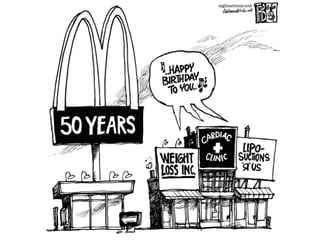
Art by Gary Sweeney, photo taken at the San Antonio Museum of Art
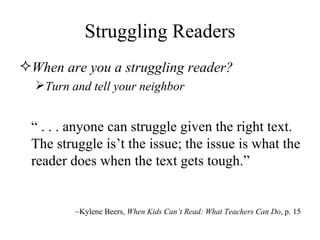
Struggling Readers When are you a struggling reader? Turn and tell your neighbor “   . . . anyone can struggle given the right text. The struggle is’t the issue; the issue is what the reader does when the text gets tough.” ~Kylene Beers,  When Kids Can’t Read: What Teachers Can Do , p. 15
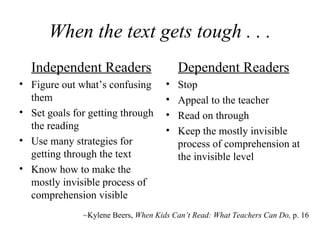
When the text gets tough . . . Independent Readers Figure out what ’s confusing them Set goals for getting through the reading Use many strategies for getting through the text Know how to make the mostly invisible process of comprehension visible Dependent Readers Stop Appeal to the teacher Read on through Keep the mostly invisible process of comprehension at the invisible level ~Kylene Beers,  When Kids Can’ t Read: What Teachers Can Do,  p. 16
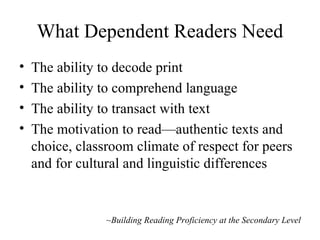
What Dependent Readers Need The ability to decode print The ability to comprehend language The ability to transact with text The motivation to read—authentic texts and choice, classroom climate of respect for peers and for cultural and linguistic differences ~ Building Reading Proficiency at the Secondary Level
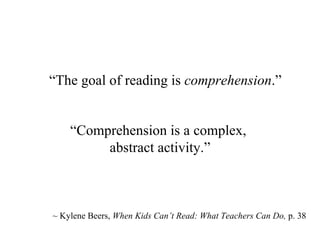
“ Comprehension is a complex,  abstract activity.” ~ Kylene Beers,  When Kids Can’ t Read: What Teachers Can Do,  p. 38 “ The goal of reading is  comprehension .”
Comprehension Reading is a social process, an interactive activity, one in which readers create meaning through transactions—interactions—with the text, their prior knowledge, the context, and other readers. ~ Kylene Beers,  When Kids Can’ t Read: What Teachers Can Do , p. 38
Comprehension The complex cognitive process involving the intentional interaction between reader and text to convey meaning ~Big Ideas in Beginning Reading, University of Oregon CTL The complex process of simultaneously extracting and constructing meaning from and with text ~Sweet & Snow,  Rethinking Reading Comprehension , 2003
What is Comprehension? Interrogate your own reading/thinking process ~Ellin Oliver Keene,  Mosaic of Thought “ Notes of a Painter”  by Henri Matisse What happens in your mind as you read that helps you make the text make sense?
Thinking Strategies Used Consistently by Proficient Readers Activate relevant, prior knowledge (“ schema”) Determine the most important ideas and themes in a text Ask questions of themselves, the author and the text Create visual and other sensory images from the text during and after reading Draw inferences from the text Retell or synthesize what they have read Utilize “ fix-up” strategies to repair comprehension when it breaks down ~Ellin Oliver Keen,  Mosaic of Thought
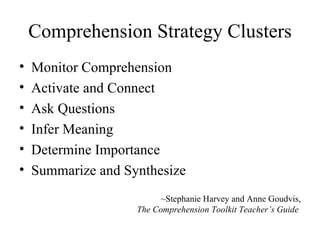
Comprehension Strategy Clusters Monitor Comprehension Activate and Connect Ask Questions Infer Meaning Determine Importance Summarize and Synthesize ~Stephanie   Harvey and Anne Goudvis, The Comprehension Toolkit Teacher’ s Guide
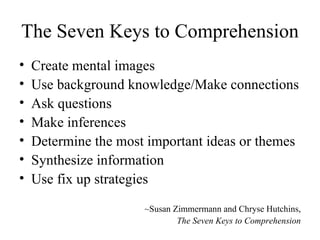
The Seven Keys to Comprehension Create mental images Use background knowledge/Make connections Ask questions Make inferences Determine the most important ideas or themes Synthesize information Use fix up strategies ~Susan Zimmermann and Chryse Hutchins, The Seven Keys to Comprehension
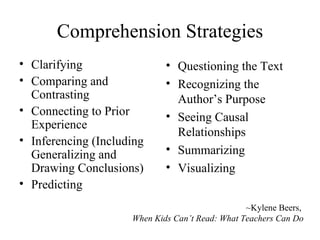
Comprehension Strategies Clarifying Comparing and Contrasting Connecting to Prior Experience Inferencing (Including Generalizing and Drawing Conclusions) Predicting Questioning the Text Recognizing the Author ’s Purpose Seeing Causal Relationships Summarizing Visualizing ~Kylene Beers,  When Kids Can’ t Read: What Teachers Can Do
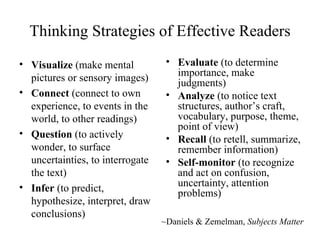
Thinking Strategies of Effective Readers Visualize  (make mental pictures or sensory images) Connect  (connect to own experience, to events in the world, to other readings) Question  (to actively wonder, to surface uncertainties, to interrogate the text) Infer  (to predict, hypothesize, interpret, draw conclusions) Evaluate  (to determine importance, make judgments) Analyze  (to notice text structures, author’ s craft, vocabulary, purpose, theme, point of view) Recall  (to retell, summarize, remember information) Self-monitor  (to recognize and act on confusion, uncertainty, attention problems) ~Daniels & Zemelman,  Subjects Matter
Teaching Tips Introduce just one strategy at a time. Model the activity yourself, as you explain to students how to use it. Practice the strategy first as a whole class. As student make use of the strategy during in-class reading time, move around the room to observe, facilitate, and help.
Teaching Strategies Showing kids how smart readers think Before: activities that prepare students to read During: helping students construct, process, and question ideas as they read After: guiding student to reflect on, integrate, and share the ideas when they’re finished Learning vocabulary
Why Think Aloud? Much of what happens with texts in classrooms gives students the mistaken impression that reading comprehension happens by magic.  To begin to build a repertoire of activities for reading comprehension, students need to have the reading process demystified.  They need to see what happens inside the mind of a proficient reader, someone who is willing to make the invisible visible by externalizing his or her mental activity.  ~Reading for Understanding , p. 212
 
My students were completely amazed that I, as a mature, adult reader, would find some texts challenging.  They delighted in watching me struggle to understand the texts they brought me, recognizing the feeling of being lost, but surprised by my patience and tenacity, by my vigorous search for handholds and willingness to stretch for any shred of meaning.  Many found strategies like using the pictures, slowing down, breaking it into chunks, using my knowledge of Spanish, thinking about what the root of a word might mean, wondering about meanings in new contexts, flat-out guessing, etc., to be a complete revelation. ~Gayle Cribb, high school social studies teacher, quoted in “Apprenticing Adolescents to Reading in Subject-Area Classrooms,” Phi Delta Kappan , October 2003

Teaching Comprehension Strategies and Thinking Aloud

  • 1.
    Art by GarySweeney, photo taken at the San Antonio Museum of Art
  • 2.
    Struggling Readers Whenare you a struggling reader? Turn and tell your neighbor “ . . . anyone can struggle given the right text. The struggle is’t the issue; the issue is what the reader does when the text gets tough.” ~Kylene Beers, When Kids Can’t Read: What Teachers Can Do , p. 15
  • 3.
    When the textgets tough . . . Independent Readers Figure out what ’s confusing them Set goals for getting through the reading Use many strategies for getting through the text Know how to make the mostly invisible process of comprehension visible Dependent Readers Stop Appeal to the teacher Read on through Keep the mostly invisible process of comprehension at the invisible level ~Kylene Beers, When Kids Can’ t Read: What Teachers Can Do, p. 16
  • 4.
    What Dependent ReadersNeed The ability to decode print The ability to comprehend language The ability to transact with text The motivation to read—authentic texts and choice, classroom climate of respect for peers and for cultural and linguistic differences ~ Building Reading Proficiency at the Secondary Level
  • 5.
    “ Comprehension isa complex, abstract activity.” ~ Kylene Beers, When Kids Can’ t Read: What Teachers Can Do, p. 38 “ The goal of reading is comprehension .”
  • 6.
    Comprehension Reading isa social process, an interactive activity, one in which readers create meaning through transactions—interactions—with the text, their prior knowledge, the context, and other readers. ~ Kylene Beers, When Kids Can’ t Read: What Teachers Can Do , p. 38
  • 7.
    Comprehension The complexcognitive process involving the intentional interaction between reader and text to convey meaning ~Big Ideas in Beginning Reading, University of Oregon CTL The complex process of simultaneously extracting and constructing meaning from and with text ~Sweet & Snow, Rethinking Reading Comprehension , 2003
  • 8.
    What is Comprehension?Interrogate your own reading/thinking process ~Ellin Oliver Keene, Mosaic of Thought “ Notes of a Painter” by Henri Matisse What happens in your mind as you read that helps you make the text make sense?
  • 9.
    Thinking Strategies UsedConsistently by Proficient Readers Activate relevant, prior knowledge (“ schema”) Determine the most important ideas and themes in a text Ask questions of themselves, the author and the text Create visual and other sensory images from the text during and after reading Draw inferences from the text Retell or synthesize what they have read Utilize “ fix-up” strategies to repair comprehension when it breaks down ~Ellin Oliver Keen, Mosaic of Thought
  • 10.
    Comprehension Strategy ClustersMonitor Comprehension Activate and Connect Ask Questions Infer Meaning Determine Importance Summarize and Synthesize ~Stephanie Harvey and Anne Goudvis, The Comprehension Toolkit Teacher’ s Guide
  • 11.
    The Seven Keysto Comprehension Create mental images Use background knowledge/Make connections Ask questions Make inferences Determine the most important ideas or themes Synthesize information Use fix up strategies ~Susan Zimmermann and Chryse Hutchins, The Seven Keys to Comprehension
  • 12.
    Comprehension Strategies ClarifyingComparing and Contrasting Connecting to Prior Experience Inferencing (Including Generalizing and Drawing Conclusions) Predicting Questioning the Text Recognizing the Author ’s Purpose Seeing Causal Relationships Summarizing Visualizing ~Kylene Beers, When Kids Can’ t Read: What Teachers Can Do
  • 13.
    Thinking Strategies ofEffective Readers Visualize (make mental pictures or sensory images) Connect (connect to own experience, to events in the world, to other readings) Question (to actively wonder, to surface uncertainties, to interrogate the text) Infer (to predict, hypothesize, interpret, draw conclusions) Evaluate (to determine importance, make judgments) Analyze (to notice text structures, author’ s craft, vocabulary, purpose, theme, point of view) Recall (to retell, summarize, remember information) Self-monitor (to recognize and act on confusion, uncertainty, attention problems) ~Daniels & Zemelman, Subjects Matter
  • 14.
    Teaching Tips Introducejust one strategy at a time. Model the activity yourself, as you explain to students how to use it. Practice the strategy first as a whole class. As student make use of the strategy during in-class reading time, move around the room to observe, facilitate, and help.
  • 15.
    Teaching Strategies Showingkids how smart readers think Before: activities that prepare students to read During: helping students construct, process, and question ideas as they read After: guiding student to reflect on, integrate, and share the ideas when they’re finished Learning vocabulary
  • 16.
    Why Think Aloud?Much of what happens with texts in classrooms gives students the mistaken impression that reading comprehension happens by magic. To begin to build a repertoire of activities for reading comprehension, students need to have the reading process demystified. They need to see what happens inside the mind of a proficient reader, someone who is willing to make the invisible visible by externalizing his or her mental activity. ~Reading for Understanding , p. 212
  • 17.
  • 18.
    My students werecompletely amazed that I, as a mature, adult reader, would find some texts challenging. They delighted in watching me struggle to understand the texts they brought me, recognizing the feeling of being lost, but surprised by my patience and tenacity, by my vigorous search for handholds and willingness to stretch for any shred of meaning. Many found strategies like using the pictures, slowing down, breaking it into chunks, using my knowledge of Spanish, thinking about what the root of a word might mean, wondering about meanings in new contexts, flat-out guessing, etc., to be a complete revelation. ~Gayle Cribb, high school social studies teacher, quoted in “Apprenticing Adolescents to Reading in Subject-Area Classrooms,” Phi Delta Kappan , October 2003