CENTRAL LUZON STATE UNIVERSITY
Science City of Munoz, Nueva Ecija
Innovation, Remediation, Enrichment
Across Comprehension Levels
Marites D. Antonio
Faculty, College of Education
Objectives
a. Revisit fundamental principles and theories in
comprehension skills development
b. Relate comprehension strategies to current
classroom practices
c. Visualize instructional plan for developing
comprehension skills
Comprehension defined
“Comprehension is understanding
what you read”
Comprehension defined
“Comprehension involves
interacting with text in various
ways.”
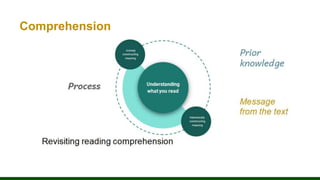
Comprehension
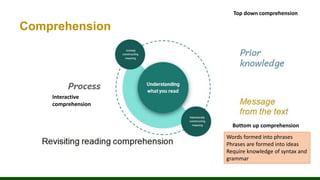
Comprehension
Top down comprehension
Bottom up comprehension
Interactive
comprehension
Words formed into phrases
Phrases are formed into ideas
Require knowledge of syntax and
grammar
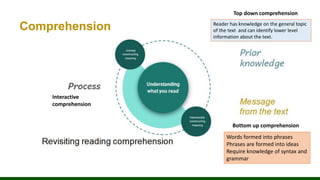
Comprehension
Top down comprehension
Bottom up comprehension
Interactive
comprehension
Words formed into phrases
Phrases are formed into ideas
Require knowledge of syntax and
grammar
Reader has knowledge on the general topic
of the text and can identify lower level
information about the text.
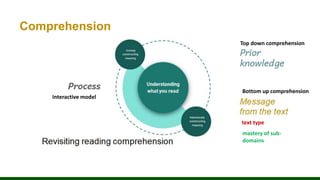
Comprehension
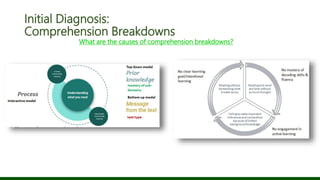
Top down comprehension
Bottom up comprehension
Interactive model
mastery of sub-
domains
text type
“…reading as simultaneously
extracting and constructing meaning
through interaction and involvement
with written language.”
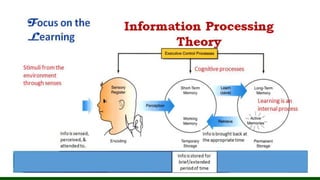
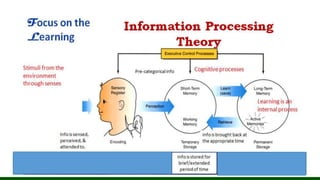
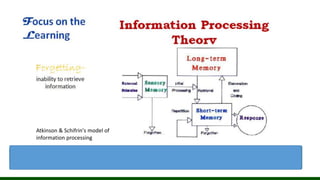
Atkinson & Schifrin's model of
information processing
“Comprehension requires basic
decoding skills and fluency”
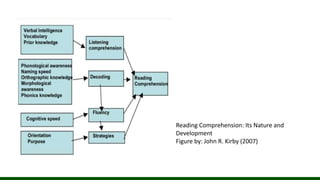
Reading Comprehension: Its Nature and
Development
Figure by: John R. Kirby (2007)
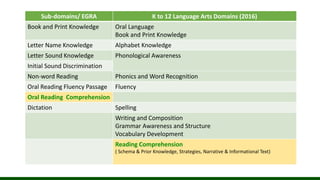
Sub-domains/ EGRA K to 12 Language Arts Domains (2016)
Book and Print Knowledge Oral Language
Book and Print Knowledge
Letter Name Knowledge Alphabet Knowledge
Letter Sound Knowledge Phonological Awareness
Initial Sound Discrimination
Non-word Reading Phonics and Word Recognition
Oral Reading Fluency Passage Fluency
Oral Reading Comprehension
Dictation Spelling
Writing and Composition
Grammar Awareness and Structure
Vocabulary Development
Reading Comprehension
( Schema & Prior Knowledge, Strategies, Narrative & Informational Text)
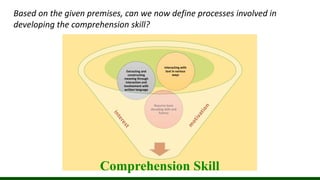
Comprehension Skill
Requires basic
decoding skills and
fluency
Extracting and
constructing
meaning through
interaction and
involvement with
written language
Interacting with
text in various
ways
Based on the given premises, can we now define processes involved in
developing the comprehension skill?
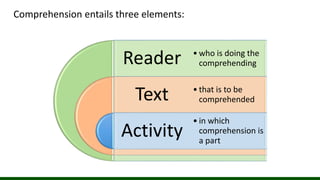
Comprehension entails three elements:
Reader
Text
Activity
• who is doing the
comprehending
• that is to be
comprehended
• in which
comprehension is
a part
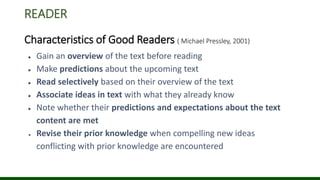
READER
Characteristics of Good Readers ( Michael Pressley, 2001)
● Gain an overview of the text before reading
● Make predictions about the upcoming text
● Read selectively based on their overview of the text
● Associate ideas in text with what they already know
● Note whether their predictions and expectations about the text
content are met
● Revise their prior knowledge when compelling new ideas
conflicting with prior knowledge are encountered
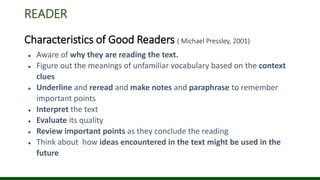
READER
Characteristics of Good Readers ( Michael Pressley, 2001)
● Aware of why they are reading the text.
● Figure out the meanings of unfamiliar vocabulary based on the context
clues
● Underline and reread and make notes and paraphrase to remember
important points
● Interpret the text
● Evaluate its quality
● Review important points as they conclude the reading
● Think about how ideas encountered in the text might be used in the
future
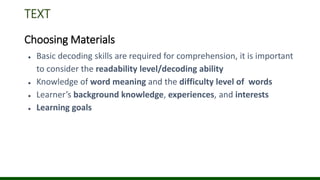
TEXT
Choosing Materials
● Basic decoding skills are required for comprehension, it is important
to consider the readability level/decoding ability
● Knowledge of word meaning and the difficulty level of words
● Learner’s background knowledge, experiences, and interests
● Learning goals
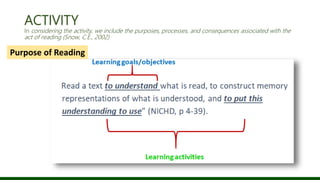
ACTIVITY
In considering the activity, we include the purposes, processes, and consequences associated with the
act of reading (Snow, C.E., 2002)
Purpose of Reading
Classroom Practices in Developing
Comprehension Across Levels
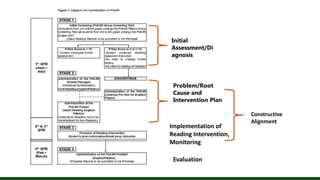
Implementation of
Reading Intervention,
Monitoring
Problem/Root
Cause and
Intervention Plan
Initial
Assessment/Di
agnosis
Evaluation
Constructive
Alignment
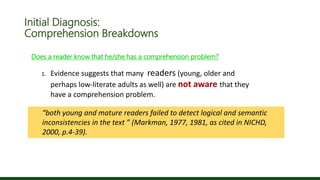
Initial Diagnosis:
Comprehension Breakdowns
1. Evidence suggests that many readers (young, older and
perhaps low-literate adults as well) are not aware that they
have a comprehension problem.
Does a reader know that he/she has a comprehension problem?
“both young and mature readers failed to detect logical and semantic
inconsistencies in the text ” (Markman, 1977, 1981, as cited in NICHD,
2000, p.4-39).
Initial Diagnosis:
Comprehension Breakdowns
1. Evidence suggests that many readers (young, older and
perhaps low-literate adults as well) are not aware that they
have a comprehension problem.
Does a reader know that he/she has a comprehension problem?
“both young and mature readers failed to detect logical and semantic
inconsistencies in the text ” (Markman, 1977, 1981, as cited in NICHD,
2000, p.4-39).
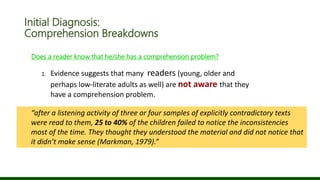
“after a listening activity of three or four samples of explicitly contradictory texts
were read to them, 25 to 40% of the children failed to notice the inconsistencies
most of the time. They thought they understood the material and did not notice that
it didn’t make sense (Markman, 1979).”
Initial Diagnosis:
Comprehension Breakdowns
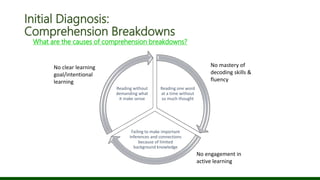
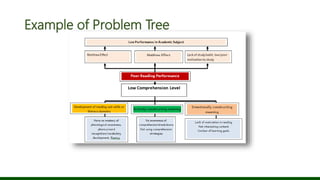
What are the causes of comprehension breakdowns?
Reading one word
at a time without
so much thought
Failing to make important
inferences and connections
because of limited
background knowledge
Reading without
demanding what
it make sense
No clear learning
goal/intentional
learning
No mastery of
decoding skills &
fluency
No engagement in
active learning
Initial Diagnosis:
Comprehension Breakdowns
What are the causes of comprehension breakdowns?
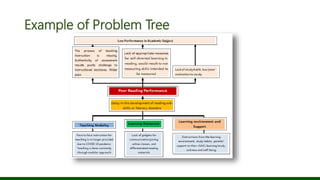
Example of Problem Tree
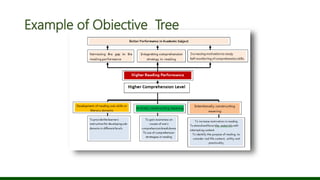
Example of Objective Tree
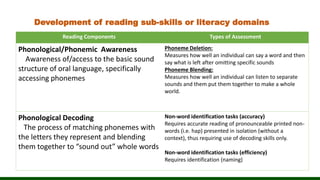
Development of reading sub-skills or literacy domains
Reading Components Types of Assessment
Phonological/Phonemic Awareness
Awareness of/access to the basic sound
structure of oral language, specifically
accessing phonemes
Phoneme Deletion:
Measures how well an individual can say a word and then
say what is left after omitting specific sounds
Phoneme Blending:
Measures how well an individual can listen to separate
sounds and them put them together to make a whole
world.
Phonological Decoding
The process of matching phonemes with
the letters they represent and blending
them together to “sound out” whole words
Non-word identification tasks (accuracy)
Requires accurate reading of pronounceable printed non-
words (i.e. hap) presented in isolation (without a
context), thus requiring use of decoding skills only.
Non-word identification tasks (efficiency)
Requires identification (naming)
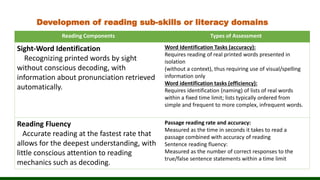
Developmen of reading sub-skills or literacy domains
Reading Components Types of Assessment
Sight-Word Identification
Recognizing printed words by sight
without conscious decoding, with
information about pronunciation retrieved
automatically.
Word Identification Tasks (accuracy):
Requires reading of real printed words presented in
isolation
(without a context), thus requiring use of visual/spelling
information only
Word identification tasks (efficiency):
Requires identification (naming) of lists of real words
within a fixed time limit; lists typically ordered from
simple and frequent to more complex, infrequent words.
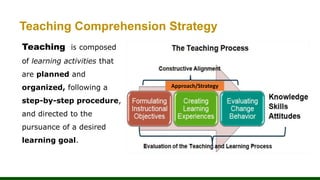
Reading Fluency
Accurate reading at the fastest rate that
allows for the deepest understanding, with
little conscious attention to reading
mechanics such as decoding.
Passage reading rate and accuracy:
Measured as the time in seconds it takes to read a
passage combined with accuracy of reading
Sentence reading fluency:
Measured as the number of correct responses to the
true/false sentence statements within a time limit
Development of reading sub-skills or literacy domains
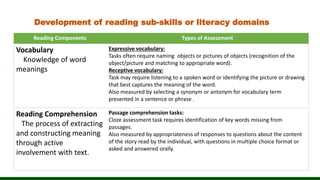
Reading Components Types of Assessment
Vocabulary
Knowledge of word
meanings
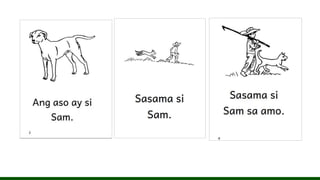
Expressive vocabulary:
Tasks often require naming objects or pictures of objects (recognition of the
object/picture and matching to appropriate word).
Receptive vocabulary:
Task may require listening to a spoken word or identifying the picture or drawing
that best captures the meaning of the word.
Also measured by selecting a synonym or antonym for vocabulary term
presented in a sentence or phrase .
Reading Comprehension
The process of extracting
and constructing meaning
through active
involvement with text.
Passage comprehension tasks:
Cloze assessment task requires identification of key words missing from
passages.
Also measured by appropriateness of responses to questions about the content
of the story read by the individual, with questions in multiple choice format or
asked and answered orally.
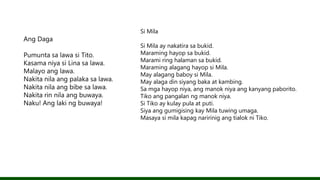
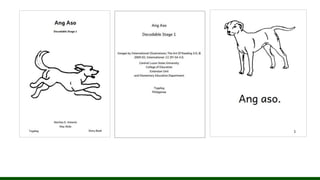
Ang Daga
Pumunta sa lawa si Tito.
Kasama niya si Lina sa lawa.
Malayo ang lawa.
Nakita nila ang palaka sa lawa.
Nakita nila ang bibe sa lawa.
Nakita rin nila ang buwaya.
Naku! Ang laki ng buwaya!
Si Mila
Si Mila ay nakatira sa bukid.
Maraming hayop sa bukid.
Marami ring halaman sa bukid.
Maraming alagang hayop si Mila.
May alagang baboy si Mila.
May alaga din siyang baka at kambing.
Sa mga hayop niya, ang manok niya ang kanyang paborito.
Tiko ang pangalan ng manok niya.
Si Tiko ay kulay pula at puti.
Siya ang gumigising kay Mila tuwing umaga.
Masaya si mila kapag naririnig ang tialok ni Tiko.
Teaching Comprehension Strategy
Teaching is composed
of learning activities that
are planned and
organized, following a
step-by-step procedure,
and directed to the
pursuance of a desired
learning goal.
Approach/Strategy
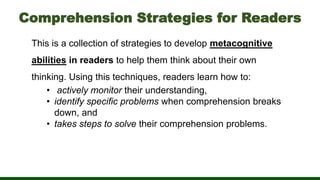
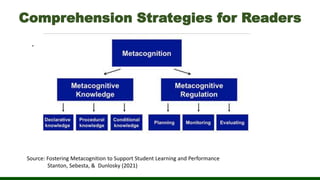
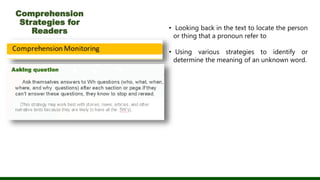
Comprehension Strategies for Readers
This is a collection of strategies to develop metacognitive
abilities in readers to help them think about their own
thinking. Using this techniques, readers learn how to:
• actively monitor their understanding,
• identify specific problems when comprehension breaks
down, and
• takes steps to solve their comprehension problems.
Comprehension Strategies for Readers
.
Source: Fostering Metacognition to Support Student Learning and Performance
Stanton, Sebesta, & Dunlosky (2021)
Actively
constructing
meaning
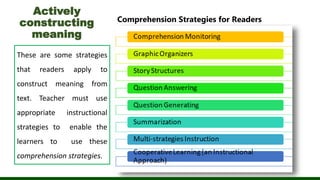
Comprehension Strategies for Readers
These are some strategies
that readers apply to
construct meaning from
text. Teacher must use
appropriate instructional
strategies to enable the
learners to use these
comprehension strategies.
Comprehension
Strategies for
Readers
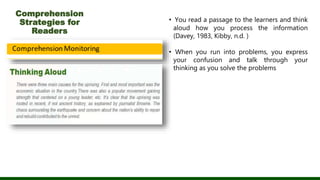
• You read a passage to the learners and think
aloud how you process the information
(Davey, 1983, Kibby, n.d. )
• When you run into problems, you express
your confusion and talk through your
thinking as you solve the problems
Comprehension
Strategies for
Readers
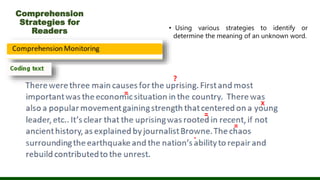
Direction: The teacher reads aloud (in italics) and thinks aloud (in brackets).
There were three main causes for the uprising. [Ok, I’ll be looking for the three causes.]
First and most important was the economic situation in the country. [That’s number one, the
economic situation.]
(Reading on-further details)
There was also a popular movement gaining strength that centered on a young leader, etc. [ Is
that number two? Hmm, I’m not sure, I’d better read on to check.]
(Reading on)
It’s clear the uprising was rooted in recent, if not ancient history, as explained by journalist
Browne, etc. [Wait a minute. This is almost the end. Did I miss the third cause? I guess I had
better read it again.]
(Re-reading)
Comprehension
Strategies for
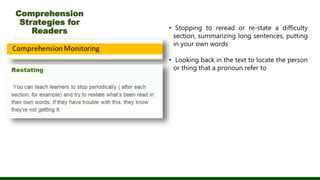
Readers • Stopping to reread or re-state a difficulty
section, summarizing long sentences, putting
in your own words
• Looking back in the text to locate the person
or thing that a pronoun refer to
Comprehension
Strategies for
Readers • Looking back in the text to locate the person
or thing that a pronoun refer to
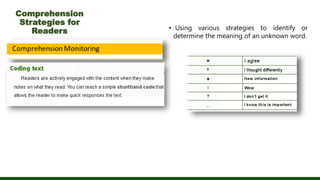
• Using various strategies to identify or
determine the meaning of an unknown word.
Comprehension
Strategies for
Readers • Using various strategies to identify or
determine the meaning of an unknown word.
Comprehension
Strategies for
Readers • Using various strategies to identify or
determine the meaning of an unknown word.
Comprehension
Strategies for
Readers
Instructional Strategy in teaching graphic organizers
• Select graphic tools that match your instructional objectives
• Begin by demonstrating how to use it with an article or story the class
has read.
• In multi-level class, you might try to tape recording the material or read
it to non-readers so that everyone has experienced the same text and all
are able to participate.
Comprehension
Strategies for
Readers
•Be sure to start with a simple organizer and explain the purpose
of the tool and when to use it.
•Then have the whole group compose of one graphic organizer
( with individuals suggesting entries)
•Then assemble small groups/pairs and ask them to use the
graphic organizer while you observe and assist.
Comprehension
Strategies for
Readers
•Grouped should work on material they can read easily or use a
taped reading.
•Finally, when you see learners are using the strategy correctly
and comfortably, then use the activity as routine or drill, as
variation.
•Examples of graphic organizers: KWL Chart, Tables, Semantic
Map/Web, Timelines, Fishbone/Herringbone
Comprehension
Strategies for
Readers
•To introduce the strategy, you ay begin with the five questions
(5Ws) that represent the basic story elements (NICHD, 2002, p 4-
91)
1. Who is the main character?
2. When and where did the story occur?
3. What did the main character(s) do?
4. How did the story end?
5. How did the main character feel?
Comprehension
Strategies for
Readers
• You should begin with a story that class has read and
demonstrate the question and answer activity for them.
• Then the whole class might practice going through the process
with another story.
• Learners also could practice this strategy in pairs
• To make the analysis of the story more concrete , you could
have the learners construct story map.
Comprehension
Strategies for
Readers
•For struggling readers, you can have them read a story in
sections (introduction, body, and conclusion), and then ask
questions about main character, and setting, record the answer
on cards, and line up the cards under the appropriate story
sections.
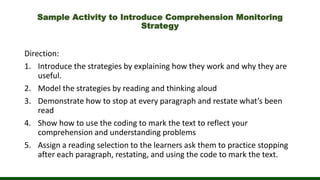
Sample Activity to Introduce Comprehension Monitoring
Strategy
Direction:
1. Introduce the strategies by explaining how they work and why they are
useful.
2. Model the strategies by reading and thinking aloud
3. Demonstrate how to stop at every paragraph and restate what’s been
read
4. Show how to use the coding to mark the text to reflect your
comprehension and understanding problems
5. Assign a reading selection to the learners ask them to practice stopping
after each paragraph, restating, and using the code to mark the text.
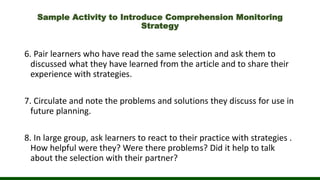
Sample Activity to Introduce Comprehension Monitoring
Strategy
6. Pair learners who have read the same selection and ask them to
discussed what they have learned from the article and to share their
experience with strategies.
7. Circulate and note the problems and solutions they discuss for use in
future planning.
8. In large group, ask learners to react to their practice with strategies .
How helpful were they? Were there problems? Did it help to talk
about the selection with their partner?
Maraming
salamat po!
References
(PDF) Reading Comprehension: Its Nature and Development. (n.d.). Retrieved from ResearchGate website:
https://www.researchgate.net/publication/242598620_Reading_Comprehension_Its_Nature_and_Development
McShane, S. (2005). Applying research in reading instruction for adults. Washington, D.C.: United States
National Institute for Literacy.
Early Grade Reading Assessment (EGRA) Toolkit: Second Edition | SharEd. (n.d.). Shared.rti.org.
https://shared.rti.org/content/early-grade-reading-assessment-egra-toolkit-second-edition
K to 12 Curriculum Guide ENGLISH (Grade 1 to Grade 10). (2016). https://www.deped.gov.ph/wp-
content/uploads/2019/01/English-CG.pdf
Stanton, J. D., Sebesta, A. J., & Dunlosky, J. (2021). Fostering Metacognition to Support Student Learning and
Performance. CBE—Life Sciences Education, 20(2). https://doi.org/10.1187/cbe.20-12-0289
CENTRAL LUZON STATE UNIVERSITY
Science City of Munoz, Nueva Ecija

Comprehension-Development LAC session pp

  • 1.
    CENTRAL LUZON STATEUNIVERSITY Science City of Munoz, Nueva Ecija
  • 2.
    Innovation, Remediation, Enrichment AcrossComprehension Levels Marites D. Antonio Faculty, College of Education
  • 3.
    Objectives a. Revisit fundamentalprinciples and theories in comprehension skills development b. Relate comprehension strategies to current classroom practices c. Visualize instructional plan for developing comprehension skills
  • 4.
    Comprehension defined “Comprehension isunderstanding what you read”
  • 5.
  • 6.
  • 7.
    Comprehension Top down comprehension Bottomup comprehension Interactive comprehension Words formed into phrases Phrases are formed into ideas Require knowledge of syntax and grammar
  • 8.
    Comprehension Top down comprehension Bottomup comprehension Interactive comprehension Words formed into phrases Phrases are formed into ideas Require knowledge of syntax and grammar Reader has knowledge on the general topic of the text and can identify lower level information about the text.
  • 9.
    Comprehension Top down comprehension Bottomup comprehension Interactive model mastery of sub- domains text type
  • 10.
    “…reading as simultaneously extractingand constructing meaning through interaction and involvement with written language.”
  • 13.
    Atkinson & Schifrin'smodel of information processing
  • 14.
  • 15.
    Reading Comprehension: ItsNature and Development Figure by: John R. Kirby (2007)
  • 16.
    Sub-domains/ EGRA Kto 12 Language Arts Domains (2016) Book and Print Knowledge Oral Language Book and Print Knowledge Letter Name Knowledge Alphabet Knowledge Letter Sound Knowledge Phonological Awareness Initial Sound Discrimination Non-word Reading Phonics and Word Recognition Oral Reading Fluency Passage Fluency Oral Reading Comprehension Dictation Spelling Writing and Composition Grammar Awareness and Structure Vocabulary Development Reading Comprehension ( Schema & Prior Knowledge, Strategies, Narrative & Informational Text)
  • 17.
    Comprehension Skill Requires basic decodingskills and fluency Extracting and constructing meaning through interaction and involvement with written language Interacting with text in various ways Based on the given premises, can we now define processes involved in developing the comprehension skill?
  • 18.
    Comprehension entails threeelements: Reader Text Activity • who is doing the comprehending • that is to be comprehended • in which comprehension is a part
  • 19.
    READER Characteristics of GoodReaders ( Michael Pressley, 2001) ● Gain an overview of the text before reading ● Make predictions about the upcoming text ● Read selectively based on their overview of the text ● Associate ideas in text with what they already know ● Note whether their predictions and expectations about the text content are met ● Revise their prior knowledge when compelling new ideas conflicting with prior knowledge are encountered
  • 20.
    READER Characteristics of GoodReaders ( Michael Pressley, 2001) ● Aware of why they are reading the text. ● Figure out the meanings of unfamiliar vocabulary based on the context clues ● Underline and reread and make notes and paraphrase to remember important points ● Interpret the text ● Evaluate its quality ● Review important points as they conclude the reading ● Think about how ideas encountered in the text might be used in the future
  • 21.
    TEXT Choosing Materials ● Basicdecoding skills are required for comprehension, it is important to consider the readability level/decoding ability ● Knowledge of word meaning and the difficulty level of words ● Learner’s background knowledge, experiences, and interests ● Learning goals
  • 22.
    ACTIVITY In considering theactivity, we include the purposes, processes, and consequences associated with the act of reading (Snow, C.E., 2002) Purpose of Reading
  • 23.
    Classroom Practices inDeveloping Comprehension Across Levels
  • 24.
    Implementation of Reading Intervention, Monitoring Problem/Root Causeand Intervention Plan Initial Assessment/Di agnosis Evaluation Constructive Alignment
  • 25.
    Initial Diagnosis: Comprehension Breakdowns 1.Evidence suggests that many readers (young, older and perhaps low-literate adults as well) are not aware that they have a comprehension problem. Does a reader know that he/she has a comprehension problem? “both young and mature readers failed to detect logical and semantic inconsistencies in the text ” (Markman, 1977, 1981, as cited in NICHD, 2000, p.4-39).
  • 26.
    Initial Diagnosis: Comprehension Breakdowns 1.Evidence suggests that many readers (young, older and perhaps low-literate adults as well) are not aware that they have a comprehension problem. Does a reader know that he/she has a comprehension problem? “both young and mature readers failed to detect logical and semantic inconsistencies in the text ” (Markman, 1977, 1981, as cited in NICHD, 2000, p.4-39). “after a listening activity of three or four samples of explicitly contradictory texts were read to them, 25 to 40% of the children failed to notice the inconsistencies most of the time. They thought they understood the material and did not notice that it didn’t make sense (Markman, 1979).”
  • 27.
    Initial Diagnosis: Comprehension Breakdowns Whatare the causes of comprehension breakdowns? Reading one word at a time without so much thought Failing to make important inferences and connections because of limited background knowledge Reading without demanding what it make sense No clear learning goal/intentional learning No mastery of decoding skills & fluency No engagement in active learning
  • 28.
    Initial Diagnosis: Comprehension Breakdowns Whatare the causes of comprehension breakdowns?
  • 29.
  • 30.
  • 31.
  • 32.
    Development of readingsub-skills or literacy domains Reading Components Types of Assessment Phonological/Phonemic Awareness Awareness of/access to the basic sound structure of oral language, specifically accessing phonemes Phoneme Deletion: Measures how well an individual can say a word and then say what is left after omitting specific sounds Phoneme Blending: Measures how well an individual can listen to separate sounds and them put them together to make a whole world. Phonological Decoding The process of matching phonemes with the letters they represent and blending them together to “sound out” whole words Non-word identification tasks (accuracy) Requires accurate reading of pronounceable printed non- words (i.e. hap) presented in isolation (without a context), thus requiring use of decoding skills only. Non-word identification tasks (efficiency) Requires identification (naming)
  • 33.
    Developmen of readingsub-skills or literacy domains Reading Components Types of Assessment Sight-Word Identification Recognizing printed words by sight without conscious decoding, with information about pronunciation retrieved automatically. Word Identification Tasks (accuracy): Requires reading of real printed words presented in isolation (without a context), thus requiring use of visual/spelling information only Word identification tasks (efficiency): Requires identification (naming) of lists of real words within a fixed time limit; lists typically ordered from simple and frequent to more complex, infrequent words. Reading Fluency Accurate reading at the fastest rate that allows for the deepest understanding, with little conscious attention to reading mechanics such as decoding. Passage reading rate and accuracy: Measured as the time in seconds it takes to read a passage combined with accuracy of reading Sentence reading fluency: Measured as the number of correct responses to the true/false sentence statements within a time limit
  • 34.
    Development of readingsub-skills or literacy domains Reading Components Types of Assessment Vocabulary Knowledge of word meanings Expressive vocabulary: Tasks often require naming objects or pictures of objects (recognition of the object/picture and matching to appropriate word). Receptive vocabulary: Task may require listening to a spoken word or identifying the picture or drawing that best captures the meaning of the word. Also measured by selecting a synonym or antonym for vocabulary term presented in a sentence or phrase . Reading Comprehension The process of extracting and constructing meaning through active involvement with text. Passage comprehension tasks: Cloze assessment task requires identification of key words missing from passages. Also measured by appropriateness of responses to questions about the content of the story read by the individual, with questions in multiple choice format or asked and answered orally.
  • 35.
    Ang Daga Pumunta salawa si Tito. Kasama niya si Lina sa lawa. Malayo ang lawa. Nakita nila ang palaka sa lawa. Nakita nila ang bibe sa lawa. Nakita rin nila ang buwaya. Naku! Ang laki ng buwaya! Si Mila Si Mila ay nakatira sa bukid. Maraming hayop sa bukid. Marami ring halaman sa bukid. Maraming alagang hayop si Mila. May alagang baboy si Mila. May alaga din siyang baka at kambing. Sa mga hayop niya, ang manok niya ang kanyang paborito. Tiko ang pangalan ng manok niya. Si Tiko ay kulay pula at puti. Siya ang gumigising kay Mila tuwing umaga. Masaya si mila kapag naririnig ang tialok ni Tiko.
  • 37.
    Teaching Comprehension Strategy Teachingis composed of learning activities that are planned and organized, following a step-by-step procedure, and directed to the pursuance of a desired learning goal. Approach/Strategy
  • 40.
    Comprehension Strategies forReaders This is a collection of strategies to develop metacognitive abilities in readers to help them think about their own thinking. Using this techniques, readers learn how to: • actively monitor their understanding, • identify specific problems when comprehension breaks down, and • takes steps to solve their comprehension problems.
  • 41.
    Comprehension Strategies forReaders . Source: Fostering Metacognition to Support Student Learning and Performance Stanton, Sebesta, & Dunlosky (2021)
  • 42.
    Actively constructing meaning Comprehension Strategies forReaders These are some strategies that readers apply to construct meaning from text. Teacher must use appropriate instructional strategies to enable the learners to use these comprehension strategies.
  • 43.
    Comprehension Strategies for Readers • Youread a passage to the learners and think aloud how you process the information (Davey, 1983, Kibby, n.d. ) • When you run into problems, you express your confusion and talk through your thinking as you solve the problems
  • 44.
    Comprehension Strategies for Readers Direction: Theteacher reads aloud (in italics) and thinks aloud (in brackets). There were three main causes for the uprising. [Ok, I’ll be looking for the three causes.] First and most important was the economic situation in the country. [That’s number one, the economic situation.] (Reading on-further details) There was also a popular movement gaining strength that centered on a young leader, etc. [ Is that number two? Hmm, I’m not sure, I’d better read on to check.] (Reading on) It’s clear the uprising was rooted in recent, if not ancient history, as explained by journalist Browne, etc. [Wait a minute. This is almost the end. Did I miss the third cause? I guess I had better read it again.] (Re-reading)
  • 45.
    Comprehension Strategies for Readers •Stopping to reread or re-state a difficulty section, summarizing long sentences, putting in your own words • Looking back in the text to locate the person or thing that a pronoun refer to
  • 46.
    Comprehension Strategies for Readers •Looking back in the text to locate the person or thing that a pronoun refer to • Using various strategies to identify or determine the meaning of an unknown word.
  • 47.
    Comprehension Strategies for Readers •Using various strategies to identify or determine the meaning of an unknown word.
  • 48.
    Comprehension Strategies for Readers •Using various strategies to identify or determine the meaning of an unknown word.
  • 49.
    Comprehension Strategies for Readers Instructional Strategyin teaching graphic organizers • Select graphic tools that match your instructional objectives • Begin by demonstrating how to use it with an article or story the class has read. • In multi-level class, you might try to tape recording the material or read it to non-readers so that everyone has experienced the same text and all are able to participate.
  • 50.
    Comprehension Strategies for Readers •Be sureto start with a simple organizer and explain the purpose of the tool and when to use it. •Then have the whole group compose of one graphic organizer ( with individuals suggesting entries) •Then assemble small groups/pairs and ask them to use the graphic organizer while you observe and assist.
  • 51.
    Comprehension Strategies for Readers •Grouped shouldwork on material they can read easily or use a taped reading. •Finally, when you see learners are using the strategy correctly and comfortably, then use the activity as routine or drill, as variation. •Examples of graphic organizers: KWL Chart, Tables, Semantic Map/Web, Timelines, Fishbone/Herringbone
  • 52.
    Comprehension Strategies for Readers •To introducethe strategy, you ay begin with the five questions (5Ws) that represent the basic story elements (NICHD, 2002, p 4- 91) 1. Who is the main character? 2. When and where did the story occur? 3. What did the main character(s) do? 4. How did the story end? 5. How did the main character feel?
  • 53.
    Comprehension Strategies for Readers • Youshould begin with a story that class has read and demonstrate the question and answer activity for them. • Then the whole class might practice going through the process with another story. • Learners also could practice this strategy in pairs • To make the analysis of the story more concrete , you could have the learners construct story map.
  • 54.
    Comprehension Strategies for Readers •For strugglingreaders, you can have them read a story in sections (introduction, body, and conclusion), and then ask questions about main character, and setting, record the answer on cards, and line up the cards under the appropriate story sections.
  • 55.
    Sample Activity toIntroduce Comprehension Monitoring Strategy Direction: 1. Introduce the strategies by explaining how they work and why they are useful. 2. Model the strategies by reading and thinking aloud 3. Demonstrate how to stop at every paragraph and restate what’s been read 4. Show how to use the coding to mark the text to reflect your comprehension and understanding problems 5. Assign a reading selection to the learners ask them to practice stopping after each paragraph, restating, and using the code to mark the text.
  • 56.
    Sample Activity toIntroduce Comprehension Monitoring Strategy 6. Pair learners who have read the same selection and ask them to discussed what they have learned from the article and to share their experience with strategies. 7. Circulate and note the problems and solutions they discuss for use in future planning. 8. In large group, ask learners to react to their practice with strategies . How helpful were they? Were there problems? Did it help to talk about the selection with their partner?
  • 57.
  • 58.
    References (PDF) Reading Comprehension:Its Nature and Development. (n.d.). Retrieved from ResearchGate website: https://www.researchgate.net/publication/242598620_Reading_Comprehension_Its_Nature_and_Development McShane, S. (2005). Applying research in reading instruction for adults. Washington, D.C.: United States National Institute for Literacy. Early Grade Reading Assessment (EGRA) Toolkit: Second Edition | SharEd. (n.d.). Shared.rti.org. https://shared.rti.org/content/early-grade-reading-assessment-egra-toolkit-second-edition K to 12 Curriculum Guide ENGLISH (Grade 1 to Grade 10). (2016). https://www.deped.gov.ph/wp- content/uploads/2019/01/English-CG.pdf Stanton, J. D., Sebesta, A. J., & Dunlosky, J. (2021). Fostering Metacognition to Support Student Learning and Performance. CBE—Life Sciences Education, 20(2). https://doi.org/10.1187/cbe.20-12-0289
  • 59.
    CENTRAL LUZON STATEUNIVERSITY Science City of Munoz, Nueva Ecija