Just What Does It
  Mean To Make
     Sense?

   Keith Pruitt, Ed.S.

Words of Wisdom Educational
         Consulting

 www.woweducationalconsulting.com
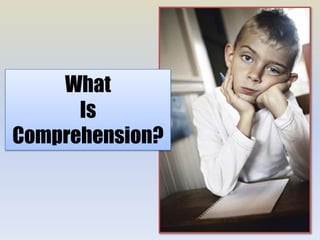
What
      Is
Comprehension?
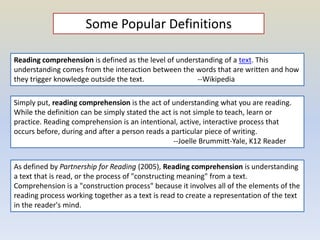
Some Popular Definitions

Reading comprehension is defined as the level of understanding of a text. This
understanding comes from the interaction between the words that are written and how
they trigger knowledge outside the text.               --Wikipedia

Simply put, reading comprehension is the act of understanding what you are reading.
While the definition can be simply stated the act is not simple to teach, learn or
practice. Reading comprehension is an intentional, active, interactive process that
occurs before, during and after a person reads a particular piece of writing.
                                                  --Joelle Brummitt-Yale, K12 Reader


As defined by Partnership for Reading (2005), Reading comprehension is understanding
a text that is read, or the process of "constructing meaning" from a text.
Comprehension is a "construction process" because it involves all of the elements of the
reading process working together as a text is read to create a representation of the text
in the reader's mind.
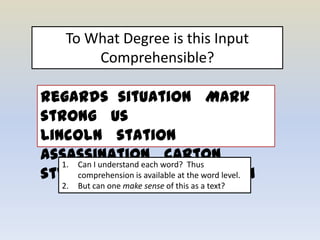
To What Degree is this Input
         Comprehensible?

regards situation Mark
strong us
Lincoln station
assassination word? Thus
   1. Can I understand each
                             carton
style language at the word level.
      comprehension is available partition
    2.   But can one make sense of this as a text?
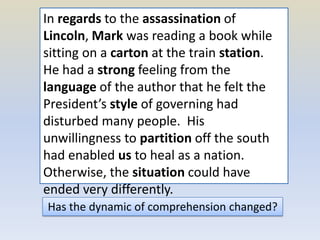
In regards to the assassination of
Lincoln, Mark was reading a book while
sitting on a carton at the train station.
He had a strong feeling from the
language of the author that he felt the
President’s style of governing had
disturbed many people. His
unwillingness to partition off the south
had enabled us to heal as a nation.
Otherwise, the situation could have
ended very differently.
Has the dynamic of comprehension changed?
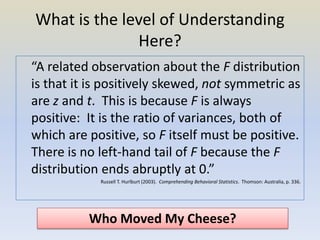
What is the level of Understanding
              Here?
“A related observation about the F distribution
is that it is positively skewed, not symmetric as
are z and t. This is because F is always
positive: It is the ratio of variances, both of
which are positive, so F itself must be positive.
There is no left-hand tail of F because the F
distribution ends abruptly at 0.”
            Russell T. Hurlburt (2003). Comprehending Behavioral Statistics. Thomson: Australia, p. 336.


          Who Moved My Cheese?
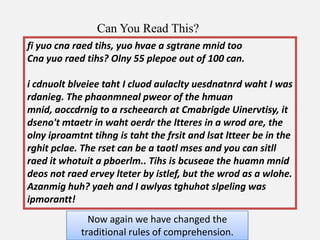
Can You Read This?
fi yuo cna raed tihs, yuo hvae a sgtrane mnid too
Cna yuo raed tihs? Olny 55 plepoe out of 100 can.

i cdnuolt blveiee taht I cluod aulaclty uesdnatnrd waht I was
rdanieg. The phaonmneal pweor of the hmuan
mnid, aoccdrnig to a rscheearch at Cmabrigde Uinervtisy, it
dseno't mtaetr in waht oerdr the ltteres in a wrod are, the
olny iproamtnt tihng is taht the frsit and lsat ltteer be in the
rghit pclae. The rset can be a taotl mses and you can sitll
raed it whotuit a pboerlm.. Tihs is bcuseae the huamn mnid
deos not raed ervey lteter by istlef, but the wrod as a wlohe.
Azanmig huh? yaeh and I awlyas tghuhot slpeling was
ipmorantt!
               Now again we have changed the
             traditional rules of comprehension.
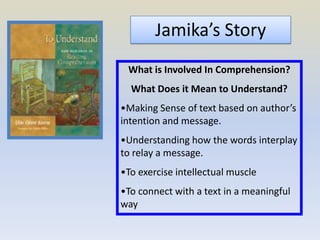
Jamika’s Story
 What is Involved In Comprehension?
  What Does it Mean to Understand?
•Making Sense of text based on author’s
intention and message.
•Understanding how the words interplay
to relay a message.
•To exercise intellectual muscle
•To connect with a text in a meaningful
way
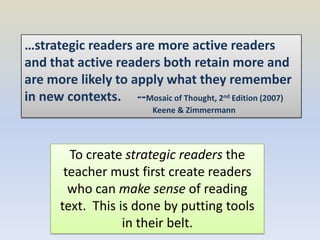
…strategic readers are more active readers
and that active readers both retain more and
are more likely to apply what they remember
in new contexts. --Mosaic of Thought, 2nd Edition (2007)
                          Keene & Zimmermann


         To create strategic readers the
        teacher must first create readers
         who can make sense of reading
       text. This is done by putting tools
                   in their belt.
How Can I Help Students to Make
       Sense of Texts?


    By thinking in terms of
 Comprehension Strategies, a
   teacher can focus on the
      necessary tools for
       comprehension.
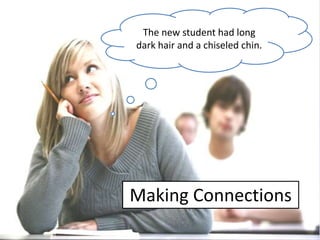
The new student had long
dark hair and a chiseled chin.


Making Connections
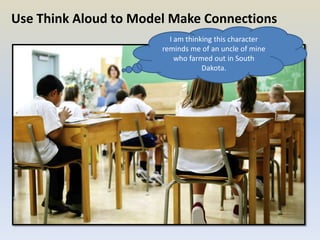
Use Think Aloud to Model Make Connections
                         I am thinking this character
                       reminds me of an uncle of mine
                           who farmed out in South
                                   Dakota.
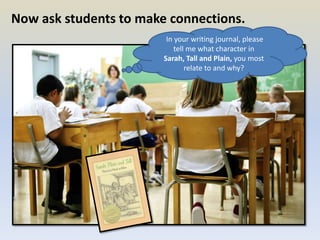
Now ask students to make connections.
                         In your writing journal, please
                            tell me what character in
                        Sarah, Tall and Plain, you most
                                relate to and why?
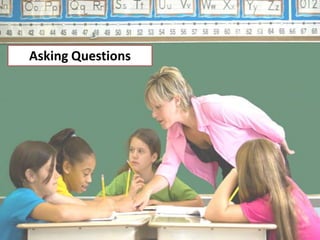
Asking Questions
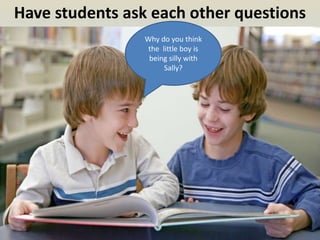
Have students ask each other questions
                 Why do you think
                  the little boy is
                  being silly with
                       Sally?
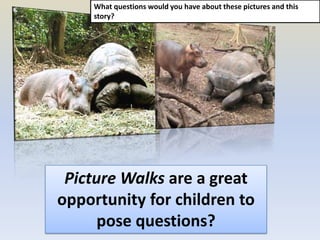
What questions would you have about these pictures and this
     story?


 Picture Walks are a great
opportunity for children to
      pose questions?
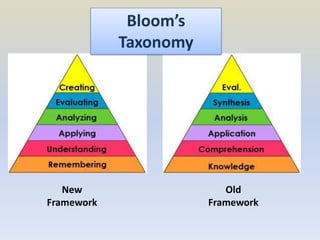
Bloom’s
            Taxonomy


   New                    Old
Framework              Framework
How Does This
Transform the type of
 questioning done in
   the classroom?
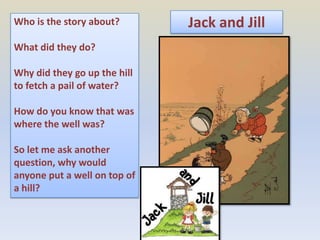
Who is the story about?       Jack and Jill
What did they do?

Why did they go up the hill
to fetch a pail of water?

How do you know that was
where the well was?

So let me ask another
question, why would
anyone put a well on top of
a hill?
Creating a Visual Image
Tell a partner what visual images are created with the following reading.


  The snow covered peaks grew larger on the
  horizon as we approached the last two miles of
  our long journey. The slopes would be packed
  with powder and the hordes taking advantage
  of an early season. We had awaited this
  getaway all summer; now the time was here
  and we were anxious to take to the lifts.
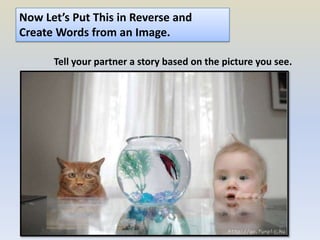
Now Let’s Put This in Reverse and
Create Words from an Image.

      Tell your partner a story based on the picture you see.
In this presentation we have but
touched briefly on the idea of what
  it really means to make sense of
       text and some methods.

Keene & Zimmermann, Mosaic of
           Thought
     Keene, To Understand
Harvey & Goudvis, Comprehension
            Toolkit
Thank You

   Keith Pruitt, Ed.S.
Words of Wisdom Educational
         Consulting

www.woweducationalconsulting.com