Building
Comprehension
Strategies with
Students
Created by Katie Soble
Contact: Soble_Kathleen@durham.edu.on.ca
Topic Slide
#
Reading, Decoding and Comprehension 3-5
Barriers to Comprehension 6-8
Reading Skills vs. Strategies 9-10
How to Teach Strategies 11-12
Pre-, During, and Post-Reading 13
Making Connections 14-16
Common Comprehension Strategies and Resources 17
•Predicting 18-19
•Clarifying 20-21
•Making Inferences 22-23
•Summarizing 24-25
•Questioning 26-27
•Visualizing 28-29
•Self-Monitoring 30-31
•Bibliography 32-34
Reading
O Reading is a complex task which involves
both decoding and comprehending the
text
O Good readers are able to do both of these
without much thought or effort, and they use
strategies to help them when one of these
factors breaks down
O Struggling or dependent readers need help
to learn how to identify when they are
struggling and what to do about it
Decoding
O The ability to recognize
letters and sound out
words
O Letters represent words:
S+CH+OO+L = “SCHOOL”
Comprehension
O Durkin’s definition: “intentional thinking
during which meaning is constructed
through interactions between text and
reader” (1993)
O Comprehension is the dialogue between
the reader and the text
O Meaning is created by the reader connecting
the text to his or her background knowledge
Barriers to
Comprehension
O Decoding is a significant factor in successful
comprehension
O Particular problem for disadvantaged
children who lack the opportunities to build
background knowledge, access to resources
and are exposed to a fraction of words in
relation to other children
O Words are labels to “packets” of information
(Marzano); therefore, the more words a child
has, the more knowledge they possess
Barriers to
Comprehension
O Dependence
O Dependent readers rely on teachers to
provide the “correct” interpretation or
information about a text
O Passive Readers do not monitor their own
reading abilities or actively engage in the
reading process
O “Metacognitive Atrophy” (Zwiers)
O Students experience this when they do not
know they are struggling or how to address it
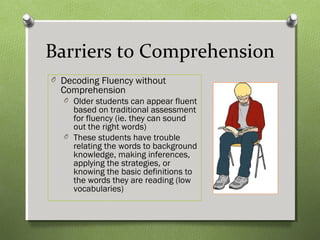
Barriers to Comprehension
O Decoding Fluency without
Comprehension
O Older students can appear fluent
based on traditional assessment
for fluency (ie. they can sound
out the right words)
O These students have trouble
relating the words to background
knowledge, making inferences,
applying the strategies, or
knowing the basic definitions to
the words they are reading (low
vocabularies)
Reading Skills vs. Reading
Strategies
According to Olson:
Skill: unconscious ability
Strategy: deliberate effort
Good readers have good reading skills.
They are able to use strategies without
thinking about them.
Dependent or struggling readers need to
break the process down and be aware of the
strategies they should be using. They need
to practice until the strategies become skills.
O Meaning is not just a product of reading, it is
a process; it is dynamic. (Beers)
O Zwiers sees these strategies as habits that
students can learn to use regularly. Many
students already use a lot of these
strategies in their daily lives such as making
connection and inferences; they just need to
translate them to their academics.
How to Teach Strategies
O According to Tokuhama-Espinosa, the
brain learns through analyzing
information, self-reflection and self-
correction
O Frequent opportunities and suitable
lengths of time for practice, as well as
meaningful feedback, is essential
O A scaffolded process is used to
gradually release readers into reading
and applying strategies independently
O Scaffolded Process:
O Teacher Models Strategy (see Mini-
Lessons)
O Guided practice (large or small
groups; pairs)
O Independent Practice
O Mini-Lessons (5-15 minutes)
O Introduce or refresh strategies
O Think Aloud and Read Aloud work
well
O “Think Aloud Mini-Lesson” Appendix
2 (p. 40)– OLC Course Profile online
Pre-, During, and Post-
Reading
O Students need multiple strategies in order to have
a selection from which to choose in different
reading situations
O They also need strategies for pre-reading, during
reading and post-reading (See “Additional Reading
Strategies” Sinclair Strategies PDF; or, “Reading
Approaches 1 and 2” Appendix 12 (p. 50)– OLC
Course Profile online)
O This enables the reader to be prepared, engaged,
and able to reflect
Making Connections
O Making connections helps facilitate learning
(Tokuhama-Espinosa) and increase retention
O It also enables the reader to make inferences by
using their background information to see patterns
and make educated guesses about the text
O It is helpful for a reader to track his or her thoughts
while readings. Using sticky notes or a graphic
organizer is a good example.
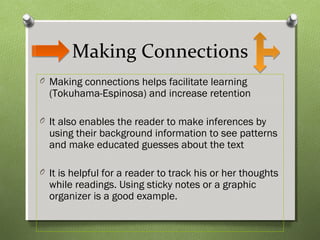
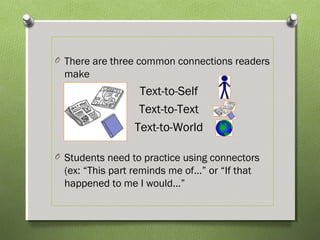
O There are three common connections readers
make
Text-to-Self
Text-to-Text
Text-to-World
O Students need to practice using connectors
(ex: “This part reminds me of…” or “If that
happened to me I would…”
Making Connections
Resources
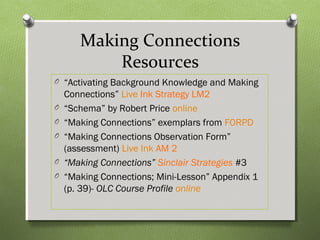
O “Activating Background Knowledge and Making
Connections” Live Ink Strategy LM2
O “Schema” by Robert Price online
O “Making Connections” exemplars from FORPD
O “Making Connections Observation Form”
(assessment) Live Ink AM 2
O “Making Connections” Sinclair Strategies #3
O “Making Connections; Mini-Lesson” Appendix 1
(p. 39)- OLC Course Profile online
Common Comprehension
Strategies
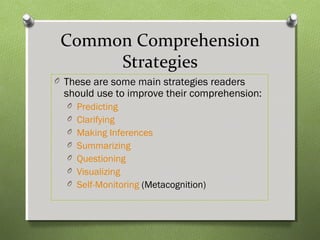
O These are some main strategies readers
should use to improve their comprehension:
O Predicting
O Clarifying
O Making Inferences
O Summarizing
O Questioning
O Visualizing
O Self-Monitoring (Metacognition)
Predicting
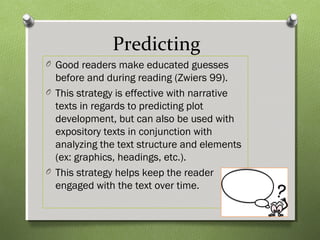
O Good readers make educated guesses
before and during reading (Zwiers 99).
O This strategy is effective with narrative
texts in regards to predicting plot
development, but can also be used with
expository texts in conjunction with
analyzing the text structure and elements
(ex: graphics, headings, etc.).
O This strategy helps keep the reader
engaged with the text over time.
Predicting Resources
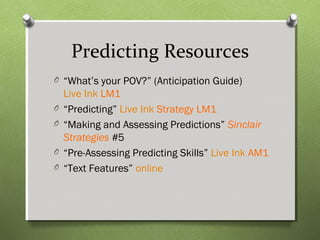
O “What’s your POV?” (Anticipation Guide)
Live Ink LM1
O “Predicting” Live Ink Strategy LM1
O “Making and Assessing Predictions” Sinclair
Strategies #5
O “Pre-Assessing Predicting Skills” Live Ink AM1
O “Text Features” online
Clarifying
O Students need to learn how to construct word
meanings through context and knowledge of
word structures.
O There are often clues in the text that can
helps students identify the meaning of a word
such as a synonym or antonym, a cause and
effect relationship, or even an explanation.
O Sometimes a reader can use clues from much
earlier in the text, or from graphics near the
word, or even from the word’s grammatical
role (Zwiers 140-5).
Clarifying Resources
O Word Wall online
O “Word Wall” Sinclair Strategies #1
O “Meaning from Context” Sinclair Strategies #2
O “Word Attack Strategies” Sinclair Strategies #7
O “Cloze Passages” Appendix 4 (p.42) - OLC Course
Profile online
Making Inferences
O Making inferences is a process of
extending the information from the text
with the reader’s own experience to
create meaning beyond what is explicitly
stated in the text (Zwiers 99).
O This strategy includes being able to make
generalizations or drawing conclusions
not explicitly stated (Beers 41).
Making Inferences Resources
O “Inferring” Live Ink Strategy LM5
O “Guidelines for Teacher-Selected Reading”
Appendix 11 (p.49)– OLC Course Profile
online
O “Making Inferences” and “Drawing
Conclusions” Scholastic Graphic Organizers
online
Summarizing
O According to Zwiers, summarizing is
the process of reducing a section of
text to a smaller chunk of important
information (31).
O This involves deleting unnecessary
and redundant information,
simplifying long lists or generalizing
specifics, and developing a main
idea (Wendling 110)
Summarizing Resources
O “Analyzing” Live Ink Strategy LM 6
O “Summarizing” Live Ink Strategy LM 7
O “Synthesizing” Live Ink Strategy LM 8
O “Paraphrasing” Appendix 5 (p.43) – OLC
Course Profile online
O “Summarizing” Scholastic Graphic
Organizers online
Questioning
O Students asking and generating their
own questions about a text has been
proven to improve their
understanding of a text (Wendling
110).
O It increases their personal investment
in the text and in finding the answers
for those questions (Zwiers 122).
O Open-ended questions lead to deeper
thinking and better retention of
information.
Questioning Resources
O “Asking Questions” (3 levels of questions
organizer) Live Ink Strategy LM3
O “Interpretive Questioning” or “Powerful
Questions” by Robert Price online
Visualizing
O The benefit of readers visualizing what they are
reading is that it promotes active engagement
and deep thinking (Wendling 108).
O The mental organization involved in visualization
helps the reader retain the information (Zwiers
68).
O Visualization can be as simple as imagining the
text as images, or as complex as creating visuals
(drawings, models, etc.) to represent what is
read.
Visualizing Resources
O “Creating Visuals for a Purpose” Live Ink LM9
O “Visualizing” Live Ink Strategy LM3
O “Reading Graphic Text” Sinclair Strategies #6
O “Opening the Door: Teaching Students to Use
Visualization to Improve Comprehension” online
Self-Monitoring
O Students need to be taught explicitly how to
monitor themselves while they are reading
(Wendling 111).
O Many struggling readers will either skip over
sections when they are confused, or give up
altogether.
O They need to learn to recognize when they are
struggling, apply an appropriate strategy and
evaluate its effectiveness.
O They also need to monitor and control their
attention to the text, commitment, attitude and
motivation (Zwiers 173).
Self-Monitoring Resources
O “Synthesizing” Live Ink Strategy LM 8
O “Peer Assessment – Analyzing Text” Live Ink AM 3
O “Assessing Reading Strategies” (self-assessment)
Live Ink AM 4
O “Affect and Literacy” Sinclair Strategies # 4
O “Metacognition” Sinclair Strategies #8
O “Reading Conferences” Appendix 7 (p.45) – OLC
Course Profile online
Bibliography
Allen, Janet. The Yellow Brick Road. Portland: Stenhouse Publishers, 2000.
Beers, Kylene. When Kids Can’t Read; What Teachers Can Do. Portsmouth:
Heinemann, 2003.
Cronsberry, Jennifer. Word Walls. Jennifer Cronsberry, 2004. Online:
http://curriculum.org/storage/108/1278503618wordwalls.pdf
“Graphic Organizers.” Scholastic Red, 2002. Online:
http://teacher.scholastic.com/reading/bestpractices/vocabulary/pdf/sr_allgo.pdf
Harvey, Stephanie and Anne Goodvis. Strategies that Work. Markham:
Pembroke Publishers Ltd., 2007.
Hanson, Susan and Jennifer F.M. Padua. Text Features. Honolulu: Pacific
Resources for Education and Learning, 2011. Online:
http://www.prel.org/media/176019/tf_eis.pdf
Independent Reading Strategies. Whitby: Sinclair Secondary School, 2011.
Marzano, Robert J. Building Background Knowledge for Academic
Achievement. Alexandria: Association for Supervision and Curriculum
Development, 2004.
Ontario Secondary School Literacy Course; Course Profile. Public and Catholic
District School Board Writing Partnerships, Queen’s Printer for
Ontario, 2003. Online:
http://resources.curriculum.org/csc/library/profiles/9/pdf/ENG1L.pdf
Olson, Carol Booth. The Reading/Writing Connection. Toronto: Pearson, 2011.
Moss, Barbara and Virginia S. Loh. 35 Strategies for Guiding Readers through
Informational Texts. New York: The Guildford Press, 2010.
“Opening the Door: Teaching Students to Use Visualization to Improve
Comprehension.” Education World, Inc., 2011. Online:
http://www.educationworld.com/a_curr/profdev/profdev094.shtml
Price, Robert. “Schema,” “Interpretive Questioning” and “Powerful
Questions.” Robert Price, 2007. Online: http://www.eggplant.org/
Sara, Amanda. The Literacy Toolkit. Bethel, CT: Crown House Publishing Ltd., 2009.
Tokuhama-Espinosa, Tracey. Mind, Brain, And Education Science. New York: W.W.
Norton and Company, 2011.
Wendling, Barbara J. and Nancy Mather. Essentials of Evidence-Based
Academic Interventions. New Jersey: Wiley, 2009.
Zwiers, Jeff. Building Reading Comprehension Habits in Grades 6-12. Newark:
International Reading Association, Inc., 2010.
Live Ink Note
O Live Ink is a resource purchased by school
license. There are some hard copies
available at select schools (Sinclair S.S. or
Anderson C.V.I.) Contact an administrator in
regards to obtaining online access.
O For further information or to login go online:
http://www.liveinkonline.ca/

Building comprehension strategies with students

  • 1.
    Building Comprehension Strategies with Students Created byKatie Soble Contact: Soble_Kathleen@durham.edu.on.ca
  • 2.
    Topic Slide # Reading, Decodingand Comprehension 3-5 Barriers to Comprehension 6-8 Reading Skills vs. Strategies 9-10 How to Teach Strategies 11-12 Pre-, During, and Post-Reading 13 Making Connections 14-16 Common Comprehension Strategies and Resources 17 •Predicting 18-19 •Clarifying 20-21 •Making Inferences 22-23 •Summarizing 24-25 •Questioning 26-27 •Visualizing 28-29 •Self-Monitoring 30-31 •Bibliography 32-34
  • 3.
    Reading O Reading isa complex task which involves both decoding and comprehending the text O Good readers are able to do both of these without much thought or effort, and they use strategies to help them when one of these factors breaks down O Struggling or dependent readers need help to learn how to identify when they are struggling and what to do about it
  • 4.
    Decoding O The abilityto recognize letters and sound out words O Letters represent words: S+CH+OO+L = “SCHOOL”
  • 5.
    Comprehension O Durkin’s definition:“intentional thinking during which meaning is constructed through interactions between text and reader” (1993) O Comprehension is the dialogue between the reader and the text O Meaning is created by the reader connecting the text to his or her background knowledge
  • 6.
    Barriers to Comprehension O Decodingis a significant factor in successful comprehension O Particular problem for disadvantaged children who lack the opportunities to build background knowledge, access to resources and are exposed to a fraction of words in relation to other children O Words are labels to “packets” of information (Marzano); therefore, the more words a child has, the more knowledge they possess
  • 7.
    Barriers to Comprehension O Dependence ODependent readers rely on teachers to provide the “correct” interpretation or information about a text O Passive Readers do not monitor their own reading abilities or actively engage in the reading process O “Metacognitive Atrophy” (Zwiers) O Students experience this when they do not know they are struggling or how to address it
  • 8.
    Barriers to Comprehension ODecoding Fluency without Comprehension O Older students can appear fluent based on traditional assessment for fluency (ie. they can sound out the right words) O These students have trouble relating the words to background knowledge, making inferences, applying the strategies, or knowing the basic definitions to the words they are reading (low vocabularies)
  • 9.
    Reading Skills vs.Reading Strategies According to Olson: Skill: unconscious ability Strategy: deliberate effort Good readers have good reading skills. They are able to use strategies without thinking about them. Dependent or struggling readers need to break the process down and be aware of the strategies they should be using. They need to practice until the strategies become skills.
  • 10.
    O Meaning isnot just a product of reading, it is a process; it is dynamic. (Beers) O Zwiers sees these strategies as habits that students can learn to use regularly. Many students already use a lot of these strategies in their daily lives such as making connection and inferences; they just need to translate them to their academics.
  • 11.
    How to TeachStrategies O According to Tokuhama-Espinosa, the brain learns through analyzing information, self-reflection and self- correction O Frequent opportunities and suitable lengths of time for practice, as well as meaningful feedback, is essential
  • 12.
    O A scaffoldedprocess is used to gradually release readers into reading and applying strategies independently O Scaffolded Process: O Teacher Models Strategy (see Mini- Lessons) O Guided practice (large or small groups; pairs) O Independent Practice O Mini-Lessons (5-15 minutes) O Introduce or refresh strategies O Think Aloud and Read Aloud work well O “Think Aloud Mini-Lesson” Appendix 2 (p. 40)– OLC Course Profile online
  • 13.
    Pre-, During, andPost- Reading O Students need multiple strategies in order to have a selection from which to choose in different reading situations O They also need strategies for pre-reading, during reading and post-reading (See “Additional Reading Strategies” Sinclair Strategies PDF; or, “Reading Approaches 1 and 2” Appendix 12 (p. 50)– OLC Course Profile online) O This enables the reader to be prepared, engaged, and able to reflect
  • 14.
    Making Connections O Makingconnections helps facilitate learning (Tokuhama-Espinosa) and increase retention O It also enables the reader to make inferences by using their background information to see patterns and make educated guesses about the text O It is helpful for a reader to track his or her thoughts while readings. Using sticky notes or a graphic organizer is a good example.
  • 15.
    O There arethree common connections readers make Text-to-Self Text-to-Text Text-to-World O Students need to practice using connectors (ex: “This part reminds me of…” or “If that happened to me I would…”
  • 16.
    Making Connections Resources O “ActivatingBackground Knowledge and Making Connections” Live Ink Strategy LM2 O “Schema” by Robert Price online O “Making Connections” exemplars from FORPD O “Making Connections Observation Form” (assessment) Live Ink AM 2 O “Making Connections” Sinclair Strategies #3 O “Making Connections; Mini-Lesson” Appendix 1 (p. 39)- OLC Course Profile online
  • 17.
    Common Comprehension Strategies O Theseare some main strategies readers should use to improve their comprehension: O Predicting O Clarifying O Making Inferences O Summarizing O Questioning O Visualizing O Self-Monitoring (Metacognition)
  • 18.
    Predicting O Good readersmake educated guesses before and during reading (Zwiers 99). O This strategy is effective with narrative texts in regards to predicting plot development, but can also be used with expository texts in conjunction with analyzing the text structure and elements (ex: graphics, headings, etc.). O This strategy helps keep the reader engaged with the text over time.
  • 19.
    Predicting Resources O “What’syour POV?” (Anticipation Guide) Live Ink LM1 O “Predicting” Live Ink Strategy LM1 O “Making and Assessing Predictions” Sinclair Strategies #5 O “Pre-Assessing Predicting Skills” Live Ink AM1 O “Text Features” online
  • 20.
    Clarifying O Students needto learn how to construct word meanings through context and knowledge of word structures. O There are often clues in the text that can helps students identify the meaning of a word such as a synonym or antonym, a cause and effect relationship, or even an explanation. O Sometimes a reader can use clues from much earlier in the text, or from graphics near the word, or even from the word’s grammatical role (Zwiers 140-5).
  • 21.
    Clarifying Resources O WordWall online O “Word Wall” Sinclair Strategies #1 O “Meaning from Context” Sinclair Strategies #2 O “Word Attack Strategies” Sinclair Strategies #7 O “Cloze Passages” Appendix 4 (p.42) - OLC Course Profile online
  • 22.
    Making Inferences O Makinginferences is a process of extending the information from the text with the reader’s own experience to create meaning beyond what is explicitly stated in the text (Zwiers 99). O This strategy includes being able to make generalizations or drawing conclusions not explicitly stated (Beers 41).
  • 23.
    Making Inferences Resources O“Inferring” Live Ink Strategy LM5 O “Guidelines for Teacher-Selected Reading” Appendix 11 (p.49)– OLC Course Profile online O “Making Inferences” and “Drawing Conclusions” Scholastic Graphic Organizers online
  • 24.
    Summarizing O According toZwiers, summarizing is the process of reducing a section of text to a smaller chunk of important information (31). O This involves deleting unnecessary and redundant information, simplifying long lists or generalizing specifics, and developing a main idea (Wendling 110)
  • 25.
    Summarizing Resources O “Analyzing”Live Ink Strategy LM 6 O “Summarizing” Live Ink Strategy LM 7 O “Synthesizing” Live Ink Strategy LM 8 O “Paraphrasing” Appendix 5 (p.43) – OLC Course Profile online O “Summarizing” Scholastic Graphic Organizers online
  • 26.
    Questioning O Students askingand generating their own questions about a text has been proven to improve their understanding of a text (Wendling 110). O It increases their personal investment in the text and in finding the answers for those questions (Zwiers 122). O Open-ended questions lead to deeper thinking and better retention of information.
  • 27.
    Questioning Resources O “AskingQuestions” (3 levels of questions organizer) Live Ink Strategy LM3 O “Interpretive Questioning” or “Powerful Questions” by Robert Price online
  • 28.
    Visualizing O The benefitof readers visualizing what they are reading is that it promotes active engagement and deep thinking (Wendling 108). O The mental organization involved in visualization helps the reader retain the information (Zwiers 68). O Visualization can be as simple as imagining the text as images, or as complex as creating visuals (drawings, models, etc.) to represent what is read.
  • 29.
    Visualizing Resources O “CreatingVisuals for a Purpose” Live Ink LM9 O “Visualizing” Live Ink Strategy LM3 O “Reading Graphic Text” Sinclair Strategies #6 O “Opening the Door: Teaching Students to Use Visualization to Improve Comprehension” online
  • 30.
    Self-Monitoring O Students needto be taught explicitly how to monitor themselves while they are reading (Wendling 111). O Many struggling readers will either skip over sections when they are confused, or give up altogether. O They need to learn to recognize when they are struggling, apply an appropriate strategy and evaluate its effectiveness. O They also need to monitor and control their attention to the text, commitment, attitude and motivation (Zwiers 173).
  • 31.
    Self-Monitoring Resources O “Synthesizing”Live Ink Strategy LM 8 O “Peer Assessment – Analyzing Text” Live Ink AM 3 O “Assessing Reading Strategies” (self-assessment) Live Ink AM 4 O “Affect and Literacy” Sinclair Strategies # 4 O “Metacognition” Sinclair Strategies #8 O “Reading Conferences” Appendix 7 (p.45) – OLC Course Profile online
  • 32.
    Bibliography Allen, Janet. TheYellow Brick Road. Portland: Stenhouse Publishers, 2000. Beers, Kylene. When Kids Can’t Read; What Teachers Can Do. Portsmouth: Heinemann, 2003. Cronsberry, Jennifer. Word Walls. Jennifer Cronsberry, 2004. Online: http://curriculum.org/storage/108/1278503618wordwalls.pdf “Graphic Organizers.” Scholastic Red, 2002. Online: http://teacher.scholastic.com/reading/bestpractices/vocabulary/pdf/sr_allgo.pdf Harvey, Stephanie and Anne Goodvis. Strategies that Work. Markham: Pembroke Publishers Ltd., 2007. Hanson, Susan and Jennifer F.M. Padua. Text Features. Honolulu: Pacific Resources for Education and Learning, 2011. Online: http://www.prel.org/media/176019/tf_eis.pdf
  • 33.
    Independent Reading Strategies.Whitby: Sinclair Secondary School, 2011. Marzano, Robert J. Building Background Knowledge for Academic Achievement. Alexandria: Association for Supervision and Curriculum Development, 2004. Ontario Secondary School Literacy Course; Course Profile. Public and Catholic District School Board Writing Partnerships, Queen’s Printer for Ontario, 2003. Online: http://resources.curriculum.org/csc/library/profiles/9/pdf/ENG1L.pdf Olson, Carol Booth. The Reading/Writing Connection. Toronto: Pearson, 2011. Moss, Barbara and Virginia S. Loh. 35 Strategies for Guiding Readers through Informational Texts. New York: The Guildford Press, 2010.
  • 34.
    “Opening the Door:Teaching Students to Use Visualization to Improve Comprehension.” Education World, Inc., 2011. Online: http://www.educationworld.com/a_curr/profdev/profdev094.shtml Price, Robert. “Schema,” “Interpretive Questioning” and “Powerful Questions.” Robert Price, 2007. Online: http://www.eggplant.org/ Sara, Amanda. The Literacy Toolkit. Bethel, CT: Crown House Publishing Ltd., 2009. Tokuhama-Espinosa, Tracey. Mind, Brain, And Education Science. New York: W.W. Norton and Company, 2011. Wendling, Barbara J. and Nancy Mather. Essentials of Evidence-Based Academic Interventions. New Jersey: Wiley, 2009. Zwiers, Jeff. Building Reading Comprehension Habits in Grades 6-12. Newark: International Reading Association, Inc., 2010.
  • 35.
    Live Ink Note OLive Ink is a resource purchased by school license. There are some hard copies available at select schools (Sinclair S.S. or Anderson C.V.I.) Contact an administrator in regards to obtaining online access. O For further information or to login go online: http://www.liveinkonline.ca/