Teacher views on educational
robotics and its introduction to the
compulsory curricula
Despoina Schina, Mireia Usart, Vanessa Esteve-Gonzalez & Mercè Gisbert
(despoina.schina@urv.cat , mireia.usart@urv.cat , vanessa.esteve@urv.cat & merce.gisbert@urv.cat)
CSEDU 2020: 12th International Conference on Computer Supported Education, May 2-4, 2020
Applied Research Group in
Education and Technology
Marie Skłodowska
Curie No. 713679
1. Introduction
2. Theoretical Framework
3. Research Questions
4. Context & Sample
5. Methodology
6. Results
7. Conclusions
8. Future Research
Contents
1. Introduction
2. Theoretical Framework
Teachers’ perceptions
• (Khanlari and Kiaie, 2015)
• (Sisman, Kucuk and An, 2019)
ER integration into the curriculum
• (Scaradozzi, Screpanti and Cesaretti, 2019)
• (Alimisis, 2013)
ER integration in Spain
• (Pittí, Moreno, Curto and Rodriguez, 2013)
• (Pina and Rubio, 2017)
3. Research Questions
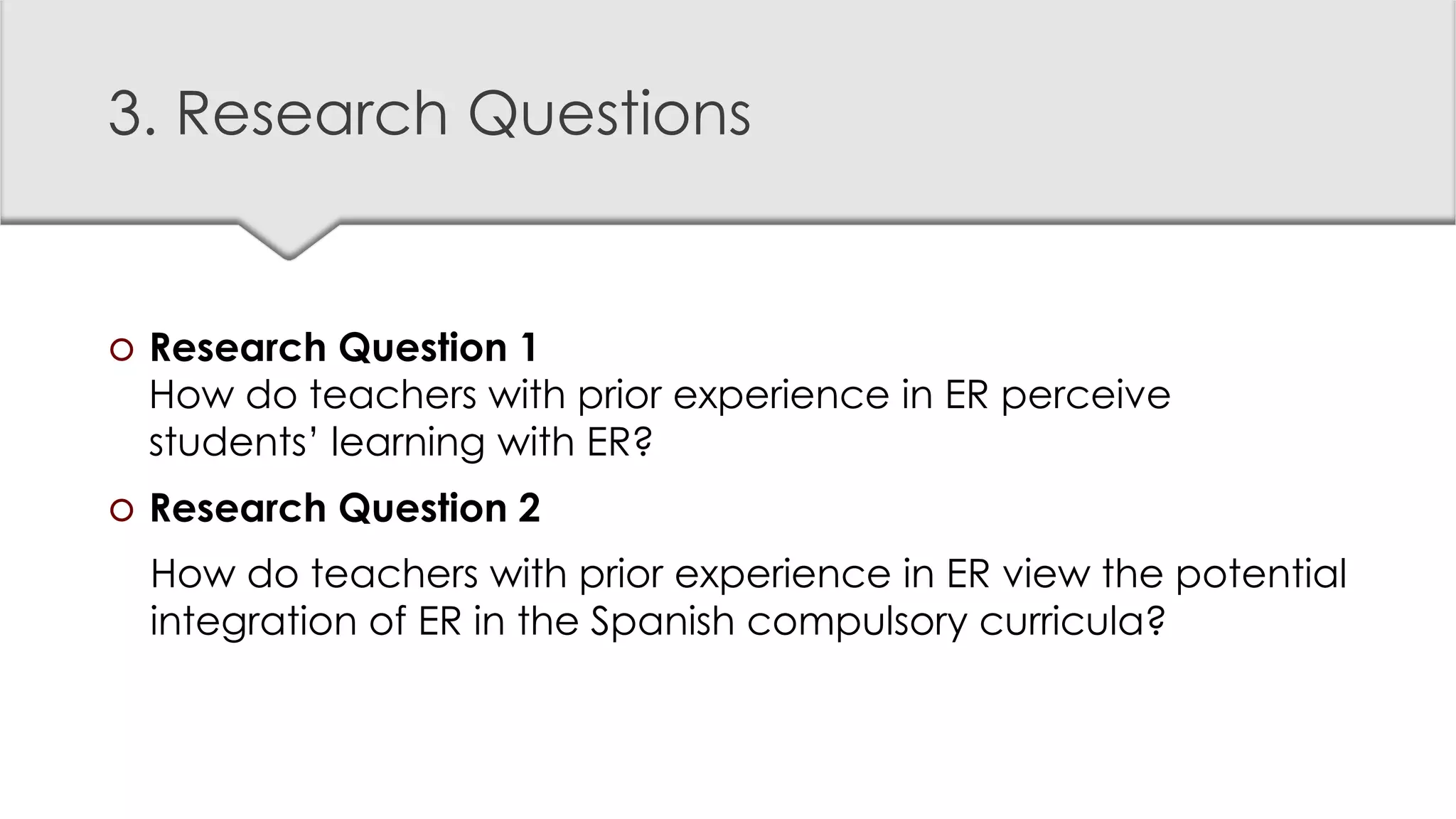
 Research Question 1
How do teachers with prior experience in ER perceive
students’ learning with ER?
 Research Question 2
How do teachers with prior experience in ER view the potential
integration of ER in the Spanish compulsory curricula?
4. Context & Sample
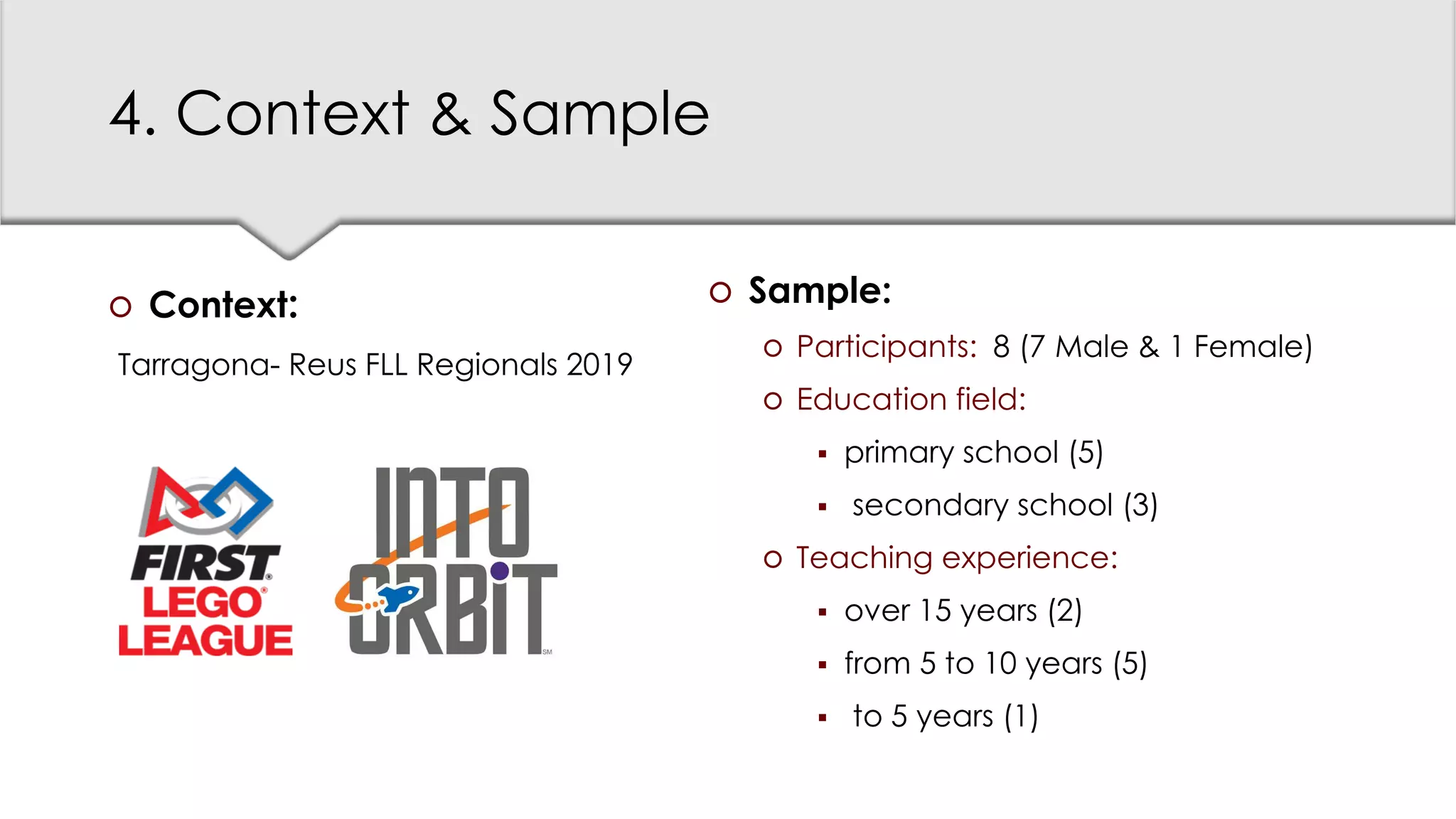
 Context:
Tarragona- Reus FLL Regionals 2019
 Sample:
 Participants: 8 (7 Male & 1 Female)
 Education field:
▪ primary school (5)
▪ secondary school (3)
 Teaching experience:
▪ over 15 years (2)
▪ from 5 to 10 years (5)
▪ to 5 years (1)
5. Methodology
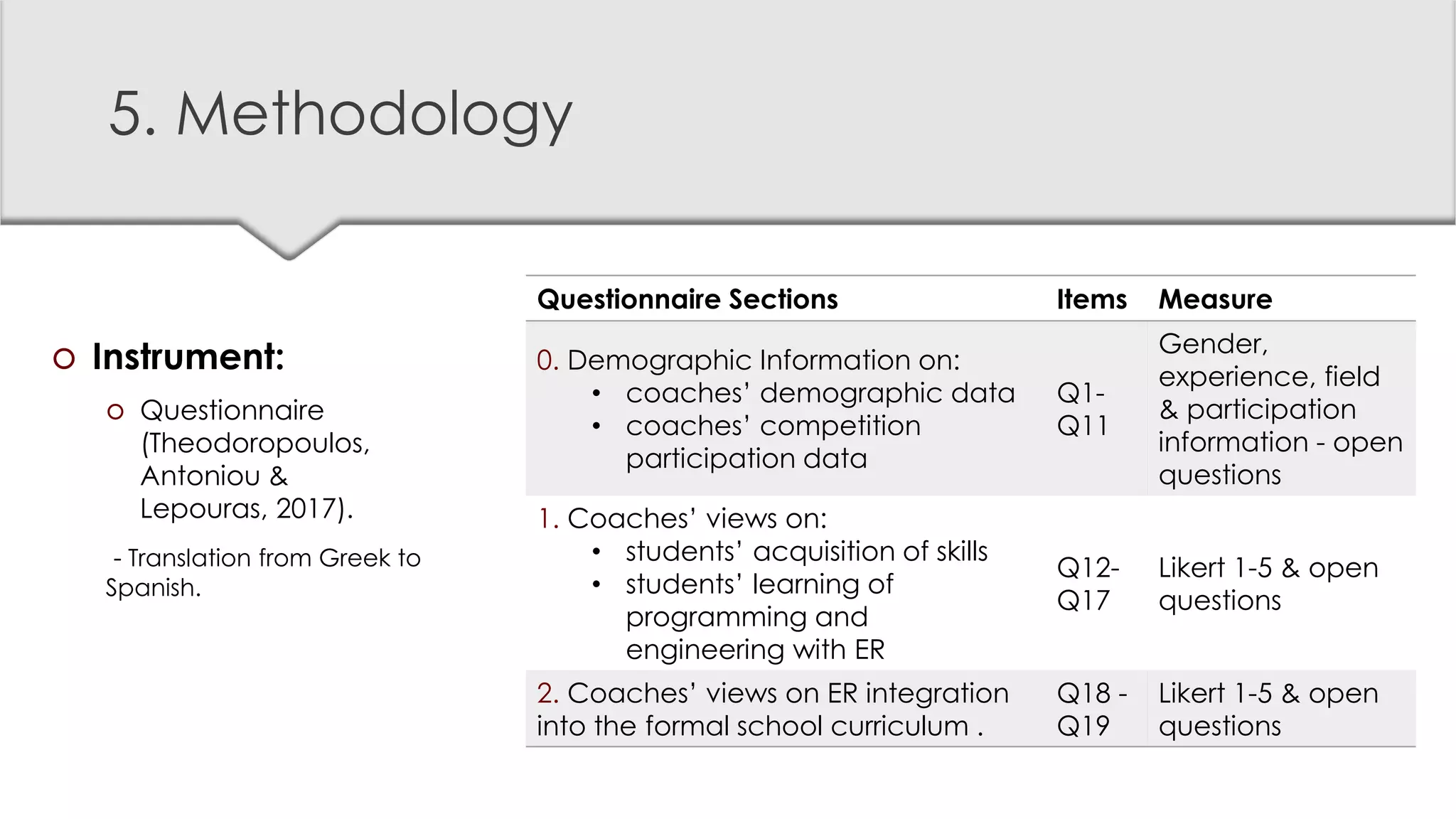
Questionnaire Sections Items Measure
0. Demographic Information on:
• coaches’ demographic data
• coaches’ competition
participation data
Q1-
Q11
Gender,
experience, field
& participation
information - open
questions
1. Coaches’ views on:
• students’ acquisition of skills
• students’ learning of
programming and
engineering with ER
Q12-
Q17
Likert 1-5 & open
questions
2. Coaches’ views on ER integration
into the formal school curriculum .
Q18 -
Q19
Likert 1-5 & open
questions
 Instrument:
 Questionnaire
(Theodoropoulos,
Antoniou &
Lepouras, 2017).
- Translation from Greek to
Spanish.
6. Results
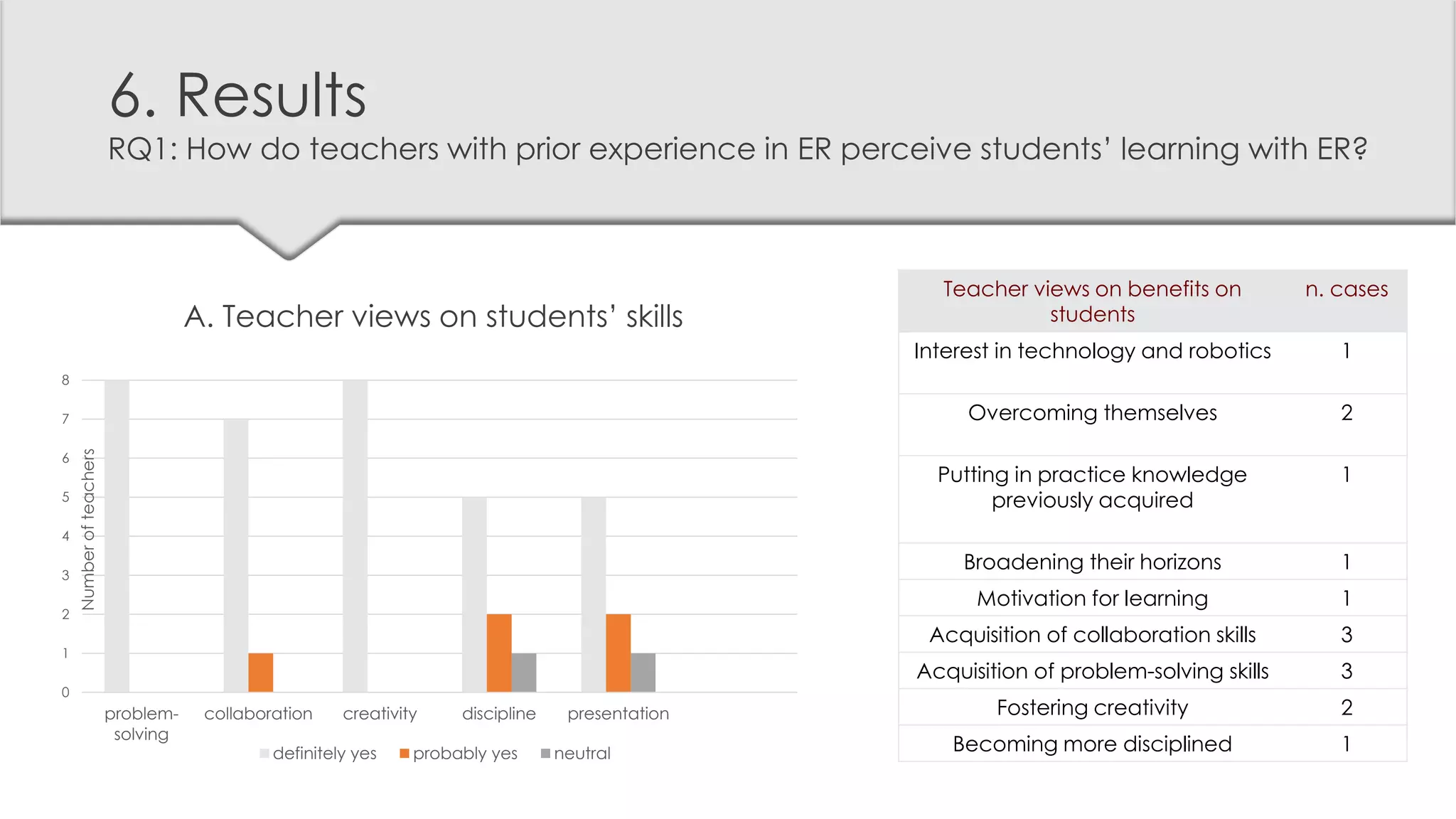
RQ1: How do teachers with prior experience in ER perceive students’ learning with ER?
A. Teacher views on students’ skills
0
1
2
3
4
5
6
7
8
problem-
solving
collaboration creativity discipline presentation
Numberofteachers
definitely yes probably yes neutral
Teacher views on benefits on
students
n. cases
Interest in technology and robotics 1
Overcoming themselves 2
Putting in practice knowledge
previously acquired
1
Broadening their horizons 1
Motivation for learning 1
Acquisition of collaboration skills 3
Acquisition of problem-solving skills 3
Fostering creativity 2
Becoming more disciplined 1
6. Results
RQ1: How do teachers with prior experience in ER perceive students’ learning with ER?
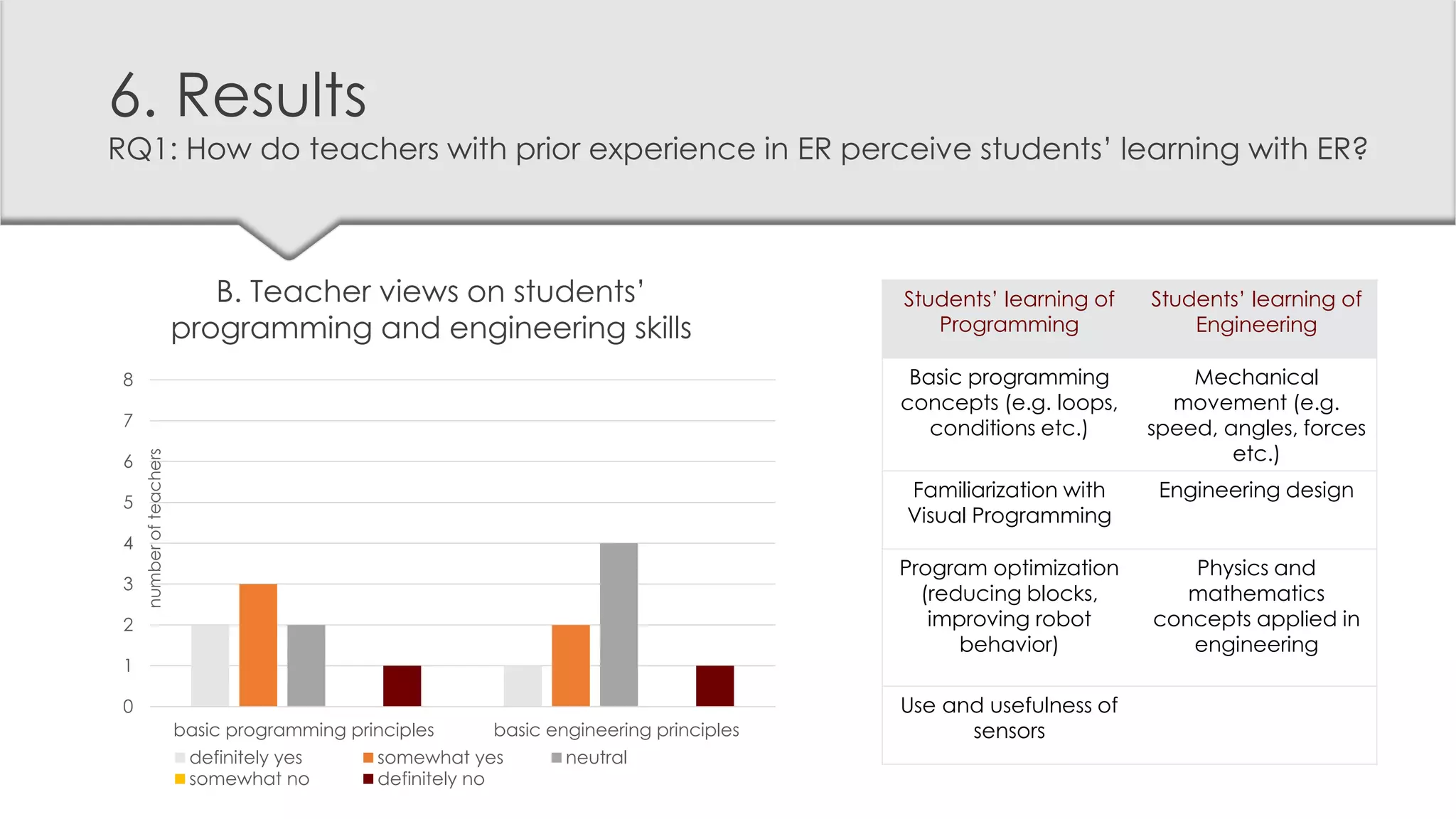
B. Teacher views on students’
programming and engineering skills
0
1
2
3
4
5
6
7
8
basic programming principles basic engineering principles
numberofteachers
definitely yes somewhat yes neutral
somewhat no definitely no
Students’ learning of
Programming
Students’ learning of
Engineering
Basic programming
concepts (e.g. loops,
conditions etc.)
Mechanical
movement (e.g.
speed, angles, forces
etc.)
Familiarization with
Visual Programming
Engineering design
Program optimization
(reducing blocks,
improving robot
behavior)
Physics and
mathematics
concepts applied in
engineering
Use and usefulness of
sensors
6. Results
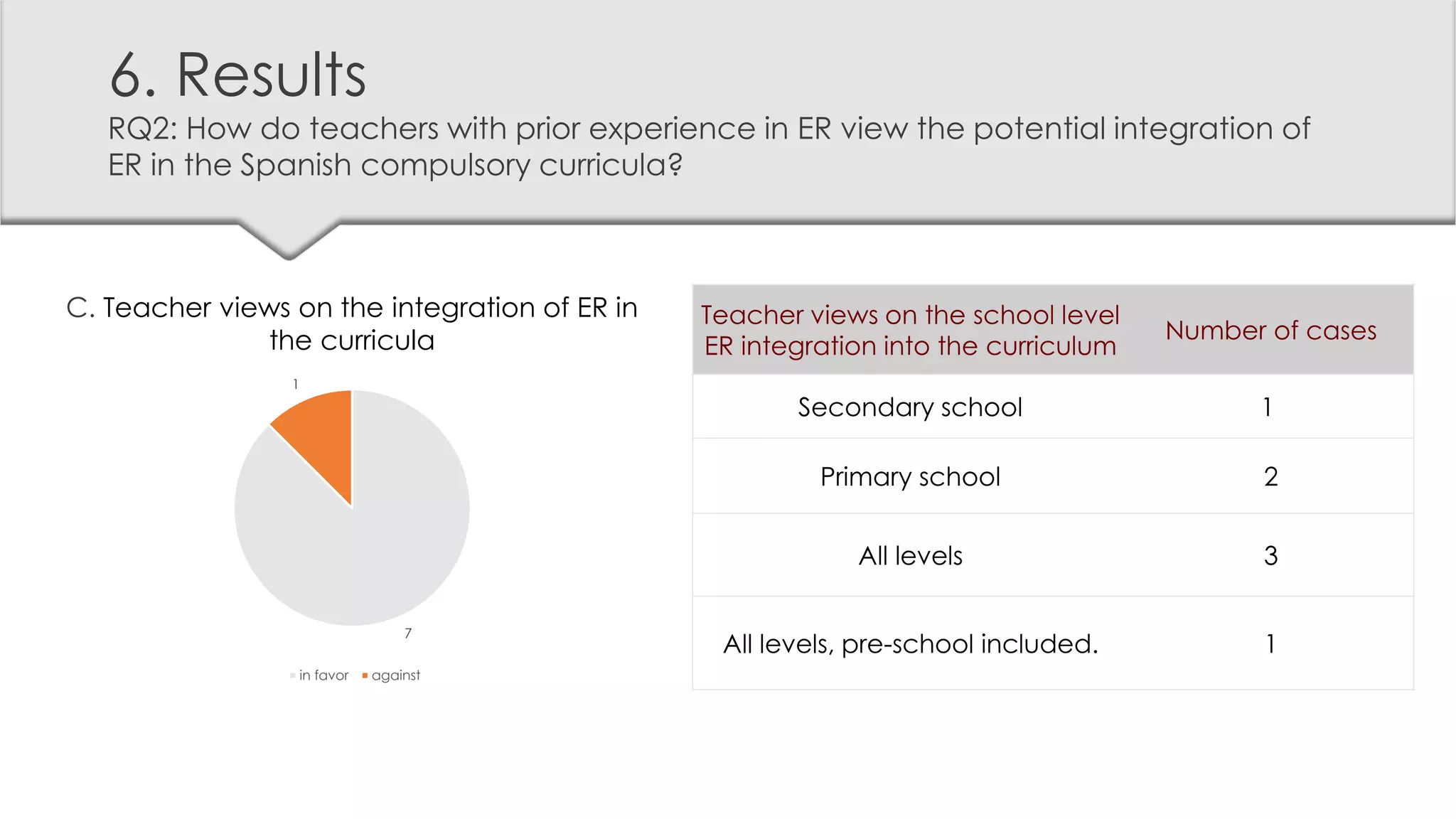
RQ2: How do teachers with prior experience in ER view the potential integration of
ER in the Spanish compulsory curricula?
Teacher views on the school level
ER integration into the curriculum
Number of cases
Secondary school 1
Primary school 2
All levels 3
All levels, pre-school included. 1
7
1
in favor against
C. Teacher views on the integration of ER in
the curricula
7. Conclusions
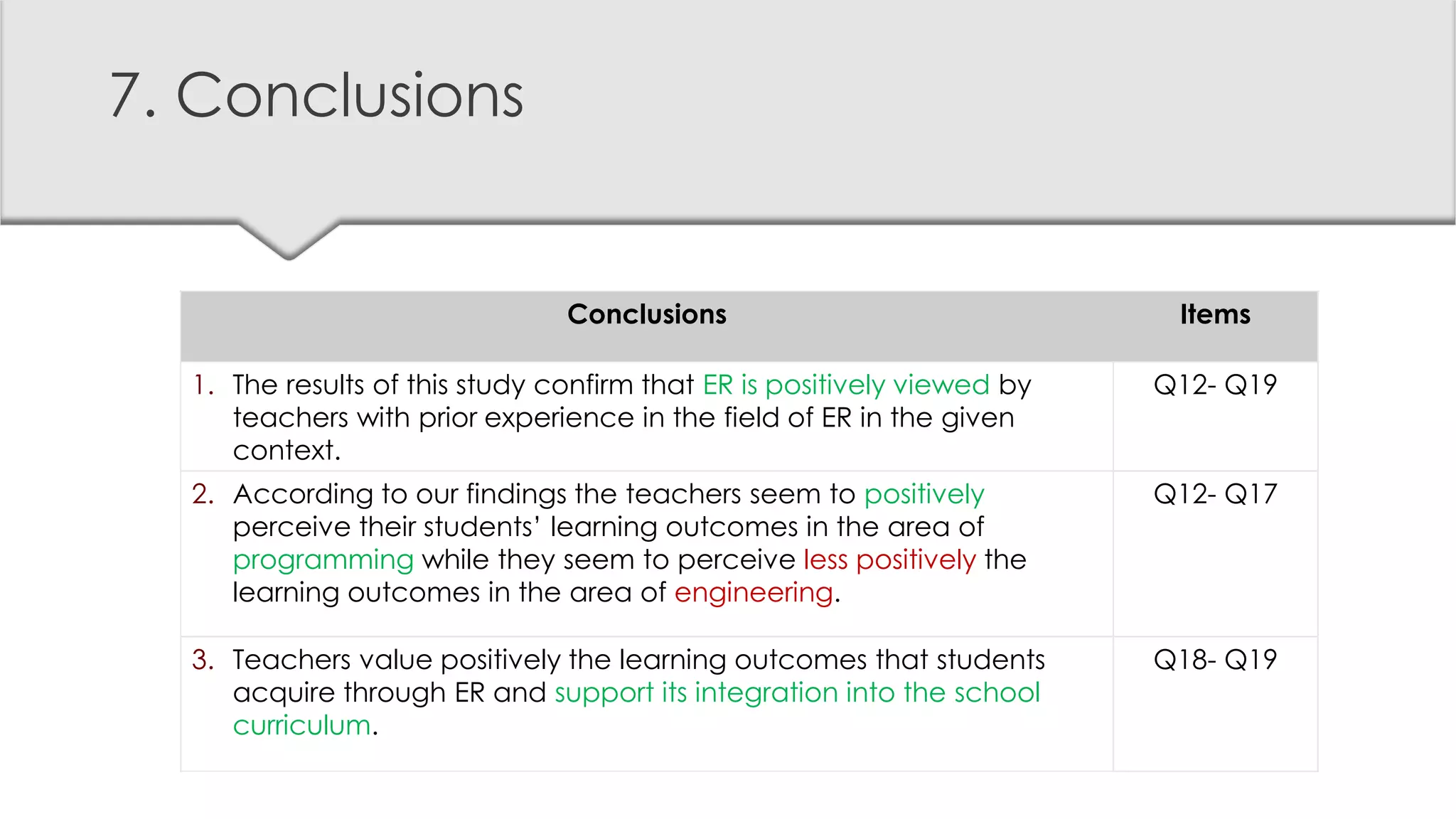
Conclusions Items
1. The results of this study confirm that ER is positively viewed by
teachers with prior experience in the field of ER in the given
context.
Q12- Q19
2. According to our findings the teachers seem to positively
perceive their students’ learning outcomes in the area of
programming while they seem to perceive less positively the
learning outcomes in the area of engineering.
Q12- Q17
3. Teachers value positively the learning outcomes that students
acquire through ER and support its integration into the school
curriculum.
Q18- Q19
8. Future Research
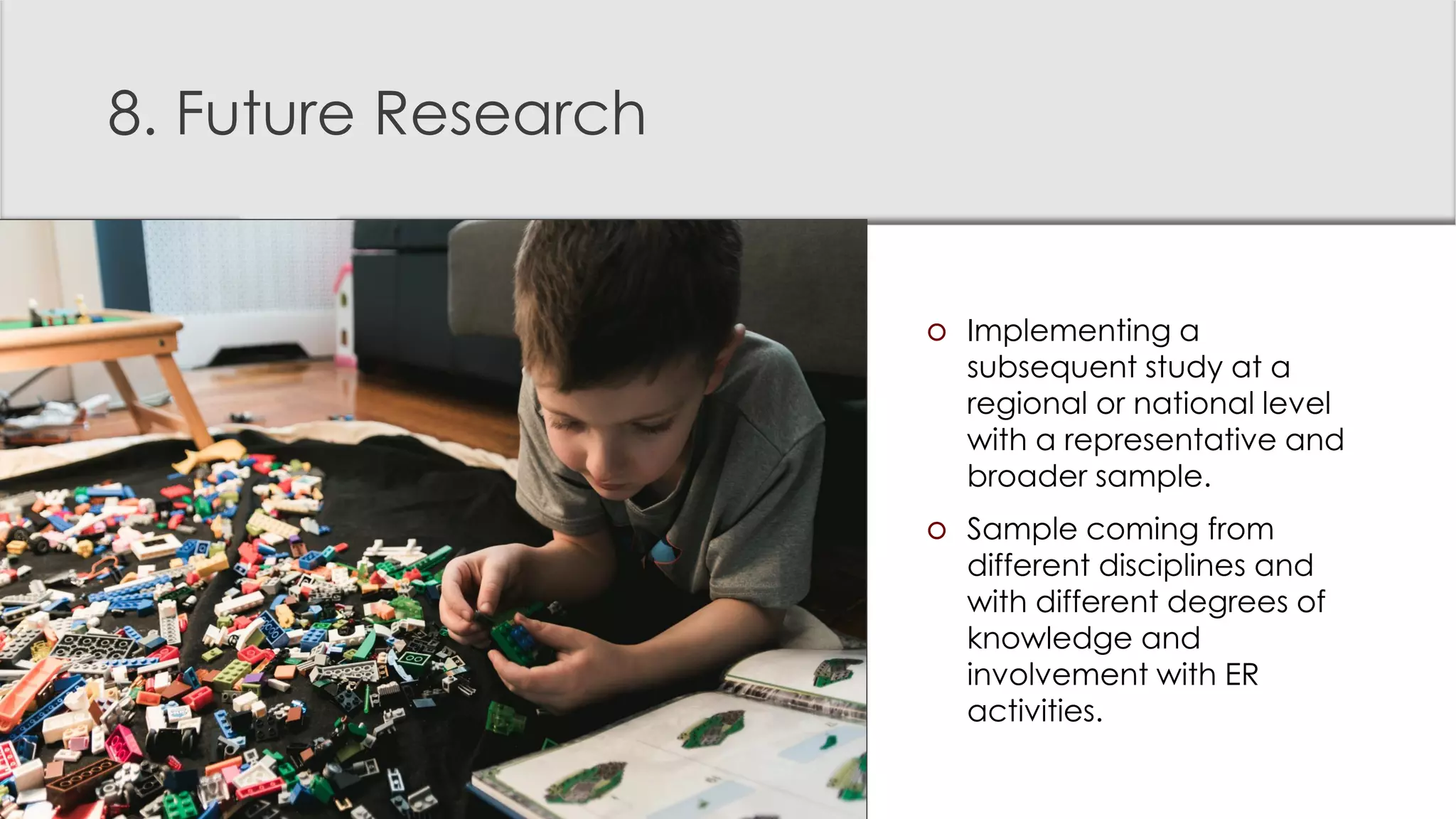
 Implementing a
subsequent study at a
regional or national level
with a representative and
broader sample.
 Sample coming from
different disciplines and
with different degrees of
knowledge and
involvement with ER
activities.
References
Alimisis, D., 2013. Educational robotics: Open questions and new challenges, Themes in Science & Technology Education, 6(1), pp.
63–71. doi: 10.1109/FIE.2014.7044055.
Khanlari, A., Kiaie, F. M., 2015. Using robotics for STEM education in primary/elementary schools: Teachers’ perceptions, In 10th
International Conference on Computer Science and Education, ICCSE 2015. IEEE, pp. 3–7. doi:
10.1109/ICCSE.2015.7250208.
Pina, A., Rubio, G., 2017. Using educational robotics with primary level students (6-12 years old) in different scholar scenarios:
Learned lessons, In CSEDU 2017 - Proceedings of the 9th International Conference on Computer Supported Education, pp.
196–208. doi: 10.5220/0006381501960208.
Pittí, K., Moreno, V., Curto, B., Rodriguez, J., 2013. Resources and Features of Robotics Learning Environments (RLEs) in Spain and
Latin America, In ACM International Conference Proceeding Series, pp. 315–322. doi: 10.1145/2536536.2536584.
Scaradozzi, D., Screpanti, L., Cesaretti, L., 2019. Towards a Definition of Educational Robotics: A Classification of Tools, Experiences
and Assessments, Smart Learning with Educational Robotics, doi: 10.1007/978-3-030-19913-5.
Sisman, B., Kucuk, S., An, S., 2019. Educational Robotics Course : Examination of Educational Potentials and Pre- service Teachers ’
Experiences, International Journal of Research in Education and Science (IJRES), 5(2), 510-531.
Theodoropoulos, A., Antoniou, A., Lepouras, G., 2017. Teacher and student views on educational robotics: The Pan-Hellenic
competition case, Application and Theory of Computer Technology, 2(4), p. 1. doi: 10.22496/atct.v2i4.94.
Teacher views on educational robotics and its introduction to the
compulsory curricula
Thank you
Despoina Schina, Mireia Usart, Vanessa Esteve-Gonzalez & Mercè Gisbert
(despoina.schina@urv.cat , mireia.usart@urv.cat , vanessa.esteve@urv.cat & merce.gisbert@urv.cat)
CSEDU 2020: 12th International Conference on Computer Supported Education, May 2-4, 2020
Applied Research Group in
Education and Technology
Marie Skłodowska
Curie No. 713679

Teacher views on educational robotics and its introduction to the compulsory curricula

  • 1.
    Teacher views oneducational robotics and its introduction to the compulsory curricula Despoina Schina, Mireia Usart, Vanessa Esteve-Gonzalez & Mercè Gisbert (despoina.schina@urv.cat , mireia.usart@urv.cat , vanessa.esteve@urv.cat & merce.gisbert@urv.cat) CSEDU 2020: 12th International Conference on Computer Supported Education, May 2-4, 2020 Applied Research Group in Education and Technology Marie Skłodowska Curie No. 713679
  • 2.
    1. Introduction 2. TheoreticalFramework 3. Research Questions 4. Context & Sample 5. Methodology 6. Results 7. Conclusions 8. Future Research Contents
  • 3.
  • 4.
    2. Theoretical Framework Teachers’perceptions • (Khanlari and Kiaie, 2015) • (Sisman, Kucuk and An, 2019) ER integration into the curriculum • (Scaradozzi, Screpanti and Cesaretti, 2019) • (Alimisis, 2013) ER integration in Spain • (Pittí, Moreno, Curto and Rodriguez, 2013) • (Pina and Rubio, 2017)
  • 5.
    3. Research Questions Research Question 1 How do teachers with prior experience in ER perceive students’ learning with ER?  Research Question 2 How do teachers with prior experience in ER view the potential integration of ER in the Spanish compulsory curricula?
  • 6.
    4. Context &Sample  Context: Tarragona- Reus FLL Regionals 2019  Sample:  Participants: 8 (7 Male & 1 Female)  Education field: ▪ primary school (5) ▪ secondary school (3)  Teaching experience: ▪ over 15 years (2) ▪ from 5 to 10 years (5) ▪ to 5 years (1)
  • 7.
    5. Methodology Questionnaire SectionsItems Measure 0. Demographic Information on: • coaches’ demographic data • coaches’ competition participation data Q1- Q11 Gender, experience, field & participation information - open questions 1. Coaches’ views on: • students’ acquisition of skills • students’ learning of programming and engineering with ER Q12- Q17 Likert 1-5 & open questions 2. Coaches’ views on ER integration into the formal school curriculum . Q18 - Q19 Likert 1-5 & open questions  Instrument:  Questionnaire (Theodoropoulos, Antoniou & Lepouras, 2017). - Translation from Greek to Spanish.
  • 8.
    6. Results RQ1: Howdo teachers with prior experience in ER perceive students’ learning with ER? A. Teacher views on students’ skills 0 1 2 3 4 5 6 7 8 problem- solving collaboration creativity discipline presentation Numberofteachers definitely yes probably yes neutral Teacher views on benefits on students n. cases Interest in technology and robotics 1 Overcoming themselves 2 Putting in practice knowledge previously acquired 1 Broadening their horizons 1 Motivation for learning 1 Acquisition of collaboration skills 3 Acquisition of problem-solving skills 3 Fostering creativity 2 Becoming more disciplined 1
  • 9.
    6. Results RQ1: Howdo teachers with prior experience in ER perceive students’ learning with ER? B. Teacher views on students’ programming and engineering skills 0 1 2 3 4 5 6 7 8 basic programming principles basic engineering principles numberofteachers definitely yes somewhat yes neutral somewhat no definitely no Students’ learning of Programming Students’ learning of Engineering Basic programming concepts (e.g. loops, conditions etc.) Mechanical movement (e.g. speed, angles, forces etc.) Familiarization with Visual Programming Engineering design Program optimization (reducing blocks, improving robot behavior) Physics and mathematics concepts applied in engineering Use and usefulness of sensors
  • 10.
    6. Results RQ2: Howdo teachers with prior experience in ER view the potential integration of ER in the Spanish compulsory curricula? Teacher views on the school level ER integration into the curriculum Number of cases Secondary school 1 Primary school 2 All levels 3 All levels, pre-school included. 1 7 1 in favor against C. Teacher views on the integration of ER in the curricula
  • 11.
    7. Conclusions Conclusions Items 1.The results of this study confirm that ER is positively viewed by teachers with prior experience in the field of ER in the given context. Q12- Q19 2. According to our findings the teachers seem to positively perceive their students’ learning outcomes in the area of programming while they seem to perceive less positively the learning outcomes in the area of engineering. Q12- Q17 3. Teachers value positively the learning outcomes that students acquire through ER and support its integration into the school curriculum. Q18- Q19
  • 12.
    8. Future Research Implementing a subsequent study at a regional or national level with a representative and broader sample.  Sample coming from different disciplines and with different degrees of knowledge and involvement with ER activities.
  • 13.
    References Alimisis, D., 2013.Educational robotics: Open questions and new challenges, Themes in Science & Technology Education, 6(1), pp. 63–71. doi: 10.1109/FIE.2014.7044055. Khanlari, A., Kiaie, F. M., 2015. Using robotics for STEM education in primary/elementary schools: Teachers’ perceptions, In 10th International Conference on Computer Science and Education, ICCSE 2015. IEEE, pp. 3–7. doi: 10.1109/ICCSE.2015.7250208. Pina, A., Rubio, G., 2017. Using educational robotics with primary level students (6-12 years old) in different scholar scenarios: Learned lessons, In CSEDU 2017 - Proceedings of the 9th International Conference on Computer Supported Education, pp. 196–208. doi: 10.5220/0006381501960208. Pittí, K., Moreno, V., Curto, B., Rodriguez, J., 2013. Resources and Features of Robotics Learning Environments (RLEs) in Spain and Latin America, In ACM International Conference Proceeding Series, pp. 315–322. doi: 10.1145/2536536.2536584. Scaradozzi, D., Screpanti, L., Cesaretti, L., 2019. Towards a Definition of Educational Robotics: A Classification of Tools, Experiences and Assessments, Smart Learning with Educational Robotics, doi: 10.1007/978-3-030-19913-5. Sisman, B., Kucuk, S., An, S., 2019. Educational Robotics Course : Examination of Educational Potentials and Pre- service Teachers ’ Experiences, International Journal of Research in Education and Science (IJRES), 5(2), 510-531. Theodoropoulos, A., Antoniou, A., Lepouras, G., 2017. Teacher and student views on educational robotics: The Pan-Hellenic competition case, Application and Theory of Computer Technology, 2(4), p. 1. doi: 10.22496/atct.v2i4.94.
  • 14.
    Teacher views oneducational robotics and its introduction to the compulsory curricula Thank you Despoina Schina, Mireia Usart, Vanessa Esteve-Gonzalez & Mercè Gisbert (despoina.schina@urv.cat , mireia.usart@urv.cat , vanessa.esteve@urv.cat & merce.gisbert@urv.cat) CSEDU 2020: 12th International Conference on Computer Supported Education, May 2-4, 2020 Applied Research Group in Education and Technology Marie Skłodowska Curie No. 713679