Co-funded by the Lifelong Learning programme of the European Union
[project ref: 543577-LLP-1-2013-1-UK-KA3-KA3MP]
The European Commission support for the production of this publication
does not constitute an endorsement of the contents which reflects the
views only of the authors, and the Commission cannot be held responsi-ble
for any use which may be made of the information contained therein.
Educational Robotics for students
with learning disabilities
• Robots can have a beneficial effect on the learning of children with
special needs
• Robots are predictable, engaging and can encourage experiential
learning, an approach that can increase the independence of
learners in terms of their ability to seek out and assimilate new
knowledge.
• No research on how teachers might incorporate robotics into their
teaching plans in order to meet their learners’ objectives
• This is the first project to look at this and in several European
countries
2
Background
Project Goals
EDUROB is a European funded project to help teachers introduce robotics
into special education by developing:
• a suite of learning scenarios that can be adapted and used by SEN
teachers to enhance lessons, teaching a range of core curriculum subjects.
• The EduRob Robot Controller app to initiate sets of pre-programmed
robot behaviours eg encouragement, instructions which can be fired
either using the robot's sensors, by inputs on the app.
• dedicated training material to guide teachers through the learning
scenarios that can impact on the specific learning targets for their
students
The consortium
• Nottingham Trent University Interactive Systems Research
Group
• VSI Hiteco from Vilnius Lithuania
• AIAS Bologna Onlus
• Interprojects Bulgaria
• Süleyman Şah University Istanbul
• Polo Europeo della Conoscenza, IC Lorenzi
• Pedagogical University of Kraków
Summary of User needs
what the teachers wanted
Information collected from 272 questionnaires and interviews
or focus groups with a further 82 teachers
– Allow for a range of learning outcomes that are required
for the student cohort.
– Maintain engagement across all ranges of ability.
– Activities which are customisable by age, SEN and
difficulty required.
– Be able to “plug-in” to existing curriculum in both special
and mainstream school as well as provide quick informal
sessions
– Encourage interaction through a variety of tactile stimuli.
Summary of User needs
what learning areas could be addressed
Information collected from interviews with 125 teachers identified a range of
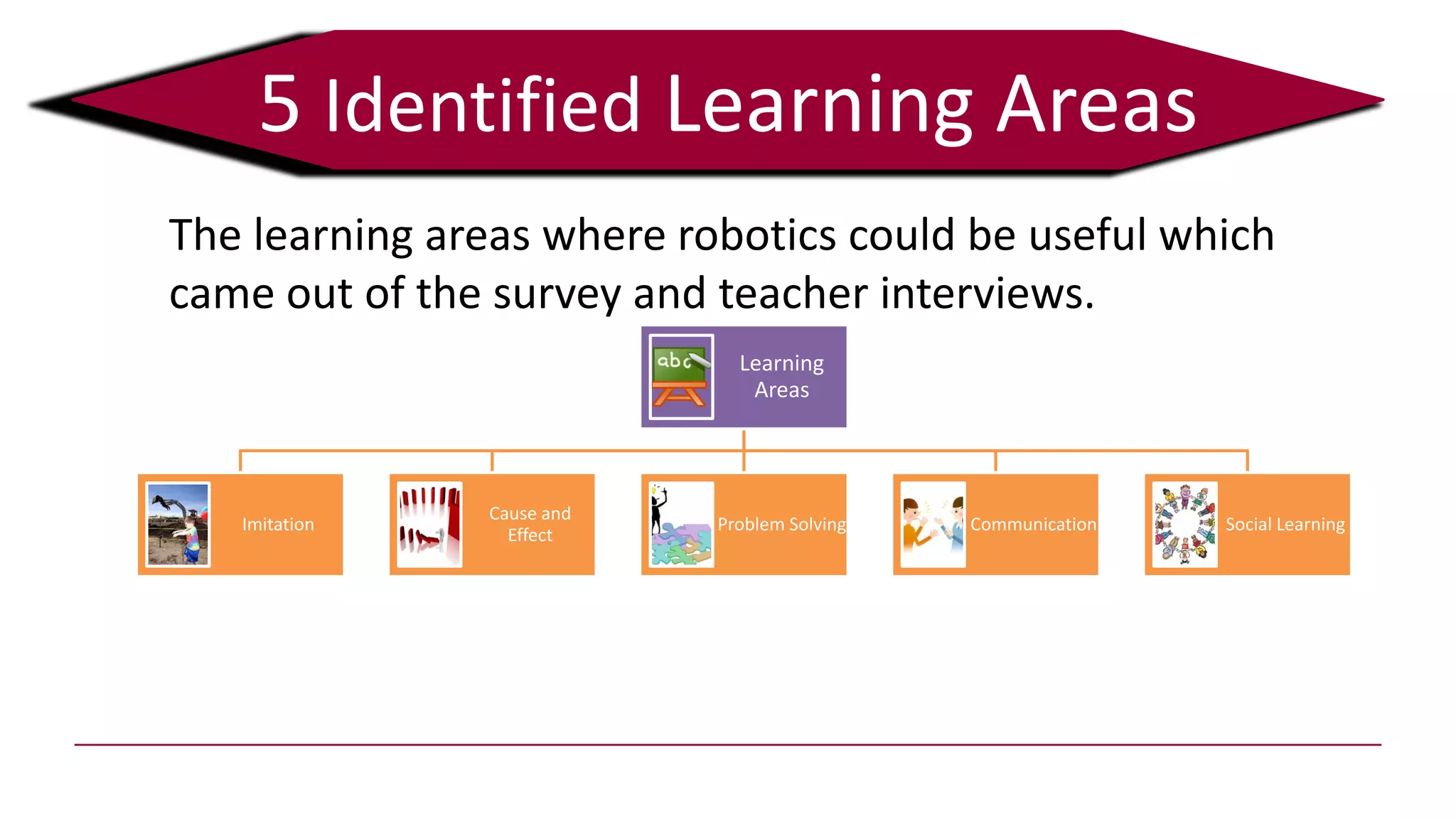
learning activities which could be classified within 5 areas of learning:
– Imitation – reinforcing behaviour.
– Cause and Effect – associating action with behaviour.
– Problem solving – through spatial reasoning, coordination.
– Speech – improving speaking and listening through robot interaction.
– Social Learning – how to act, appropriate behaviour.
These cut across several subject areas eg imitation could be used in physical
education, music, learning numbers in mathematics
Pedagogic framework
curricula to be followed
• Identify the learning needs of the student including their level of
capability.
• Match these needs to an appropriate learning area.
• Identify the learning objectives to be achieved within the appropriate
curriculum.
• Identify the potential learning scenarios derived from that robotic
learning area that allows the learning objective to be achieved.
• Map the curriculum requirements to the learning scenario (i.e. if
necessary customise learning scenario elements to meet learning
requirements).
• Utilise within a standardised lesson plan for implementation into everyday
teaching activity.
Pedagogic framework
barriers to implementation
– Teachers limited experience of technology, none of robots
– Lack of financial resources for expensive technology
– Need technical support to keep robots in work
– No existing training materials
– Teachers need time to plan how they might use robots
– Not all teachers able to run one to one sessions
Pedagogic framework
• Organisational includes wider organisation in which
teachers work and can often be the biggest barrier to
implementation.
• The technical: factors related to availability, access,
accessibility, implementation and maintenance of the
tools and services.
• Educational: learning goals, what have they achieved
so far, engagement, personalisation.
• The Social nature of the interactions between learner
and teacher, learner and robot and learner to learner.
Co-funded by the Lifelong Learning programme of the European Union
[project ref: 543577-LLP-1-2013-1-UK-KA3-KA3MP]
The European Commission support for the production of this publication
does not constitute an endorsement of the contents which reflects the
views only of the authors, and the Commission cannot be held responsi-ble
for any use which may be made of the information contained therein.
Robotic Learning Demos
Dr Andy Burton and Nick Shopland
Co-funded by the Lifelong Learning programme of the European Union
[project ref: 543577-LLP-1-2013-1-UK-KA3-KA3MP]
The European Commission support for the production of this publication
does not constitute an endorsement of the contents which reflects the
views only of the authors, and the Commission cannot be held responsi-ble
for any use which may be made of the information contained therein.
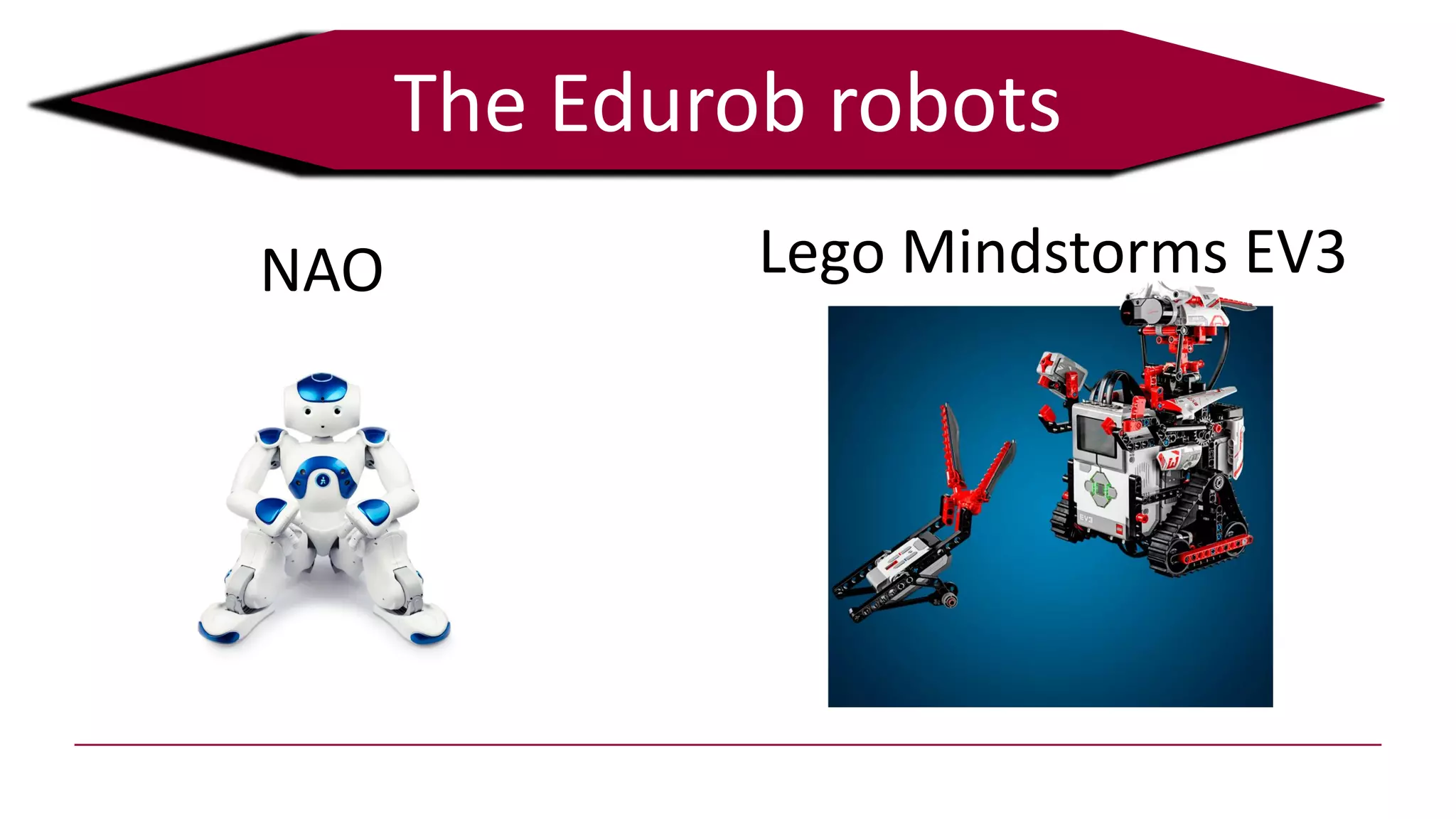
The Edurob robots
NAO Lego Mindstorms EV3
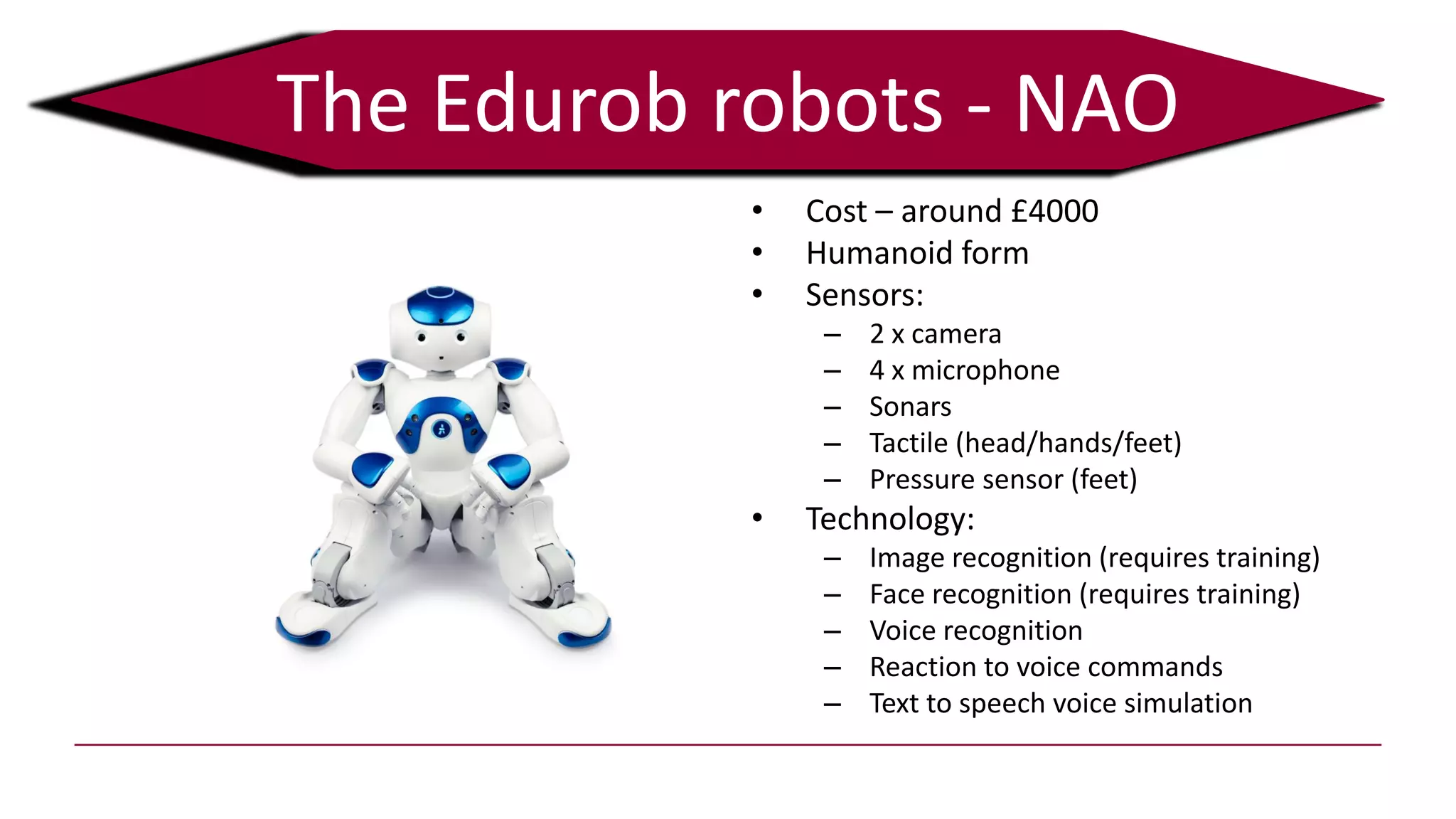
The Edurob robots - NAO
• Cost – around £4000
• Humanoid form
• Sensors:
– 2 x camera
– 4 x microphone
– Sonars
– Tactile (head/hands/feet)
– Pressure sensor (feet)
• Technology:
– Image recognition (requires training)
– Face recognition (requires training)
– Voice recognition
– Reaction to voice commands
– Text to speech voice simulation
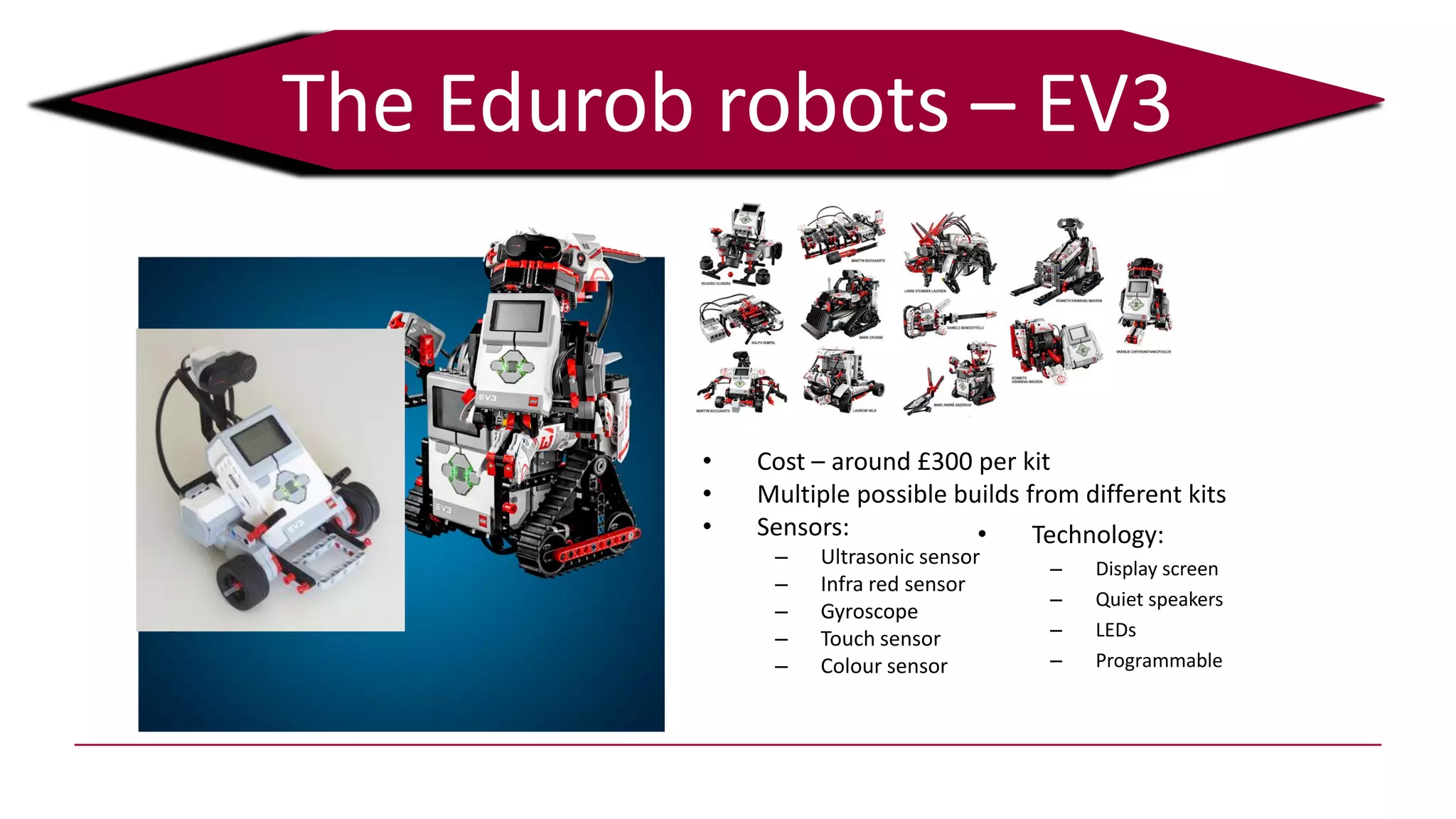
The Edurob robots – EV3
• Cost – around £300 per kit
• Multiple possible builds from different kits
• Sensors:
– Ultrasonic sensor
– Infra red sensor
– Gyroscope
– Touch sensor
– Colour sensor
• Technology:
– Display screen
– Quiet speakers
– LEDs
– Programmable
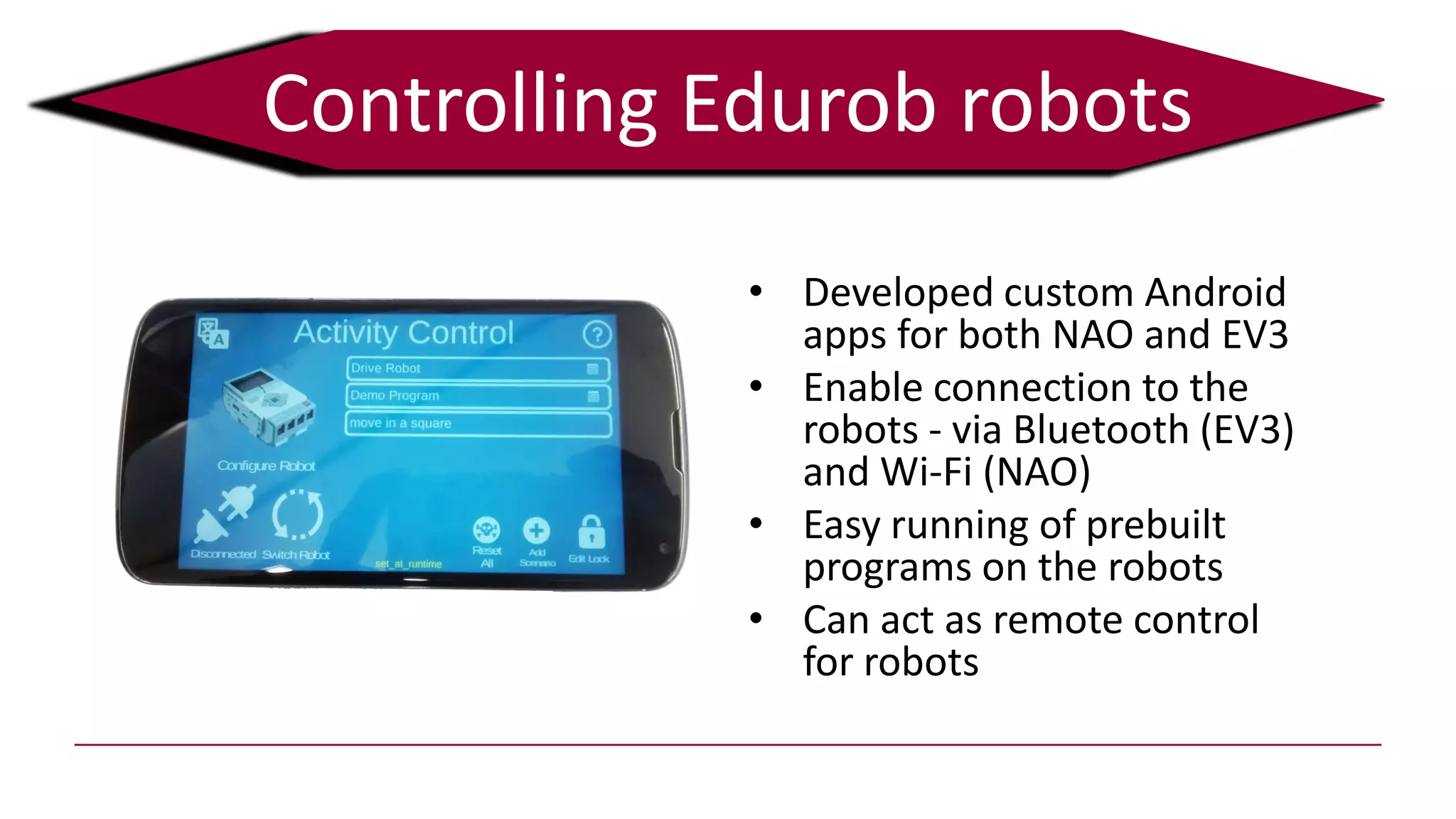
Controlling Edurob robots
• Developed custom Android
apps for both NAO and EV3
• Enable connection to the
robots - via Bluetooth (EV3)
and Wi-Fi (NAO)
• Easy running of prebuilt
programs on the robots
• Can act as remote control
for robots
5 Identified Learning Areas
Learning
Areas
Imitation
Cause and
Effect
Problem Solving Communication Social Learning
The learning areas where robotics could be useful which
came out of the survey and teacher interviews.
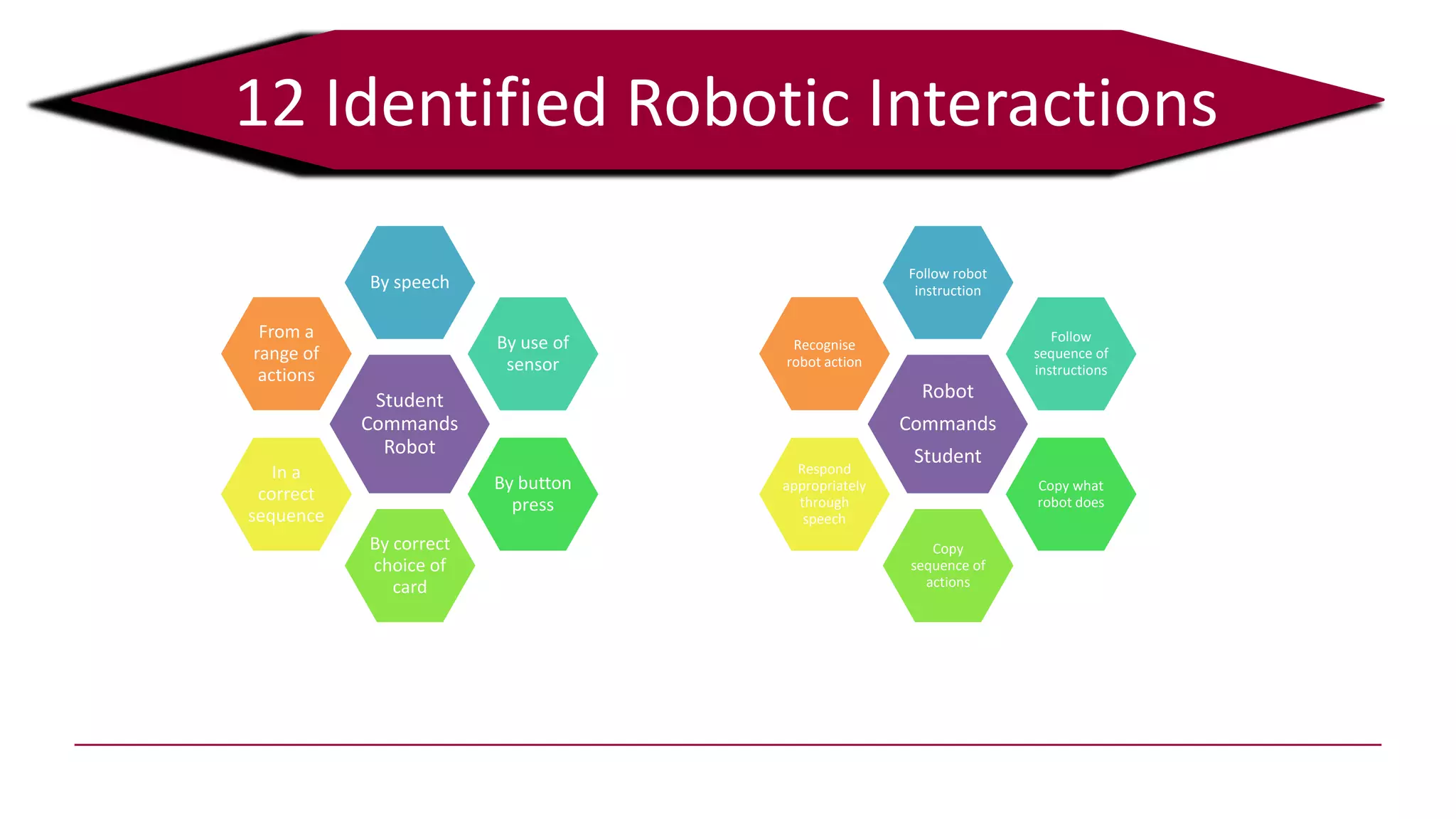
12 Identified Robotic Interactions
Student
Commands
Robot
By speech
By use of
sensor
By button
press
By correct
choice of
card
In a
correct
sequence
From a
range of
actions
Robot
Commands
Student
Follow robot
instruction
Follow
sequence of
instructions
Copy what
robot does
Copy
sequence of
actions
Respond
appropriately
through
speech
Recognise
robot action
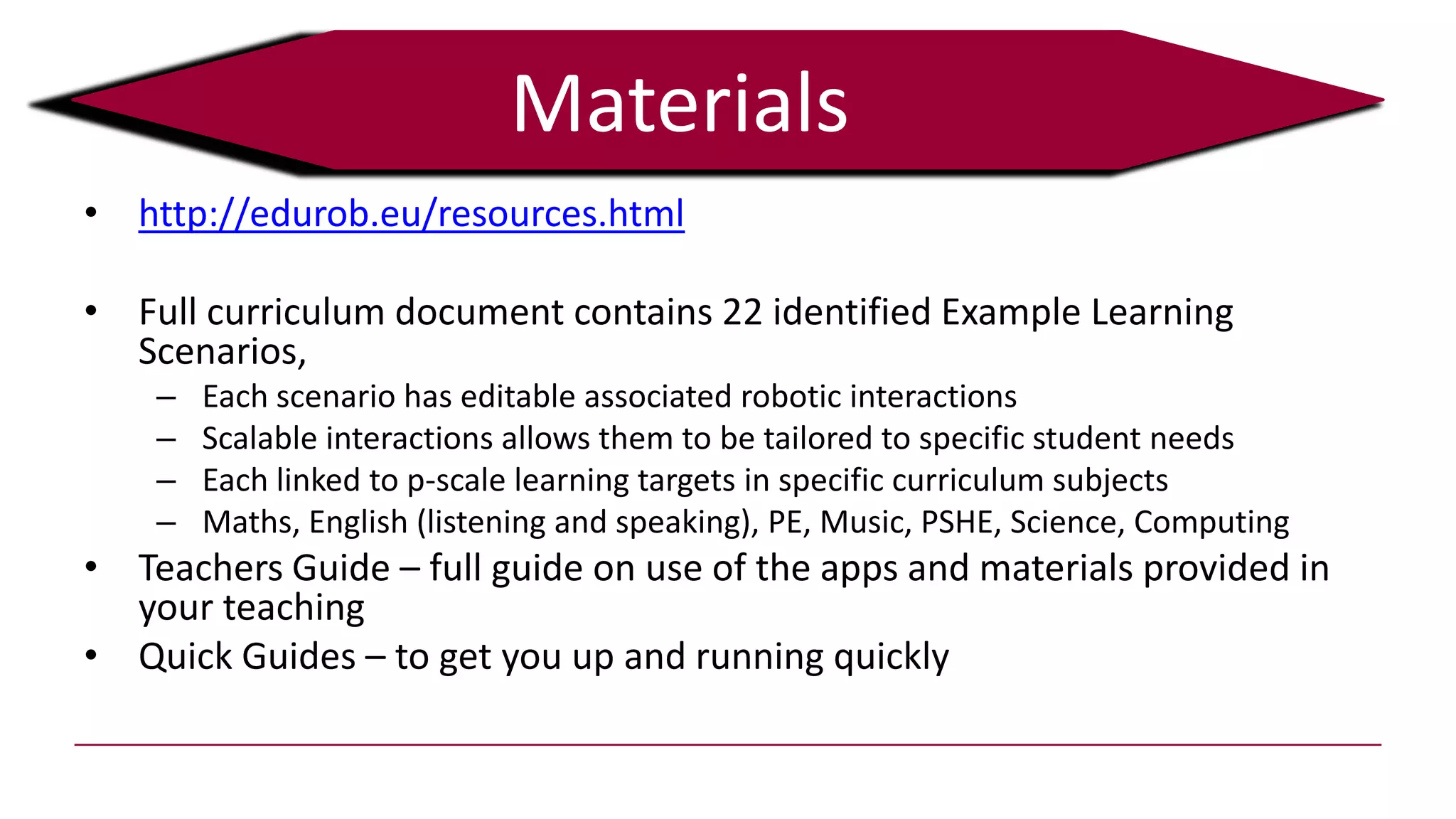
Materials
• http://edurob.eu/resources.html
• Full curriculum document contains 22 identified Example Learning
Scenarios,
– Each scenario has editable associated robotic interactions
– Scalable interactions allows them to be tailored to specific student needs
– Each linked to p-scale learning targets in specific curriculum subjects
– Maths, English (listening and speaking), PE, Music, PSHE, Science, Computing
• Teachers Guide – full guide on use of the apps and materials provided in
your teaching
• Quick Guides – to get you up and running quickly
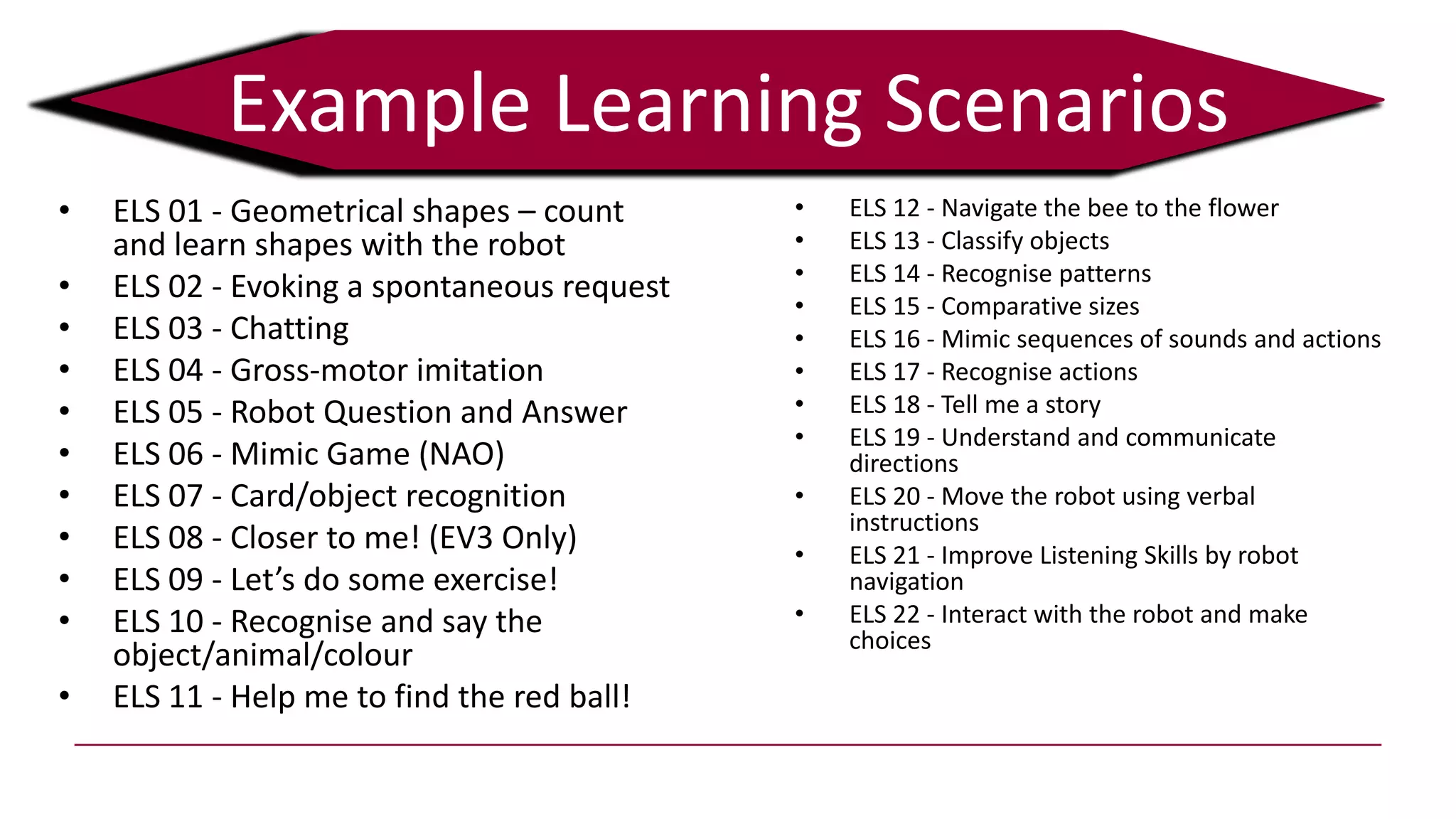
Example Learning Scenarios
• ELS 01 - Geometrical shapes – count
and learn shapes with the robot
• ELS 02 - Evoking a spontaneous request
• ELS 03 - Chatting
• ELS 04 - Gross-motor imitation
• ELS 05 - Robot Question and Answer
• ELS 06 - Mimic Game (NAO)
• ELS 07 - Card/object recognition
• ELS 08 - Closer to me! (EV3 Only)
• ELS 09 - Let’s do some exercise!
• ELS 10 - Recognise and say the
object/animal/colour
• ELS 11 - Help me to find the red ball!
• ELS 12 - Navigate the bee to the flower
• ELS 13 - Classify objects
• ELS 14 - Recognise patterns
• ELS 15 - Comparative sizes
• ELS 16 - Mimic sequences of sounds and actions
• ELS 17 - Recognise actions
• ELS 18 - Tell me a story
• ELS 19 - Understand and communicate
directions
• ELS 20 - Move the robot using verbal
instructions
• ELS 21 - Improve Listening Skills by robot
navigation
• ELS 22 - Interact with the robot and make
choices
Demonstration
• Summarise the example learning scenarios
created with live demo examples
• Create some videos for use here too?
Co-funded by the Lifelong Learning programme of the European Union
[project ref: 543577-LLP-1-2013-1-UK-KA3-KA3MP]
The European Commission support for the production of this publication
does not constitute an endorsement of the contents which reflects the
views only of the authors, and the Commission cannot be held responsi-ble
for any use which may be made of the information contained therein.
Robots in Schools – initial findings
Joanna Kossewska, Lorenzo Desideri
Co-fundeby the Lifelong Learning programme of the European Union
[project ref: 543577-LLP-1-2013-1-UK-KA3-KA3MP]
The European Commission support for the production of this publication
does not constitute an endorsement of the contents which reflects the
views only of the authors, and d the Commission cannot be held
responsi-ble for any use which may be made of the information contained
therein.
Aim of the pilots
• The aim of the pilot assessment is to validate
the effectiveness of robotic mediated
teaching and learning strategies.
• Single-case research approach combined
with qualitative analysis
• The experiment design followed an ABAB methodology
– 16 sessions per case (8 without robot and 8 with robot)
• Outcome measures derived from video/observations analysis of the
session
• participants observed with regards to
– Their learning goal achievement
– their general level of engagement with the learning material
– the amount of prompting that is provided to them during their course of the
sessions
Methodology Overview
• 77 students involved so far (final target=75)
– Different health conditions: ASD, intellectual disability, sensory
impairment, learning disability, communication disorders, others
– Different levels of severity (mild to severe)
– Age range: 4-16
• Pilot settings: Mainstream schools, Special schools, Clinical
services
• Robot type:
– Non-humanoid: Lego Mindstorms EV3, KRAZ3
– Humanoid: NAO
Pilot site characteristics
• Activities should be carefully prepared; Robot
works in highly structured settings
• Children had different reactions towards the
robot
• Increased engagemet was observed
Insights from Italy
Insights from Italy
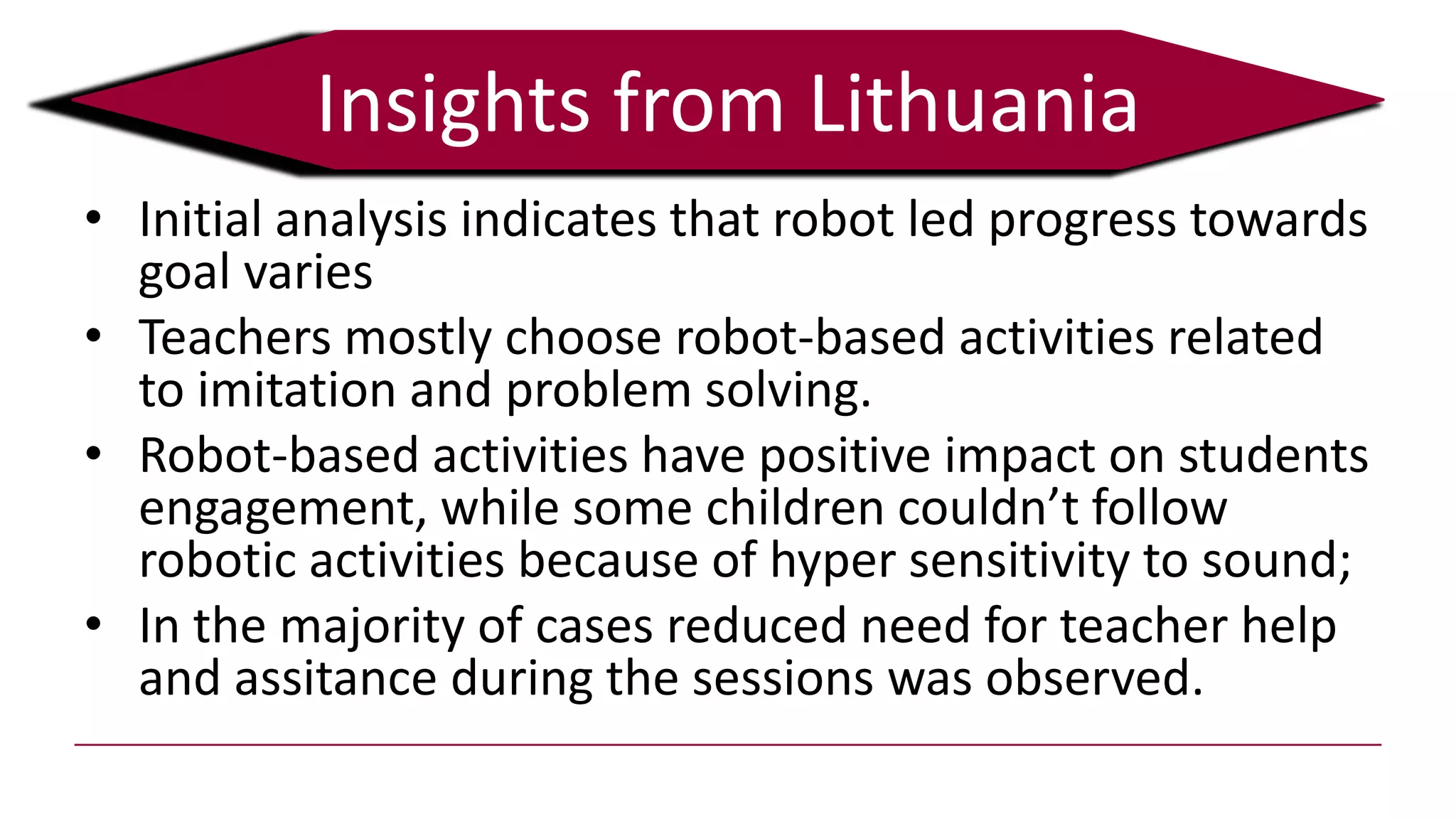
«Hello!» without robot «Hello!» with robot
• Participant: A., male, 5 years old, ASD
• Learning objective: say «Hello»
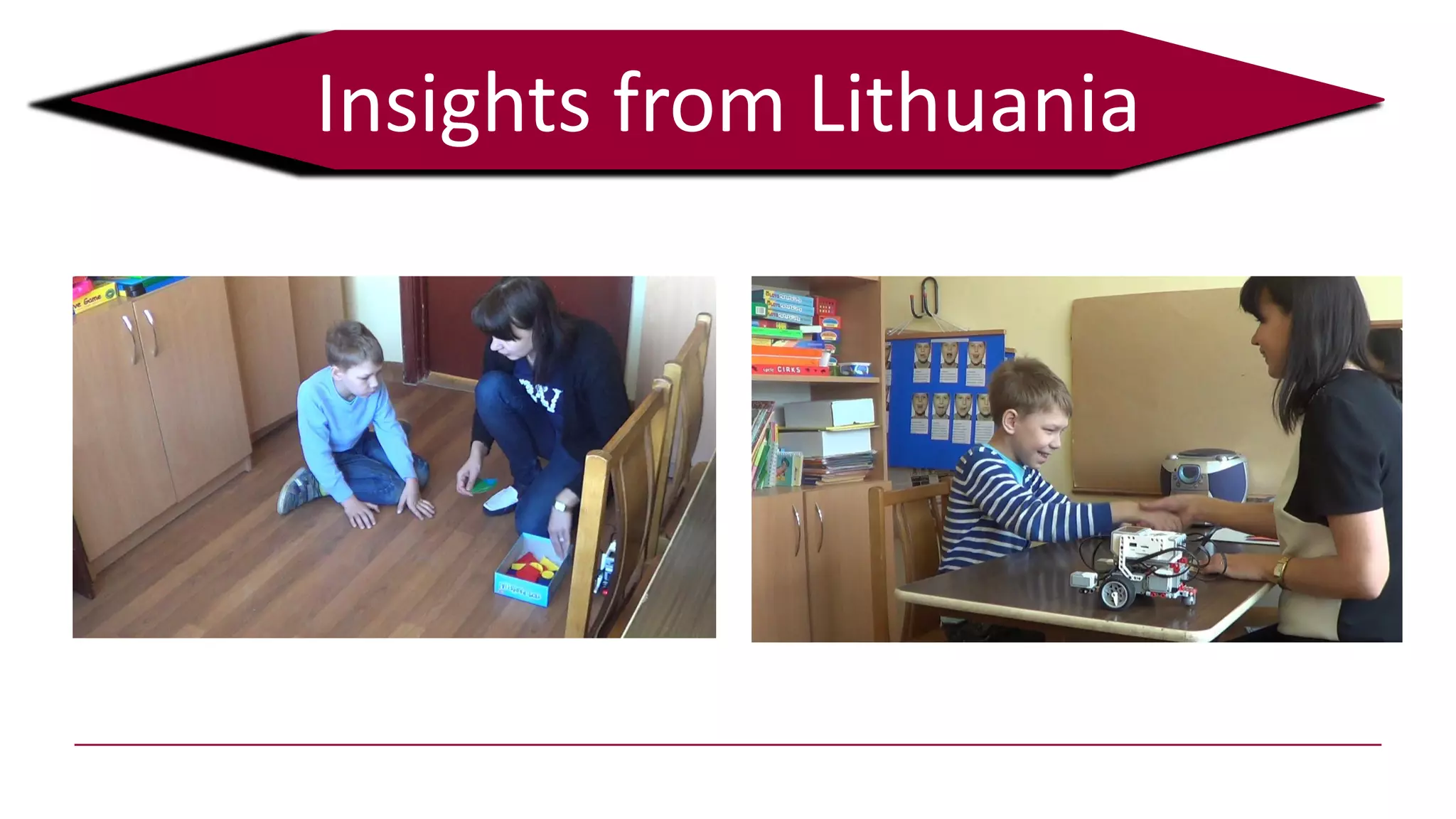
• Initial analysis indicates that robot led progress towards
goal varies
• Teachers mostly choose robot-based activities related
to imitation and problem solving.
• Robot-based activities have positive impact on students
engagement, while some children couldn’t follow
robotic activities because of hyper sensitivity to sound;
• In the majority of cases reduced need for teacher help
and assitance during the sessions was observed.
Insights from Lithuania
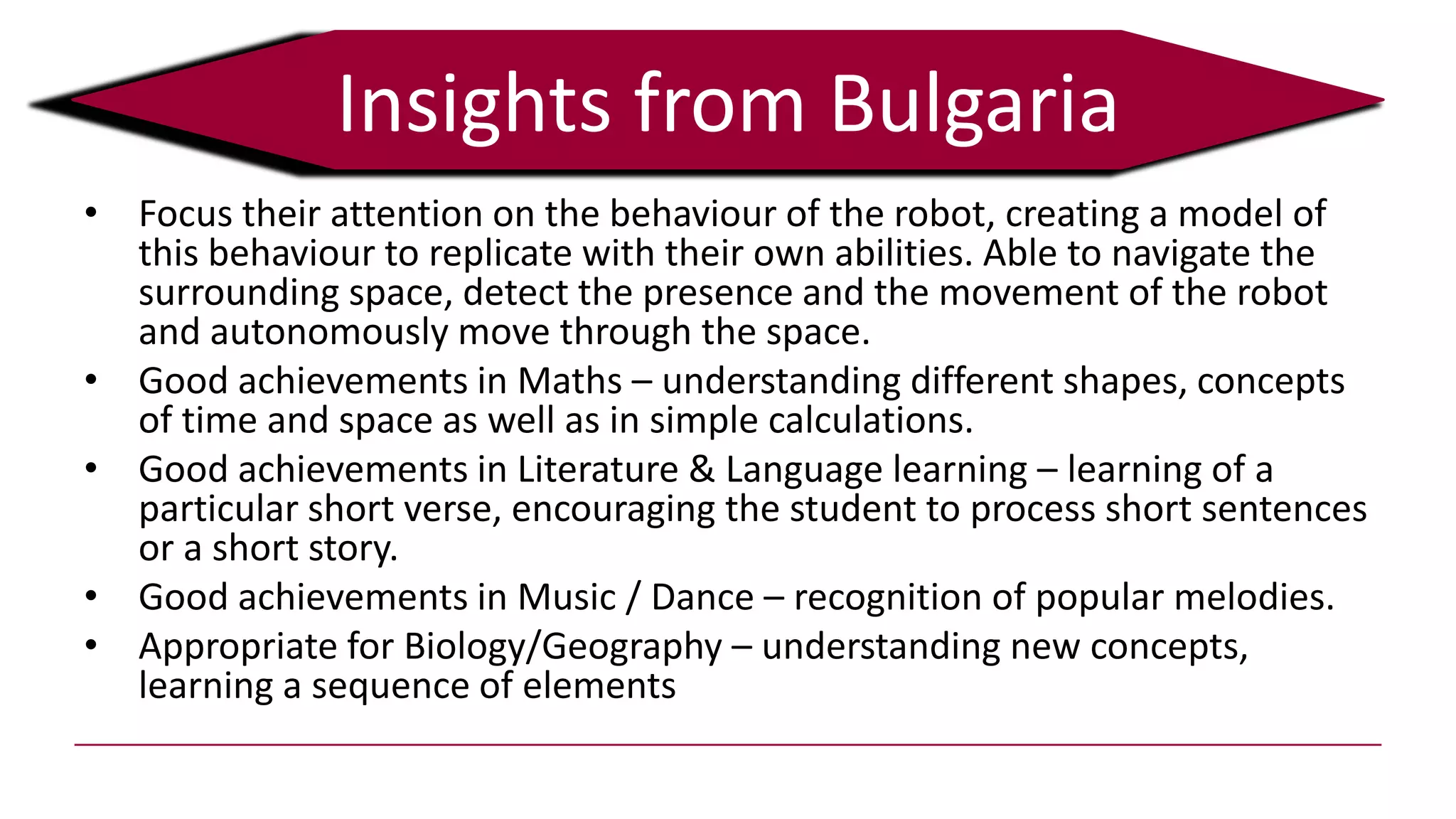
• Focus their attention on the behaviour of the robot, creating a model of
this behaviour to replicate with their own abilities. Able to navigate the
surrounding space, detect the presence and the movement of the robot
and autonomously move through the space.
• Good achievements in Maths – understanding different shapes, concepts
of time and space as well as in simple calculations.
• Good achievements in Literature & Language learning – learning of a
particular short verse, encouraging the student to process short sentences
or a short story.
• Good achievements in Music / Dance – recognition of popular melodies.
• Appropriate for Biology/Geography – understanding new concepts,
learning a sequence of elements
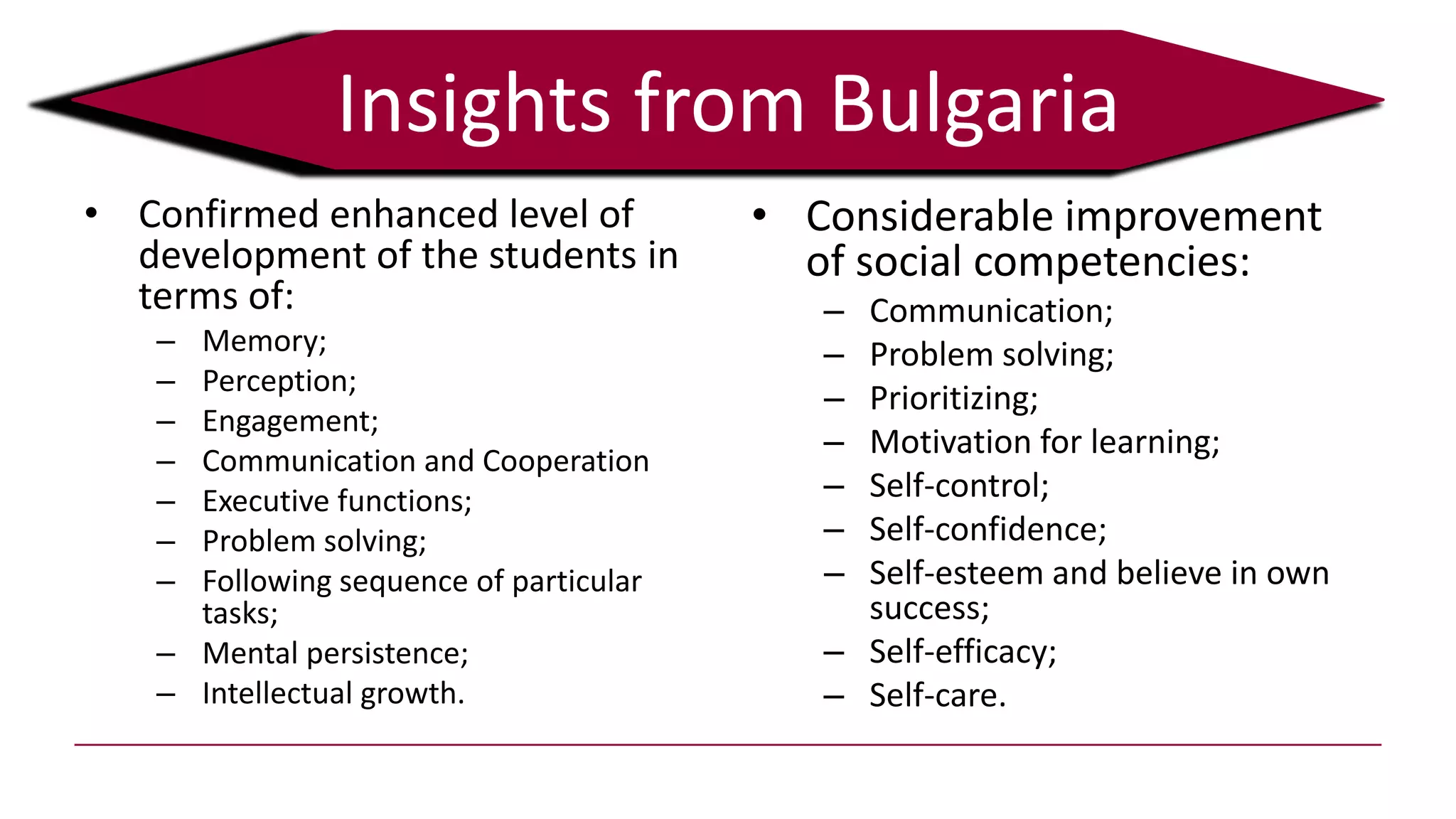
Insights from Bulgaria
• Confirmed enhanced level of
development of the students in
terms of:
– Memory;
– Perception;
– Engagement;
– Communication and Cooperation
– Executive functions;
– Problem solving;
– Following sequence of particular
tasks;
– Mental persistence;
– Intellectual growth.
• Considerable improvement
of social competencies:
– Communication;
– Problem solving;
– Prioritizing;
– Motivation for learning;
– Self-control;
– Self-confidence;
– Self-esteem and believe in own
success;
– Self-efficacy;
– Self-care.
Insights from Bulgaria
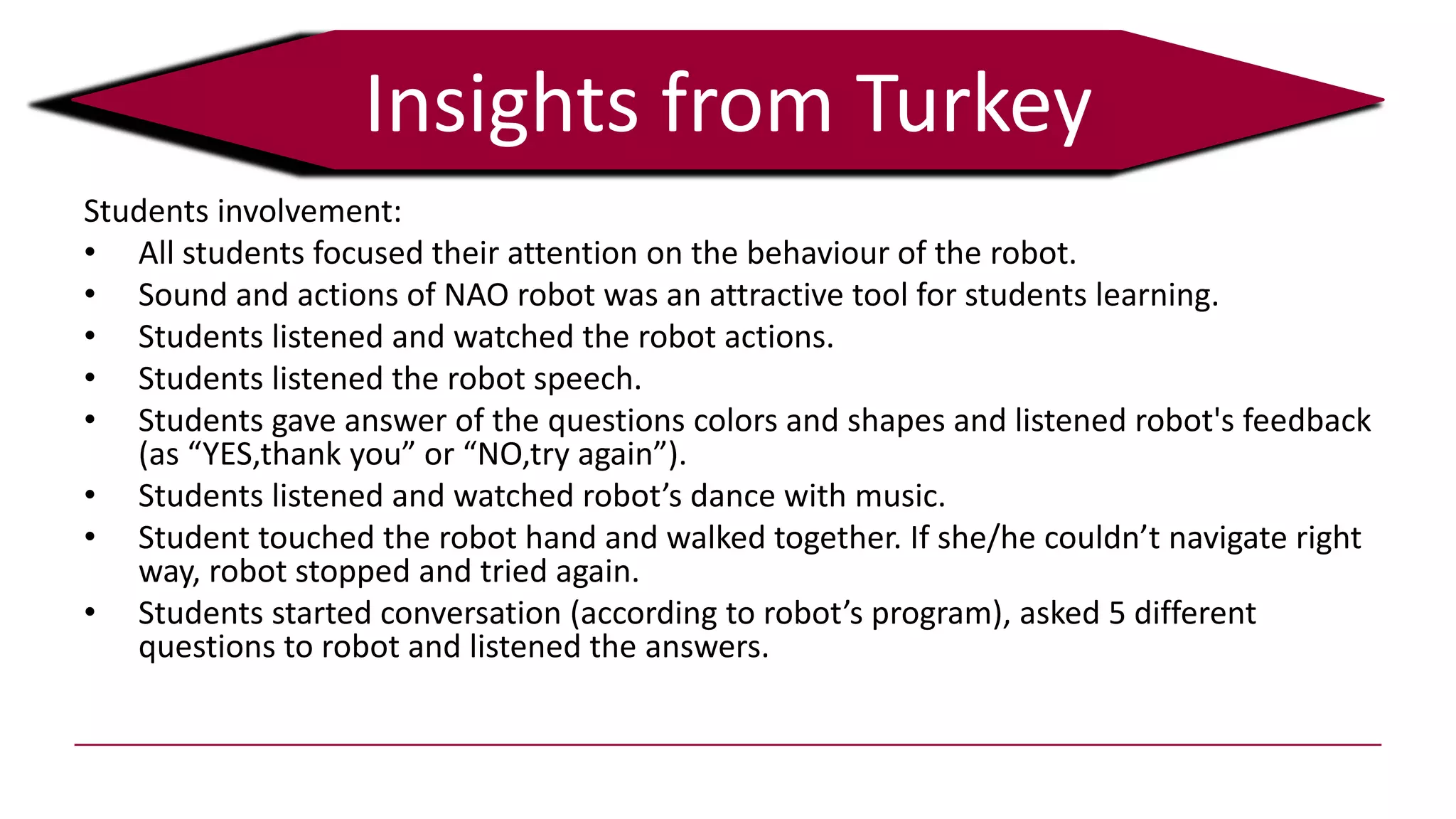
Students involvement:
• All students focused their attention on the behaviour of the robot.
• Sound and actions of NAO robot was an attractive tool for students learning.
• Students listened and watched the robot actions.
• Students listened the robot speech.
• Students gave answer of the questions colors and shapes and listened robot's feedback
(as “YES,thank you” or “NO,try again”).
• Students listened and watched robot’s dance with music.
• Student touched the robot hand and walked together. If she/he couldn’t navigate right
way, robot stopped and tried again.
• Students started conversation (according to robot’s program), asked 5 different
questions to robot and listened the answers.
Insights from Turkey
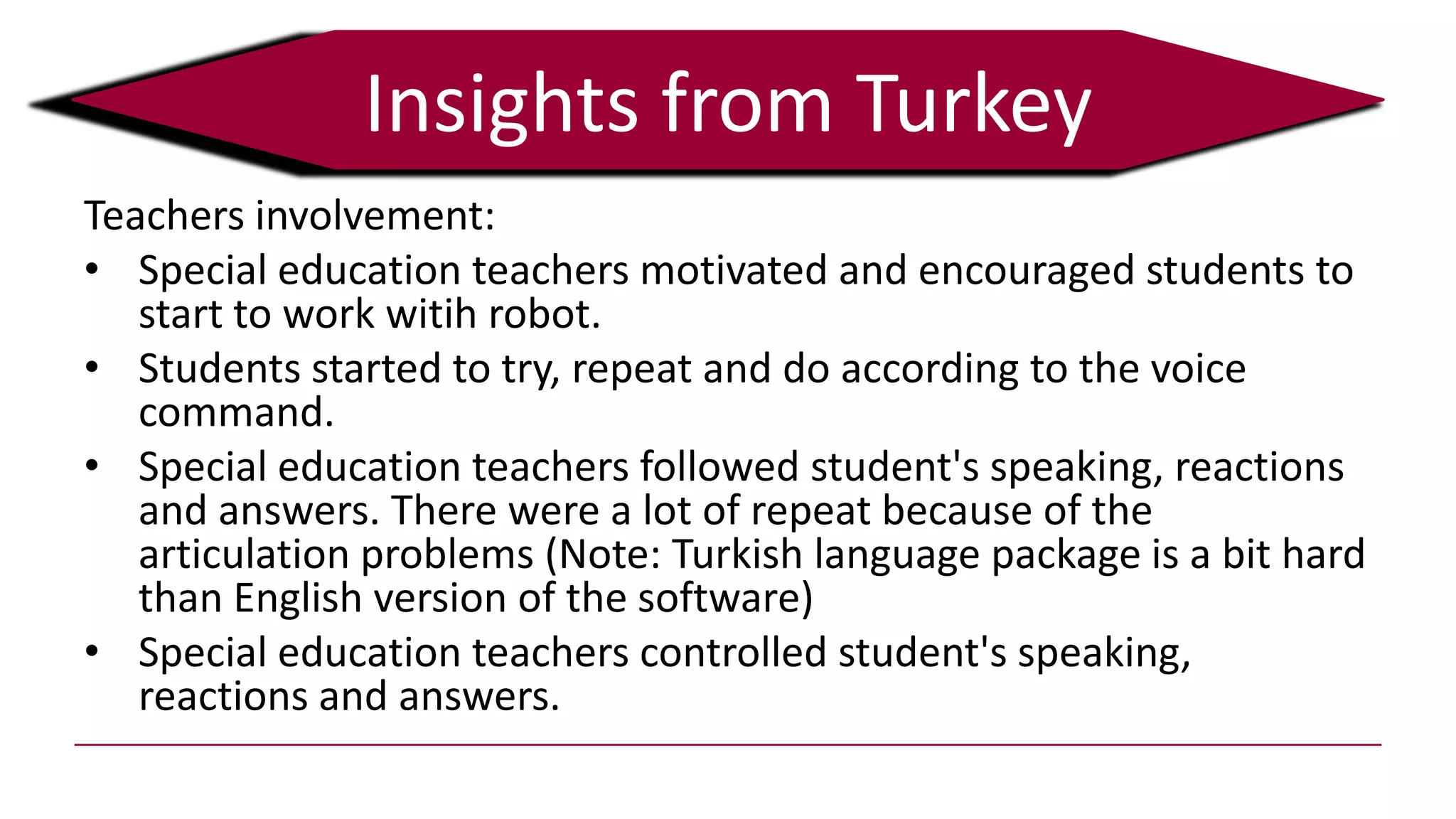
Teachers involvement:
• Special education teachers motivated and encouraged students to
start to work witih robot.
• Students started to try, repeat and do according to the voice
command.
• Special education teachers followed student's speaking, reactions
and answers. There were a lot of repeat because of the
articulation problems (Note: Turkish language package is a bit hard
than English version of the software)
• Special education teachers controlled student's speaking,
reactions and answers.
Insights from Turkey
• Engagement was statistically higher with the
robot for two out of six different learning
objectives
• Prompt significantly lower for one of six
learning objectives
• To assess success, it is important to select the
right kind of teaching scenario.
Insights from UK
Three patterns of children NAO interaction:
• Avoidance - fear, escaping
• Semi-interest in NAO robot but more in contact
with the teacher
• Higher-interest in NAO than in the teacher
Insights from Poland
• Overall encouraging results: Robot-mediated learning approach seem
to lead to positive outcomes (e.g., goal achievement)
• In general, teachers have been positive about the impact the use of
robot had on the teaching effectiveness
• One-to-one sessions seem to be more effective than group/class
activities
• Video analyses are necessary to support our preliminary observations
for which students' engagement increases when a robot is part of the
interaction
Preliminary conclusions
Co-funded by the Lifelong Learning programme of the European Union
[project ref: 543577-LLP-1-2013-1-UK-KA3-KA3MP]
The European Commission support for the production of this publication
does not constitute an endorsement of the contents which reflects the
views only of the authors, and the Commission cannot be held responsi-ble
for any use which may be made of the information contained therein.
Interactive Hands-On session
Co-funded by the Lifelong Learning programme of the European Union
[project ref: 543577-LLP-1-2013-1-UK-KA3-KA3MP]
The European Commission support for the production of this publication
does not constitute an endorsement of the contents which reflects the
views only of the authors, and the Commission cannot be held responsi-ble
for any use which may be made of the information contained therein.
• Need a plan for which interactions we will fire
and on which robots.
Co-funded by the Lifelong Learning programme of the European Union
[project ref: 543577-LLP-1-2013-1-UK-KA3-KA3MP]
The European Commission support for the production of this publication
does not constitute an endorsement of the contents which reflects the
views only of the authors, and the Commission cannot be held responsi-ble
for any use which may be made of the information contained therein.
Open discussion of use of robots in
SEN Education
• Co-funded by the Lifelong Learning programme of the European Union [project
ref: 543577-LLP-1-2013-1-UK-KA3-KA3MP]
• The European Commission support for the production of this publication does not
constitute an endorsement of the contents which reflects the views only of the
authors, and the Commission cannot be held responsi-ble for any use which may
be made of the information contained therein.
• A set of ideas/questions/prompts in order to
trigger useful discussion??
• Recording of the session will be useful. Could
this act as a steering group meeting?
Co-funded by the Lifelong Learning programme of the European Union
[project ref: 543577-LLP-1-2013-1-UK-KA3-KA3MP]
The European Commission support for the production of this publication
does not constitute an endorsement of the contents which reflects the
views only of the authors, and the Commission cannot be held responsi-ble
for any use which may be made of the information contained therein.
Thank you
•Any questions?

Robotics and Education – EduRob Project Results Launch

  • 1.
    Co-funded by theLifelong Learning programme of the European Union [project ref: 543577-LLP-1-2013-1-UK-KA3-KA3MP] The European Commission support for the production of this publication does not constitute an endorsement of the contents which reflects the views only of the authors, and the Commission cannot be held responsi-ble for any use which may be made of the information contained therein. Educational Robotics for students with learning disabilities
  • 2.
    • Robots canhave a beneficial effect on the learning of children with special needs • Robots are predictable, engaging and can encourage experiential learning, an approach that can increase the independence of learners in terms of their ability to seek out and assimilate new knowledge. • No research on how teachers might incorporate robotics into their teaching plans in order to meet their learners’ objectives • This is the first project to look at this and in several European countries 2 Background
  • 3.
    Project Goals EDUROB isa European funded project to help teachers introduce robotics into special education by developing: • a suite of learning scenarios that can be adapted and used by SEN teachers to enhance lessons, teaching a range of core curriculum subjects. • The EduRob Robot Controller app to initiate sets of pre-programmed robot behaviours eg encouragement, instructions which can be fired either using the robot's sensors, by inputs on the app. • dedicated training material to guide teachers through the learning scenarios that can impact on the specific learning targets for their students
  • 4.
    The consortium • NottinghamTrent University Interactive Systems Research Group • VSI Hiteco from Vilnius Lithuania • AIAS Bologna Onlus • Interprojects Bulgaria • Süleyman Şah University Istanbul • Polo Europeo della Conoscenza, IC Lorenzi • Pedagogical University of Kraków
  • 5.
    Summary of Userneeds what the teachers wanted Information collected from 272 questionnaires and interviews or focus groups with a further 82 teachers – Allow for a range of learning outcomes that are required for the student cohort. – Maintain engagement across all ranges of ability. – Activities which are customisable by age, SEN and difficulty required. – Be able to “plug-in” to existing curriculum in both special and mainstream school as well as provide quick informal sessions – Encourage interaction through a variety of tactile stimuli.
  • 6.
    Summary of Userneeds what learning areas could be addressed Information collected from interviews with 125 teachers identified a range of learning activities which could be classified within 5 areas of learning: – Imitation – reinforcing behaviour. – Cause and Effect – associating action with behaviour. – Problem solving – through spatial reasoning, coordination. – Speech – improving speaking and listening through robot interaction. – Social Learning – how to act, appropriate behaviour. These cut across several subject areas eg imitation could be used in physical education, music, learning numbers in mathematics
  • 7.
    Pedagogic framework curricula tobe followed • Identify the learning needs of the student including their level of capability. • Match these needs to an appropriate learning area. • Identify the learning objectives to be achieved within the appropriate curriculum. • Identify the potential learning scenarios derived from that robotic learning area that allows the learning objective to be achieved. • Map the curriculum requirements to the learning scenario (i.e. if necessary customise learning scenario elements to meet learning requirements). • Utilise within a standardised lesson plan for implementation into everyday teaching activity.
  • 8.
    Pedagogic framework barriers toimplementation – Teachers limited experience of technology, none of robots – Lack of financial resources for expensive technology – Need technical support to keep robots in work – No existing training materials – Teachers need time to plan how they might use robots – Not all teachers able to run one to one sessions
  • 9.
    Pedagogic framework • Organisationalincludes wider organisation in which teachers work and can often be the biggest barrier to implementation. • The technical: factors related to availability, access, accessibility, implementation and maintenance of the tools and services. • Educational: learning goals, what have they achieved so far, engagement, personalisation. • The Social nature of the interactions between learner and teacher, learner and robot and learner to learner.
  • 10.
    Co-funded by theLifelong Learning programme of the European Union [project ref: 543577-LLP-1-2013-1-UK-KA3-KA3MP] The European Commission support for the production of this publication does not constitute an endorsement of the contents which reflects the views only of the authors, and the Commission cannot be held responsi-ble for any use which may be made of the information contained therein. Robotic Learning Demos Dr Andy Burton and Nick Shopland Co-funded by the Lifelong Learning programme of the European Union [project ref: 543577-LLP-1-2013-1-UK-KA3-KA3MP] The European Commission support for the production of this publication does not constitute an endorsement of the contents which reflects the views only of the authors, and the Commission cannot be held responsi-ble for any use which may be made of the information contained therein.
  • 11.
    The Edurob robots NAOLego Mindstorms EV3
  • 12.
    The Edurob robots- NAO • Cost – around £4000 • Humanoid form • Sensors: – 2 x camera – 4 x microphone – Sonars – Tactile (head/hands/feet) – Pressure sensor (feet) • Technology: – Image recognition (requires training) – Face recognition (requires training) – Voice recognition – Reaction to voice commands – Text to speech voice simulation
  • 13.
    The Edurob robots– EV3 • Cost – around £300 per kit • Multiple possible builds from different kits • Sensors: – Ultrasonic sensor – Infra red sensor – Gyroscope – Touch sensor – Colour sensor • Technology: – Display screen – Quiet speakers – LEDs – Programmable
  • 14.
    Controlling Edurob robots •Developed custom Android apps for both NAO and EV3 • Enable connection to the robots - via Bluetooth (EV3) and Wi-Fi (NAO) • Easy running of prebuilt programs on the robots • Can act as remote control for robots
  • 15.
    5 Identified LearningAreas Learning Areas Imitation Cause and Effect Problem Solving Communication Social Learning The learning areas where robotics could be useful which came out of the survey and teacher interviews.
  • 16.
    12 Identified RoboticInteractions Student Commands Robot By speech By use of sensor By button press By correct choice of card In a correct sequence From a range of actions Robot Commands Student Follow robot instruction Follow sequence of instructions Copy what robot does Copy sequence of actions Respond appropriately through speech Recognise robot action
  • 17.
    Materials • http://edurob.eu/resources.html • Fullcurriculum document contains 22 identified Example Learning Scenarios, – Each scenario has editable associated robotic interactions – Scalable interactions allows them to be tailored to specific student needs – Each linked to p-scale learning targets in specific curriculum subjects – Maths, English (listening and speaking), PE, Music, PSHE, Science, Computing • Teachers Guide – full guide on use of the apps and materials provided in your teaching • Quick Guides – to get you up and running quickly
  • 18.
    Example Learning Scenarios •ELS 01 - Geometrical shapes – count and learn shapes with the robot • ELS 02 - Evoking a spontaneous request • ELS 03 - Chatting • ELS 04 - Gross-motor imitation • ELS 05 - Robot Question and Answer • ELS 06 - Mimic Game (NAO) • ELS 07 - Card/object recognition • ELS 08 - Closer to me! (EV3 Only) • ELS 09 - Let’s do some exercise! • ELS 10 - Recognise and say the object/animal/colour • ELS 11 - Help me to find the red ball! • ELS 12 - Navigate the bee to the flower • ELS 13 - Classify objects • ELS 14 - Recognise patterns • ELS 15 - Comparative sizes • ELS 16 - Mimic sequences of sounds and actions • ELS 17 - Recognise actions • ELS 18 - Tell me a story • ELS 19 - Understand and communicate directions • ELS 20 - Move the robot using verbal instructions • ELS 21 - Improve Listening Skills by robot navigation • ELS 22 - Interact with the robot and make choices
  • 19.
    Demonstration • Summarise theexample learning scenarios created with live demo examples • Create some videos for use here too?
  • 20.
    Co-funded by theLifelong Learning programme of the European Union [project ref: 543577-LLP-1-2013-1-UK-KA3-KA3MP] The European Commission support for the production of this publication does not constitute an endorsement of the contents which reflects the views only of the authors, and the Commission cannot be held responsi-ble for any use which may be made of the information contained therein. Robots in Schools – initial findings Joanna Kossewska, Lorenzo Desideri Co-fundeby the Lifelong Learning programme of the European Union [project ref: 543577-LLP-1-2013-1-UK-KA3-KA3MP] The European Commission support for the production of this publication does not constitute an endorsement of the contents which reflects the views only of the authors, and d the Commission cannot be held responsi-ble for any use which may be made of the information contained therein.
  • 21.
    Aim of thepilots • The aim of the pilot assessment is to validate the effectiveness of robotic mediated teaching and learning strategies. • Single-case research approach combined with qualitative analysis
  • 22.
    • The experimentdesign followed an ABAB methodology – 16 sessions per case (8 without robot and 8 with robot) • Outcome measures derived from video/observations analysis of the session • participants observed with regards to – Their learning goal achievement – their general level of engagement with the learning material – the amount of prompting that is provided to them during their course of the sessions Methodology Overview
  • 23.
    • 77 studentsinvolved so far (final target=75) – Different health conditions: ASD, intellectual disability, sensory impairment, learning disability, communication disorders, others – Different levels of severity (mild to severe) – Age range: 4-16 • Pilot settings: Mainstream schools, Special schools, Clinical services • Robot type: – Non-humanoid: Lego Mindstorms EV3, KRAZ3 – Humanoid: NAO Pilot site characteristics
  • 24.
    • Activities shouldbe carefully prepared; Robot works in highly structured settings • Children had different reactions towards the robot • Increased engagemet was observed Insights from Italy
  • 25.
    Insights from Italy «Hello!»without robot «Hello!» with robot • Participant: A., male, 5 years old, ASD • Learning objective: say «Hello»
  • 26.
    • Initial analysisindicates that robot led progress towards goal varies • Teachers mostly choose robot-based activities related to imitation and problem solving. • Robot-based activities have positive impact on students engagement, while some children couldn’t follow robotic activities because of hyper sensitivity to sound; • In the majority of cases reduced need for teacher help and assitance during the sessions was observed. Insights from Lithuania
  • 27.
  • 28.
    • Focus theirattention on the behaviour of the robot, creating a model of this behaviour to replicate with their own abilities. Able to navigate the surrounding space, detect the presence and the movement of the robot and autonomously move through the space. • Good achievements in Maths – understanding different shapes, concepts of time and space as well as in simple calculations. • Good achievements in Literature & Language learning – learning of a particular short verse, encouraging the student to process short sentences or a short story. • Good achievements in Music / Dance – recognition of popular melodies. • Appropriate for Biology/Geography – understanding new concepts, learning a sequence of elements Insights from Bulgaria
  • 29.
    • Confirmed enhancedlevel of development of the students in terms of: – Memory; – Perception; – Engagement; – Communication and Cooperation – Executive functions; – Problem solving; – Following sequence of particular tasks; – Mental persistence; – Intellectual growth. • Considerable improvement of social competencies: – Communication; – Problem solving; – Prioritizing; – Motivation for learning; – Self-control; – Self-confidence; – Self-esteem and believe in own success; – Self-efficacy; – Self-care. Insights from Bulgaria
  • 30.
  • 31.
    Students involvement: • Allstudents focused their attention on the behaviour of the robot. • Sound and actions of NAO robot was an attractive tool for students learning. • Students listened and watched the robot actions. • Students listened the robot speech. • Students gave answer of the questions colors and shapes and listened robot's feedback (as “YES,thank you” or “NO,try again”). • Students listened and watched robot’s dance with music. • Student touched the robot hand and walked together. If she/he couldn’t navigate right way, robot stopped and tried again. • Students started conversation (according to robot’s program), asked 5 different questions to robot and listened the answers. Insights from Turkey
  • 32.
    Teachers involvement: • Specialeducation teachers motivated and encouraged students to start to work witih robot. • Students started to try, repeat and do according to the voice command. • Special education teachers followed student's speaking, reactions and answers. There were a lot of repeat because of the articulation problems (Note: Turkish language package is a bit hard than English version of the software) • Special education teachers controlled student's speaking, reactions and answers. Insights from Turkey
  • 33.
    • Engagement wasstatistically higher with the robot for two out of six different learning objectives • Prompt significantly lower for one of six learning objectives • To assess success, it is important to select the right kind of teaching scenario. Insights from UK
  • 34.
    Three patterns ofchildren NAO interaction: • Avoidance - fear, escaping • Semi-interest in NAO robot but more in contact with the teacher • Higher-interest in NAO than in the teacher Insights from Poland
  • 35.
  • 36.
    • Overall encouragingresults: Robot-mediated learning approach seem to lead to positive outcomes (e.g., goal achievement) • In general, teachers have been positive about the impact the use of robot had on the teaching effectiveness • One-to-one sessions seem to be more effective than group/class activities • Video analyses are necessary to support our preliminary observations for which students' engagement increases when a robot is part of the interaction Preliminary conclusions
  • 37.
    Co-funded by theLifelong Learning programme of the European Union [project ref: 543577-LLP-1-2013-1-UK-KA3-KA3MP] The European Commission support for the production of this publication does not constitute an endorsement of the contents which reflects the views only of the authors, and the Commission cannot be held responsi-ble for any use which may be made of the information contained therein. Interactive Hands-On session Co-funded by the Lifelong Learning programme of the European Union [project ref: 543577-LLP-1-2013-1-UK-KA3-KA3MP] The European Commission support for the production of this publication does not constitute an endorsement of the contents which reflects the views only of the authors, and the Commission cannot be held responsi-ble for any use which may be made of the information contained therein.
  • 38.
    • Need aplan for which interactions we will fire and on which robots.
  • 39.
    Co-funded by theLifelong Learning programme of the European Union [project ref: 543577-LLP-1-2013-1-UK-KA3-KA3MP] The European Commission support for the production of this publication does not constitute an endorsement of the contents which reflects the views only of the authors, and the Commission cannot be held responsi-ble for any use which may be made of the information contained therein. Open discussion of use of robots in SEN Education • Co-funded by the Lifelong Learning programme of the European Union [project ref: 543577-LLP-1-2013-1-UK-KA3-KA3MP] • The European Commission support for the production of this publication does not constitute an endorsement of the contents which reflects the views only of the authors, and the Commission cannot be held responsi-ble for any use which may be made of the information contained therein.
  • 40.
    • A setof ideas/questions/prompts in order to trigger useful discussion?? • Recording of the session will be useful. Could this act as a steering group meeting?
  • 41.
    Co-funded by theLifelong Learning programme of the European Union [project ref: 543577-LLP-1-2013-1-UK-KA3-KA3MP] The European Commission support for the production of this publication does not constitute an endorsement of the contents which reflects the views only of the authors, and the Commission cannot be held responsi-ble for any use which may be made of the information contained therein. Thank you •Any questions?