Educational Robotics for People with Disabilities
By KarelVan Isacker
Robotic Mediated
Learning
 Robots can provide a powerful
alternative learning method for
students with learning disabilities.
 Utilising the multiple sensor arrays
available in modern robots, they can be
programmed to interact with students
in specific ways to encourage and
engage them in learning activities.
 Certain students may find robots easier
to engage with and less threatening
than human trainers.
 Robots can play a key role in enhancing
the informal learning most children
naturally develop as they play.
Special Needs
Education
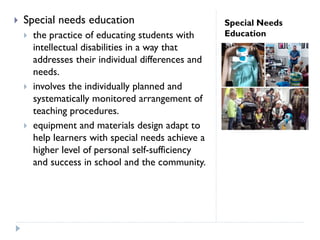
 Special needs education
 the practice of educating students with
intellectual disabilities in a way that
addresses their individual differences and
needs.
 involves the individually planned and
systematically monitored arrangement of
teaching procedures.
 equipment and materials design adapt to
help learners with special needs achieve a
higher level of personal self-sufficiency
and success in school and the community.
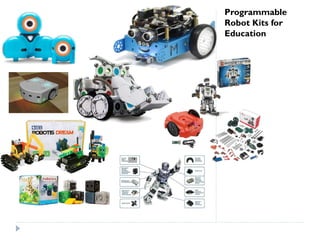
Programmable
Robot Kits for
Education
Teaching STEM
with Robotics
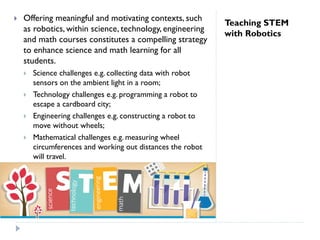
 Offering meaningful and motivating contexts, such
as robotics, within science, technology, engineering
and math courses constitutes a compelling strategy
to enhance science and math learning for all
students.
 Science challenges e.g. collecting data with robot
sensors on the ambient light in a room;
 Technology challenges e.g. programming a robot to
escape a cardboard city;
 Engineering challenges e.g. constructing a robot to
move without wheels;
 Mathematical challenges e.g. measuring wheel
circumferences and working out distances the robot
will travel.
Individualised
Education Plan
Educational Robotics for
People with Learning
Disabilities (543577-LLP-1-
2013-1-UK-KA3-KA3MP) -
http://edurob.eu/
 Individual Education Plans include a child’s
 classification, placement, services (such as a
one-on-one aid and therapies), academic and
behavioural goals, percentage of time in
regular education and progress reports from
teachers and therapists.
 These plans are tailored specifically to the
child’s special needs – not to the needs of
the teacher, school or district.
 Software was developed to allow a set of
adaptable learning tools, working with a
number of different types of robots to
allow educators to tailor learning for a
student’s Individual Education Plan.
11-9-2018
Outcomes
Downloads available at
http://edurob.eu/resources.
html
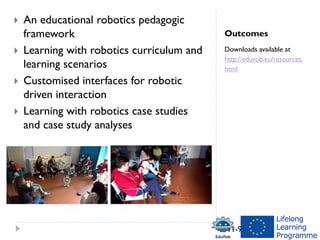
 An educational robotics pedagogic
framework
 Learning with robotics curriculum and
learning scenarios
 Customised interfaces for robotic
driven interaction
 Learning with robotics case studies
and case study analyses
11-9-2018
ReasonsToTeach
Robotics In Schools
 An Introduction to Programming
 Learning to program a computer is an excellent skill to have to make
students more likely to get a job in the future, and earn more money
in their lifetime.
 Increases Creativity
 Robotics is a production-based learning module. Students have the
opportunity to create something tangible and make it perform the
actions that they program it to do.
 Prepare them for the future
 Jobs in the STEM field are the fastest growing careers, and are
projected to grow exponentially. E.g. the drone industry.
 Teaching Children How toTurn Frustration into
Innovation
 Learning how to build and program a robot can be a complex and
difficult process. Robotics in schools can help students turn their
frustration into creativity and innovation.
 Promoting Inclusivity
 Robotics is a field that is easily accessible to a wide range of students
with varying talents and skills.
 Studies have shown robots do a great job of engaging students on
the autism spectrum.
 Robotics is also a field that has the ability to empower young girls in
the classroom.
Taking It A Step
Further:
Programming And
Robotics Building
For Children -
PROBOBUILD
Using Open Source
technology and hardware,
the price of applying this
course will be minimal,
while the benefits will be
plentiful.
 Science, technology, engineering and maths (STEM)
education won’t realise its full potential unless we
address issues of resources, equity, and teacher
professional learning.
 This projects aims at addressing these 3 elements by
 training teachers how to introduce future life skills (3D
printing as an integral part of daily life, e.g. fixing coffee
machine component with 3D printed component) into
mainstream education
 through an innovative modular yet condense training course
that will allow teachers to apply them in their STEM
(Science,Technology, Engineering en Mathematics) courses
where suitable.
 Children will as such be prepared for the core 3D
aspects that will be crucial in their future jobs:
 Programming,
 3D design
 3D scanning
 3D printing,
 Basics of developing an own robot.
Envisaged modules
 Algorithms and Programming: Scratch (It has
language version)
 Programming a robot: Makeblock
Mbot http://www.makeblock.com/mbot-v1-1-stem-
educational-robot-kit (is compatible with Scratch).We
will use Scratch for programming robot, it can be
programmed by national language versions of scratch
 3D Design: Fusion 360.We will teach design based on
robotics (gears, wheels, base for the robots, etc).
 3D Scanning (for teachers to support the pupils with
their 3D design activities).We will use free/open source
software for scanning, e.g. Reprap.org Ciclop 3D Scanner
(http://reprap.org/wiki/File:Ciclop.png),
http://www.makerscanner.com/
 3D Print:We will use Prusa i3 printer
 Design my own robot:After we finish the cycle we
will add 2-3 project based robots (like instructions)
Goals
 Pupils
 Future Life skills (3D printing as an
integral part of daily life, e.g. fixing coffee
machine component with 3D printed
component, internet of things with
connected devices; coping with and
understanding new environments)
 Technical, analytical and logical skills and
practice
 Teachers
 Prepare willingness to embed 3D
printing in a wider variety of
educational activities.
 Motivation to mainstream 3D printing
practices.
Envisaged material
 Train the trainer handbook for
teachers, including specific training for
3D scanning
 Training curriculum and course
material for pupils “early childhood
discovery programs”
 Online training platform with
interactive videos/animated
instructions viaVideo Scribe
What is needed?
 Train teachers who can bring robotics
directly to classrooms.
 Teachers need to be confident with
using the technology, know the
content they want to teach, and the
pedagogical strategies needed to teach
the content with the technology.
 Make it affordable.
Contact details
 KarelVan Isacker
 karel@phoenixkm.eu
 +32 496 334056
Amersveldestraat 189
8610 Kortemark
Belgium

Educational robotics session

  • 1.
    Educational Robotics forPeople with Disabilities By KarelVan Isacker
  • 2.
    Robotic Mediated Learning  Robotscan provide a powerful alternative learning method for students with learning disabilities.  Utilising the multiple sensor arrays available in modern robots, they can be programmed to interact with students in specific ways to encourage and engage them in learning activities.  Certain students may find robots easier to engage with and less threatening than human trainers.  Robots can play a key role in enhancing the informal learning most children naturally develop as they play.
  • 3.
    Special Needs Education  Specialneeds education  the practice of educating students with intellectual disabilities in a way that addresses their individual differences and needs.  involves the individually planned and systematically monitored arrangement of teaching procedures.  equipment and materials design adapt to help learners with special needs achieve a higher level of personal self-sufficiency and success in school and the community.
  • 4.
  • 5.
    Teaching STEM with Robotics Offering meaningful and motivating contexts, such as robotics, within science, technology, engineering and math courses constitutes a compelling strategy to enhance science and math learning for all students.  Science challenges e.g. collecting data with robot sensors on the ambient light in a room;  Technology challenges e.g. programming a robot to escape a cardboard city;  Engineering challenges e.g. constructing a robot to move without wheels;  Mathematical challenges e.g. measuring wheel circumferences and working out distances the robot will travel.
  • 6.
    Individualised Education Plan Educational Roboticsfor People with Learning Disabilities (543577-LLP-1- 2013-1-UK-KA3-KA3MP) - http://edurob.eu/  Individual Education Plans include a child’s  classification, placement, services (such as a one-on-one aid and therapies), academic and behavioural goals, percentage of time in regular education and progress reports from teachers and therapists.  These plans are tailored specifically to the child’s special needs – not to the needs of the teacher, school or district.  Software was developed to allow a set of adaptable learning tools, working with a number of different types of robots to allow educators to tailor learning for a student’s Individual Education Plan. 11-9-2018
  • 7.
    Outcomes Downloads available at http://edurob.eu/resources. html An educational robotics pedagogic framework  Learning with robotics curriculum and learning scenarios  Customised interfaces for robotic driven interaction  Learning with robotics case studies and case study analyses 11-9-2018
  • 8.
    ReasonsToTeach Robotics In Schools An Introduction to Programming  Learning to program a computer is an excellent skill to have to make students more likely to get a job in the future, and earn more money in their lifetime.  Increases Creativity  Robotics is a production-based learning module. Students have the opportunity to create something tangible and make it perform the actions that they program it to do.  Prepare them for the future  Jobs in the STEM field are the fastest growing careers, and are projected to grow exponentially. E.g. the drone industry.  Teaching Children How toTurn Frustration into Innovation  Learning how to build and program a robot can be a complex and difficult process. Robotics in schools can help students turn their frustration into creativity and innovation.  Promoting Inclusivity  Robotics is a field that is easily accessible to a wide range of students with varying talents and skills.  Studies have shown robots do a great job of engaging students on the autism spectrum.  Robotics is also a field that has the ability to empower young girls in the classroom.
  • 9.
    Taking It AStep Further: Programming And Robotics Building For Children - PROBOBUILD Using Open Source technology and hardware, the price of applying this course will be minimal, while the benefits will be plentiful.  Science, technology, engineering and maths (STEM) education won’t realise its full potential unless we address issues of resources, equity, and teacher professional learning.  This projects aims at addressing these 3 elements by  training teachers how to introduce future life skills (3D printing as an integral part of daily life, e.g. fixing coffee machine component with 3D printed component) into mainstream education  through an innovative modular yet condense training course that will allow teachers to apply them in their STEM (Science,Technology, Engineering en Mathematics) courses where suitable.  Children will as such be prepared for the core 3D aspects that will be crucial in their future jobs:  Programming,  3D design  3D scanning  3D printing,  Basics of developing an own robot.
  • 10.
    Envisaged modules  Algorithmsand Programming: Scratch (It has language version)  Programming a robot: Makeblock Mbot http://www.makeblock.com/mbot-v1-1-stem- educational-robot-kit (is compatible with Scratch).We will use Scratch for programming robot, it can be programmed by national language versions of scratch  3D Design: Fusion 360.We will teach design based on robotics (gears, wheels, base for the robots, etc).  3D Scanning (for teachers to support the pupils with their 3D design activities).We will use free/open source software for scanning, e.g. Reprap.org Ciclop 3D Scanner (http://reprap.org/wiki/File:Ciclop.png), http://www.makerscanner.com/  3D Print:We will use Prusa i3 printer  Design my own robot:After we finish the cycle we will add 2-3 project based robots (like instructions)
  • 11.
    Goals  Pupils  FutureLife skills (3D printing as an integral part of daily life, e.g. fixing coffee machine component with 3D printed component, internet of things with connected devices; coping with and understanding new environments)  Technical, analytical and logical skills and practice  Teachers  Prepare willingness to embed 3D printing in a wider variety of educational activities.  Motivation to mainstream 3D printing practices.
  • 12.
    Envisaged material  Trainthe trainer handbook for teachers, including specific training for 3D scanning  Training curriculum and course material for pupils “early childhood discovery programs”  Online training platform with interactive videos/animated instructions viaVideo Scribe
  • 13.
    What is needed? Train teachers who can bring robotics directly to classrooms.  Teachers need to be confident with using the technology, know the content they want to teach, and the pedagogical strategies needed to teach the content with the technology.  Make it affordable.
  • 14.
    Contact details  KarelVanIsacker  karel@phoenixkm.eu  +32 496 334056 Amersveldestraat 189 8610 Kortemark Belgium