Teachers’ perceptions of Bee-
Bot robotic toy and their ability
to integrate it in their teaching
Despoina Schina, Vanessa Esteve-Gonzalez & Mireia Usart
(* despoina.schina@urv.cat, vanessa.esteve@urv.cat & mireia.usart@urv.cat )
RiE 2020: 11th International Conference on Robotics in Education, September 30th - October 2nd , 2020
Applied Research Group in
Education and Technology
Marie Skłodowska
Curie No. 713679
Contents
1. Introduction
2. Research Questions
3. Context & Sample
4. Methodology
5. Results
6. Conclusions
7. Future Research
1. Introduction
The use of Bee-bot in class reinforces children’s:
 logical thinking and problem solving (Fernaeus, Håkansson, Jacobsson &
Ljungblad, 2010).
 development of mathematical thinking (Highfield, 2010; Highfield, Mulligan
& Hedberg, 2008).
 transformational (geometric) and measurement processes, problem-solving
and semiotic processing (Highfield, Mulligan & Hedberg, 2008).
 knowledge in the areas of biology, botany, geometry and earth science
(Cacco & Moro, 2014).
 knowledge in the area of history and music (Mantzanidou, 2020).
 language learning (Collado, 2017).
A. The potential of the Bee-bot across different areas of the curriculum.
1. Introduction
Few studies focus on training teachers in robotic toys:
 Caballero-González, García-Valcárcel & Muñoz-Repiso, 2017:
a one-day workshop for preschool teachers in using the Bee-bot robotic toy in their
classes.
 Castro, Cecchi, Salvini, Valente M, Buselli, Menichetti, Calvani & Dario, 2018:
a joint training in robotics and pedagogy with different ER resources, one of which
was the Bee-bot.
 Negrini, 2019:
training in Blue-Bot and other ER resources for preschool and primary school teachers.
 Moro, Agatolio & Menegatti, 2018:
training in using robotic toys and other ER resources, methodology and designing ER
didactical units for pre-service and in-service learning support teachers.
B. Previous Research in Teacher Training in Robotic Toys.
2. Research Questions
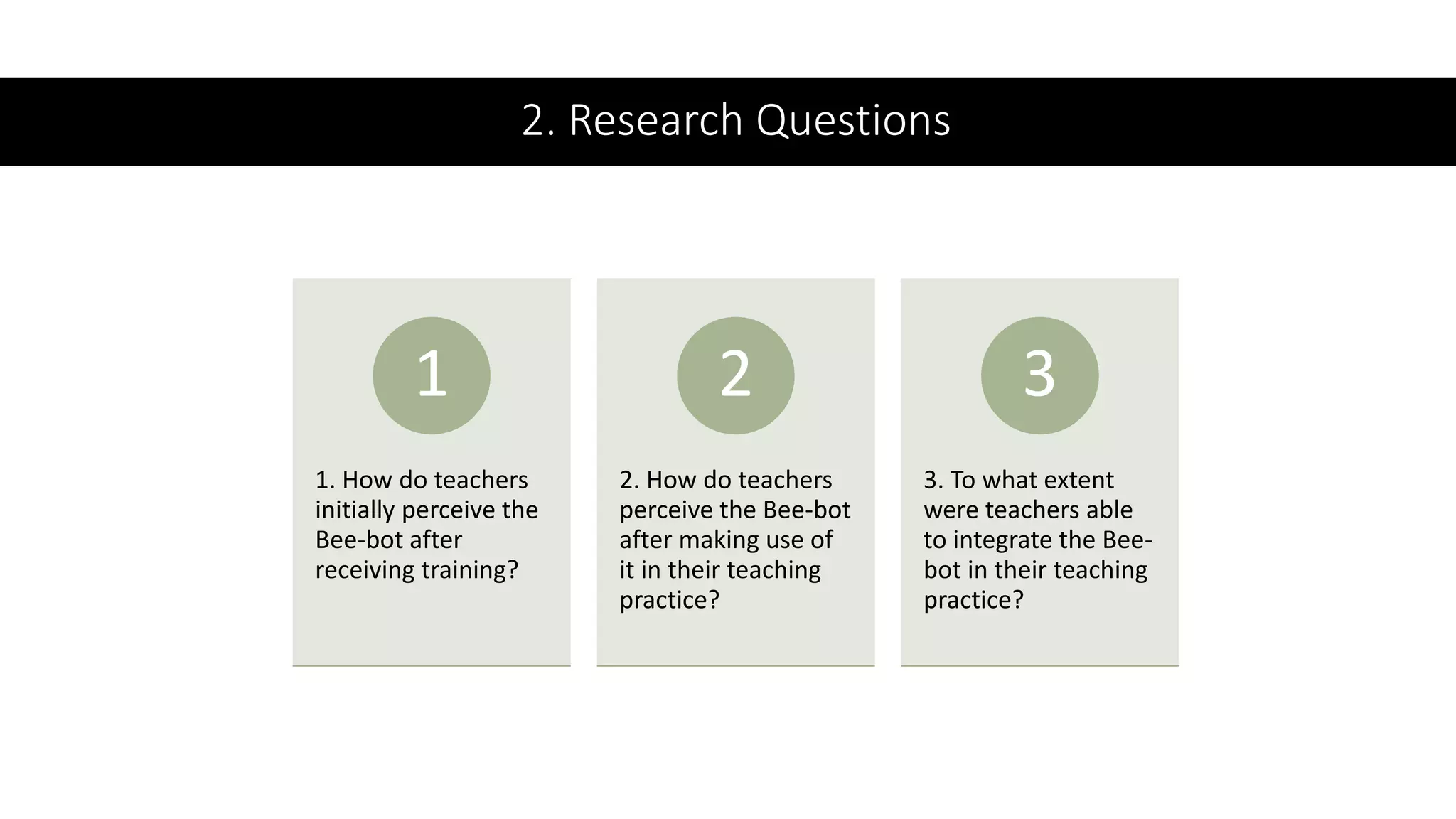
1. How do teachers
initially perceive the
Bee-bot after
receiving training?
1
2. How do teachers
perceive the Bee-bot
after making use of
it in their teaching
practice?
2
3. To what extent
were teachers able
to integrate the Bee-
bot in their teaching
practice?
3
3. Context &
Sample
Context:
 January - December of 2019
 non-formal educational
institution, located in
Thessaloniki, Greece
specialized in teaching
foreign languages.
 two sessions were held:
• a training session in
January 2019.
• a follow-up session in
December 2019.
Sample:
 2 female foreign language
teachers with no prior
experience in ER.
 teachers of English, with
more than 25 years of
teaching experience.
4. Training Description
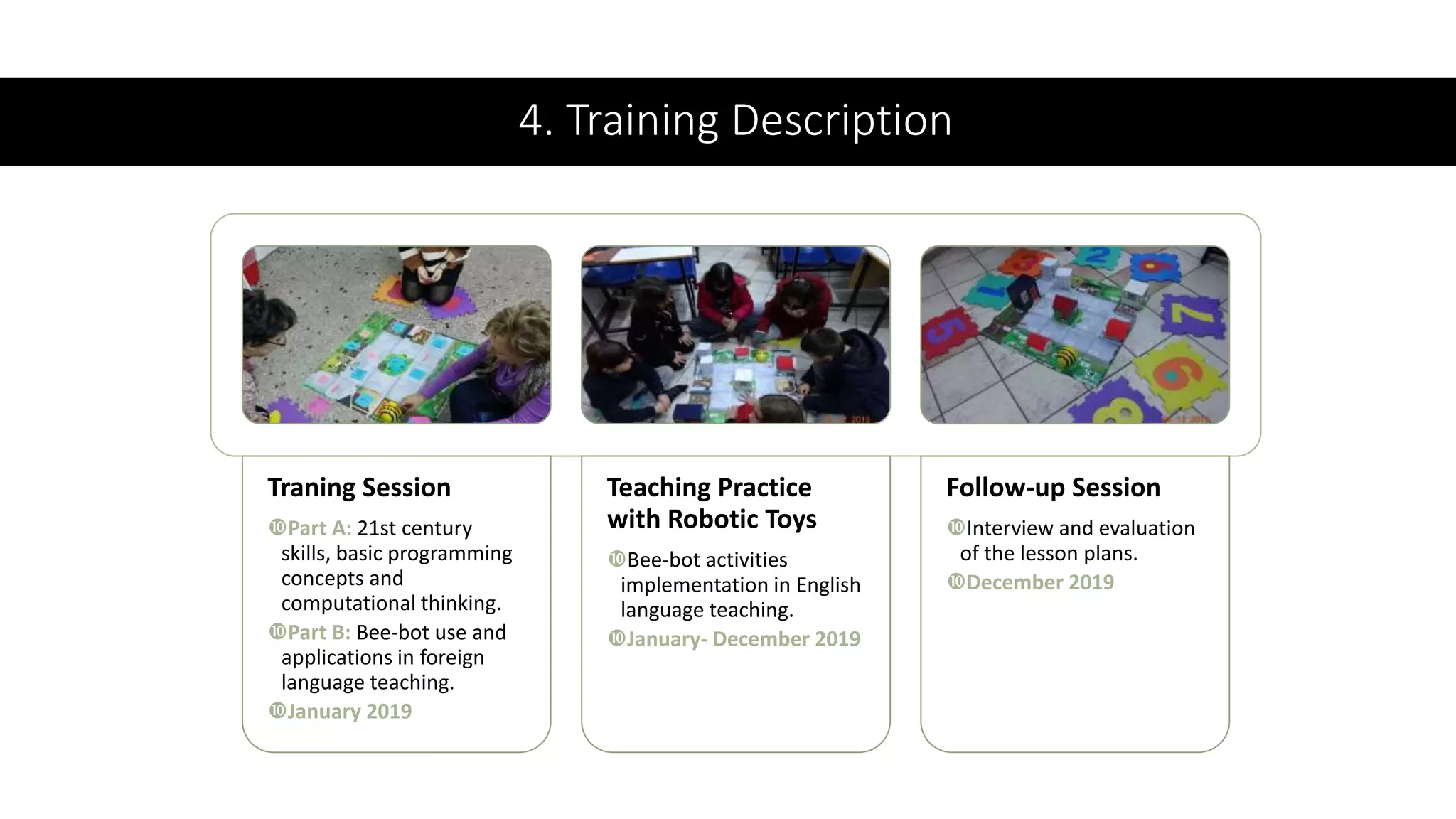
Traning Session
Part A: 21st century
skills, basic programming
concepts and
computational thinking.
Part B: Bee-bot use and
applications in foreign
language teaching.
January 2019
Teaching Practice
with Robotic Toys
Bee-bot activities
implementation in English
language teaching.
January- December 2019
Follow-up Session
Interview and evaluation
of the lesson plans.
December 2019
5. Methodology
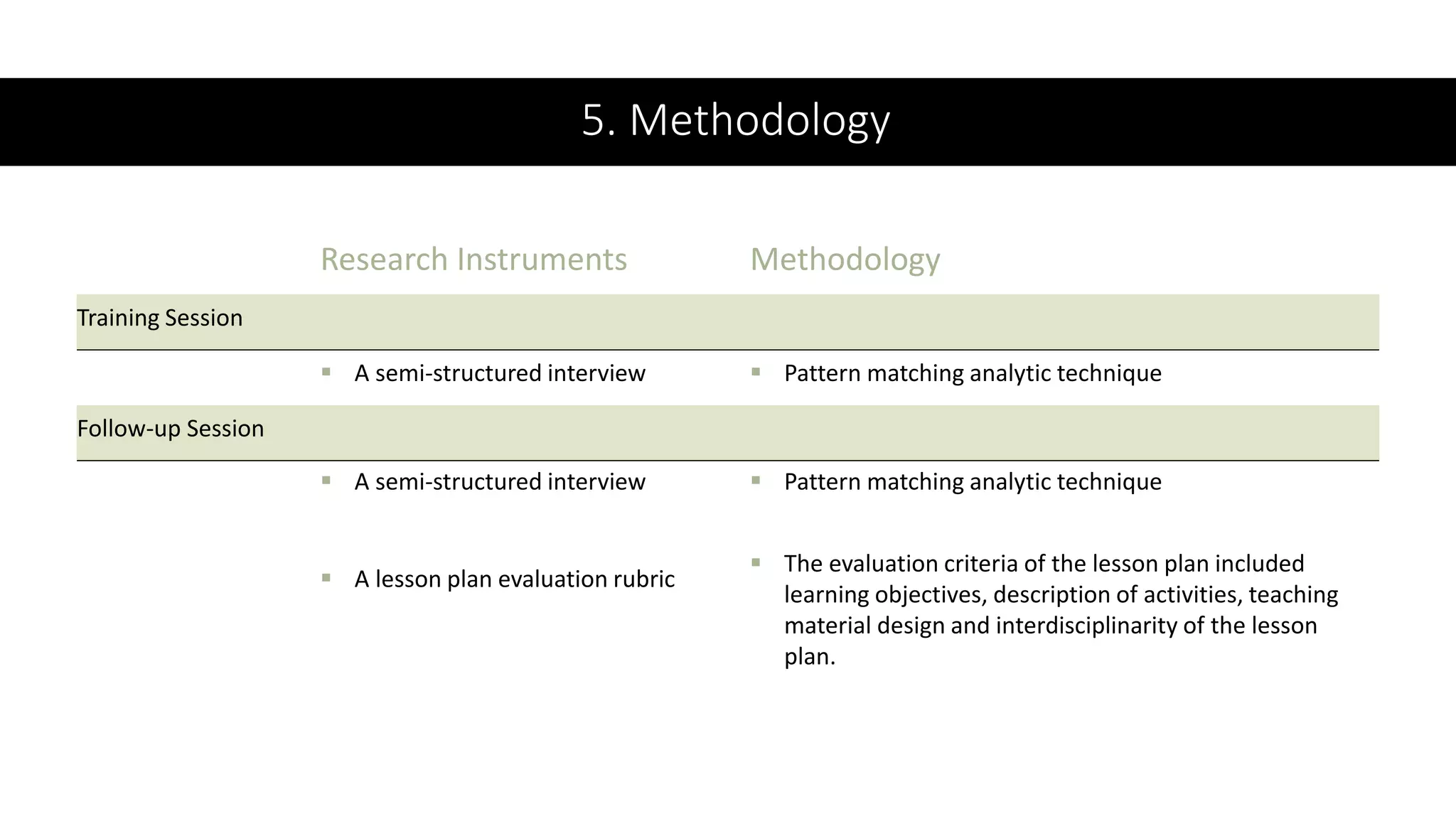
Research Instruments Methodology
Training Session
 A semi-structured interview  Pattern matching analytic technique
Follow-up Session
 A semi-structured interview  Pattern matching analytic technique
 A lesson plan evaluation rubric
 The evaluation criteria of the lesson plan included
learning objectives, description of activities, teaching
material design and interdisciplinarity of the lesson
plan.
6. Results RQ1: How do teachers initially perceive the Bee-bot after receiving training?
Teachers’ general perceptions
of the Bee-bot
Teachers’ views on usefulness
of the Bee-bot in foreign
language
Teachers’ views on students’
skills development through the
Bee-bot
Teachers are confident to
apply the Bee-bot in their
classroom practice [T1-T2].
There are multiple
applications of the robotic toys
in the foreign language
instruction [T1-T2].
The Bee-bot will enhance
students’ problem-solving
skills [T2], critical [T1], and
mathematical thinking [T2].
Teachers need further practice
with robotics activities design
[T2].
The Bee-bot will engage the
learners in foreign language
instruction [T1-T2].
Through the Bee-bot use
students enhance teamwork
[T2].
6. Results RQ2: RQ2: How do teachers perceive the Bee-bot after making use of it in their
teaching practice?
Bee-bot implementation Students’ reaction Usefulness in foreign
language instruction
Implementation in the
formal education
Classroom implementation
3-5 times per semester in
various levels.
Students were enthusiastic
about using the Bee-bot in
class [T1-T2].
Teachers used the Bee-bot
in grammar, vocabulary
and reading exercises [T1-
T2].
Bee-bot can be integrated
in different disciplines of
the formal curriculum [T1-
T2].
Teachers are confident,
eager to continue using
the Bee-bot and want to
learn more about ER. They
had difficulties in time-
management, mat design
and classroom
management [T1-T2].
Students were able to do
the Bee-bot activities. First,
they had difficulty with
programming the robot to
turn, laterality, sequencing
and decomposing
instructions [T1-T2].
Bee-bot activities were
useful to children
attention deficit and
dyslexia; they enhanced
the concentration,
achievement and self-
confidence [T1-T2].
The implementation
requires purchasing
equipment [T1], hiring
teaching assistants [T1],
designing ready-to-use
materials [T1] and teacher
training [T2].
6. Results RQ3: To what extent were teachers able to integrate the Bee-bot in their teaching
practice?
The teachers were able to integrate successfully the Bee-bot robotic toy in their teaching of English
as a foreign language.
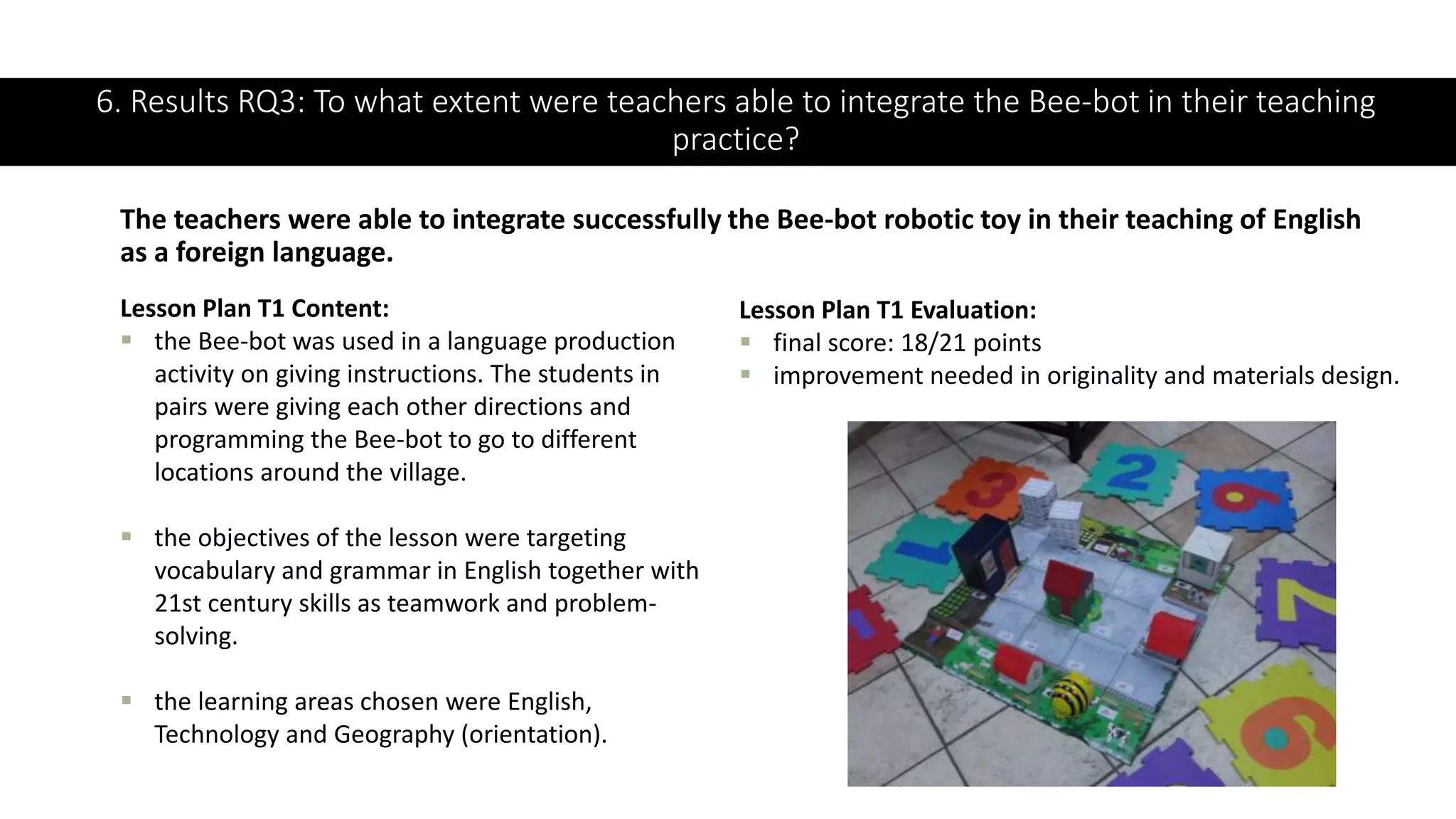
Lesson Plan T1 Content:
 the Bee-bot was used in a language production
activity on giving instructions. The students in
pairs were giving each other directions and
programming the Bee-bot to go to different
locations around the village.
 the objectives of the lesson were targeting
vocabulary and grammar in English together with
21st century skills as teamwork and problem-
solving.
 the learning areas chosen were English,
Technology and Geography (orientation).
Lesson Plan T1 Evaluation:
 final score: 18/21 points
 improvement needed in originality and materials design.
6. Results RQ3: To what extent were teachers able to integrate the Bee-bot in their teaching
practice?
The teachers were able to integrate successfully the Bee-bot robotic toy in their teaching of English
as a foreign language.
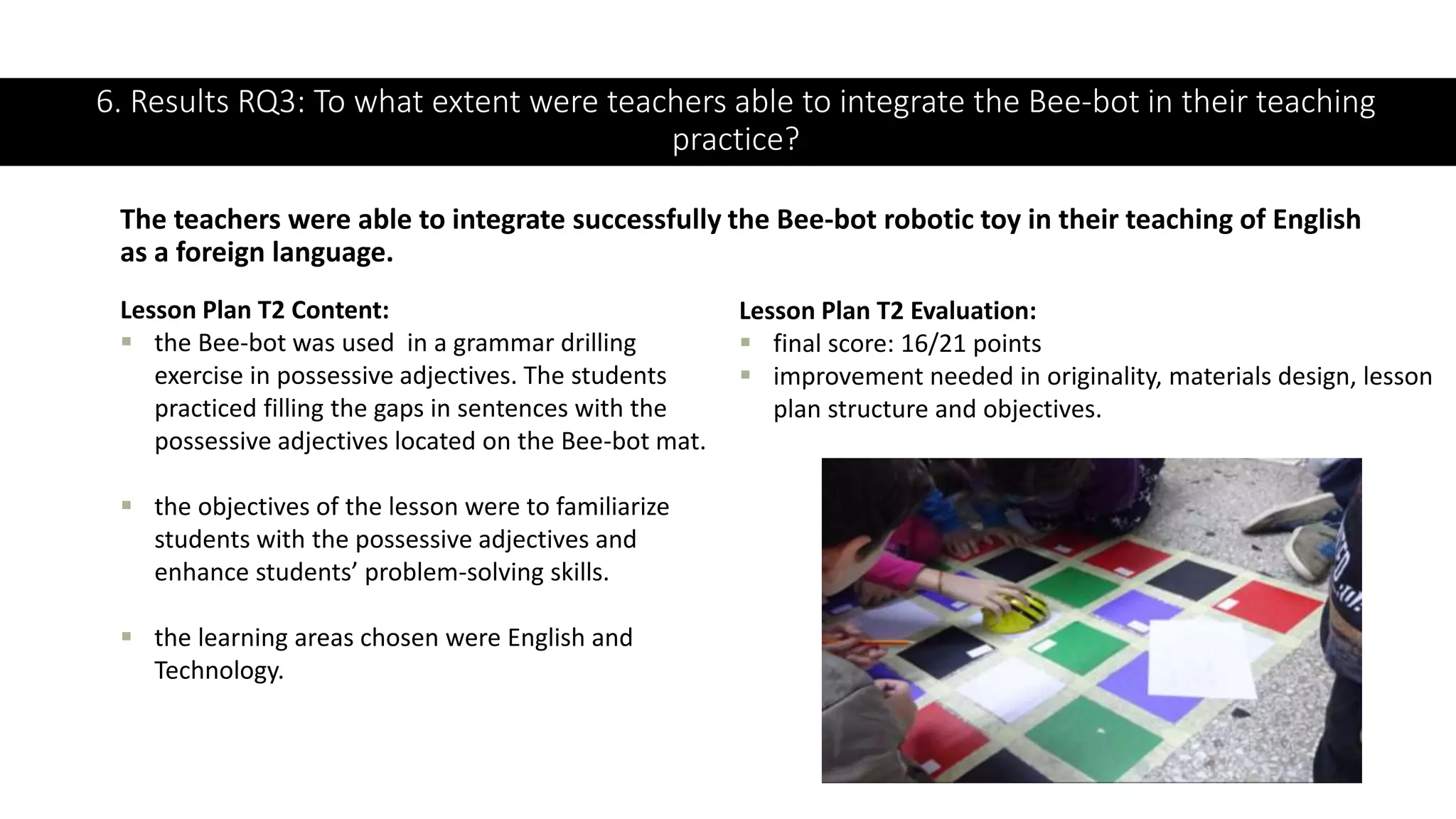
Lesson Plan T2 Content:
 the Bee-bot was used in a grammar drilling
exercise in possessive adjectives. The students
practiced filling the gaps in sentences with the
possessive adjectives located on the Bee-bot mat.
 the objectives of the lesson were to familiarize
students with the possessive adjectives and
enhance students’ problem-solving skills.
 the learning areas chosen were English and
Technology.
Lesson Plan T2 Evaluation:
 final score: 16/21 points
 improvement needed in originality, materials design, lesson
plan structure and objectives.
6. Conclusions
After the training, the teachers felt self-confident to use
Bee-bot, considered that there are multiple applications in
the foreign language teaching and viewed that the Bee-bot
promotes the development of students' skills.
Teachers’ positive perceptions sustained from the initial
training until almost a year later of teaching practice, in the
follow-up session.
Teachers were able to integrate the Bee-bot resource in
their daily teaching practice to address the objectives of
their classes.
1. How do teachers initially perceive the
Bee-bot after receiving training?
2. How do teachers perceive the Bee-bot
after making use of it in their teaching
practice?
3. To what extent were teachers able to
integrate the Bee-bot in their teaching
practice?
7. Future Research
Study teachers’ perceptions of ER
resources.
Study teachers’ integration of ER across
different areas of the curriculum.
References
Caballero González, Y. A., García-Valcárcel Muñoz-Repiso, A.: Development of computational thinking and collaborative learning in kindergarten
using programmable educational robots: a teacher training experience. In: J. M. Dodero, M. S. Ibarra Sáiz, & I. Ruiz Rube (Eds.), 5th International
Conference on Technological Ecosystems for Enhancing Multiculturality (2017).
Cacco, L., Moro, M.: When a bee meets a sunflower. In: Proceedings of 4th International Workshop Teaching Robotics Teaching with Robotics and
5th International Conference on Robotics in Education, pp. 68–75. Padova (2014)
Castro, E., Cecchi, F., Salvini, P. Valente M., Buselli, E., Menichetti, L., Calvani, A., Dario, P: Design and Impact of a Teacher Training Course, and
Attitude Change Concerning Educational Robotics. International Journal of Social Robotics 10, 669–685 (2018).
Collado, E.: Robots as Language Learning Tools, Learning Languages, 22(2), 28-31 (2017).
Fernaeus, Y., Håkansson, M. , Jacobsson, M., Ljungblad, S.: How do you play with a robotic toy animal? A long-term study of Pleo. In: Proceedings
of the 9th International Conference on Interaction Design and Children, pp. 39–48. Barcelona (2010).
Highfield, K.: Robotic toys as a catalyst for mathematical problem solving, Australian Primary Mathematics Classroom, 15(2), 22–27 (2010).
Highfield, K., Mulligan, J., Hedberg, J.: Early mathematics learning through exploration with programable toys. In: Proceedings of Joint Conference
Psychology and Mathematics, pp. 17–21 (2008).
Mantzanidou G.: Educational Robotics in Kindergarten, a Case Study. In: Merdan M., Lepuschitz W., Koppensteiner G., Balogh R., Obdržálek D.
(eds) Robotics in Education. RiE 2019 Advances in Intelligent Systems and Computing, pp. 52-58. Springer, Cham (2020).
Moro, M., Agatolio, F., Menegatti, E.: The RoboESL project: Development, evaluation and outcomes regarding the proposed robotic enhanced
curricula. International Journal of Smart Education and Urban Society (IJSEUS), 9(1), 48–60 (2018).
Negrini L.: Teacher Training in Educational Robotics. In: Lepuschitz W., Merdan M., Koppensteiner G., Balogh R., Obdržálek D. (eds) Robotics in
Education. RiE 2018. Advances in Intelligent Systems and Computing, vol 829. Springer, Cham (2019).
Thank you
Despoina Schina, Vanessa Esteve-Gonzalez & Mireia Usart
(* despoina.schina@urv.cat, vanessa.esteve@urv.cat & mireia.usart@urv.cat )
RiE 2020: 11th International Conference on Robotics in Education, September 30th - October 2nd , 2020
Applied Research Group in
Education and Technology
Marie Skłodowska
Curie No. 713679

Presentation - 11th International Conference on Robotics in Education

  • 1.
    Teachers’ perceptions ofBee- Bot robotic toy and their ability to integrate it in their teaching Despoina Schina, Vanessa Esteve-Gonzalez & Mireia Usart (* despoina.schina@urv.cat, vanessa.esteve@urv.cat & mireia.usart@urv.cat ) RiE 2020: 11th International Conference on Robotics in Education, September 30th - October 2nd , 2020 Applied Research Group in Education and Technology Marie Skłodowska Curie No. 713679
  • 2.
    Contents 1. Introduction 2. ResearchQuestions 3. Context & Sample 4. Methodology 5. Results 6. Conclusions 7. Future Research
  • 3.
    1. Introduction The useof Bee-bot in class reinforces children’s:  logical thinking and problem solving (Fernaeus, Håkansson, Jacobsson & Ljungblad, 2010).  development of mathematical thinking (Highfield, 2010; Highfield, Mulligan & Hedberg, 2008).  transformational (geometric) and measurement processes, problem-solving and semiotic processing (Highfield, Mulligan & Hedberg, 2008).  knowledge in the areas of biology, botany, geometry and earth science (Cacco & Moro, 2014).  knowledge in the area of history and music (Mantzanidou, 2020).  language learning (Collado, 2017). A. The potential of the Bee-bot across different areas of the curriculum.
  • 4.
    1. Introduction Few studiesfocus on training teachers in robotic toys:  Caballero-González, García-Valcárcel & Muñoz-Repiso, 2017: a one-day workshop for preschool teachers in using the Bee-bot robotic toy in their classes.  Castro, Cecchi, Salvini, Valente M, Buselli, Menichetti, Calvani & Dario, 2018: a joint training in robotics and pedagogy with different ER resources, one of which was the Bee-bot.  Negrini, 2019: training in Blue-Bot and other ER resources for preschool and primary school teachers.  Moro, Agatolio & Menegatti, 2018: training in using robotic toys and other ER resources, methodology and designing ER didactical units for pre-service and in-service learning support teachers. B. Previous Research in Teacher Training in Robotic Toys.
  • 5.
    2. Research Questions 1.How do teachers initially perceive the Bee-bot after receiving training? 1 2. How do teachers perceive the Bee-bot after making use of it in their teaching practice? 2 3. To what extent were teachers able to integrate the Bee- bot in their teaching practice? 3
  • 6.
    3. Context & Sample Context: January - December of 2019  non-formal educational institution, located in Thessaloniki, Greece specialized in teaching foreign languages.  two sessions were held: • a training session in January 2019. • a follow-up session in December 2019. Sample:  2 female foreign language teachers with no prior experience in ER.  teachers of English, with more than 25 years of teaching experience.
  • 7.
    4. Training Description TraningSession Part A: 21st century skills, basic programming concepts and computational thinking. Part B: Bee-bot use and applications in foreign language teaching. January 2019 Teaching Practice with Robotic Toys Bee-bot activities implementation in English language teaching. January- December 2019 Follow-up Session Interview and evaluation of the lesson plans. December 2019
  • 8.
    5. Methodology Research InstrumentsMethodology Training Session  A semi-structured interview  Pattern matching analytic technique Follow-up Session  A semi-structured interview  Pattern matching analytic technique  A lesson plan evaluation rubric  The evaluation criteria of the lesson plan included learning objectives, description of activities, teaching material design and interdisciplinarity of the lesson plan.
  • 9.
    6. Results RQ1:How do teachers initially perceive the Bee-bot after receiving training? Teachers’ general perceptions of the Bee-bot Teachers’ views on usefulness of the Bee-bot in foreign language Teachers’ views on students’ skills development through the Bee-bot Teachers are confident to apply the Bee-bot in their classroom practice [T1-T2]. There are multiple applications of the robotic toys in the foreign language instruction [T1-T2]. The Bee-bot will enhance students’ problem-solving skills [T2], critical [T1], and mathematical thinking [T2]. Teachers need further practice with robotics activities design [T2]. The Bee-bot will engage the learners in foreign language instruction [T1-T2]. Through the Bee-bot use students enhance teamwork [T2].
  • 10.
    6. Results RQ2:RQ2: How do teachers perceive the Bee-bot after making use of it in their teaching practice? Bee-bot implementation Students’ reaction Usefulness in foreign language instruction Implementation in the formal education Classroom implementation 3-5 times per semester in various levels. Students were enthusiastic about using the Bee-bot in class [T1-T2]. Teachers used the Bee-bot in grammar, vocabulary and reading exercises [T1- T2]. Bee-bot can be integrated in different disciplines of the formal curriculum [T1- T2]. Teachers are confident, eager to continue using the Bee-bot and want to learn more about ER. They had difficulties in time- management, mat design and classroom management [T1-T2]. Students were able to do the Bee-bot activities. First, they had difficulty with programming the robot to turn, laterality, sequencing and decomposing instructions [T1-T2]. Bee-bot activities were useful to children attention deficit and dyslexia; they enhanced the concentration, achievement and self- confidence [T1-T2]. The implementation requires purchasing equipment [T1], hiring teaching assistants [T1], designing ready-to-use materials [T1] and teacher training [T2].
  • 11.
    6. Results RQ3:To what extent were teachers able to integrate the Bee-bot in their teaching practice? The teachers were able to integrate successfully the Bee-bot robotic toy in their teaching of English as a foreign language. Lesson Plan T1 Content:  the Bee-bot was used in a language production activity on giving instructions. The students in pairs were giving each other directions and programming the Bee-bot to go to different locations around the village.  the objectives of the lesson were targeting vocabulary and grammar in English together with 21st century skills as teamwork and problem- solving.  the learning areas chosen were English, Technology and Geography (orientation). Lesson Plan T1 Evaluation:  final score: 18/21 points  improvement needed in originality and materials design.
  • 12.
    6. Results RQ3:To what extent were teachers able to integrate the Bee-bot in their teaching practice? The teachers were able to integrate successfully the Bee-bot robotic toy in their teaching of English as a foreign language. Lesson Plan T2 Content:  the Bee-bot was used in a grammar drilling exercise in possessive adjectives. The students practiced filling the gaps in sentences with the possessive adjectives located on the Bee-bot mat.  the objectives of the lesson were to familiarize students with the possessive adjectives and enhance students’ problem-solving skills.  the learning areas chosen were English and Technology. Lesson Plan T2 Evaluation:  final score: 16/21 points  improvement needed in originality, materials design, lesson plan structure and objectives.
  • 13.
    6. Conclusions After thetraining, the teachers felt self-confident to use Bee-bot, considered that there are multiple applications in the foreign language teaching and viewed that the Bee-bot promotes the development of students' skills. Teachers’ positive perceptions sustained from the initial training until almost a year later of teaching practice, in the follow-up session. Teachers were able to integrate the Bee-bot resource in their daily teaching practice to address the objectives of their classes. 1. How do teachers initially perceive the Bee-bot after receiving training? 2. How do teachers perceive the Bee-bot after making use of it in their teaching practice? 3. To what extent were teachers able to integrate the Bee-bot in their teaching practice?
  • 14.
    7. Future Research Studyteachers’ perceptions of ER resources. Study teachers’ integration of ER across different areas of the curriculum.
  • 15.
    References Caballero González, Y.A., García-Valcárcel Muñoz-Repiso, A.: Development of computational thinking and collaborative learning in kindergarten using programmable educational robots: a teacher training experience. In: J. M. Dodero, M. S. Ibarra Sáiz, & I. Ruiz Rube (Eds.), 5th International Conference on Technological Ecosystems for Enhancing Multiculturality (2017). Cacco, L., Moro, M.: When a bee meets a sunflower. In: Proceedings of 4th International Workshop Teaching Robotics Teaching with Robotics and 5th International Conference on Robotics in Education, pp. 68–75. Padova (2014) Castro, E., Cecchi, F., Salvini, P. Valente M., Buselli, E., Menichetti, L., Calvani, A., Dario, P: Design and Impact of a Teacher Training Course, and Attitude Change Concerning Educational Robotics. International Journal of Social Robotics 10, 669–685 (2018). Collado, E.: Robots as Language Learning Tools, Learning Languages, 22(2), 28-31 (2017). Fernaeus, Y., Håkansson, M. , Jacobsson, M., Ljungblad, S.: How do you play with a robotic toy animal? A long-term study of Pleo. In: Proceedings of the 9th International Conference on Interaction Design and Children, pp. 39–48. Barcelona (2010). Highfield, K.: Robotic toys as a catalyst for mathematical problem solving, Australian Primary Mathematics Classroom, 15(2), 22–27 (2010). Highfield, K., Mulligan, J., Hedberg, J.: Early mathematics learning through exploration with programable toys. In: Proceedings of Joint Conference Psychology and Mathematics, pp. 17–21 (2008). Mantzanidou G.: Educational Robotics in Kindergarten, a Case Study. In: Merdan M., Lepuschitz W., Koppensteiner G., Balogh R., Obdržálek D. (eds) Robotics in Education. RiE 2019 Advances in Intelligent Systems and Computing, pp. 52-58. Springer, Cham (2020). Moro, M., Agatolio, F., Menegatti, E.: The RoboESL project: Development, evaluation and outcomes regarding the proposed robotic enhanced curricula. International Journal of Smart Education and Urban Society (IJSEUS), 9(1), 48–60 (2018). Negrini L.: Teacher Training in Educational Robotics. In: Lepuschitz W., Merdan M., Koppensteiner G., Balogh R., Obdržálek D. (eds) Robotics in Education. RiE 2018. Advances in Intelligent Systems and Computing, vol 829. Springer, Cham (2019).
  • 16.
    Thank you Despoina Schina,Vanessa Esteve-Gonzalez & Mireia Usart (* despoina.schina@urv.cat, vanessa.esteve@urv.cat & mireia.usart@urv.cat ) RiE 2020: 11th International Conference on Robotics in Education, September 30th - October 2nd , 2020 Applied Research Group in Education and Technology Marie Skłodowska Curie No. 713679