08/15/17
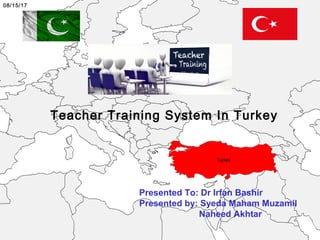
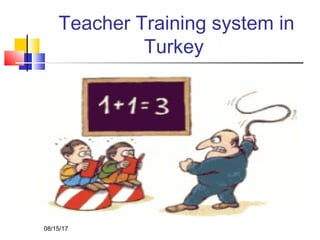
Teacher Training System In Turkey
Presented To: Dr Irfan Bashir
Presented by: Syeda Maham Muzamil
Naheed Akhtar
08/15/17
The General Information about The Republic of Turkey
08/15/17
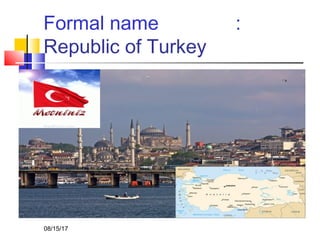
Formal name :
Republic of Turkey
08/15/17
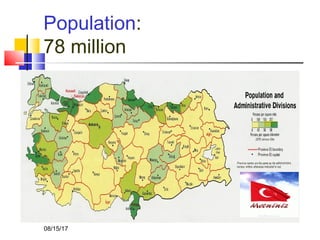
Population:
78 million
08/15/17
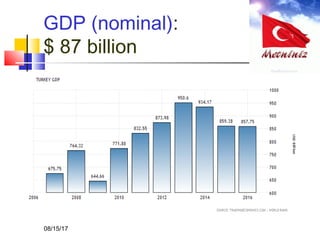
GDP (nominal):
$ 87 billion
08/15/17
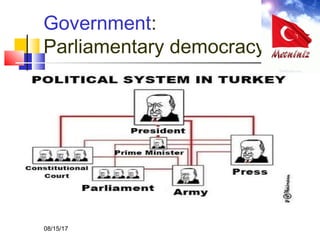
Government:
Parliamentary democracy
08/15/17
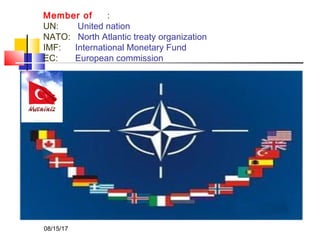
Member of :
UN: United nation
NATO: North Atlantic treaty organization
IMF: International Monetary Fund
EC: European commission
08/15/17
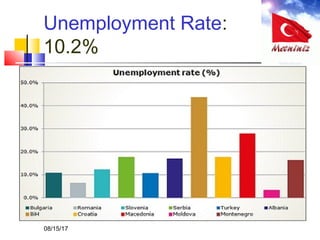
Unemployment Rate:
10.2%
08/15/17
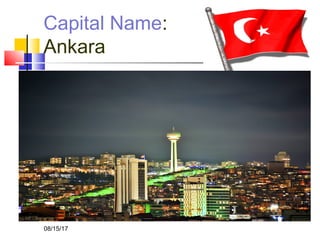
Capital Name:
Ankara
08/15/17
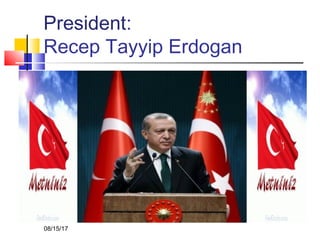
President:
Recep Tayyip Erdogan
08/15/17
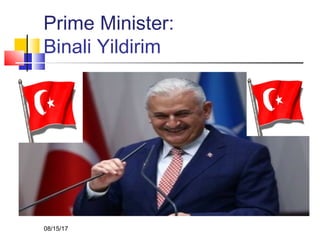
Prime Minister:
Binali Yildirim
08/15/17
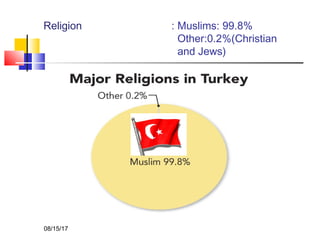
Religion : Muslims: 99.8%
Other:0.2%(Christian
and Jews)
08/15/17
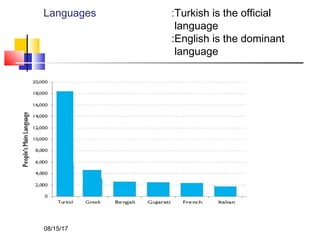
Languages :Turkish is the official
language
:English is the dominant
language
08/15/17
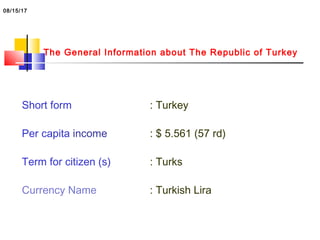
The General Information about The Republic of Turkey
Short form : Turkey
Per capita income : $ 5.561 (57 rd)
Term for citizen (s) : Turks
Currency Name : Turkish Lira
08/15/17
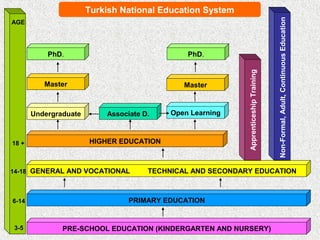
Turkish National Education System
PRE-SCHOOL EDUCATION (KINDERGARTEN AND NURSERY)
PRIMARY EDUCATION
AGE
3-5
6-14
GENERAL AND VOCATIONAL TECHNICAL AND SECONDARY EDUCATION14-18
HIGHER EDUCATION
ApprenticeshipTraining
Non-Formal,Adult,ContinuousEducation
18 +
Open LearningAssociate D.Undergraduate
Master
PhD.
Master
PhD.
Teacher Training system in
Turkey
08/15/17
Outline
 Teaching Profession
 History of Teacher training in Turkey
 Objectives of Teacher Training
 Level wise Number of teachers, Teacher Training Institutes, and
Students in Turkey
 Curriculum of teacher education: Turkey
 Accreditation in teacher training
 Policies Of Teacher Education
 Teacher Education Programs
 Pre & in-service Teacher Education
 Teaching Profession Entrance Examination
 Strengths and Weaknesses of Teacher Training in Turkey
 Discussion
08/15/17
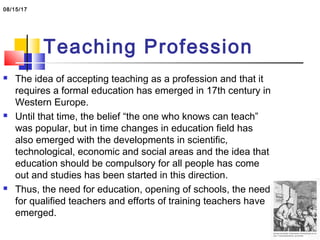
Teaching Profession
 The idea of accepting teaching as a profession and that it
requires a formal education has emerged in 17th century in
Western Europe.
 Until that time, the belief “the one who knows can teach”
was popular, but in time changes in education field has
also emerged with the developments in scientific,
technological, economic and social areas and the idea that
education should be compulsory for all people has come
out and studies has been started in this direction.
 Thus, the need for education, opening of schools, the need
for qualified teachers and efforts of training teachers have
emerged.
08/15/17
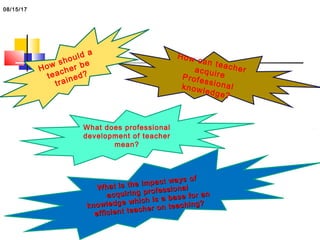
How can teacheracquireProfessionalknowledge?
How should a
teacher be
trained?
What does professional
development of teacher
mean?
What is the impact ways of
acquiring professional
knowledge which is a base for an
efficient teacher on teaching?
08/15/17
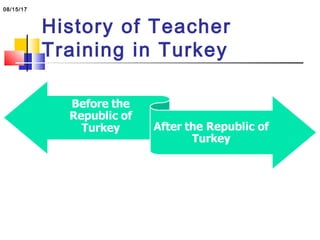
History of Teacher
Training in Turkey
08/15/17
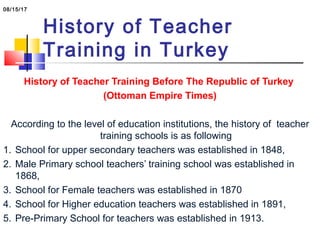
History of Teacher
Training in Turkey
History of Teacher Training Before The Republic of Turkey
(Ottoman Empire Times)
According to the level of education institutions, the history of teacher
training schools is as following
1. School for upper secondary teachers was established in 1848,
2. Male Primary school teachers’ training school was established in
1868,
3. School for Female teachers was established in 1870
4. School for Higher education teachers was established in 1891,
5. Pre-Primary School for teachers was established in 1913.
08/15/17
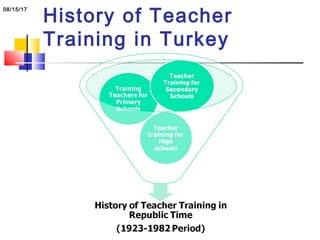
History of Teacher
Training in Turkey
08/15/17
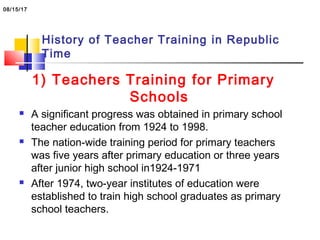
History of Teacher Training in Republic
Time
1) Teachers Training for Primary
Schools
 A significant progress was obtained in primary school
teacher education from 1924 to 1998.
 The nation-wide training period for primary teachers
was five years after primary education or three years
after junior high school in1924-1971
 After 1974, two-year institutes of education were
established to train high school graduates as primary
school teachers.
08/15/17
History of Teacher Training in Republic
Time
2) Teacher Training for Secondary
Schools
 In 1982 advanced education change, teacher training schools and
institutions were connected to YOK (Yuksek Ogretim Kurulu Turkish).
 In 1982, three-year institutes of education took the responsibility of
training teachers for secondary schools. Meanwhile, in 1976 the length
of education was increased to four year and they were reorganized
under the new name as Higher Teacher Training Colleges with new
departments such as Physics, Chemistry, History, Geography, Turkish
language and Literature, etc.
08/15/17
History of Teacher Training in Republic
Time
3) PGCE
(postgraduate certificate in education)
based Education 1982-1998
 For this purpose, National Committee of Teacher Training
(NCTT) was set up to supervise, evaluate and analyze teacher
training programs of faculties and determined the needs and
expectations.
 To achieve these goals in education, the Turkish Higher
Education Council (YOK) began to work on projects which would
enable to train well-equipped and skillful teachers
08/15/17
Transferring Teacher Training to
Universities (1982-)
Why Universities?
In 1978-1979 with a few weeks training which only
included theoretical knowledge but not practical studies,
70.000 people were assigned as teachers.
Between 1974-1980 15.000 people became a teacher
with training and 42.000 people became a teacher
without having any training just attending some exams.
Selection of students were conducted with a written
essay exam and interviews.
08/15/17
Objectives
 Quality in instruction, training, and
administration.
 Acquire knowledge about the current policies
and strategies for the organization and
management of initial and in-service teachers
training activities.
 Acquire information about how initial and in-
service teachers training initiatives are
organized and managed in Turkey.
08/15/17
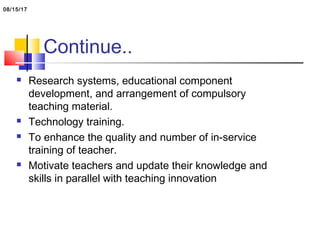
Continue..
 Research systems, educational component
development, and arrangement of compulsory
teaching material.
 Technology training.
 To enhance the quality and number of in-service
training of teacher.
 Motivate teachers and update their knowledge and
skills in parallel with teaching innovation
08/15/17
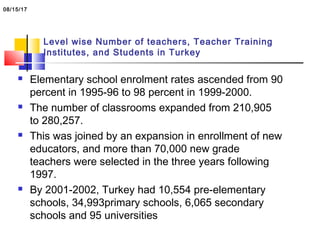
Level wise Number of teachers, Teacher Training
Institutes, and Students in Turkey
 Elementary school enrolment rates ascended from 90
percent in 1995-96 to 98 percent in 1999-2000.
 The number of classrooms expanded from 210,905
to 280,257.
 This was joined by an expansion in enrollment of new
educators, and more than 70,000 new grade
teachers were selected in the three years following
1997.
 By 2001-2002, Turkey had 10,554 pre-elementary
schools, 34,993primary schools, 6,065 secondary
schools and 95 universities
08/15/17
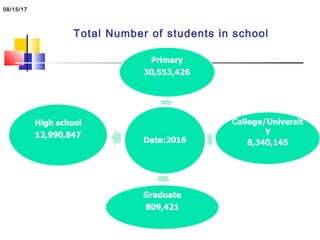
DepaTotal Number of students in school
rtments in Faculty of Education
08/15/17
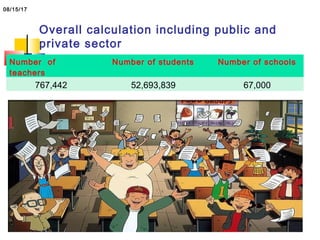
Overall calculation including public and
private sector
Number of
teachers
Number of students Number of schools
767,442 52,693,839 67,000
08/15/17
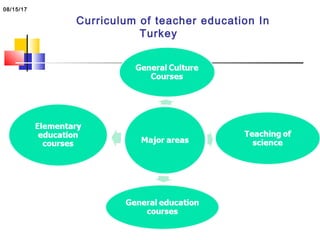
DepaCurriculum of teacher education In
Turkey
rtments in Faculty of Education
08/15/17
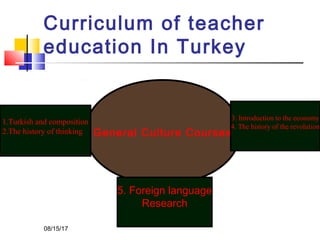
Curriculum of teacher
education In Turkey
General Culture Courses
5. Foreign language
Research
3. Introduction to the economy
4. The history of the revolution
1.Turkish and composition
2.The history of thinking
08/15/17
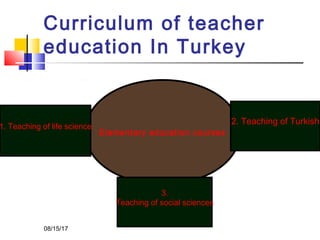
Curriculum of teacher
education In Turkey
Elementary education courses
3.
Teaching of social sciences
2. Teaching of Turkish
1. Teaching of life science
08/15/17
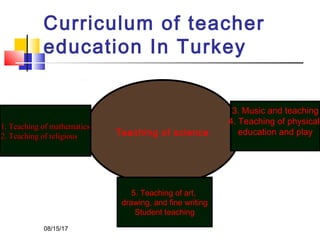
Curriculum of teacher
education In Turkey
Teaching of science
5. Teaching of art,
drawing, and fine writing
Student teaching
3. Music and teaching
4. Teaching of physical
education and play
1. Teaching of mathematics1. Teaching of mathematics
2. Teaching of religious2. Teaching of religious
08/15/17
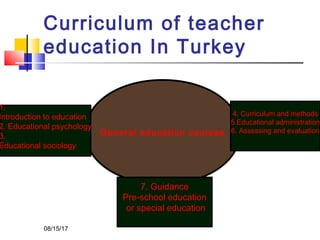
Curriculum of teacher
education In Turkey
General education courses
7. Guidance
Pre-school education
or special education
4. Curriculum and methods
5.Educational administration
6. Assessing and evaluation
1.
Introduction to education
2. Educational psychology
3.
Educational sociology
08/15/17
Policies of Teacher Education
 Teacher education is provided at universities and university
colleges.
 Some of the university colleges for arts provide teacher
education in practical arts subjects.
 A teaching qualification is obtained after completion of between
three and five and a half years of full-time studies– different
educational levels requires different amounts of credit points.
 The teaching degrees comprise general courses as well as
specialisation courses such as sports, foreign languages etc.
 Teacher students who intend to work with pupils with special
needs receive special training
08/15/17
Policies of Teacher Education
 Today's teacher education in Turkey is completely managed by
Council of Higher Education, and carried out at university's faculties of
education. In addition, some of the graduates of the universities that
are identified by the Ministry of Higher Education are appointed in
case they obtain a pedagogic formation certificate.
 The meeting of Council of Higher Education on 09.02.2012 concluded
that teacher education programs that are either open or distance
oriented would not accepts students by 2012-2013 academic years,
thus programs of Anadolu University Open Education Faculty such as
Early Childhood Education and English language teacher education
programs did not accept students.
 Moreover, the night programs of all teacher education programs were
closed, except from Early Childhood, Counseling and Psychological
Advising, Special Education, Religion Culture and Ethics teacher
education programs.
08/15/17
Pre and In Service Training
 Planned and conducted by the Ministry
of Education at both local and national
level when it is necessary.
 Depending on the developments in
various areas such as technology,
pedagogy and management.
08/15/17
Teacher Training
Programme
08/15/17
Teacher Training Programme
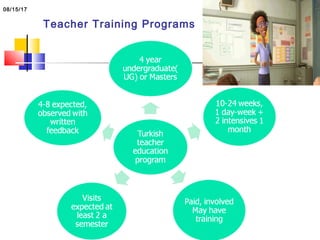
 Teachers were trained via Pedagogical Formation
programme conducted by the departments of
education in some universities since the midst of
1970s.
 In other words, the students of certain faculties
(science, literature etc.) would both attend their
undergraduate programs and took the pedagogical
proficiency courses parallel to these programs.
08/15/17
Teacher Training Programs
08/15/17
Current Situation in Teacher
Training
 Today's teacher education in Turkey is completely managed by
Council of Higher Education, and carried out at university's faculties of
education. In addition, some of the graduates of the universities that
are identified by the Ministry of Higher Education are appointed in
case they obtain a pedagogic formation certificate.
08/15/17
Accreditation in Teacher
Training
08/15/17
Accreditation in Teacher
Training
 Firstly, with the cooperation of HEC and World Bank,
teacher education programs have been readjusted
and a common curriculum in all teacher education
institutions has been applied.
 To increase the quality in this application, teacher
education standards and an accreditation model have
been developed. Afterwards, to complete the
application finally, HEC and MEB have determined
the teacher competencies.
08/15/17
Selection of Teacher Candidates and
Students’ Profile
08/15/17
Selection of Teacher Candidates and Students’
Profile
 Applicants must fulfill the necessary qualifications for higher
education, and any other special qualifications prescribed by the
higher education institution itself.
 Candidates need to take a national university entrance
examination and get a grade that is adequate for the university
chosen by the test.
 This practice is common for all programs at tertiary level in
Turkey.
 The candidates should have diploma of a upper secondary
program and have taken the required grade from the university
entrance examination for the given university and the program.
08/15/17
The Strengths and Weaknesses of
teacher training in turkey
08/15/17
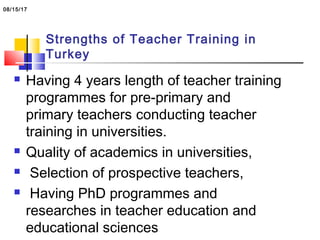
Strengths of Teacher Training in
Turkey
 Having 4 years length of teacher training
programmes for pre-primary and
primary teachers conducting teacher
training in universities.
 Quality of academics in universities,
 Selection of prospective teachers,
 Having PhD programmes and
researches in teacher education and
educational sciences
08/15/17
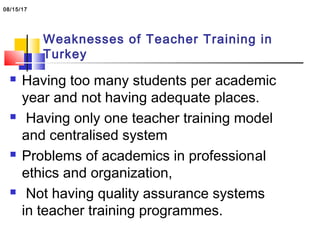
Weaknesses of Teacher Training in
Turkey
 Having too many students per academic
year and not having adequate places.
 Having only one teacher training model
and centralised system
 Problems of academics in professional
ethics and organization,
 Not having quality assurance systems
in teacher training programmes.
08/15/17

Teacher Training system in Turkey

  • 1.
  • 2.
    Teacher Training SystemIn Turkey Presented To: Dr Irfan Bashir Presented by: Syeda Maham Muzamil Naheed Akhtar 08/15/17
  • 3.
    The General Informationabout The Republic of Turkey 08/15/17
  • 4.
    Formal name : Republicof Turkey 08/15/17
  • 5.
  • 6.
    GDP (nominal): $ 87billion 08/15/17
  • 7.
  • 8.
    Member of : UN:United nation NATO: North Atlantic treaty organization IMF: International Monetary Fund EC: European commission 08/15/17
  • 9.
  • 10.
  • 11.
  • 12.
  • 13.
    Religion : Muslims:99.8% Other:0.2%(Christian and Jews) 08/15/17
  • 14.
    Languages :Turkish isthe official language :English is the dominant language 08/15/17
  • 15.
    The General Informationabout The Republic of Turkey Short form : Turkey Per capita income : $ 5.561 (57 rd) Term for citizen (s) : Turks Currency Name : Turkish Lira 08/15/17
  • 16.
    Turkish National EducationSystem PRE-SCHOOL EDUCATION (KINDERGARTEN AND NURSERY) PRIMARY EDUCATION AGE 3-5 6-14 GENERAL AND VOCATIONAL TECHNICAL AND SECONDARY EDUCATION14-18 HIGHER EDUCATION ApprenticeshipTraining Non-Formal,Adult,ContinuousEducation 18 + Open LearningAssociate D.Undergraduate Master PhD. Master PhD.
  • 17.
    Teacher Training systemin Turkey 08/15/17
  • 18.
    Outline  Teaching Profession History of Teacher training in Turkey  Objectives of Teacher Training  Level wise Number of teachers, Teacher Training Institutes, and Students in Turkey  Curriculum of teacher education: Turkey  Accreditation in teacher training  Policies Of Teacher Education  Teacher Education Programs  Pre & in-service Teacher Education  Teaching Profession Entrance Examination  Strengths and Weaknesses of Teacher Training in Turkey  Discussion 08/15/17
  • 19.
    Teaching Profession  Theidea of accepting teaching as a profession and that it requires a formal education has emerged in 17th century in Western Europe.  Until that time, the belief “the one who knows can teach” was popular, but in time changes in education field has also emerged with the developments in scientific, technological, economic and social areas and the idea that education should be compulsory for all people has come out and studies has been started in this direction.  Thus, the need for education, opening of schools, the need for qualified teachers and efforts of training teachers have emerged. 08/15/17
  • 20.
    How can teacheracquireProfessionalknowledge? Howshould a teacher be trained? What does professional development of teacher mean? What is the impact ways of What is the impact ways of acquiring professional acquiring professional knowledge which is a base for an knowledge which is a base for an efficient teacher on teaching? efficient teacher on teaching? 08/15/17
  • 21.
    History of Teacher Trainingin Turkey 08/15/17
  • 22.
    History of Teacher Trainingin Turkey History of Teacher Training Before The Republic of Turkey (Ottoman Empire Times) According to the level of education institutions, the history of teacher training schools is as following 1. School for upper secondary teachers was established in 1848, 2. Male Primary school teachers’ training school was established in 1868, 3. School for Female teachers was established in 1870 4. School for Higher education teachers was established in 1891, 5. Pre-Primary School for teachers was established in 1913. 08/15/17
  • 23.
    History of Teacher Trainingin Turkey 08/15/17
  • 24.
    History of TeacherTraining in Republic Time 1) Teachers Training for Primary Schools  A significant progress was obtained in primary school teacher education from 1924 to 1998.  The nation-wide training period for primary teachers was five years after primary education or three years after junior high school in1924-1971  After 1974, two-year institutes of education were established to train high school graduates as primary school teachers. 08/15/17
  • 25.
    History of TeacherTraining in Republic Time 2) Teacher Training for Secondary Schools  In 1982 advanced education change, teacher training schools and institutions were connected to YOK (Yuksek Ogretim Kurulu Turkish).  In 1982, three-year institutes of education took the responsibility of training teachers for secondary schools. Meanwhile, in 1976 the length of education was increased to four year and they were reorganized under the new name as Higher Teacher Training Colleges with new departments such as Physics, Chemistry, History, Geography, Turkish language and Literature, etc. 08/15/17
  • 26.
    History of TeacherTraining in Republic Time 3) PGCE (postgraduate certificate in education) based Education 1982-1998  For this purpose, National Committee of Teacher Training (NCTT) was set up to supervise, evaluate and analyze teacher training programs of faculties and determined the needs and expectations.  To achieve these goals in education, the Turkish Higher Education Council (YOK) began to work on projects which would enable to train well-equipped and skillful teachers 08/15/17
  • 27.
    Transferring Teacher Trainingto Universities (1982-) Why Universities? In 1978-1979 with a few weeks training which only included theoretical knowledge but not practical studies, 70.000 people were assigned as teachers. Between 1974-1980 15.000 people became a teacher with training and 42.000 people became a teacher without having any training just attending some exams. Selection of students were conducted with a written essay exam and interviews. 08/15/17
  • 28.
    Objectives  Quality ininstruction, training, and administration.  Acquire knowledge about the current policies and strategies for the organization and management of initial and in-service teachers training activities.  Acquire information about how initial and in- service teachers training initiatives are organized and managed in Turkey. 08/15/17
  • 29.
    Continue..  Research systems,educational component development, and arrangement of compulsory teaching material.  Technology training.  To enhance the quality and number of in-service training of teacher.  Motivate teachers and update their knowledge and skills in parallel with teaching innovation 08/15/17
  • 30.
    Level wise Numberof teachers, Teacher Training Institutes, and Students in Turkey  Elementary school enrolment rates ascended from 90 percent in 1995-96 to 98 percent in 1999-2000.  The number of classrooms expanded from 210,905 to 280,257.  This was joined by an expansion in enrollment of new educators, and more than 70,000 new grade teachers were selected in the three years following 1997.  By 2001-2002, Turkey had 10,554 pre-elementary schools, 34,993primary schools, 6,065 secondary schools and 95 universities 08/15/17
  • 31.
    DepaTotal Number ofstudents in school rtments in Faculty of Education 08/15/17
  • 32.
    Overall calculation includingpublic and private sector Number of teachers Number of students Number of schools 767,442 52,693,839 67,000 08/15/17
  • 33.
    DepaCurriculum of teachereducation In Turkey rtments in Faculty of Education 08/15/17
  • 34.
    Curriculum of teacher educationIn Turkey General Culture Courses 5. Foreign language Research 3. Introduction to the economy 4. The history of the revolution 1.Turkish and composition 2.The history of thinking 08/15/17
  • 35.
    Curriculum of teacher educationIn Turkey Elementary education courses 3. Teaching of social sciences 2. Teaching of Turkish 1. Teaching of life science 08/15/17
  • 36.
    Curriculum of teacher educationIn Turkey Teaching of science 5. Teaching of art, drawing, and fine writing Student teaching 3. Music and teaching 4. Teaching of physical education and play 1. Teaching of mathematics1. Teaching of mathematics 2. Teaching of religious2. Teaching of religious 08/15/17
  • 37.
    Curriculum of teacher educationIn Turkey General education courses 7. Guidance Pre-school education or special education 4. Curriculum and methods 5.Educational administration 6. Assessing and evaluation 1. Introduction to education 2. Educational psychology 3. Educational sociology 08/15/17
  • 38.
    Policies of TeacherEducation  Teacher education is provided at universities and university colleges.  Some of the university colleges for arts provide teacher education in practical arts subjects.  A teaching qualification is obtained after completion of between three and five and a half years of full-time studies– different educational levels requires different amounts of credit points.  The teaching degrees comprise general courses as well as specialisation courses such as sports, foreign languages etc.  Teacher students who intend to work with pupils with special needs receive special training 08/15/17
  • 39.
    Policies of TeacherEducation  Today's teacher education in Turkey is completely managed by Council of Higher Education, and carried out at university's faculties of education. In addition, some of the graduates of the universities that are identified by the Ministry of Higher Education are appointed in case they obtain a pedagogic formation certificate.  The meeting of Council of Higher Education on 09.02.2012 concluded that teacher education programs that are either open or distance oriented would not accepts students by 2012-2013 academic years, thus programs of Anadolu University Open Education Faculty such as Early Childhood Education and English language teacher education programs did not accept students.  Moreover, the night programs of all teacher education programs were closed, except from Early Childhood, Counseling and Psychological Advising, Special Education, Religion Culture and Ethics teacher education programs. 08/15/17
  • 40.
    Pre and InService Training  Planned and conducted by the Ministry of Education at both local and national level when it is necessary.  Depending on the developments in various areas such as technology, pedagogy and management. 08/15/17
  • 41.
  • 42.
    Teacher Training Programme Teachers were trained via Pedagogical Formation programme conducted by the departments of education in some universities since the midst of 1970s.  In other words, the students of certain faculties (science, literature etc.) would both attend their undergraduate programs and took the pedagogical proficiency courses parallel to these programs. 08/15/17
  • 43.
  • 44.
    Current Situation inTeacher Training  Today's teacher education in Turkey is completely managed by Council of Higher Education, and carried out at university's faculties of education. In addition, some of the graduates of the universities that are identified by the Ministry of Higher Education are appointed in case they obtain a pedagogic formation certificate. 08/15/17
  • 45.
  • 46.
    Accreditation in Teacher Training Firstly, with the cooperation of HEC and World Bank, teacher education programs have been readjusted and a common curriculum in all teacher education institutions has been applied.  To increase the quality in this application, teacher education standards and an accreditation model have been developed. Afterwards, to complete the application finally, HEC and MEB have determined the teacher competencies. 08/15/17
  • 47.
    Selection of TeacherCandidates and Students’ Profile 08/15/17
  • 48.
    Selection of TeacherCandidates and Students’ Profile  Applicants must fulfill the necessary qualifications for higher education, and any other special qualifications prescribed by the higher education institution itself.  Candidates need to take a national university entrance examination and get a grade that is adequate for the university chosen by the test.  This practice is common for all programs at tertiary level in Turkey.  The candidates should have diploma of a upper secondary program and have taken the required grade from the university entrance examination for the given university and the program. 08/15/17
  • 49.
    The Strengths andWeaknesses of teacher training in turkey 08/15/17
  • 50.
    Strengths of TeacherTraining in Turkey  Having 4 years length of teacher training programmes for pre-primary and primary teachers conducting teacher training in universities.  Quality of academics in universities,  Selection of prospective teachers,  Having PhD programmes and researches in teacher education and educational sciences 08/15/17
  • 51.
    Weaknesses of TeacherTraining in Turkey  Having too many students per academic year and not having adequate places.  Having only one teacher training model and centralised system  Problems of academics in professional ethics and organization,  Not having quality assurance systems in teacher training programmes. 08/15/17

Editor's Notes

  • #4 GDP:Gross Domestic product Rd: Rank degree