EDUCATION
IN
TÜRKİYE
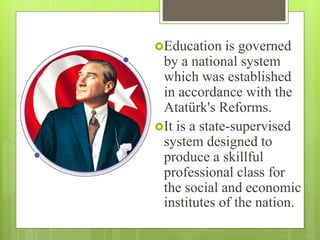
Education is governed
by a national system
which was established
in accordance with the
Atatürk's Reforms.
It is a state-supervised
system designed to
produce a skillful
professional class for
the social and economic
institutes of the nation.
Turkish Education System has democratic,
modern, secular andco-education characteristics.
The aims of the system are;
to increase prosperity and welfare of Turkish
citizens and society,
to make Turkish Nation contemporary
civilisations constructive, creative and
distinguished partner
Turkish National Educational System
has two main parts:
Formal Education
Non-formal Education
Formal Education
Now that the new system of 4+4+4 has been
implemented on 12 April 2012.
5 years old: Primary School begins and
attendance to school is compulsory.
9/10 years old: Secondary School begins and
attendance to school is compulsory.
13/14 years old: High School begins. Distance
education, Religious high school an option.
There are Public Schools and also Private Schools.
Pre-primary School Education
Pre-primary education includes the
optional education of children
between 36–72-month who are under
the age of compulsory primary
education. The levels are:
Nurseries 0-36 months
Kindergarden 37-60 months
Pre-school Class 61-72 months
Primary School Education
Primary school lasts 4 years. Primary
education covers the education, is
compulsory for all citizens, boys or
girls, and is given free of charge in
Public schools.
Secondary School Education
The aims of Secondary Education are;
to prepare the students for life and for the
next education level paralel to his / her
interest and skills.
to prepare them for High School education
High School Education
The aims of High School Education are;
to provide the students with common
general culture
To prepare them for tertiary education,
life and vocational fields in accordance
with their interests and talents through
various programmes.
The Education program includes;
Turkish language, Turkish Literature,
Mathmatics, Social sciences, Scince, Human
rights
History, Geography, Philosophy,
Music, art / handicraft, physical education
Foreign Languages (English, German,..)
Religious Culture and ethics
Individual and group activities
Traffic safety and first aid
Career guidance and elective courses.
Non-formal Education
In our country Non-formal education is
realized by;
Public Training
Apprenticeship Education
Distance Education
Non-formal Education aims;
to teach adults how to read and write,
to provide basic knowledge,
to develop further knowledge and skills
already acquired
to create new opportunities for
improving their standard of living
Thanks for your interest

EDUCATION IN TÜRKİYE.pptx

  • 2.
  • 3.
    Education is governed bya national system which was established in accordance with the Atatürk's Reforms. It is a state-supervised system designed to produce a skillful professional class for the social and economic institutes of the nation.
  • 4.
    Turkish Education Systemhas democratic, modern, secular andco-education characteristics. The aims of the system are; to increase prosperity and welfare of Turkish citizens and society, to make Turkish Nation contemporary civilisations constructive, creative and distinguished partner
  • 5.
    Turkish National EducationalSystem has two main parts: Formal Education Non-formal Education
  • 6.
    Formal Education Now thatthe new system of 4+4+4 has been implemented on 12 April 2012. 5 years old: Primary School begins and attendance to school is compulsory. 9/10 years old: Secondary School begins and attendance to school is compulsory. 13/14 years old: High School begins. Distance education, Religious high school an option. There are Public Schools and also Private Schools.
  • 7.
    Pre-primary School Education Pre-primaryeducation includes the optional education of children between 36–72-month who are under the age of compulsory primary education. The levels are: Nurseries 0-36 months Kindergarden 37-60 months Pre-school Class 61-72 months
  • 8.
    Primary School Education Primaryschool lasts 4 years. Primary education covers the education, is compulsory for all citizens, boys or girls, and is given free of charge in Public schools.
  • 9.
    Secondary School Education Theaims of Secondary Education are; to prepare the students for life and for the next education level paralel to his / her interest and skills. to prepare them for High School education
  • 10.
    High School Education Theaims of High School Education are; to provide the students with common general culture To prepare them for tertiary education, life and vocational fields in accordance with their interests and talents through various programmes.
  • 11.
    The Education programincludes; Turkish language, Turkish Literature, Mathmatics, Social sciences, Scince, Human rights History, Geography, Philosophy, Music, art / handicraft, physical education Foreign Languages (English, German,..) Religious Culture and ethics Individual and group activities Traffic safety and first aid Career guidance and elective courses.
  • 12.
    Non-formal Education In ourcountry Non-formal education is realized by; Public Training Apprenticeship Education Distance Education
  • 13.
    Non-formal Education aims; toteach adults how to read and write, to provide basic knowledge, to develop further knowledge and skills already acquired to create new opportunities for improving their standard of living
  • 14.