
 FULL CONCENTRATION & FOCUS
 ACTIVE INVOLVEMENT
 MAKE NOTES
 PARTICIPATION (PAIR/GROUP WORK)
 SHARING (EXPERIENCES/IDEAS/SUGGESTIONS)
THE LYCEUM LGCS
 EACH TEACHER WILL HAVE 100 POINTS IN THEIR BAG TO
START off WITH .
 To qualify for the annual increment slab, a teacher must have
90 points in the bag at the end of academic session.
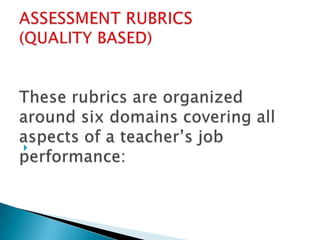
 Teachers will be assessed in six domains throughout the year.
(Appendix A) Quality based
 +
 Monthly Teacher Report (Appendix B) Punctuality &
Time based
 If a teacher fails to meet the minimum standard in any
domain , points will be deducted accordingly.
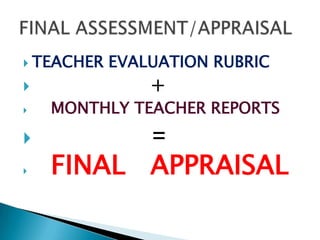
 TEACHER EVALUATION RUBRIC
 +
 MONTHLY TEACHER REPORTS
 =
 FINAL APPRAISAL
APPENDIX B
 If a teacher fails to submit results on time ,2
points will be deducted from the total‟
 100-2=98
 If a teacher submits the planner after
specified time,2 points will be deducted as
well 100-2=98
 If the same teacher fails to submit results and
planner on time then 98-2=96
 Teachers who reach the finish line
(academic year) with max points will be
eligible for increment

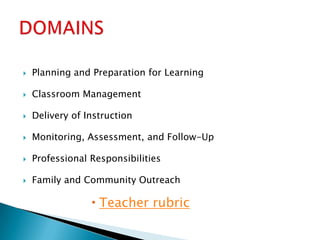
 Planning and Preparation for Learning
 Classroom Management
 Delivery of Instruction
 Monitoring, Assessment, and Follow-Up
 Professional Responsibilities
 Family and Community Outreach
 Teacher rubric
 Highly Effective (HE)

 Effective (E)
 RED ZONES

 -1 Improvement Necessary (IN)
 -2 Does Not Meet Standards (NS)

 The rubrics are designed to give teachers not only an
end-of-the-year but also ongoing assessment of
where they stand in all performance areas and
detailed guidance on how to improve.
 They are not checklists for classroom visits
 Unannounced mini-observations every 2-3 weeks
followed by face-to-face conversations are the best
way for Branch Heads to have an accurate sense of
teachers‟ performance, give ongoing praise and
suggestions, and listen to concerns.
 The Effective level describes solid, expected
professional performance; teachers should
feel good about scoring at this level.

 The Highly Effective level is reserved for truly
outstanding teaching that meets very
demanding criteria; there will be relatively
few ratings at this level. (Extra mile )
 Improvement Necessary indicates that
performance has real deficiencies; no teacher
should be content to remain at this level.
 Performance at the Does Not Meet Standards
level is clearly unacceptable should lead to
dismissal if it is not improved immediately.


 Follows prescribed curriculum
 • Uses available materials and resources & chooses activities
appropriate for students
 (web,worksheets,charts,presentations etc)
 Chooses activities relevant to the prescribed curriculum and student
abilities
 Considers time available in planning, keeping in mind ample time for
students‟ involvement and practice. ( Hands on learning)
 Demonstrates flexibility in planning
 Plans student grouping according to instructional needs .
 Develops long-range plans and daily lessons

 What is it?
 To understand just go through this quotation
 "Tell me, I'll forget. Show me, I'll remember. Involve
me, I'll understand"
 Hands-on learning is an educational method that
directly involves the learner, by actively encouraging
them to do something in order to learn about it.
 In short, it is 'learning by doing„
 CAN YOU THINK OF EXAMPLES?
 First and foremost, it is clear that there are certain
situations in which hands-on learning is the only way
to teach something.
 For example, there is no use trying to teach a child to
ride a bicycle in a traditional classroom - they need to
get outside to try out a bike.
 It gives ample time and opportunities to learn.
 Furthermore, hands-on learning allows students to
directly observe and understand what is happening.
 This is a particularly successful way to teach
kinesthetic learners, who learn best by example.
 It also encourages young pupils to do things for
themselves, which will help them with learning
independently later on in life.
 Focuses student attention
 Informs students of objectives of the lesson
Relates the lesson to previous and future lessons
 Presents new material clearly and logically
 Models, demonstrates and provides examples
 Monitors student learning continuously

 Highly engaging homework?
 What is your take on that?
 Arguments against giving home work
 „there is no point of setting homework for the sake of it‟,
 „children need to have a childhood, why rob them of their
evenings‟
 „research shows that homework doesn‟t make much difference‟.
 „I couldn‟t possibly cope with all the marking if I set homework
every week‟ (teacher view)
 „half the class won‟t do it anyway, so what‟s the point‟
 Bridging between teacher-led and student-
led learning:
 Extending learning time.
 Creating Opportunities for Creativity and
Choice.
 Developing the skills required for
independent learning
 there is always a „sake‟ because homework
can and should always be an integral part of
the learning process
 the research doesn‟t really deal fully with the
nature of homework being set; we are not
just talking about any old task – we are
talking about great homework that feeds into
lessons and provides exciting opportunities
for student-led learning and creativity
 • Provides feedback on assignments as quickly
as possible .(Timely)
 • Gives written and oral comments, as well as
points with corrections.
 • Makes opportunities for one-to-one
conferences to discuss student progress

 • Interprets test results to students and parents
on time

 What is meant by one to one
conferences/meeting/feedback?
 Advantages
 Disadvantages
 ADVANTAGES
 The student has the undivided attention of the teacher.

 More opportunity to engage in real communication, more
feedback and better understanding of the learner‟s needs.
 The student has more opportunities to use the teacher as a
resource – to ask questions, to see models of language, and to
practise skills.
 The learner can develop a real and productive relationship with
the teacher
 The learner‟s needs can be addressed more fully because there is
more flexibility in timing and structure.
 The teacher has a greater opportunity to engage in real
interaction and to learn.
 Classes can be physically and mentally exhausting for learner and teacher.
 The class may become boring if the teacher does not find new approaches
or the learner does not respond to the class.
 There are no opportunities to interact with other learners, develop a group
dynamic and to receive support.
 The learner and teacher may not get on
 The teacher may feel pressurised to achieve results because of a greater
degree of responsibility.
 The teacher may find it difficult to find suitable materials and
activities, and to structure an effective syllabus
 The teacher may feel that they do not have the experience, training or
resources necessary for this kind of class and that they are only effective
working with large groups

 With younger students, we can use a form A
such as the "Stars and Stairs" shown in Figure
1 where the star is the success feedback and
the stair is the intervention feedback.
 This helps establish a forward-looking stance
to corrective feedback: "What's my next step?
What do I need to do to accomplish this
learning?
 STARS AND STAIRS
 With older students, we can use a similar frame
with a section labelled.
 Asking students to think about their work before
receiving feedback scratches up the "soil" in the
brain so the feedback seeds have a place to settle
in and grow.
 In addition, this offers guided practice for
students in becoming competent self-assessors.
 FIGURE 2
 Written feedback can be a powerful tool for
helping students to move forward in their
learning.
 Do you remember ever getting an English paper
with more red marks than your original writing?
Did you feel that it was hopeless to try to write?
 Written feedback has the advantage that the
student can refer to it over and over again.
 With oral feedback, the student may forget
what was said.

- WRITE your comments in eligible writing so that students can read
them.

- Write your feedback in student understandable talk and don‟t
forget to give corrections.
 FOLLOW UP
- Instead of telling , asking questions
- Be positive or neutral, never negative!

- Be very concrete about what the student needs to do to improve
 AND FOLLOW UP
 Avoid “Write better”, “Enlarge ideas,” and “Be specific.”

-Review your written feedback notes for students to see if you need
to do whole class, small group, pair or individual focused instruction.

- Allow an opportunity for the student to re-do the work. Student
 learning is the REAL purpose.
 • Participates in professional workshops
 • Attends professional meetings and gives useful suggestions.
 • Keeps current in subject area
 • Engages in continuing education
 KEY to successful & Effective teaching
 Observe
 Imagine
 Innovate

 Adheres to authorized policies .
 . Selects appropriate AND proper channels for resolving
concerns/problems
 Participates in the development and review of school policies
and regulations.

 • Strives to stay informed regarding policies and regulations
applicable to his/her position
 • Exercises responsibility for student management
throughout the entire building .
 • Uses discretion in handling confidential information

 I will trust you until you give me reason to do
otherwise.
 I will respect you and work with you to solve
problems.
 I will promptly correct and offer feedback on
your work.
 I will work with you to meet learning goals.
 I will offer extra help and alternative
assessments should you require them.
 THANK YOU FOR YOU
PATIENCE AND INVOLVEMENT
 &
 BEST OF LUCK

Teacher Evaluation Rubrics

  • 2.
     FULL CONCENTRATION& FOCUS  ACTIVE INVOLVEMENT  MAKE NOTES  PARTICIPATION (PAIR/GROUP WORK)  SHARING (EXPERIENCES/IDEAS/SUGGESTIONS)
  • 3.
  • 4.
     EACH TEACHERWILL HAVE 100 POINTS IN THEIR BAG TO START off WITH .  To qualify for the annual increment slab, a teacher must have 90 points in the bag at the end of academic session.  Teachers will be assessed in six domains throughout the year. (Appendix A) Quality based  +  Monthly Teacher Report (Appendix B) Punctuality & Time based  If a teacher fails to meet the minimum standard in any domain , points will be deducted accordingly.
  • 5.
     TEACHER EVALUATIONRUBRIC  +  MONTHLY TEACHER REPORTS  =  FINAL APPRAISAL
  • 6.
  • 7.
     If ateacher fails to submit results on time ,2 points will be deducted from the total‟  100-2=98  If a teacher submits the planner after specified time,2 points will be deducted as well 100-2=98  If the same teacher fails to submit results and planner on time then 98-2=96  Teachers who reach the finish line (academic year) with max points will be eligible for increment
  • 8.
  • 9.
     Planning andPreparation for Learning  Classroom Management  Delivery of Instruction  Monitoring, Assessment, and Follow-Up  Professional Responsibilities  Family and Community Outreach  Teacher rubric
  • 10.
     Highly Effective(HE)   Effective (E)  RED ZONES   -1 Improvement Necessary (IN)  -2 Does Not Meet Standards (NS) 
  • 11.
     The rubricsare designed to give teachers not only an end-of-the-year but also ongoing assessment of where they stand in all performance areas and detailed guidance on how to improve.  They are not checklists for classroom visits  Unannounced mini-observations every 2-3 weeks followed by face-to-face conversations are the best way for Branch Heads to have an accurate sense of teachers‟ performance, give ongoing praise and suggestions, and listen to concerns.
  • 12.
     The Effectivelevel describes solid, expected professional performance; teachers should feel good about scoring at this level.   The Highly Effective level is reserved for truly outstanding teaching that meets very demanding criteria; there will be relatively few ratings at this level. (Extra mile )
  • 13.
     Improvement Necessaryindicates that performance has real deficiencies; no teacher should be content to remain at this level.  Performance at the Does Not Meet Standards level is clearly unacceptable should lead to dismissal if it is not improved immediately.  
  • 15.
     Follows prescribedcurriculum  • Uses available materials and resources & chooses activities appropriate for students  (web,worksheets,charts,presentations etc)  Chooses activities relevant to the prescribed curriculum and student abilities  Considers time available in planning, keeping in mind ample time for students‟ involvement and practice. ( Hands on learning)  Demonstrates flexibility in planning  Plans student grouping according to instructional needs .  Develops long-range plans and daily lessons 
  • 16.
     What isit?  To understand just go through this quotation  "Tell me, I'll forget. Show me, I'll remember. Involve me, I'll understand"  Hands-on learning is an educational method that directly involves the learner, by actively encouraging them to do something in order to learn about it.  In short, it is 'learning by doing„  CAN YOU THINK OF EXAMPLES?
  • 17.
     First andforemost, it is clear that there are certain situations in which hands-on learning is the only way to teach something.  For example, there is no use trying to teach a child to ride a bicycle in a traditional classroom - they need to get outside to try out a bike.  It gives ample time and opportunities to learn.  Furthermore, hands-on learning allows students to directly observe and understand what is happening.  This is a particularly successful way to teach kinesthetic learners, who learn best by example.  It also encourages young pupils to do things for themselves, which will help them with learning independently later on in life.
  • 18.
     Focuses studentattention  Informs students of objectives of the lesson Relates the lesson to previous and future lessons  Presents new material clearly and logically  Models, demonstrates and provides examples  Monitors student learning continuously 
  • 19.
     Highly engaginghomework?  What is your take on that?  Arguments against giving home work  „there is no point of setting homework for the sake of it‟,  „children need to have a childhood, why rob them of their evenings‟  „research shows that homework doesn‟t make much difference‟.  „I couldn‟t possibly cope with all the marking if I set homework every week‟ (teacher view)  „half the class won‟t do it anyway, so what‟s the point‟
  • 20.
     Bridging betweenteacher-led and student- led learning:  Extending learning time.  Creating Opportunities for Creativity and Choice.  Developing the skills required for independent learning
  • 21.
     there isalways a „sake‟ because homework can and should always be an integral part of the learning process  the research doesn‟t really deal fully with the nature of homework being set; we are not just talking about any old task – we are talking about great homework that feeds into lessons and provides exciting opportunities for student-led learning and creativity
  • 22.
     • Providesfeedback on assignments as quickly as possible .(Timely)  • Gives written and oral comments, as well as points with corrections.  • Makes opportunities for one-to-one conferences to discuss student progress   • Interprets test results to students and parents on time 
  • 23.
     What ismeant by one to one conferences/meeting/feedback?  Advantages  Disadvantages
  • 24.
     ADVANTAGES  Thestudent has the undivided attention of the teacher.   More opportunity to engage in real communication, more feedback and better understanding of the learner‟s needs.  The student has more opportunities to use the teacher as a resource – to ask questions, to see models of language, and to practise skills.  The learner can develop a real and productive relationship with the teacher  The learner‟s needs can be addressed more fully because there is more flexibility in timing and structure.  The teacher has a greater opportunity to engage in real interaction and to learn.
  • 25.
     Classes canbe physically and mentally exhausting for learner and teacher.  The class may become boring if the teacher does not find new approaches or the learner does not respond to the class.  There are no opportunities to interact with other learners, develop a group dynamic and to receive support.  The learner and teacher may not get on  The teacher may feel pressurised to achieve results because of a greater degree of responsibility.  The teacher may find it difficult to find suitable materials and activities, and to structure an effective syllabus  The teacher may feel that they do not have the experience, training or resources necessary for this kind of class and that they are only effective working with large groups 
  • 26.
     With youngerstudents, we can use a form A such as the "Stars and Stairs" shown in Figure 1 where the star is the success feedback and the stair is the intervention feedback.  This helps establish a forward-looking stance to corrective feedback: "What's my next step? What do I need to do to accomplish this learning?  STARS AND STAIRS
  • 27.
     With olderstudents, we can use a similar frame with a section labelled.  Asking students to think about their work before receiving feedback scratches up the "soil" in the brain so the feedback seeds have a place to settle in and grow.  In addition, this offers guided practice for students in becoming competent self-assessors.  FIGURE 2
  • 28.
     Written feedbackcan be a powerful tool for helping students to move forward in their learning.  Do you remember ever getting an English paper with more red marks than your original writing? Did you feel that it was hopeless to try to write?  Written feedback has the advantage that the student can refer to it over and over again.  With oral feedback, the student may forget what was said.
  • 29.
     - WRITE yourcomments in eligible writing so that students can read them.  - Write your feedback in student understandable talk and don‟t forget to give corrections.  FOLLOW UP - Instead of telling , asking questions - Be positive or neutral, never negative!  - Be very concrete about what the student needs to do to improve  AND FOLLOW UP  Avoid “Write better”, “Enlarge ideas,” and “Be specific.”  -Review your written feedback notes for students to see if you need to do whole class, small group, pair or individual focused instruction.  - Allow an opportunity for the student to re-do the work. Student  learning is the REAL purpose.
  • 30.
     • Participatesin professional workshops  • Attends professional meetings and gives useful suggestions.  • Keeps current in subject area  • Engages in continuing education  KEY to successful & Effective teaching  Observe  Imagine  Innovate 
  • 31.
     Adheres toauthorized policies .  . Selects appropriate AND proper channels for resolving concerns/problems  Participates in the development and review of school policies and regulations.   • Strives to stay informed regarding policies and regulations applicable to his/her position  • Exercises responsibility for student management throughout the entire building .  • Uses discretion in handling confidential information 
  • 32.
     I willtrust you until you give me reason to do otherwise.  I will respect you and work with you to solve problems.  I will promptly correct and offer feedback on your work.  I will work with you to meet learning goals.  I will offer extra help and alternative assessments should you require them.
  • 33.
     THANK YOUFOR YOU PATIENCE AND INVOLVEMENT  &  BEST OF LUCK