English Teaching Methodology
 BY
 MUHAMMAD HAROON BAIG
 MA TESOL (Oxford),CELTA(Cambridge),MA
Eng(Punjab),PGD TEFL (AIOU)
WORSHOP ON
1)Methodology of English teaching at
middle school/secondary/high school
2)Teaching English as a Second Language
/ TEFL
4) A Course in English Language Teaching
THE NATURE OF
LANGUAGE TEACHING
 1. What's methodology?
English teaching methodology is a set of methods
used for study or action in English teaching. It is the
science to research the Teaching rules at
middle/high school, which will guide our teaching
to develop the students' communicative competence.
2.The nature of language
teaching
2. The definition of teaching.
Teaching is an attempt to help someone
acquire, or change some skills,
attitude,knowledge, ideal, or appreciation.
In other words, the teacher's task is to
create or influence desirable changes in
behavior, or in tendencies toward
behavior, in his/her students.
Let’s reflect about these ideas:
 What are the most important issues when
teaching English today?
About teachers?
About students?
About methodology?
About materials?
about evaluation?
About any other issues?
Strategies in English language
Learning and Teaching
Definition of Strategies:
1. Wenden and Rubin (1987) defines
strategies as…”any set of operations,
steps, plans, routines used by the learner
to facilitate the obtaining, storage,
retrieval, and use of information.”
2. Richards and Platt (1992) state that
learning strategies are “intentional
behavior and thoughts used by learners
during learning so as to better help
them understand, learn or remember
new information.”
Teacher Role in Strategy
Training
 Teacher should
learn about
students
1. Interests
2. Goals
3. motivations
4. Learning styles
5. Purpose for learning
a language
 The most important
teacher role in
English language
teaching is the
provision of a wide
range of tasks to
match the needs of
all students
possessing different
learning styles,
motivations etc.
What is Intelligence?
Gardner's Multiple Intelligence
Theory
Howard Earl Gardner - an American developmental
psychologist who is based at Harvard University.
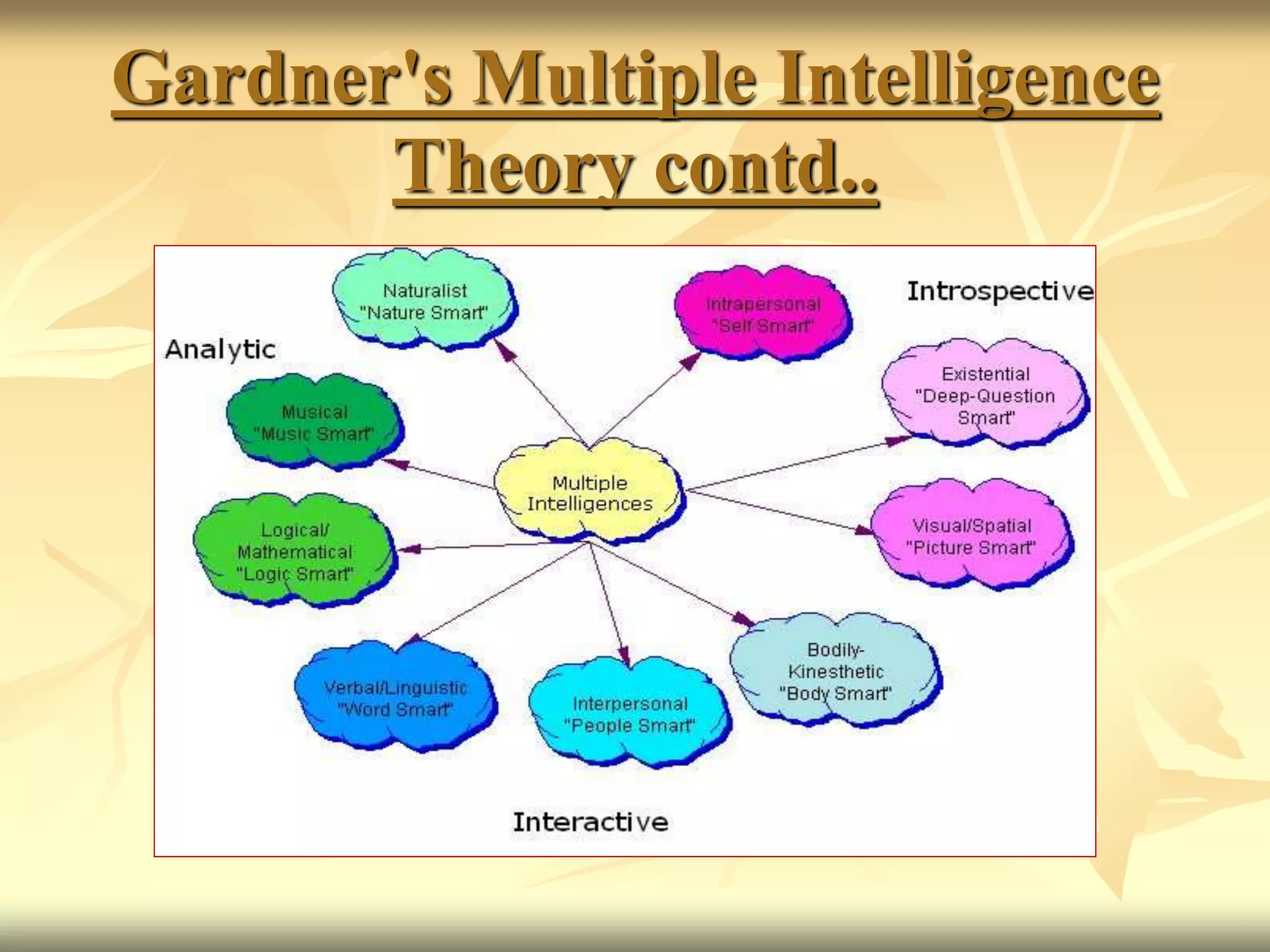
Gardner's Multiple Intelligence
Theory contd..
 Math-logical Intelligence: How my students
will think more logically & critically?
 Linguistic Intelligence: How can I make my
students use spoken or written language to
learn better?
 Interpersonal Intelligence: How to bring
collaborative learning, peer discussions and
interactions in class?
 Intrapersonal Intelligence: How can I provide
my students to reflect about the subject?
Gardner's Multiple Intelligence
Theory contd..
Multiple Intelligence
INTELLIGENCE TYPES AND
APPROPRIATE EDUCATIONAL ACTIVITIES
Intelligence Type Educational Activities
Linguistic lectures, worksheets, word games, journals, debates
Logical puzzles, estimations, problem solving
Spatial charts, diagrams, graphic organizers, drawing, films
Bodily hands-on, mime, craft, demonstrations
Musical singing, poetry, Jazz Chants, mood music
Interpersonal group work, peer tutoring, class projects
Intrapersonal reflection, interest centers, personal values tasks
Naturalist field trips, show and tell, plant and animals
(Adapted from Christison, 1998)
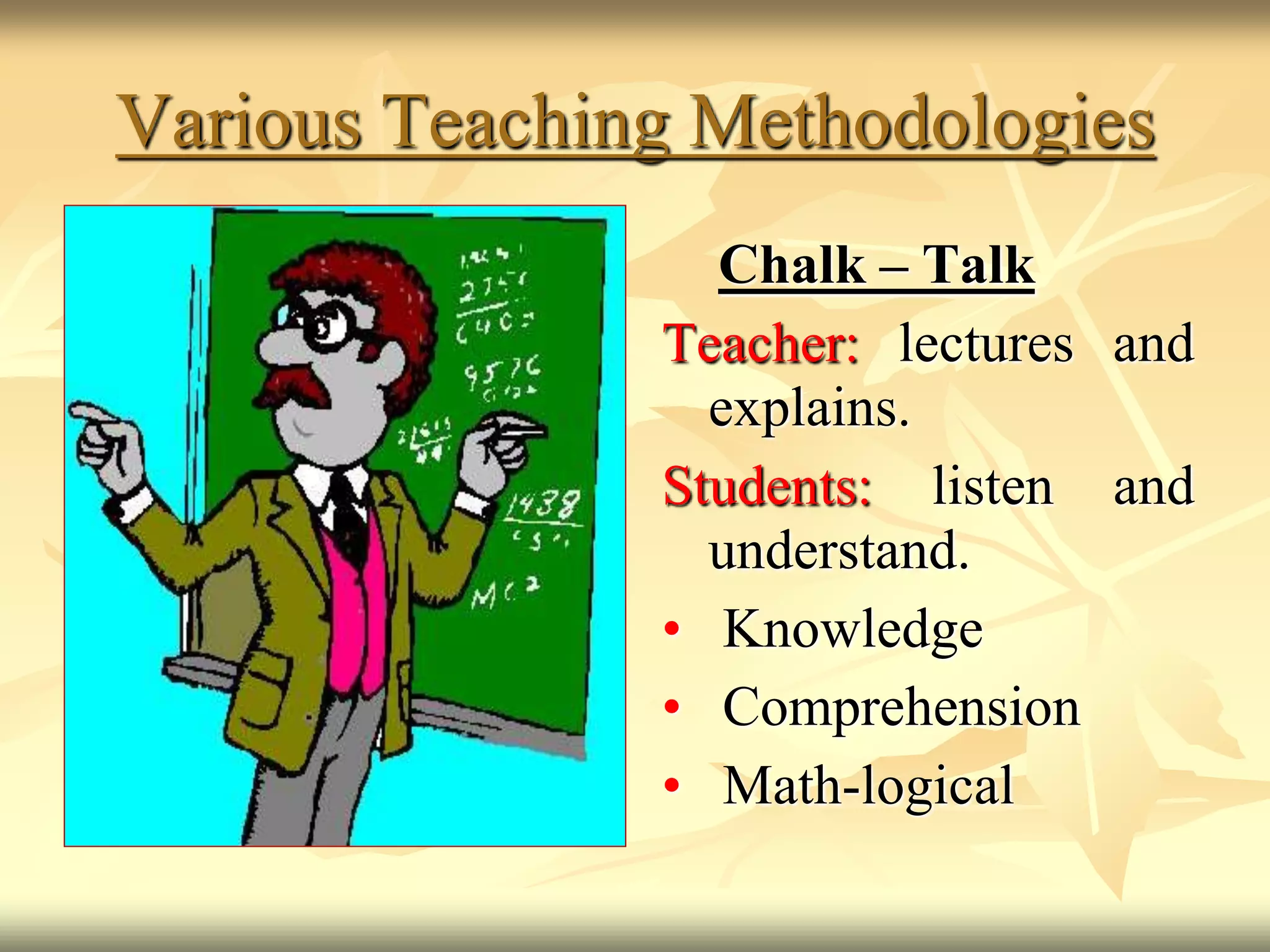
Various Teaching Methodologies
Chalk – Talk
Teacher: lectures and
explains.
Students: listen and
understand.
• Knowledge
• Comprehension
• Math-logical
Various Teaching Methodologies
Seminar
Teacher: Explains &
demonstrates.
Students: Observe &
understand.
1) Knowledge
2) Comprehension
3) Math-logical
4) Linguistic
Various Teaching Methodologies
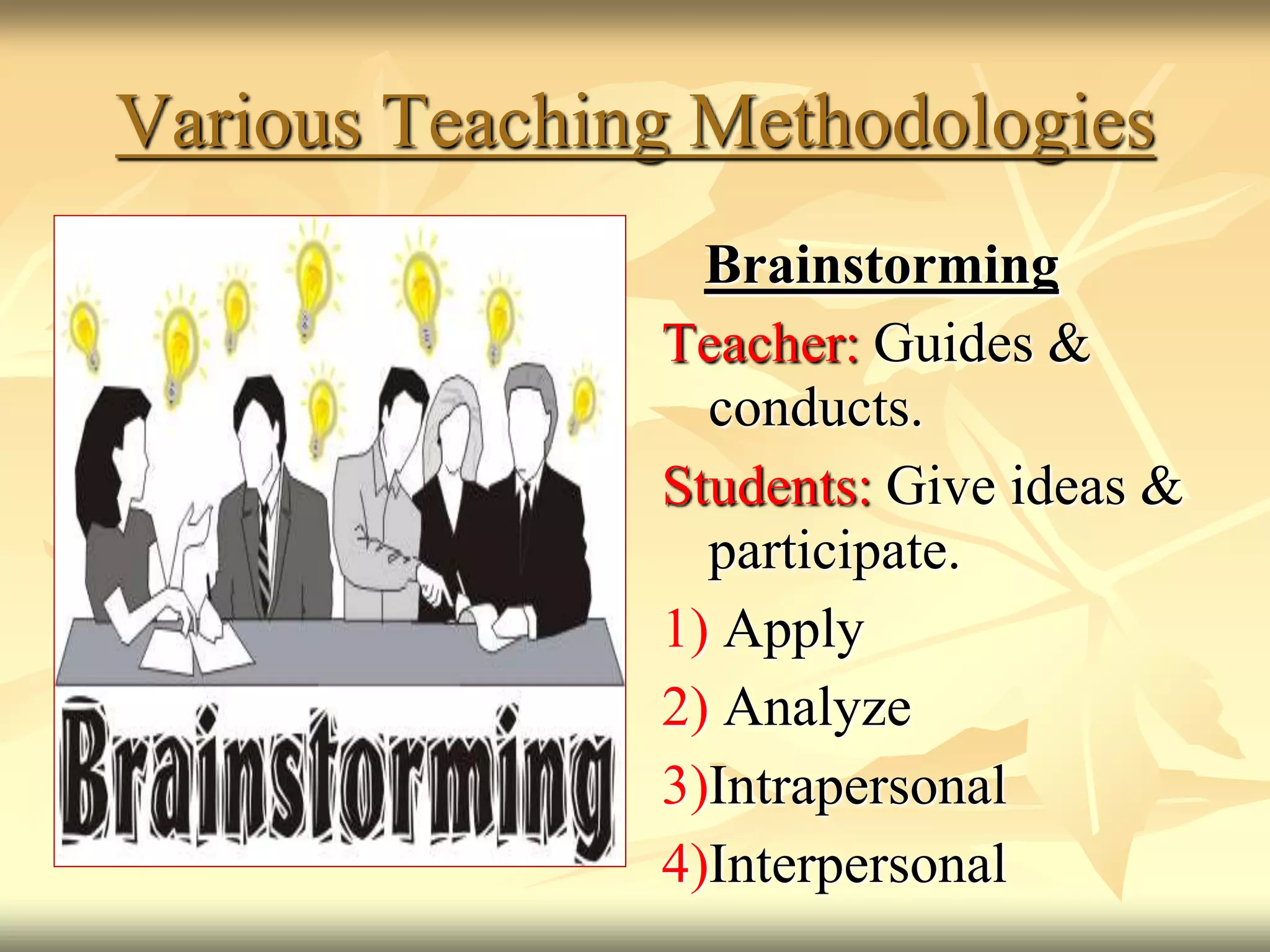
Brainstorming
Teacher: Guides &
conducts.
Students: Give ideas &
participate.
1) Apply
2) Analyze
3)Intrapersonal
4)Interpersonal
Various Teaching Methodologies
Quiz
Teacher: Questions &
facilitates.
Students: Answer &
participate.
1) Knowledge
2) Understanding
3) Linguistic
4) Interpersonal
Various Teaching Methodologies
Role Play
Teacher: Facilitates &
guides.
Students: Participate &
conducts.
1) Apply
2) Spatial/Visual
3) Linguistic
4) Kinesthetic
Various Teaching Methodologies
Debate
Teacher: Facilitates &
conducts.
Students: Discuss &
give ideas.
1) Comprehension
2) Analyze
3) Linguistic
4) Interpersonal
About teacher
• Changing Role of Teacher
Changing Role of Teacher
“What you can do for the students that
Dr. Google cannot do ?”
Application of Techniques
 Language
mastered more
meaningfully
when instructors
utilize:
1. Sounds
2. Patterns
3. Gestures
4. Symbols
5. And multimedia
 Computers and
interactive
multimedia learning
are creating
meaningful learning
environment in
foreign language
pedagogy
 (Jacobs,1992)
Techniques continued
Good teaching means
that the teacher must:
1. Be knowledgeable in
discipline
2. Show enthusiasm
3. Emphasize concepts
and critical thinking
4. Encourage questions
from students
5. Be caring to
students(Ali, 2005)
Creativity and Art as a
constructivist
technique which
allows student to
make personal
discoveries through
student centered
learning: with the
freedom to choose
how to learn, what to
learn, when to learn,
and to become an
active member of the
community of
learners
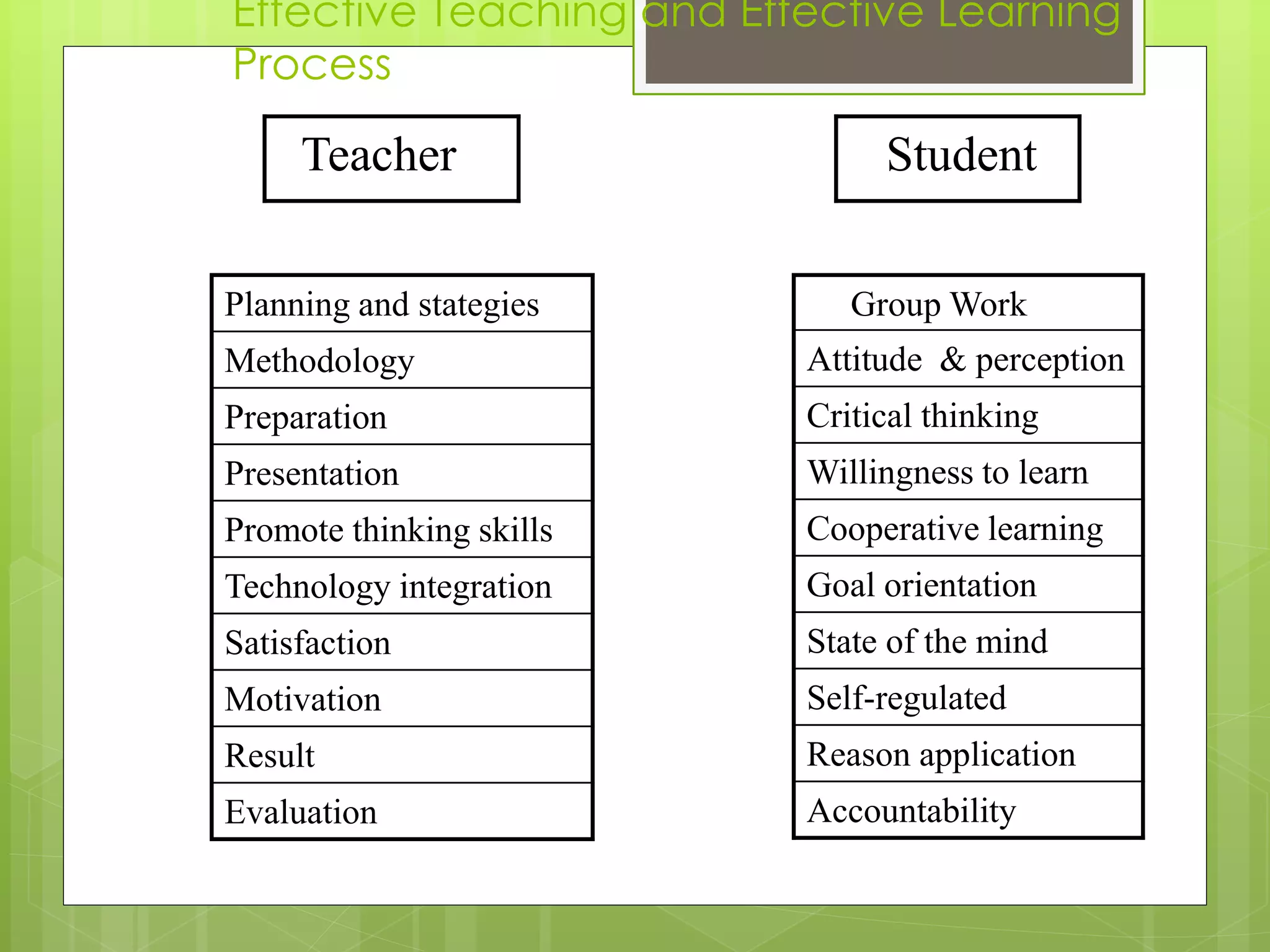
Effective Teaching and Effective Learning
Process
Teacher Student
Planning and stategies
Methodology
Preparation
Presentation
Promote thinking skills
Technology integration
Satisfaction
Motivation
Result
Evaluation
Group Work
Attitude & perception
Critical thinking
Willingness to learn
Cooperative learning
Goal orientation
State of the mind
Self-regulated
Reason application
Accountability
Factors Effecting Learning Outcome
Student’s attitude
Learning environment
Student’s interaction
Learning instruction
Teacher’s attitude
Social environment
Classroom management
Student-teacher interaction
Techniques of Positive Teaching
Storytelling + surprises
Use reasoning
Use communications
Relevancy
Use left-right brain
Connections
Techniques of Positive Teaching Continued
Presentations
Using fewer facts
Media integration
Emphasize Concepts
Experience
Encourage questions
Learning Process
Motivation Engagement Group Learning
Learning Process
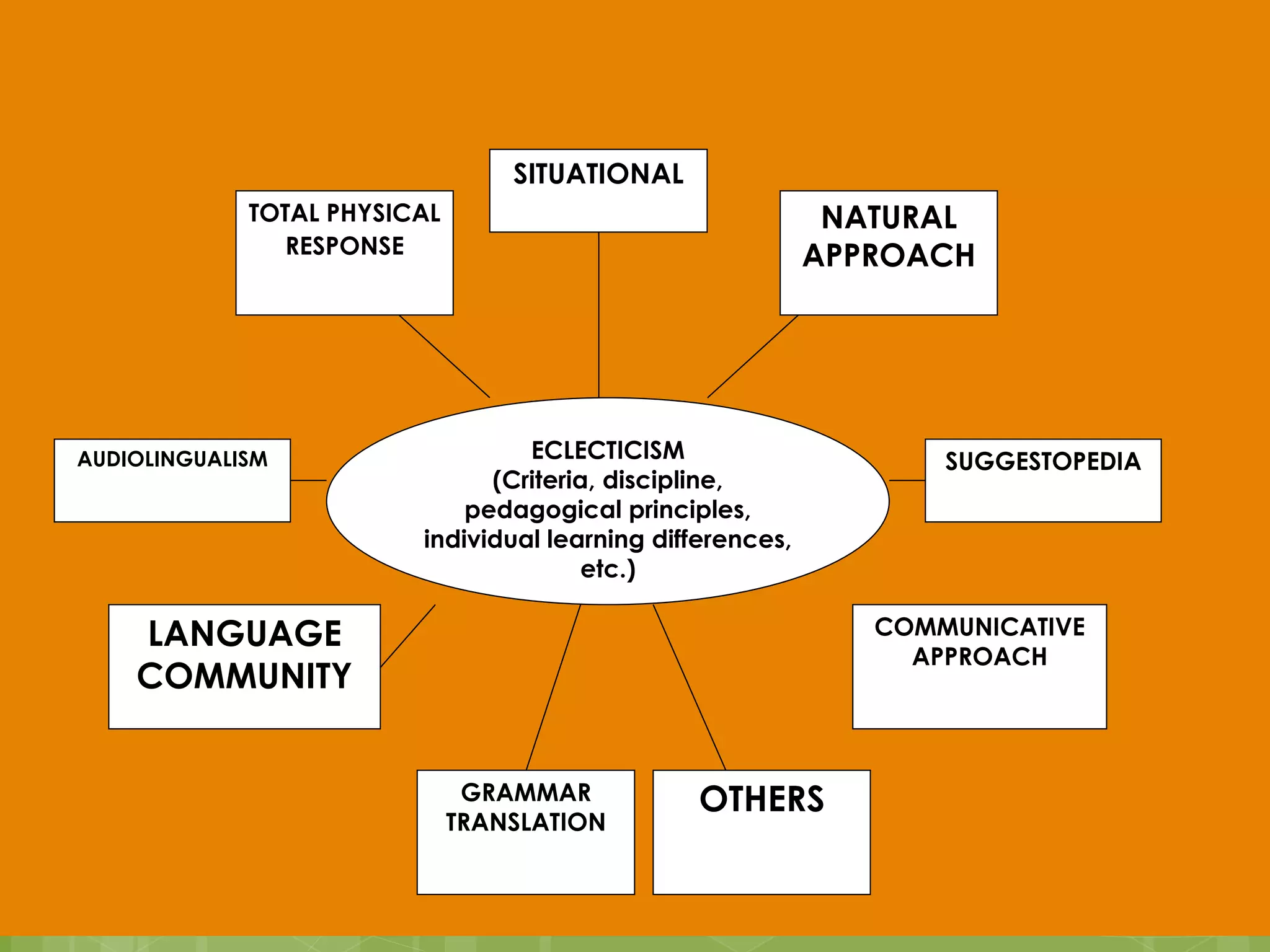
ECLECTICISM
(Criteria, discipline,
pedagogical principles,
individual learning differences,
etc.)
SITUATIONAL
TOTAL PHYSICAL
RESPONSE
NATURAL
APPROACH
AUDIOLINGUALISM SUGGESTOPEDIA
LANGUAGE
COMMUNITY
GRAMMAR
TRANSLATION
OTHERS
COMMUNICATIVE
APPROACH
MATERIALS…
 Does the material match learner objectives?
 Is the material learner-centered?
 Does the material facilitate interactive learning?
 Is the material socio-culturally appropriate?
 Is the material gender-sensitive?
 Is the material up-to-date?
 Are vocabulary and comprehensible input levels well-
graded?
 Is the material age-appropriate?
 Is the material interesting and visually attractive?
 Is the material relevant to real life?

ENGLISH TEACHING METHODOLOGY (EFL)

  • 1.
    English Teaching Methodology BY  MUHAMMAD HAROON BAIG  MA TESOL (Oxford),CELTA(Cambridge),MA Eng(Punjab),PGD TEFL (AIOU)
  • 2.
    WORSHOP ON 1)Methodology ofEnglish teaching at middle school/secondary/high school 2)Teaching English as a Second Language / TEFL 4) A Course in English Language Teaching
  • 3.
    THE NATURE OF LANGUAGETEACHING  1. What's methodology? English teaching methodology is a set of methods used for study or action in English teaching. It is the science to research the Teaching rules at middle/high school, which will guide our teaching to develop the students' communicative competence.
  • 4.
    2.The nature oflanguage teaching 2. The definition of teaching. Teaching is an attempt to help someone acquire, or change some skills, attitude,knowledge, ideal, or appreciation. In other words, the teacher's task is to create or influence desirable changes in behavior, or in tendencies toward behavior, in his/her students.
  • 5.
    Let’s reflect aboutthese ideas:  What are the most important issues when teaching English today? About teachers? About students? About methodology? About materials? about evaluation? About any other issues?
  • 6.
    Strategies in Englishlanguage Learning and Teaching Definition of Strategies: 1. Wenden and Rubin (1987) defines strategies as…”any set of operations, steps, plans, routines used by the learner to facilitate the obtaining, storage, retrieval, and use of information.” 2. Richards and Platt (1992) state that learning strategies are “intentional behavior and thoughts used by learners during learning so as to better help them understand, learn or remember new information.”
  • 7.
    Teacher Role inStrategy Training  Teacher should learn about students 1. Interests 2. Goals 3. motivations 4. Learning styles 5. Purpose for learning a language  The most important teacher role in English language teaching is the provision of a wide range of tasks to match the needs of all students possessing different learning styles, motivations etc.
  • 8.
  • 9.
    Gardner's Multiple Intelligence Theory HowardEarl Gardner - an American developmental psychologist who is based at Harvard University.
  • 10.
  • 11.
     Math-logical Intelligence:How my students will think more logically & critically?  Linguistic Intelligence: How can I make my students use spoken or written language to learn better?  Interpersonal Intelligence: How to bring collaborative learning, peer discussions and interactions in class?  Intrapersonal Intelligence: How can I provide my students to reflect about the subject? Gardner's Multiple Intelligence Theory contd..
  • 12.
    Multiple Intelligence INTELLIGENCE TYPESAND APPROPRIATE EDUCATIONAL ACTIVITIES Intelligence Type Educational Activities Linguistic lectures, worksheets, word games, journals, debates Logical puzzles, estimations, problem solving Spatial charts, diagrams, graphic organizers, drawing, films Bodily hands-on, mime, craft, demonstrations Musical singing, poetry, Jazz Chants, mood music Interpersonal group work, peer tutoring, class projects Intrapersonal reflection, interest centers, personal values tasks Naturalist field trips, show and tell, plant and animals (Adapted from Christison, 1998)
  • 13.
    Various Teaching Methodologies Chalk– Talk Teacher: lectures and explains. Students: listen and understand. • Knowledge • Comprehension • Math-logical
  • 14.
    Various Teaching Methodologies Seminar Teacher:Explains & demonstrates. Students: Observe & understand. 1) Knowledge 2) Comprehension 3) Math-logical 4) Linguistic
  • 15.
    Various Teaching Methodologies Brainstorming Teacher:Guides & conducts. Students: Give ideas & participate. 1) Apply 2) Analyze 3)Intrapersonal 4)Interpersonal
  • 16.
    Various Teaching Methodologies Quiz Teacher:Questions & facilitates. Students: Answer & participate. 1) Knowledge 2) Understanding 3) Linguistic 4) Interpersonal
  • 17.
    Various Teaching Methodologies RolePlay Teacher: Facilitates & guides. Students: Participate & conducts. 1) Apply 2) Spatial/Visual 3) Linguistic 4) Kinesthetic
  • 18.
    Various Teaching Methodologies Debate Teacher:Facilitates & conducts. Students: Discuss & give ideas. 1) Comprehension 2) Analyze 3) Linguistic 4) Interpersonal
  • 19.
  • 20.
    Changing Role ofTeacher “What you can do for the students that Dr. Google cannot do ?”
  • 22.
    Application of Techniques Language mastered more meaningfully when instructors utilize: 1. Sounds 2. Patterns 3. Gestures 4. Symbols 5. And multimedia  Computers and interactive multimedia learning are creating meaningful learning environment in foreign language pedagogy  (Jacobs,1992)
  • 23.
    Techniques continued Good teachingmeans that the teacher must: 1. Be knowledgeable in discipline 2. Show enthusiasm 3. Emphasize concepts and critical thinking 4. Encourage questions from students 5. Be caring to students(Ali, 2005) Creativity and Art as a constructivist technique which allows student to make personal discoveries through student centered learning: with the freedom to choose how to learn, what to learn, when to learn, and to become an active member of the community of learners
  • 24.
    Effective Teaching andEffective Learning Process Teacher Student Planning and stategies Methodology Preparation Presentation Promote thinking skills Technology integration Satisfaction Motivation Result Evaluation Group Work Attitude & perception Critical thinking Willingness to learn Cooperative learning Goal orientation State of the mind Self-regulated Reason application Accountability
  • 25.
    Factors Effecting LearningOutcome Student’s attitude Learning environment Student’s interaction Learning instruction Teacher’s attitude Social environment Classroom management Student-teacher interaction
  • 26.
    Techniques of PositiveTeaching Storytelling + surprises Use reasoning Use communications Relevancy Use left-right brain Connections
  • 27.
    Techniques of PositiveTeaching Continued Presentations Using fewer facts Media integration Emphasize Concepts Experience Encourage questions
  • 28.
    Learning Process Motivation EngagementGroup Learning Learning Process
  • 29.
    ECLECTICISM (Criteria, discipline, pedagogical principles, individuallearning differences, etc.) SITUATIONAL TOTAL PHYSICAL RESPONSE NATURAL APPROACH AUDIOLINGUALISM SUGGESTOPEDIA LANGUAGE COMMUNITY GRAMMAR TRANSLATION OTHERS COMMUNICATIVE APPROACH
  • 30.
    MATERIALS…  Does thematerial match learner objectives?  Is the material learner-centered?  Does the material facilitate interactive learning?  Is the material socio-culturally appropriate?  Is the material gender-sensitive?  Is the material up-to-date?  Are vocabulary and comprehensible input levels well- graded?  Is the material age-appropriate?  Is the material interesting and visually attractive?  Is the material relevant to real life?