From Grades to
Feedback
Peter Jory
Don Ross Secondary Nov.2, 2012
A bit about me …
• Director of Instruction in SD No.48 (Sea to Sky)
• Former principal of Lake Cowichan Secondary School
  • AFL in Communications 11/12 classes for 4 years
  • Focus of School Plan and PLC sessions for 3 years
• BCELC and Quamichan experience with AFL
• VP in 3 different schools and a teacher in Agassiz (mostly
  English and PE)
A bit about you …
• Please chat with partner and be ready to
report out in about 3 minutes


1. Who are you and what do you teach?
2. What types of AFL pieces are you using?
3. What do you want to get from the workshop?
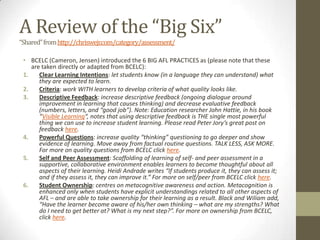
A Review of the “Big Six”
“Shared” from http://chriswejr.com/category/assessment/

 • BCELC (Cameron, Jensen) introduced the 6 BIG AFL PRACTICES as (please note that these
    are taken directly or adapted from BCELC):
 1.    Clear Learning Intentions: let students know (in a language they can understand) what
       they are expected to learn.
 2.    Criteria: work WITH learners to develop criteria of what quality looks like.
 3.    Descriptive Feedback: increase descriptive feedback (ongoing dialogue around
       improvement in learning that causes thinking) and decrease evaluative feedback
       (numbers, letters, and “good job”). Note: Education researcher John Hattie, in his book
       “Visible Learning“, notes that using descriptive feedback is THE single most powerful
       thing we can use to increase student learning. Please read Peter Jory’s great post on
       feedback here.
 4.    Powerful Questions: increase quality “thinking” questioning to go deeper and show
       evidence of learning. Move away from factual routine questions. TALK LESS, ASK MORE.
       For more on quality questions from BCELC click here.
 5.    Self and Peer Assessment: Scaffolding of learning of self- and peer assessment in a
       supportive, collaborative environment enables learners to become thoughtful about all
       aspects of their learning. Heidi Andrade writes “If students produce it, they can assess it;
       and if they assess it, they can improve it.” For more on self/peer from BCELC click here.
 6.    Student Ownership: centres on metacognitive awareness and action. Metacognition is
       enhanced only when students have explicit understandings related to all other aspects of
       AFL – and are able to take ownership for their learning as a result. Black and Wiliam add,
       “Have the learner become aware of his/her own thinking – what are my strengths? What
       do I need to get better at? What is my next step?”. For more on ownership from BCELC,
       click here.
Why do we “grade”
assignments in school?

• Please chat with partner and be ready to
report out in about 3 minutes
“Traditional” assessment
• Everything is tallied in a mark book or spreadsheet
• Marks are seen as motivators
• Marks are averaged over the reporting period so that
  everything counts and it therefore deemed “important”
• Late assignments are penalized a set amount, a set amount
  per period of time, or not accepted at all
• All students do all of the same assignments
• Assignments that are not submitted receive a “zero” which is
  then averaged in the same way as submitted assignments
• There are sometimes little distinction between behaviour and
  understanding in regard to the student’s achievement
• Once an assignment is submitted, it is “done”
What the research tells us:
• Marks on individual assignments have little or no motivating
  effect on students to learn
• Low marks on assignments often have a demotivating effect in
  regard to learning
• Students will often attribute low assignment marks to factors
  other than their own learning or interest in learning – such as
  the teacher’s interest in them
• Low marks often come from a lack of understanding about the
  assignment expectations rather than content knowledge
• Students are frequently dissatisfied with the lack of specific
  advice they get, and the clarity of the advice they do get.
• Once a mark is given on an assignment – STUDENTS RARELY
  LOOK AT THE FEEDBACK TEACHERS PROVIDE
What the anecdotal
information tells us … if you
ask:
• Most students will tell you that though they “prefer” to get
  higher marks on assignments, it would not generally change
  their behaviour in regard to LEARNING
• Students want to be successful in their learning and respond
  positively to “more help”, meaning specific information on
  how to improve
• THEY WANT AND NEED MORE FEEDBACK
• http://meganjakse.blogspot.ca/2011/08/5-years-later-
  assessment.html
What is FEEDBACK?
• “.. Feedback needs to provide information specifically relating
  to the task or process of learning that fills a gap between what
  is understood and what is aimed to be understood.” –Sadler
• “Our feedback must tell students not just what needs to be
  improved, but also how to go about it.” -Wiliam
• “Learning is more likely to be fostered when feedback focuses
  on features of the task (success criteria) and emphasizes
  learning goals.” -Kluger & DeNisi
• “In giving students descriptive feedback, you have modeled
  the kind of thinking you want them to do as self-assessors.” -
  Chappius
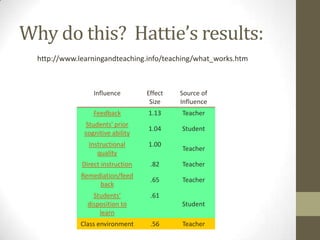
Why do this? Hattie’s results:
  http://www.learningandteaching.info/teaching/what_works.htm


                  Influence        Effect   Source of
                                    Size    Influence
                  Feedback         1.13     Teacher
               Students' prior
                                   1.04     Student
               cognitive ability
                Instructional      1.00
                                            Teacher
                   quality
              Direct instruction    .82     Teacher
              Remediation/feed
                                    .65     Teacher
                   back
                  Students'         .61
                disposition to              Student
                    learn
              Class environment     .56     Teacher
As we evolve in our school
system …


• Here is a serious question: How would anyone really embrace
  inquiry and personalized learning using only traditional
  assessment methodology?
When do we give FEEDBACK?

• “Any feedback that students can't act upon or do something
  about is useless feedback.” –Schimmer
• “Students can assess themselves only when they have a clear
  pic of the targets their learning is meant to attain.” -Black &
  Wiliam
• "Feedback needs to come while the students still think of the
  learning goal as a learning goal ... " -Brookhart
What could it look like to
increase FEEDBACK in your
classroom tomorrow?
• More interactions each class. Either go to them or have them come
  to you, but strive to have at least one more “check in” with every
  student every day, check for understanding, and give some specific
  information to guide their learning
• More steps built into your assignments where students can share,
  reflect, discuss, and revise their evidence of learning
• More chances for you to review assignments with students before
  giving a summative mark
• Opportunities for students to resubmit assignments or rewrite tests
  if they can show evidence that their learning has evolved (because
  the “test” you arbitrarily put on that day should not mean removing
  any further motivation to learn or show learning)
What can it look like to be “all
in” with formative assessment?
• Assignments do not receive a mark or grade, but are not
  accepted as complete until they are “Fully Meeting” or
  “Exceeding” your expectations
• Students are given specific FEEDBACK on each assignment
  until it is “Fully Meeting” or “Exceeding” expectations
• More assignments are deemed to be practice, and how many
  are completed may differ between students
• Key assignments are mandatory, may receive letter grades
  based on the criteria (ideally in a co-created rubric), and
  missing any of them at reporting time means the student is at
  an “I” or “In Progress” level
Continued …
• Achievement really starts at the C+ level – meaning if a
  student has all of their key assignments in and at the “Fully
  Meeting” level, they would have at least a C+ when it comes
  time for reporting
• Their achievement level is determined through conversation
  using the evidence of learning they have provided compared
  with the criteria you have set for the course (using the
  appropriate resources)
• Assignment tracking can use an old mark book or Excel
  spreadsheet – but there is no averaging or calculating done!
Sounds weird …


• Discuss with a partner!
The Power of Switching
• for “struggling and reluctant” learners:
  • Transition from just passing to mastery
       (No more, “I just want the 5/10.”)
  • Migration of more learning to exam situations
• for “typical” students:
  • Focus on learning instead of doing (Ownership)
  • Improved achievement
• for “high achievers”:
  • The “stretch” learning they need to excel at the next level,
    instead of giving them credit for previously learned skills
After trying it:

• “I can’t go back.”

• http://www.bcpvpa.bc.ca/downloads/adminfo_pdf/AdminfoJo
  ry0411.pdf

• Further experiences with English 10 and Communications
  11/12, both of which are exam courses
• Differential between class average and MOE Exam average
  gets very tight – we can start to teach and assess more in line
  with the Ministry curricula and standards
What about late assignments
and unsubmitted assignments?
• Excellent commentary by Tom Schimmer:

• http://tomschimmer.com/2011/02/21/enough-with-the-late-
  penalties/
Changing the vernacular
• Moving from being focused on tasks to being focused on
  LEARNING vastly improves learning – which translates into
  achievement gains

•   Use of the Three Critical Questions:
•   1. What am I learning?
•   2. How is my learning going?
•   3. Where do I need to go next?
Making the “leap” when
mandatory reporting time
comes:
• Evidence collection (portfolio?)
• Interim assessments that include conversations with each
  student so they know where they are at in their learning
• Clarity of criteria and standards
• Opportunities for student to complete missing assignments
  and move from current level to desired level
• Flexibility to decide what counts and what doesn’t
• Does the spreadsheet really tell a more accurate story of
  student learning than your profession judgement backed by
  the above?
What are the roadblocks?


• Please chat with partner and be ready to
report out in about 3 minutes
Isn’t this more work?
That depends …
• If you still have to touch every assignment and assess every
  assignment and record every mark, then YES, it will be more
  work.
• If you encourage a climate of student ownership for learning
  and build in structures that give opportunities for self and
  peer reflection, and you give a lot of feedback directly to the
  student before actually “giving a mark”, then NO, it will be not
  be more work.
• You should be “busier” in the class with the kids. You may be
  less busy outside of class, or at least you can spend more
  time planning instead of marking or giving comments that
  will often not be used or understood.
What kinds of foundational
pieces do you need to make
this happen?
• The students need to understand what you are doing and why
  you are doing it
• If this is not part of your general school culture already, you
  will want to inform your parents (letter home, blog page,
  resources etc.)
• Inform your principal
• Find, create, and co-create criteria, rubrics, and exemplars
• Exam course? Exam marking guides to shape expectations
Reporting Pilot

• The BCESIS Gradebook program and the jurisdictional
  reporting template do not effectively meet our needs
• “Binning” solution with zeroed columns counting only the
  assignments needed to provide evidence of learning

• School District No. 48 has applied to develop alternate report
  cards that do not use letter grades for grades 4-9, replacing
  them with more specific information, such as competency
  rubric
More Resources:
• http://www.edugains.ca/resourcesAER/VideoLibrary/Feedbac
  k/ViewingGuideFeedbackAfLVideoSeries.pdf

• http://seatoskylearning.edublogs.org/2012/01/05/calling-all-
  formative-assessment-super-stars/

• http://attheprincipalsoffice.wordpress.com/2011/12/23/feedb
  ack-or-feedforward/

• http://peterjory.blogspot.ca/2011/12/draft-towards-grading-
  policy-that.html
Contact me:

•   On Twitter            @peterjory
•   Today’s hashtag:      #SD48ACB
•   Via the School District No. 48 (Sea to Sky) website
•   Via my blog http://peterjory.blogspot.ca/

From Grades to Feedback

  • 1.
    From Grades to Feedback PeterJory Don Ross Secondary Nov.2, 2012
  • 2.
    A bit aboutme … • Director of Instruction in SD No.48 (Sea to Sky) • Former principal of Lake Cowichan Secondary School • AFL in Communications 11/12 classes for 4 years • Focus of School Plan and PLC sessions for 3 years • BCELC and Quamichan experience with AFL • VP in 3 different schools and a teacher in Agassiz (mostly English and PE)
  • 3.
    A bit aboutyou … • Please chat with partner and be ready to report out in about 3 minutes 1. Who are you and what do you teach? 2. What types of AFL pieces are you using? 3. What do you want to get from the workshop?
  • 4.
    A Review ofthe “Big Six” “Shared” from http://chriswejr.com/category/assessment/ • BCELC (Cameron, Jensen) introduced the 6 BIG AFL PRACTICES as (please note that these are taken directly or adapted from BCELC): 1. Clear Learning Intentions: let students know (in a language they can understand) what they are expected to learn. 2. Criteria: work WITH learners to develop criteria of what quality looks like. 3. Descriptive Feedback: increase descriptive feedback (ongoing dialogue around improvement in learning that causes thinking) and decrease evaluative feedback (numbers, letters, and “good job”). Note: Education researcher John Hattie, in his book “Visible Learning“, notes that using descriptive feedback is THE single most powerful thing we can use to increase student learning. Please read Peter Jory’s great post on feedback here. 4. Powerful Questions: increase quality “thinking” questioning to go deeper and show evidence of learning. Move away from factual routine questions. TALK LESS, ASK MORE. For more on quality questions from BCELC click here. 5. Self and Peer Assessment: Scaffolding of learning of self- and peer assessment in a supportive, collaborative environment enables learners to become thoughtful about all aspects of their learning. Heidi Andrade writes “If students produce it, they can assess it; and if they assess it, they can improve it.” For more on self/peer from BCELC click here. 6. Student Ownership: centres on metacognitive awareness and action. Metacognition is enhanced only when students have explicit understandings related to all other aspects of AFL – and are able to take ownership for their learning as a result. Black and Wiliam add, “Have the learner become aware of his/her own thinking – what are my strengths? What do I need to get better at? What is my next step?”. For more on ownership from BCELC, click here.
  • 5.
    Why do we“grade” assignments in school? • Please chat with partner and be ready to report out in about 3 minutes
  • 6.
    “Traditional” assessment • Everythingis tallied in a mark book or spreadsheet • Marks are seen as motivators • Marks are averaged over the reporting period so that everything counts and it therefore deemed “important” • Late assignments are penalized a set amount, a set amount per period of time, or not accepted at all • All students do all of the same assignments • Assignments that are not submitted receive a “zero” which is then averaged in the same way as submitted assignments • There are sometimes little distinction between behaviour and understanding in regard to the student’s achievement • Once an assignment is submitted, it is “done”
  • 7.
    What the researchtells us: • Marks on individual assignments have little or no motivating effect on students to learn • Low marks on assignments often have a demotivating effect in regard to learning • Students will often attribute low assignment marks to factors other than their own learning or interest in learning – such as the teacher’s interest in them • Low marks often come from a lack of understanding about the assignment expectations rather than content knowledge • Students are frequently dissatisfied with the lack of specific advice they get, and the clarity of the advice they do get. • Once a mark is given on an assignment – STUDENTS RARELY LOOK AT THE FEEDBACK TEACHERS PROVIDE
  • 8.
    What the anecdotal informationtells us … if you ask: • Most students will tell you that though they “prefer” to get higher marks on assignments, it would not generally change their behaviour in regard to LEARNING • Students want to be successful in their learning and respond positively to “more help”, meaning specific information on how to improve • THEY WANT AND NEED MORE FEEDBACK • http://meganjakse.blogspot.ca/2011/08/5-years-later- assessment.html
  • 9.
    What is FEEDBACK? •“.. Feedback needs to provide information specifically relating to the task or process of learning that fills a gap between what is understood and what is aimed to be understood.” –Sadler • “Our feedback must tell students not just what needs to be improved, but also how to go about it.” -Wiliam • “Learning is more likely to be fostered when feedback focuses on features of the task (success criteria) and emphasizes learning goals.” -Kluger & DeNisi • “In giving students descriptive feedback, you have modeled the kind of thinking you want them to do as self-assessors.” - Chappius
  • 10.
    Why do this?Hattie’s results: http://www.learningandteaching.info/teaching/what_works.htm Influence Effect Source of Size Influence Feedback 1.13 Teacher Students' prior 1.04 Student cognitive ability Instructional 1.00 Teacher quality Direct instruction .82 Teacher Remediation/feed .65 Teacher back Students' .61 disposition to Student learn Class environment .56 Teacher
  • 11.
    As we evolvein our school system … • Here is a serious question: How would anyone really embrace inquiry and personalized learning using only traditional assessment methodology?
  • 12.
    When do wegive FEEDBACK? • “Any feedback that students can't act upon or do something about is useless feedback.” –Schimmer • “Students can assess themselves only when they have a clear pic of the targets their learning is meant to attain.” -Black & Wiliam • "Feedback needs to come while the students still think of the learning goal as a learning goal ... " -Brookhart
  • 13.
    What could itlook like to increase FEEDBACK in your classroom tomorrow? • More interactions each class. Either go to them or have them come to you, but strive to have at least one more “check in” with every student every day, check for understanding, and give some specific information to guide their learning • More steps built into your assignments where students can share, reflect, discuss, and revise their evidence of learning • More chances for you to review assignments with students before giving a summative mark • Opportunities for students to resubmit assignments or rewrite tests if they can show evidence that their learning has evolved (because the “test” you arbitrarily put on that day should not mean removing any further motivation to learn or show learning)
  • 14.
    What can itlook like to be “all in” with formative assessment? • Assignments do not receive a mark or grade, but are not accepted as complete until they are “Fully Meeting” or “Exceeding” your expectations • Students are given specific FEEDBACK on each assignment until it is “Fully Meeting” or “Exceeding” expectations • More assignments are deemed to be practice, and how many are completed may differ between students • Key assignments are mandatory, may receive letter grades based on the criteria (ideally in a co-created rubric), and missing any of them at reporting time means the student is at an “I” or “In Progress” level
  • 15.
    Continued … • Achievementreally starts at the C+ level – meaning if a student has all of their key assignments in and at the “Fully Meeting” level, they would have at least a C+ when it comes time for reporting • Their achievement level is determined through conversation using the evidence of learning they have provided compared with the criteria you have set for the course (using the appropriate resources) • Assignment tracking can use an old mark book or Excel spreadsheet – but there is no averaging or calculating done!
  • 16.
    Sounds weird … •Discuss with a partner!
  • 17.
    The Power ofSwitching • for “struggling and reluctant” learners: • Transition from just passing to mastery (No more, “I just want the 5/10.”) • Migration of more learning to exam situations • for “typical” students: • Focus on learning instead of doing (Ownership) • Improved achievement • for “high achievers”: • The “stretch” learning they need to excel at the next level, instead of giving them credit for previously learned skills
  • 18.
    After trying it: •“I can’t go back.” • http://www.bcpvpa.bc.ca/downloads/adminfo_pdf/AdminfoJo ry0411.pdf • Further experiences with English 10 and Communications 11/12, both of which are exam courses • Differential between class average and MOE Exam average gets very tight – we can start to teach and assess more in line with the Ministry curricula and standards
  • 19.
    What about lateassignments and unsubmitted assignments? • Excellent commentary by Tom Schimmer: • http://tomschimmer.com/2011/02/21/enough-with-the-late- penalties/
  • 20.
    Changing the vernacular •Moving from being focused on tasks to being focused on LEARNING vastly improves learning – which translates into achievement gains • Use of the Three Critical Questions: • 1. What am I learning? • 2. How is my learning going? • 3. Where do I need to go next?
  • 21.
    Making the “leap”when mandatory reporting time comes: • Evidence collection (portfolio?) • Interim assessments that include conversations with each student so they know where they are at in their learning • Clarity of criteria and standards • Opportunities for student to complete missing assignments and move from current level to desired level • Flexibility to decide what counts and what doesn’t • Does the spreadsheet really tell a more accurate story of student learning than your profession judgement backed by the above?
  • 22.
    What are theroadblocks? • Please chat with partner and be ready to report out in about 3 minutes
  • 23.
    Isn’t this morework? That depends … • If you still have to touch every assignment and assess every assignment and record every mark, then YES, it will be more work. • If you encourage a climate of student ownership for learning and build in structures that give opportunities for self and peer reflection, and you give a lot of feedback directly to the student before actually “giving a mark”, then NO, it will be not be more work. • You should be “busier” in the class with the kids. You may be less busy outside of class, or at least you can spend more time planning instead of marking or giving comments that will often not be used or understood.
  • 24.
    What kinds offoundational pieces do you need to make this happen? • The students need to understand what you are doing and why you are doing it • If this is not part of your general school culture already, you will want to inform your parents (letter home, blog page, resources etc.) • Inform your principal • Find, create, and co-create criteria, rubrics, and exemplars • Exam course? Exam marking guides to shape expectations
  • 25.
    Reporting Pilot • TheBCESIS Gradebook program and the jurisdictional reporting template do not effectively meet our needs • “Binning” solution with zeroed columns counting only the assignments needed to provide evidence of learning • School District No. 48 has applied to develop alternate report cards that do not use letter grades for grades 4-9, replacing them with more specific information, such as competency rubric
  • 26.
    More Resources: • http://www.edugains.ca/resourcesAER/VideoLibrary/Feedbac k/ViewingGuideFeedbackAfLVideoSeries.pdf • http://seatoskylearning.edublogs.org/2012/01/05/calling-all- formative-assessment-super-stars/ • http://attheprincipalsoffice.wordpress.com/2011/12/23/feedb ack-or-feedforward/ • http://peterjory.blogspot.ca/2011/12/draft-towards-grading- policy-that.html
  • 27.
    Contact me: • On Twitter @peterjory • Today’s hashtag: #SD48ACB • Via the School District No. 48 (Sea to Sky) website • Via my blog http://peterjory.blogspot.ca/