Question Tags
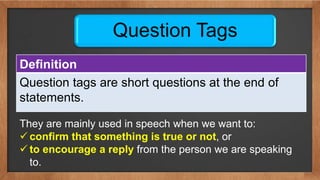
Definition
Question tags are short questions at the end of
statements.
They are mainly used in speech when we want to:
 confirm that something is true or not, or
 to encourage a reply from the person we are speaking
to.
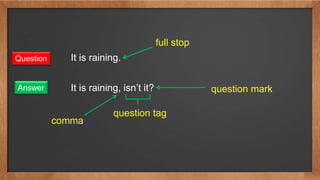
It is raining.
It is raining, isn’t it?
Question
Answer
comma
question mark
full stop
question tag
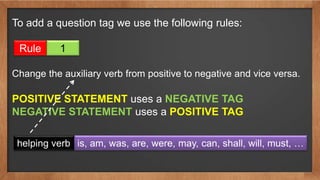
To add a question tag we use the following rules:
Rule 1
Change the auxiliary verb from positive to negative and vice versa.
POSITIVE STATEMENT uses a NEGATIVE TAG
NEGATIVE STATEMENT uses a POSITIVE TAG
helping verb is, am, was, are, were, may, can, shall, will, must, …
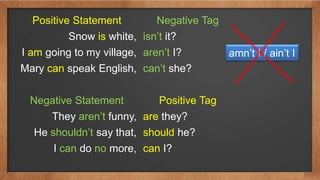
Positive Statement Negative Tag
Snow is white, isn’t it?
I am going to my village, aren’t I?
Mary can speak English, can’t she?
Negative Statement Positive Tag
They aren’t funny, are they?
He shouldn’t say that, should he?
I can do no more, can I?
amn’t I / ain’t I
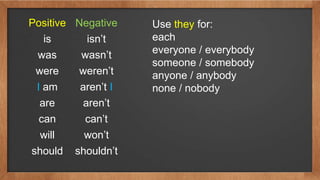
Positive Negative
is isn’t
was wasn’t
were weren’t
I am aren’t I
are aren’t
can can’t
will won’t
should shouldn’t
Use they for:
each
everyone / everybody
someone / somebody
anyone / anybody
none / nobody
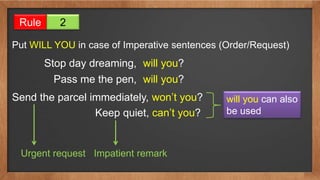
Rule 2
Put WILL YOU in case of Imperative sentences (Order/Request)
Stop day dreaming, will you?
Pass me the pen, will you?
Send the parcel immediately, won’t you?
Keep quiet, can’t you?
will you can also
be used
Urgent request Impatient remark
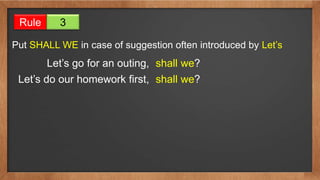
Rule 3
Put SHALL WE in case of suggestion often introduced by Let’s
Let’s go for an outing, shall we?
Let’s do our homework first, shall we?
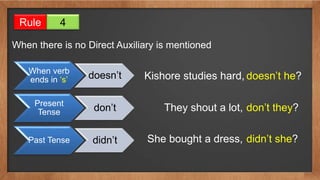
Rule 4
When there is no Direct Auxiliary is mentioned
When verb
ends in ‘s’ doesn’t
Present
Tense don’t
Past Tense didn’t
Kishore studies hard, doesn’t he?
They shout a lot, don’t they?
She bought a dress, didn’t she?
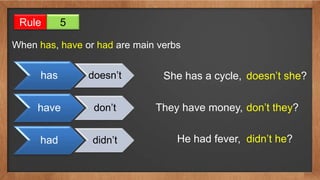
Rule 5
When has, have or had are main verbs
has doesn’t
have don’t
had didn’t
She has a cycle, doesn’t she?
They have money, don’t they?
He had fever, didn’t he?
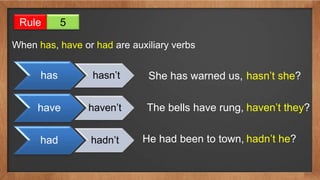
Rule 5
When has, have or had are auxiliary verbs
has hasn’t
have haven’t
had hadn’t
She has warned us, hasn’t she?
The bells have rung, haven’t they?
He had been to town, hadn’t he?

Question tag

  • 1.
    Question Tags Definition Question tagsare short questions at the end of statements. They are mainly used in speech when we want to:  confirm that something is true or not, or  to encourage a reply from the person we are speaking to.
  • 2.
    It is raining. Itis raining, isn’t it? Question Answer comma question mark full stop question tag
  • 3.
    To add aquestion tag we use the following rules: Rule 1 Change the auxiliary verb from positive to negative and vice versa. POSITIVE STATEMENT uses a NEGATIVE TAG NEGATIVE STATEMENT uses a POSITIVE TAG helping verb is, am, was, are, were, may, can, shall, will, must, …
  • 4.
    Positive Statement NegativeTag Snow is white, isn’t it? I am going to my village, aren’t I? Mary can speak English, can’t she? Negative Statement Positive Tag They aren’t funny, are they? He shouldn’t say that, should he? I can do no more, can I? amn’t I / ain’t I
  • 5.
    Positive Negative is isn’t waswasn’t were weren’t I am aren’t I are aren’t can can’t will won’t should shouldn’t Use they for: each everyone / everybody someone / somebody anyone / anybody none / nobody
  • 6.
    Rule 2 Put WILLYOU in case of Imperative sentences (Order/Request) Stop day dreaming, will you? Pass me the pen, will you? Send the parcel immediately, won’t you? Keep quiet, can’t you? will you can also be used Urgent request Impatient remark
  • 7.
    Rule 3 Put SHALLWE in case of suggestion often introduced by Let’s Let’s go for an outing, shall we? Let’s do our homework first, shall we?
  • 8.
    Rule 4 When thereis no Direct Auxiliary is mentioned When verb ends in ‘s’ doesn’t Present Tense don’t Past Tense didn’t Kishore studies hard, doesn’t he? They shout a lot, don’t they? She bought a dress, didn’t she?
  • 9.
    Rule 5 When has,have or had are main verbs has doesn’t have don’t had didn’t She has a cycle, doesn’t she? They have money, don’t they? He had fever, didn’t he?
  • 10.
    Rule 5 When has,have or had are auxiliary verbs has hasn’t have haven’t had hadn’t She has warned us, hasn’t she? The bells have rung, haven’t they? He had been to town, hadn’t he?