
Teacher Connect Session 3 2008
Agenda Homework Parent Teacher Communication Differentiated Instruction Design Down Planning DPA Classroom Management
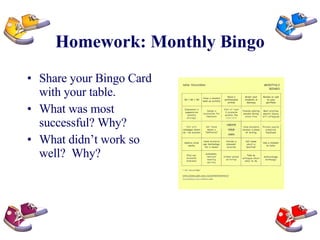
Homework: Monthly Bingo Share your Bingo Card with your table. What was most successful? Why? What didn’t work so well?  Why?
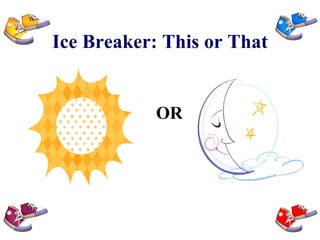
Ice Breaker: This or That OR
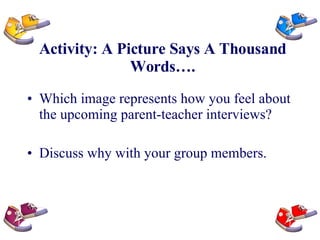
Activity: A Picture Says A Thousand Words…. Which image represents how you feel about the upcoming parent-teacher interviews? Discuss why with your group members.
Parent Teacher Conferences This should not be your first contact with the parents Meet the Teacher Night Informal chats during arrival/dismissal or playground duty Positive phone calls home Communication in the agenda It’s not too late!!!!!!!!!!!
Before the Conference Check the schedule of conferences.  Call any parents you have requested to see who have not booked a conference time.  Some may need to be scheduled at alternate times.
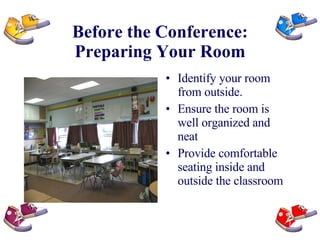
Before the Conference: Preparing Your Room Identify your room from outside. Ensure the room is well organized and neat Provide comfortable seating inside and outside the classroom
Before the Conference: Gather Materials Ontario Student Record (OSR) Standardized test results Student’s grades in other classes Record of student grades/work completed/observations/anecdotal reports Attendance record Copy of report card Communication record (phone calls home, agenda, copies of newsletter) LST report or IEP
Before the Conference: Preparing Yourself Dress professionally Check parent names  Be aware of cultural norms in your community Collaborate with colleagues, administration, CYW, LST, etc
Before the Conference: Establish the Agenda Be clear about the purpose of your conference. Inform parents about student learning Increase parent knowledge about school programs Develop mutual goals for the student Before beginning, you want to know what action you hope will result from the discussion with the parents
During the Conference 1.  Warm Up Make parents comfortable Introduce yourself Begin with positive remarks Remind parents that you are all working together with the child’s best interests in mind
During the Conference 2.  The Presentation Share information about the student’s progress, strengths and learning Share standards (no jargon) Be a good listener  Share concerns Be positive, yet honest and frank
During the Interview 3.  The Plan Next steps – curriculum expectations and/or learning skills Be reasonable – choose one or two critical goals Team approach – parent, student and teacher Possible involvement of other team members – CYW, Speech and language, etc.
During the Conference 4.  Conclusion Summarize Review the plan of action Set a timeline to meet again Follow through with your action items
During the Conference End by saying something positive about the student Thank the parent for his/her time Acknowledge the importance of the parents’ coming to the interview
After the Conference The parent should leave the interview with positive feelings.  Both you and the parent should feel that the time spent was worthwhile.  Emphasize your certainty that joint efforts will be productive.
In Case of Conflict Be diplomatic Document, document, document No one wins an argument Be prepared to limit discussion One step at a time Again, try to end on a positive note Thank the parents for coming
After the Conference Record date, time and issues discussed Note any follow up required Document follow up completed
Say Something…
Break
To begin … Your first name & the first letter of your last name Large  enough to see across the room Using a  MARKER  . . . On the front  of the index card please print: Anna Z.
Differentiated Instruction
Anticipation Guide On your own, read each statement in the anticipation guide.  In the first column put a T for true if you agree Put an F for false if you disagree
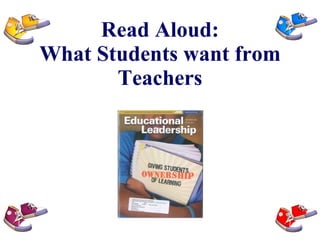
Read Aloud: What Students want from Teachers
Why Differentiate Instruction? “ Children already come to us differentiated.  It just makes sense that we would differentiate our instruction in response to them.” Carol Ann Tomlinson “ The Differentiated Classroom”
Paradigm Shift Old Paradigm:  Teach to the middle New Paradigm: Address the needs of all children
Differentiating Instruction Requires teachers to: increase their understanding of  who  they teach acknowledge that no two students: learn at the same pace solve problems in exactly the same way have the same interests have learned the same skills
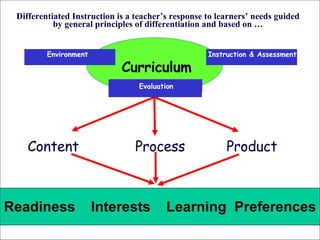
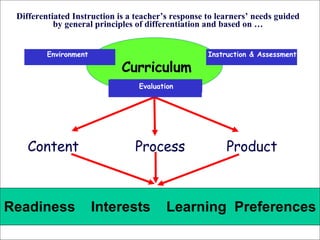
Differentiated Instruction is a teacher’s response to learners’ needs guided by general principles of differentiation and based on …   Content   Process  Product Environment Instruction & Assessment Readiness  Interests  Learning  Preferences Curriculum Evaluation
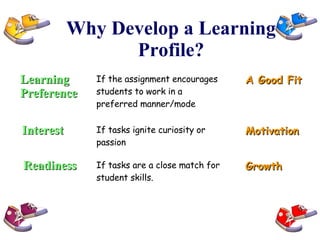
Why Develop a Learning Profile? Learning Preference If the assignment encourages students to work in a preferred manner/mode   A Good Fit If tasks ignite curiosity or passion   Motivation If tasks are a close match for student skills. Growth Interest Readiness
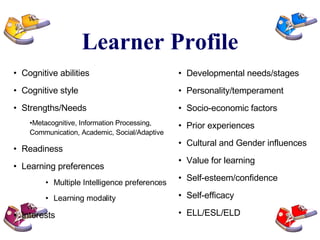
Learner Profile Cognitive abilities Cognitive style Strengths/Needs Metacognitive, Information Processing, Communication, Academic, Social/Adaptive Readiness Learning preferences  Multiple Intelligence preferences Learning modality Interests Developmental needs/stages Personality/temperament Socio-economic factors Prior experiences Cultural and Gender influences Value for learning Self-esteem/confidence Self-efficacy ELL/ESL/ELD
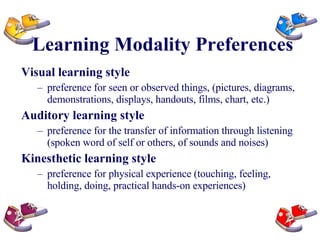
Learning Modality Preferences Visual learning style   preference for seen or observed things, (pictures, diagrams, demonstrations, displays, handouts, films, chart, etc.)  Auditory learning style   preference for the transfer of information through listening (spoken word of self or others, of sounds and noises) Kinesthetic learning style preference for physical experience (touching, feeling, holding, doing, practical hands-on experiences)
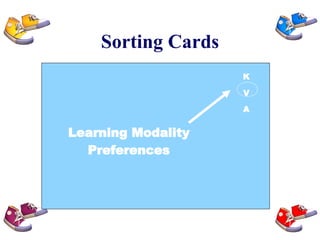
Sorting Cards First Name & First Initial of Last Name Written in marker  Large enough to see across the room K V A Learning Modality Preferences
Activity Eight Ways of Being Smart Read the descriptors for the 8 intelligences. Reflect on your own strengths, likes and learning experiences. Determine: which 2 or 3 intelligences are your strongest. which ones are weaker?
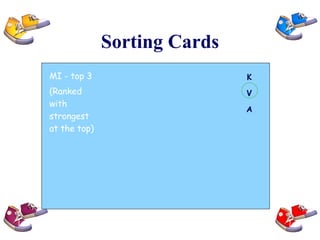
Sorting Cards First Name & First Initial of Last Name Written in marker  Large enough to see across the room K V A MI - top 3 (Ranked with strongest at the top)
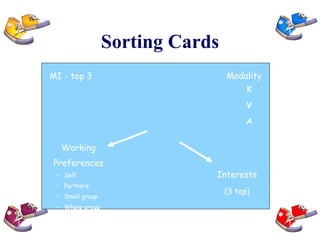
Sorting Cards First Name & First Initial of Last Name Written in marker  Large enough to see across the room K V A MI - top 3 Modality Interests (3 top) Working Preferences Self Partners Small group Whole group
Differentiated Instruction is a teacher’s response to learners’ needs guided by general principles of differentiation and based on …   Content   Process  Product Environment Instruction & Assessment Readiness  Interests  Learning  Preferences Curriculum Evaluation
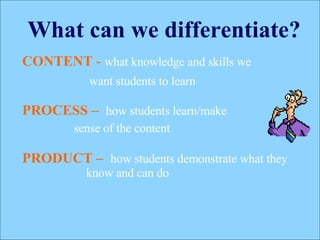
What can we differentiate? CONTENT   -   what knowledge and skills we   want students to learn   PROCESS   –  how students learn/make  sense of the content PRODUCT   –   how students demonstrate what they know and can do
CONTENT: The “What” You differentiate content when you: pre-assess & match learner’s readiness level Valid  data – assessment of what the child already knows and can do provide  choice  about topics to explore in greater depth provide  resources  that match the learner’s level of understanding
PROCESS:  The “How” Adapt the process by: Simplifying the task or adding greater  complexity  or abstractness to tasks  Engaging students in  higher levels of thinking Increasing the  variety of ways  in which you ask them to learn (e.g., learning style, multiple intelligence)
PRODUCT:  End Results Products reflect what students have  understood or been able to apply Products are differentiated when you plan units that reflect many ways to represent learning Products can match: Learning style, multiple intelligence Consider authentic audiences, opportunity to self select, variety of formats/performance tasks
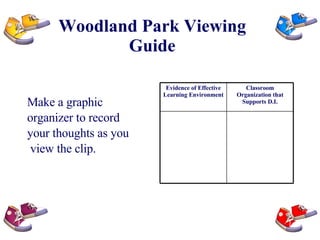
Woodland Park Viewing Guide Make a graphic organizer to record your thoughts as you view the clip. Classroom Organization that Supports D.I. Evidence of Effective Learning Environment
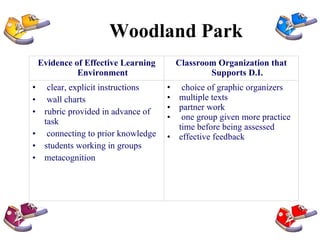
Woodland Park   choice of graphic organizers multiple texts partner work one group given more practice time before being assessed effective feedback   clear, explicit instructions wall charts  rubric provided in advance of task connecting to prior knowledge students working in groups metacognition Classroom Organization that Supports D.I. Evidence of Effective Learning Environment
“ DI Deck” What can we use in the classroom to put the principles and instructional strategies of DI into practice?
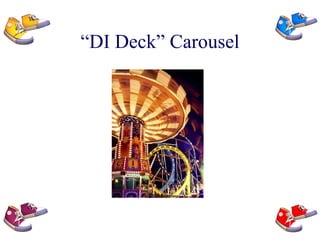
“DI Deck” Carousel
Next Steps Before the next session, try implementing  one  of the cards in your “DI Deck” Share your experience with a colleague
There is no recipe for differentiation.  Teachers construct differentiated classrooms in varying ways depending on their own personalities, the nature of the subject and grade levels they teach, and the learning profiles of their students. Carol Ann Tomlinson
I am a Child… I am a Teacher How does the poem reflect the key messages of DI?
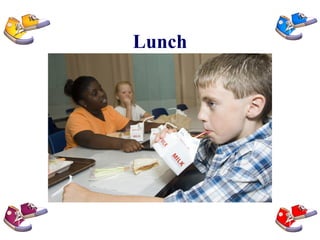
Lunch
TACK 101 What is TACK? Where do we find TACK ? How do we use TACK? How do we determine the relationship between the expectations and tack?
What is TACK? T  – thinking A  – application C  – communication K  – knowledge and understanding
Where do we find TACK? Achievement Chart in the curriculum documents Four categories of knowledge and skills Curriculum expectations can be categorized into these four areas Within theses categories are subsets of knowledge and skills that define the categories
How do we use TACK? Provides a framework for teachers to plan for learning;  plan and provide feedback; Guide in the development of assessment tasks and tools and;  make judgments about student work. Assessment is balanced between the four  categories and achievement of expectations is considered within the appropriate categories
Levels on the Achievement Chart Provincial standard – Level 3 Descriptors –  define the criteria effectiveness, accuracy, depth Qualifiers – define the levels of achievement
How do we determine the relationship between the expectations and TACK? Verbs from the expectations fall into TACK categories Some overlap depending upon the expectation and how it’s being used Verb chart can help you determine the TACK categories you are targeting for a unit
Processing Card On the index card provided: Explain your understanding of TACK at this point in time. List other questions do you still have.
Design Down Curriculum Planning Backgrounder As you read the backgrounder, question the text.  Jot your questions in the margins of the article. As we work through the content, refer back to your questions:  Where they answered?  What more information do you need?
Planning for Curriculum and Assessment: Design Down Design Down Model or Backwards Design Model Clarify results and evidence before designing the lessons and activities Way of thinking more accurately, being more strategic Overcomes the prevalence of “Aimless Activity and Superficial Coverage”
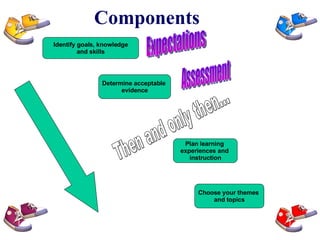
Components Identify goals, knowledge and skills Determine acceptable  evidence Plan learning  experiences and  instruction Choose your themes  and topics Then and only then... Expectations Assessment
Identify Desired Results Expectations from the curriculum guide(s) What expectations do you want to meet? What learning skills do you want to assess? Enduring Understandings/Big Ideas What is the “So What?”
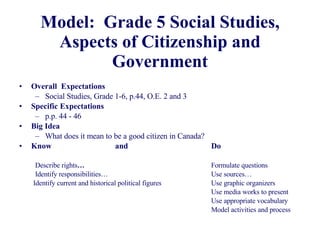
Model:  Grade 5 Social Studies, Aspects of Citizenship and Government Overall  Expectations Social Studies, Grade 1-6, p.44, O.E. 2 and 3 Specific Expectations p.p. 44 - 46 Big Idea What does it mean to be a good citizen in Canada? Know  and  Do Describe   rights … Formulate questions Identify responsibilities… Use sources… Identify current and historical political figures Use graphic organizers Use media works to present Use appropriate vocabulary Model activities and process
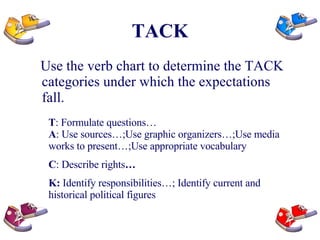
TACK Use the verb chart to determine the TACK categories under which the expectations fall. T : Formulate questions… A : Use sources…;Use graphic organizers…;Use media works to present…;Use appropriate vocabulary C : Describe   rights … K:  Identify responsibilities…; Identify current and historical political figures
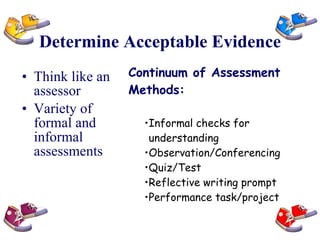
Determine Acceptable Evidence Think like an assessor Variety of formal and informal assessments Continuum of Assessment Methods: Informal checks for  understanding Observation/Conferencing Quiz/Test Reflective writing prompt Performance task/project
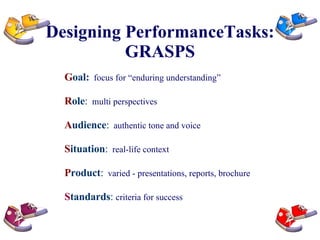
Designing PerformanceTasks: GRASPS G oal:   focus for “enduring understanding” R ole :   multi perspectives   A udience :   authentic tone and voice   S ituation :   real-life context   P roduct :   varied - presentations, reports, brochure S tandards :  criteria for success
Model: Performance Task Hall of Citizenship Recognition
Performance Task Analysis GRASPS Does it contain all components?  Does it allow for summative assessment of the expectations (targets)? Differentiation Does it differentiate for product, process, content according to the student’s readiness, interests and learning profile?
What Formative Assessment Methods will you use? Know  Describe   rights … Identify responsibilities… Identify current and historical political figures… Do Formulate questions… Use sources… Use graphic organizers… Use media works… Use appropriate vocabulary…. Model activities and processes…
Teaching/Learning Strategies Examine the expectations and summative tasks. What lessons do I need to teach to help students reach these targets? Where will I build formative assessments to provide feedback? How will I accommodate or modify my spec ed and ELL students
Topic/Themes/Resources What topics relate to the expectations selected? What resources do I have? What resources do I need to get?
Design Down Resources Ontario Curriculum Planner www.ocup.org/units/units55.php Understanding By Design Bookstore Video series (Medianet) Association for Supervision and Curriculum Design  www.ascd.org Talk About Assessment Bookstore
Consolidation Making the Shift to Expectation-Based Planning Self-assessment: At what stage are you in making the shift? Reflect upon your stage of development in Design Down.
DPA: Intermediate Chair Raising Activities
Break
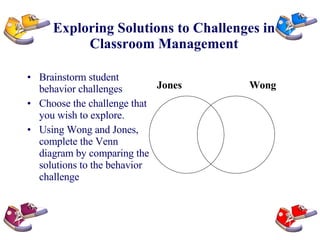
Exploring Solutions to Challenges in Classroom Management Brainstorm student behavior challenges Choose the challenge that you wish to explore. Using Wong and Jones, complete the Venn diagram by comparing the solutions to the behavior challenge Jones Wong
Homework Write a reflection about your parent-teacher interview. Choose one of the ideas from the  DI Deck and use it with your students.
Questions

Session 3

  • 1.
  • 2.
    Agenda Homework ParentTeacher Communication Differentiated Instruction Design Down Planning DPA Classroom Management
  • 3.
    Homework: Monthly BingoShare your Bingo Card with your table. What was most successful? Why? What didn’t work so well? Why?
  • 4.
  • 5.
    Activity: A PictureSays A Thousand Words…. Which image represents how you feel about the upcoming parent-teacher interviews? Discuss why with your group members.
  • 6.
    Parent Teacher ConferencesThis should not be your first contact with the parents Meet the Teacher Night Informal chats during arrival/dismissal or playground duty Positive phone calls home Communication in the agenda It’s not too late!!!!!!!!!!!
  • 7.
    Before the ConferenceCheck the schedule of conferences. Call any parents you have requested to see who have not booked a conference time. Some may need to be scheduled at alternate times.
  • 8.
    Before the Conference:Preparing Your Room Identify your room from outside. Ensure the room is well organized and neat Provide comfortable seating inside and outside the classroom
  • 9.
    Before the Conference:Gather Materials Ontario Student Record (OSR) Standardized test results Student’s grades in other classes Record of student grades/work completed/observations/anecdotal reports Attendance record Copy of report card Communication record (phone calls home, agenda, copies of newsletter) LST report or IEP
  • 10.
    Before the Conference:Preparing Yourself Dress professionally Check parent names Be aware of cultural norms in your community Collaborate with colleagues, administration, CYW, LST, etc
  • 11.
    Before the Conference:Establish the Agenda Be clear about the purpose of your conference. Inform parents about student learning Increase parent knowledge about school programs Develop mutual goals for the student Before beginning, you want to know what action you hope will result from the discussion with the parents
  • 12.
    During the Conference1. Warm Up Make parents comfortable Introduce yourself Begin with positive remarks Remind parents that you are all working together with the child’s best interests in mind
  • 13.
    During the Conference2. The Presentation Share information about the student’s progress, strengths and learning Share standards (no jargon) Be a good listener Share concerns Be positive, yet honest and frank
  • 14.
    During the Interview3. The Plan Next steps – curriculum expectations and/or learning skills Be reasonable – choose one or two critical goals Team approach – parent, student and teacher Possible involvement of other team members – CYW, Speech and language, etc.
  • 15.
    During the Conference4. Conclusion Summarize Review the plan of action Set a timeline to meet again Follow through with your action items
  • 16.
    During the ConferenceEnd by saying something positive about the student Thank the parent for his/her time Acknowledge the importance of the parents’ coming to the interview
  • 17.
    After the ConferenceThe parent should leave the interview with positive feelings. Both you and the parent should feel that the time spent was worthwhile. Emphasize your certainty that joint efforts will be productive.
  • 18.
    In Case ofConflict Be diplomatic Document, document, document No one wins an argument Be prepared to limit discussion One step at a time Again, try to end on a positive note Thank the parents for coming
  • 19.
    After the ConferenceRecord date, time and issues discussed Note any follow up required Document follow up completed
  • 20.
  • 21.
  • 22.
    To begin …Your first name & the first letter of your last name Large enough to see across the room Using a MARKER . . . On the front of the index card please print: Anna Z.
  • 23.
  • 24.
    Anticipation Guide Onyour own, read each statement in the anticipation guide. In the first column put a T for true if you agree Put an F for false if you disagree
  • 25.
    Read Aloud: WhatStudents want from Teachers
  • 26.
    Why Differentiate Instruction?“ Children already come to us differentiated. It just makes sense that we would differentiate our instruction in response to them.” Carol Ann Tomlinson “ The Differentiated Classroom”
  • 27.
    Paradigm Shift OldParadigm: Teach to the middle New Paradigm: Address the needs of all children
  • 28.
    Differentiating Instruction Requiresteachers to: increase their understanding of who they teach acknowledge that no two students: learn at the same pace solve problems in exactly the same way have the same interests have learned the same skills
  • 29.
    Differentiated Instruction isa teacher’s response to learners’ needs guided by general principles of differentiation and based on … Content Process Product Environment Instruction & Assessment Readiness Interests Learning Preferences Curriculum Evaluation
  • 30.
    Why Develop aLearning Profile? Learning Preference If the assignment encourages students to work in a preferred manner/mode A Good Fit If tasks ignite curiosity or passion Motivation If tasks are a close match for student skills. Growth Interest Readiness
  • 31.
    Learner Profile Cognitiveabilities Cognitive style Strengths/Needs Metacognitive, Information Processing, Communication, Academic, Social/Adaptive Readiness Learning preferences Multiple Intelligence preferences Learning modality Interests Developmental needs/stages Personality/temperament Socio-economic factors Prior experiences Cultural and Gender influences Value for learning Self-esteem/confidence Self-efficacy ELL/ESL/ELD
  • 32.
    Learning Modality PreferencesVisual learning style preference for seen or observed things, (pictures, diagrams, demonstrations, displays, handouts, films, chart, etc.) Auditory learning style preference for the transfer of information through listening (spoken word of self or others, of sounds and noises) Kinesthetic learning style preference for physical experience (touching, feeling, holding, doing, practical hands-on experiences)
  • 33.
    Sorting Cards FirstName & First Initial of Last Name Written in marker Large enough to see across the room K V A Learning Modality Preferences
  • 34.
    Activity Eight Waysof Being Smart Read the descriptors for the 8 intelligences. Reflect on your own strengths, likes and learning experiences. Determine: which 2 or 3 intelligences are your strongest. which ones are weaker?
  • 35.
    Sorting Cards FirstName & First Initial of Last Name Written in marker Large enough to see across the room K V A MI - top 3 (Ranked with strongest at the top)
  • 36.
    Sorting Cards FirstName & First Initial of Last Name Written in marker Large enough to see across the room K V A MI - top 3 Modality Interests (3 top) Working Preferences Self Partners Small group Whole group
  • 37.
    Differentiated Instruction isa teacher’s response to learners’ needs guided by general principles of differentiation and based on … Content Process Product Environment Instruction & Assessment Readiness Interests Learning Preferences Curriculum Evaluation
  • 38.
    What can wedifferentiate? CONTENT - what knowledge and skills we want students to learn PROCESS – how students learn/make sense of the content PRODUCT – how students demonstrate what they know and can do
  • 39.
    CONTENT: The “What”You differentiate content when you: pre-assess & match learner’s readiness level Valid data – assessment of what the child already knows and can do provide choice about topics to explore in greater depth provide resources that match the learner’s level of understanding
  • 40.
    PROCESS: The“How” Adapt the process by: Simplifying the task or adding greater complexity or abstractness to tasks Engaging students in higher levels of thinking Increasing the variety of ways in which you ask them to learn (e.g., learning style, multiple intelligence)
  • 41.
    PRODUCT: EndResults Products reflect what students have understood or been able to apply Products are differentiated when you plan units that reflect many ways to represent learning Products can match: Learning style, multiple intelligence Consider authentic audiences, opportunity to self select, variety of formats/performance tasks
  • 42.
    Woodland Park ViewingGuide Make a graphic organizer to record your thoughts as you view the clip. Classroom Organization that Supports D.I. Evidence of Effective Learning Environment
  • 43.
    Woodland Park  choice of graphic organizers multiple texts partner work one group given more practice time before being assessed effective feedback   clear, explicit instructions wall charts rubric provided in advance of task connecting to prior knowledge students working in groups metacognition Classroom Organization that Supports D.I. Evidence of Effective Learning Environment
  • 44.
    “ DI Deck”What can we use in the classroom to put the principles and instructional strategies of DI into practice?
  • 45.
  • 46.
    Next Steps Beforethe next session, try implementing one of the cards in your “DI Deck” Share your experience with a colleague
  • 47.
    There is norecipe for differentiation. Teachers construct differentiated classrooms in varying ways depending on their own personalities, the nature of the subject and grade levels they teach, and the learning profiles of their students. Carol Ann Tomlinson
  • 48.
    I am aChild… I am a Teacher How does the poem reflect the key messages of DI?
  • 49.
  • 50.
    TACK 101 Whatis TACK? Where do we find TACK ? How do we use TACK? How do we determine the relationship between the expectations and tack?
  • 51.
    What is TACK?T – thinking A – application C – communication K – knowledge and understanding
  • 52.
    Where do wefind TACK? Achievement Chart in the curriculum documents Four categories of knowledge and skills Curriculum expectations can be categorized into these four areas Within theses categories are subsets of knowledge and skills that define the categories
  • 53.
    How do weuse TACK? Provides a framework for teachers to plan for learning; plan and provide feedback; Guide in the development of assessment tasks and tools and; make judgments about student work. Assessment is balanced between the four categories and achievement of expectations is considered within the appropriate categories
  • 54.
    Levels on theAchievement Chart Provincial standard – Level 3 Descriptors – define the criteria effectiveness, accuracy, depth Qualifiers – define the levels of achievement
  • 55.
    How do wedetermine the relationship between the expectations and TACK? Verbs from the expectations fall into TACK categories Some overlap depending upon the expectation and how it’s being used Verb chart can help you determine the TACK categories you are targeting for a unit
  • 56.
    Processing Card Onthe index card provided: Explain your understanding of TACK at this point in time. List other questions do you still have.
  • 57.
    Design Down CurriculumPlanning Backgrounder As you read the backgrounder, question the text. Jot your questions in the margins of the article. As we work through the content, refer back to your questions: Where they answered? What more information do you need?
  • 58.
    Planning for Curriculumand Assessment: Design Down Design Down Model or Backwards Design Model Clarify results and evidence before designing the lessons and activities Way of thinking more accurately, being more strategic Overcomes the prevalence of “Aimless Activity and Superficial Coverage”
  • 59.
    Components Identify goals,knowledge and skills Determine acceptable evidence Plan learning experiences and instruction Choose your themes and topics Then and only then... Expectations Assessment
  • 60.
    Identify Desired ResultsExpectations from the curriculum guide(s) What expectations do you want to meet? What learning skills do you want to assess? Enduring Understandings/Big Ideas What is the “So What?”
  • 61.
    Model: Grade5 Social Studies, Aspects of Citizenship and Government Overall Expectations Social Studies, Grade 1-6, p.44, O.E. 2 and 3 Specific Expectations p.p. 44 - 46 Big Idea What does it mean to be a good citizen in Canada? Know and Do Describe rights … Formulate questions Identify responsibilities… Use sources… Identify current and historical political figures Use graphic organizers Use media works to present Use appropriate vocabulary Model activities and process
  • 62.
    TACK Use theverb chart to determine the TACK categories under which the expectations fall. T : Formulate questions… A : Use sources…;Use graphic organizers…;Use media works to present…;Use appropriate vocabulary C : Describe rights … K: Identify responsibilities…; Identify current and historical political figures
  • 63.
    Determine Acceptable EvidenceThink like an assessor Variety of formal and informal assessments Continuum of Assessment Methods: Informal checks for understanding Observation/Conferencing Quiz/Test Reflective writing prompt Performance task/project
  • 64.
    Designing PerformanceTasks: GRASPSG oal: focus for “enduring understanding” R ole : multi perspectives A udience : authentic tone and voice S ituation : real-life context P roduct : varied - presentations, reports, brochure S tandards : criteria for success
  • 65.
    Model: Performance TaskHall of Citizenship Recognition
  • 66.
    Performance Task AnalysisGRASPS Does it contain all components? Does it allow for summative assessment of the expectations (targets)? Differentiation Does it differentiate for product, process, content according to the student’s readiness, interests and learning profile?
  • 67.
    What Formative AssessmentMethods will you use? Know Describe rights … Identify responsibilities… Identify current and historical political figures… Do Formulate questions… Use sources… Use graphic organizers… Use media works… Use appropriate vocabulary…. Model activities and processes…
  • 68.
    Teaching/Learning Strategies Examinethe expectations and summative tasks. What lessons do I need to teach to help students reach these targets? Where will I build formative assessments to provide feedback? How will I accommodate or modify my spec ed and ELL students
  • 69.
    Topic/Themes/Resources What topicsrelate to the expectations selected? What resources do I have? What resources do I need to get?
  • 70.
    Design Down ResourcesOntario Curriculum Planner www.ocup.org/units/units55.php Understanding By Design Bookstore Video series (Medianet) Association for Supervision and Curriculum Design www.ascd.org Talk About Assessment Bookstore
  • 71.
    Consolidation Making theShift to Expectation-Based Planning Self-assessment: At what stage are you in making the shift? Reflect upon your stage of development in Design Down.
  • 72.
    DPA: Intermediate ChairRaising Activities
  • 73.
  • 74.
    Exploring Solutions toChallenges in Classroom Management Brainstorm student behavior challenges Choose the challenge that you wish to explore. Using Wong and Jones, complete the Venn diagram by comparing the solutions to the behavior challenge Jones Wong
  • 75.
    Homework Write areflection about your parent-teacher interview. Choose one of the ideas from the DI Deck and use it with your students.
  • 76.

Editor's Notes