QUESTION TAGS
Structure (1) Question tags are mini questions that we often put at the end of a sentence in spoken English.  We use an auxiliary verb or modal verb, the structure is: auxiliary verb or modal verb + personal subject pronoun + question mark (?):  I shouldn’t have lost my temper, should I?
Structure (2) We use a negative question tag after a positive sentence:  Mary plays the piano very well, doesn’t she? We use a positive question tag after a negative sentence:  You didn’t lock the door, did you?
Intonation A question tag with a  falling intonation  is a way of making conversation by asking the listener to agree with the speaker: It’s a lovely day, isn’t it? A question tag with a  rising intonation  means that the speaker is asking for confirmation:  She’d like to meet him, wouldn’t she?
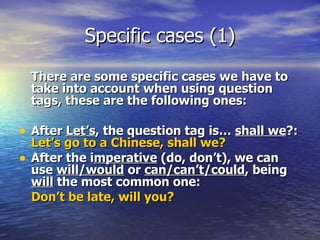
Specific cases (1) There are some specific cases we have to take into account when using question tags, these are the following ones: After  Let’s , the question tag is…  shall we ?:  Let’s go to a Chinese, shall we? After the i mperative  (do, don’t), we can use  will/would  or  can/can’t/could , being  will  the most common one:  Don’t be late, will you?
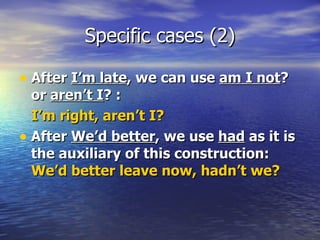
Specific cases (2) After  I’m late , we can use  am I not ? or  aren’t I ? :  I’m right, aren’t I? After  We’d better , we use  had  as it is the auxiliary of this construction:  We’d better leave now, hadn’t we?
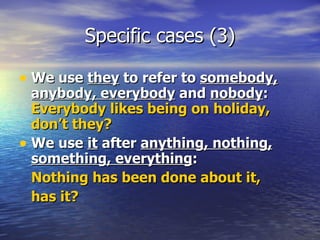
Specific cases (3) We use  they  to refer to  somebody, anybody, everybody  and  nobody :  Everybody likes being on holiday, don’t they? We use  it  after  anything, nothing, something, everything :  Nothing has been done about it,  has it?
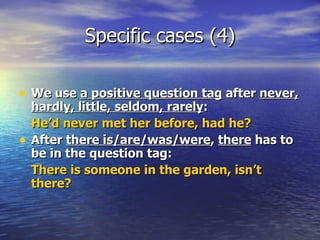
Specific cases (4) We use  a positive question tag  after  never, hardly, little, seldom, rarely :  He’d never met her before, had he? After  there is/are/was/were ,  there  has to be in the question tag:  There is someone in the garden, isn’t there?
Specific cases (4) After  this/that/ these/those , we use either  it  as singular subject pronoun or  they  as plural subject pronoun:  This picture is a Picasso, isn’t it?

Question Tags

  • 1.
  • 2.
    Structure (1) Questiontags are mini questions that we often put at the end of a sentence in spoken English. We use an auxiliary verb or modal verb, the structure is: auxiliary verb or modal verb + personal subject pronoun + question mark (?): I shouldn’t have lost my temper, should I?
  • 3.
    Structure (2) Weuse a negative question tag after a positive sentence: Mary plays the piano very well, doesn’t she? We use a positive question tag after a negative sentence: You didn’t lock the door, did you?
  • 4.
    Intonation A questiontag with a falling intonation is a way of making conversation by asking the listener to agree with the speaker: It’s a lovely day, isn’t it? A question tag with a rising intonation means that the speaker is asking for confirmation: She’d like to meet him, wouldn’t she?
  • 5.
    Specific cases (1)There are some specific cases we have to take into account when using question tags, these are the following ones: After Let’s , the question tag is… shall we ?: Let’s go to a Chinese, shall we? After the i mperative (do, don’t), we can use will/would or can/can’t/could , being will the most common one: Don’t be late, will you?
  • 6.
    Specific cases (2)After I’m late , we can use am I not ? or aren’t I ? : I’m right, aren’t I? After We’d better , we use had as it is the auxiliary of this construction: We’d better leave now, hadn’t we?
  • 7.
    Specific cases (3)We use they to refer to somebody, anybody, everybody and nobody : Everybody likes being on holiday, don’t they? We use it after anything, nothing, something, everything : Nothing has been done about it, has it?
  • 8.
    Specific cases (4)We use a positive question tag after never, hardly, little, seldom, rarely : He’d never met her before, had he? After there is/are/was/were , there has to be in the question tag: There is someone in the garden, isn’t there?
  • 9.
    Specific cases (4)After this/that/ these/those , we use either it as singular subject pronoun or they as plural subject pronoun: This picture is a Picasso, isn’t it?