English Tenses
Verónica Esteban Díaz
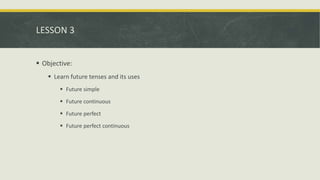
LESSON 3
 Objective:
 Learn future tenses and its uses
 Future simple
 Future continuous
 Future perfect
 Future perfect continuous
FUTURE SIMPLE
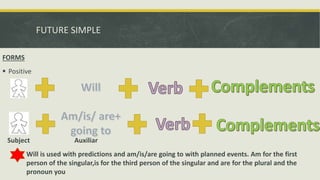
FORMS
 Positive
Subject Auxiliar
Will is used with predictions and am/is/are going to with planned events. Am for the first
person of the singular,is for the third person of the singular and are for the plural and the
pronoun you
FUTURE SIMPLE
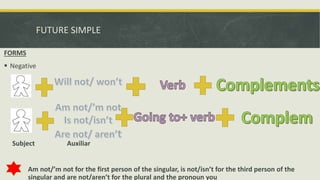
FORMS
 Negative
Subject Auxiliar
Am not/’m not for the first person of the singular, is not/isn’t for the third person of the
singular and are not/aren’t for the plural and the pronoun you
FUTURE SIMPLE
FORMS
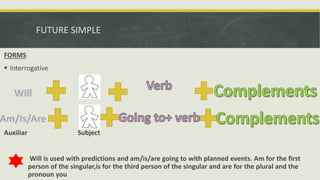
 Interrogative
Auxiliar Subject
Will is used with predictions and am/is/are going to with planned events. Am for the first
person of the singular,is for the third person of the singular and are for the plural and the
pronoun you
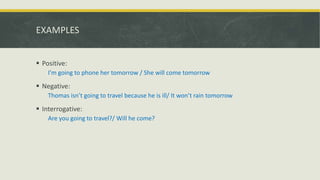
EXAMPLES
 Positive:
I’m going to phone her tomorrow / She will come tomorrow
 Negative:
Thomas isn’t going to travel because he is ill/ It won’t rain tomorrow
 Interrogative:
Are you going to travel?/ Will he come?
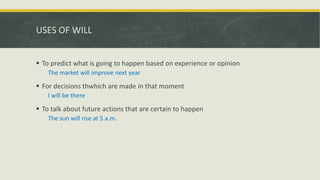
USES OF WILL
 To predict what is going to happen based on experience or opinion
The market will improve next year
 For decisions thwhich are made in that moment
I will be there
 To talk about future actions that are certain to happen
The sun will rise at 5 a.m.
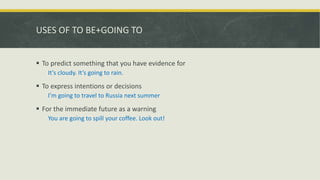
USES OF TO BE+GOING TO
 To predict something that you have evidence for
It’s cloudy. It’s going to rain.
 To express intentions or decisions
I’m going to travel to Russia next summer
 For the immediate future as a warning
You are going to spill your coffee. Look out!
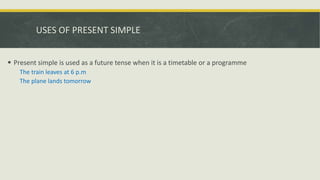
USES OF PRESENT SIMPLE
 Present simple is used as a future tense when it is a timetable or a programme
The train leaves at 6 p.m
The plane lands tomorrow
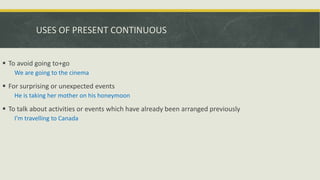
USES OF PRESENT CONTINUOUS
 To avoid going to+go
We are going to the cinema
 For surprising or unexpected events
He is taking her mother on his honeymoon
 To talk about activities or events which have already been arranged previously
I’m travelling to Canada
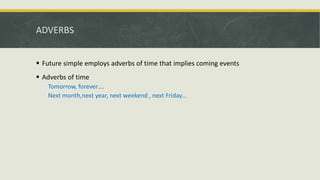
ADVERBS
 Future simple employs adverbs of time that implies coming events
 Adverbs of time
Tomorrow, forever….
Next month,next year, next weekend , next Friday…
EXERCISES
 http://www.perfect-english-grammar.com/simple-future-exercise-1.html
 http://www.englishpage.com/verbpage/verbs19.htm
 https://english.lingolia.com/en/grammar/tenses-comparison/future-
tenses/exercises
FUTURE CONTINUOUS
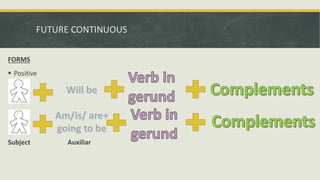
FORMS
 Positive
Subject Auxiliar
FUTURE CONTINUOUS
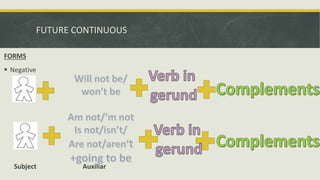
FORMS
 Negative
Subject Auxiliar
FUTURE CONTINUOUS
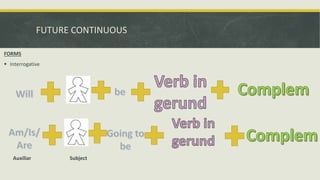
FORMS
 Interrogative
Auxiliar Subject
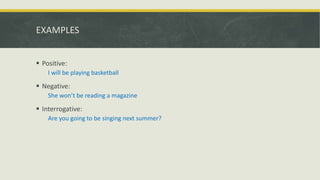
EXAMPLES
 Positive:
I will be playing basketball
 Negative:
She won’t be reading a magazine
 Interrogative:
Are you going to be singing next summer?
USES
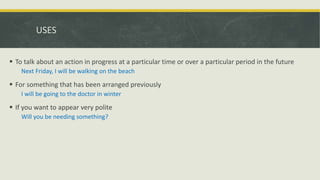
 To talk about an action in progress at a particular time or over a particular period in the future
Next Friday, I will be walking on the beach
 For something that has been arranged previously
I will be going to the doctor in winter
 If you want to appear very polite
Will you be needing something?
ADVERBS
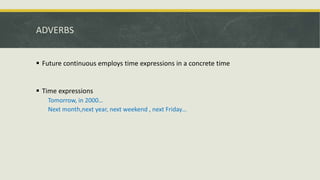
 Future continuous employs time expressions in a concrete time
 Time expressions
Tomorrow, in 2000…
Next month,next year, next weekend , next Friday…
EXERCISES
 http://www.myenglishpages.com/site_php_files/grammar-exercise-future-
progressive.php
 http://www.really-learn-english.com/future-progressive-exercises.html
 http://mrbrownslearningspace.com/wp-
content/uploads/2015/01/Future_Progressive_2.htm
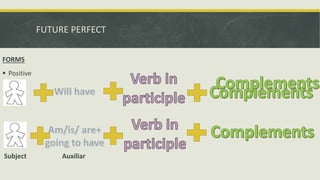
FUTURE PERFECT
FORMS
 Positive
Subject Auxiliar
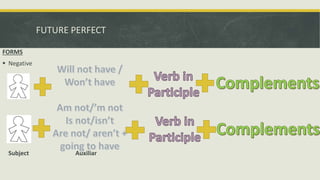
FUTURE PERFECT
FORMS
 Negative
Subject Auxiliar
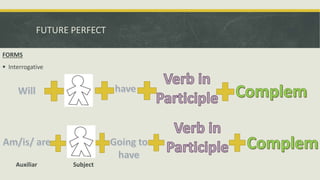
FUTURE PERFECT
FORMS
 Interrogative
Auxiliar Subject
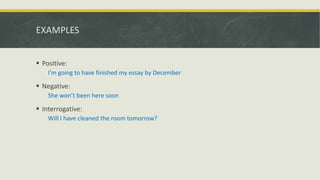
EXAMPLES
 Positive:
I’m going to have finished my essay by December
 Negative:
She won’t been here soon
 Interrogative:
Will I have cleaned the room tomorrow?
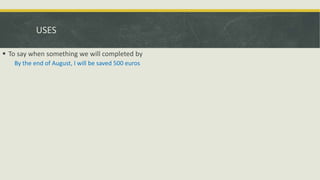
USES
 To say when something we will completed by
By the end of August, I will be saved 500 euros
ADVERBS
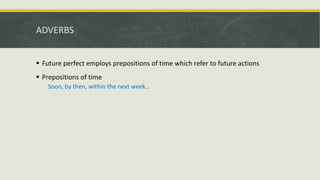
 Future perfect employs prepositions of time which refer to future actions
 Prepositions of time
Soon, by then, within the next week…
EXERCISES
 http://www.really-learn-english.com/future-perfect-exercises.html
 http://www.englisch-
hilfen.de/en/exercises/tenses/future_perfect_statements.htm
 http://www.learnenglishfeelgood.com/esl-future-perfect-tense2.html
FUTURE PERFECT CONTINUOUS
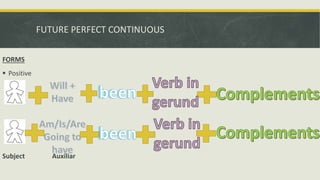
FORMS
 Positive
Subject Auxiliar
FUTURE PERFECT CONTINUOUS
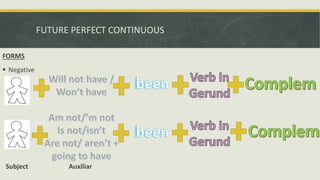
FORMS
 Negative
Subject Auxiliar
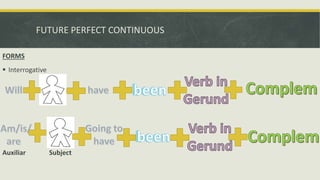
FUTURE PERFECT CONTINUOUS
FORMS
 Interrogative
Auxiliar Subject
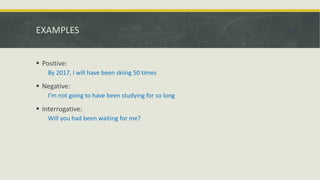
EXAMPLES
 Positive:
By 2017, I will have been skiing 50 times
 Negative:
I’m not going to have been studying for so long
 Interrogative:
Will you had been waiting for me?
USES
 To emphasise duration at a specified time in the future
I will have been working for hours
ADVERBS
 Future perfect continuous employs prepositions of time because they refer to
the duration of time
 Prepositions of time
For, during, by 2040 …
EXERCISES
 http://www.englishpage.com/verbpage/verbs26.htm
 https://www.ego4u.com/en/cram-up/grammar/future-2-progressive/exercises
 http://www.perfect-english-grammar.com/support-
files/future_perfect_continuous_mixed.pdf

English tenses lesson 4