Articles
by Neiriberto & Carol Calil
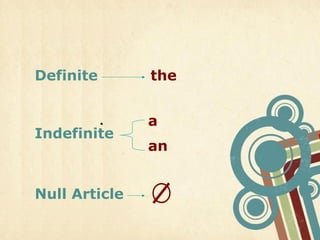
Definite       the


               a
Indefinite
               an


Null Article
Definite

1. When talking about something specific:

       The umbrella next to the door is not mine.


2. When the speaker and the listener are talking
about the same specific item:

       William, don´t forget to close the refrigerator.
Definite

3. For the second and all other references to
the same noun:
       We bought a new computer last month. The
       computer lets us access the internet really quickly.


4. With the superlative form of an adjective,
which means with the word most or with the end
est:

       Murilo is the best student in class.
Definite

5. The names of countries that look plural,
including countries that end in s or have the
words united, union, republic or kingdom:

        Neiriberto won the bet on this rule, now Carol has
        to go to the Bahamas.

6. For the parts of something:
  (In general, we do not use the for body parts)

        Mary´s kitchen is beautiful: the refrigerator is silver,
        the stove is black...
Definite

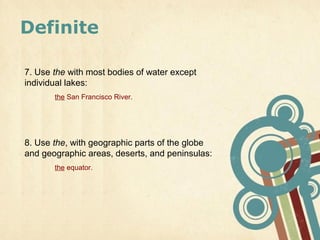
7. Use the with most bodies of water except
individual lakes:
       the San Francisco River.


8. Use the, with geographic parts of the globe
and geographic areas, deserts, and peninsulas:
       the equator.
Indefinite

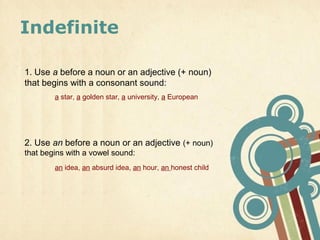
1. Use a before a noun or an adjective (+ noun)
that begins with a consonant sound:
        a star, a golden star, a university, a European


2. Use an before a noun or an adjective (+ noun)
that begins with a vowel sound:
        an idea, an absurd idea, an hour, an honest child
Indefinite

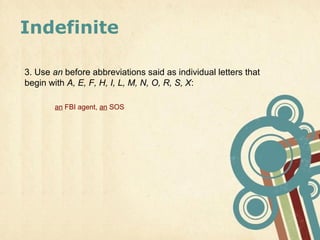
3. Use an before abbreviations said as individual letters that
begin with A, E, F, H, I, L, M, N, O, R, S, X:

       an FBI agent, an SOS
Null Article

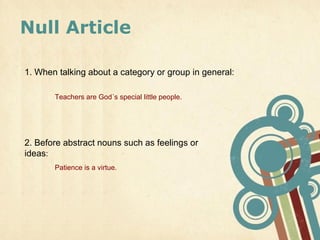
1. When talking about a category or group in general:

       Teachers are God´s special little people.


2. Before abstract nouns such as feelings or
ideas:
       Patience is a virtue.
In planning a class on articles, it´s
important to know how articles are used
within the native language of your student.
Some languages have no article while
others have articles that appear to be
equivalent to English but the usages do
not overlap.

Neriberto and ana calil's articles

  • 1.
  • 2.
    Definite the a Indefinite an Null Article
  • 3.
    Definite 1. When talkingabout something specific: The umbrella next to the door is not mine. 2. When the speaker and the listener are talking about the same specific item: William, don´t forget to close the refrigerator.
  • 4.
    Definite 3. For thesecond and all other references to the same noun: We bought a new computer last month. The computer lets us access the internet really quickly. 4. With the superlative form of an adjective, which means with the word most or with the end est: Murilo is the best student in class.
  • 5.
    Definite 5. The namesof countries that look plural, including countries that end in s or have the words united, union, republic or kingdom: Neiriberto won the bet on this rule, now Carol has to go to the Bahamas. 6. For the parts of something: (In general, we do not use the for body parts) Mary´s kitchen is beautiful: the refrigerator is silver, the stove is black...
  • 6.
    Definite 7. Use thewith most bodies of water except individual lakes: the San Francisco River. 8. Use the, with geographic parts of the globe and geographic areas, deserts, and peninsulas: the equator.
  • 7.
    Indefinite 1. Use abefore a noun or an adjective (+ noun) that begins with a consonant sound: a star, a golden star, a university, a European 2. Use an before a noun or an adjective (+ noun) that begins with a vowel sound: an idea, an absurd idea, an hour, an honest child
  • 8.
    Indefinite 3. Use anbefore abbreviations said as individual letters that begin with A, E, F, H, I, L, M, N, O, R, S, X: an FBI agent, an SOS
  • 9.
    Null Article 1. Whentalking about a category or group in general: Teachers are God´s special little people. 2. Before abstract nouns such as feelings or ideas: Patience is a virtue.
  • 10.
    In planning aclass on articles, it´s important to know how articles are used within the native language of your student. Some languages have no article while others have articles that appear to be equivalent to English but the usages do not overlap.