República Bolivariana de Venezuela
Ministerio del Poder Popular para la Educación
U.E. Colegio “ Francisco Lazo Martí”
Cabudare, Edo Lara.

Integrantes:
Albornoz Génesis
Aponte Emperatriz
Navea Alexis
Pérez Nilaurys
Año y Sección:
2do Cs “B”
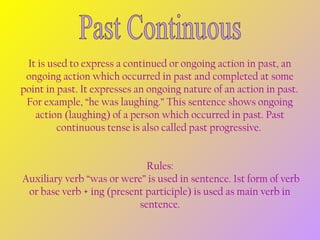
It is used to express a continued or ongoing action in past, an
ongoing action which occurred in past and completed at some
point in past. It expresses an ongoing nature of an action in past. 
For example, “he was laughing.” This sentence shows ongoing
action (laughing) of a person which occurred in past. Past
continuous tense is also called past progressive.  
 
Rules:
Auxiliary verb “was or were” is used in sentence. 1st form of verb
or base verb + ing (present participle) is used as main verb in
sentence.
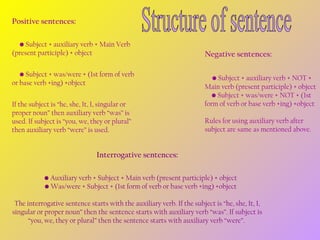
Positive sentences:
          • Subject + auxiliary verb + Main Verb
(present participle) + object
          • Subject + was/were + (1st form of verb
or base verb +ing) +object
If the subject is “he, she, It, I, singular or
proper noun” then auxiliary verb “was” is
used. If subject is “you, we, they or plural”
then auxiliary verb “were” is used.

Negative sentences:
         • Subject + auxiliary verb + NOT +
Main verb (present participle) + object
         • Subject + was/were + NOT + (1st
form of verb or base verb +ing) +object
Rules for using auxiliary verb after
subject are same as mentioned above.

Interrogative sentences:
         • Auxiliary verb + Subject + Main verb (present participle) + object
         • Was/were + Subject + (1st form of verb or base verb +ing) +object
The interrogative sentence starts with the auxiliary verb. If the subject is “he, she, It, I,
singular or proper noun” then the sentence starts with auxiliary verb “was”. If subject is
“you, we, they or plural” then the sentence starts with auxiliary verb “were”.
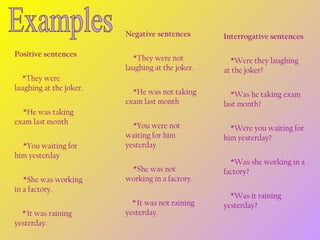
Negative sentences
Positive sentences
         *They were
laughing at the joker.
          *He was taking
exam last month
          *You waiting for
him yesterday
          *She was working
in a factory.
         * It was raining
yesterday.

Interrogative sentences

         *They were not
laughing at the joker.

        *Were they laughing
at the joker?

         *He was not taking
exam last month

        *Was he taking exam
last month?

         *You were not
waiting for him
yesterday

        *Were you waiting for
him yesterday?

         *She was not
working in a factory.
        * It was not raining
yesterday.

        *Was she working in a
factory?
        *Was it raining
yesterday?
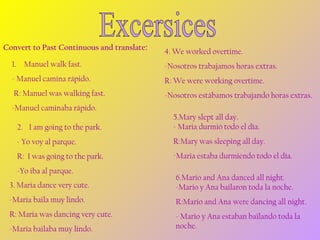
Convert to Past Continuous and translate:

4. We worked overtime.

1. Manuel walk fast.

-Nosotros trabajamos horas extras.

- Manuel camina rápido.

R: We were working overtime.

R: Manuel was walking fast.

-Nosotros estábamos trabajando horas extras.

-Manuel caminaba rápido.
2. I am going to the park.

5.Mary slept all day.
- Maria durmió todo el día.

- Yo voy al parque.

R:Mary was sleeping all day.

R: I was going to the park.

-Maria estaba durmiendo todo el día.

-Yo iba al parque.
3. Maria dance very cute.

6.Mario and Ana danced all night.
-Mario y Ana bailaron toda la noche.

-Maria baila muy lindo.

R:Mario and Ana were dancing all night.

R: Maria was dancing very cute.

- Mario y Ana estaban bailando toda la
noche.

-Maria bailaba muy lindo.
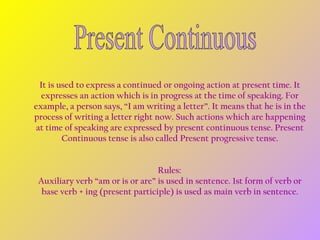
It is used to express a continued or ongoing action at present time. It
expresses an action which is in progress at the time of speaking. For
example, a person says, “I am writing a letter”. It means that he is in the
process of writing a letter right now. Such actions which are happening
at time of speaking are expressed by present continuous tense. Present
Continuous tense is also called Present progressive tense.
Rules: 
Auxiliary verb “am or is or are” is used in sentence. 1st form of verb or
base verb + ing (present participle) is used as main verb in sentence.
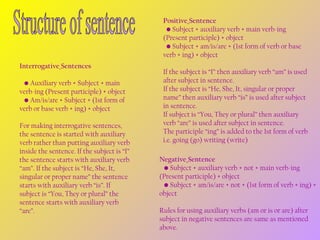
Positive Sentence
    • Subject + auxiliary verb + main verb-ing
(Present participle) + object
    • Subject + am/is/are + (1st form of verb or base
verb + ing) + object
Interrogative Sentences
      • Auxiliary verb + Subject + main
verb-ing (Present participle) + object
      • Am/is/are + Subject + (1st form of
verb or base verb + ing) + object
For making interrogative sentences,
the sentence is started with auxiliary
verb rather than putting auxiliary verb
inside the sentence. If the subject is “I”
the sentence starts with auxiliary verb
“am”. If the subject is “He, She, It,
singular or proper name” the sentence
starts with auxiliary verb “is”. If
subject is “You, They or plural” the
sentence starts with auxiliary verb
“are”.

If the subject is “I” then auxiliary verb “am” is used
after subject in sentence.
If the subject is “He, She, It, singular or proper
name” then auxiliary verb “is” is used after subject
in sentence.
If subject is “You, They or plural” then auxiliary
verb “are” is used after subject in sentence.
The participle “ing” is added to the 1st form of verb
i.e. going (go) writing (write)
Negative Sentence
      • Subject + auxiliary verb + not + main verb-ing
(Present participle) + object
      • Subject + am/is/are + not + (1st form of verb + ing) +
object
Rules for using auxiliary verbs (am or is or are) after
subject in negative sentences are same as mentioned
above. 
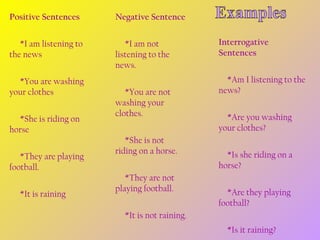
Positive Sentences

Negative Sentence

           *I am listening to
the news

          *I am not
listening to the
news.

           *You are washing
your clothes
           *She is riding on
horse
           *They are playing
football.
           *It is raining

          *You are not
washing your
clothes.
          *She is not
riding on a horse.
          *They are not
playing football.

Interrogative
Sentences
         *Am I listening to the
news?
         *Are you washing
your clothes?
         *Is she riding on a
horse?
         *Are they playing
football?

          *It is not raining.
         *Is it raining?
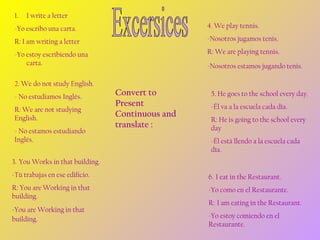
1.

I write a letter

-Yo escribo una carta.

4. We play tennis.

R: I am writing a letter

-Nosotros jugamos tenis.

-Yo estoy escribiendo una
carta.

R: We are playing tennis.

2. We do not study English.
- No estudiamos Inglés.
R: We are not studying
English.
- No estamos estudiando
Inglés.

-Nosotros estamos jugando tenis.

Convert to
Present
Continuous and
translate :

5. He goes to the school every day.
-Él va a la escuela cada día.
R: He is going to the school every
day
-Él está llendo a la escuela cada
día. 

3.  You Works in that building.
-Tú trabajas en ese edificio.

6.  I eat in the Restaurant.

R: You are Working in that
building.

-Yo como en el Restaurante. 

-You are Working in that
building.

R:  I am eating in the Restaurant.
-Yo estoy comiendo en el
Restaurante.
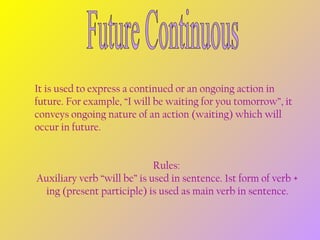
It is used to express a continued or an ongoing action in
future. For example, “I will be waiting for you tomorrow”, it
conveys ongoing nature of an action (waiting) which will
occur in future.
 
Rules:
Auxiliary verb “will be” is used in sentence. 1st form of verb +
ing (present participle) is used as main verb in sentence.
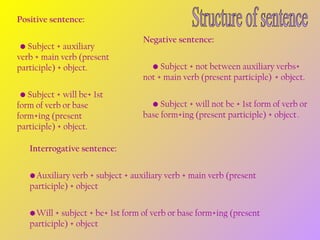
Positive sentence:
   • Subject + auxiliary
verb + main verb (present
participle) + object.
   • Subject + will be+ 1st
form of verb or base
form+ing (present
participle) + object.

Negative sentence:
          • Subject + not between auxiliary verbs+
not + main verb (present participle)  + object.
          • Subject + will not be + 1st form of verb or
base form+ing (present participle) + object .

Interrogative sentence:
• Auxiliary verb + subject + auxiliary verb + main verb (present
participle) + object
• Will + subject + be+ 1st form of verb or base form+ing (present
participle) + object
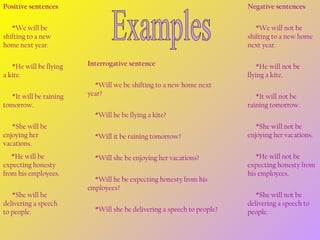
Positive sentences

Negative sentences

            *We will be
shifting to a new
home next year.

           *We will not be
shifting to a new home
next year.

            *He will be flying
a kite.
            *It will be raining
tomorrow.

Interrogative sentence
          *Will we be shifting to a new home next
year?

           *He will not be
flying a kite.
           *It will not be
raining tomorrow.

          *Will he be flying a kite?
            *She will be
enjoying her
vacations.
           *He will be
expecting honesty
from his employees.
            *She will be
delivering a speech
to people.

          *Will it be raining tomorrow?
          *Will she be enjoying her vacations?
          *Will he be expecting honesty from his
employees?
          *Will she be delivering a speech to people?

           *She will not be
enjoying her vacations.
           *He will not be
expecting honesty from
his employees.
           *She will not be
delivering a speech to
people.
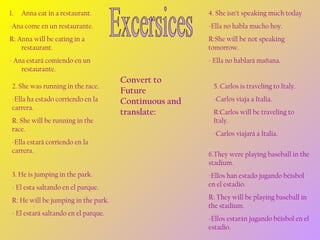
1.

Anna eat in a restaurant.

4. She isn’t speaking much today

-Ana come en un restaurante.

-Ella no habla mucho hoy.

R: Anna will be eating in a
restaurant.

R:She will be not speaking
tomorrow.

- Ana estará comiendo en un
restaurante.

- Ella no hablará mañana.

2. She was running in the race.
-Ella ha estado corriendo en la
carrera.
R: She will be running in the
race.
-Ella estará corriendo en la
carrera.
3. He is jumping in the park.
- El esta saltando en el parque.
R: He will be jumping in the park.
- El estará saltando en el parque.

Convert to
Future
Continuous and
translate:

5. Carlos is traveling to Italy.
-Carlos viaja a Italia.
R:Carlos will be traveling to
Italy.
-Carlos viajará a Italia.
6.They were playing baseball in the
stadium.
-Ellos han estado jugando béisbol
en el estadio.
R: They will be playing baseball in
the stadium.
-Ellos estarán jugando béisbol en el
estadio.
Past, present, future (continuous).

Past, present, future (continuous).

  • 1.
    República Bolivariana deVenezuela Ministerio del Poder Popular para la Educación U.E. Colegio “ Francisco Lazo Martí” Cabudare, Edo Lara. Integrantes: Albornoz Génesis Aponte Emperatriz Navea Alexis Pérez Nilaurys Año y Sección: 2do Cs “B”
  • 2.
    It is usedto express a continued or ongoing action in past, an ongoing action which occurred in past and completed at some point in past. It expresses an ongoing nature of an action in past.  For example, “he was laughing.” This sentence shows ongoing action (laughing) of a person which occurred in past. Past continuous tense is also called past progressive.     Rules: Auxiliary verb “was or were” is used in sentence. 1st form of verb or base verb + ing (present participle) is used as main verb in sentence.
  • 3.
    Positive sentences:           • Subject+ auxiliary verb + Main Verb (present participle) + object           • Subject + was/were + (1st form of verb or base verb +ing) +object If the subject is “he, she, It, I, singular or proper noun” then auxiliary verb “was” is used. If subject is “you, we, they or plural” then auxiliary verb “were” is used. Negative sentences:          • Subject + auxiliary verb + NOT + Main verb (present participle) + object          • Subject + was/were + NOT + (1st form of verb or base verb +ing) +object Rules for using auxiliary verb after subject are same as mentioned above. Interrogative sentences:          • Auxiliary verb + Subject + Main verb (present participle) + object          • Was/were + Subject + (1st form of verb or base verb +ing) +object The interrogative sentence starts with the auxiliary verb. If the subject is “he, she, It, I, singular or proper noun” then the sentence starts with auxiliary verb “was”. If subject is “you, we, they or plural” then the sentence starts with auxiliary verb “were”.
  • 4.
    Negative sentences Positive sentences          *Theywere laughing at the joker.           *He was taking exam last month           *You waiting for him yesterday           *She was working in a factory.          * It was raining yesterday. Interrogative sentences          *They were not laughing at the joker.         *Were they laughing at the joker?          *He was not taking exam last month         *Was he taking exam last month?          *You were not waiting for him yesterday         *Were you waiting for him yesterday?          *She was not working in a factory.         * It was not raining yesterday.         *Was she working in a factory?         *Was it raining yesterday?
  • 5.
    Convert to PastContinuous and translate: 4. We worked overtime. 1. Manuel walk fast. -Nosotros trabajamos horas extras. - Manuel camina rápido. R: We were working overtime. R: Manuel was walking fast. -Nosotros estábamos trabajando horas extras. -Manuel caminaba rápido. 2. I am going to the park. 5.Mary slept all day. - Maria durmió todo el día. - Yo voy al parque. R:Mary was sleeping all day. R: I was going to the park. -Maria estaba durmiendo todo el día. -Yo iba al parque. 3. Maria dance very cute. 6.Mario and Ana danced all night. -Mario y Ana bailaron toda la noche. -Maria baila muy lindo. R:Mario and Ana were dancing all night. R: Maria was dancing very cute. - Mario y Ana estaban bailando toda la noche. -Maria bailaba muy lindo.
  • 6.
    It is usedto express a continued or ongoing action at present time. It expresses an action which is in progress at the time of speaking. For example, a person says, “I am writing a letter”. It means that he is in the process of writing a letter right now. Such actions which are happening at time of speaking are expressed by present continuous tense. Present Continuous tense is also called Present progressive tense. Rules:  Auxiliary verb “am or is or are” is used in sentence. 1st form of verb or base verb + ing (present participle) is used as main verb in sentence.
  • 7.
    Positive Sentence     • Subject+ auxiliary verb + main verb-ing (Present participle) + object     • Subject + am/is/are + (1st form of verb or base verb + ing) + object Interrogative Sentences       • Auxiliary verb + Subject + main verb-ing (Present participle) + object       • Am/is/are + Subject + (1st form of verb or base verb + ing) + object For making interrogative sentences, the sentence is started with auxiliary verb rather than putting auxiliary verb inside the sentence. If the subject is “I” the sentence starts with auxiliary verb “am”. If the subject is “He, She, It, singular or proper name” the sentence starts with auxiliary verb “is”. If subject is “You, They or plural” the sentence starts with auxiliary verb “are”. If the subject is “I” then auxiliary verb “am” is used after subject in sentence. If the subject is “He, She, It, singular or proper name” then auxiliary verb “is” is used after subject in sentence. If subject is “You, They or plural” then auxiliary verb “are” is used after subject in sentence. The participle “ing” is added to the 1st form of verb i.e. going (go) writing (write) Negative Sentence       • Subject + auxiliary verb + not + main verb-ing (Present participle) + object       • Subject + am/is/are + not + (1st form of verb + ing) + object Rules for using auxiliary verbs (am or is or are) after subject in negative sentences are same as mentioned above. 
  • 8.
    Positive Sentences Negative Sentence            *Iam listening to the news           *I am not listening to the news.            *You are washing your clothes            *She is riding on horse            *They are playing football.            *It is raining           *You are not washing your clothes.           *She is not riding on a horse.           *They are not playing football. Interrogative Sentences          *Am I listening to the news?          *Are you washing your clothes?          *Is she riding on a horse?          *Are they playing football?           *It is not raining.          *Is it raining?
  • 9.
    1. I write aletter -Yo escribo una carta. 4. We play tennis. R: I am writing a letter -Nosotros jugamos tenis. -Yo estoy escribiendo una carta. R: We are playing tennis. 2. We do not study English. - No estudiamos Inglés. R: We are not studying English. - No estamos estudiando Inglés. -Nosotros estamos jugando tenis. Convert to Present Continuous and translate : 5. He goes to the school every day. -Él va a la escuela cada día. R: He is going to the school every day -Él está llendo a la escuela cada día.  3.  You Works in that building. -Tú trabajas en ese edificio. 6.  I eat in the Restaurant. R: You are Working in that building. -Yo como en el Restaurante.  -You are Working in that building. R:  I am eating in the Restaurant. -Yo estoy comiendo en el Restaurante.
  • 10.
    It is usedto express a continued or an ongoing action in future. For example, “I will be waiting for you tomorrow”, it conveys ongoing nature of an action (waiting) which will occur in future.   Rules: Auxiliary verb “will be” is used in sentence. 1st form of verb + ing (present participle) is used as main verb in sentence.
  • 11.
    Positive sentence:    • Subject+ auxiliary verb + main verb (present participle) + object.    • Subject + will be+ 1st form of verb or base form+ing (present participle) + object. Negative sentence:           • Subject + not between auxiliary verbs+ not + main verb (present participle)  + object.           • Subject + will not be + 1st form of verb or base form+ing (present participle) + object . Interrogative sentence: • Auxiliary verb + subject + auxiliary verb + main verb (present participle) + object • Will + subject + be+ 1st form of verb or base form+ing (present participle) + object
  • 12.
    Positive sentences Negative sentences             *Wewill be shifting to a new home next year.            *We will not be shifting to a new home next year.             *He will be flying a kite.             *It will be raining tomorrow. Interrogative sentence           *Will we be shifting to a new home next year?            *He will not be flying a kite.            *It will not be raining tomorrow.           *Will he be flying a kite?             *She will be enjoying her vacations.            *He will be expecting honesty from his employees.             *She will be delivering a speech to people.           *Will it be raining tomorrow?           *Will she be enjoying her vacations?           *Will he be expecting honesty from his employees?           *Will she be delivering a speech to people?            *She will not be enjoying her vacations.            *He will not be expecting honesty from his employees.            *She will not be delivering a speech to people.
  • 13.
    1. Anna eat ina restaurant. 4. She isn’t speaking much today -Ana come en un restaurante. -Ella no habla mucho hoy. R: Anna will be eating in a restaurant. R:She will be not speaking tomorrow. - Ana estará comiendo en un restaurante. - Ella no hablará mañana. 2. She was running in the race. -Ella ha estado corriendo en la carrera. R: She will be running in the race. -Ella estará corriendo en la carrera. 3. He is jumping in the park. - El esta saltando en el parque. R: He will be jumping in the park. - El estará saltando en el parque. Convert to Future Continuous and translate: 5. Carlos is traveling to Italy. -Carlos viaja a Italia. R:Carlos will be traveling to Italy. -Carlos viajará a Italia. 6.They were playing baseball in the stadium. -Ellos han estado jugando béisbol en el estadio. R: They will be playing baseball in the stadium. -Ellos estarán jugando béisbol en el estadio.