Management                                 tenth edition


 Stephen P. Robbins                        Mary Coulter


             Chapter         Introduction
             17              to
                             Controlling
Copyright © 2010 Pearson Education, Inc.
Publishing as Prentice Hall
                                           17–1
Learning Outcomes
Follow this Learning Outline as you read and study
this chapter.
17.1 What Is Control and Why Is It Important?
   • Define controlling.
   • Discuss the reasons why control is important.
   • Explain the planning-controlling link.
17.2 The Control Process
   • Describe the three steps in the control process.
   • Explain why what is measured is more critical than how it’s
     measured.
   • Explain the three courses of action managers can take in
     controlling.
Copyright © 2010 Pearson Education, Inc.
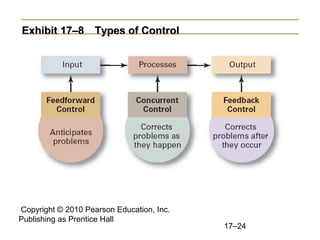
Publishing as Prentice Hall
                                                     17–2
Learning Outcomes
17.3 Controlling Organizational Performance
   • Define organizational performance.
   • Describe three most frequently used measures of organizational
     performance.

17.4 Tools for Measuring Organizational Performance
   • Contrast feedforward, concurrent, and feedback controls.
   • Explain the types of financial and information controls managers
     can use.
   • Describe how balanced scorecards and benchmarking are used
     in controlling.

Copyright © 2010 Pearson Education, Inc.
Publishing as Prentice Hall
                                                  17–3
Learning Outcomes
17.5 Contemporary Issues in Control
   • Describe how managers may have to adjust controls
     for cross-cultural differences.
   • Discuss the types of workplace concerns managers
     face and how they can address those concerns.
   • Explain why control is important to customer
     interactions.
   • Define corporate governance.


Copyright © 2010 Pearson Education, Inc.
Publishing as Prentice Hall
                                           17–4
What Is Control?
• Controlling
    The process of monitoring activities to ensure that
     they are being accomplished as planned and of
     correcting any significant deviations.
• The Purpose of Control
    To ensure that activities are completed in ways that
     lead to accomplishment of organizational goals.


Copyright © 2010 Pearson Education, Inc.
Publishing as Prentice Hall
                                            17–5
Why Is Control Important?
• As the final link in management functions:
    Planning
          Controls let managers know whether their goals and plans
           are on target and what future actions to take.
    Empowering employees
          Control systems provide managers with information and
           feedback on employee performance.
    Protecting the workplace
          Controls enhance physical security and help minimize
           workplace disruptions.


Copyright © 2010 Pearson Education, Inc.
Publishing as Prentice Hall
                                                    17–6
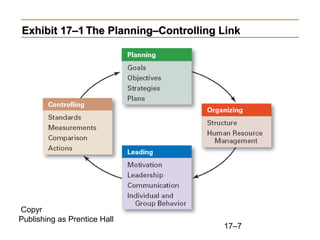
Exhibit 17–1 The Planning–Controlling Link


Copyright © 2010 Pearson Education, Inc.
Publishing as Prentice Hall
                                           17–7
The Control Process
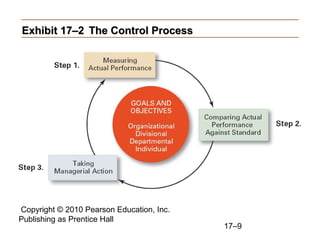
• The Process of Control
    1. Measuring actual
       performance.
    2. Comparing actual
       performance against a
       standard.
    3. Taking action to correct
       deviations or inadequate
       standards.


Copyright © 2010 Pearson Education, Inc.
Publishing as Prentice Hall
                                           17–8
Exhibit 17–2 The Control Process


Copyright © 2010 Pearson Education, Inc.
Publishing as Prentice Hall
                                           17–9
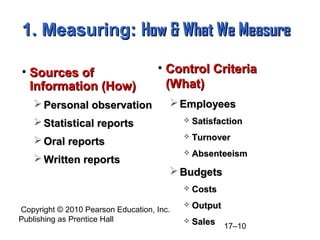
1. Measuring: How & What We Measure

• Sources of                        • Control Criteria
  Information (How)                   (What)
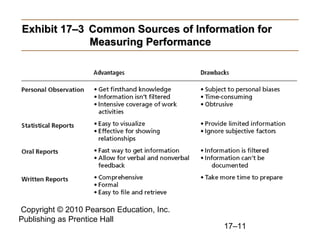
    Personal observation               Employees
    Statistical reports                      Satisfaction

    Oral reports                             Turnover
                                              Absenteeism
    Written reports
                                        Budgets
                                              Costs

Copyright © 2010 Pearson Education, Inc.
                                              Output
Publishing as Prentice Hall                   Sales 17–10
Exhibit 17–3 Common Sources of Information for
             Measuring Performance


Copyright © 2010 Pearson Education, Inc.
Publishing as Prentice Hall
                                           17–11
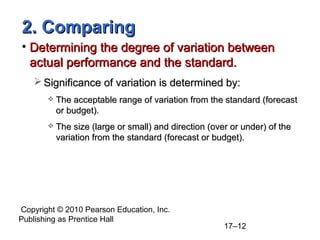
2. Comparing
• Determining the degree of variation between
  actual performance and the standard.
    Significance of variation is determined by:
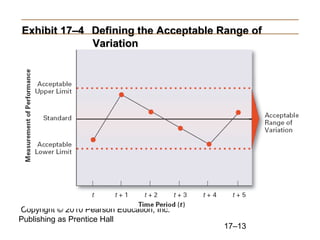
          The acceptable range of variation from the standard (forecast
           or budget).
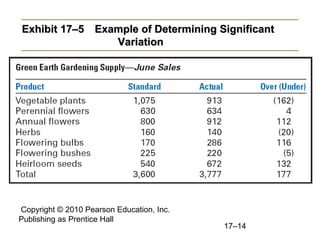
          The size (large or small) and direction (over or under) of the
           variation from the standard (forecast or budget).


Copyright © 2010 Pearson Education, Inc.
Publishing as Prentice Hall
                                                       17–12
Exhibit 17–4 Defining the Acceptable Range of
             Variation


Copyright © 2010 Pearson Education, Inc.
Publishing as Prentice Hall
                                           17–13
Exhibit 17–5 Example of Determining Significant
                Variation


Copyright © 2010 Pearson Education, Inc.
Publishing as Prentice Hall
                                           17–14
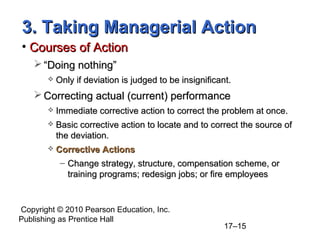
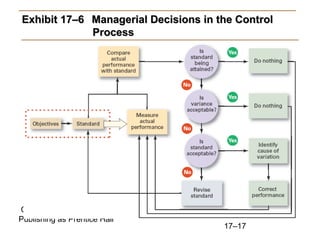
3. Taking Managerial Action
• Courses of Action
    “Doing nothing”
          Only if deviation is judged to be insignificant.
    Correcting actual (current) performance
          Immediate corrective action to correct the problem at once.
          Basic corrective action to locate and to correct the source of
           the deviation.
          Corrective Actions
            – Change strategy, structure, compensation scheme, or
              training programs; redesign jobs; or fire employees


Copyright © 2010 Pearson Education, Inc.
Publishing as Prentice Hall
                                                         17–15
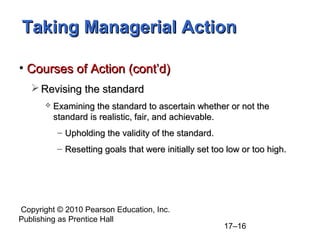
Taking Managerial Action

• Courses of Action (cont’d)
    Revising the standard
         Examining the standard to ascertain whether or not the
          standard is realistic, fair, and achievable.
          – Upholding the validity of the standard.
          – Resetting goals that were initially set too low or too high.


Copyright © 2010 Pearson Education, Inc.
Publishing as Prentice Hall
                                                       17–16
Exhibit 17–6 Managerial Decisions in the Control
             Process


Copyright © 2010 Pearson Education, Inc.
Publishing as Prentice Hall
                                           17–17
Controlling for Organizational
Performance
• What Is Performance?
    The end result of an activity
• What Is Organizational
  Performance?
    The accumulated end results of all of the
     organization’s work processes and activities
          Designing strategies, work processes, and work activities.
          Coordinating the work of employees.

Copyright © 2010 Pearson Education, Inc.
Publishing as Prentice Hall
                                                     17–18
Organizational Performance Measures
 • Organizational Productivity
     Productivity: the overall output of goods and/or
      services divided by the inputs needed to generate
      that output.
           Output: sales revenues
           Inputs: costs of resources (materials, labor expense, and
            facilities)
     Ultimately, productivity is a measure of how efficiently
      employees do their work.


Copyright © 2010 Pearson Education, Inc.
Publishing as Prentice Hall
                                                      17–19
Organizational Performance Measures (cont’d)
 • Organizational Effectiveness
     Measuring how appropriate organizational goals are
      and how well the organization is achieving its goals.
         Systems resource model
           – The ability of the organization to exploit its environment in
             acquiring scarce and valued resources.
         The process model

           – The efficiency of an organization’s transformation process
             in converting inputs to outputs.
         The multiple constituencies model

           – The effectiveness of the organization in meeting each
             constituencies’ needs.
Copyright © 2010 Pearson Education, Inc.
Publishing as Prentice Hall
                                                      17–20
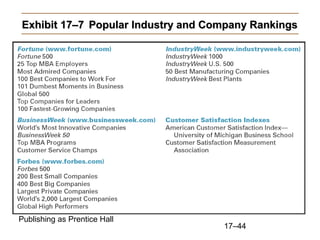
Industry and Company Rankings
• Industry rankings on:               • Corporate Culture
    Profits                            Audits
    Return on revenue                • Compensation and
    Return on shareholders’            benefits surveys
     equity
                                      • Customer satisfaction
    Growth in profits
                                        surveys
    Revenues per employee
    Revenues per dollar of
     assets
    Revenues per dollar of
     equity

Copyright © 2010 Pearson Education, Inc.
Publishing as Prentice Hall
                                                 17–21
Tools for Measuring
Organizational Performance
• Feedforward Control
    A control that prevents anticipated problems before
     actual occurrences of the problem.
        Building in quality through design.
        Requiring suppliers conform to ISO 9002.

• Concurrent Control
    A control that takes place while the monitored activity
     is in progress.
          Direct supervision: management by walking around.

Copyright © 2010 Pearson Education, Inc.
Publishing as Prentice Hall
                                                    17–22
Tools for Measuring
Organizational Performance
(cont’d)
 • Feedback Control
      A control that takes place after an activity is done.
            Corrective action is after-the-fact, when the problem has
             already occurred.
      Advantages of feedback controls:
            Provide managers with information on the effectiveness of
             their planning efforts.
         Enhance employee motivation by providing them with
          information on how well they are doing.
Copyright © 2010 Pearson Education, Inc.
Publishing as Prentice Hall
                                                       17–23
Exhibit 17–8 Types of Control


Copyright © 2010 Pearson Education, Inc.
Publishing as Prentice Hall
                                           17–24
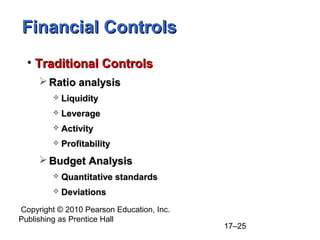
Financial Controls
  • Traditional Controls
      Ratio analysis
            Liquidity
            Leverage
            Activity
            Profitability
      Budget Analysis
            Quantitative standards
            Deviations
Copyright © 2010 Pearson Education, Inc.
Publishing as Prentice Hall
                                           17–25
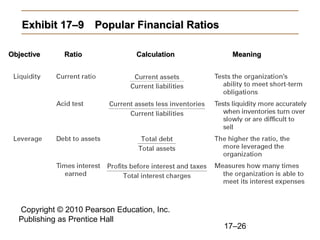
Exhibit 17–9 Popular Financial Ratios

Objective     Ratio              Calculation    Meaning


  Copyright © 2010 Pearson Education, Inc.
  Publishing as Prentice Hall
                                               17–26
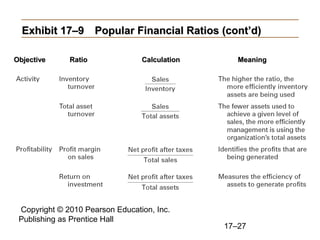
Exhibit 17–9 Popular Financial Ratios (cont’d)

Objective     Ratio              Calculation      Meaning


 Copyright © 2010 Pearson Education, Inc.
 Publishing as Prentice Hall
                                               17–27
Financial Controls

• Managing Earnings
    “Timing” income and expenses to enhance current
     financial results, which gives an unrealistic picture of
     the organization’s financial performance.
    New laws and regulations require companies to clarify
     their financial information.


Copyright © 2010 Pearson Education, Inc.
Publishing as Prentice Hall
                                             17–28
Tools for Measuring Org’l Performance (cont’d.)
• Balanced Scorecard
    Is a measurement tool that uses goals set by
     managers in four areas to measure a company’s
     performance:
          Financial
          Customer
          Internal processes
          People/innovation/growth assets
    Is intended to emphasize that all of these areas are
     important to an organization’s success and that there
     should be a balance among them.
Copyright © 2010 Pearson Education, Inc.
Publishing as Prentice Hall
                                             17–29
Information Controls
• Purposes of Information Controls
    As a tool to help managers control other
     organizational activities.
          Managers need the right information at the right time and in
           the right amount.

    As an organizational area that managers need to
     control.
          Managers must have comprehensive and secure controls in
           place to protect the organization’s important information.


Copyright © 2010 Pearson Education, Inc.
Publishing as Prentice Hall
                                                      17–30
Information Controls (cont’d)
• Management Information Systems (MIS)
    A system used to provide management with needed
     information on a regular basis.
          Data: an unorganized collection of raw, unanalyzed facts
           (e.g., unsorted list of customer names).
          Information: data that has been analyzed and organized
           such that it has value and relevance to managers.


Copyright © 2010 Pearson Education, Inc.
Publishing as Prentice Hall
                                                    17–31
Benchmarking of Best Practices
• Benchmark
    The standard of excellence against which to measure
     and compare.
• Benchmarking
    Is the search for the best practices among
     competitors or noncompetitors that lead to their
     superior performance.
    Is a control tool for identifying and measuring specific
     performance gaps and areas for improvement.


Copyright © 2010 Pearson Education, Inc.
Publishing as Prentice Hall
                                             17–32
Contemporary Issues in Control
• Cross-Cultural Issues
    The use of technology to increase direct corporate
     control of local operations
    Legal constraints on corrective actions in foreign
     countries
    Difficulty with the comparability of data collected from
     operations in different countries


Copyright © 2010 Pearson Education, Inc.
Publishing as Prentice Hall
                                             17–33
Contemporary Issues in Control
(cont’d)
• Workplace Concerns
    Workplace privacy versus workplace monitoring:
        E-mail, telephone, computer, and Internet usage
        Productivity, harassment, security, confidentiality, intellectual
         property protection
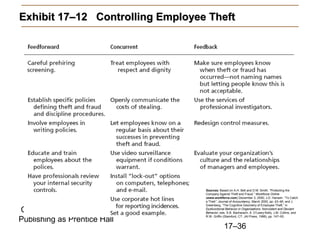
    Employee theft
          The unauthorized taking of company property by employees
           for their personal use.
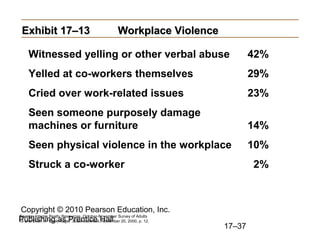
    Workplace violence
       Anger, rage, and violence in the workplace is affecting
        employee productivity.
Copyright © 2010 Pearson Education, Inc.
Publishing as Prentice Hall
                                                       17–34
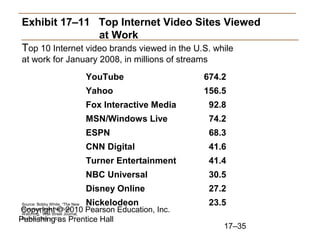
Exhibit 17–11 Top Internet Video Sites Viewed
                   at Work
Top 10 Internet video brands viewed in the U.S. while
at work for January 2008, in millions of streams
                                  YouTube                 674.2
                                  Yahoo                   156.5
                                  Fox Interactive Media    92.8
                                  MSN/Windows Live         74.2
                                  ESPN                     68.3
                                  CNN Digital              41.6
                                  Turner Entertainment     41.4
                                  NBC Universal            30.5
                                  Disney Online            27.2
Source: Bobby White, “The New     Nickelodeon              23.5
Copyright © 2010 Pearson Education, Inc.
Workplace Rules: No Video
Watching,” Wall Street Journal,
Publishing as Prentice Hall
March 4, 2008, p. B3.

                                                              17–35
Exhibit 17–12 Controlling Employee Theft


                                           Sources: Based on A.H. Bell and D.M. Smith. “Protecting the
                                           Company Against Theft and Fraud,” Workforce Online
                                           (www.workforce.com) December 3, 2000; J.D. Hansen. “To Catch
                                           a Thief,” Journal of Accountancy, March 2000, pp. 43–46; and J.
                                           Greenberg, “The Cognitive Geometry of Employee Theft,” in
Copyright © 2010 Pearson Education, Inc.   Dysfunctional Behavior in Organizations: Nonviolent and Deviant
                                           Behavior, eds. S.B. Bacharach, A. O’Leary-Kelly, J.M. Collins, and

Publishing as Prentice Hall
                                           R.W. Griffin (Stamford, CT: JAI Press, 1998), pp. 147–93.


                                                        17–36
Exhibit 17–13                                     Workplace Violence

    Witnessed yelling or other verbal abuse                                     42%
    Yelled at co-workers themselves                                             29%
    Cried over work-related issues                                              23%
    Seen someone purposely damage
    machines or furniture                                                       14%
    Seen physical violence in the workplace                                     10%
    Struck a co-worker                                                          2%


Copyright © 2010 Pearson Education, Inc.
Source: Integra Realty Resources, October-November Survey of Adults
Publishing as Prentice Hall
18 and Over, in “Desk Rage.” BusinessWeek, November 20, 2000, p. 12.
                                                                        17–37
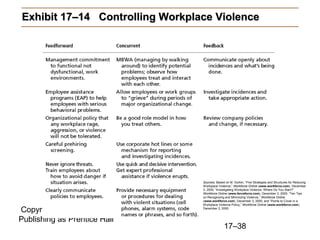
Exhibit 17–14 Controlling Workplace Violence


                                           Sources: Based on M. Gorkin, “Five Strategies and Structures for Reducing
                                           Workplace Violence,” Workforce Online (www.workforce.com). December
                                           3, 2000; “Investigating Workplace Violence: Where Do You Start?”
                                           Workforce Online (www.forceforce.com), December 3, 2000; “Ten Tips
                                           on Recognizing and Minimizing Violence,” Workforce Online
                                           (www.workforce.com), December 3, 2000; and “Points to Cover in a
                                           Workplace Violence Policy,” Workforce Online (www.workforce.com),

Copyright © 2010 Pearson Education, Inc.   December 3, 2000.


Publishing as Prentice Hall
                                                         17–38
Contemporary Issues in Control
(cont’d)
• Customer Interactions
   Service profit chain
         Is the service sequence from employees to customers to
          profit.
   Service capability affects service value which impacts
    on customer satisfaction that, in turn, leads to
    customer loyalty in the form of repeat business
    (profit).


Copyright © 2010 Pearson Education, Inc.
Publishing as Prentice Hall
                                                    17–39
Contemporary Issues in Control
(cont’d)
• Corporate Governance
    The system used to govern a corporation so that the
     interests of the corporate owners are protected.
          Changes in the role of boards of directors
          Increased scrutiny of financial reporting (Sarbanes-Oxley Act
           of 2002)
            – More disclosure and transparency of corporate financial
              information
            – Certification of financial results by senior management

Copyright © 2010 Pearson Education, Inc.
Publishing as Prentice Hall
                                                        17–40
Terms to Know
• controlling                          •   productivity
• market control                       •   organizational
• bureaucratic control                     effectiveness
• clan control                         •   feedforward control
• control process                      •   concurrent control
• range of variation                   •   management by walking
• immediate corrective                     around
  action                               •   feedback control
• basic corrective action              •   economic value added
• performance                              (EVA)
                                       •   market value added
• organizational
                                           (MVA)
  performance
Copyright © 2010 Pearson Education, Inc.
Publishing as Prentice Hall
                                                    17–41
Terms to Know (cont’d)
                    • management information
                      system (MIS)
                    • data
                    • information
                    • balanced scorecard
                    • benchmarking
                    • employee theft
                    • service profit chain
                    • corporate governance


Copyright © 2010 Pearson Education, Inc.
Publishing as Prentice Hall
                                               17–42
All rights reserved. No part of this publication may be reproduced,
             stored in a retrieval system, or transmitted, in any form or by
           any means, electronic, mechanical, photocopying, recording, or
           otherwise, without the prior written permission of the publisher.
                        Printed in the United States of America.


Copyright © 2010 Pearson Education, Inc.
Publishing as Prentice Hall
                                                           17–43
Exhibit 17–7 Popular Industry and Company Rankings


Copyright © 2010 Pearson Education, Inc.
Publishing as Prentice Hall
                                           17–44

Ch 17 introduction to controlling

  • 1.
    Management tenth edition Stephen P. Robbins Mary Coulter Chapter Introduction 17 to Controlling Copyright © 2010 Pearson Education, Inc. Publishing as Prentice Hall 17–1
  • 2.
    Learning Outcomes Follow thisLearning Outline as you read and study this chapter. 17.1 What Is Control and Why Is It Important? • Define controlling. • Discuss the reasons why control is important. • Explain the planning-controlling link. 17.2 The Control Process • Describe the three steps in the control process. • Explain why what is measured is more critical than how it’s measured. • Explain the three courses of action managers can take in controlling. Copyright © 2010 Pearson Education, Inc. Publishing as Prentice Hall 17–2
  • 3.
    Learning Outcomes 17.3 ControllingOrganizational Performance • Define organizational performance. • Describe three most frequently used measures of organizational performance. 17.4 Tools for Measuring Organizational Performance • Contrast feedforward, concurrent, and feedback controls. • Explain the types of financial and information controls managers can use. • Describe how balanced scorecards and benchmarking are used in controlling. Copyright © 2010 Pearson Education, Inc. Publishing as Prentice Hall 17–3
  • 4.
    Learning Outcomes 17.5 ContemporaryIssues in Control • Describe how managers may have to adjust controls for cross-cultural differences. • Discuss the types of workplace concerns managers face and how they can address those concerns. • Explain why control is important to customer interactions. • Define corporate governance. Copyright © 2010 Pearson Education, Inc. Publishing as Prentice Hall 17–4
  • 5.
    What Is Control? •Controlling  The process of monitoring activities to ensure that they are being accomplished as planned and of correcting any significant deviations. • The Purpose of Control  To ensure that activities are completed in ways that lead to accomplishment of organizational goals. Copyright © 2010 Pearson Education, Inc. Publishing as Prentice Hall 17–5
  • 6.
    Why Is ControlImportant? • As the final link in management functions:  Planning  Controls let managers know whether their goals and plans are on target and what future actions to take.  Empowering employees  Control systems provide managers with information and feedback on employee performance.  Protecting the workplace  Controls enhance physical security and help minimize workplace disruptions. Copyright © 2010 Pearson Education, Inc. Publishing as Prentice Hall 17–6
  • 7.
    Exhibit 17–1 ThePlanning–Controlling Link Copyright © 2010 Pearson Education, Inc. Publishing as Prentice Hall 17–7
  • 8.
    The Control Process •The Process of Control 1. Measuring actual performance. 2. Comparing actual performance against a standard. 3. Taking action to correct deviations or inadequate standards. Copyright © 2010 Pearson Education, Inc. Publishing as Prentice Hall 17–8
  • 9.
    Exhibit 17–2 TheControl Process Copyright © 2010 Pearson Education, Inc. Publishing as Prentice Hall 17–9
  • 10.
    1. Measuring: How& What We Measure • Sources of • Control Criteria Information (How) (What)  Personal observation  Employees  Statistical reports  Satisfaction  Oral reports  Turnover  Absenteeism  Written reports  Budgets  Costs Copyright © 2010 Pearson Education, Inc.  Output Publishing as Prentice Hall  Sales 17–10
  • 11.
    Exhibit 17–3 CommonSources of Information for Measuring Performance Copyright © 2010 Pearson Education, Inc. Publishing as Prentice Hall 17–11
  • 12.
    2. Comparing • Determiningthe degree of variation between actual performance and the standard.  Significance of variation is determined by:  The acceptable range of variation from the standard (forecast or budget).  The size (large or small) and direction (over or under) of the variation from the standard (forecast or budget). Copyright © 2010 Pearson Education, Inc. Publishing as Prentice Hall 17–12
  • 13.
    Exhibit 17–4 Definingthe Acceptable Range of Variation Copyright © 2010 Pearson Education, Inc. Publishing as Prentice Hall 17–13
  • 14.
    Exhibit 17–5 Exampleof Determining Significant Variation Copyright © 2010 Pearson Education, Inc. Publishing as Prentice Hall 17–14
  • 15.
    3. Taking ManagerialAction • Courses of Action  “Doing nothing”  Only if deviation is judged to be insignificant.  Correcting actual (current) performance  Immediate corrective action to correct the problem at once.  Basic corrective action to locate and to correct the source of the deviation.  Corrective Actions – Change strategy, structure, compensation scheme, or training programs; redesign jobs; or fire employees Copyright © 2010 Pearson Education, Inc. Publishing as Prentice Hall 17–15
  • 16.
    Taking Managerial Action •Courses of Action (cont’d)  Revising the standard  Examining the standard to ascertain whether or not the standard is realistic, fair, and achievable. – Upholding the validity of the standard. – Resetting goals that were initially set too low or too high. Copyright © 2010 Pearson Education, Inc. Publishing as Prentice Hall 17–16
  • 17.
    Exhibit 17–6 ManagerialDecisions in the Control Process Copyright © 2010 Pearson Education, Inc. Publishing as Prentice Hall 17–17
  • 18.
    Controlling for Organizational Performance •What Is Performance?  The end result of an activity • What Is Organizational Performance?  The accumulated end results of all of the organization’s work processes and activities  Designing strategies, work processes, and work activities.  Coordinating the work of employees. Copyright © 2010 Pearson Education, Inc. Publishing as Prentice Hall 17–18
  • 19.
    Organizational Performance Measures • Organizational Productivity  Productivity: the overall output of goods and/or services divided by the inputs needed to generate that output.  Output: sales revenues  Inputs: costs of resources (materials, labor expense, and facilities)  Ultimately, productivity is a measure of how efficiently employees do their work. Copyright © 2010 Pearson Education, Inc. Publishing as Prentice Hall 17–19
  • 20.
    Organizational Performance Measures(cont’d) • Organizational Effectiveness  Measuring how appropriate organizational goals are and how well the organization is achieving its goals.  Systems resource model – The ability of the organization to exploit its environment in acquiring scarce and valued resources.  The process model – The efficiency of an organization’s transformation process in converting inputs to outputs.  The multiple constituencies model – The effectiveness of the organization in meeting each constituencies’ needs. Copyright © 2010 Pearson Education, Inc. Publishing as Prentice Hall 17–20
  • 21.
    Industry and CompanyRankings • Industry rankings on: • Corporate Culture  Profits Audits  Return on revenue • Compensation and  Return on shareholders’ benefits surveys equity • Customer satisfaction  Growth in profits surveys  Revenues per employee  Revenues per dollar of assets  Revenues per dollar of equity Copyright © 2010 Pearson Education, Inc. Publishing as Prentice Hall 17–21
  • 22.
    Tools for Measuring OrganizationalPerformance • Feedforward Control  A control that prevents anticipated problems before actual occurrences of the problem.  Building in quality through design.  Requiring suppliers conform to ISO 9002. • Concurrent Control  A control that takes place while the monitored activity is in progress.  Direct supervision: management by walking around. Copyright © 2010 Pearson Education, Inc. Publishing as Prentice Hall 17–22
  • 23.
    Tools for Measuring OrganizationalPerformance (cont’d) • Feedback Control  A control that takes place after an activity is done.  Corrective action is after-the-fact, when the problem has already occurred.  Advantages of feedback controls:  Provide managers with information on the effectiveness of their planning efforts. Enhance employee motivation by providing them with information on how well they are doing. Copyright © 2010 Pearson Education, Inc. Publishing as Prentice Hall 17–23
  • 24.
    Exhibit 17–8 Typesof Control Copyright © 2010 Pearson Education, Inc. Publishing as Prentice Hall 17–24
  • 25.
    Financial Controls • Traditional Controls  Ratio analysis  Liquidity  Leverage  Activity  Profitability  Budget Analysis  Quantitative standards  Deviations Copyright © 2010 Pearson Education, Inc. Publishing as Prentice Hall 17–25
  • 26.
    Exhibit 17–9 PopularFinancial Ratios Objective Ratio Calculation Meaning Copyright © 2010 Pearson Education, Inc. Publishing as Prentice Hall 17–26
  • 27.
    Exhibit 17–9 PopularFinancial Ratios (cont’d) Objective Ratio Calculation Meaning Copyright © 2010 Pearson Education, Inc. Publishing as Prentice Hall 17–27
  • 28.
    Financial Controls • ManagingEarnings  “Timing” income and expenses to enhance current financial results, which gives an unrealistic picture of the organization’s financial performance.  New laws and regulations require companies to clarify their financial information. Copyright © 2010 Pearson Education, Inc. Publishing as Prentice Hall 17–28
  • 29.
    Tools for MeasuringOrg’l Performance (cont’d.) • Balanced Scorecard  Is a measurement tool that uses goals set by managers in four areas to measure a company’s performance:  Financial  Customer  Internal processes  People/innovation/growth assets  Is intended to emphasize that all of these areas are important to an organization’s success and that there should be a balance among them. Copyright © 2010 Pearson Education, Inc. Publishing as Prentice Hall 17–29
  • 30.
    Information Controls • Purposesof Information Controls  As a tool to help managers control other organizational activities.  Managers need the right information at the right time and in the right amount.  As an organizational area that managers need to control.  Managers must have comprehensive and secure controls in place to protect the organization’s important information. Copyright © 2010 Pearson Education, Inc. Publishing as Prentice Hall 17–30
  • 31.
    Information Controls (cont’d) •Management Information Systems (MIS)  A system used to provide management with needed information on a regular basis.  Data: an unorganized collection of raw, unanalyzed facts (e.g., unsorted list of customer names).  Information: data that has been analyzed and organized such that it has value and relevance to managers. Copyright © 2010 Pearson Education, Inc. Publishing as Prentice Hall 17–31
  • 32.
    Benchmarking of BestPractices • Benchmark  The standard of excellence against which to measure and compare. • Benchmarking  Is the search for the best practices among competitors or noncompetitors that lead to their superior performance.  Is a control tool for identifying and measuring specific performance gaps and areas for improvement. Copyright © 2010 Pearson Education, Inc. Publishing as Prentice Hall 17–32
  • 33.
    Contemporary Issues inControl • Cross-Cultural Issues  The use of technology to increase direct corporate control of local operations  Legal constraints on corrective actions in foreign countries  Difficulty with the comparability of data collected from operations in different countries Copyright © 2010 Pearson Education, Inc. Publishing as Prentice Hall 17–33
  • 34.
    Contemporary Issues inControl (cont’d) • Workplace Concerns  Workplace privacy versus workplace monitoring:  E-mail, telephone, computer, and Internet usage  Productivity, harassment, security, confidentiality, intellectual property protection  Employee theft  The unauthorized taking of company property by employees for their personal use.  Workplace violence Anger, rage, and violence in the workplace is affecting employee productivity. Copyright © 2010 Pearson Education, Inc. Publishing as Prentice Hall 17–34
  • 35.
    Exhibit 17–11 TopInternet Video Sites Viewed at Work Top 10 Internet video brands viewed in the U.S. while at work for January 2008, in millions of streams YouTube 674.2 Yahoo 156.5 Fox Interactive Media 92.8 MSN/Windows Live 74.2 ESPN 68.3 CNN Digital 41.6 Turner Entertainment 41.4 NBC Universal 30.5 Disney Online 27.2 Source: Bobby White, “The New Nickelodeon 23.5 Copyright © 2010 Pearson Education, Inc. Workplace Rules: No Video Watching,” Wall Street Journal, Publishing as Prentice Hall March 4, 2008, p. B3. 17–35
  • 36.
    Exhibit 17–12 ControllingEmployee Theft Sources: Based on A.H. Bell and D.M. Smith. “Protecting the Company Against Theft and Fraud,” Workforce Online (www.workforce.com) December 3, 2000; J.D. Hansen. “To Catch a Thief,” Journal of Accountancy, March 2000, pp. 43–46; and J. Greenberg, “The Cognitive Geometry of Employee Theft,” in Copyright © 2010 Pearson Education, Inc. Dysfunctional Behavior in Organizations: Nonviolent and Deviant Behavior, eds. S.B. Bacharach, A. O’Leary-Kelly, J.M. Collins, and Publishing as Prentice Hall R.W. Griffin (Stamford, CT: JAI Press, 1998), pp. 147–93. 17–36
  • 37.
    Exhibit 17–13 Workplace Violence Witnessed yelling or other verbal abuse 42% Yelled at co-workers themselves 29% Cried over work-related issues 23% Seen someone purposely damage machines or furniture 14% Seen physical violence in the workplace 10% Struck a co-worker 2% Copyright © 2010 Pearson Education, Inc. Source: Integra Realty Resources, October-November Survey of Adults Publishing as Prentice Hall 18 and Over, in “Desk Rage.” BusinessWeek, November 20, 2000, p. 12. 17–37
  • 38.
    Exhibit 17–14 ControllingWorkplace Violence Sources: Based on M. Gorkin, “Five Strategies and Structures for Reducing Workplace Violence,” Workforce Online (www.workforce.com). December 3, 2000; “Investigating Workplace Violence: Where Do You Start?” Workforce Online (www.forceforce.com), December 3, 2000; “Ten Tips on Recognizing and Minimizing Violence,” Workforce Online (www.workforce.com), December 3, 2000; and “Points to Cover in a Workplace Violence Policy,” Workforce Online (www.workforce.com), Copyright © 2010 Pearson Education, Inc. December 3, 2000. Publishing as Prentice Hall 17–38
  • 39.
    Contemporary Issues inControl (cont’d) • Customer Interactions  Service profit chain  Is the service sequence from employees to customers to profit.  Service capability affects service value which impacts on customer satisfaction that, in turn, leads to customer loyalty in the form of repeat business (profit). Copyright © 2010 Pearson Education, Inc. Publishing as Prentice Hall 17–39
  • 40.
    Contemporary Issues inControl (cont’d) • Corporate Governance  The system used to govern a corporation so that the interests of the corporate owners are protected.  Changes in the role of boards of directors  Increased scrutiny of financial reporting (Sarbanes-Oxley Act of 2002) – More disclosure and transparency of corporate financial information – Certification of financial results by senior management Copyright © 2010 Pearson Education, Inc. Publishing as Prentice Hall 17–40
  • 41.
    Terms to Know •controlling • productivity • market control • organizational • bureaucratic control effectiveness • clan control • feedforward control • control process • concurrent control • range of variation • management by walking • immediate corrective around action • feedback control • basic corrective action • economic value added • performance (EVA) • market value added • organizational (MVA) performance Copyright © 2010 Pearson Education, Inc. Publishing as Prentice Hall 17–41
  • 42.
    Terms to Know(cont’d) • management information system (MIS) • data • information • balanced scorecard • benchmarking • employee theft • service profit chain • corporate governance Copyright © 2010 Pearson Education, Inc. Publishing as Prentice Hall 17–42
  • 43.
    All rights reserved.No part of this publication may be reproduced, stored in a retrieval system, or transmitted, in any form or by any means, electronic, mechanical, photocopying, recording, or otherwise, without the prior written permission of the publisher. Printed in the United States of America. Copyright © 2010 Pearson Education, Inc. Publishing as Prentice Hall 17–43
  • 44.
    Exhibit 17–7 PopularIndustry and Company Rankings Copyright © 2010 Pearson Education, Inc. Publishing as Prentice Hall 17–44