PRESENTATION
ON
AUTOMOBILE INDUSTRY
BY

RAJ GUPTA
MANGESH BHOSLE
KALPESH BHASAGRE
SANDEEP YADAV
NARESH SOLANKI
UNDER THE GUIDANCE OF
PROF.SEEMA LADHA
AUTOMOBILE INDUSTRY
The automotive industry began in the 1890s with hundreds of manufacturers that
pioneered the horseless carriage

After World War II, the U.S. produced about 75 percent of world's auto production. In
1980, the U.S. was overtaken by Japan and became world's leader again in 1994.
In 2006, Japan narrowly passed the U.S. in production and held this rank until 2009, when
China took the top spot with 13.8 million units
With 19.3 million units manufactured in 2012, China almost doubled the U.S. production,
with 10.3 million units, while Japan was in third place with 9.9 million units
The first car ran on India's roads in 1897. Until the 1930s, cars were imported directly, but
in very small numbers.
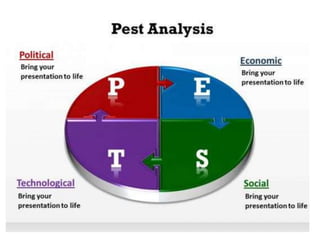
Political
In 2002, the Indian government formulated an auto policy that aimed at promoting
integrated, phased, enduring and self-sustained growth of theIndian automotive industry
Allows automatic approval for foreign equity investment up to 100% in theautomotive
sector and does not lay down any minimum investment criteria.

Ensure a balanced transition to open trade at minimal risk to the Indianeconomy and local
industry.
Promoting multi-model transportation and the implementation of mass rapid transport
system

Economic
Economic pressures on the industry are causing automobile companies toreorganize the
traditional sales process.
Weighted tax deduction of up to 150% for in-house research and R & Dactivities.

Govt. has granted concessions, such as reduced interest rates for exportfinancing.
Several Indian firms have partnered with global players.
While some haveformed joint ventures with equity participation, other also has entered
intotechnology tie-ups.
Social
Since changed lifestyle of people, leads to increased purchase of automobiles,
so automobile sector have a large customer base to serve
Indian customers are highly discerning, educated and well informed. Theyare
price sensitive and put a lot of emphasis on value for money.
Preference for fuel efficient cars with low running costs
Technological
The Government of India is promoting National Automotive Testing andR&D
Infrastructure Project (NATRIP)to support the growth of the autoindustry in India
Technological solutions helps in integrating the supply chain, hence
reducelosses and increase profitability
Major global players like audi, BMW Hyundai etc have setup their manufacturing
units in India.
Environmental
Physical infrastructure such as roads and bridges affect the use of automobiles. If
there is good availability of roads or the roads are smooththen it will affect the use
of automobiles

Physical conditions like environmental situation affect the use of automobiles. If
the environment is pleasant then it will lead to more use of vehicles.
Legal
Legal provision relating to environmental population by automobiles.
 Legal provisions relating to safety measures
 Ensure a balanced transition to open trade at minimal risk to the Indianeconomy
and local industry
ISSUES AND CHALLENGES
Competitive pressures
The rapid development of the low-cost labour economies in Eastern Europe, South East
Asia, China and India is putting enormous pressures on labour intensive suppliers

Sustainability
Increasingly, environmental considerations and public opinion are driving manufacturers'
decisions around the mix of materials used in manufacturing, the types of engine and the
end of vehicle life (ELV)

Supply chain management and cost reduction
In the age of global trading, supply chains never stand still.
Therefore, supply chain architectures must be kept under constant review in order for then
to be both logistically efficient and cost effective.

Emerging markets
Rapid economic developments in emerging markets, notably China and India, are providing
significant opportunities to increase sales and reduce costs
Founded in 1945 as a manufacturer of locomotives, the company manufactured
its first commercial vehicle in 1954 in a collaboration with Daimler-Benz AG, which
ended in 1969
Tata Motors Limited (formerly TELCO, short for "Tata Engineering and Locomotive
Company") is an Indian multinational automotive manufacturing company

Its products include passenger cars, trucks, vans, coaches, buses and military vehicles.
It is the world's eighteenth-largest motor vehicle manufacturing company, fourth-largest
truck manufacturer and second-largest bus manufacturer by volume.
Tata Motors is listed on the Bombay Stock Exchange, where it is a constituent of the
BSE SENSEX index, the National Stock Exchange of India and the New York Stock
Exchange. Tata Motors is ranked 314th in the 2012 Fortune Global 500 ranking of the
world's biggest corporations.
Tata Motors has auto manufacturing and assembly plants in Jamshedpur, Pantnagar,
Lucknow, Sanand, Dharwad and Pune in India, as well as in Argentina, South Africa,
Thailand and the United Kingdom. It has research and development centres in Pune,
Jamshedpur, Lucknow and Dharwad, India, and in South Korea, Spain, and the United
Kingdom
MISSION
To be passionate in anticipating and providing the best
vehicles and experiences that excite our customers globally.

VISION
Most admired by our customers, employees, business
partners and shareholders for the experience and value they
enjoy from being with us.
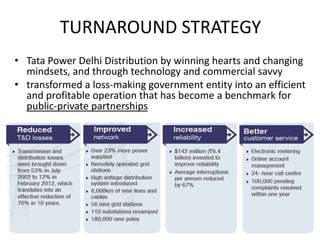
TURNAROUND STRATEGY
• Tata Power Delhi Distribution by winning hearts and changing
mindsets, and through technology and commercial savvy
• transformed a loss-making government entity into an efficient
and profitable operation that has become a benchmark for
public-private partnerships
R&D STRATEGY
• Tata Group companies cumulatively spend Rs.12,500 crore on
research & development.
• knowledge-based engineering application software from Tata
Technologies that speeds up results.
• An engine ‘start-stop’ technology developed by Jaguar Land Rover
that stops an engine when the vehicle isn't moving, thus saving on
fuel;
• High performance rail steel that saved £150,000 over five years was
developed by Tata Steel Europe
• High standard steel for safer and fuel efficient vehicles from Tata
Steel Europe
• The world's cheapest car, Nano, an innovation from Group company
Tata Motors, launched in April 2009, has 37 patents,
• Swach, the cheapest water filter from Tata Chemicals, has 14.
• Tata Steel, which acquired British company Corus in 2007,
meanwhile, files around 50 patents each year.
P2 STRATEGIES
• P2 or pollution prevention is a proactive strategy that
uses fewer or smarter resources to begin requiring
lesser cleanup at the final disposal.
• It is done by reducing or eliminating waste at the
source by modifying production processes, promoting
the use of non-toxic or less-toxic substances,
implementing conservation techniques, and re-using
materials rather than putting them into the waste
stream.
• It assumes no waste will occur. It is an effective ‘getting
more from less’ strategy.
• Reducing packaging material by either using
sustainable packaging (replacing wood with
metal) or reusing existing packaging (recycling
wood).
• The company recycles close to 69 percent of the
wood packaging thus eliminating use of fresh
wood.
• The company aims to source 60% of its
components from the park thereby increasing its
resource efficiency and reducing its emissions
due to reduction in logistics and transportation.
R2 STRATEGIES
• This is a ‘getting more from the same’ strategy where
otherwise wasted resources are recovered by way of
proper disposal – recycling or reconditioning.
• Increasing life of aggregates – ‘Recon’ business
• In 2010-11 a total of 13,788 engines and 8,690 other
parts were reconditioned.
• Other resource conservation techniques like reusing
engine oil for multiple testing cycles has been
employed.
• A 200 litre engine oil barrel can now be used to test
170 engines instead of 85.
• Reusing paint sludge and thinner

• Last year, approximately 390 tonnes of hazardous
paint sludge was converted to a low quality paint
suitable for floor painting.
• Tata Motors has also developed a process to convert
the incinerator ash to pavement bricks that can be
used in walkways within the plant.
• This model has been very successful and has
significantly reduced the amount of hazardous
incinerated ash sent to landfills.
SWOT ANALYSIS
STRENGTHS:
• CONSOLIDATED net profits of Rs 1988.73crores for the quarter ended June30, 2010 on
the back of strong sales in the domestic market and a good show of J&LR.
• A strong faith of Indian people in Tata brands.
• A group global sale grows by 36% at 90,646 vehicles in July 2010.
• Market leader in commercial vehicles.
• largest car seller in passenger car vehicles.

•largest truck manufacturer.
•largest bus manufacturer.
WEAKNESSES:
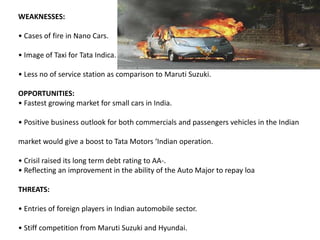
• Cases of fire in Nano Cars.

• Image of Taxi for Tata Indica.
• Less no of service station as comparison to Maruti Suzuki.
OPPORTUNITIES:
• Fastest growing market for small cars in India.
• Positive business outlook for both commercials and passengers vehicles in the Indian
market would give a boost to Tata Motors ‘Indian operation.
• Crisil raised its long term debt rating to AA-.
• Reflecting an improvement in the ability of the Auto Major to repay loa
THREATS:
• Entries of foreign players in Indian automobile sector.
• Stiff competition from Maruti Suzuki and Hyundai.
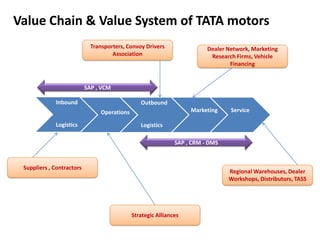
Value Chain & Value System of TATA motors
Transporters, Convoy Drivers
Association

Dealer Network, Marketing
Research Firms, Vehicle
Financing

SAP , VCM
Inbound

Outbound
Marketing

Operations
Logistics

Service

Logistics
SAP , CRM - DMS

Suppliers , Contractors

Regional Warehouses, Dealer
Workshops, Distributors, TASS

Strategic Alliances
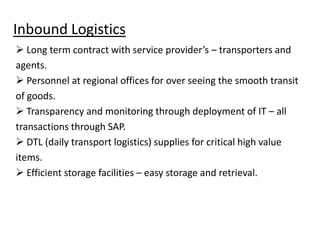
Inbound Logistics
 Long term contract with service provider’s – transporters and
agents.
 Personnel at regional offices for over seeing the smooth transit
of goods.
 Transparency and monitoring through deployment of IT – all
transactions through SAP.
 DTL (daily transport logistics) supplies for critical high value
items.
 Efficient storage facilities – easy storage and retrieval.
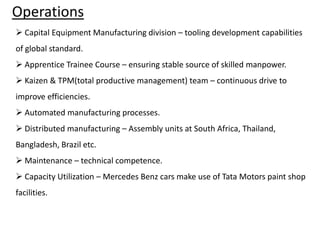
Operations
 Capital Equipment Manufacturing division – tooling development capabilities
of global standard.

 Apprentice Trainee Course – ensuring stable source of skilled manpower.
 Kaizen & TPM(total productive management) team – continuous drive to
improve efficiencies.
 Automated manufacturing processes.
 Distributed manufacturing – Assembly units at South Africa, Thailand,
Bangladesh, Brazil etc.
 Maintenance – technical competence.

 Capacity Utilization – Mercedes Benz cars make use of Tata Motors paint shop
facilities.
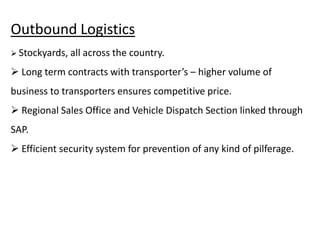
Outbound Logistics
 Stockyards, all across the

country.

 Long term contracts with transporter’s – higher volume of
business to transporters ensures competitive price.
 Regional Sales Office and Vehicle Dispatch Section linked through
SAP.
 Efficient security system for prevention of any kind of pilferage.
Marketing & Sales
 Structured approach to understanding the requirements of individual customers
conducted at regular intervals.
 Clear identification of product requirements, leading to development of
innovative products – Tata 207 DI, Tata Ace
 Pan India presence and global footprint.
 Independent teams for addressing the requirements of institutional customers –
Defense, State Transport Units
 Helping to augment the scarce resources – Fiat selling vehicles through Tata
dealerships, in return Tata has access to Fiat’s technology and unutilized capacity.
 Quick assessment of the changing market dynamics and consumer preferences –
Tata 407 LCV
 Large network of dealers – use of technology (CRM-DMS).
Service
 Easy availability of spare parts.
 Efficient collection of data from field and communication to the
respective plants.

 Pan India presence, as well as global presence.
 Large network of workshops – Dealer workshops and TASS.
 Training facilities – for dealer end and TASS personnel.
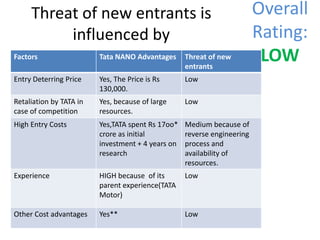
Threat of new entrants is
influenced by
Factors

Tata NANO Advantages

Threat of new
entrants

Entry Deterring Price

Yes, The Price is Rs
130,000.

Low

Retaliation by TATA in
case of competition

Yes, because of large
resources.

Low

High Entry Costs

Yes,TATA spent Rs 17oo*
crore as initial
investment + 4 years on
research

Medium because of
reverse engineering
process and
availability of
resources.

Experience

HIGH because of its
parent experience(TATA
Motor)

Low

Other Cost advantages

Yes**

Low

Overall
Rating:
LOW
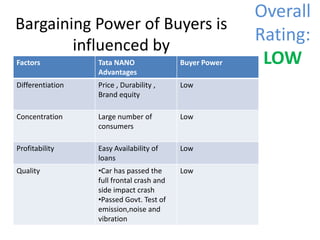
Bargaining Power of Buyers is
influenced by
Factors

Tata NANO
Advantages

Buyer Power

Differentiation

Price , Durability ,
Brand equity

Low

Concentration

Large number of
consumers

Low

Profitability

Easy Availability of
loans

Low

Quality

•Car has passed the
full frontal crash and
side impact crash
•Passed Govt. Test of
emission,noise and
vibration

Low

Overall
Rating:
LOW
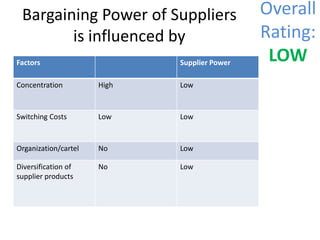
Bargaining Power of Suppliers
is influenced by
Factors

Supplier Power

Concentration

High

Low

Switching Costs

Low

Low

Organization/cartel

No

Low

Diversification of
supplier products

No

Low

Overall
Rating:
LOW
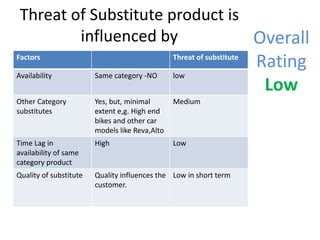
Threat of Substitute product is
influenced by
Overall
Factors

Threat of substitute

Availability

Same category -NO

low

Other Category
substitutes

Yes, but, minimal
extent e,g. High end
bikes and other car
models like Reva,Alto

Medium

Time Lag in
availability of same
category product

High

Low

Quality of substitute

Quality influences the Low in short term
customer.

Rating
Low
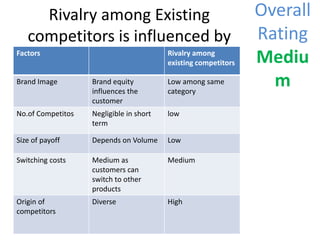
Rivalry among Existing
competitors is influenced by
Factors

Rivalry among
existing competitors

Brand Image

Brand equity
influences the
customer

Low among same
category

No.of Competitos

Negligible in short
term

low

Size of payoff

Depends on Volume

Low

Switching costs

Medium as
customers can
switch to other
products

Medium

Origin of
competitors

Diverse

High

Overall
Rating
Mediu
m
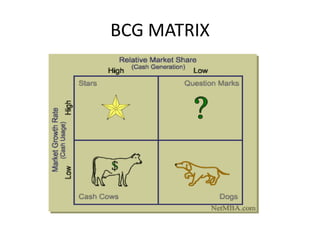
BCG MATRIX
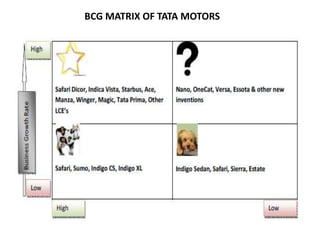
BCG MATRIX OF TATA MOTORS
ARTICLES OF TATA MOTORS
Tata Motors hit record high as Jaguar Land Rover
reports good sales in August
Sep 11, 2013, 03.59AM IST

MUMBAI: India's largest truck and bus maker Tata Motors hit its record high beating
analysts price targets fuelled by its British subsidiary Jaguar Rand Rover's (JLR)
reported record sales in August, its plan to sell vehicles in Indonesia and its
marketing alliance with Malaysian conglomerate DRB-HICOM for distribution and
assembly of its commercial vehicles in that country.
Investors should start buying Tata Motors on
decline, say analysts
Sep 11, 2013, 12.43PM IST

MUMBAI: Tata Motors surprised the street following a sharp rally of over 17
per cent in the month of September. The major upside was seen yesterday as
it rallied over 10 per cent after its subsidiary Jaguar Land Rover (JLR)
reported strong sales for the month of August.
According to analysts, while there may be more upside for the stock on hopes
of better sales from JLR, it has run up sharply and investors should use
correction to start accumulating.
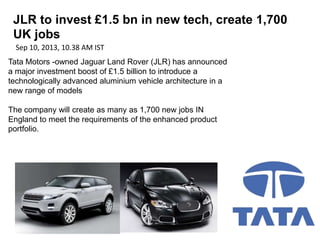
JLR to invest £1.5 bn in new tech, create 1,700
UK jobs
Sep 10, 2013, 10.38 AM IST
Tata Motors -owned Jaguar Land Rover (JLR) has announced
a major investment boost of £1.5 billion to introduce a
technologically advanced aluminium vehicle architecture in a
new range of models
The company will create as many as 1,700 new jobs IN
England to meet the requirements of the enhanced product
portfolio.
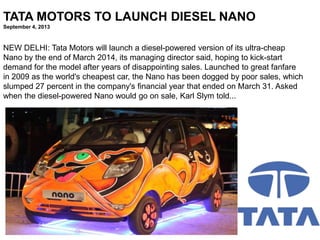
TATA MOTORS TO LAUNCH DIESEL NANO
September 4, 2013

NEW DELHI: Tata Motors will launch a diesel-powered version of its ultra-cheap
Nano by the end of March 2014, its managing director said, hoping to kick-start
demand for the model after years of disappointing sales. Launched to great fanfare
in 2009 as the world's cheapest car, the Nano has been dogged by poor sales, which
slumped 27 percent in the company's financial year that ended on March 31. Asked
when the diesel-powered Nano would go on sale, Karl Slym told...
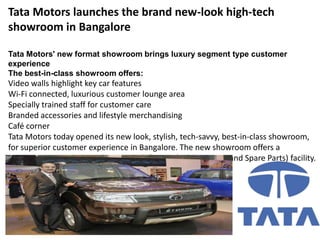
Tata Motors launches the brand new-look high-tech
showroom in Bangalore
Tata Motors' new format showroom brings luxury segment type customer
experience
The best-in-class showroom offers:

Video walls highlight key car features
Wi-Fi connected, luxurious customer lounge area
Specially trained staff for customer care
Branded accessories and lifestyle merchandising
Café corner
Tata Motors today opened its new look, stylish, tech-savvy, best-in-class showroom,
for superior customer experience in Bangalore. The new showroom offers a
contemporary-styled, single-point hub for 3- S (Sales, Service and Spare Parts) facility.
THANK YOU ALL

automobile industry

  • 1.
    PRESENTATION ON AUTOMOBILE INDUSTRY BY RAJ GUPTA MANGESHBHOSLE KALPESH BHASAGRE SANDEEP YADAV NARESH SOLANKI UNDER THE GUIDANCE OF PROF.SEEMA LADHA
  • 2.
    AUTOMOBILE INDUSTRY The automotiveindustry began in the 1890s with hundreds of manufacturers that pioneered the horseless carriage After World War II, the U.S. produced about 75 percent of world's auto production. In 1980, the U.S. was overtaken by Japan and became world's leader again in 1994. In 2006, Japan narrowly passed the U.S. in production and held this rank until 2009, when China took the top spot with 13.8 million units With 19.3 million units manufactured in 2012, China almost doubled the U.S. production, with 10.3 million units, while Japan was in third place with 9.9 million units The first car ran on India's roads in 1897. Until the 1930s, cars were imported directly, but in very small numbers.
  • 4.
    Political In 2002, theIndian government formulated an auto policy that aimed at promoting integrated, phased, enduring and self-sustained growth of theIndian automotive industry Allows automatic approval for foreign equity investment up to 100% in theautomotive sector and does not lay down any minimum investment criteria. Ensure a balanced transition to open trade at minimal risk to the Indianeconomy and local industry. Promoting multi-model transportation and the implementation of mass rapid transport system Economic Economic pressures on the industry are causing automobile companies toreorganize the traditional sales process. Weighted tax deduction of up to 150% for in-house research and R & Dactivities. Govt. has granted concessions, such as reduced interest rates for exportfinancing. Several Indian firms have partnered with global players. While some haveformed joint ventures with equity participation, other also has entered intotechnology tie-ups.
  • 5.
    Social Since changed lifestyleof people, leads to increased purchase of automobiles, so automobile sector have a large customer base to serve Indian customers are highly discerning, educated and well informed. Theyare price sensitive and put a lot of emphasis on value for money. Preference for fuel efficient cars with low running costs Technological The Government of India is promoting National Automotive Testing andR&D Infrastructure Project (NATRIP)to support the growth of the autoindustry in India Technological solutions helps in integrating the supply chain, hence reducelosses and increase profitability Major global players like audi, BMW Hyundai etc have setup their manufacturing units in India.
  • 6.
    Environmental Physical infrastructure suchas roads and bridges affect the use of automobiles. If there is good availability of roads or the roads are smooththen it will affect the use of automobiles Physical conditions like environmental situation affect the use of automobiles. If the environment is pleasant then it will lead to more use of vehicles. Legal Legal provision relating to environmental population by automobiles.  Legal provisions relating to safety measures  Ensure a balanced transition to open trade at minimal risk to the Indianeconomy and local industry
  • 7.
    ISSUES AND CHALLENGES Competitivepressures The rapid development of the low-cost labour economies in Eastern Europe, South East Asia, China and India is putting enormous pressures on labour intensive suppliers Sustainability Increasingly, environmental considerations and public opinion are driving manufacturers' decisions around the mix of materials used in manufacturing, the types of engine and the end of vehicle life (ELV) Supply chain management and cost reduction In the age of global trading, supply chains never stand still. Therefore, supply chain architectures must be kept under constant review in order for then to be both logistically efficient and cost effective. Emerging markets Rapid economic developments in emerging markets, notably China and India, are providing significant opportunities to increase sales and reduce costs
  • 9.
    Founded in 1945as a manufacturer of locomotives, the company manufactured its first commercial vehicle in 1954 in a collaboration with Daimler-Benz AG, which ended in 1969 Tata Motors Limited (formerly TELCO, short for "Tata Engineering and Locomotive Company") is an Indian multinational automotive manufacturing company Its products include passenger cars, trucks, vans, coaches, buses and military vehicles. It is the world's eighteenth-largest motor vehicle manufacturing company, fourth-largest truck manufacturer and second-largest bus manufacturer by volume. Tata Motors is listed on the Bombay Stock Exchange, where it is a constituent of the BSE SENSEX index, the National Stock Exchange of India and the New York Stock Exchange. Tata Motors is ranked 314th in the 2012 Fortune Global 500 ranking of the world's biggest corporations. Tata Motors has auto manufacturing and assembly plants in Jamshedpur, Pantnagar, Lucknow, Sanand, Dharwad and Pune in India, as well as in Argentina, South Africa, Thailand and the United Kingdom. It has research and development centres in Pune, Jamshedpur, Lucknow and Dharwad, India, and in South Korea, Spain, and the United Kingdom
  • 10.
    MISSION To be passionatein anticipating and providing the best vehicles and experiences that excite our customers globally. VISION Most admired by our customers, employees, business partners and shareholders for the experience and value they enjoy from being with us.
  • 12.
    TURNAROUND STRATEGY • TataPower Delhi Distribution by winning hearts and changing mindsets, and through technology and commercial savvy • transformed a loss-making government entity into an efficient and profitable operation that has become a benchmark for public-private partnerships
  • 13.
    R&D STRATEGY • TataGroup companies cumulatively spend Rs.12,500 crore on research & development. • knowledge-based engineering application software from Tata Technologies that speeds up results. • An engine ‘start-stop’ technology developed by Jaguar Land Rover that stops an engine when the vehicle isn't moving, thus saving on fuel; • High performance rail steel that saved £150,000 over five years was developed by Tata Steel Europe • High standard steel for safer and fuel efficient vehicles from Tata Steel Europe • The world's cheapest car, Nano, an innovation from Group company Tata Motors, launched in April 2009, has 37 patents, • Swach, the cheapest water filter from Tata Chemicals, has 14. • Tata Steel, which acquired British company Corus in 2007, meanwhile, files around 50 patents each year.
  • 14.
    P2 STRATEGIES • P2or pollution prevention is a proactive strategy that uses fewer or smarter resources to begin requiring lesser cleanup at the final disposal. • It is done by reducing or eliminating waste at the source by modifying production processes, promoting the use of non-toxic or less-toxic substances, implementing conservation techniques, and re-using materials rather than putting them into the waste stream. • It assumes no waste will occur. It is an effective ‘getting more from less’ strategy.
  • 15.
    • Reducing packagingmaterial by either using sustainable packaging (replacing wood with metal) or reusing existing packaging (recycling wood). • The company recycles close to 69 percent of the wood packaging thus eliminating use of fresh wood. • The company aims to source 60% of its components from the park thereby increasing its resource efficiency and reducing its emissions due to reduction in logistics and transportation.
  • 16.
    R2 STRATEGIES • Thisis a ‘getting more from the same’ strategy where otherwise wasted resources are recovered by way of proper disposal – recycling or reconditioning. • Increasing life of aggregates – ‘Recon’ business • In 2010-11 a total of 13,788 engines and 8,690 other parts were reconditioned. • Other resource conservation techniques like reusing engine oil for multiple testing cycles has been employed. • A 200 litre engine oil barrel can now be used to test 170 engines instead of 85.
  • 17.
    • Reusing paintsludge and thinner • Last year, approximately 390 tonnes of hazardous paint sludge was converted to a low quality paint suitable for floor painting. • Tata Motors has also developed a process to convert the incinerator ash to pavement bricks that can be used in walkways within the plant. • This model has been very successful and has significantly reduced the amount of hazardous incinerated ash sent to landfills.
  • 18.
    SWOT ANALYSIS STRENGTHS: • CONSOLIDATEDnet profits of Rs 1988.73crores for the quarter ended June30, 2010 on the back of strong sales in the domestic market and a good show of J&LR. • A strong faith of Indian people in Tata brands. • A group global sale grows by 36% at 90,646 vehicles in July 2010. • Market leader in commercial vehicles. • largest car seller in passenger car vehicles. •largest truck manufacturer. •largest bus manufacturer.
  • 19.
    WEAKNESSES: • Cases offire in Nano Cars. • Image of Taxi for Tata Indica. • Less no of service station as comparison to Maruti Suzuki. OPPORTUNITIES: • Fastest growing market for small cars in India. • Positive business outlook for both commercials and passengers vehicles in the Indian market would give a boost to Tata Motors ‘Indian operation. • Crisil raised its long term debt rating to AA-. • Reflecting an improvement in the ability of the Auto Major to repay loa THREATS: • Entries of foreign players in Indian automobile sector. • Stiff competition from Maruti Suzuki and Hyundai.
  • 20.
    Value Chain &Value System of TATA motors Transporters, Convoy Drivers Association Dealer Network, Marketing Research Firms, Vehicle Financing SAP , VCM Inbound Outbound Marketing Operations Logistics Service Logistics SAP , CRM - DMS Suppliers , Contractors Regional Warehouses, Dealer Workshops, Distributors, TASS Strategic Alliances
  • 21.
    Inbound Logistics  Longterm contract with service provider’s – transporters and agents.  Personnel at regional offices for over seeing the smooth transit of goods.  Transparency and monitoring through deployment of IT – all transactions through SAP.  DTL (daily transport logistics) supplies for critical high value items.  Efficient storage facilities – easy storage and retrieval.
  • 22.
    Operations  Capital EquipmentManufacturing division – tooling development capabilities of global standard.  Apprentice Trainee Course – ensuring stable source of skilled manpower.  Kaizen & TPM(total productive management) team – continuous drive to improve efficiencies.  Automated manufacturing processes.  Distributed manufacturing – Assembly units at South Africa, Thailand, Bangladesh, Brazil etc.  Maintenance – technical competence.  Capacity Utilization – Mercedes Benz cars make use of Tata Motors paint shop facilities.
  • 23.
    Outbound Logistics  Stockyards,all across the country.  Long term contracts with transporter’s – higher volume of business to transporters ensures competitive price.  Regional Sales Office and Vehicle Dispatch Section linked through SAP.  Efficient security system for prevention of any kind of pilferage.
  • 24.
    Marketing & Sales Structured approach to understanding the requirements of individual customers conducted at regular intervals.  Clear identification of product requirements, leading to development of innovative products – Tata 207 DI, Tata Ace  Pan India presence and global footprint.  Independent teams for addressing the requirements of institutional customers – Defense, State Transport Units  Helping to augment the scarce resources – Fiat selling vehicles through Tata dealerships, in return Tata has access to Fiat’s technology and unutilized capacity.  Quick assessment of the changing market dynamics and consumer preferences – Tata 407 LCV  Large network of dealers – use of technology (CRM-DMS).
  • 25.
    Service  Easy availabilityof spare parts.  Efficient collection of data from field and communication to the respective plants.  Pan India presence, as well as global presence.  Large network of workshops – Dealer workshops and TASS.  Training facilities – for dealer end and TASS personnel.
  • 27.
    Threat of newentrants is influenced by Factors Tata NANO Advantages Threat of new entrants Entry Deterring Price Yes, The Price is Rs 130,000. Low Retaliation by TATA in case of competition Yes, because of large resources. Low High Entry Costs Yes,TATA spent Rs 17oo* crore as initial investment + 4 years on research Medium because of reverse engineering process and availability of resources. Experience HIGH because of its parent experience(TATA Motor) Low Other Cost advantages Yes** Low Overall Rating: LOW
  • 28.
    Bargaining Power ofBuyers is influenced by Factors Tata NANO Advantages Buyer Power Differentiation Price , Durability , Brand equity Low Concentration Large number of consumers Low Profitability Easy Availability of loans Low Quality •Car has passed the full frontal crash and side impact crash •Passed Govt. Test of emission,noise and vibration Low Overall Rating: LOW
  • 29.
    Bargaining Power ofSuppliers is influenced by Factors Supplier Power Concentration High Low Switching Costs Low Low Organization/cartel No Low Diversification of supplier products No Low Overall Rating: LOW
  • 30.
    Threat of Substituteproduct is influenced by Overall Factors Threat of substitute Availability Same category -NO low Other Category substitutes Yes, but, minimal extent e,g. High end bikes and other car models like Reva,Alto Medium Time Lag in availability of same category product High Low Quality of substitute Quality influences the Low in short term customer. Rating Low
  • 31.
    Rivalry among Existing competitorsis influenced by Factors Rivalry among existing competitors Brand Image Brand equity influences the customer Low among same category No.of Competitos Negligible in short term low Size of payoff Depends on Volume Low Switching costs Medium as customers can switch to other products Medium Origin of competitors Diverse High Overall Rating Mediu m
  • 32.
  • 33.
    BCG MATRIX OFTATA MOTORS
  • 34.
    ARTICLES OF TATAMOTORS Tata Motors hit record high as Jaguar Land Rover reports good sales in August Sep 11, 2013, 03.59AM IST MUMBAI: India's largest truck and bus maker Tata Motors hit its record high beating analysts price targets fuelled by its British subsidiary Jaguar Rand Rover's (JLR) reported record sales in August, its plan to sell vehicles in Indonesia and its marketing alliance with Malaysian conglomerate DRB-HICOM for distribution and assembly of its commercial vehicles in that country.
  • 35.
    Investors should startbuying Tata Motors on decline, say analysts Sep 11, 2013, 12.43PM IST MUMBAI: Tata Motors surprised the street following a sharp rally of over 17 per cent in the month of September. The major upside was seen yesterday as it rallied over 10 per cent after its subsidiary Jaguar Land Rover (JLR) reported strong sales for the month of August. According to analysts, while there may be more upside for the stock on hopes of better sales from JLR, it has run up sharply and investors should use correction to start accumulating.
  • 36.
    JLR to invest£1.5 bn in new tech, create 1,700 UK jobs Sep 10, 2013, 10.38 AM IST Tata Motors -owned Jaguar Land Rover (JLR) has announced a major investment boost of £1.5 billion to introduce a technologically advanced aluminium vehicle architecture in a new range of models The company will create as many as 1,700 new jobs IN England to meet the requirements of the enhanced product portfolio.
  • 37.
    TATA MOTORS TOLAUNCH DIESEL NANO September 4, 2013 NEW DELHI: Tata Motors will launch a diesel-powered version of its ultra-cheap Nano by the end of March 2014, its managing director said, hoping to kick-start demand for the model after years of disappointing sales. Launched to great fanfare in 2009 as the world's cheapest car, the Nano has been dogged by poor sales, which slumped 27 percent in the company's financial year that ended on March 31. Asked when the diesel-powered Nano would go on sale, Karl Slym told...
  • 38.
    Tata Motors launchesthe brand new-look high-tech showroom in Bangalore Tata Motors' new format showroom brings luxury segment type customer experience The best-in-class showroom offers: Video walls highlight key car features Wi-Fi connected, luxurious customer lounge area Specially trained staff for customer care Branded accessories and lifestyle merchandising Café corner Tata Motors today opened its new look, stylish, tech-savvy, best-in-class showroom, for superior customer experience in Bangalore. The new showroom offers a contemporary-styled, single-point hub for 3- S (Sales, Service and Spare Parts) facility.
  • 39.

Editor's Notes

  • #28 *http://books.google.co.in/books?id=nDEEAAAAMBAJ&pg=PT53&dq=tata+nano+suppliers&lr=&ei=IA_wS-2VB5KMkASm-ZydCg&cd=11#v=onepage&q=tata%20nano%20suppliers&f=false** local component manufacturers will save about Rs 16 lakh per month as transportation charges, for nearly 400 tonnes of spare parts that they sent to Singur. Vendors will also get benefit---http://www.dancewithshadows.com/autoindia/how-tata-nano-project-will-benefit-gujarat/
  • #29 1.) CRISIL Research estimates the consumer price of the car at around Rs 1.3 lakh. This brings down the cost of ownership of an entry level car in India by 30%