Management Development Jun 7, 2009
Managerial Skills vs. developmental tool Six important managerial skills Observation Monitor employee performance Implementation of professional development programs Demonstrate working knowledge and expertise Good decision making Ability to conduct and evaluate research Jun 7, 2009
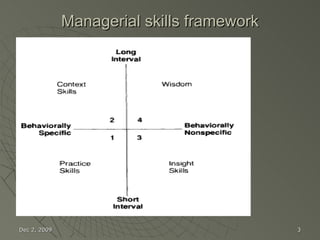
Managerial skills framework Jun 7, 2009
Managerial Skills vs. developmental tool How does development tool help Involves converting abstract generalizations to behavior tailored to specific situations It enhances behavioral and inter personal skills (moves up from cognitive learning to actually incorporating it) Stresses on conceptual and general knowledge Decision making under conditions of ambiguity(Mintzberg) Structured practice skills workshop raises the ability of the learners to describe in detail their own and other’s behavior in a work context  It is a long term exercise and thus changes are not overnight Jun 7, 2009
Career Planning & Development   Career Planning It’s a process through which a person: evaluates his or her own abilities and interests,  considers alternative career opportunities,  establishes career goals and  plans practical developmental activities. Career planning is important because it would help the individual to explore, choose and strive to derive satisfaction with one’s career objective. Jun 7, 2009
Development Career development results from the matching of the individual with the organization.  Although organizations should take more responsibility for the development of human resources, they cannot take full responsibility for each individual’s career development. INDIVIDUAL STRATEGIES Know yourself by taking a personal skills inventory to determine your strengths and weaknesses. Analyze career opportunities Establish Career goals – short term and long term Review: There should be a continual process of evaluating and modifying career goals and plans over time. Jun 7, 2009
ORGANISATIONAL STRATEGIES Improve Manpower Planning and Forecasting Systems Improve Dissemination of Career Option Information Special Assignments and Job Rotation Sabbaticals, Flexible Working Hours Assessment Centre / Development Centre Jun 7, 2009
Career Anchor what people  want most out of a career  There are 8 career anchors as defined by Edger Schein You may combine a few of these career anchors, but there should be one at the top of your list Jun 7, 2009
1. Autonomy/independence  wanting to be self reliant - useful with today's contracting out. These people have a primary need to work under their own rules and steam. They avoid standards and prefer to work alone Jun 7, 2009
2. Security/stability  wanting to remain with one employer for life - not so likely any more.  Security-focused people seek stability and continuity as a primary factor of their lives. They avoid risks and are generally 'lifers' in their job. Jun 7, 2009
3. Technical/functional competence  to identify with a professional discipline.   This kind of person likes being good at something and will work to become a guru or expert. They like to be challenged and then use their skill to meet the challenge, doing the job properly and better than almost anyone else Jun 7, 2009
4. General management  having a broad, overview, facilitating role, not a specialist. Unlike technical/functional people, these folks want to be managers (and not just to get more money, although this may be used as a metric of success). They like problem-solving and dealing with other people. They thrive on responsibility. To be successful, they also need emotional competence Jun 7, 2009
5. Entrepreneurial creativity  a premium wherever innovation drives competitiveness  These folks like to invent things, be creative and, most of all, to run their own businesses. They differ from those who seek autonomy in that they will share the workload. They find ownership very important. They easily get bored. Wealth, for them, is a sign of success. Jun 7, 2009
6. Service  dedication to worthwhile causes ranging from the environment to poverty. Service-oriented people are driven by how they can help other people more than using their talents (which may fall in other areas). They may well work in public services or in HR. Jun 7, 2009
7. Pure challenge  just solving difficult problems - no pattern necessary People driven by challenge seek constant stimulation and difficult problems that they can tackle. Such people will change jobs when the current one gets boring and their career can be very varied Jun 7, 2009
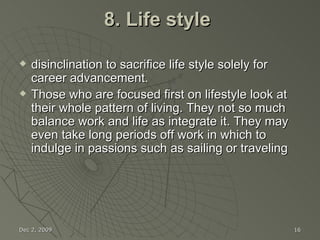
8. Life style  disinclination to sacrifice life style solely for career advancement. Those who are focused first on lifestyle look at their whole pattern of living. They not so much balance work and life as integrate it. They may even take long periods off work in which to indulge in passions such as sailing or traveling Jun 7, 2009
Career anchor as a tool Further work required I am working on it  Rahul Jun 7, 2009
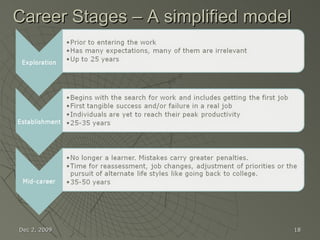
Career Stages – A simplified model  Jun 7, 2009
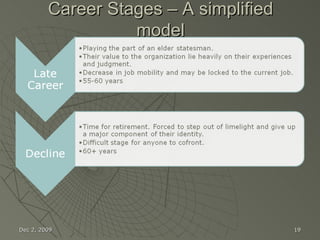
Career Stages – A simplified model Jun 7, 2009
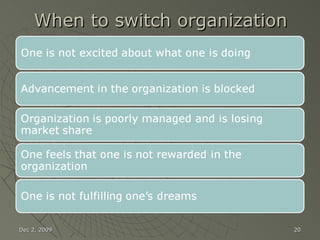
When to switch organization Jun 7, 2009
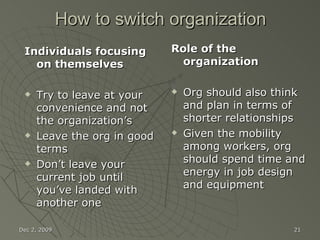
How to switch organization Individuals focusing on themselves Try to leave at your convenience and not the organization’s Leave the org in good terms Don’t leave your current job until you’ve landed with another one Role of the organization Org should also think and plan in terms of shorter relationships Given the mobility among workers, org should spend time and energy in job design and equipment Jun 7, 2009
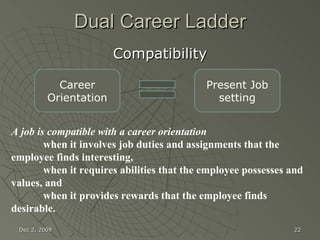
Dual Career Ladder Compatibility Jun 7, 2009 Career Orientation Present Job setting A job is compatible with a career orientation  when it involves job duties and assignments that the employee finds interesting,  when it requires abilities that the employee possesses and values, and  when it provides rewards that the employee finds desirable.
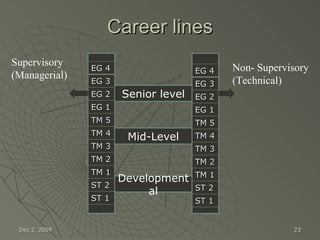
Career lines  Jun 7, 2009 Senior level Mid-Level Developmental Supervisory (Managerial) Non- Supervisory (Technical) EG 4 EG 3 EG 2 EG 1 TM 5 TM 4 TM 3 TM 2 TM 1 ST 2 ST 1 EG 4 EG 3 EG 2 EG 1 TM 5 TM 4 TM 3 TM 2 TM 1 ST 2 ST 1
Dual career path system Recognizes the diversity of career orientations and provides incentives that are consistent with employees' underlying career values. Higher job satisfaction Stronger commitment towards organisation Lesser attrition Jun 7, 2009
Dual Career ladder  Implications All persons are governed by same set of values and goals is incorrect Organizations need to understand diversity in employee population Supervisor have a role of career developer Coaching is important element of a manager’s job Rewards may not be common across all groups of employees Jun 7, 2009
Dual Career Ladder Branching point: A person chooses (or is chosen for) either the managerial ladder or the technical ladder.  The titles are different in each ladder, but pay and perquisites same Managerial ladder extends into the executive ranks, while the technical ladder stops far short of this.  Managerial ladder appear more desirable to ambitious young employees. Switch back and forth:  Between the managerial and technical ladders.  A good career strategy ! But switching between ladders is difficult and not done by very many employees.  Eg TML Jun 7, 2009
Succession Planning Why ?   The continued existence of an organization over time require a succession of persons to fill key position . When ? Identify and develop people to replace current incumbents in key position for a variety of reasons. Superannuation:  Employees retiring because they reach a certain age. Resignation:  Employees leaving their current job to join a new job Promotion:  Employees moving upward in the hierarchy of the organization. Diversification:  Employees being redeployed to new activities. Creation of New Position:  Employees getting placed in new positions at the same level. Jun 7, 2009
Jun 7, 2009 How ? Within the organization  :  Organizations should look inward to identify potential and make effort to groom  people to higher and varied responsibilities. Succession by people from within gives a shared feeling among employee that they can grow as the organization grows.  Outside the organization When qualified and competent people are not available internally or when planning to launch a major expansion or diversification programmes requiring new ideas etc.., company’s may look outside the org.  Complete dependence on internal source may cause stagnation for the organization.   Succession planning is pro-active and future focused, and enables managers and supervisors to assess, evaluate, and develop a talent pool of individuals who are willing and able to fill positions when needed.
ThankYou Jun 7, 2009

Management Devlopment

  • 1.
  • 2.
    Managerial Skills vs.developmental tool Six important managerial skills Observation Monitor employee performance Implementation of professional development programs Demonstrate working knowledge and expertise Good decision making Ability to conduct and evaluate research Jun 7, 2009
  • 3.
  • 4.
    Managerial Skills vs.developmental tool How does development tool help Involves converting abstract generalizations to behavior tailored to specific situations It enhances behavioral and inter personal skills (moves up from cognitive learning to actually incorporating it) Stresses on conceptual and general knowledge Decision making under conditions of ambiguity(Mintzberg) Structured practice skills workshop raises the ability of the learners to describe in detail their own and other’s behavior in a work context It is a long term exercise and thus changes are not overnight Jun 7, 2009
  • 5.
    Career Planning &Development Career Planning It’s a process through which a person: evaluates his or her own abilities and interests, considers alternative career opportunities, establishes career goals and plans practical developmental activities. Career planning is important because it would help the individual to explore, choose and strive to derive satisfaction with one’s career objective. Jun 7, 2009
  • 6.
    Development Career developmentresults from the matching of the individual with the organization. Although organizations should take more responsibility for the development of human resources, they cannot take full responsibility for each individual’s career development. INDIVIDUAL STRATEGIES Know yourself by taking a personal skills inventory to determine your strengths and weaknesses. Analyze career opportunities Establish Career goals – short term and long term Review: There should be a continual process of evaluating and modifying career goals and plans over time. Jun 7, 2009
  • 7.
    ORGANISATIONAL STRATEGIES ImproveManpower Planning and Forecasting Systems Improve Dissemination of Career Option Information Special Assignments and Job Rotation Sabbaticals, Flexible Working Hours Assessment Centre / Development Centre Jun 7, 2009
  • 8.
    Career Anchor whatpeople want most out of a career There are 8 career anchors as defined by Edger Schein You may combine a few of these career anchors, but there should be one at the top of your list Jun 7, 2009
  • 9.
    1. Autonomy/independence wanting to be self reliant - useful with today's contracting out. These people have a primary need to work under their own rules and steam. They avoid standards and prefer to work alone Jun 7, 2009
  • 10.
    2. Security/stability wanting to remain with one employer for life - not so likely any more. Security-focused people seek stability and continuity as a primary factor of their lives. They avoid risks and are generally 'lifers' in their job. Jun 7, 2009
  • 11.
    3. Technical/functional competence to identify with a professional discipline. This kind of person likes being good at something and will work to become a guru or expert. They like to be challenged and then use their skill to meet the challenge, doing the job properly and better than almost anyone else Jun 7, 2009
  • 12.
    4. General management having a broad, overview, facilitating role, not a specialist. Unlike technical/functional people, these folks want to be managers (and not just to get more money, although this may be used as a metric of success). They like problem-solving and dealing with other people. They thrive on responsibility. To be successful, they also need emotional competence Jun 7, 2009
  • 13.
    5. Entrepreneurial creativity a premium wherever innovation drives competitiveness These folks like to invent things, be creative and, most of all, to run their own businesses. They differ from those who seek autonomy in that they will share the workload. They find ownership very important. They easily get bored. Wealth, for them, is a sign of success. Jun 7, 2009
  • 14.
    6. Service dedication to worthwhile causes ranging from the environment to poverty. Service-oriented people are driven by how they can help other people more than using their talents (which may fall in other areas). They may well work in public services or in HR. Jun 7, 2009
  • 15.
    7. Pure challenge just solving difficult problems - no pattern necessary People driven by challenge seek constant stimulation and difficult problems that they can tackle. Such people will change jobs when the current one gets boring and their career can be very varied Jun 7, 2009
  • 16.
    8. Life style disinclination to sacrifice life style solely for career advancement. Those who are focused first on lifestyle look at their whole pattern of living. They not so much balance work and life as integrate it. They may even take long periods off work in which to indulge in passions such as sailing or traveling Jun 7, 2009
  • 17.
    Career anchor asa tool Further work required I am working on it Rahul Jun 7, 2009
  • 18.
    Career Stages –A simplified model Jun 7, 2009
  • 19.
    Career Stages –A simplified model Jun 7, 2009
  • 20.
    When to switchorganization Jun 7, 2009
  • 21.
    How to switchorganization Individuals focusing on themselves Try to leave at your convenience and not the organization’s Leave the org in good terms Don’t leave your current job until you’ve landed with another one Role of the organization Org should also think and plan in terms of shorter relationships Given the mobility among workers, org should spend time and energy in job design and equipment Jun 7, 2009
  • 22.
    Dual Career LadderCompatibility Jun 7, 2009 Career Orientation Present Job setting A job is compatible with a career orientation when it involves job duties and assignments that the employee finds interesting, when it requires abilities that the employee possesses and values, and when it provides rewards that the employee finds desirable.
  • 23.
    Career lines Jun 7, 2009 Senior level Mid-Level Developmental Supervisory (Managerial) Non- Supervisory (Technical) EG 4 EG 3 EG 2 EG 1 TM 5 TM 4 TM 3 TM 2 TM 1 ST 2 ST 1 EG 4 EG 3 EG 2 EG 1 TM 5 TM 4 TM 3 TM 2 TM 1 ST 2 ST 1
  • 24.
    Dual career pathsystem Recognizes the diversity of career orientations and provides incentives that are consistent with employees' underlying career values. Higher job satisfaction Stronger commitment towards organisation Lesser attrition Jun 7, 2009
  • 25.
    Dual Career ladder Implications All persons are governed by same set of values and goals is incorrect Organizations need to understand diversity in employee population Supervisor have a role of career developer Coaching is important element of a manager’s job Rewards may not be common across all groups of employees Jun 7, 2009
  • 26.
    Dual Career LadderBranching point: A person chooses (or is chosen for) either the managerial ladder or the technical ladder. The titles are different in each ladder, but pay and perquisites same Managerial ladder extends into the executive ranks, while the technical ladder stops far short of this. Managerial ladder appear more desirable to ambitious young employees. Switch back and forth: Between the managerial and technical ladders. A good career strategy ! But switching between ladders is difficult and not done by very many employees. Eg TML Jun 7, 2009
  • 27.
    Succession Planning Why? The continued existence of an organization over time require a succession of persons to fill key position . When ? Identify and develop people to replace current incumbents in key position for a variety of reasons. Superannuation: Employees retiring because they reach a certain age. Resignation: Employees leaving their current job to join a new job Promotion: Employees moving upward in the hierarchy of the organization. Diversification: Employees being redeployed to new activities. Creation of New Position: Employees getting placed in new positions at the same level. Jun 7, 2009
  • 28.
    Jun 7, 2009How ? Within the organization : Organizations should look inward to identify potential and make effort to groom people to higher and varied responsibilities. Succession by people from within gives a shared feeling among employee that they can grow as the organization grows. Outside the organization When qualified and competent people are not available internally or when planning to launch a major expansion or diversification programmes requiring new ideas etc.., company’s may look outside the org. Complete dependence on internal source may cause stagnation for the organization. Succession planning is pro-active and future focused, and enables managers and supervisors to assess, evaluate, and develop a talent pool of individuals who are willing and able to fill positions when needed.
  • 29.