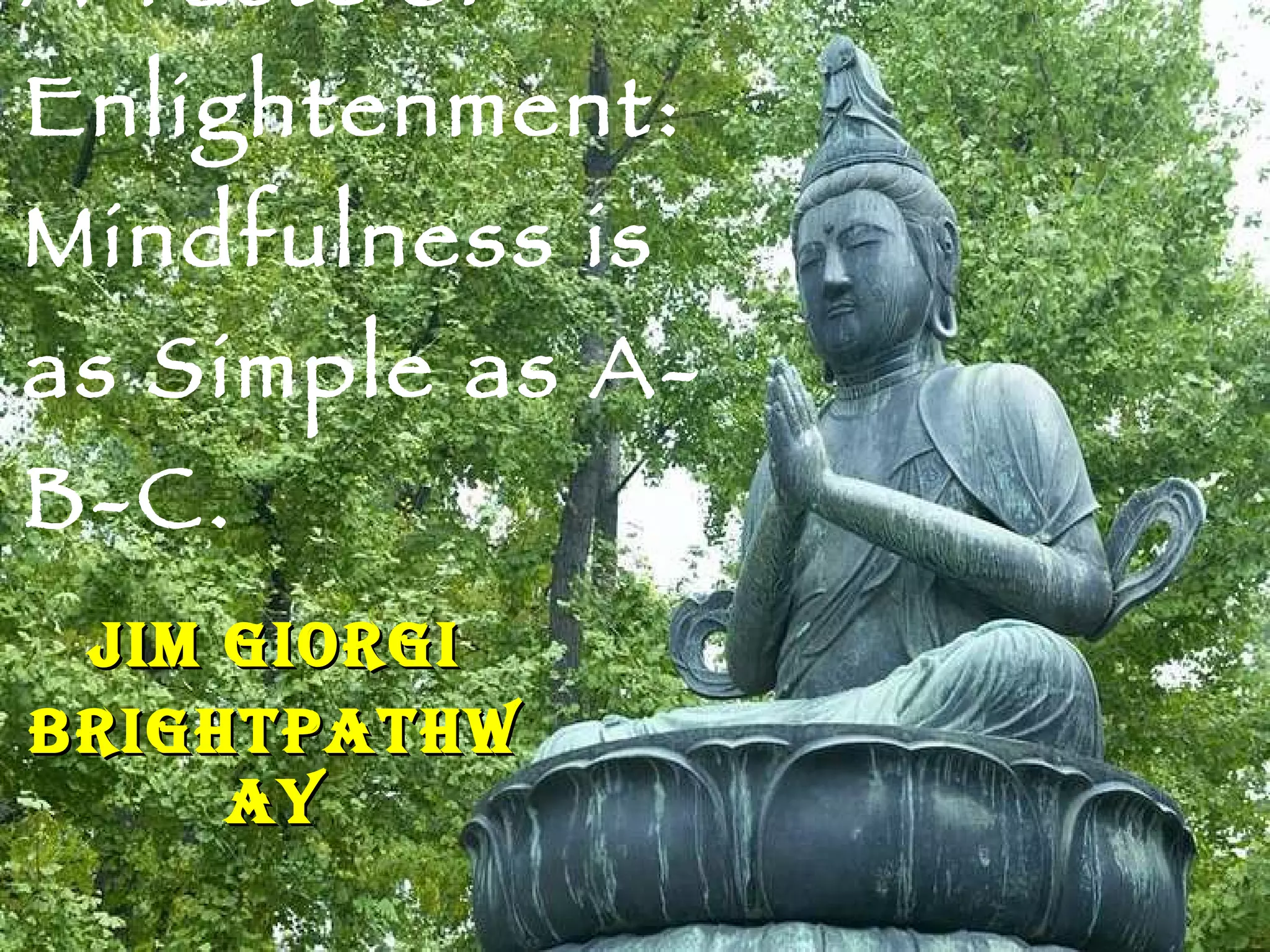
A Taste of Enlightenment: Mindfulness is as Simple as A-B-C. Jim Giorgi Brightpathway
The First Noble Truth:  Life is Suffering Living in this world entails periods of stress, anxiety  and unhappiness: in a word, Suffering The Buddha taught that suffering is based in a feeling of Separation which produces a tendency to  attach mentally  and  react emotionally  to objects and conditions we  desire  to attract in order to attain happiness or avoid to escape unhappiness
Our normal waking consciousness is dominated by thoughts.  On average, 60,000 per day, usually the same ones we had yesterday.
We are immersed in and attached to an endless train of thoughts.  Some are useful, many are just “noise”, like static on a radio. Our thoughts are filters through which we distort our perception of reality.
Attaching to good thoughts is like looking at the world through rose-colored glasses.  Attaching to bad thoughts is like looking at the world through mud-colored glasses.
Our moment-to-moment experience is colored by our reactions to our thoughts.  Our moods are tyrannized by them. We become the “effect” of our thoughts, instead of the cause.
If you started saying aloud the thoughts that continually and compulsively run through your head, anybody listening to you would think that you were insane.   -Eckhart Tolle
Thoughts are tools - abstractions.  They are  a   reality,  but they are not reality itself.  They are good servants but  bad masters. Does the hammer tell the carpenter   what to do?
The advice to  “ think  outside  the box ”  is faulty, because … Thinking  is  the box.   Thinking don’t solve problems   , it creates them
Q: How can you control your thoughts? A: You can’t! But…You CAN control your ATTENTION
The Story of Ikkyu “ Please write words of the highest and most subtle wisdom…” “ Attention Attention Attention.”
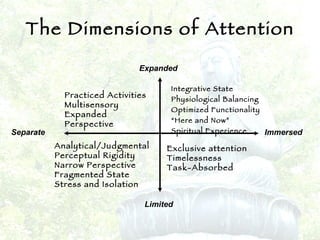
The Dimensions of Attention Integrative State Physiological Balancing Optimized Functionality “ Here and Now” Spiritual Experience Practiced Activities Multisensory Expanded Perspective Analytical/Judgmental Perceptual Rigidity Narrow Perspective Fragmented State Stress and Isolation Exclusive attention Timelessness Task-Absorbed Expanded Separate Limited Immersed
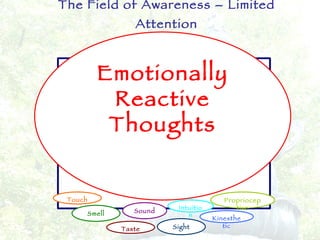
The Field of Awareness – Limited Attention Emotionally Reactive Thoughts Touch Smell Sound Kinesthetic Taste Intuition Sight Proprioceptive
Meditation is not about controlling thoughts It’s about controlling  ATTENTION
Controlling attention means attending away from thoughts and attending  to the space between  the thoughts
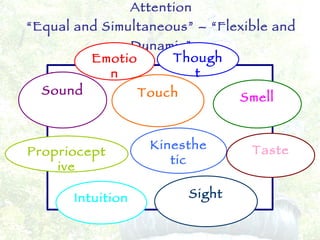
The Field of Awareness – Expanded Attention “Equal and Simultaneous” – “Flexible and Dynamic” m Emotion Thought Sound Touch Smell Proprioceptive Kinesthetic Taste Intuition Sight
The space between the thoughts  has many names: “ Mushin ”   “ Empty Mind ” “ Clear Mind ”
Empty mind is not a mind empty of thoughts but rather empty of the attachments and reactions  to thoughts  Suffering (stress) is not the product of external events but of reactions to thoughts
Like tuning a radio that is between stations, meditation tunes out the “static” of thoughts and allows the “music” to be heard loud and clear
When thoughts arise- Neither entertain nor resist, Have your thoughts without them having you. No attachment or reaction
Meditation is like weight training for one’s “Attentional Muscles” It is emerging from the trap of attachment to thoughts and the reactions to them.
Dissolving the boundaries of thought-created time and space into  Timelessness  and  Spaciousness The Eternal “Present Moment”
“ Master, how may I enter the Tao?” “ Do you hear the sound of the brook babbling in the distance?” “ Yes, Master.” “ Then enter there!”
Where does the sound end and your hearing of it begin?  Where does the object you are looking at end and your seeing of it begin?  Where does what is touching your skin end and your feeling of it begin?
“ Get out of your “head” and come to your senses.” See, hear, touch, smell, taste the “suchness”, without label, judgment or condition.
Meditation is learning how to do nothing while you ’ re doing nothing so that you can learn how to  “ do nothing ”  while you ’ re doing something  –   “ Mindfulness ”
Mindfulness is “ Meditation in Action ” Being totally immersed in what you ’ re doing while you’re doing it.  Acting with Effortlessness Being in  “ The Zone ”
You can be fully relaxed  and  fully alert, performing effortlessly and functioning optimally… all at the same time.
Mindfulness –  As simple as “A-B-C”. A:  A ttention  to present moment  experience (sensations) B:  B reathing C:  C orporal  (Body) Awareness
Hear all sounds as mantras See all beings as Buddhas See all phenomena as Nirvana Namaste The Tibetan “Shortcut” to Enlightenment

Taste of Enlightenment

  • 1.
    A Taste ofEnlightenment: Mindfulness is as Simple as A-B-C. Jim Giorgi Brightpathway
  • 2.
    The First NobleTruth: Life is Suffering Living in this world entails periods of stress, anxiety and unhappiness: in a word, Suffering The Buddha taught that suffering is based in a feeling of Separation which produces a tendency to attach mentally and react emotionally to objects and conditions we desire to attract in order to attain happiness or avoid to escape unhappiness
  • 3.
    Our normal wakingconsciousness is dominated by thoughts. On average, 60,000 per day, usually the same ones we had yesterday.
  • 4.
    We are immersedin and attached to an endless train of thoughts. Some are useful, many are just “noise”, like static on a radio. Our thoughts are filters through which we distort our perception of reality.
  • 5.
    Attaching to goodthoughts is like looking at the world through rose-colored glasses. Attaching to bad thoughts is like looking at the world through mud-colored glasses.
  • 6.
    Our moment-to-moment experienceis colored by our reactions to our thoughts. Our moods are tyrannized by them. We become the “effect” of our thoughts, instead of the cause.
  • 7.
    If you startedsaying aloud the thoughts that continually and compulsively run through your head, anybody listening to you would think that you were insane. -Eckhart Tolle
  • 8.
    Thoughts are tools- abstractions. They are a reality, but they are not reality itself. They are good servants but bad masters. Does the hammer tell the carpenter what to do?
  • 9.
    The advice to “ think outside the box ” is faulty, because … Thinking is the box. Thinking don’t solve problems , it creates them
  • 10.
    Q: How canyou control your thoughts? A: You can’t! But…You CAN control your ATTENTION
  • 11.
    The Story ofIkkyu “ Please write words of the highest and most subtle wisdom…” “ Attention Attention Attention.”
  • 12.
    The Dimensions ofAttention Integrative State Physiological Balancing Optimized Functionality “ Here and Now” Spiritual Experience Practiced Activities Multisensory Expanded Perspective Analytical/Judgmental Perceptual Rigidity Narrow Perspective Fragmented State Stress and Isolation Exclusive attention Timelessness Task-Absorbed Expanded Separate Limited Immersed
  • 13.
    The Field ofAwareness – Limited Attention Emotionally Reactive Thoughts Touch Smell Sound Kinesthetic Taste Intuition Sight Proprioceptive
  • 14.
    Meditation is notabout controlling thoughts It’s about controlling ATTENTION
  • 15.
    Controlling attention meansattending away from thoughts and attending to the space between the thoughts
  • 16.
    The Field ofAwareness – Expanded Attention “Equal and Simultaneous” – “Flexible and Dynamic” m Emotion Thought Sound Touch Smell Proprioceptive Kinesthetic Taste Intuition Sight
  • 17.
    The space betweenthe thoughts has many names: “ Mushin ” “ Empty Mind ” “ Clear Mind ”
  • 18.
    Empty mind isnot a mind empty of thoughts but rather empty of the attachments and reactions to thoughts Suffering (stress) is not the product of external events but of reactions to thoughts
  • 19.
    Like tuning aradio that is between stations, meditation tunes out the “static” of thoughts and allows the “music” to be heard loud and clear
  • 20.
    When thoughts arise-Neither entertain nor resist, Have your thoughts without them having you. No attachment or reaction
  • 21.
    Meditation is likeweight training for one’s “Attentional Muscles” It is emerging from the trap of attachment to thoughts and the reactions to them.
  • 22.
    Dissolving the boundariesof thought-created time and space into Timelessness and Spaciousness The Eternal “Present Moment”
  • 23.
    “ Master, howmay I enter the Tao?” “ Do you hear the sound of the brook babbling in the distance?” “ Yes, Master.” “ Then enter there!”
  • 24.
    Where does thesound end and your hearing of it begin? Where does the object you are looking at end and your seeing of it begin? Where does what is touching your skin end and your feeling of it begin?
  • 25.
    “ Get outof your “head” and come to your senses.” See, hear, touch, smell, taste the “suchness”, without label, judgment or condition.
  • 26.
    Meditation is learninghow to do nothing while you ’ re doing nothing so that you can learn how to “ do nothing ” while you ’ re doing something – “ Mindfulness ”
  • 27.
    Mindfulness is “Meditation in Action ” Being totally immersed in what you ’ re doing while you’re doing it. Acting with Effortlessness Being in “ The Zone ”
  • 28.
    You can befully relaxed and fully alert, performing effortlessly and functioning optimally… all at the same time.
  • 29.
    Mindfulness – As simple as “A-B-C”. A: A ttention to present moment experience (sensations) B: B reathing C: C orporal (Body) Awareness
  • 30.
    Hear all soundsas mantras See all beings as Buddhas See all phenomena as Nirvana Namaste The Tibetan “Shortcut” to Enlightenment