Mindfulness Practice
Overview of Practice
In day to day life we are often caught up
coping with tasks, dealing with difficulties
and trying to find security and some form
of happiness . We fail to realize how
conditioned we have become, how we
respond repetitively and unthinkingly to
situations. We sleepwalk through routines
and fail to see the things we see, fail to
taste the food we eat or be present with
others even when they are right in front of
us. We become disconnected.
Our experience becomes fragmented and so does our sense of self.
Mindfulness practice seeks to restore wholeness, awareness of our
moment to moment experience of life as it is; the pain, joy, sorrow and
to deal with it directly, without hesitation. We do this by developing our
inherent ability to simply know directly what we see, hear, touch and
think; by developing the power of observation, of “being mindful”.
Overview of Practice
Mindfulness is a 2500 year old
practice intended to develop a
deepening capacity to focus
attention and to enhance
awareness of the way the mind
works.
We have a great readiness to
become caught up in external
events and relationships or
consumed with some type of
desire, urge or sense of loss or
poverty. We feel empty and try to
find things to fill us, or we feel lost
and try to find things to identify
with, some interest, passion,
compulsion; we try to lose
ourselves to avoid the pain of
feeling a kind of nothingness
creeping into our experience.
Some people gamble, others use
drugs, alcohol, sex or food; some
people consume material goods
and are always after that next
object, and never find the peace
we crave.
Mindfulness Defined
Satipatthana is a Pali word
suggesting mindful presence,
which has been elaborated to
include attending to immediate
experience with care and
discernment.
A modern definition is: an
awareness that arises through
intentionally attending in an open,
accepting, and discerning way to
whatever is arising in the present
moment.
Why Practice Mindfulness
Physical and Emotional Pain is
Inevitable in life but Suffering
occurs when we get caught up
with beliefs and attitudes that do
not allow us to let go, accept, or
take rational action.
We learn socially and are
conditioned by our avoidance of
pain and pursuit of pleasure. We
have biological urges and
tendencies, and we think that we
are in control, but we are not. We
do not even know what we are
going to think in the next moment.
We form images of ourselves and
live in relation to them. We
become experts on suffering.
Ways to Create Suffering
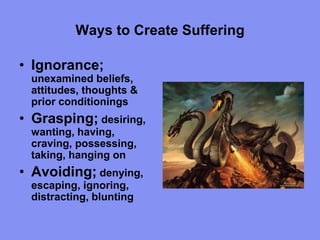
• Ignorance;
unexamined beliefs,
attitudes, thoughts &
prior conditionings
• Grasping; desiring,
wanting, having,
craving, possessing,
taking, hanging on
• Avoiding; denying,
escaping, ignoring,
distracting, blunting
Beliefs, Thoughts & Attitudes to Suffer By
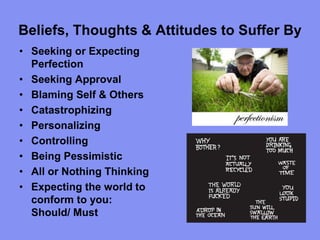
• Seeking or Expecting
Perfection
• Seeking Approval
• Blaming Self & Others
• Catastrophizing
• Personalizing
• Controlling
• Being Pessimistic
• All or Nothing Thinking
• Expecting the world to
conform to you:
Should/ Must
Mindfulness Practice
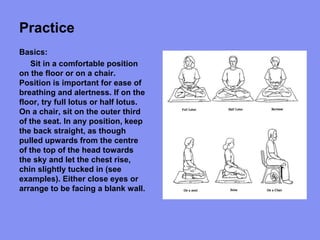
“The training of mental attention that
awakens us beyond the conditioned
mind and habitual thinking, and reveals
the nature of reality” TARA BRACH
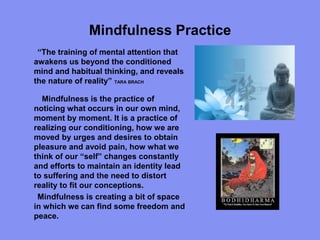
Mindfulness is the practice of
noticing what occurs in our own mind,
moment by moment. It is a practice of
realizing our conditioning, how we are
moved by urges and desires to obtain
pleasure and avoid pain, how what we
think of our “self” changes constantly
and efforts to maintain an identity lead
to suffering and the need to distort
reality to fit our conceptions.
Mindfulness is creating a bit of space
in which we can find some freedom and
peace.
Practice
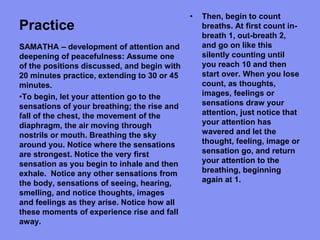
Basics:
Sit in a comfortable position
on the floor or on a chair.
Position is important for ease of
breathing and alertness. If on the
floor, try full lotus or half lotus.
On a chair, sit on the outer third
of the seat. In any position, keep
the back straight, as though
pulled upwards from the centre
of the top of the head towards
the sky and let the chest rise,
chin slightly tucked in (see
examples). Either close eyes or
arrange to be facing a blank wall.
Practice
• Then, begin to count
breaths. At first count in-
breath 1, out-breath 2,
and go on like this
silently counting until
you reach 10 and then
start over. When you lose
count, as thoughts,
images, feelings or
sensations draw your
attention, just notice that
your attention has
wavered and let the
thought, feeling, image or
sensation go, and return
your attention to the
breathing, beginning
again at 1.
SAMATHA – development of attention and
deepening of peacefulness: Assume one
of the positions discussed, and begin with
20 minutes practice, extending to 30 or 45
minutes.
•To begin, let your attention go to the
sensations of your breathing; the rise and
fall of the chest, the movement of the
diaphragm, the air moving through
nostrils or mouth. Breathing the sky
around you. Notice where the sensations
are strongest. Notice the very first
sensation as you begin to inhale and then
exhale. Notice any other sensations from
the body, sensations of seeing, hearing,
smelling, and notice thoughts, images
and feelings as they arise. Notice how all
these moments of experience rise and fall
away.
Practice
the rising and falling of
thoughts, feelings, images
or other provoking
sensations, and then you
can let these go and return
to the breath, all with a
sense of effortlessness,
then let go of the counting
and just attend to the
sensations of the breath
and notice whatever else
arises.
Shift from counting each inhalation
and exhalation separately and now
count “1” for each complete breath (in
and out), and count each breath until
10 and then start again.
It is expected that thoughts, images,
feelings, strong bodily sensations such
as pains or itches will arise as you
attend to your breathing, and for a
moment your mind will float away with
these. Practice means to notice these
driftings, over and over, and let them
go by returning to attending to the
breath sensations.
When you feel that you are able to
follow the breath sensations and notice
Practice
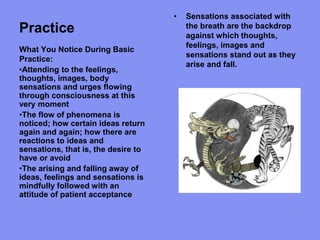
• Sensations associated with
the breath are the backdrop
against which thoughts,
feelings, images and
sensations stand out as they
arise and fall.
What You Notice During Basic
Practice:
•Attending to the feelings,
thoughts, images, body
sensations and urges flowing
through consciousness at this
very moment
•The flow of phenomena is
noticed; how certain ideas return
again and again; how there are
reactions to ideas and
sensations, that is, the desire to
have or avoid
•The arising and falling away of
ideas, feelings and sensations is
mindfully followed with an
attitude of patient acceptance
Practice
As you practice, naturally,
you begin to notice
aspects of experience that
are held to be universally
true:
Impermanence – thoughts,
images, feelings and
sensations are very fleeting;
they arise and fall away
rapidly no matter how you try
to grasp them. It requires a
kind of effort to bring an idea
or feeling back moment after
moment as when we ruminate,
make ourselves anxious or
depressed. We begin to see
how we cling to ideas and
objects, which leads to
suffering, as even when we
grab hold of something we
want, it begins to lose its
shine.
VIPASSANA – Is taking practice
further. Samatha leads to some
awareness of how our mind works, but
the main focus is on the breath and this
produces in itself a deepening calm as it
blocks ruminating about the future,
dwelling on the past, and fragmenting in
the present. Feelings of peacefulness is
the result.
Vipassana deliberately focuses on how
the mind works; on what it is doing
moment to moment; how thoughts and
images arise together and instantly give
rise to responses such as desire,
aversion or indifference; we notice
themes emerge in what arises, and the
sequence of thoughts and feelings.
Practice
they refer to real, enduring things, such as
“personality”, or a collection of traits,
values, attitudes, styles.
When these are noticed during practice,
they are seen to arise and fall like any
other type of idea, feeling, image. We
notice that we change how we feel about
things; what we want changes constantly;
attitudes, and values change; our view of
who we are changes. We have
contradictory feelings and beliefs.
We notice that we tell ourselves stories,
involving the people in our lives, the
situations we find ourselves in; we dream
about the future and lament the past; or
fear the future and idealize the past. We
have arguments with people who are not
here now, or who are deceased. All in the
name of trying to “find” ourselves, or to
“be something”. There is no something to
find or anything to be, other than what you
are.
Impermanence (cont) –
Everything changes, decays, falls
away and there is always
something new arising. We
become stuck seeing the world in
terms of our ideas about it;
language makes things seem
concrete. We believe that things
and feelings, people and
relationships are enduring,
whereas the reality is that
everything changes. There is
nothing to cling to, and the act of
clinging makes us ill, bit by bit or
dramatically (as in denial of loss).
No-self – the ideas and images we
form of our self may seem
substantial; may seem as though
Practice
As we practice, we begin to see
suffering arise in an instant, and we
learn that this same suffering will also
fade or fall away if we do not propagate
it by engaging in our usual reactions.
Mindfulness helps to give distance
between the stream of thoughts and
self-related issues and our response to
them. It is the beginning of a bit of
freedom.
Reactivity leads to suffering – just as
we have a continuous stream of
thoughts, images and feelings as we
engage in trying to grasp or avoid
things, or trying to build up our self-
image, we have reactions to all of
these mental states. We have
negative, positive or indifferent
responses. We experience longing,
anger, desire, envy, irritation, anxiety
or boredom. As we practice, we
begin to see that we respond so
automatically and thoughtlessly that
we experience all these forms of
suffering and then wonder why. Even
things that are positive and bring joy
can then lead to fear about losing the
source of the joy, actions to prevent
the loss and anguish when joy fades.
Practice
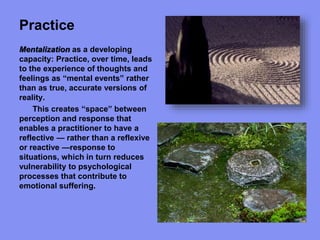
Mentalization as a developing
capacity: Practice, over time, leads
to the experience of thoughts and
feelings as “mental events” rather
than as true, accurate versions of
reality.
This creates “space” between
perception and response that
enables a practitioner to have a
reflective — rather than a reflexive
or reactive —response to
situations, which in turn reduces
vulnerability to psychological
processes that contribute to
emotional suffering.
Daily Mindfulness Practice
• Ritualize
Dedicated time and area
Quiet
Appropriate seating
Posture (position, legs, hands, head, eyes)
• Right Thinking
Alert; notice what arises
Open & Receptive; accept without judgment, resistance or grasping
• Natural Presence
Experience of this present moment
Being open to all that arises; body sensations, thoughts, images,
feelings & reactions, states of mind, and awareness itself
Benefits of Mindful Living
• Attention
• Awareness
• Awakening
• Responsibility
• Discernment
• Wisdom
• Peacefulness
• Health
The Method
Moving from sitting practice to spontaneous daily practice. Form
the intention to notice when you are not being mindful and when you
notice that you are not being mindful, bring your attention to your
breath and open to all the senses, and be mindful of thinking,
feelings, images, sounds, smells. When you encounter strong
negative experiences, practice the following method.
Pause
Breathe
Be Mindful (situation, problem, your response, how it is unfolding)
Discern
Open/Accept/Release/Live Through/Act
Opening
• Focus attention on the “problem”
(anxiety, thought, urge, images,
bodily pain)
• Then open around it by also
noticing sensations in your body
right Now.
• Notice your breathing Now,
sensations in chest, diaphragm,
feet, legs, hands, face Now; and
also notice sounds Now and what
you are seeing Now
• Stay with this until calm and the
problem is placed in the context of
your entire experience now.
Accepting
• Discomfort
• Obstacles
• Inconveniences
• Limitations
• Aging
• Loss
• Change
• Challenge to self-
image
Living Through
• Allow the feelings to flow
through you
• Neither grasp or avoid
• Stay with whatever emerges
while maintaining
mindfulness
• Grief
• Fear
• Hurt
Releasing
• Emotional closure
• Accepting finality
• Let go of grasping or
avoidance
• Allowing a reorganization of
the self (e.g. identity, esteem,
direction, relationships)
• Letting go of desire to have
something or someone return,
recapture, redo, erase, get
even, punish
Acting
• Intuitive vs. Impulsive
• Whole vs. Parts
• Knowing when to act
• Standing still
• Fear of acting
• Responsibility (for what?)
• Skillful vs. Unskillful
• Values
Mindfulness Practices
Western Variations
Body Scan
Mindfulness of Breath
Mindfulness of Thoughts & Feelings
Metta
Buddhist Traditions (examples)
Theravada – Anapansati, Jhana, Bramavihara, Vipassana
Tibetan – Guided (e.g. Hollow Body) Esoteric
Zen/Chan - Zazen
Mindfulness Practices
Western Variations
Body Scan
Mindfulness Practices
Western Variations
Mindfulness of Breath
Mindfulness Practices
Western Variations
Metta - Lovingkindness

Mindfulness Practice Manual

  • 1.
  • 2.
    Overview of Practice Inday to day life we are often caught up coping with tasks, dealing with difficulties and trying to find security and some form of happiness . We fail to realize how conditioned we have become, how we respond repetitively and unthinkingly to situations. We sleepwalk through routines and fail to see the things we see, fail to taste the food we eat or be present with others even when they are right in front of us. We become disconnected. Our experience becomes fragmented and so does our sense of self. Mindfulness practice seeks to restore wholeness, awareness of our moment to moment experience of life as it is; the pain, joy, sorrow and to deal with it directly, without hesitation. We do this by developing our inherent ability to simply know directly what we see, hear, touch and think; by developing the power of observation, of “being mindful”.
  • 3.
    Overview of Practice Mindfulnessis a 2500 year old practice intended to develop a deepening capacity to focus attention and to enhance awareness of the way the mind works. We have a great readiness to become caught up in external events and relationships or consumed with some type of desire, urge or sense of loss or poverty. We feel empty and try to find things to fill us, or we feel lost and try to find things to identify with, some interest, passion, compulsion; we try to lose ourselves to avoid the pain of feeling a kind of nothingness creeping into our experience. Some people gamble, others use drugs, alcohol, sex or food; some people consume material goods and are always after that next object, and never find the peace we crave.
  • 4.
    Mindfulness Defined Satipatthana isa Pali word suggesting mindful presence, which has been elaborated to include attending to immediate experience with care and discernment. A modern definition is: an awareness that arises through intentionally attending in an open, accepting, and discerning way to whatever is arising in the present moment.
  • 5.
    Why Practice Mindfulness Physicaland Emotional Pain is Inevitable in life but Suffering occurs when we get caught up with beliefs and attitudes that do not allow us to let go, accept, or take rational action. We learn socially and are conditioned by our avoidance of pain and pursuit of pleasure. We have biological urges and tendencies, and we think that we are in control, but we are not. We do not even know what we are going to think in the next moment. We form images of ourselves and live in relation to them. We become experts on suffering.
  • 6.
    Ways to CreateSuffering • Ignorance; unexamined beliefs, attitudes, thoughts & prior conditionings • Grasping; desiring, wanting, having, craving, possessing, taking, hanging on • Avoiding; denying, escaping, ignoring, distracting, blunting
  • 7.
    Beliefs, Thoughts &Attitudes to Suffer By • Seeking or Expecting Perfection • Seeking Approval • Blaming Self & Others • Catastrophizing • Personalizing • Controlling • Being Pessimistic • All or Nothing Thinking • Expecting the world to conform to you: Should/ Must
  • 8.
    Mindfulness Practice “The trainingof mental attention that awakens us beyond the conditioned mind and habitual thinking, and reveals the nature of reality” TARA BRACH Mindfulness is the practice of noticing what occurs in our own mind, moment by moment. It is a practice of realizing our conditioning, how we are moved by urges and desires to obtain pleasure and avoid pain, how what we think of our “self” changes constantly and efforts to maintain an identity lead to suffering and the need to distort reality to fit our conceptions. Mindfulness is creating a bit of space in which we can find some freedom and peace.
  • 9.
    Practice Basics: Sit in acomfortable position on the floor or on a chair. Position is important for ease of breathing and alertness. If on the floor, try full lotus or half lotus. On a chair, sit on the outer third of the seat. In any position, keep the back straight, as though pulled upwards from the centre of the top of the head towards the sky and let the chest rise, chin slightly tucked in (see examples). Either close eyes or arrange to be facing a blank wall.
  • 10.
    Practice • Then, beginto count breaths. At first count in- breath 1, out-breath 2, and go on like this silently counting until you reach 10 and then start over. When you lose count, as thoughts, images, feelings or sensations draw your attention, just notice that your attention has wavered and let the thought, feeling, image or sensation go, and return your attention to the breathing, beginning again at 1. SAMATHA – development of attention and deepening of peacefulness: Assume one of the positions discussed, and begin with 20 minutes practice, extending to 30 or 45 minutes. •To begin, let your attention go to the sensations of your breathing; the rise and fall of the chest, the movement of the diaphragm, the air moving through nostrils or mouth. Breathing the sky around you. Notice where the sensations are strongest. Notice the very first sensation as you begin to inhale and then exhale. Notice any other sensations from the body, sensations of seeing, hearing, smelling, and notice thoughts, images and feelings as they arise. Notice how all these moments of experience rise and fall away.
  • 11.
    Practice the rising andfalling of thoughts, feelings, images or other provoking sensations, and then you can let these go and return to the breath, all with a sense of effortlessness, then let go of the counting and just attend to the sensations of the breath and notice whatever else arises. Shift from counting each inhalation and exhalation separately and now count “1” for each complete breath (in and out), and count each breath until 10 and then start again. It is expected that thoughts, images, feelings, strong bodily sensations such as pains or itches will arise as you attend to your breathing, and for a moment your mind will float away with these. Practice means to notice these driftings, over and over, and let them go by returning to attending to the breath sensations. When you feel that you are able to follow the breath sensations and notice
  • 12.
    Practice • Sensations associatedwith the breath are the backdrop against which thoughts, feelings, images and sensations stand out as they arise and fall. What You Notice During Basic Practice: •Attending to the feelings, thoughts, images, body sensations and urges flowing through consciousness at this very moment •The flow of phenomena is noticed; how certain ideas return again and again; how there are reactions to ideas and sensations, that is, the desire to have or avoid •The arising and falling away of ideas, feelings and sensations is mindfully followed with an attitude of patient acceptance
  • 13.
    Practice As you practice,naturally, you begin to notice aspects of experience that are held to be universally true: Impermanence – thoughts, images, feelings and sensations are very fleeting; they arise and fall away rapidly no matter how you try to grasp them. It requires a kind of effort to bring an idea or feeling back moment after moment as when we ruminate, make ourselves anxious or depressed. We begin to see how we cling to ideas and objects, which leads to suffering, as even when we grab hold of something we want, it begins to lose its shine. VIPASSANA – Is taking practice further. Samatha leads to some awareness of how our mind works, but the main focus is on the breath and this produces in itself a deepening calm as it blocks ruminating about the future, dwelling on the past, and fragmenting in the present. Feelings of peacefulness is the result. Vipassana deliberately focuses on how the mind works; on what it is doing moment to moment; how thoughts and images arise together and instantly give rise to responses such as desire, aversion or indifference; we notice themes emerge in what arises, and the sequence of thoughts and feelings.
  • 14.
    Practice they refer toreal, enduring things, such as “personality”, or a collection of traits, values, attitudes, styles. When these are noticed during practice, they are seen to arise and fall like any other type of idea, feeling, image. We notice that we change how we feel about things; what we want changes constantly; attitudes, and values change; our view of who we are changes. We have contradictory feelings and beliefs. We notice that we tell ourselves stories, involving the people in our lives, the situations we find ourselves in; we dream about the future and lament the past; or fear the future and idealize the past. We have arguments with people who are not here now, or who are deceased. All in the name of trying to “find” ourselves, or to “be something”. There is no something to find or anything to be, other than what you are. Impermanence (cont) – Everything changes, decays, falls away and there is always something new arising. We become stuck seeing the world in terms of our ideas about it; language makes things seem concrete. We believe that things and feelings, people and relationships are enduring, whereas the reality is that everything changes. There is nothing to cling to, and the act of clinging makes us ill, bit by bit or dramatically (as in denial of loss). No-self – the ideas and images we form of our self may seem substantial; may seem as though
  • 15.
    Practice As we practice,we begin to see suffering arise in an instant, and we learn that this same suffering will also fade or fall away if we do not propagate it by engaging in our usual reactions. Mindfulness helps to give distance between the stream of thoughts and self-related issues and our response to them. It is the beginning of a bit of freedom. Reactivity leads to suffering – just as we have a continuous stream of thoughts, images and feelings as we engage in trying to grasp or avoid things, or trying to build up our self- image, we have reactions to all of these mental states. We have negative, positive or indifferent responses. We experience longing, anger, desire, envy, irritation, anxiety or boredom. As we practice, we begin to see that we respond so automatically and thoughtlessly that we experience all these forms of suffering and then wonder why. Even things that are positive and bring joy can then lead to fear about losing the source of the joy, actions to prevent the loss and anguish when joy fades.
  • 16.
    Practice Mentalization as adeveloping capacity: Practice, over time, leads to the experience of thoughts and feelings as “mental events” rather than as true, accurate versions of reality. This creates “space” between perception and response that enables a practitioner to have a reflective — rather than a reflexive or reactive —response to situations, which in turn reduces vulnerability to psychological processes that contribute to emotional suffering.
  • 17.
    Daily Mindfulness Practice •Ritualize Dedicated time and area Quiet Appropriate seating Posture (position, legs, hands, head, eyes) • Right Thinking Alert; notice what arises Open & Receptive; accept without judgment, resistance or grasping • Natural Presence Experience of this present moment Being open to all that arises; body sensations, thoughts, images, feelings & reactions, states of mind, and awareness itself
  • 18.
    Benefits of MindfulLiving • Attention • Awareness • Awakening • Responsibility • Discernment • Wisdom • Peacefulness • Health
  • 19.
    The Method Moving fromsitting practice to spontaneous daily practice. Form the intention to notice when you are not being mindful and when you notice that you are not being mindful, bring your attention to your breath and open to all the senses, and be mindful of thinking, feelings, images, sounds, smells. When you encounter strong negative experiences, practice the following method. Pause Breathe Be Mindful (situation, problem, your response, how it is unfolding) Discern Open/Accept/Release/Live Through/Act
  • 20.
    Opening • Focus attentionon the “problem” (anxiety, thought, urge, images, bodily pain) • Then open around it by also noticing sensations in your body right Now. • Notice your breathing Now, sensations in chest, diaphragm, feet, legs, hands, face Now; and also notice sounds Now and what you are seeing Now • Stay with this until calm and the problem is placed in the context of your entire experience now.
  • 21.
    Accepting • Discomfort • Obstacles •Inconveniences • Limitations • Aging • Loss • Change • Challenge to self- image
  • 22.
    Living Through • Allowthe feelings to flow through you • Neither grasp or avoid • Stay with whatever emerges while maintaining mindfulness • Grief • Fear • Hurt
  • 23.
    Releasing • Emotional closure •Accepting finality • Let go of grasping or avoidance • Allowing a reorganization of the self (e.g. identity, esteem, direction, relationships) • Letting go of desire to have something or someone return, recapture, redo, erase, get even, punish
  • 24.
    Acting • Intuitive vs.Impulsive • Whole vs. Parts • Knowing when to act • Standing still • Fear of acting • Responsibility (for what?) • Skillful vs. Unskillful • Values
  • 25.
    Mindfulness Practices Western Variations BodyScan Mindfulness of Breath Mindfulness of Thoughts & Feelings Metta Buddhist Traditions (examples) Theravada – Anapansati, Jhana, Bramavihara, Vipassana Tibetan – Guided (e.g. Hollow Body) Esoteric Zen/Chan - Zazen
  • 26.
  • 27.
  • 28.