Social Emotional Learning:  From Theory to Action Children’s Home + Aid Community Schools Program Training designed by Peace Games, Inc. www.peacegames.org
Goals & Expectations (re-)introduce the concept of social emotional learning and why it matters explore the key components of a program that integrates SEL identify resources available to us as we begin a new school year … all in a way that is practical, experiential, and fun
What is Social Emotional Learning? According to the Collaborative for Academic Social and Emotional Learning (CASEL),  SEL is… “the process of developing the ability to recognize and manage emotions, develop caring and concern for others, make responsible decisions, establish positive relationships, and handle challenging situations effectively”
What is the purpose of a school? TO TEACH haiku sight words photosynthesis the Civil War Shakespeare the Pythagorean Theorem multiplying fractions subject-verb agreement conjugating Latin verbs trigonometry dinosaurs Ancient Egypt semi-colons chiaroscuro Bacon’s Rebellion iambic pentameter diagramming sentences topic sentences proper citation the Law of Gravity the plu-perfect tense the Periodic Table noble gasses supply & demand the capital of Illinois cumulonimbus clouds counting by 5’s the metric system long division how to write your name to walk in a straight line  E=mc 2 vowels fractions the Bill of Rights the “I Have a Dream” speech the Underground Railroad the Trail of Tears 1492 1776 Brown v. Board of Education colors shapes five paragraph essays world religions SELF-AWARENESS SOCIAL AWARENESS RESPONSIBLE DECISION MAKING SELF-MANAGEMENT RELATIONSHIP SKILLS
SEL & Academic Achievement: Can we really have  both ?
What difference does SEL make? In an analysis of more than 700 school-based SEL programs, involving more than 288,000 students, researchers at CASEL measured outcomes in six areas: Social and emotional skills Attitudes toward self, others, and school Positive social behaviors Conduct problems Emotional distress Academic performance
What difference does SEL make? Make A Prediction!
What difference does SEL make? 23 9 9 9 10 11 Social-emotional skills Attitudes  Positive social behavior   Conduct problems   Emotional distress   Academic performance Outcomes Percentile  Improvement from, “The Benefits of School-Based Social and Emotional Learning Programs” (CASEL, 2007)
SEL in Illinois Illinois is currently the  only  state to include SEL in its statewide learning standards. 3 broad  goals  that organize the knowledge and skills of SEL 10  learning standards  that outline specific knowledge and skills In each grade cluster, developmentally-appropriate  benchmarks  that highlight specific features to emphasize – and that can be taught in  integrated ways from the Illinois State Board of Education; http://www.isbe.state.il.us/ils/social_emotional/standards.htm
SEL in Illinois The three SEL Goals mirror core SEL skills identified by researchers at CASEL: To develop  self-awareness  and  self-management  skills to achieve school and life success To use  social-awareness  and interpersonal skills to establish and maintain  positive relationships To demonstrate  decision-making  skills and responsible behaviors in personal, school, and community contexts from the Illinois State Board of Education; http://www.isbe.state.il.us/ils/social_emotional/standards.htm
SEL In Action? But schools are chaotic places – and there is a lot to do each day.  How can we make room to meet SEL goals, too?
SEL In Action! AGENDA Creating a climate The role of an instructor Resources for success
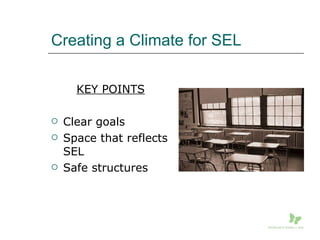
Creating a Climate for SEL KEY POINTS Clear goals Space that reflects SEL Safe structures
Activity: Magic Quilt Your vision for a school that supports and embodies SEL: What does it look like?  What words describe it?
Clarify your SEL goals What are the two or three most important SEL goals that you have for your students? TURN & TALK!
Clarify your SEL goals Each SEL skill is important, but they cannot all be taught effectively at the same time and some may be more critical than others for any specific group. Be sensitive to the fact that focus may change depending on groupings, times of day, recent events Poll other people – parents, colleagues, administrators, teachers – about what they see Listen to children, too; what’s important to  them ?
Safe Structures Classroom Management Proactive Focus on clear expectations Safety Discipline Reactive Focus on clear consequences Fairness Both classroom management  and  discipline are critical for creating a climate for SEL
Prevention First Expectations should be clear specific and descriptive, developed  with  children, posted in a visible place Teach and model behaviors you want to see before problems arise, role plays, practice Rituals and routines help quiet signals, time out space, ways to leave or rejoin the group Have ways to “save face” and avoid power struggles defusing tension, non-public criticism, validating conflict Create activities likely to succeed well planned, good for multiple learning styles, fun
Game!
The Role of the Instructor KEY POINTS The “decisive element” Multiple roles Supportive relationships
Teachers and a Climate for SEL “ I’ve come to the frightening conclusion that  I am the decisive element in the classroom .  It is my personal approach that creates the climate.  It’s my daily mood that makes the weather.  As a teacher, I possess tremendous power to make a child’s life miserable or joyous.  I can be a tool of torture or an instrument of inspiration.  I can humiliate or humor, hurt or heal.  In all situations, it is my response that decides whether a crisis will be escalated or de-escalated, and a child humanized or dehumanized… I do make a difference.” - Chaim Ginott, teacher and psychologist
The Roles of an Instructor Cop sets limits keeps people safe holds people accountable Friend cares for their students supports their decisions listens without judgment Mentor spends some extra time models motivates & encourages Teacher plans engaging lessons corrects mistakes assesses progress
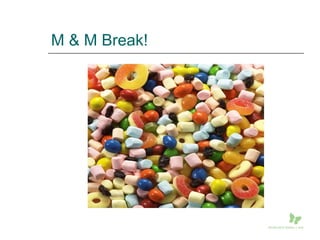
M & M Break!
M & M Break! RED Think of a discouraging teacher you had growing up.  Share one thing that teacher did that was discouraging to you. GREEN Think of an encouraging teacher you had growing up.  Share one thing that teacher did that was encouraging. ORANGE Think of one child you are dealing with now that could use encouragement.  Briefly share why. YELLOW Share an encouraging statement with a member of your group. BROWN   or  BLUE Pass
A Thought to Ponder Research shows: The main predictor of achievement is a child’s perception of,  “Does the teacher like me?” Robert Rosenthal & Lenore Jackson,  Pygmalion in the Classroom , 1968
Break and Game
Resources for Success KEY POINTS Everyday Peacemaking Lesson Planning 101 “ Lesson Logs”
Everyday Peacemaking Highlights An overview of SEL Activities by grade and activity type Activities for multiple learning styles Teaching tips Appendices Search by activity name or skills taught
Everyday Peacemaking : Scavenger Hunt
Lesson Planning 101 Purpose: what you want students to learn Outcomes and Indicators: how you know whether or not they’ve learned it
Lesson Planning 101 Think ahead – about skills you want to teach and what resources you have Sketch an outline; don’t write a script Be flexible (by having a back-up plan in your back pocket) Assess your successes and shortcomings
A Space for SEL in Afterschool An  Afterschool Peace Club  can create a structured space for SEL activities and community building Clarify goals Design structure and sequence Plan lessons
Putting It All Together Choose one of the five SEL skills identified by CASEL: Self-awareness Social awareness Self-management Relationship skills Responsible decision making Using the Resource Book, sketch out  five lessons  that focus on teaching this skill. Focus on: Goals/objectives Outcomes Focus activities Ways to measure success
Hang onto Those Innovations!
A Final Game for the Journey
Teachable Moments: A Final Thought Opportunities to teach SEL happen  everyday .  Be on the lookout for them and use them. Good luck!

Social Emotional Learning In Action

  • 1.
    Social Emotional Learning: From Theory to Action Children’s Home + Aid Community Schools Program Training designed by Peace Games, Inc. www.peacegames.org
  • 2.
    Goals & Expectations(re-)introduce the concept of social emotional learning and why it matters explore the key components of a program that integrates SEL identify resources available to us as we begin a new school year … all in a way that is practical, experiential, and fun
  • 3.
    What is SocialEmotional Learning? According to the Collaborative for Academic Social and Emotional Learning (CASEL), SEL is… “the process of developing the ability to recognize and manage emotions, develop caring and concern for others, make responsible decisions, establish positive relationships, and handle challenging situations effectively”
  • 4.
    What is thepurpose of a school? TO TEACH haiku sight words photosynthesis the Civil War Shakespeare the Pythagorean Theorem multiplying fractions subject-verb agreement conjugating Latin verbs trigonometry dinosaurs Ancient Egypt semi-colons chiaroscuro Bacon’s Rebellion iambic pentameter diagramming sentences topic sentences proper citation the Law of Gravity the plu-perfect tense the Periodic Table noble gasses supply & demand the capital of Illinois cumulonimbus clouds counting by 5’s the metric system long division how to write your name to walk in a straight line  E=mc 2 vowels fractions the Bill of Rights the “I Have a Dream” speech the Underground Railroad the Trail of Tears 1492 1776 Brown v. Board of Education colors shapes five paragraph essays world religions SELF-AWARENESS SOCIAL AWARENESS RESPONSIBLE DECISION MAKING SELF-MANAGEMENT RELATIONSHIP SKILLS
  • 5.
    SEL & AcademicAchievement: Can we really have both ?
  • 6.
    What difference doesSEL make? In an analysis of more than 700 school-based SEL programs, involving more than 288,000 students, researchers at CASEL measured outcomes in six areas: Social and emotional skills Attitudes toward self, others, and school Positive social behaviors Conduct problems Emotional distress Academic performance
  • 7.
    What difference doesSEL make? Make A Prediction!
  • 8.
    What difference doesSEL make? 23 9 9 9 10 11 Social-emotional skills Attitudes Positive social behavior Conduct problems Emotional distress Academic performance Outcomes Percentile Improvement from, “The Benefits of School-Based Social and Emotional Learning Programs” (CASEL, 2007)
  • 9.
    SEL in IllinoisIllinois is currently the only state to include SEL in its statewide learning standards. 3 broad goals that organize the knowledge and skills of SEL 10 learning standards that outline specific knowledge and skills In each grade cluster, developmentally-appropriate benchmarks that highlight specific features to emphasize – and that can be taught in integrated ways from the Illinois State Board of Education; http://www.isbe.state.il.us/ils/social_emotional/standards.htm
  • 10.
    SEL in IllinoisThe three SEL Goals mirror core SEL skills identified by researchers at CASEL: To develop self-awareness and self-management skills to achieve school and life success To use social-awareness and interpersonal skills to establish and maintain positive relationships To demonstrate decision-making skills and responsible behaviors in personal, school, and community contexts from the Illinois State Board of Education; http://www.isbe.state.il.us/ils/social_emotional/standards.htm
  • 11.
    SEL In Action?But schools are chaotic places – and there is a lot to do each day. How can we make room to meet SEL goals, too?
  • 12.
    SEL In Action!AGENDA Creating a climate The role of an instructor Resources for success
  • 13.
    Creating a Climatefor SEL KEY POINTS Clear goals Space that reflects SEL Safe structures
  • 14.
    Activity: Magic QuiltYour vision for a school that supports and embodies SEL: What does it look like? What words describe it?
  • 15.
    Clarify your SELgoals What are the two or three most important SEL goals that you have for your students? TURN & TALK!
  • 16.
    Clarify your SELgoals Each SEL skill is important, but they cannot all be taught effectively at the same time and some may be more critical than others for any specific group. Be sensitive to the fact that focus may change depending on groupings, times of day, recent events Poll other people – parents, colleagues, administrators, teachers – about what they see Listen to children, too; what’s important to them ?
  • 17.
    Safe Structures ClassroomManagement Proactive Focus on clear expectations Safety Discipline Reactive Focus on clear consequences Fairness Both classroom management and discipline are critical for creating a climate for SEL
  • 18.
    Prevention First Expectationsshould be clear specific and descriptive, developed with children, posted in a visible place Teach and model behaviors you want to see before problems arise, role plays, practice Rituals and routines help quiet signals, time out space, ways to leave or rejoin the group Have ways to “save face” and avoid power struggles defusing tension, non-public criticism, validating conflict Create activities likely to succeed well planned, good for multiple learning styles, fun
  • 19.
  • 20.
    The Role ofthe Instructor KEY POINTS The “decisive element” Multiple roles Supportive relationships
  • 21.
    Teachers and aClimate for SEL “ I’ve come to the frightening conclusion that I am the decisive element in the classroom . It is my personal approach that creates the climate. It’s my daily mood that makes the weather. As a teacher, I possess tremendous power to make a child’s life miserable or joyous. I can be a tool of torture or an instrument of inspiration. I can humiliate or humor, hurt or heal. In all situations, it is my response that decides whether a crisis will be escalated or de-escalated, and a child humanized or dehumanized… I do make a difference.” - Chaim Ginott, teacher and psychologist
  • 22.
    The Roles ofan Instructor Cop sets limits keeps people safe holds people accountable Friend cares for their students supports their decisions listens without judgment Mentor spends some extra time models motivates & encourages Teacher plans engaging lessons corrects mistakes assesses progress
  • 23.
    M & MBreak!
  • 24.
    M & MBreak! RED Think of a discouraging teacher you had growing up. Share one thing that teacher did that was discouraging to you. GREEN Think of an encouraging teacher you had growing up. Share one thing that teacher did that was encouraging. ORANGE Think of one child you are dealing with now that could use encouragement. Briefly share why. YELLOW Share an encouraging statement with a member of your group. BROWN or BLUE Pass
  • 25.
    A Thought toPonder Research shows: The main predictor of achievement is a child’s perception of, “Does the teacher like me?” Robert Rosenthal & Lenore Jackson, Pygmalion in the Classroom , 1968
  • 26.
  • 27.
    Resources for SuccessKEY POINTS Everyday Peacemaking Lesson Planning 101 “ Lesson Logs”
  • 28.
    Everyday Peacemaking HighlightsAn overview of SEL Activities by grade and activity type Activities for multiple learning styles Teaching tips Appendices Search by activity name or skills taught
  • 29.
    Everyday Peacemaking :Scavenger Hunt
  • 30.
    Lesson Planning 101Purpose: what you want students to learn Outcomes and Indicators: how you know whether or not they’ve learned it
  • 31.
    Lesson Planning 101Think ahead – about skills you want to teach and what resources you have Sketch an outline; don’t write a script Be flexible (by having a back-up plan in your back pocket) Assess your successes and shortcomings
  • 32.
    A Space forSEL in Afterschool An Afterschool Peace Club can create a structured space for SEL activities and community building Clarify goals Design structure and sequence Plan lessons
  • 33.
    Putting It AllTogether Choose one of the five SEL skills identified by CASEL: Self-awareness Social awareness Self-management Relationship skills Responsible decision making Using the Resource Book, sketch out five lessons that focus on teaching this skill. Focus on: Goals/objectives Outcomes Focus activities Ways to measure success
  • 34.
    Hang onto ThoseInnovations!
  • 35.
    A Final Gamefor the Journey
  • 36.
    Teachable Moments: AFinal Thought Opportunities to teach SEL happen everyday . Be on the lookout for them and use them. Good luck!

Editor's Notes

  • #2 Welcome, introduce trainers, & opening ritual (with debrief), p. 19 Depending on the size of the group: weather report (small group) or stand up sit down (large group)
  • #3 Go over goals for the training Ask participants what else they hope to leave with – or any questions that they want answered
  • #4 A review and shared language Read aloud – or have someone volunteer to read aloud Point out that when people think about SEL, there may be many skills or qualities that come to mind (compassion, conflict management, trust, empathy, friendship, problem solving, etc.), but that these offer a good umbrella that encompasses a wide range without being too broad
  • #5 Let’s take a step back and think about schools – and their purpose It’s multi-faceted for sure, but most would agree that at least one primary function is – “to teach” But to teach what? Click to reveal a cascade of topics that students are responsible for during the course of their schooling – and which, by extension, teachers are responsible for teaching Ask, how it feels to look at this list? What’s missing? What else did you learn? What, if anything, did you fail to learn in school? What does it say about the job of schools and teachers? Add on top of all of these things, one at a time and slowly: Self-awareness, self-management, social awareness, responsible decision making, relationship skills
  • #6 Seems like a lot, doesn’t it? Something seems bound to get lost: if we focus too much on SEL, won’t academic performance suffer?
  • #7 Explain that this study was a “meta-analysis” – a review of over 200 research studies Each study had to examine programs during the school day, with a key focus on social and emotional development In addition, interventions studied involved students from 5-18 years old with no ‘at risk’ designation; each study had a control group to measure change; and data was collected on at least one of these six outcome areas
  • #8 Have participants turn to a partner or small group of 3 Good teachers ask their students to try to predict outcomes as a way to assess their current thinking and to observe how it changes. We shouldn’t ask students to do something that we wouldn’t do ourselves…!
  • #9 Before revealing answers, ask groups to think about the following question: Which of the following outcome areas saw improvement? Which saw the most improvement? Why? Ask groups to share their predictions Reveal the outcomes and compare predictions Emphasize academic improvement and its implications: although SEL interventions required time in an academic schedule, they did NOT detract from academic performance; in fact, students in SEL programs scored 11 percent HIGHER on standardized achievement tests Ask, does this surprise you? Why or why not?
  • #10 Given not only that SEL helps classrooms and schools become more peaceful but also that it can improve academic performance, it makes sense to treat SEL with the same deference we give to other academic subject areas Learning standards help educators define what students should learn and measure how well they’ve learned it Currently, Illinois is the only state to do this: with a structure that combines the theoretical with specifics
  • #11 Briefly read aloud – and note the integration of CASEL skills and IL standards
  • #12 And yet… Just because it’s a good idea to teach SEL doesn’t mean we all know where to begin. The whole prospect has some people scratching their heads
  • #15 Ask people to think about a school that embodies SEL: What, specifically, does it look like? What would a person see there? How are people interacting? Rather than describe it, ask people to draw it – or color it or write words that describe it. Pass out blank pieces of paper, crayons, markers and have people work on it. Encourage people to work together, if they want. When people are finished, have them paste their drawing onto a piece of construction paper of their choice. Have one facilitator assemble panels into a paper quilt (or, if there’s time, do it collaboratively). (See Everyday Peacemaking , p. 53)
  • #16 Have people ‘turn & talk’ to their neighbor for two minutes about which SEL skills are most important for their students. Each are important, but they cannot all be taught at the same time. Invite 2-3 groups to share
  • #17 Before teaching, know what you’re teaching and why Understand your constituency
  • #18 Ask, what is the difference between ‘classroom management’ and ‘discipline’? Summarize differences, acknowledging any additional distinctions made by participants Explain that good planning and management is just as important as being able to respond swiftly and fairly
  • #19 Maybe this as a handout instead of a slide , depending on time and the experience of the group being trained
  • #22 Read the quote aloud and ask people to follow along (aloud or silently) Emphasize: The most important element in teaching SEL to students is not the poster on the wall, the curriculum binder, or the books on the shelf: it’s the TEACHER Figuring out what kind of teacher to be and how to uphold that model matters most, but it’s not just a matter of willing ourselves to be good teachers; it takes deliberation and practice
  • #23 Despite what we said about the purpose of school, being a teacher means more than just teaching Remember to keep a balance of multiple roles: Without being a cop, you cannot teach effectively; being too good of a friend makes a lousy cop; etc.
  • #24 Focus on: Encouragement Split into groups of 3-5 – and have a bowl of M&M’s or similarly-colored candy for each group
  • #25 In groups, have each person take turns; when it is your turn, take ONE piece of candy and respond to the statement it represents When it is not your turn, your only job is to listen to the person speaking Model once for the group and then give groups 10-15 minutes Debrief: How easy or hard was this activity? How did it feel to remember people who encouraged or discouraged you? Was one easier than the other? Why?
  • #26 Planning good lessons shows respect for your students – and that you care about them Likewise, spending extra time with them, supporting their decisions, and keeping the class safe demonstrates caring and support Being an effective teacher – especially one that integrates SEL – all comes back to building supportive and caring relationships
  • #27 10 minute stretch & “bio” break 10-15 minute game (Frozen Beanbag Challenge, p. 30), with debrief
  • #28 Now, about that planning
  • #29 A resource book for integrating SEL Pass out books to review Briefly highlight how the book is organized – table of contents (activity types and grade clusters), the introduction (SEL overview and learning styles), a sample activity (learning styles, teaching tips), additional resources (appendices) Explain that we’re going to spend a little time getting to know the book better before using it
  • #30 Put people in pairs and hand out Scavenger Hunt handouts Allow each pair one hint on a square of their choosing, – and if you want, allow groups to collaborate for the last three minutes After 15 minutes, go over the answers and get feedback on what they found in the book What did people see that they liked? That they had questions about? That they want to go back and read in more detail?
  • #33 Have people turn to Appendix B (p. 125) and review key points about creating a Peace Club, applying the general guidelines to specific plans related to your site
  • #34 In small groups or pairs: Practice putting together activities around a theme and outlining lessons, using CASEL skills as a focus Explain that including clear and specific goals, debriefing questions, and assessment measures will help Circulate around the group and offer advice and help, encouraging innovation or additional activities that may not appear in the book Give groups 15-20 minutes (or more if needed) Share – and after each group shares, ask the rest of the groups to offer feedback: What did you like that you heard? What would you suggest to make it better?
  • #35 Thank groups for sharing their sequences and their lessons Introduce the Lesson Logs or “Treasure Chest” for this year by handing out Innovation Forms: Legacies matter. No need to recreate new lessons each year, but take 5-10 minutes to share what you did in a way that may help someone else lead it
  • #36 Lead “Safe Crossing” (p. 38) Debrief: It may seem like we’re working in isolation, but we need collaboration and creative problem solving to reimagine our programs from this new perspective and to create programs that support children as leaders and peacemakers
  • #37 Thanks and hand out evaluation