

Reham Marzouk
Institute of Graduate Studies & Research
Human Computer Interaction
Course Code: 1404811
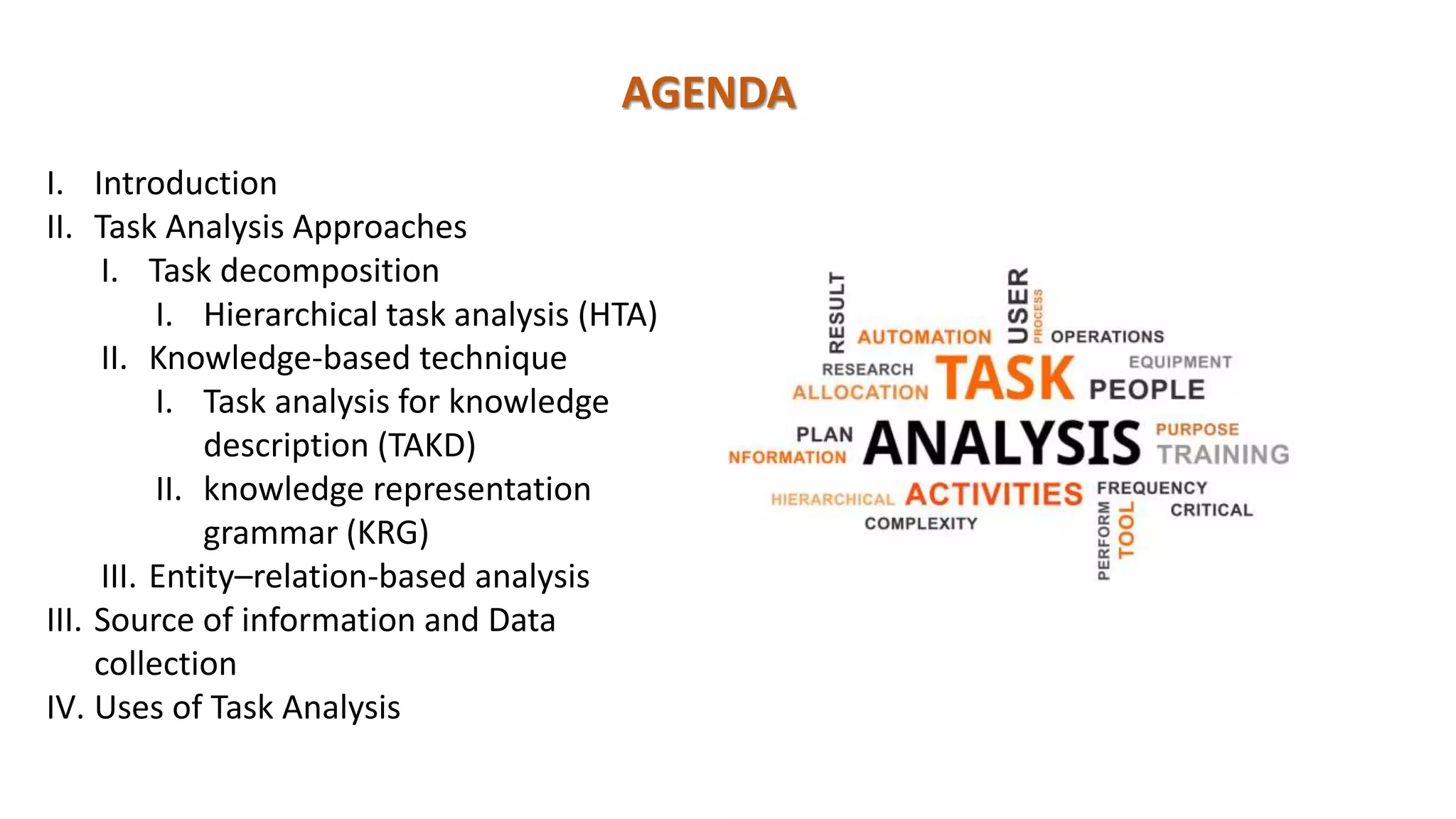
AGENDA
I. Introduction
II. Task Analysis Approaches
I. Task decomposition
I. Hierarchical task analysis (HTA)
II. Knowledge-based technique
I. Task analysis for knowledge
description (TAKD)
II. knowledge representation
grammar (KRG)
III. Entity–relation-based analysis
III. Source of information and Data
collection
IV. Uses of Task Analysis
What’s Task analysis
Task analysis is the process of analyzing the way people
perform their jobs: the things they do, the things they act
on and the things they need to know.
One of the purposes of task analysis is
to help in the production of training
materials and documentation. For this
purpose, analysis of existing systems is
sufficient
Task analysis is about existing systems
and procedures; its main tools are those
of observation in various forms
What are the aims of Task Analysis
 Verifies that the set of actions employed by the
user does accomplish the task
 Used to predict the time taken to learn a new task
and become a proficient user of the particular
application
 Used to predict the time taken for a proficient user
to accomplish the set task
 To improve the delivery of information to the user
Scope of Task analysis
 Unlike goal-oriented models that understand the
internal cognitive processes.
 Look more at the observable behavior of users
than their internal mental state.
 Restricted to precisely this objective observable
behavior.
 You should be interested in what, not why.
 Include some inferences about the user’s internal
goals.
Task Analysis
Approaches
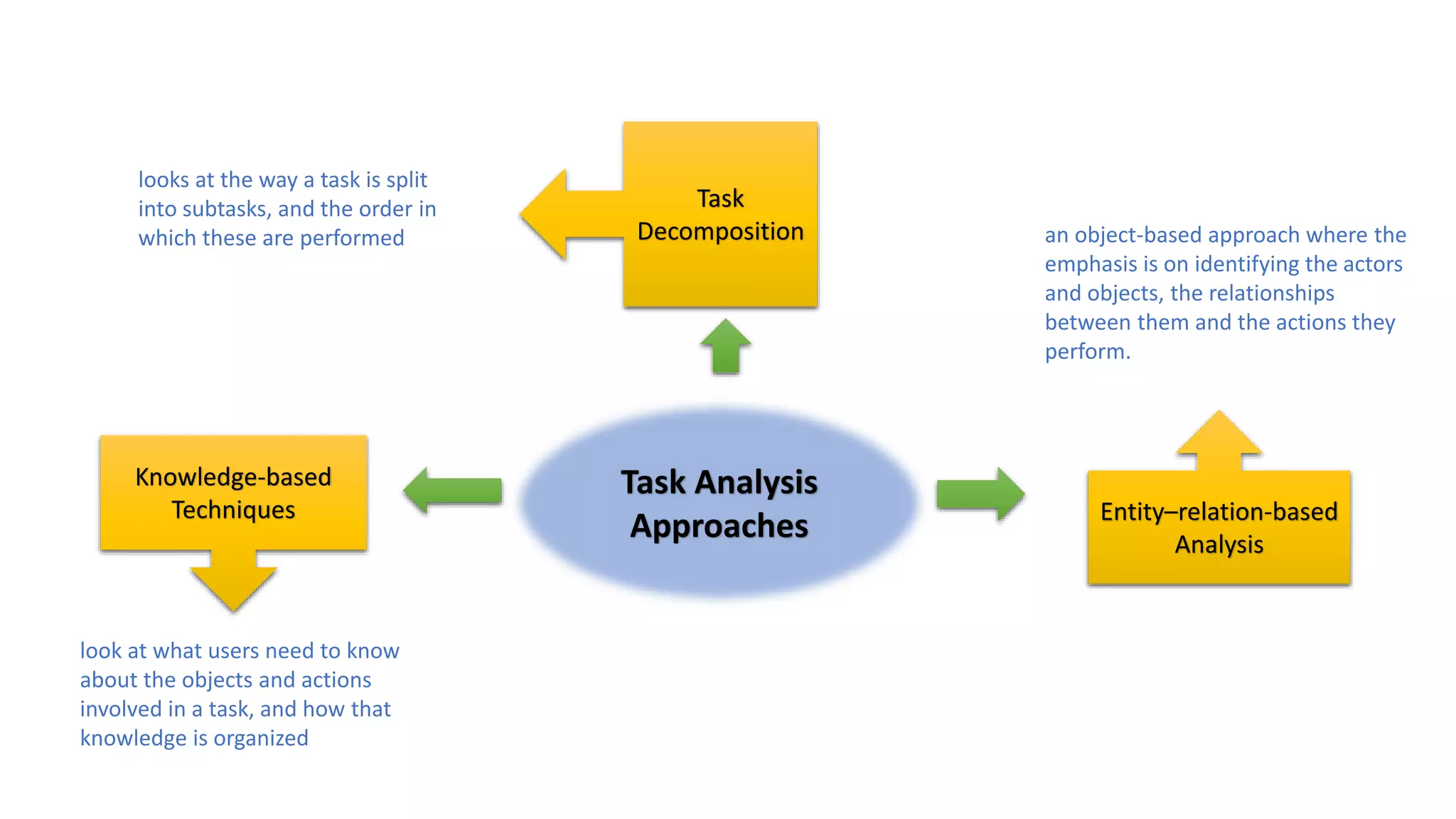
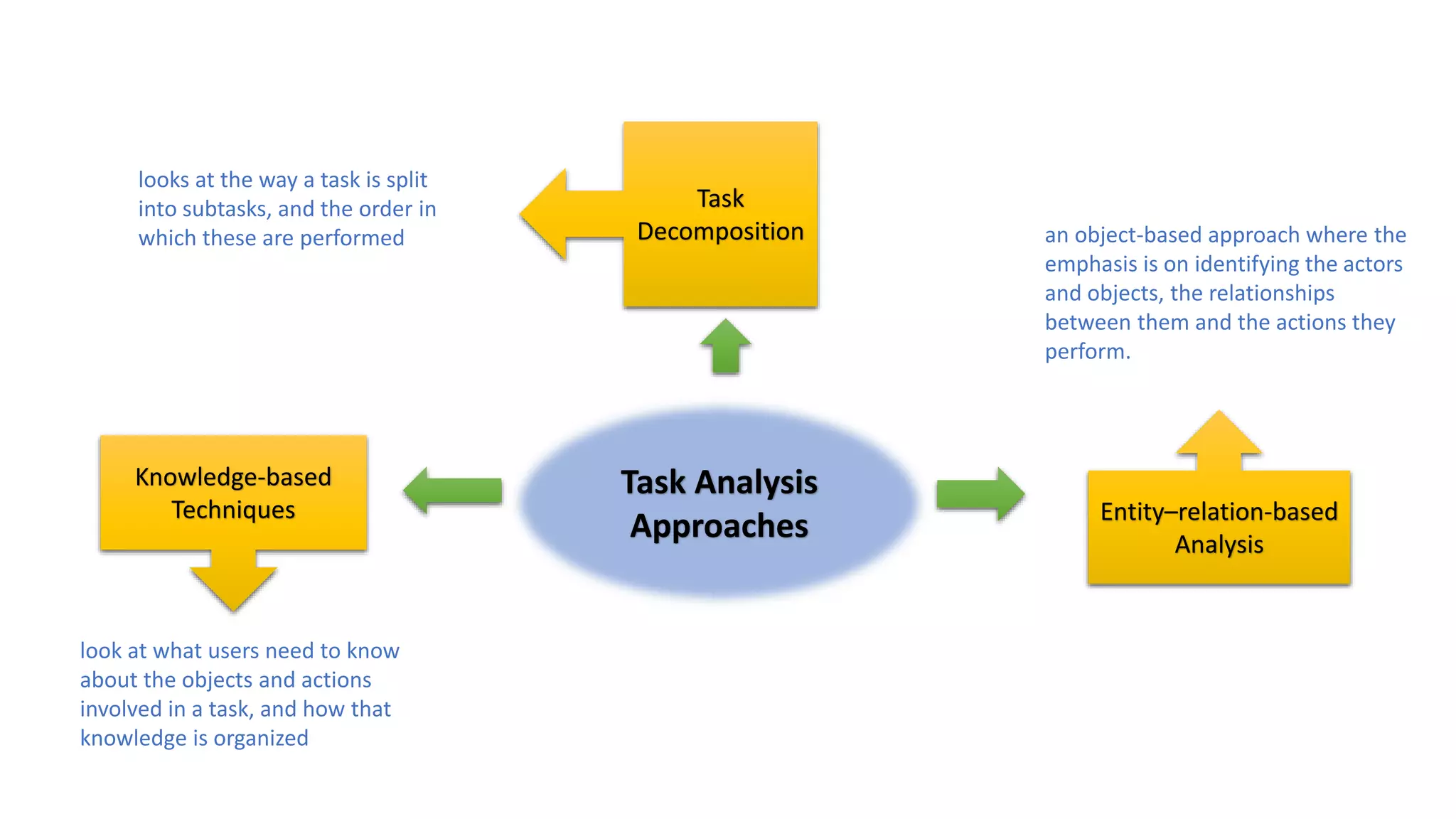
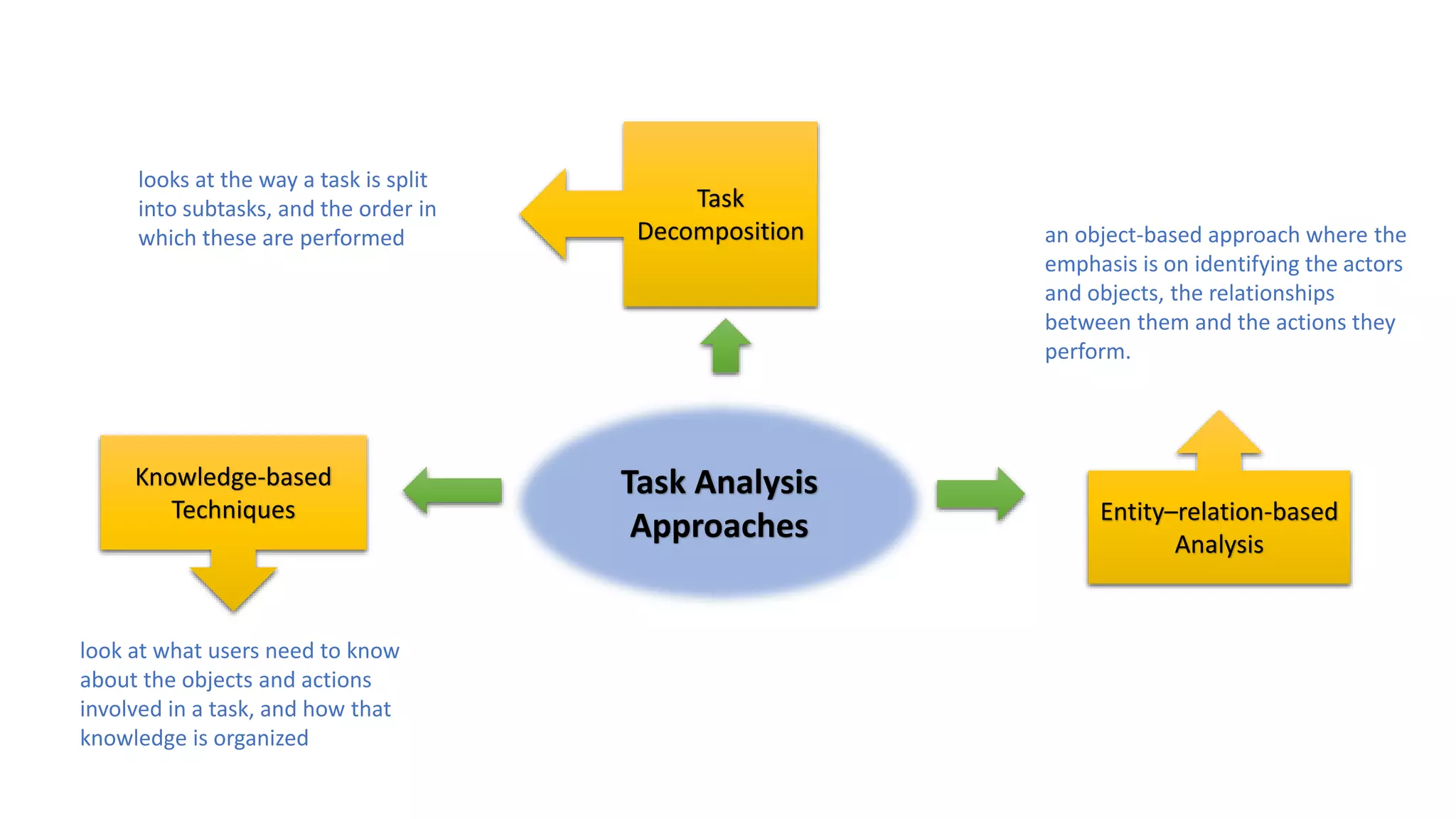
looks at the way a task is split
into subtasks, and the order in
which these are performed
look at what users need to know
about the objects and actions
involved in a task, and how that
knowledge is organized
an object-based approach where the
emphasis is on identifying the actors
and objects, the relationships
between them and the actions they
perform.
Entity–relation-based
Analysis
Knowledge-based
Techniques
Task
Decomposition
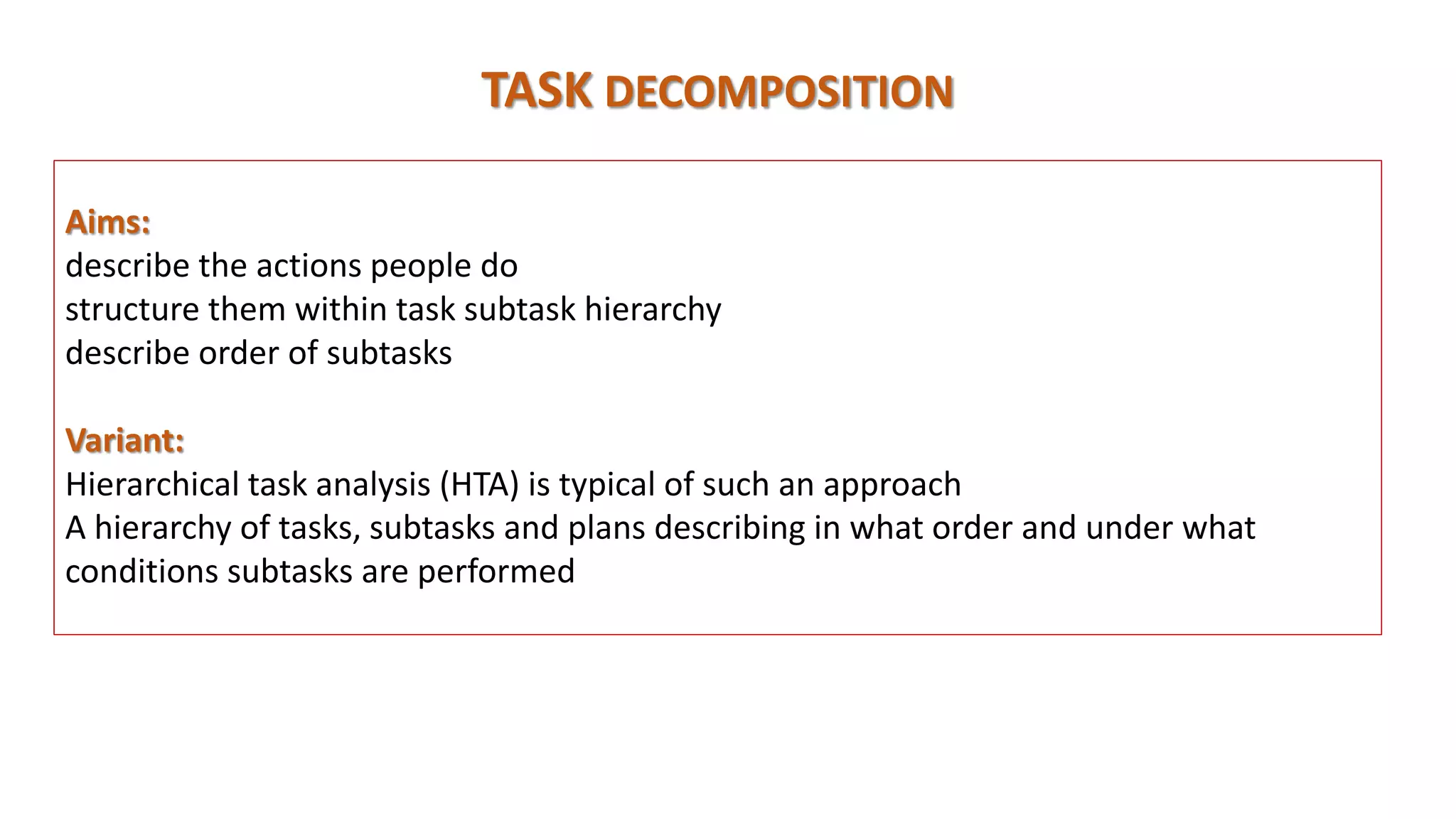
Aims:
describe the actions people do
structure them within task subtask hierarchy
describe order of subtasks
Variant:
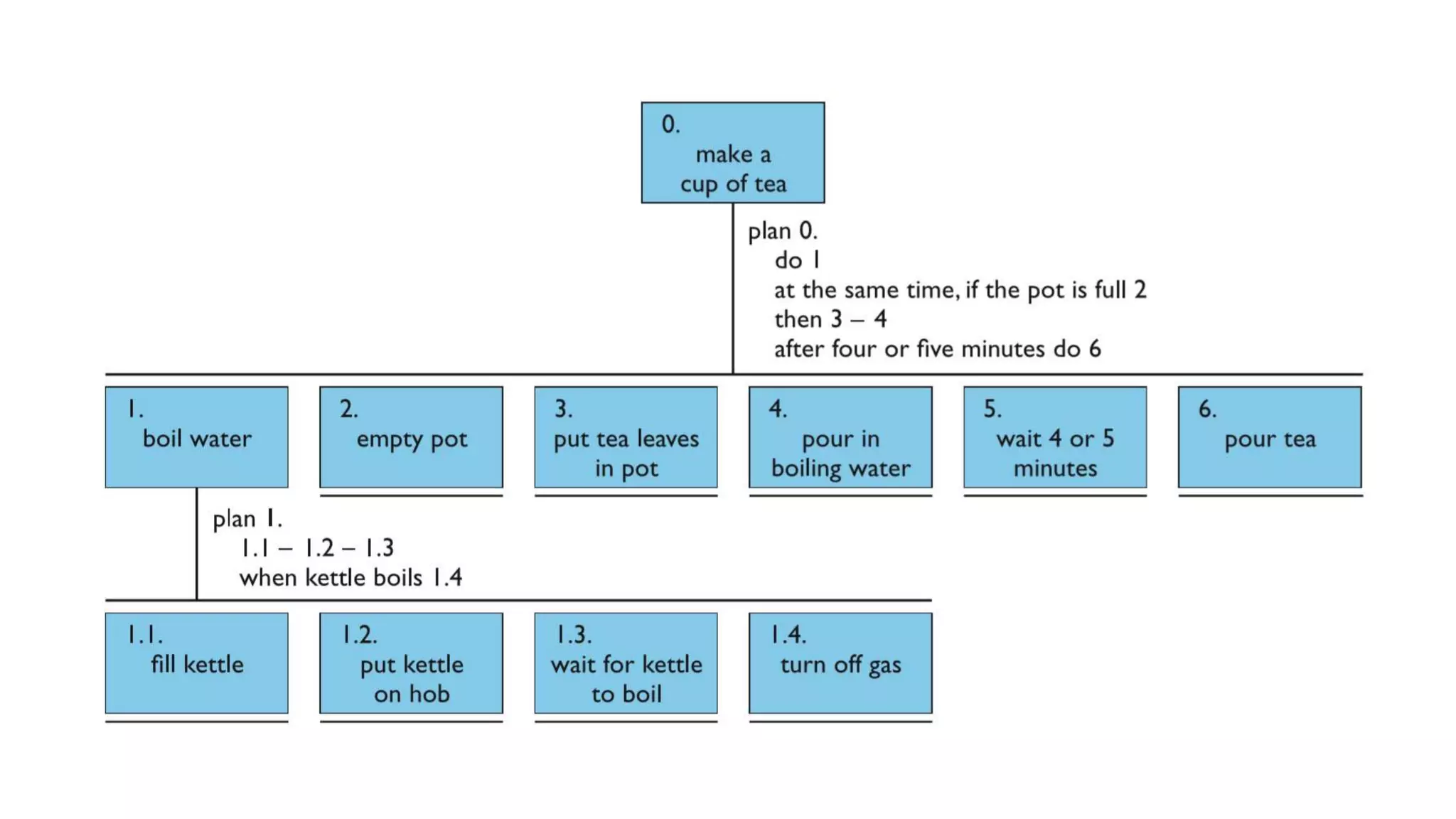
Hierarchical task analysis (HTA) is typical of such an approach
A hierarchy of tasks, subtasks and plans describing in what order and under what
conditions subtasks are performed
TASK DECOMPOSITION
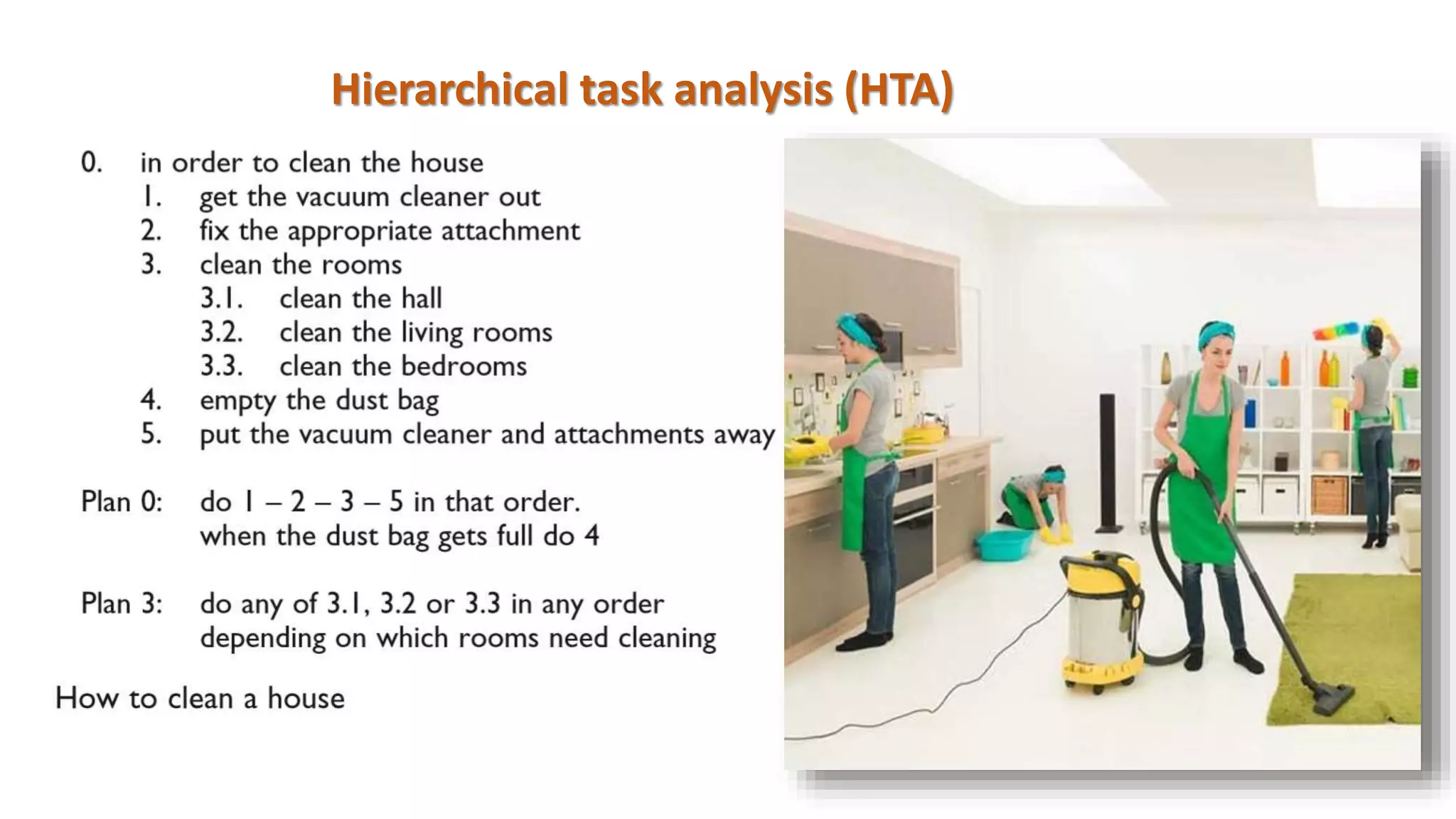
Hierarchical task analysis (HTA)
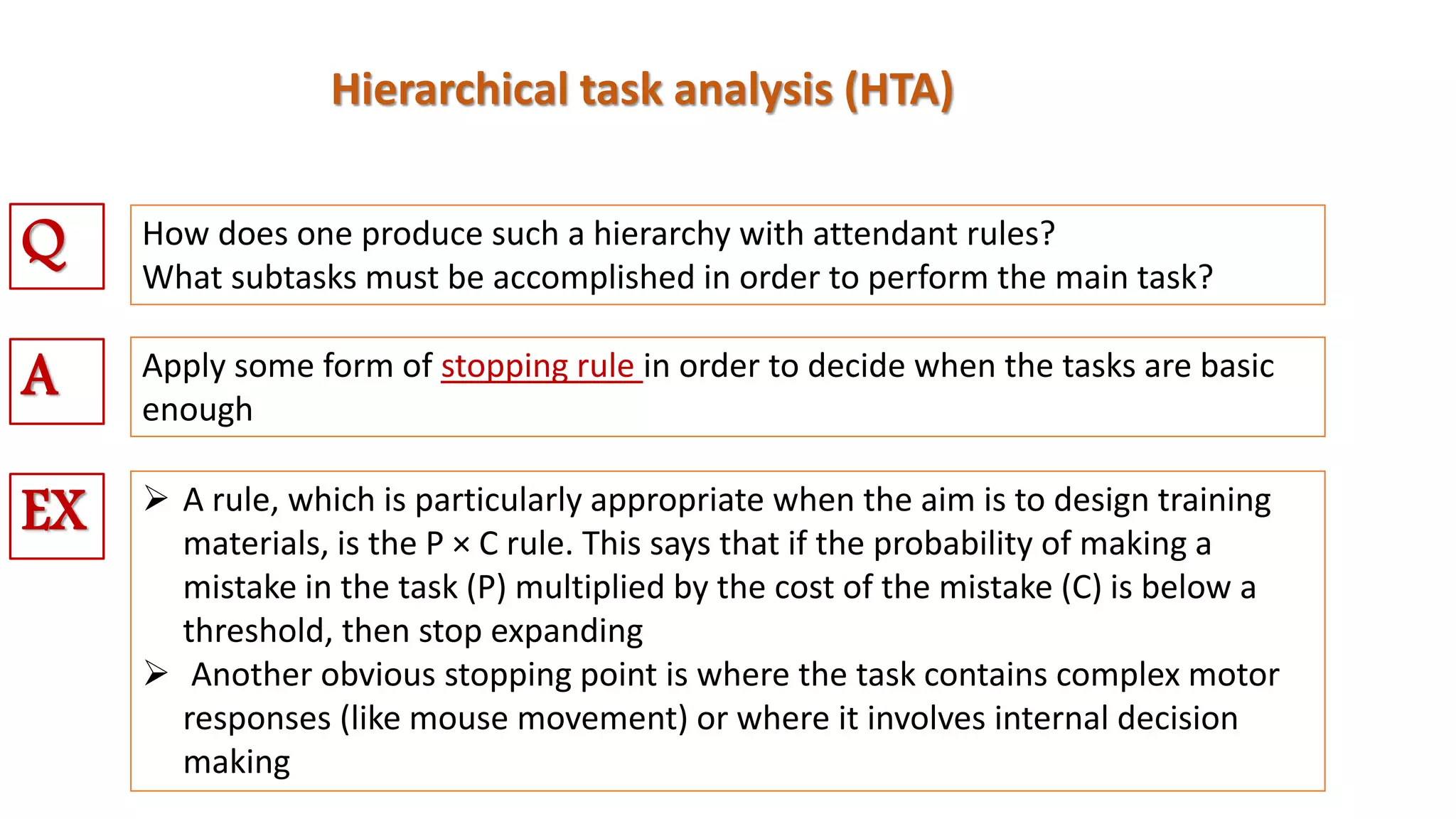
How does one produce such a hierarchy with attendant rules?
What subtasks must be accomplished in order to perform the main task?
Q
Apply some form of stopping rule in order to decide when the tasks are basic
enough
A
EX  A rule, which is particularly appropriate when the aim is to design training
materials, is the P × C rule. This says that if the probability of making a
mistake in the task (P) multiplied by the cost of the mistake (C) is below a
threshold, then stop expanding
 Another obvious stopping point is where the task contains complex motor
responses (like mouse movement) or where it involves internal decision
making
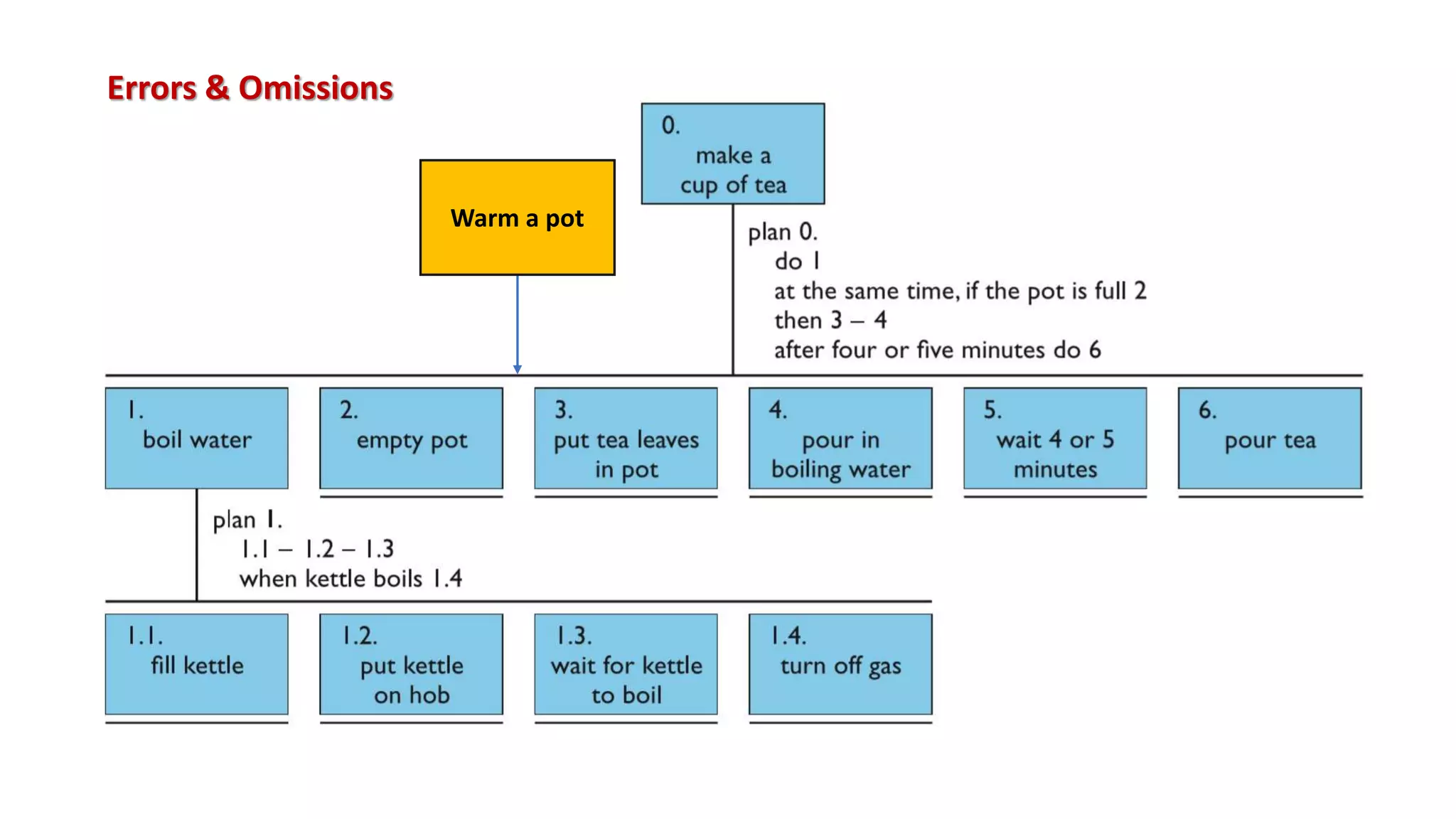
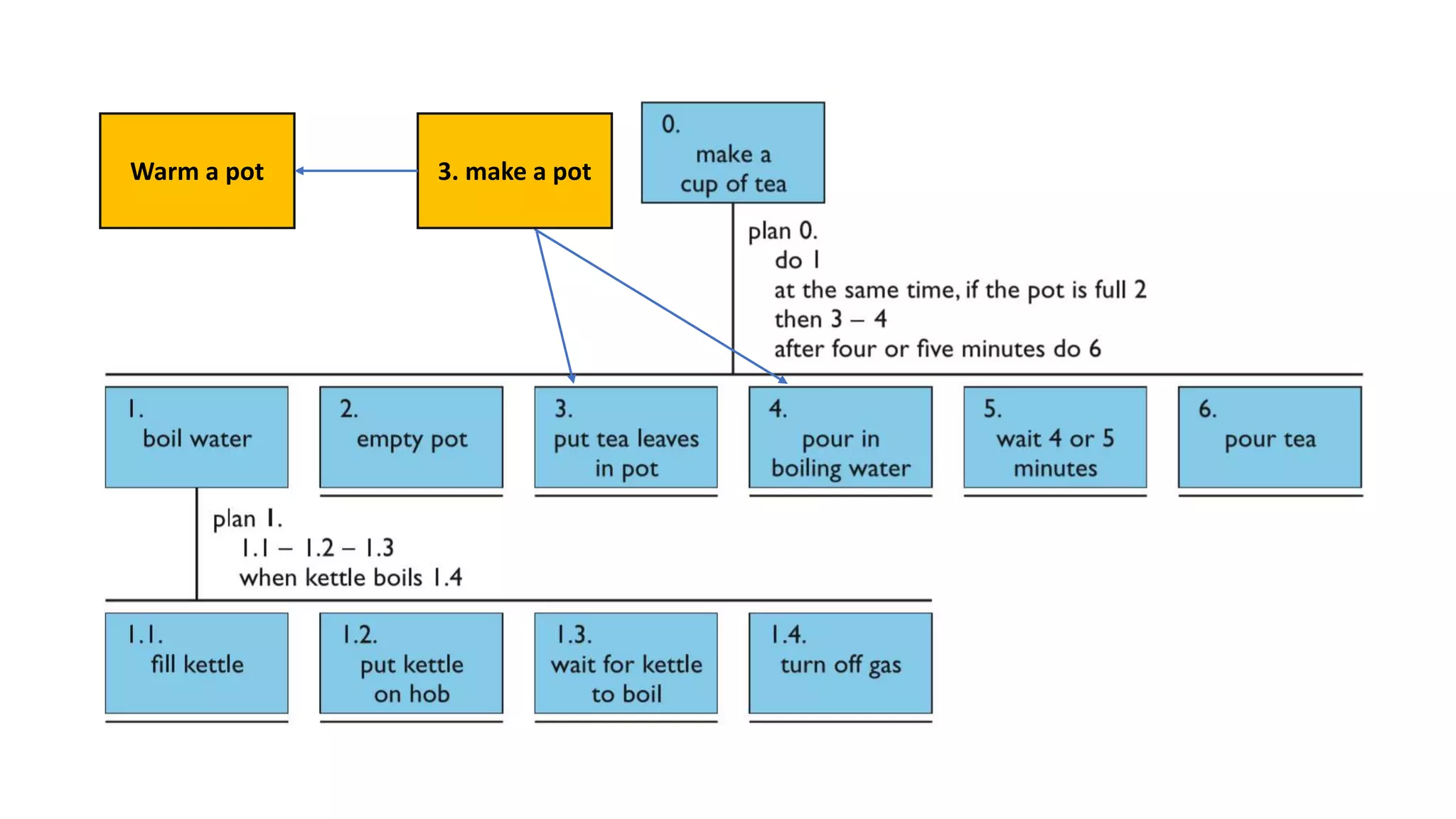
Warm a pot
Errors & Omissions
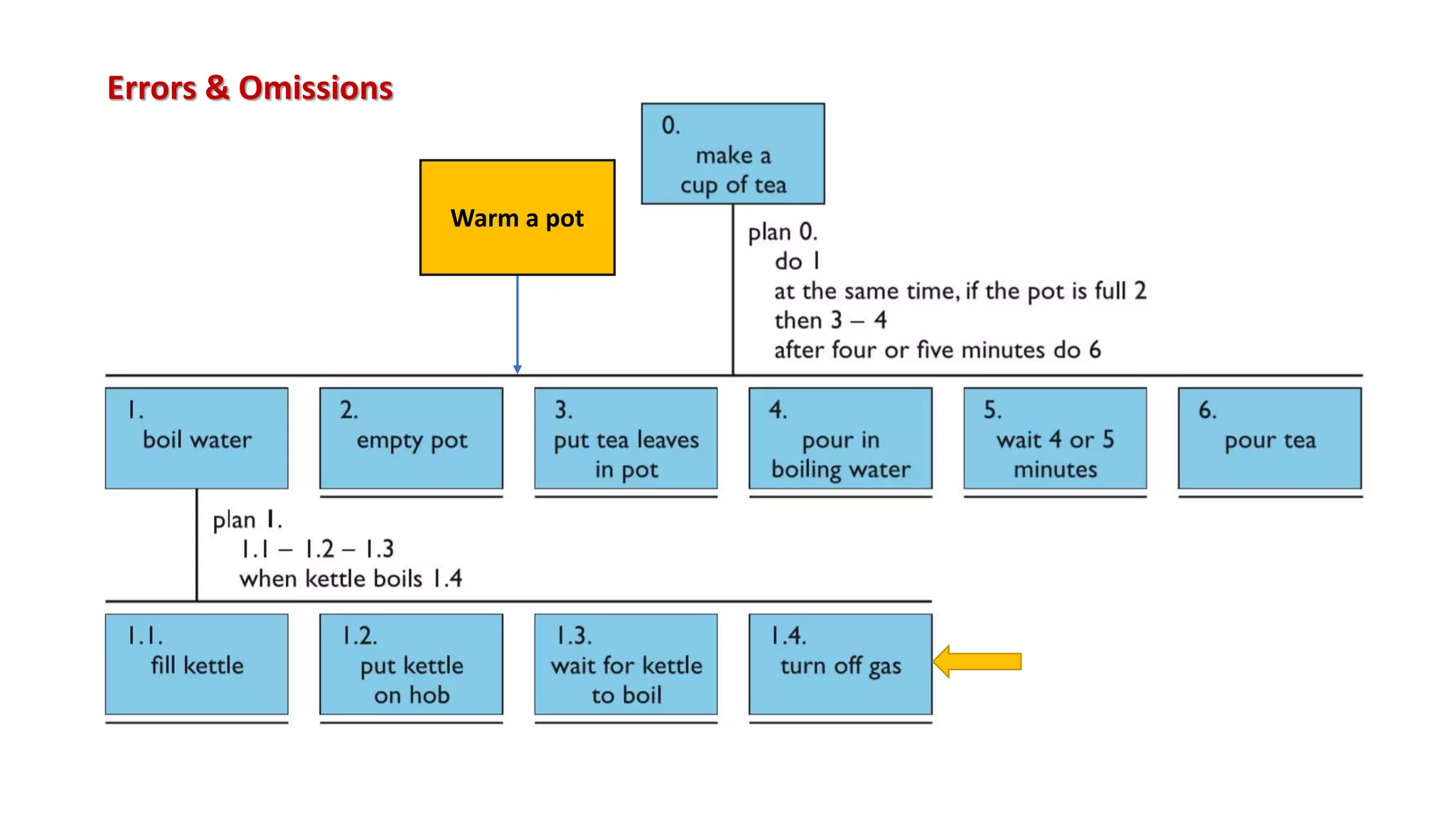
Warm a pot
Errors & Omissions
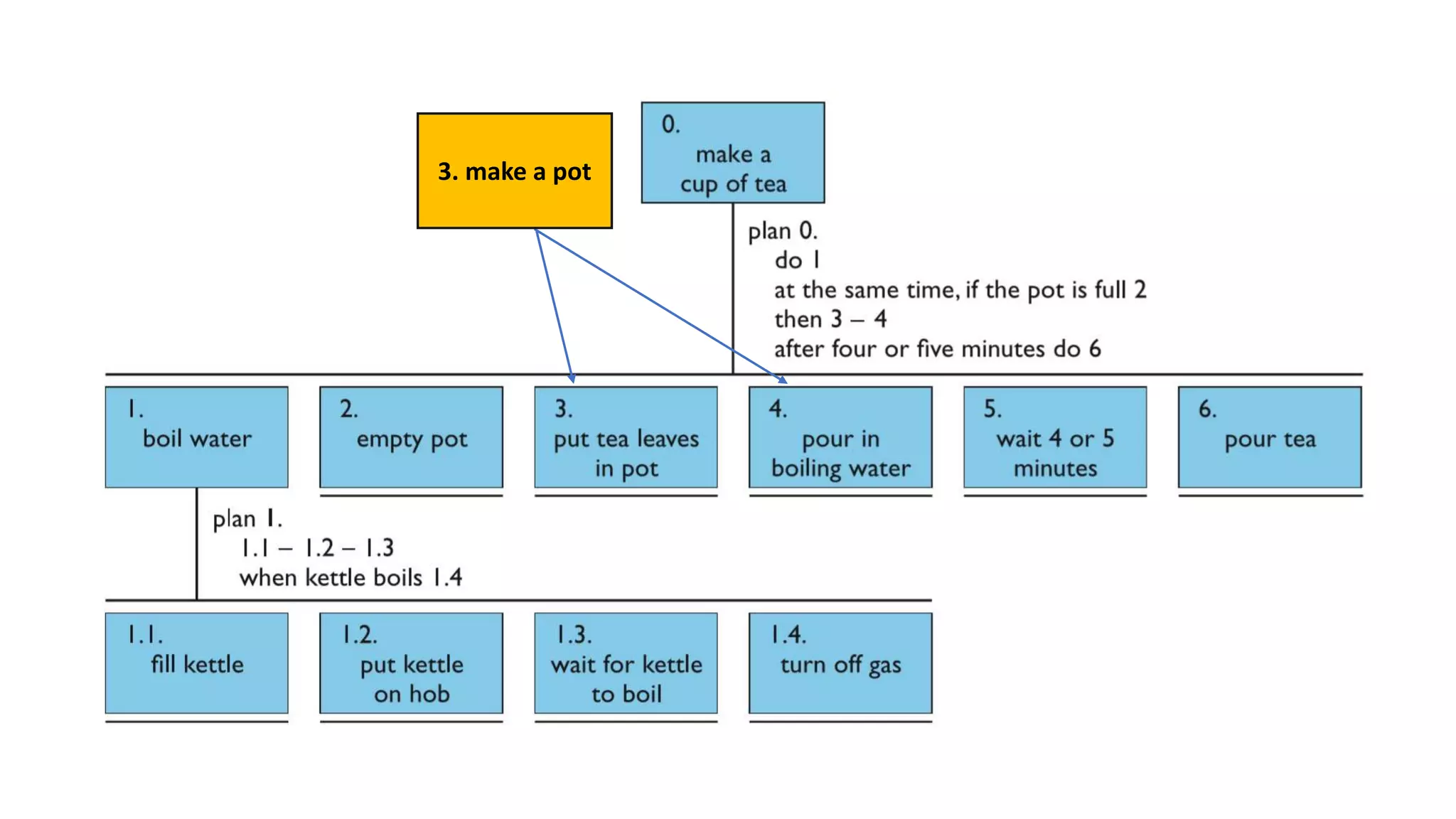
3. make a pot
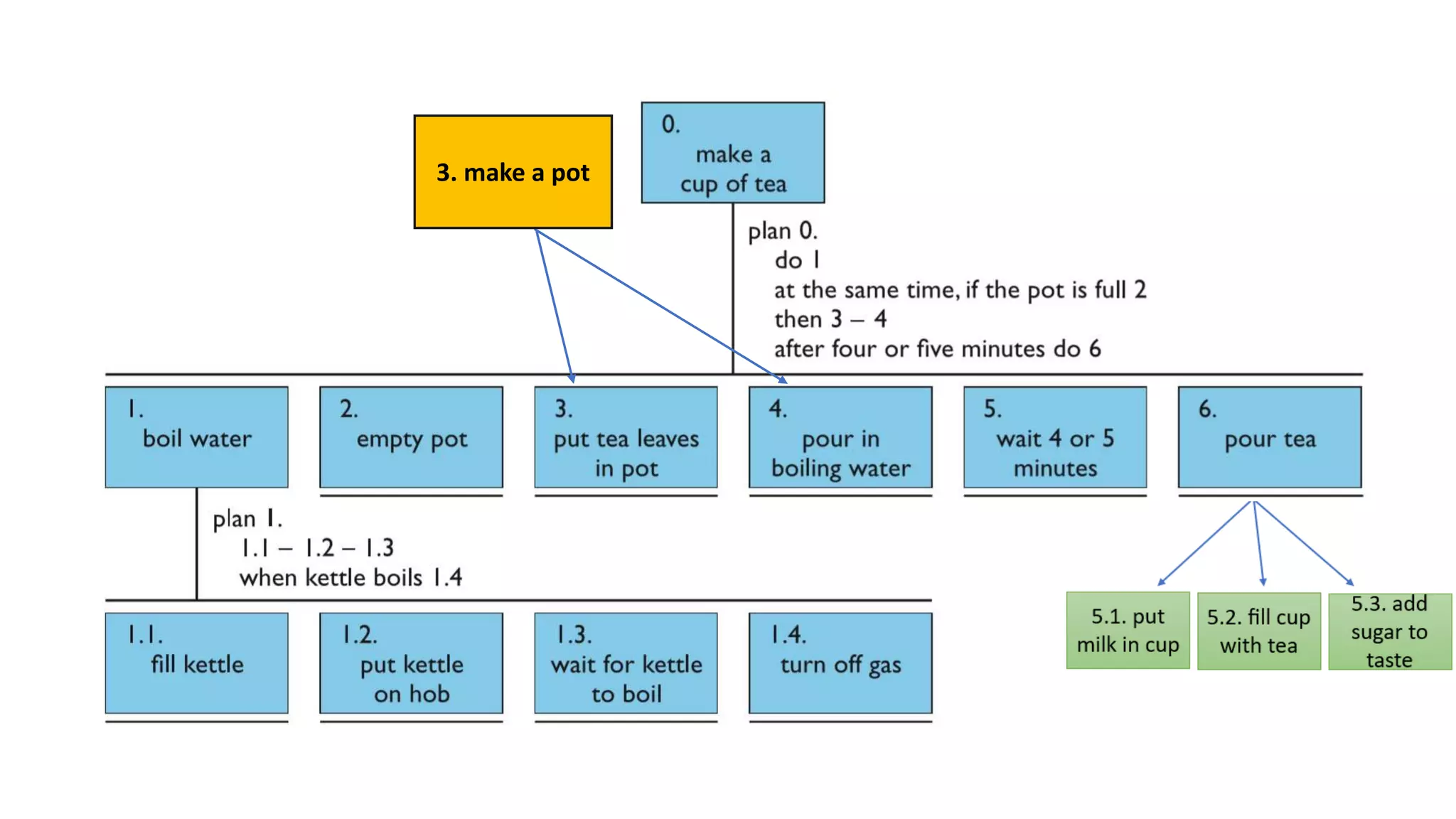
3. make a pot
Warm a pot
3. make a pot
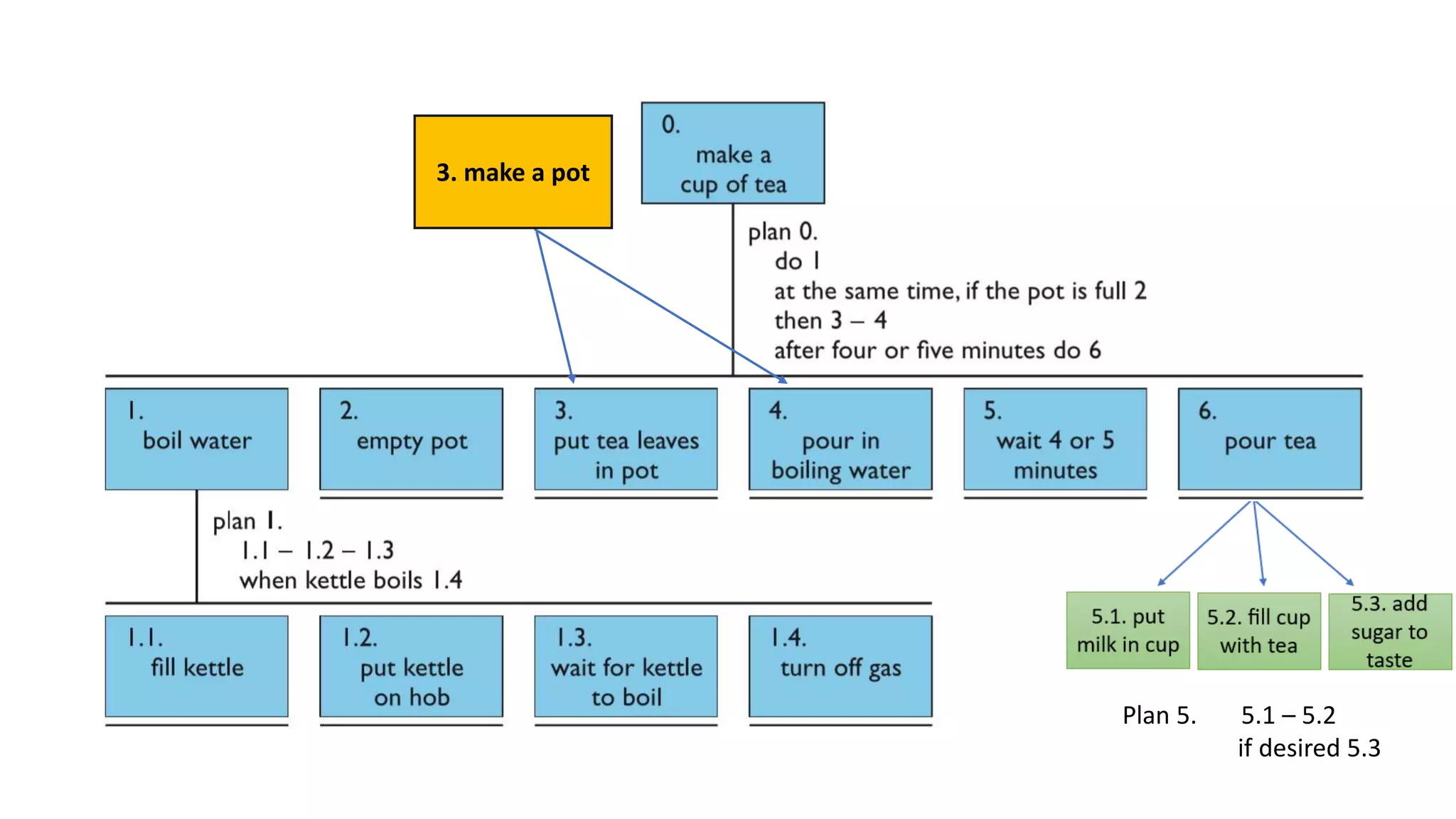
3. make a pot
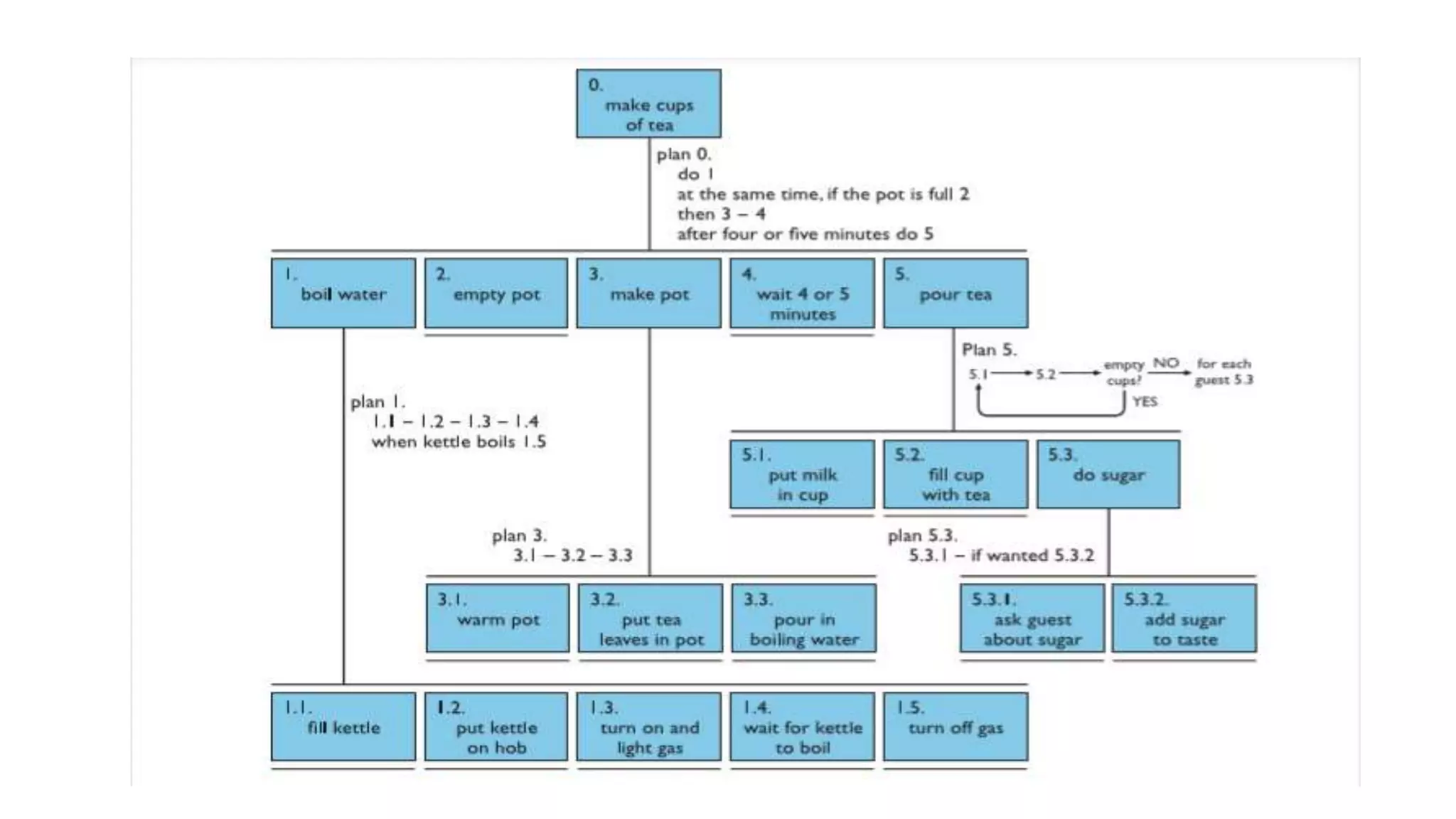
Plan 5. 5.1 – 5.2
if desired 5.3
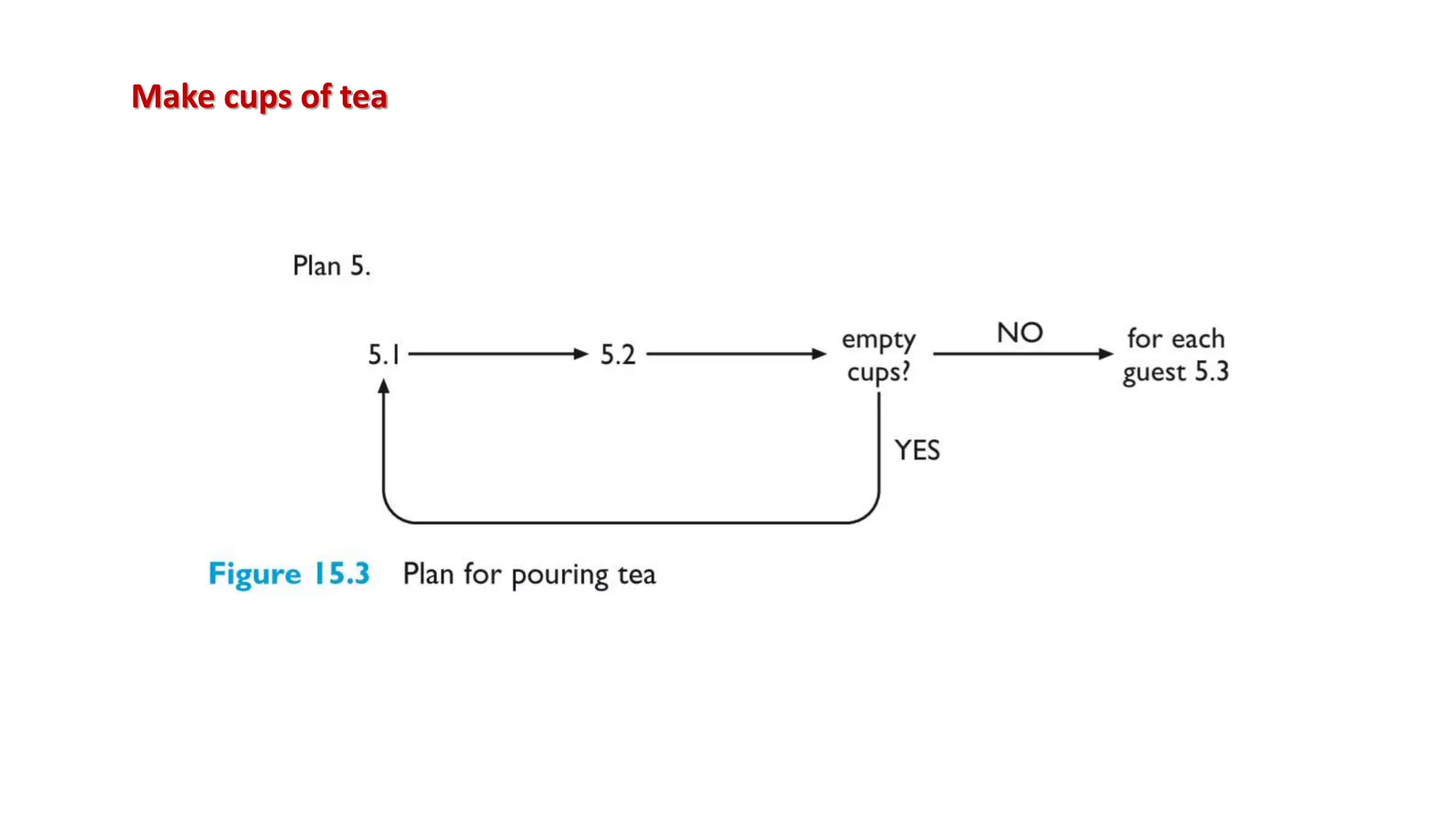
Make cups of tea
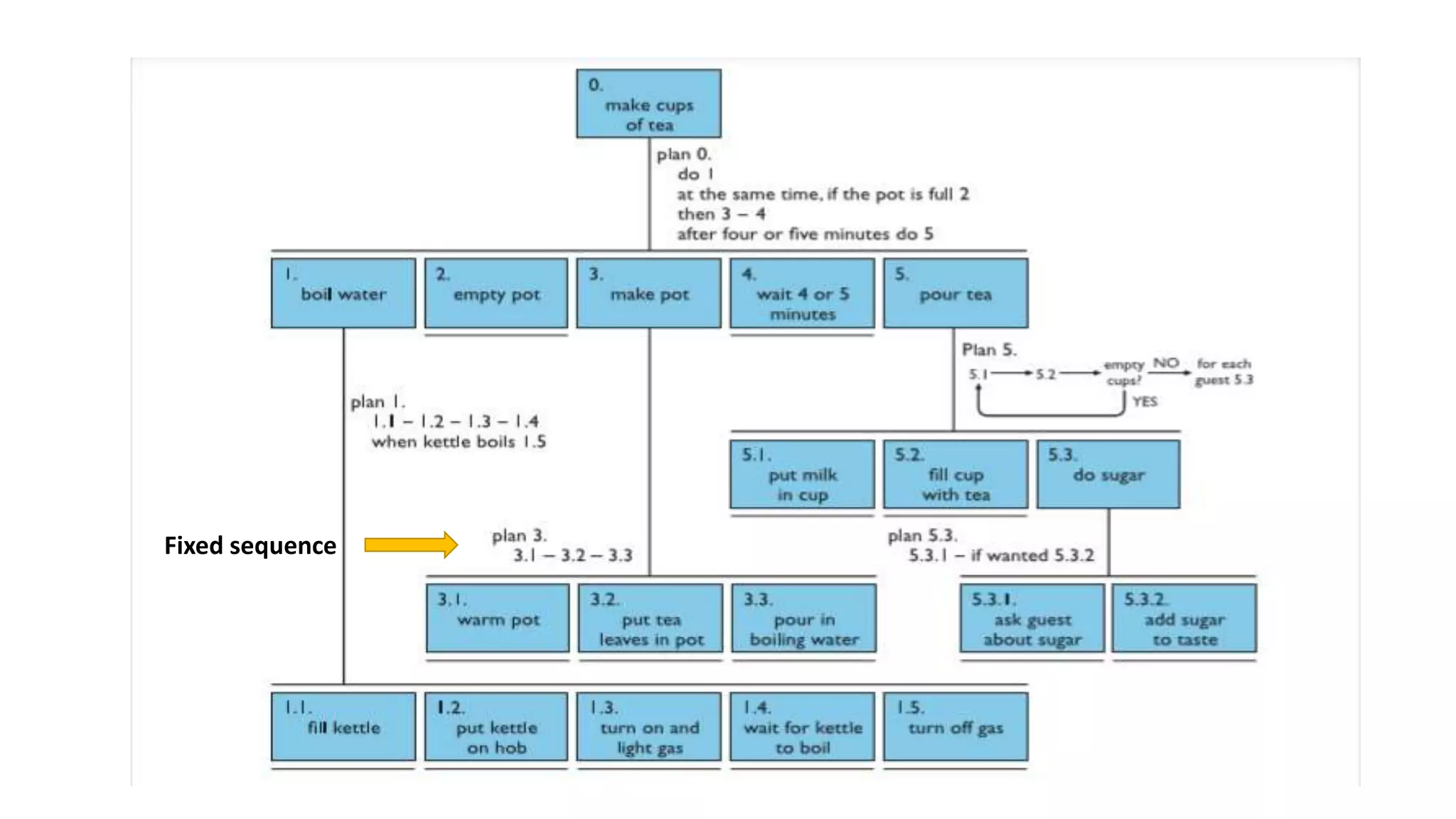
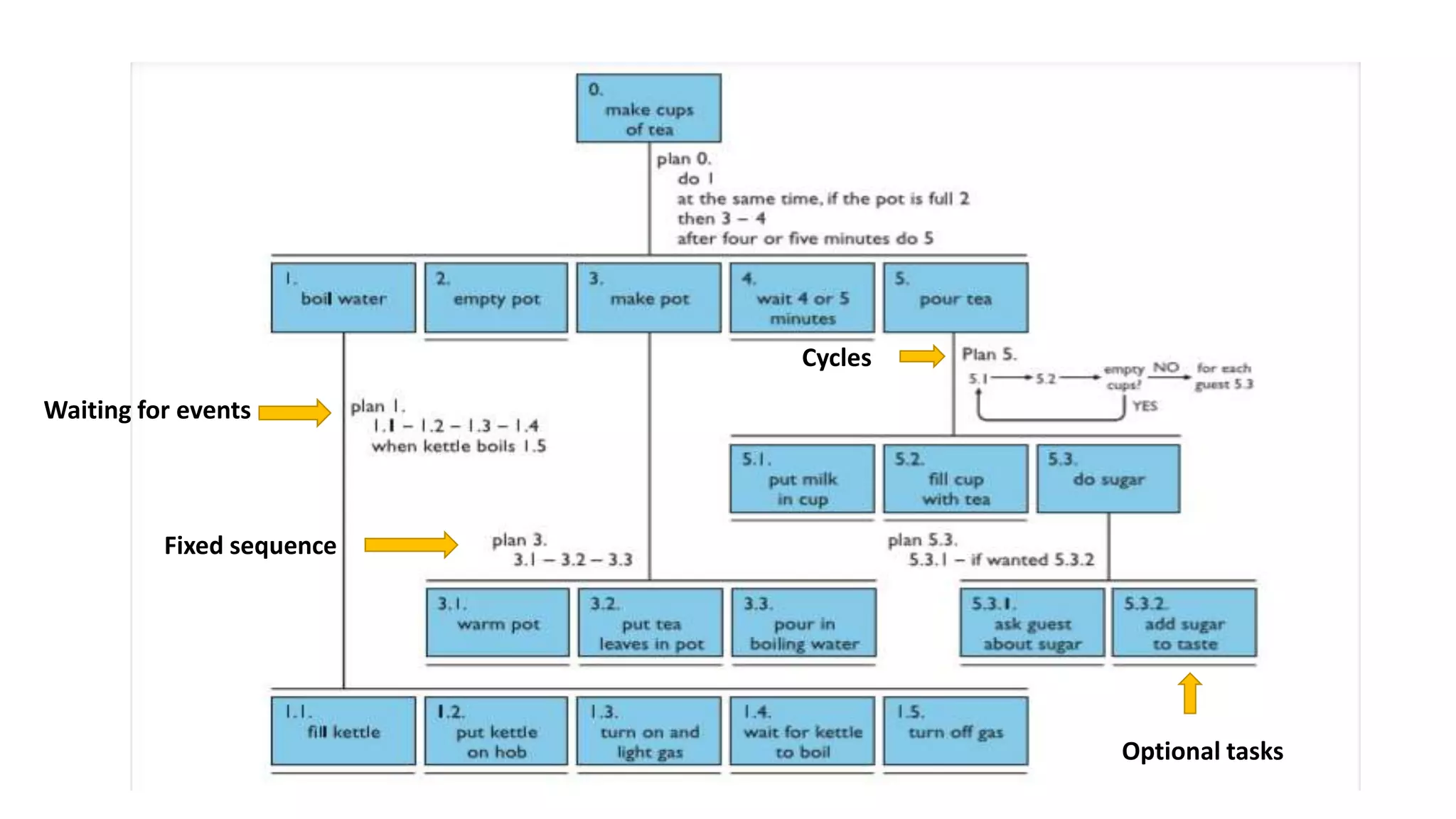
Fixed sequence
Fixed sequence
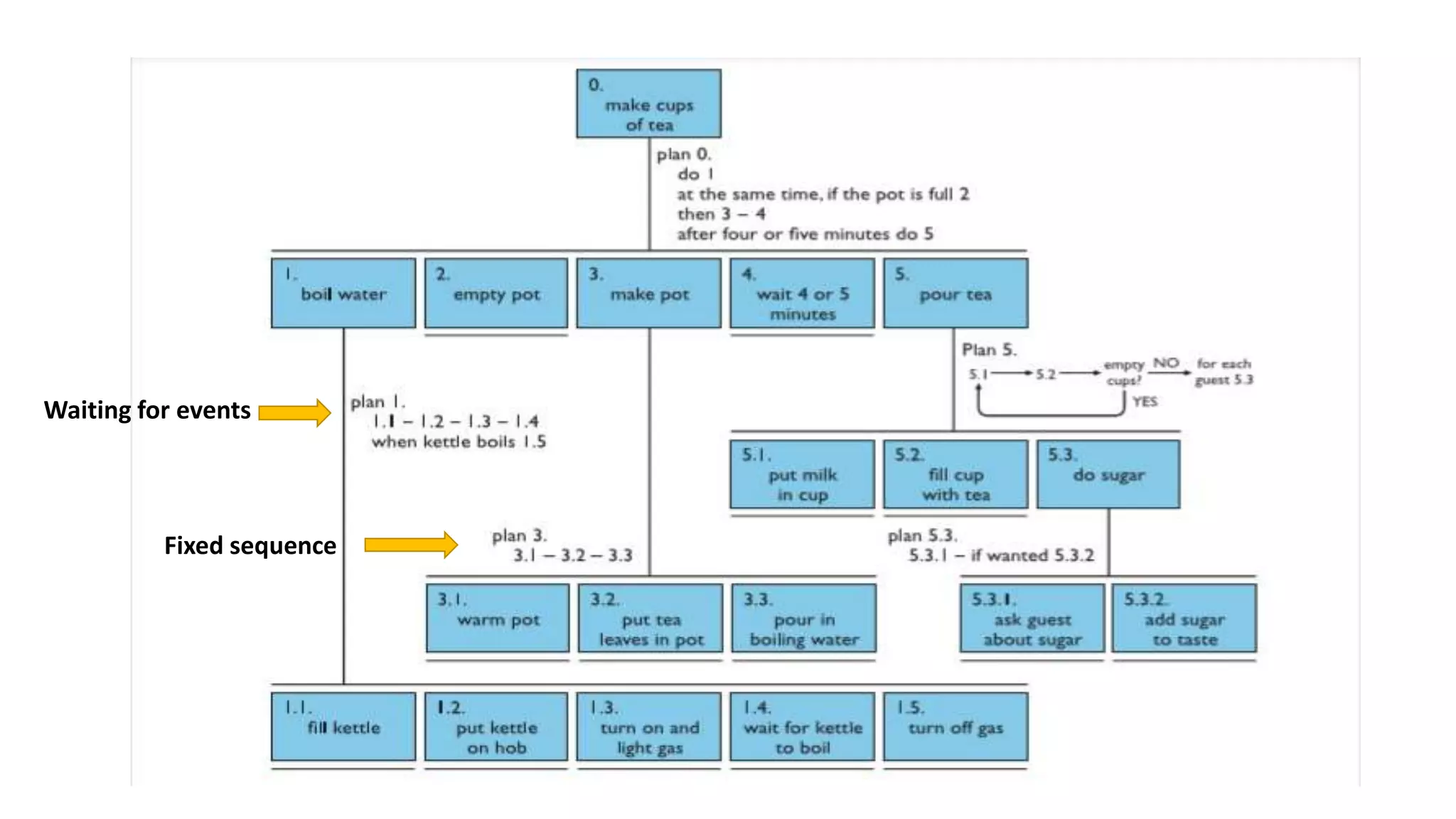
Waiting for events
Fixed sequence
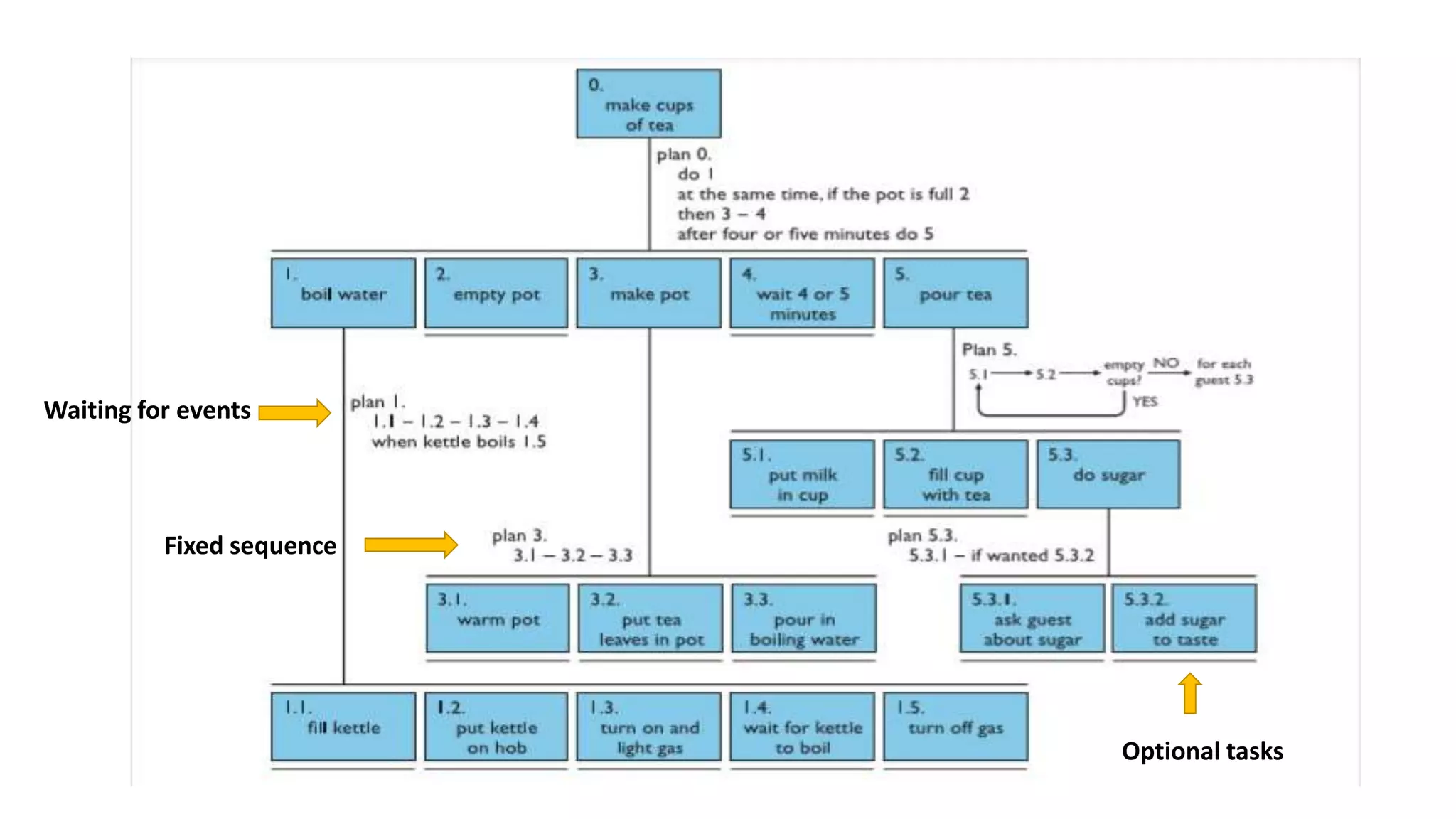
Optional tasks
Waiting for events
Fixed sequence
Optional tasks
Waiting for events
Cycles
Fixed sequence
Optional tasks
Waiting for events
Cycles
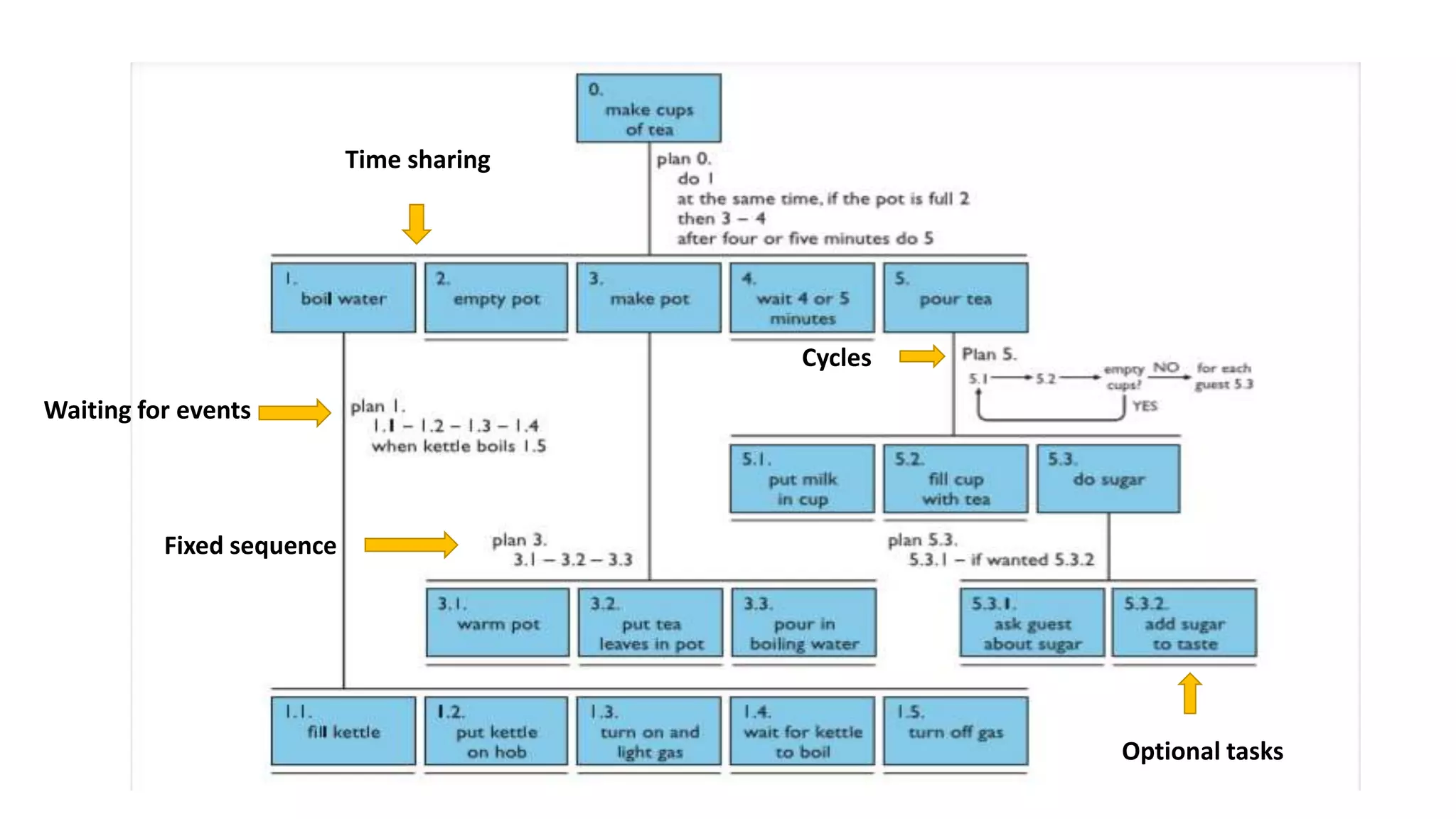
Time sharing
Fixed sequence
Optional tasks
Waiting for events
Cycles
Time sharing
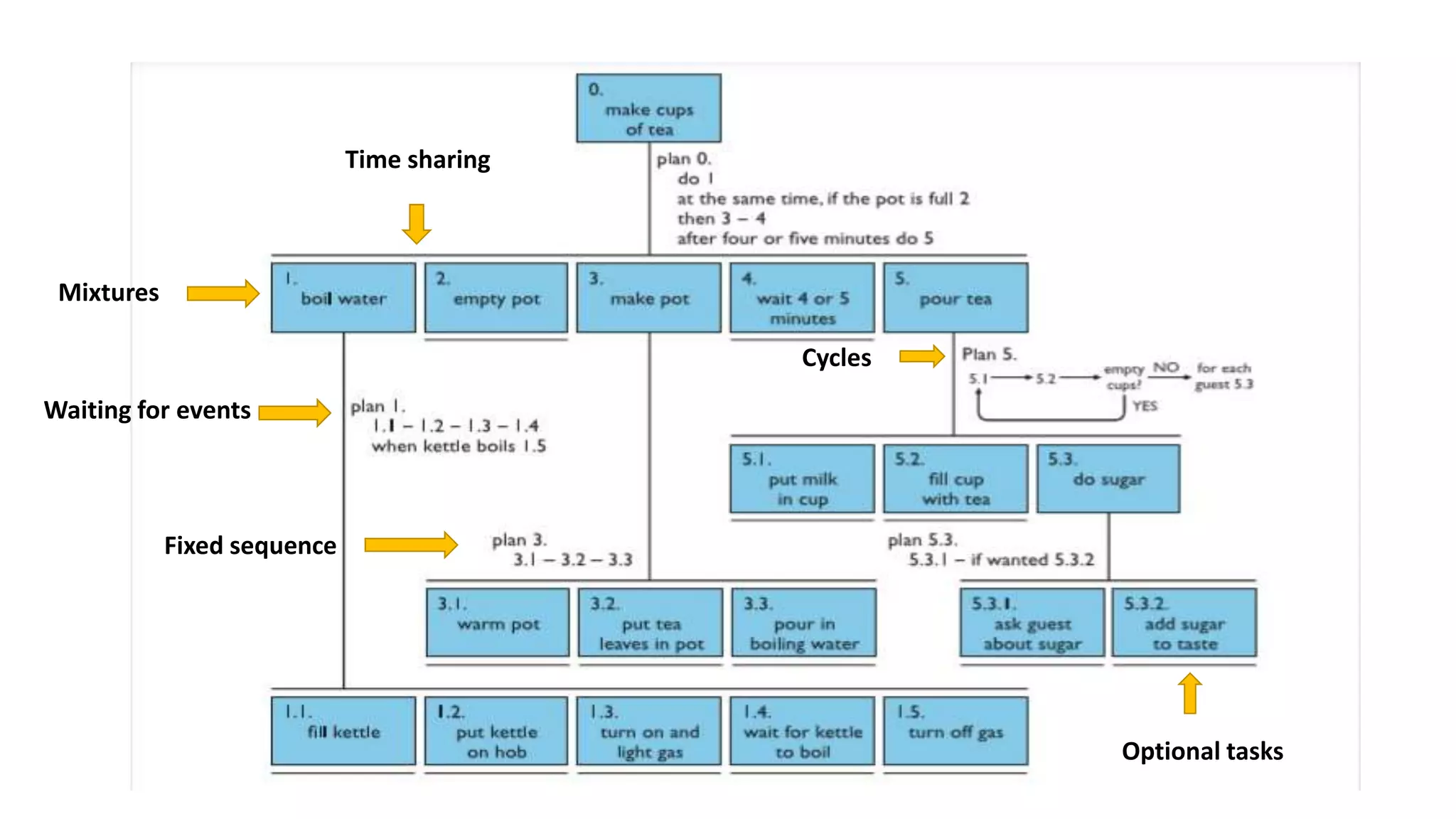
Mixtures
Task Analysis
Approaches
looks at the way a task is split
into subtasks, and the order in
which these are performed
look at what users need to know
about the objects and actions
involved in a task, and how that
knowledge is organized
an object-based approach where the
emphasis is on identifying the actors
and objects, the relationships
between them and the actions they
perform.
Entity–relation-based
Analysis
Knowledge-based
Techniques
Task
Decomposition
Knowledge-based technique
Aims:
• understand knowledge required to perform a task
• provide training material, how-to manuals;
• take advantage of common knowledge across tasks.
Focus on:
• objects used in task
• actions performed
Use taxonomies:
• represent levels of abstraction
• organization (grouping) depends on purpose
• listing all objects then remove unnecessary
Declarative knowledge elicitation techniques:
• established convention, existing documentation
• asking users to list objects; card sorting
• structured interviews, listing nouns and verbs
Knowledge-based technique
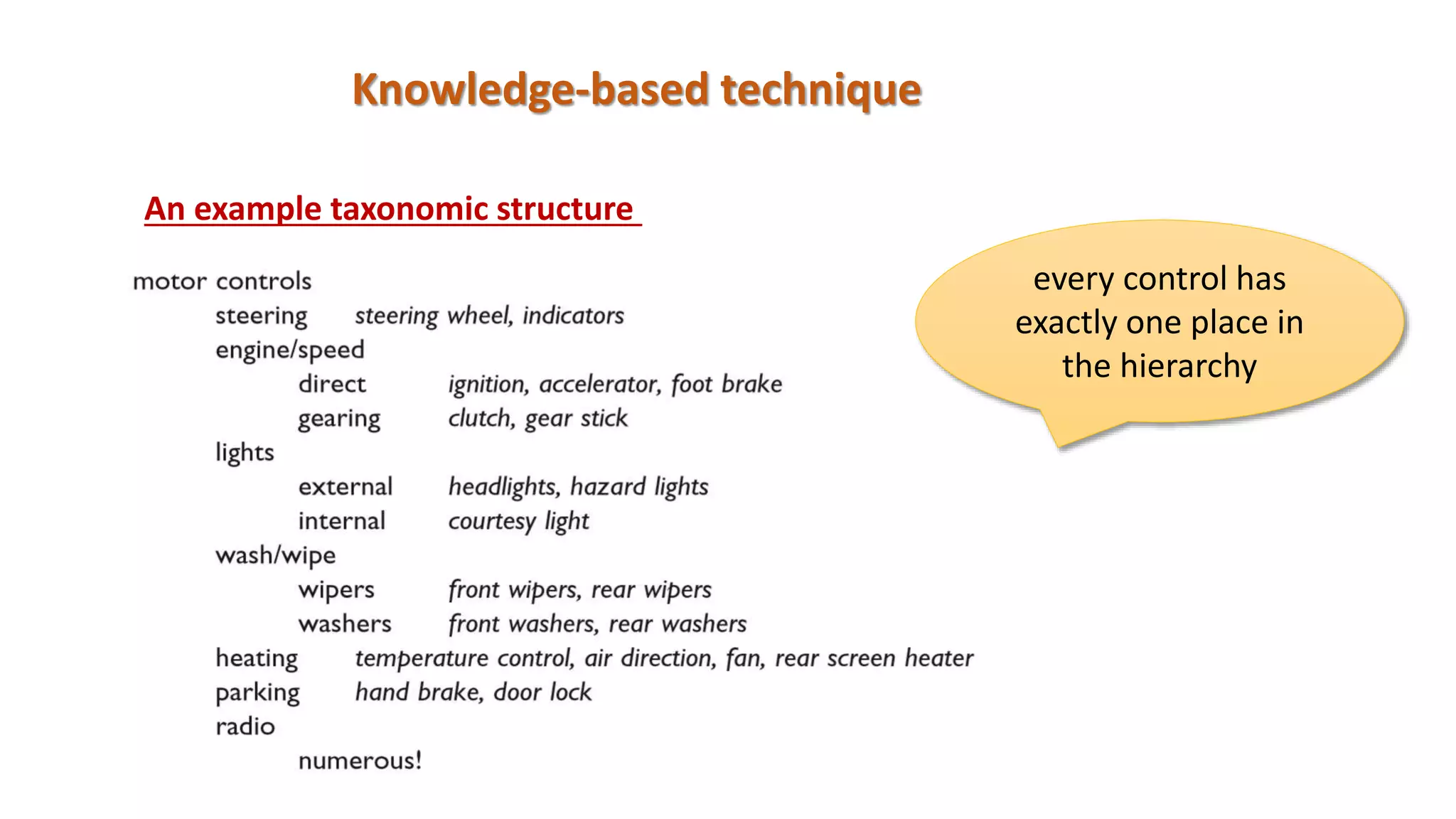
An example taxonomic structure
every control has
exactly one place in
the hierarchy
Knowledge-based technique
Depending on the
expected use of the
task analysis, we may
require different
structures
An example taxonomic structure
Knowledge-based technique
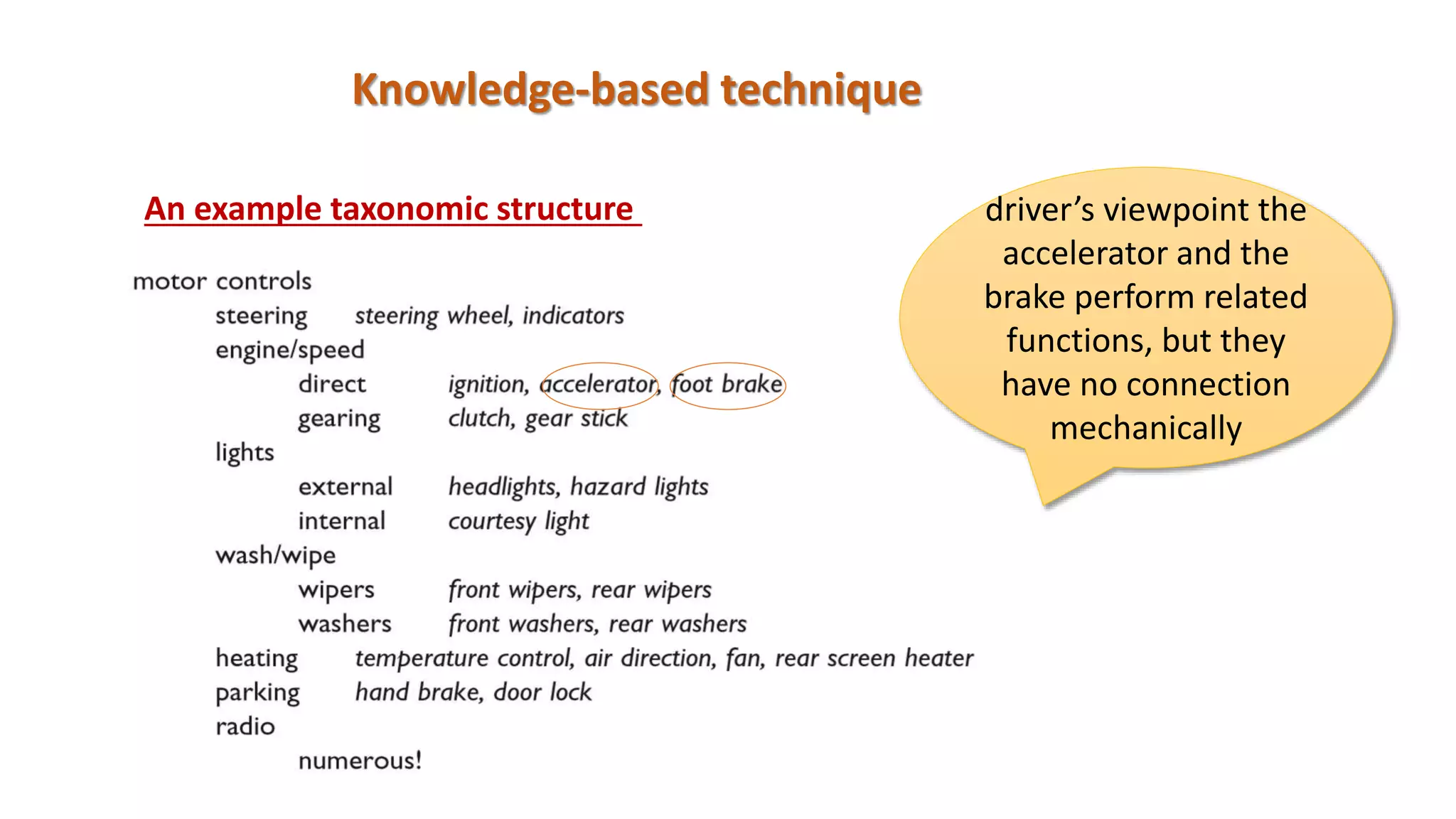
driver’s viewpoint the
accelerator and the
brake perform related
functions, but they
have no connection
mechanically
An example taxonomic structure
Knowledge-based technique
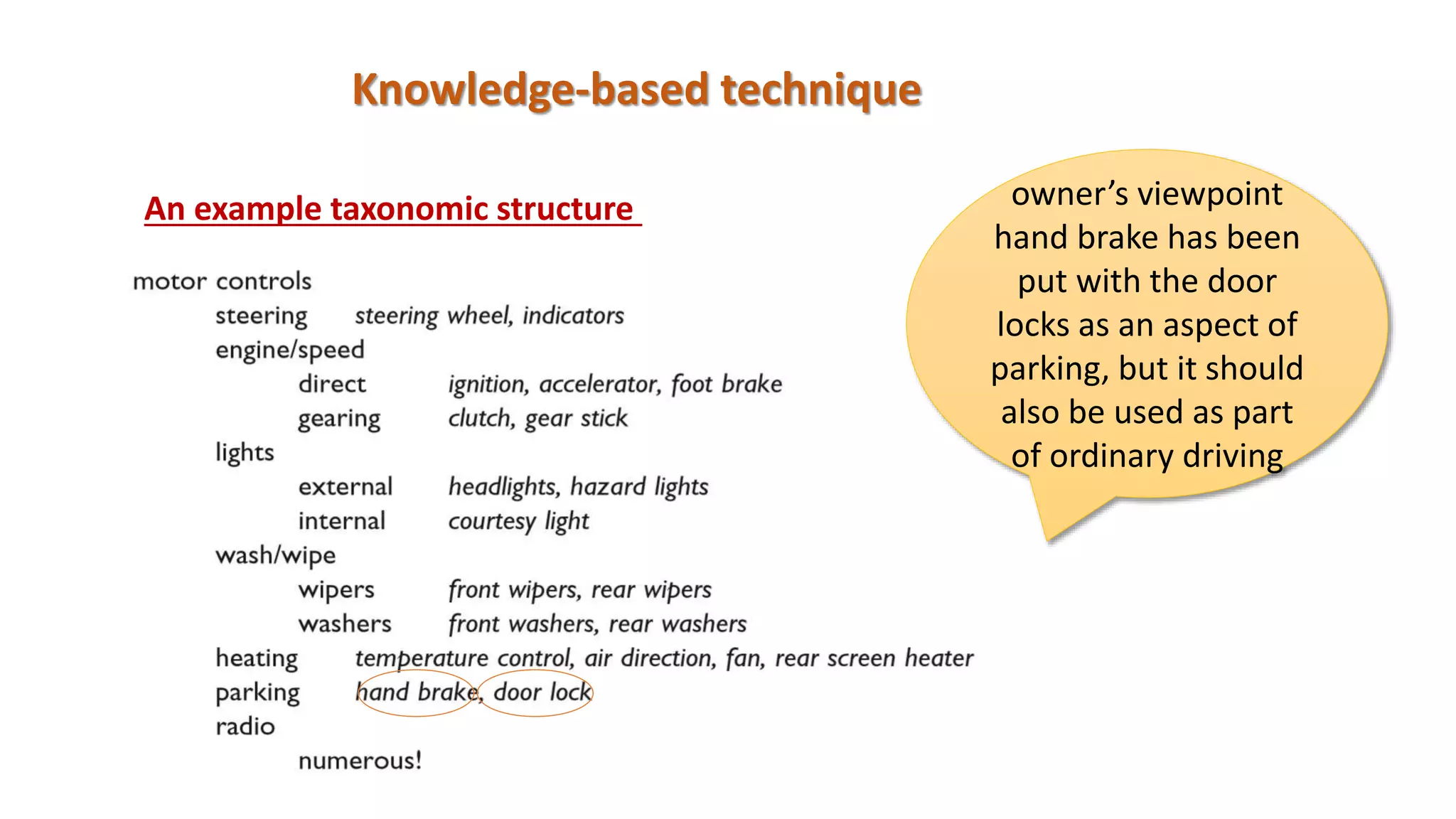
An example taxonomic structure owner’s viewpoint
hand brake has been
put with the door
locks as an aspect of
parking, but it should
also be used as part
of ordinary driving
Knowledge-based technique
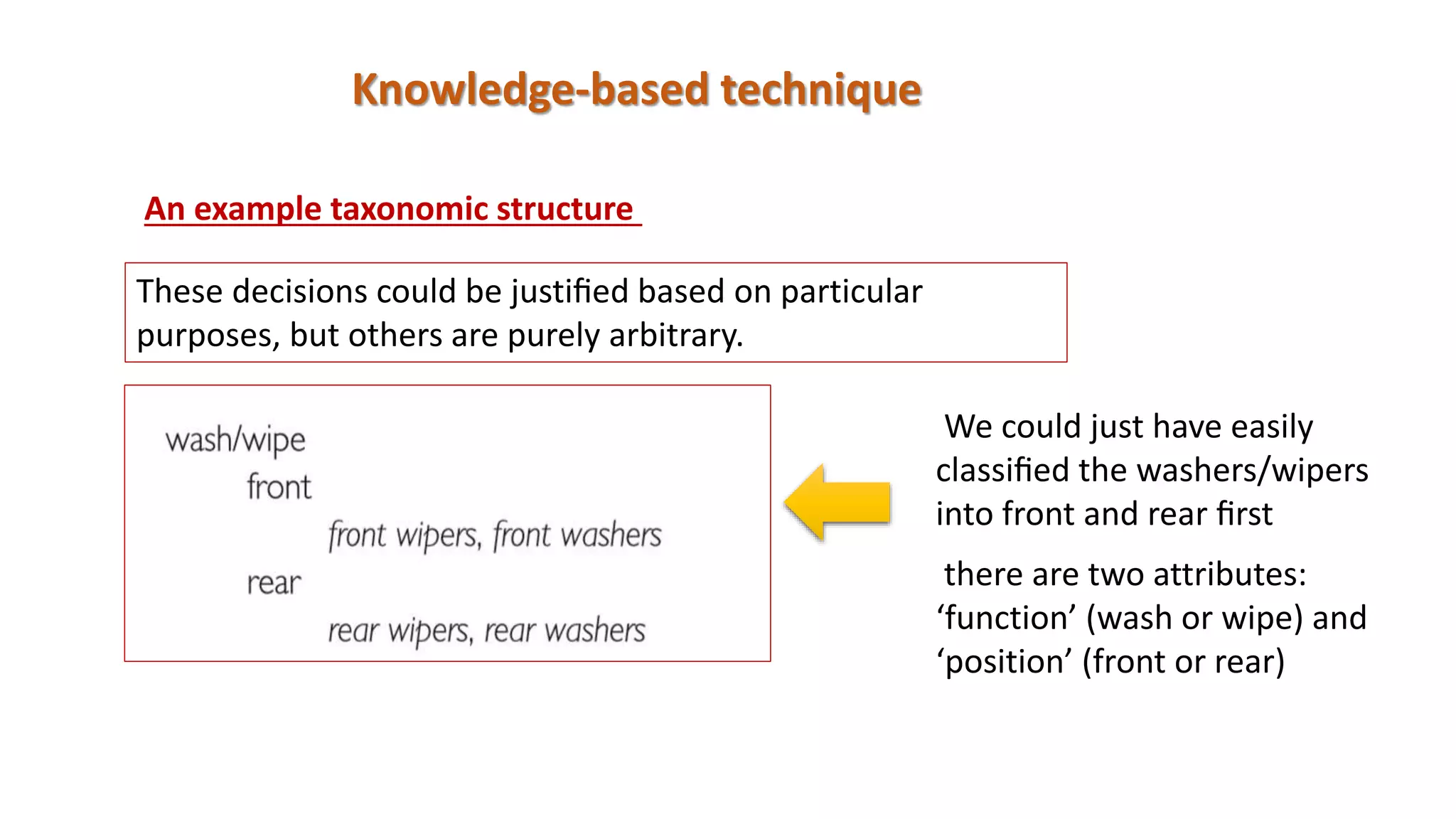
An example taxonomic structure
These decisions could be justified based on particular
purposes, but others are purely arbitrary.
We could just have easily
classified the washers/wipers
into front and rear first
there are two attributes:
‘function’ (wash or wipe) and
‘position’ (front or rear)
Task analysis for knowledge description (TAKD)
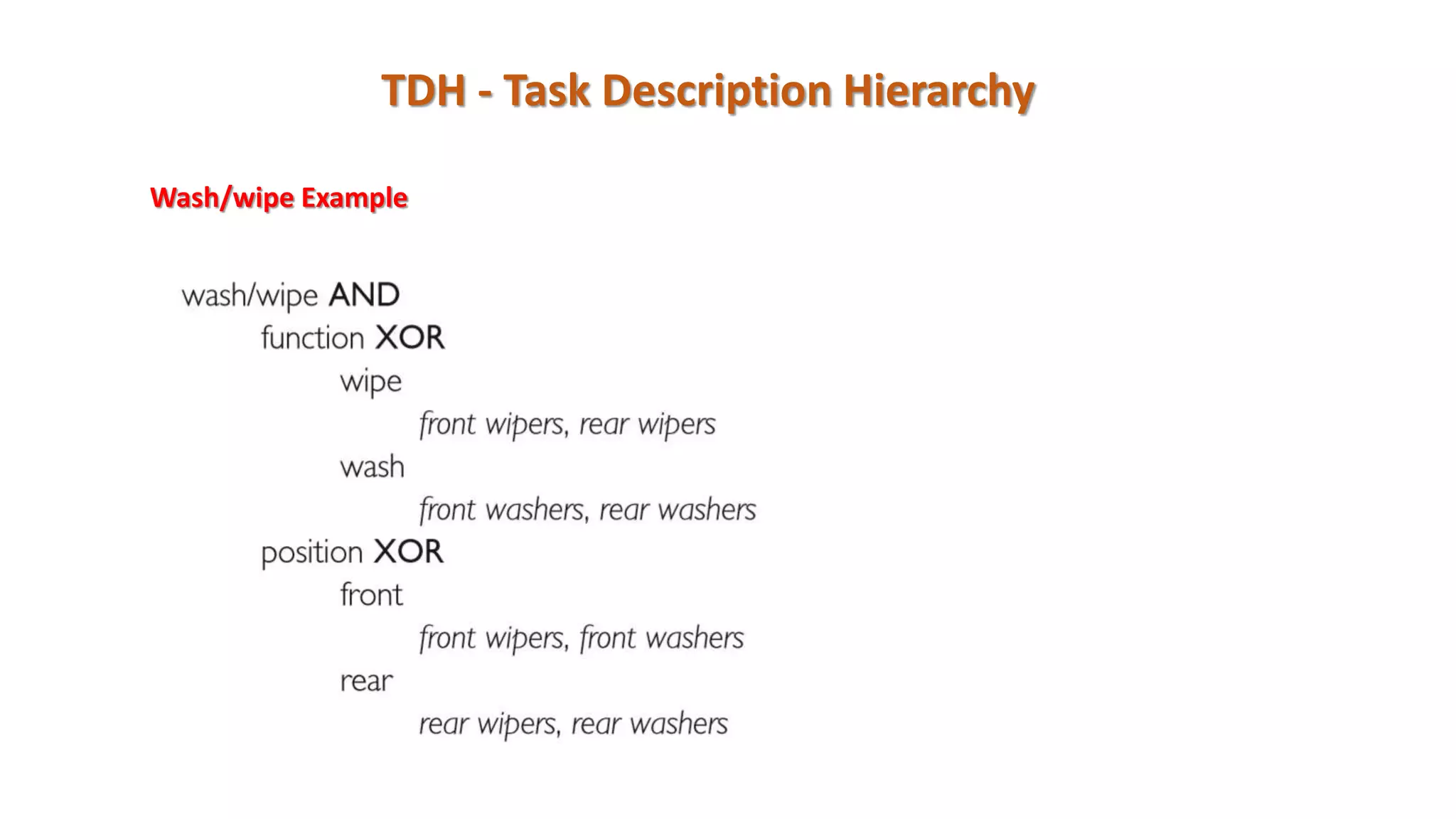
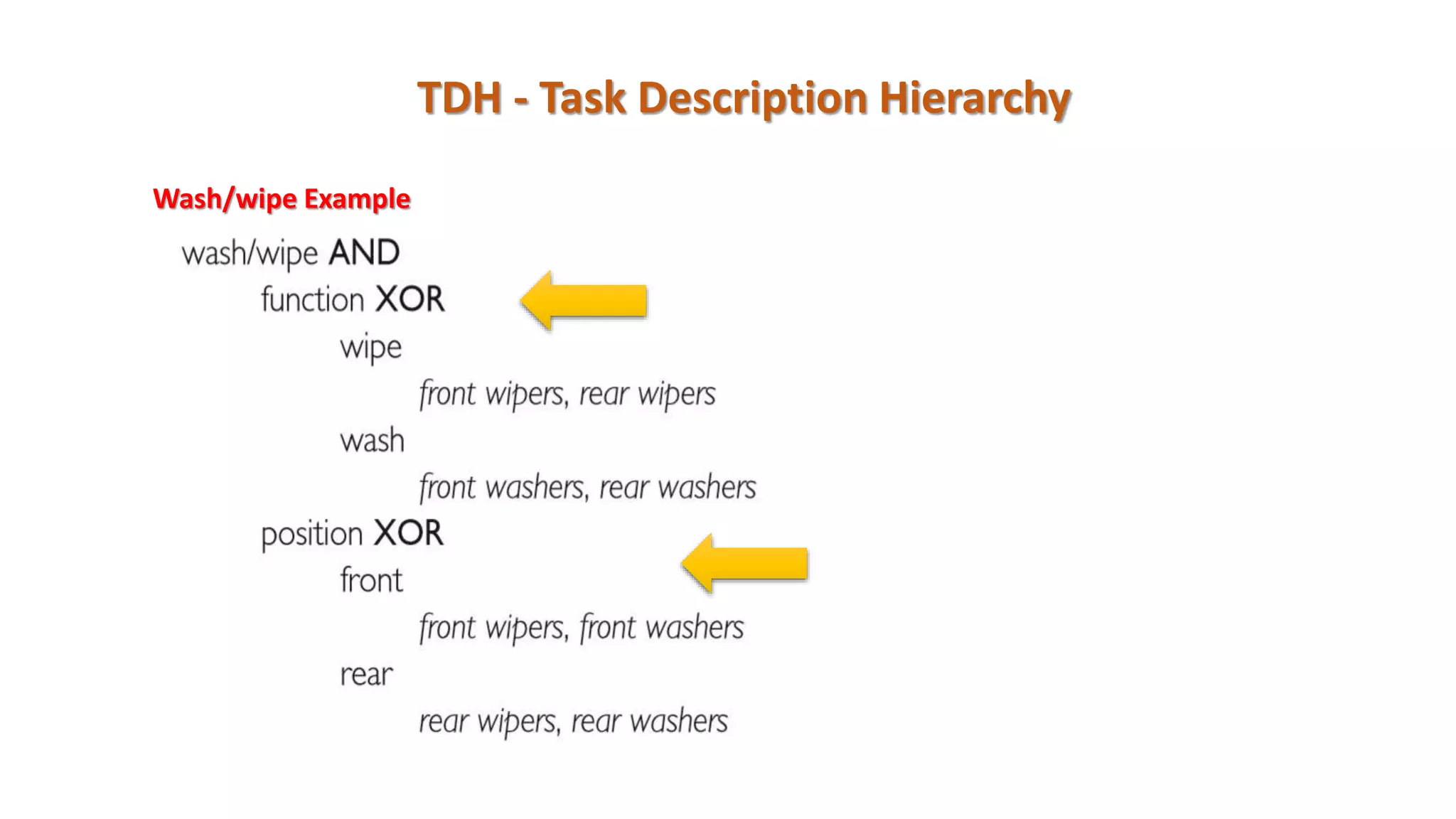
Task Analysis for Knowledge Description (TAKD) uses three types of
branches in TDH taxonomies:
• XOR — object in exactly one branch
• AND — object must be in both
• OR — can be in one, many or none
Uses a special form of taxonomy called Task Descriptive Hierarchy (TDH)
A completed TDH can distinguish any two specific objects
Wash/wipe Example
TDH - Task Description Hierarchy
Wash/wipe Example
TDH - Task Description Hierarchy
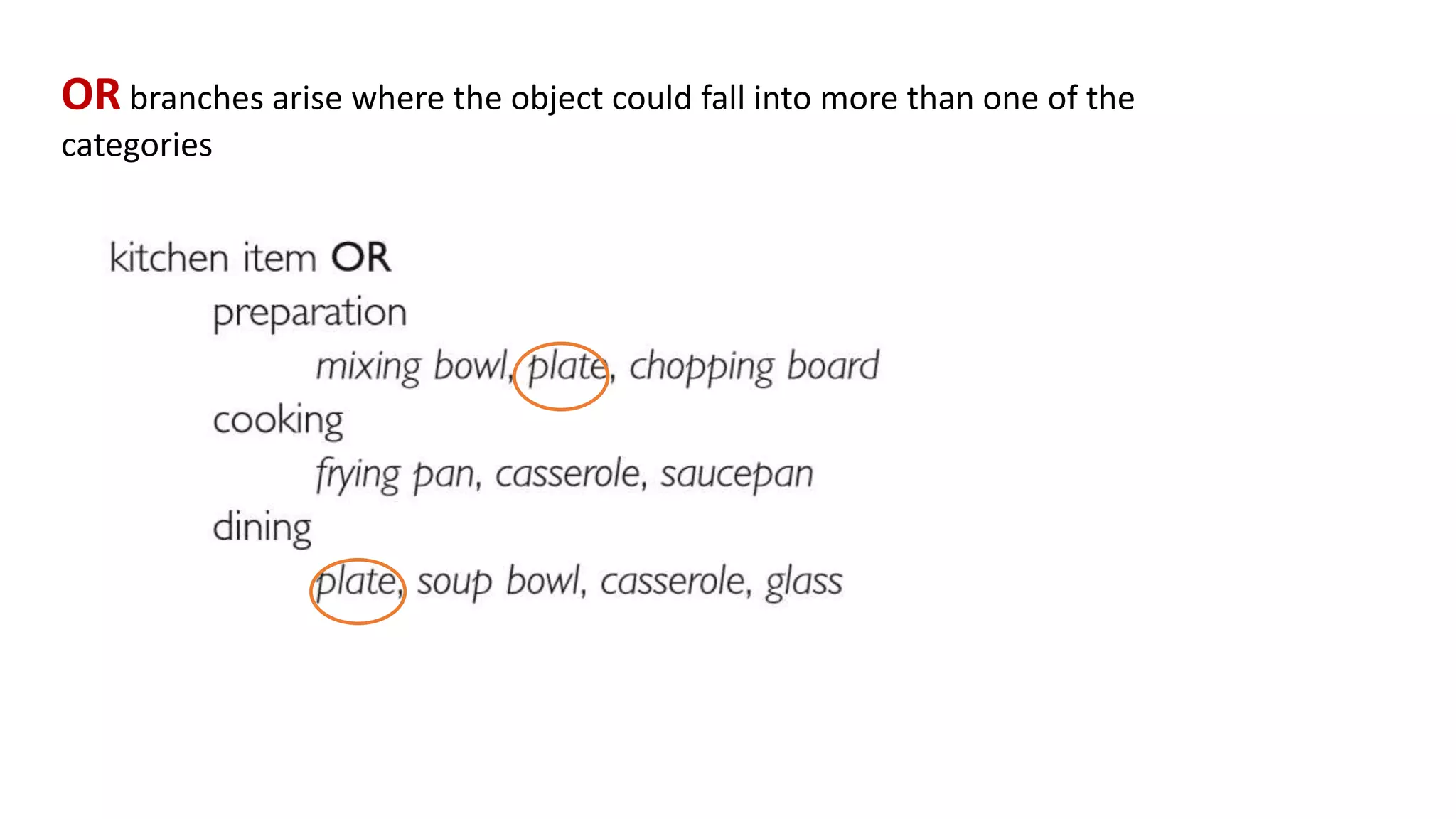
OR branches arise where the object could fall into more than one of the
categories
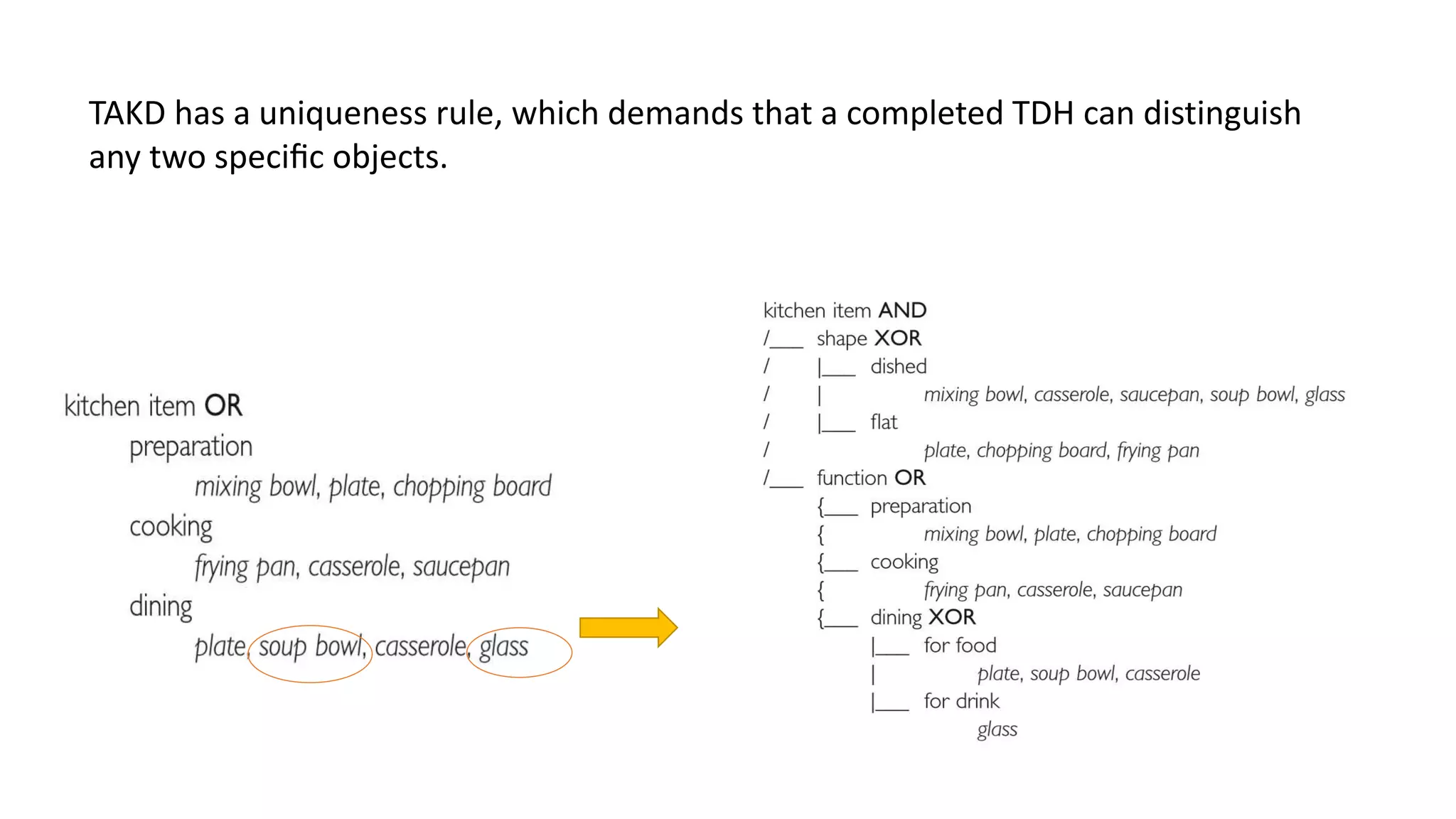
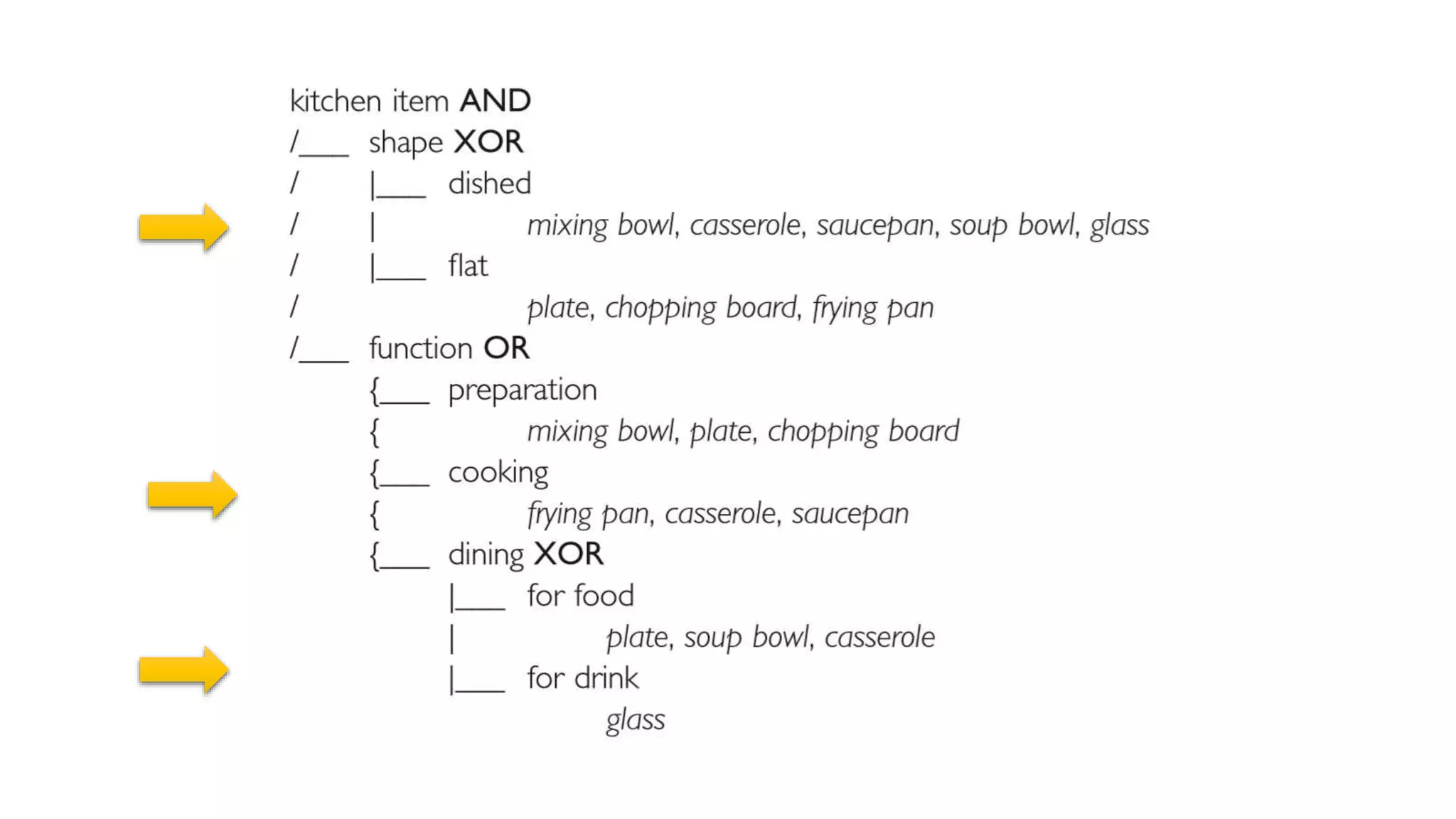
TAKD has a uniqueness rule, which demands that a completed TDH can distinguish
any two specific objects.
Knowledge Representation Grammar (KRG)
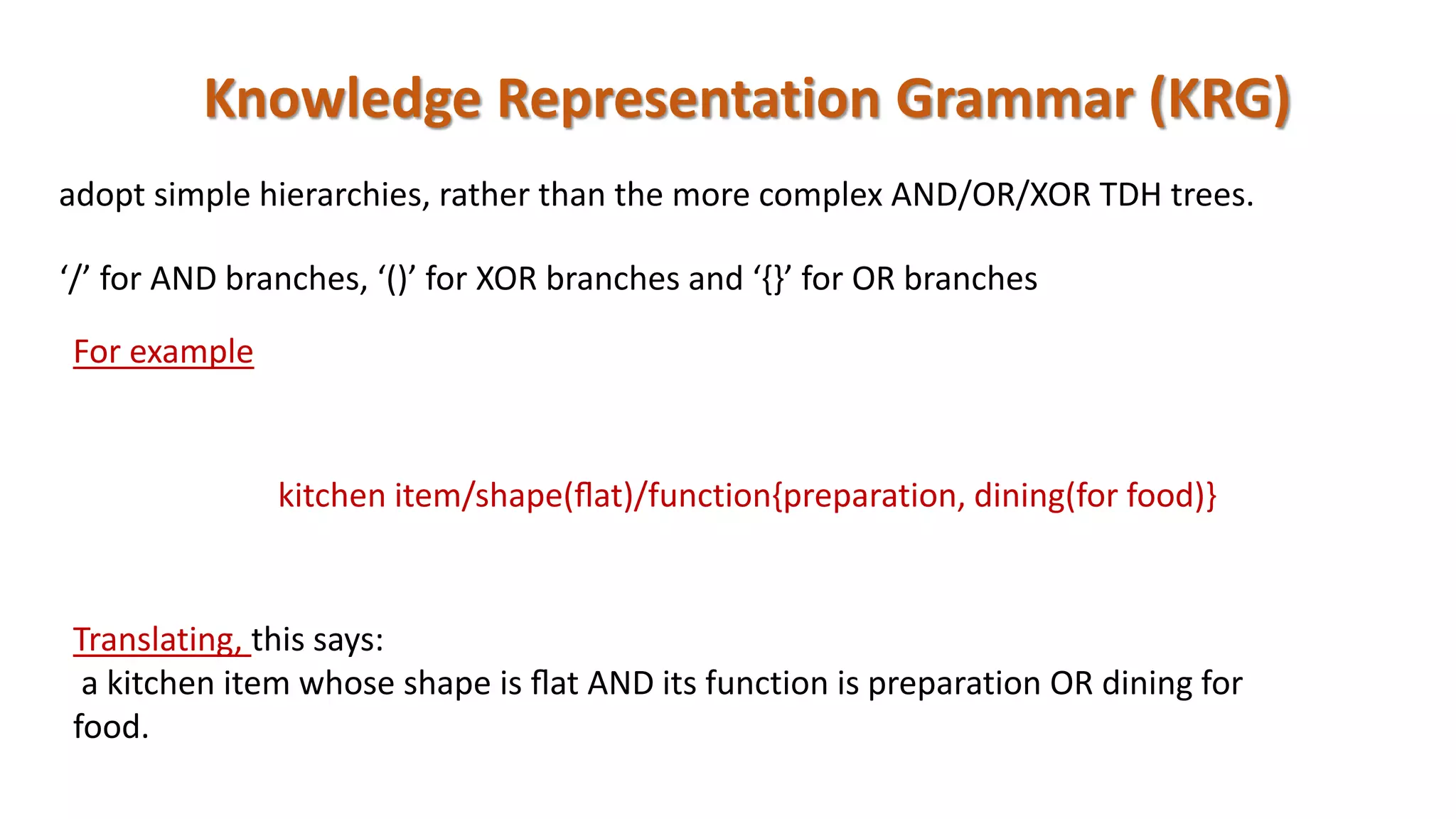
‘/’ for AND branches, ‘()’ for XOR branches and ‘{}’ for OR branches
For example
kitchen item/shape(flat)/function{preparation, dining(for food)}
Translating, this says:
a kitchen item whose shape is flat AND its function is preparation OR dining for
food.
adopt simple hierarchies, rather than the more complex AND/OR/XOR TDH trees.
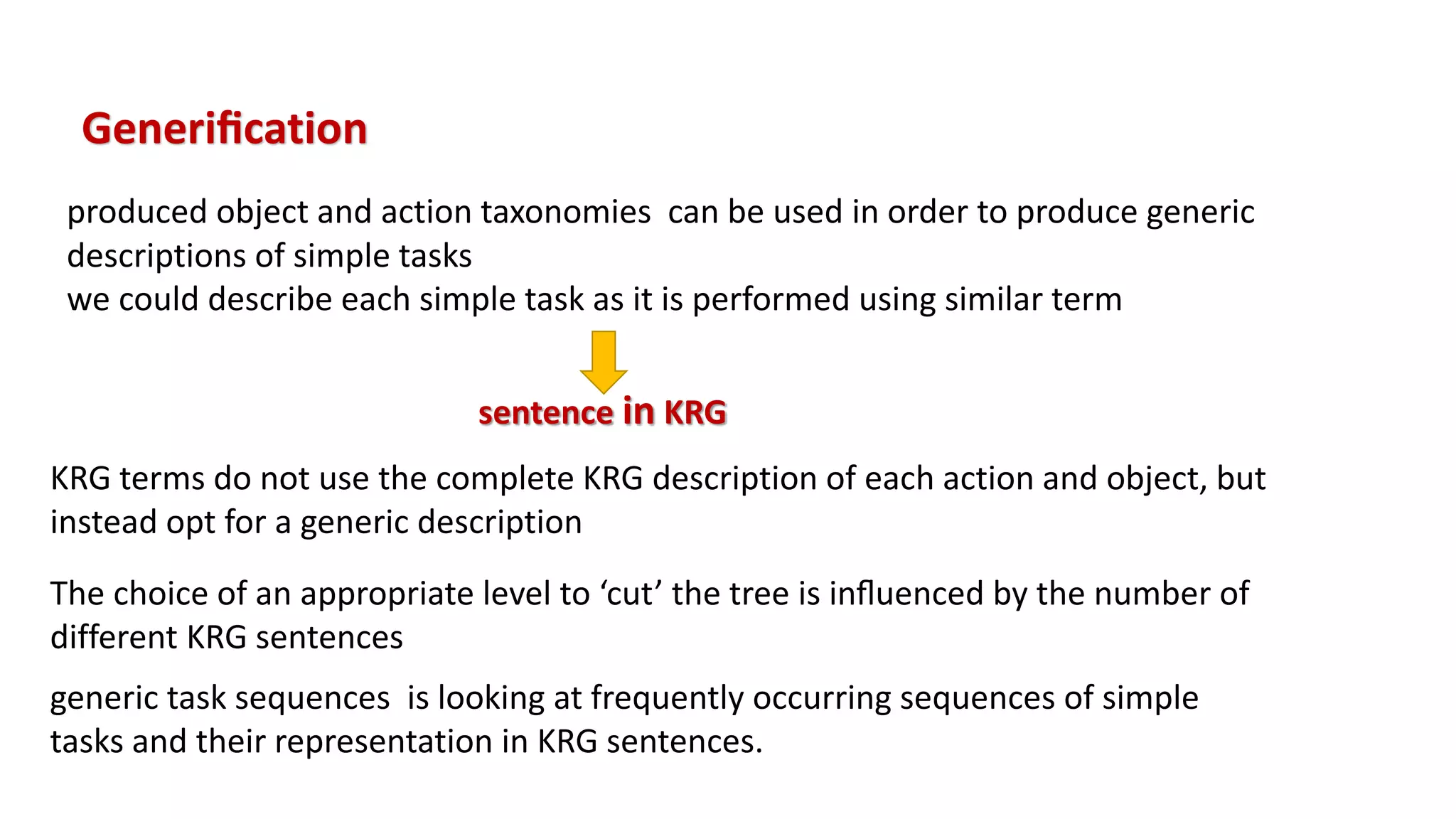
Generification
produced object and action taxonomies can be used in order to produce generic
descriptions of simple tasks
we could describe each simple task as it is performed using similar term
sentence in KRG
KRG terms do not use the complete KRG description of each action and object, but
instead opt for a generic description
The choice of an appropriate level to ‘cut’ the tree is influenced by the number of
different KRG sentences
generic task sequences is looking at frequently occurring sequences of simple
tasks and their representation in KRG sentences.
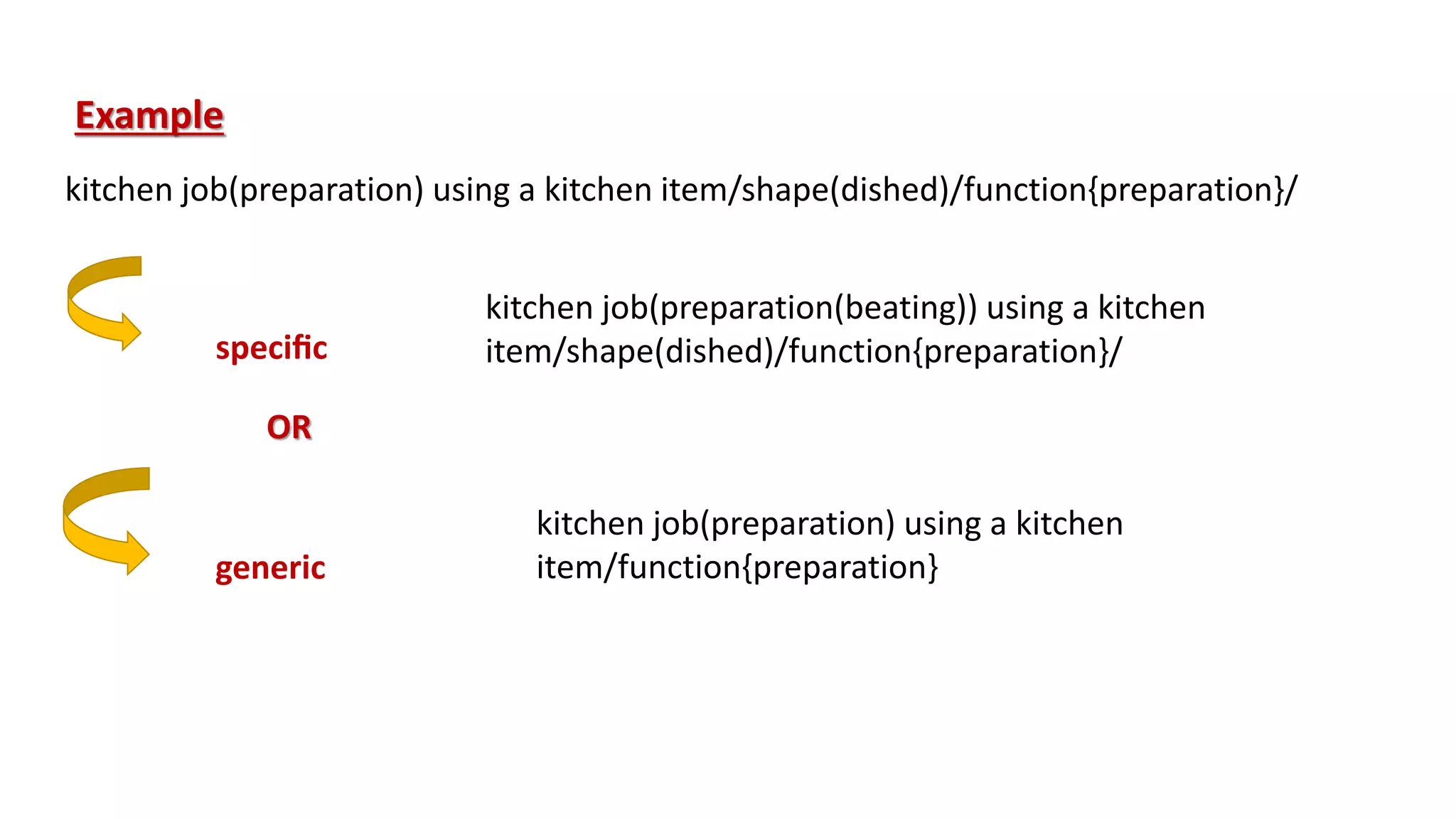
Example
kitchen job(preparation) using a kitchen item/shape(dished)/function{preparation}/
kitchen job(preparation(beating)) using a kitchen
item/shape(dished)/function{preparation}/
OR
kitchen job(preparation) using a kitchen
item/function{preparation}
specific
generic
Task Analysis
Approaches
looks at the way a task is split
into subtasks, and the order in
which these are performed
look at what users need to know
about the objects and actions
involved in a task, and how that
knowledge is organized
an object-based approach where the
emphasis is on identifying the actors
and objects, the relationships
between them and the actions they
perform.
Entity–relation-based
Analysis
Knowledge-based
Techniques
Task
Decomposition
Entity–relation-based analysis
Emphasis on
objects, actions and their relationships
Similar to object-oriented analysis, but
• includes non-computer entities
• emphasizes domain understanding not
implementation
Running example:
`Vera's Veggies’, a market gardening firm
Owner/manager: Vera Bradshaw
Employees: Sam Gummage and Tony Peagreen
various tools including a tractor `Fergie' two fields and a glasshouse
new computer controlled irrigation system
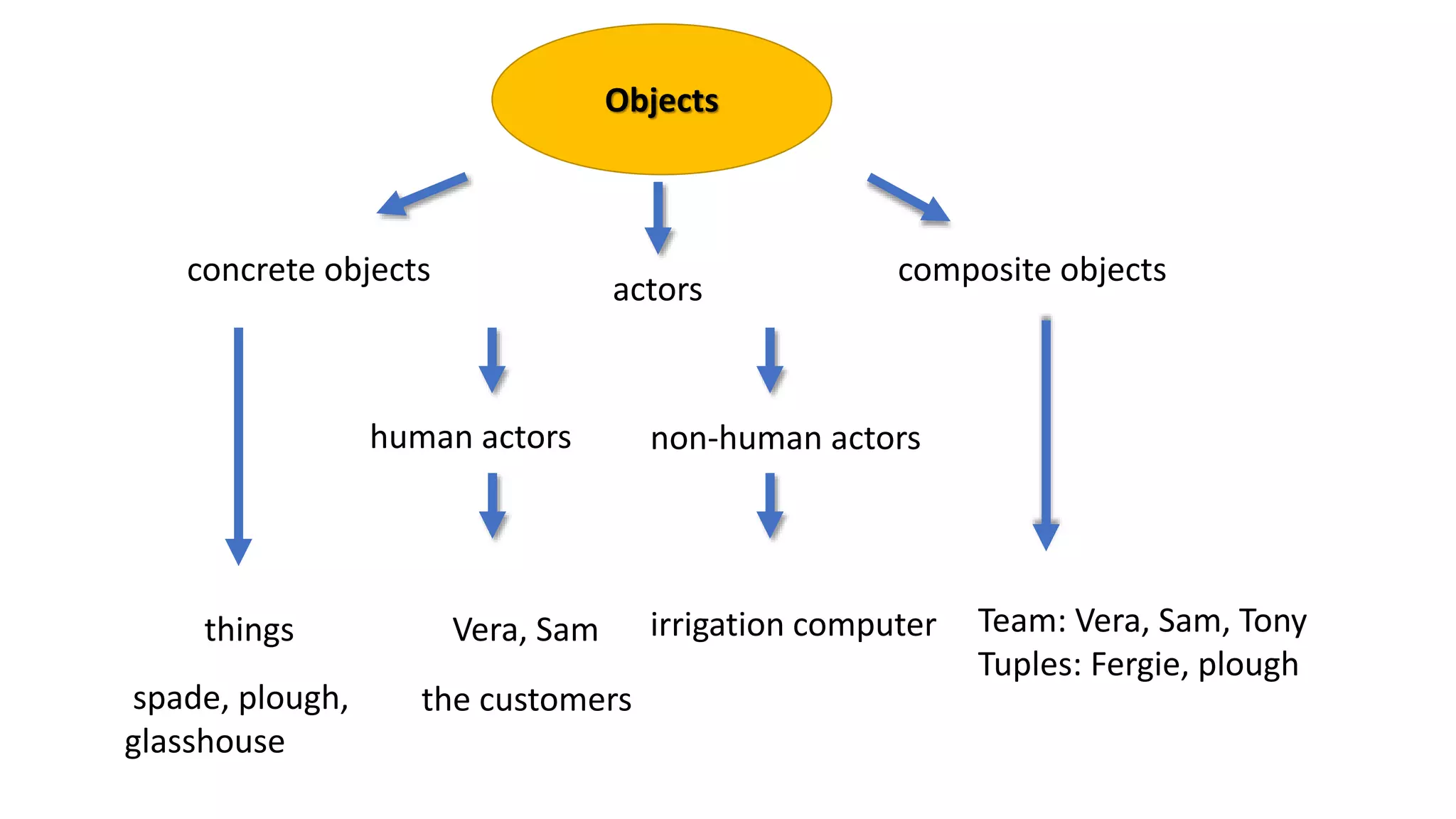
Objects
concrete objects
actors
composite objects
human actors non-human actors
Team: Vera, Sam, Tony
Tuples: Fergie, plough
things Vera, Sam irrigation computer
spade, plough,
glasshouse
the customers
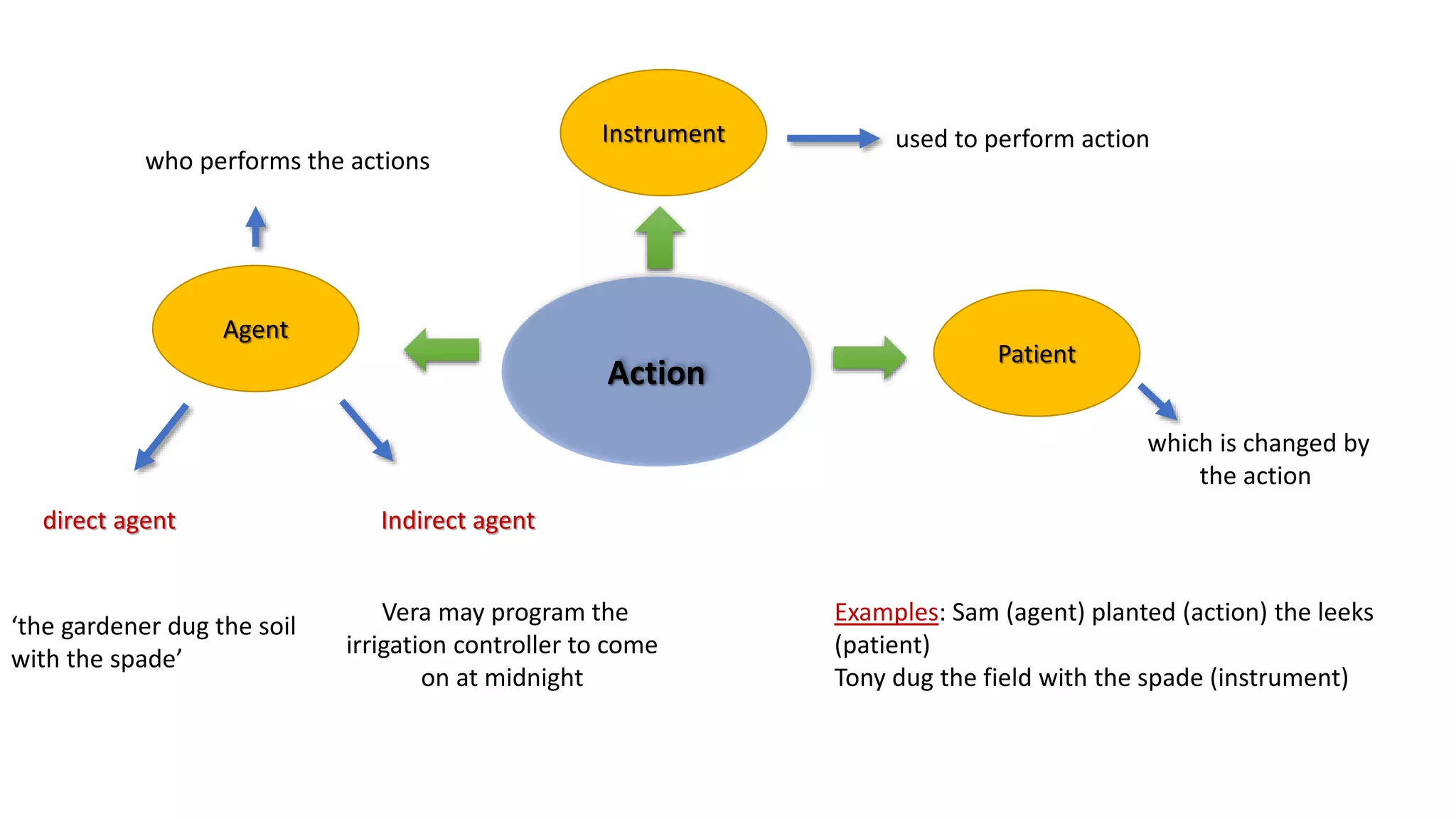
Agent
Action
Patient
‘the gardener dug the soil
with the spade’
direct agent Indirect agent
Vera may program the
irrigation controller to come
on at midnight
Examples: Sam (agent) planted (action) the leeks
(patient)
Tony dug the field with the spade (instrument)
Instrument
who performs the actions
which is changed by
the action
used to perform action
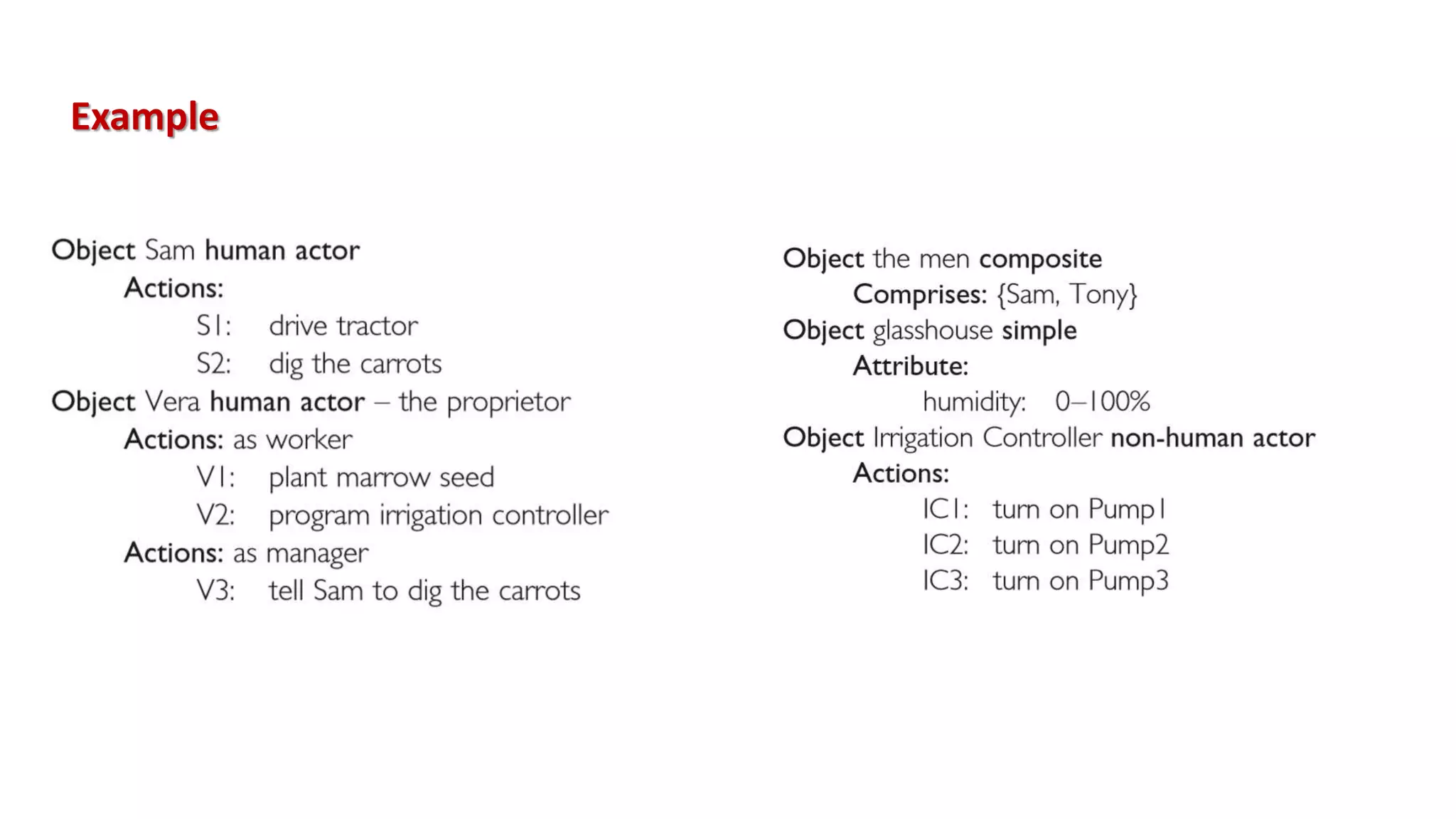
Example
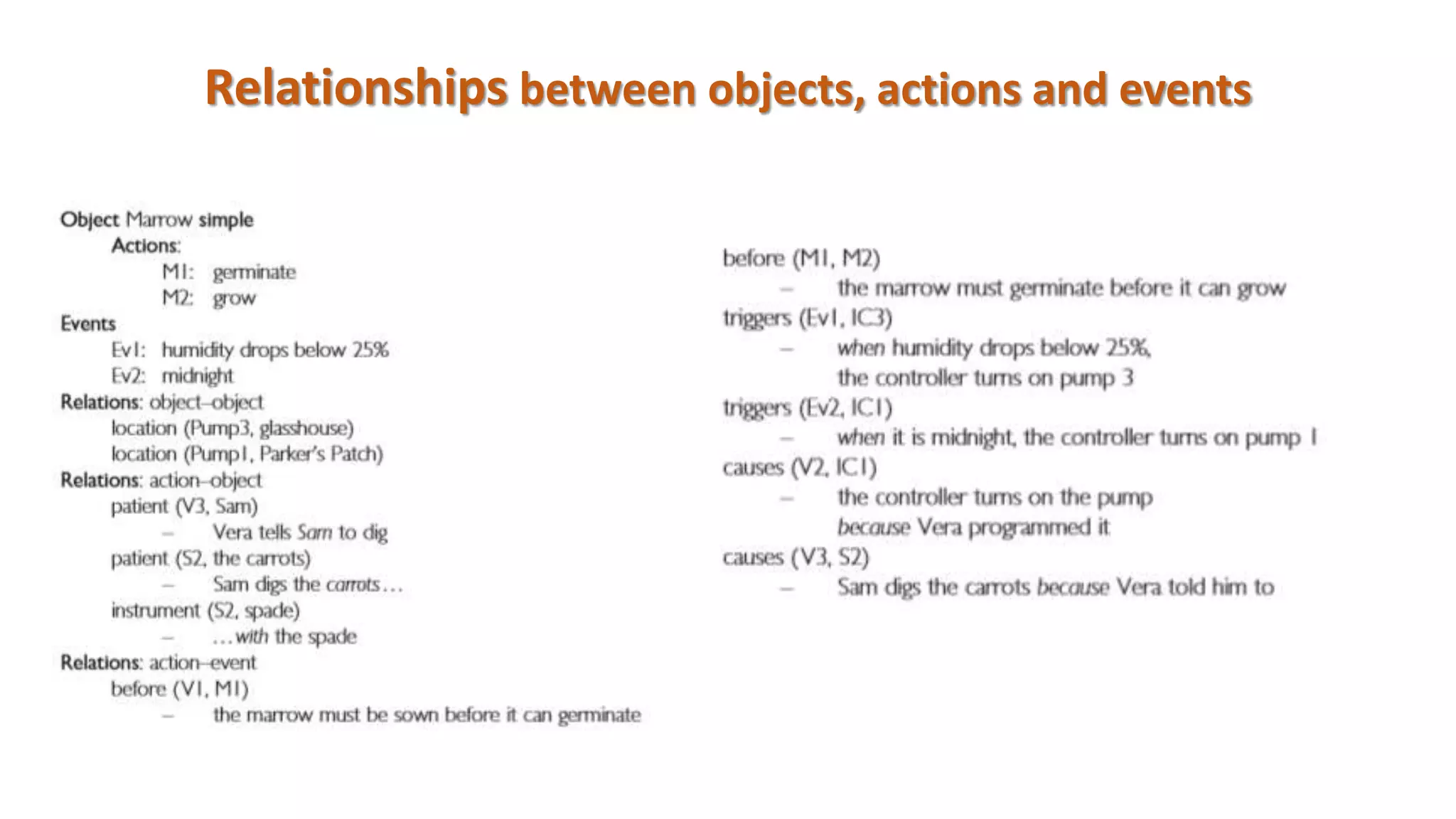
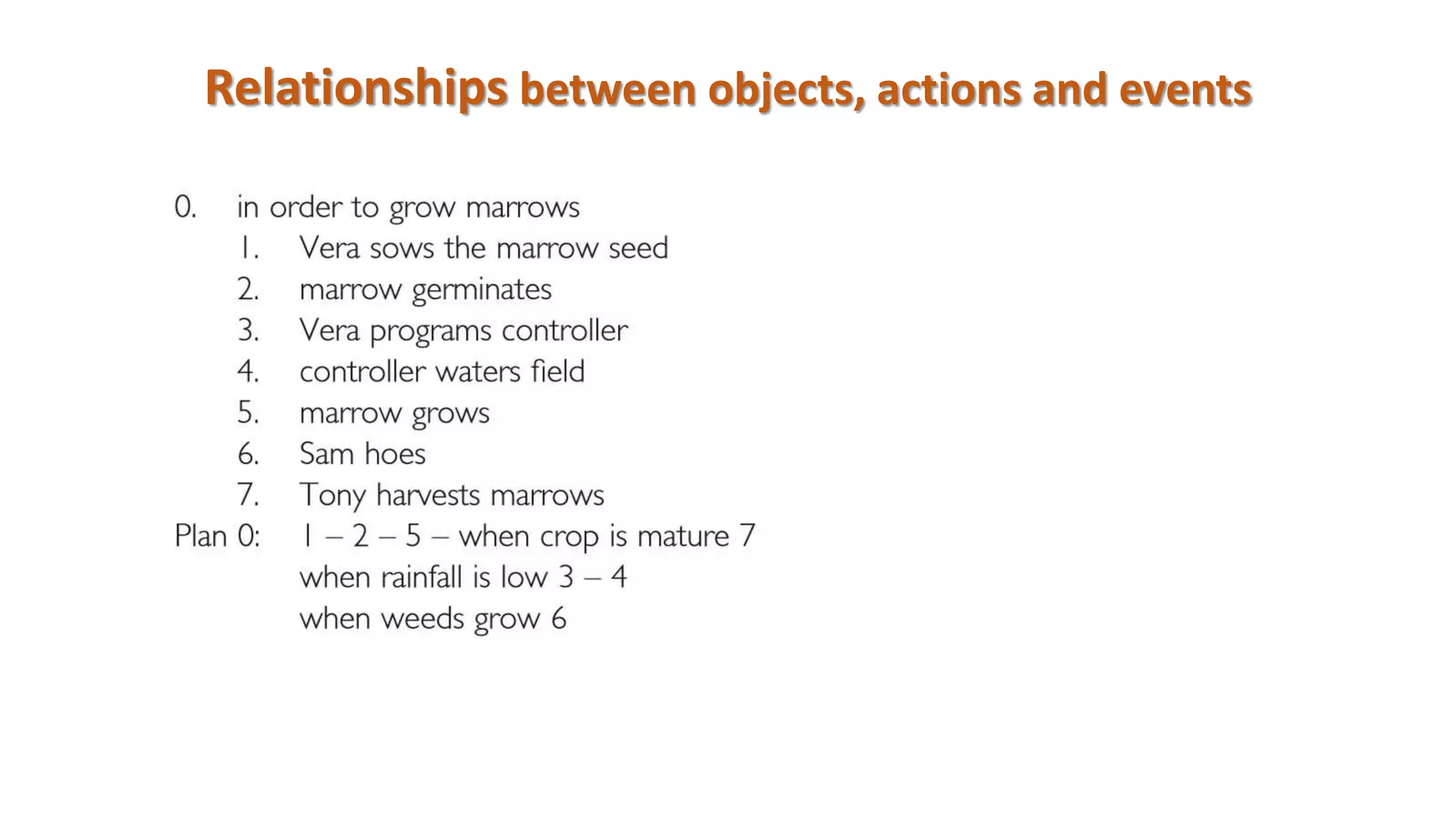
Relationships between objects, actions and events
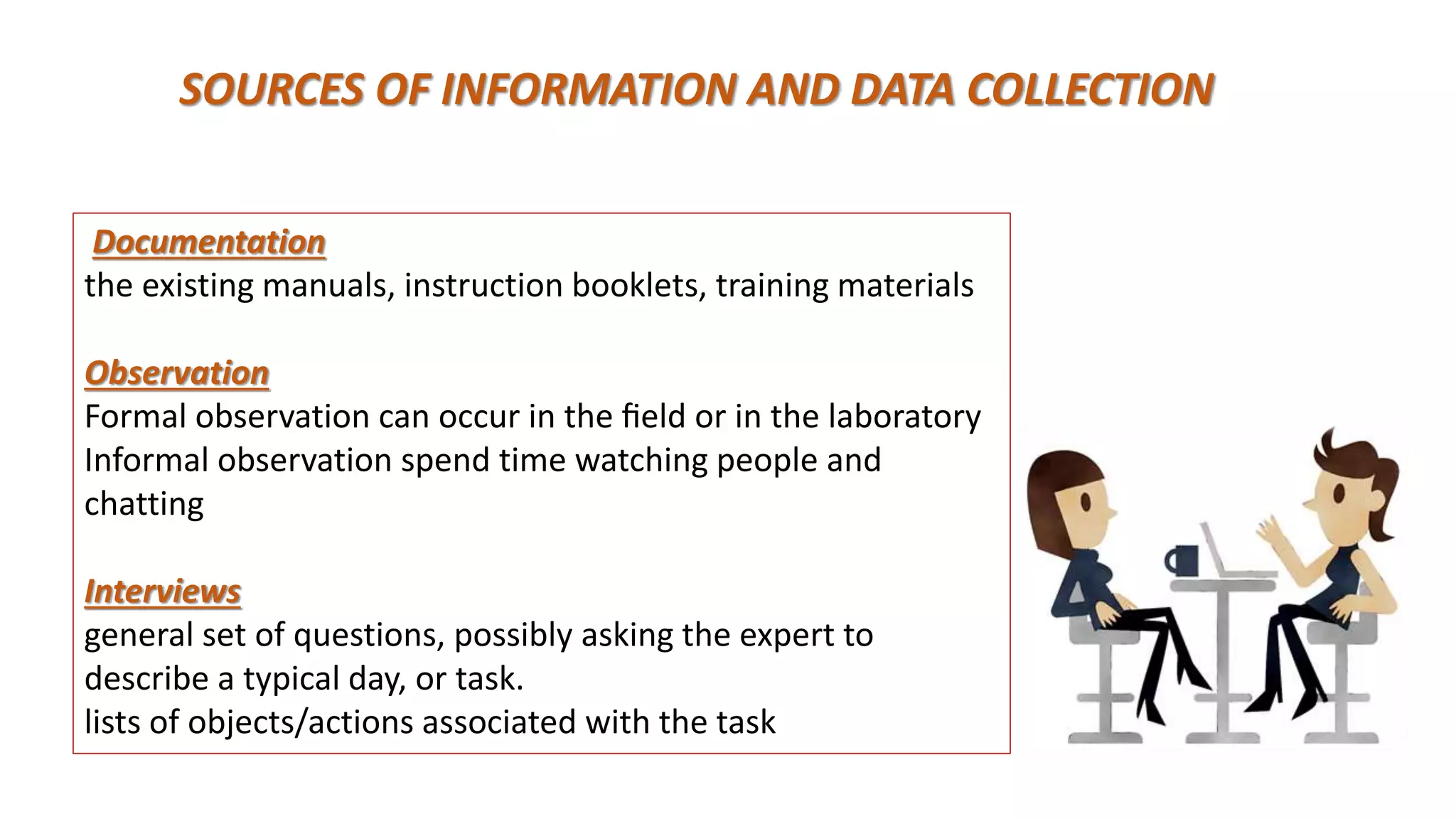
SOURCES OF INFORMATION AND DATA COLLECTION
Documentation
the existing manuals, instruction booklets, training materials
Observation
Formal observation can occur in the field or in the laboratory
Informal observation spend time watching people and
chatting
Interviews
general set of questions, possibly asking the expert to
describe a typical day, or task.
lists of objects/actions associated with the task
SOURCES OF INFORMATION AND DATA COLLECTION
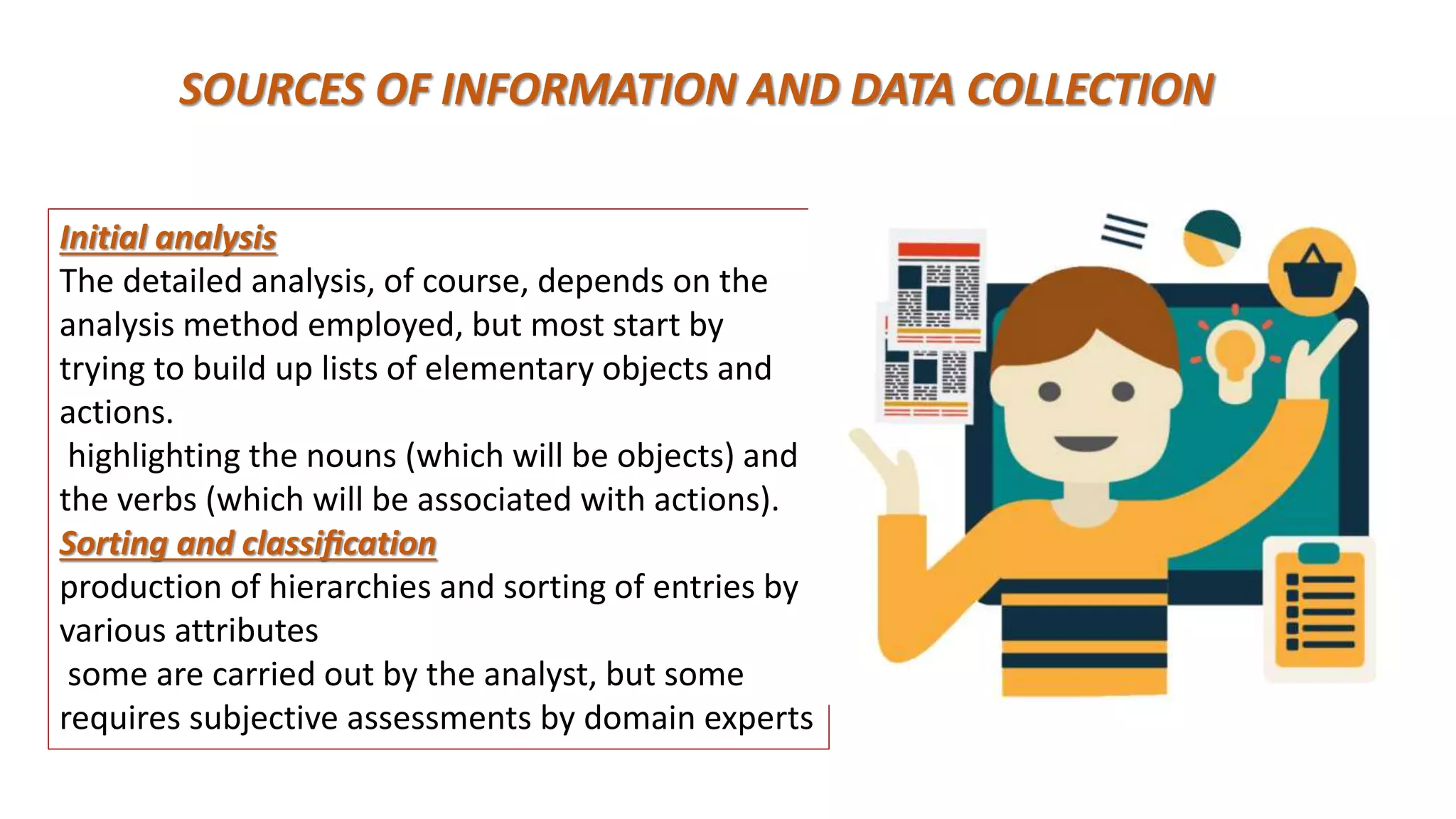
Initial analysis
The detailed analysis, of course, depends on the
analysis method employed, but most start by
trying to build up lists of elementary objects and
actions.
highlighting the nouns (which will be objects) and
the verbs (which will be associated with actions).
Sorting and classification
production of hierarchies and sorting of entries by
various attributes
some are carried out by the analyst, but some
requires subjective assessments by domain experts
USES OF TASK ANALYSIS
1. Manuals and tuition
Earliest techniques in task analysis were aimed at teaching novices how to
perform a task. In particular, this was important for military training, for example
how to disassemble and clean a rifle. Training had to be quick and efficient as
conscripts in peacetime may only serve a few years before returning to civilian
life, or in wartime may only survive a few months.
The hierarchical structure of HTA can be used to
structure manuals or course material. For example, we
want to write a beginner’s manual on tea making
based on the hierarchical task analysis
USES OF TASK ANALYSIS
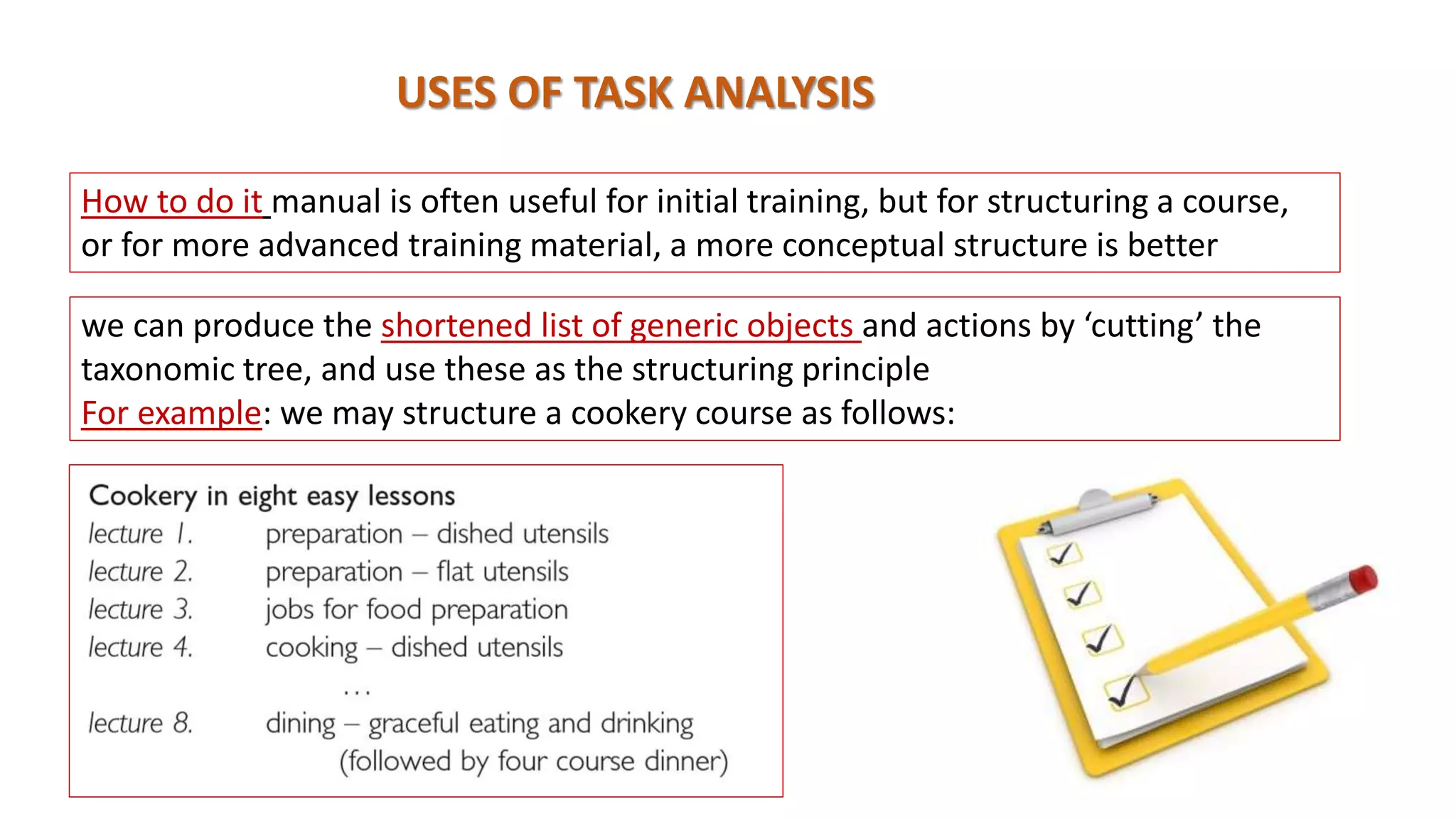
How to do it manual is often useful for initial training, but for structuring a course,
or for more advanced training material, a more conceptual structure is better
we can produce the shortened list of generic objects and actions by ‘cutting’ the
taxonomic tree, and use these as the structuring principle
For example: we may structure a cookery course as follows:
USES OF TASK ANALYSIS
Task analysis can be used to help a user transfer from
one system to another
comparison of functionality is not sufficient as the
crucial differences may be in procedures
two systems may seem completely different in terms
of detailed commands and presentation, but have
similar high-level concepts or similar patterns of use.
These common features should be brought out and
can be used to help the user transfer knowledge from
one system to another
USES OF TASK ANALYSIS
2. Requirements capture and systems design
The task analysis of an existing system can help in two ways:
1. the analyst can ask ‘Which of the existing objects, tasks, etc., should be in the
new system?’
2. the formalized presentation of the existing state of affairs may help the client to
clarify what the novel features are to be.
TDH taxonomies can help the designer to choose an
internal model for the system which matches the existing
expectations of the users. This may, of course, be
modified to accommodate novel features, but gives a
reasonable first structure.
USES OF TASK ANALYSIS
Task sequences obtained from a task decomposition can be
used when designing the system’s dialog
The order in which subtasks are performed in the system can
be made to mirror that of the original job.
If we know that a certain task is frequently performed, then
we want it to be easy for the user to perform the subtasks in
the appropriate order.
3. Detailed interface design
Taxonomies of tasks or objects may be used in the design of menus
TDH trees are obviously most useful in this respect.
An object/action may be found by several paths through the menus.
Task analysis

Task analysis

  • 1.
    Reham Marzouk Institute ofGraduate Studies & Research Human Computer Interaction Course Code: 1404811
  • 2.
    AGENDA I. Introduction II. TaskAnalysis Approaches I. Task decomposition I. Hierarchical task analysis (HTA) II. Knowledge-based technique I. Task analysis for knowledge description (TAKD) II. knowledge representation grammar (KRG) III. Entity–relation-based analysis III. Source of information and Data collection IV. Uses of Task Analysis
  • 3.
    What’s Task analysis Taskanalysis is the process of analyzing the way people perform their jobs: the things they do, the things they act on and the things they need to know. One of the purposes of task analysis is to help in the production of training materials and documentation. For this purpose, analysis of existing systems is sufficient Task analysis is about existing systems and procedures; its main tools are those of observation in various forms
  • 4.
    What are theaims of Task Analysis  Verifies that the set of actions employed by the user does accomplish the task  Used to predict the time taken to learn a new task and become a proficient user of the particular application  Used to predict the time taken for a proficient user to accomplish the set task  To improve the delivery of information to the user
  • 5.
    Scope of Taskanalysis  Unlike goal-oriented models that understand the internal cognitive processes.  Look more at the observable behavior of users than their internal mental state.  Restricted to precisely this objective observable behavior.  You should be interested in what, not why.  Include some inferences about the user’s internal goals.
  • 6.
    Task Analysis Approaches looks atthe way a task is split into subtasks, and the order in which these are performed look at what users need to know about the objects and actions involved in a task, and how that knowledge is organized an object-based approach where the emphasis is on identifying the actors and objects, the relationships between them and the actions they perform. Entity–relation-based Analysis Knowledge-based Techniques Task Decomposition
  • 7.
    Aims: describe the actionspeople do structure them within task subtask hierarchy describe order of subtasks Variant: Hierarchical task analysis (HTA) is typical of such an approach A hierarchy of tasks, subtasks and plans describing in what order and under what conditions subtasks are performed TASK DECOMPOSITION
  • 8.
  • 9.
    Hierarchical task analysis(HTA) How does one produce such a hierarchy with attendant rules? What subtasks must be accomplished in order to perform the main task? Q Apply some form of stopping rule in order to decide when the tasks are basic enough A EX  A rule, which is particularly appropriate when the aim is to design training materials, is the P × C rule. This says that if the probability of making a mistake in the task (P) multiplied by the cost of the mistake (C) is below a threshold, then stop expanding  Another obvious stopping point is where the task contains complex motor responses (like mouse movement) or where it involves internal decision making
  • 11.
    Warm a pot Errors& Omissions
  • 12.
    Warm a pot Errors& Omissions
  • 13.
  • 14.
    3. make apot Warm a pot
  • 15.
  • 16.
    3. make apot Plan 5. 5.1 – 5.2 if desired 5.3
  • 17.
  • 19.
  • 20.
  • 21.
  • 22.
  • 23.
    Fixed sequence Optional tasks Waitingfor events Cycles Time sharing
  • 24.
    Fixed sequence Optional tasks Waitingfor events Cycles Time sharing Mixtures
  • 25.
    Task Analysis Approaches looks atthe way a task is split into subtasks, and the order in which these are performed look at what users need to know about the objects and actions involved in a task, and how that knowledge is organized an object-based approach where the emphasis is on identifying the actors and objects, the relationships between them and the actions they perform. Entity–relation-based Analysis Knowledge-based Techniques Task Decomposition
  • 26.
    Knowledge-based technique Aims: • understandknowledge required to perform a task • provide training material, how-to manuals; • take advantage of common knowledge across tasks. Focus on: • objects used in task • actions performed Use taxonomies: • represent levels of abstraction • organization (grouping) depends on purpose • listing all objects then remove unnecessary Declarative knowledge elicitation techniques: • established convention, existing documentation • asking users to list objects; card sorting • structured interviews, listing nouns and verbs
  • 27.
    Knowledge-based technique An exampletaxonomic structure every control has exactly one place in the hierarchy
  • 28.
    Knowledge-based technique Depending onthe expected use of the task analysis, we may require different structures An example taxonomic structure
  • 29.
    Knowledge-based technique driver’s viewpointthe accelerator and the brake perform related functions, but they have no connection mechanically An example taxonomic structure
  • 30.
    Knowledge-based technique An exampletaxonomic structure owner’s viewpoint hand brake has been put with the door locks as an aspect of parking, but it should also be used as part of ordinary driving
  • 31.
    Knowledge-based technique An exampletaxonomic structure These decisions could be justified based on particular purposes, but others are purely arbitrary. We could just have easily classified the washers/wipers into front and rear first there are two attributes: ‘function’ (wash or wipe) and ‘position’ (front or rear)
  • 32.
    Task analysis forknowledge description (TAKD) Task Analysis for Knowledge Description (TAKD) uses three types of branches in TDH taxonomies: • XOR — object in exactly one branch • AND — object must be in both • OR — can be in one, many or none Uses a special form of taxonomy called Task Descriptive Hierarchy (TDH) A completed TDH can distinguish any two specific objects
  • 33.
    Wash/wipe Example TDH -Task Description Hierarchy
  • 34.
    Wash/wipe Example TDH -Task Description Hierarchy
  • 35.
    OR branches arisewhere the object could fall into more than one of the categories
  • 36.
    TAKD has auniqueness rule, which demands that a completed TDH can distinguish any two specific objects.
  • 38.
    Knowledge Representation Grammar(KRG) ‘/’ for AND branches, ‘()’ for XOR branches and ‘{}’ for OR branches For example kitchen item/shape(flat)/function{preparation, dining(for food)} Translating, this says: a kitchen item whose shape is flat AND its function is preparation OR dining for food. adopt simple hierarchies, rather than the more complex AND/OR/XOR TDH trees.
  • 39.
    Generification produced object andaction taxonomies can be used in order to produce generic descriptions of simple tasks we could describe each simple task as it is performed using similar term sentence in KRG KRG terms do not use the complete KRG description of each action and object, but instead opt for a generic description The choice of an appropriate level to ‘cut’ the tree is influenced by the number of different KRG sentences generic task sequences is looking at frequently occurring sequences of simple tasks and their representation in KRG sentences.
  • 40.
    Example kitchen job(preparation) usinga kitchen item/shape(dished)/function{preparation}/ kitchen job(preparation(beating)) using a kitchen item/shape(dished)/function{preparation}/ OR kitchen job(preparation) using a kitchen item/function{preparation} specific generic
  • 41.
    Task Analysis Approaches looks atthe way a task is split into subtasks, and the order in which these are performed look at what users need to know about the objects and actions involved in a task, and how that knowledge is organized an object-based approach where the emphasis is on identifying the actors and objects, the relationships between them and the actions they perform. Entity–relation-based Analysis Knowledge-based Techniques Task Decomposition
  • 42.
    Entity–relation-based analysis Emphasis on objects,actions and their relationships Similar to object-oriented analysis, but • includes non-computer entities • emphasizes domain understanding not implementation Running example: `Vera's Veggies’, a market gardening firm Owner/manager: Vera Bradshaw Employees: Sam Gummage and Tony Peagreen various tools including a tractor `Fergie' two fields and a glasshouse new computer controlled irrigation system
  • 43.
    Objects concrete objects actors composite objects humanactors non-human actors Team: Vera, Sam, Tony Tuples: Fergie, plough things Vera, Sam irrigation computer spade, plough, glasshouse the customers
  • 44.
    Agent Action Patient ‘the gardener dugthe soil with the spade’ direct agent Indirect agent Vera may program the irrigation controller to come on at midnight Examples: Sam (agent) planted (action) the leeks (patient) Tony dug the field with the spade (instrument) Instrument who performs the actions which is changed by the action used to perform action
  • 45.
  • 46.
  • 47.
  • 48.
    SOURCES OF INFORMATIONAND DATA COLLECTION Documentation the existing manuals, instruction booklets, training materials Observation Formal observation can occur in the field or in the laboratory Informal observation spend time watching people and chatting Interviews general set of questions, possibly asking the expert to describe a typical day, or task. lists of objects/actions associated with the task
  • 49.
    SOURCES OF INFORMATIONAND DATA COLLECTION Initial analysis The detailed analysis, of course, depends on the analysis method employed, but most start by trying to build up lists of elementary objects and actions. highlighting the nouns (which will be objects) and the verbs (which will be associated with actions). Sorting and classification production of hierarchies and sorting of entries by various attributes some are carried out by the analyst, but some requires subjective assessments by domain experts
  • 50.
    USES OF TASKANALYSIS 1. Manuals and tuition Earliest techniques in task analysis were aimed at teaching novices how to perform a task. In particular, this was important for military training, for example how to disassemble and clean a rifle. Training had to be quick and efficient as conscripts in peacetime may only serve a few years before returning to civilian life, or in wartime may only survive a few months. The hierarchical structure of HTA can be used to structure manuals or course material. For example, we want to write a beginner’s manual on tea making based on the hierarchical task analysis
  • 51.
    USES OF TASKANALYSIS How to do it manual is often useful for initial training, but for structuring a course, or for more advanced training material, a more conceptual structure is better we can produce the shortened list of generic objects and actions by ‘cutting’ the taxonomic tree, and use these as the structuring principle For example: we may structure a cookery course as follows:
  • 52.
    USES OF TASKANALYSIS Task analysis can be used to help a user transfer from one system to another comparison of functionality is not sufficient as the crucial differences may be in procedures two systems may seem completely different in terms of detailed commands and presentation, but have similar high-level concepts or similar patterns of use. These common features should be brought out and can be used to help the user transfer knowledge from one system to another
  • 53.
    USES OF TASKANALYSIS 2. Requirements capture and systems design The task analysis of an existing system can help in two ways: 1. the analyst can ask ‘Which of the existing objects, tasks, etc., should be in the new system?’ 2. the formalized presentation of the existing state of affairs may help the client to clarify what the novel features are to be. TDH taxonomies can help the designer to choose an internal model for the system which matches the existing expectations of the users. This may, of course, be modified to accommodate novel features, but gives a reasonable first structure.
  • 54.
    USES OF TASKANALYSIS Task sequences obtained from a task decomposition can be used when designing the system’s dialog The order in which subtasks are performed in the system can be made to mirror that of the original job. If we know that a certain task is frequently performed, then we want it to be easy for the user to perform the subtasks in the appropriate order. 3. Detailed interface design Taxonomies of tasks or objects may be used in the design of menus TDH trees are obviously most useful in this respect. An object/action may be found by several paths through the menus.