chapter 15 task models
What is Task Analysis? Methods to analyse people's jobs: what people do what things they work with what they must know
An Example in order to clean the house get the vacuum cleaner out   fix  the appropriate attachments clean the rooms when the dust bag gets full, empty it put the vacuum cleaner and tools away must know about: vacuum cleaners, their attachments,   dust bags,  cupboards, rooms etc.
Approaches to task analysi s Task decomposition splitting task into (ordered) subtasks Knowledge based techniques what the user knows about the task and how it is organised Entity/object  based analysis relationships between objects, actions and the people who perform them lots of different notations/techniques
general method observe collect  unstructured lists of words and actions organize   using notation or diagrams
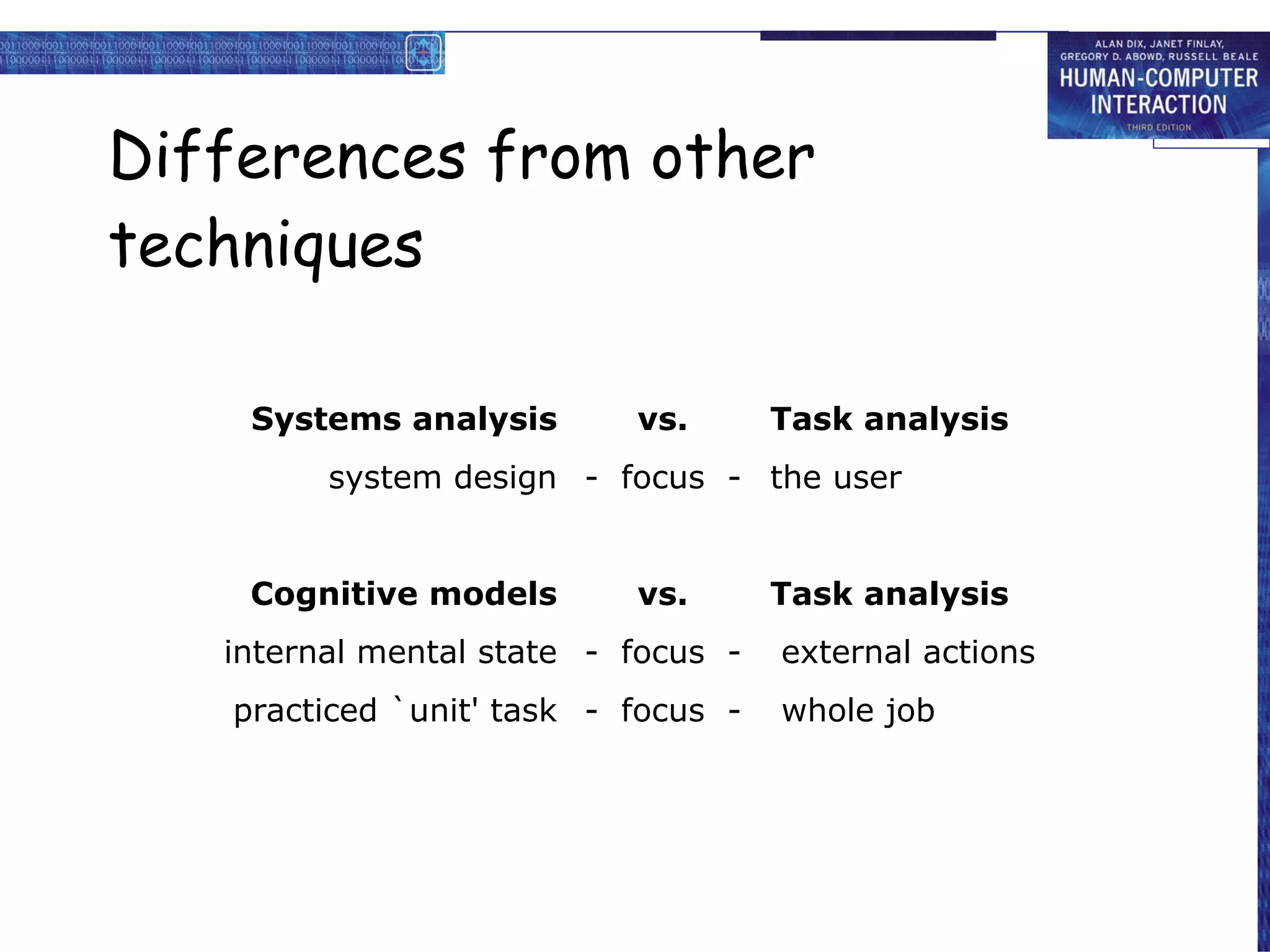
Di ffe rences from other techniques Systems analysis vs. Task analysis system design -  focus  - the user Cognitive models vs. Task analysis internal mental state -  focus  -  external actions practiced `unit' task -  focus  -  whole job
Task Decomposition Aims: describe the actions people do structure them within task subtask  h ierarchy describe order of subtasks Variants: Hierarchical Task Analysis (HTA) most common  CTT (CNUCE, Pisa) uses LOTOS temporal operators
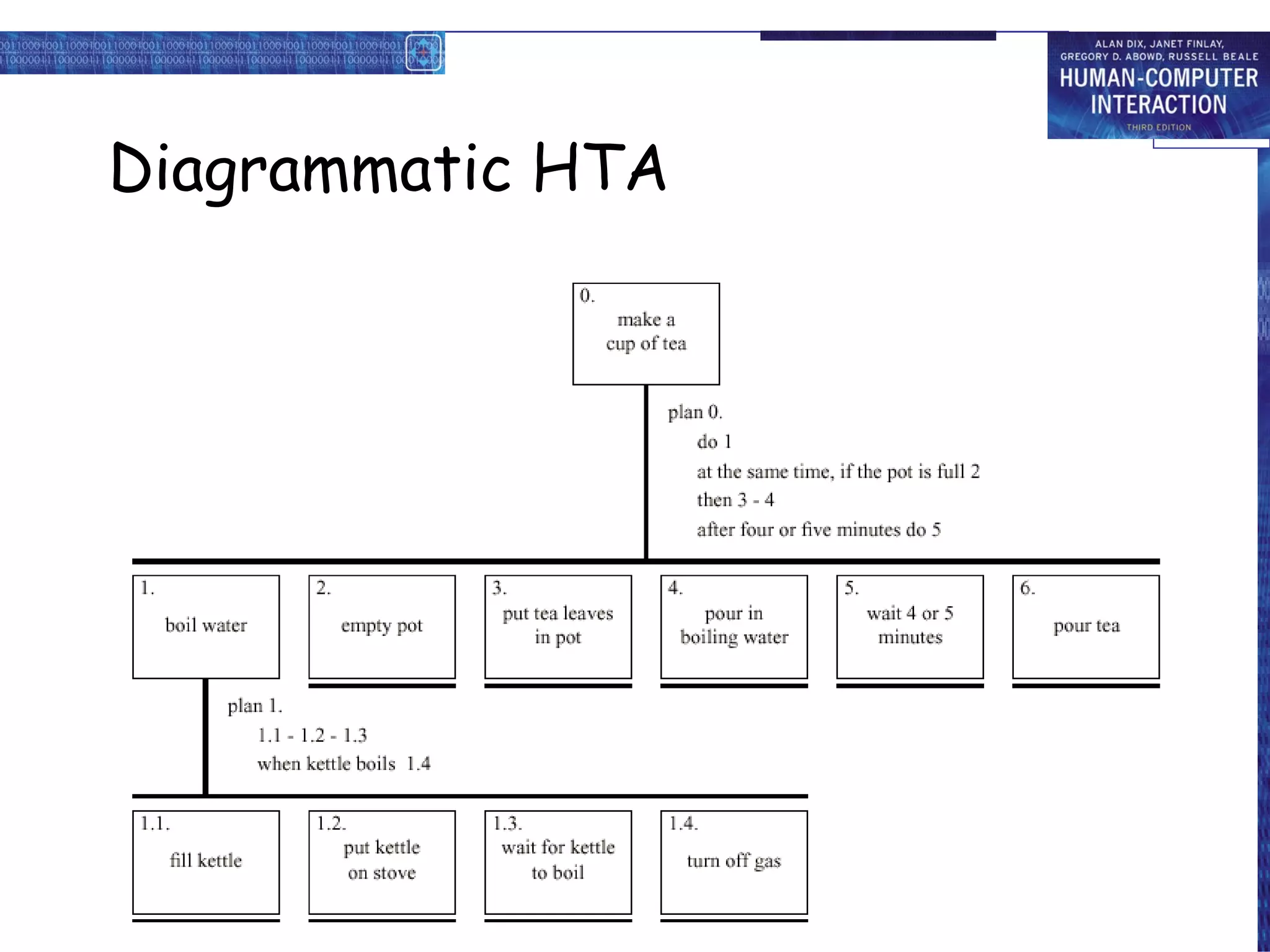
Textual HTA description Hierarchy description ... 0. in order to clean the house 1. get the vacuum cleaner out 2. get the appropriate attachment 3. clean the rooms 3.1. clean the hall 3.2. clean the living rooms 3.3. clean the bedrooms 4. empty the dust bag 5. put vacuum cleaner and attachments away ... and plans Plan 0: do 1 - 2 - 3 - 5 in that order. when the dust bag gets full do 4 Plan 3: do any of 3.1, 3.2 or 3.3 in any order depending   on which rooms need cleaning N.B. only the plans denote order
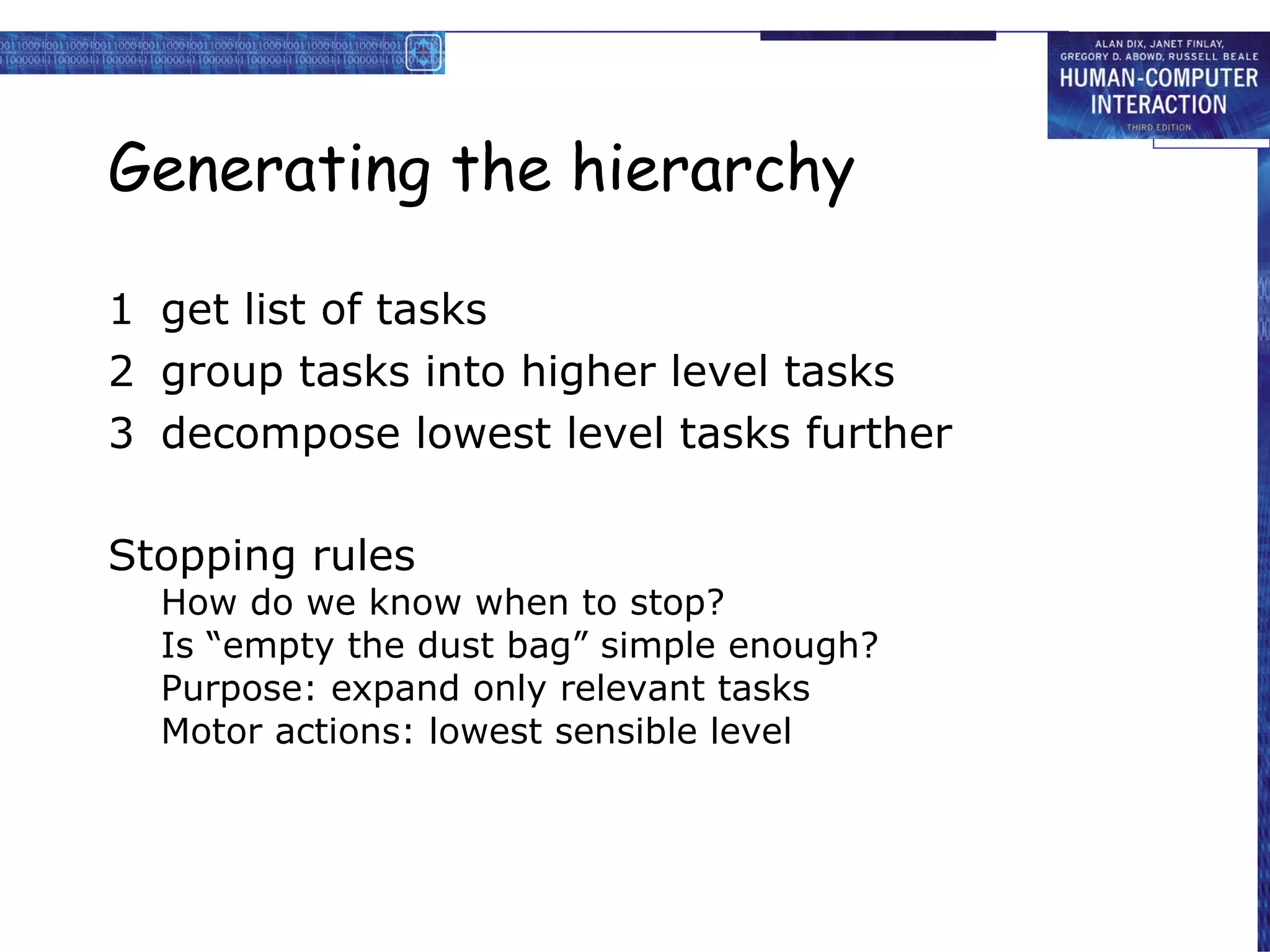
Generating the hierarchy 1  get list of tasks 2  group tasks into higher level tasks 3  decompose lowest level tasks further Stopping rules How do we know when to stop? Is “empty the dust bag” simple enough? Purpose: expand only relevant tasks Motor actions: lowest sensible level
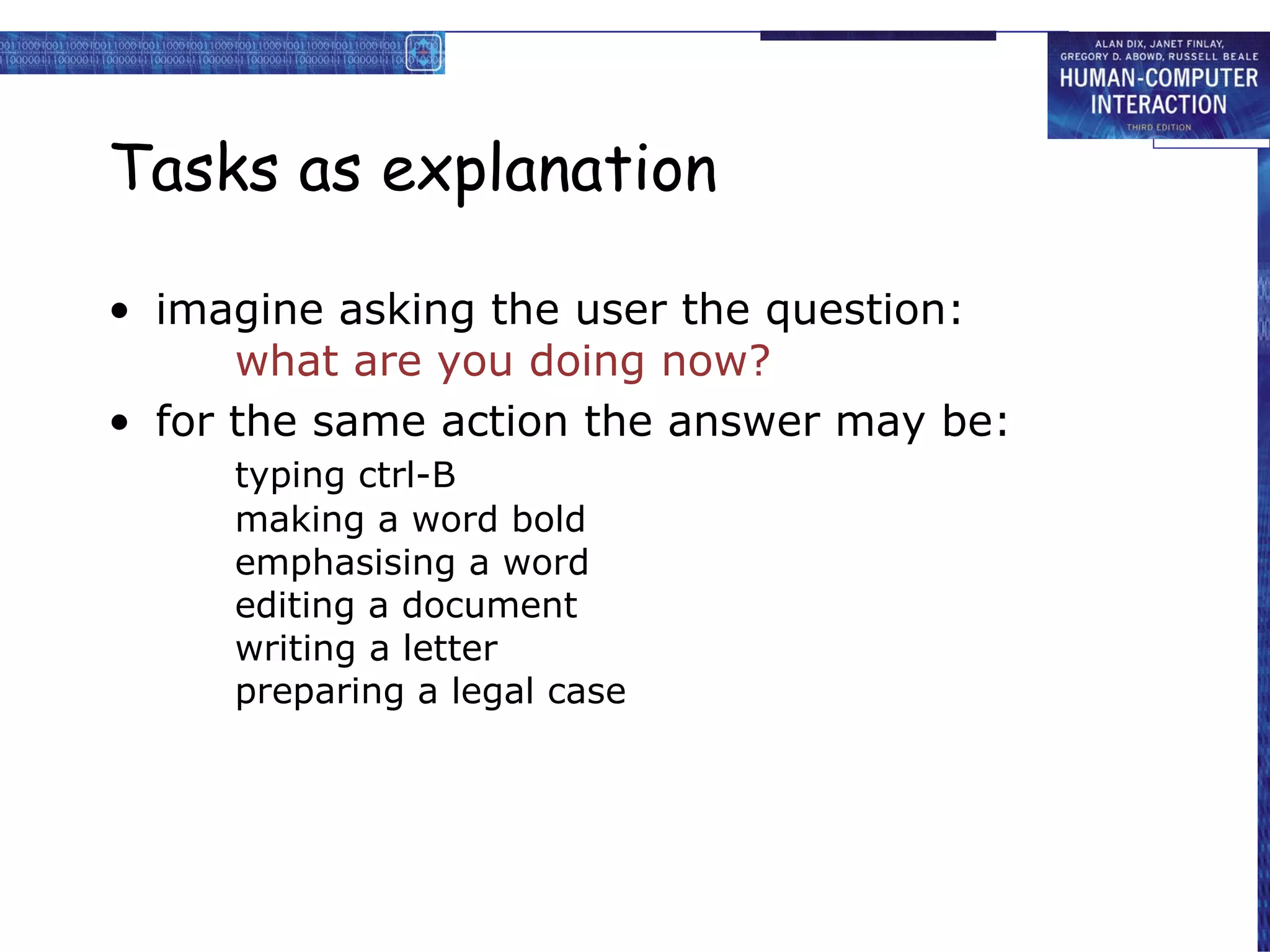
Tasks as explanation imagine asking the user the question: what are you doing now? for the same action the answer may be: typing ctrl-B making a word bold emphasising a word editing a document writing a letter preparing a legal case
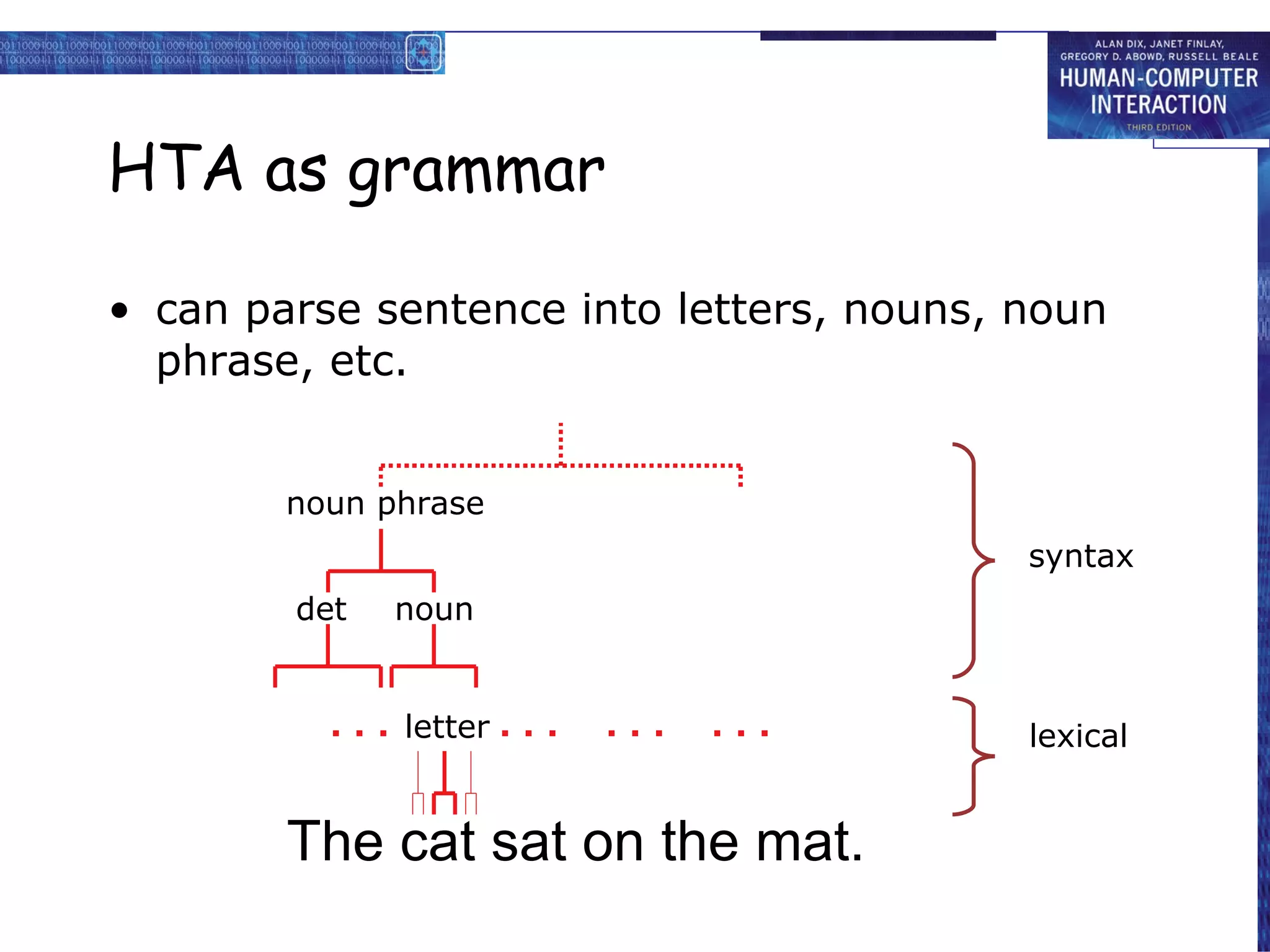
HTA as grammar can parse sentence into letters, nouns, noun phrase, etc. The cat sat on the mat. letter noun det noun phrase . . . . . . . . . . . . lexical syntax
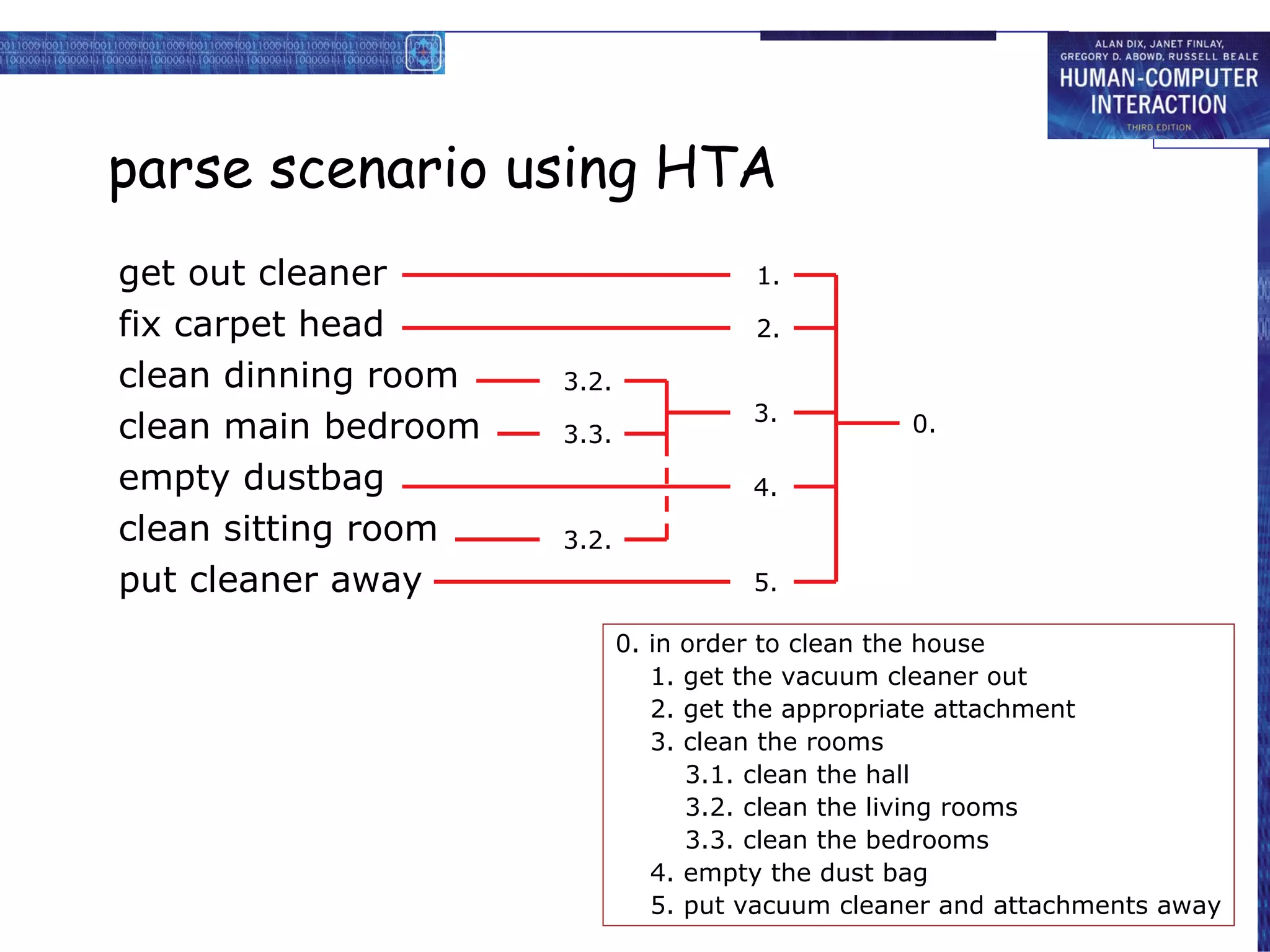
parse scenario using HTA 0. in order to clean the house 1. get the vacuum cleaner out 2. get the appropriate attachment 3. clean the rooms 3.1. clean the hall 3.2. clean the living rooms 3.3. clean the bedrooms 4. empty the dust bag 5. put vacuum cleaner and attachments away get out cleaner fix carpet head clean dinning room clean main bedroom empty dustbag clean sitting room put cleaner away 1. 2. 3.2. 3.3. 3.2. 3. 4. 5. 0.
Diagrammatic HTA
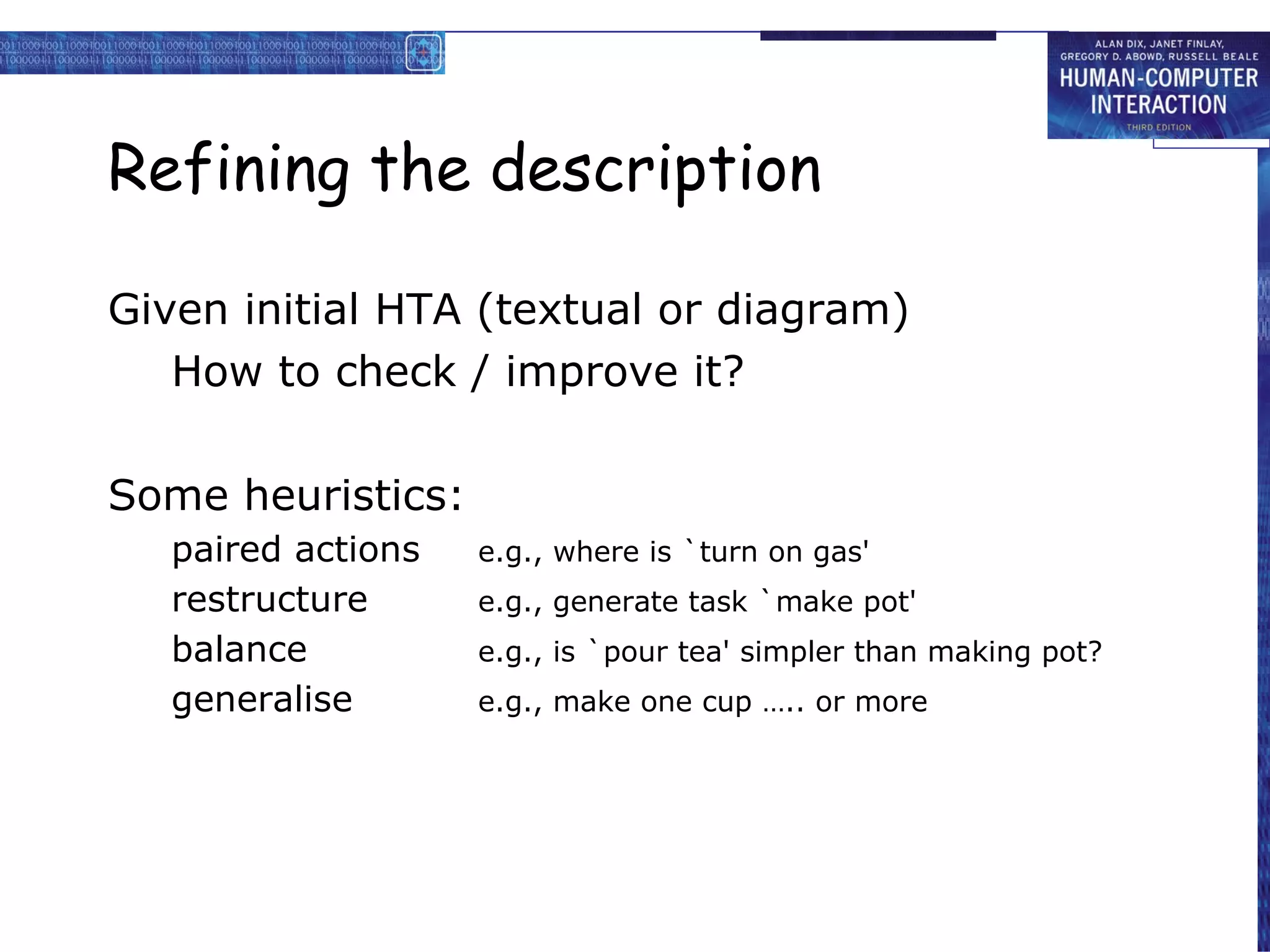
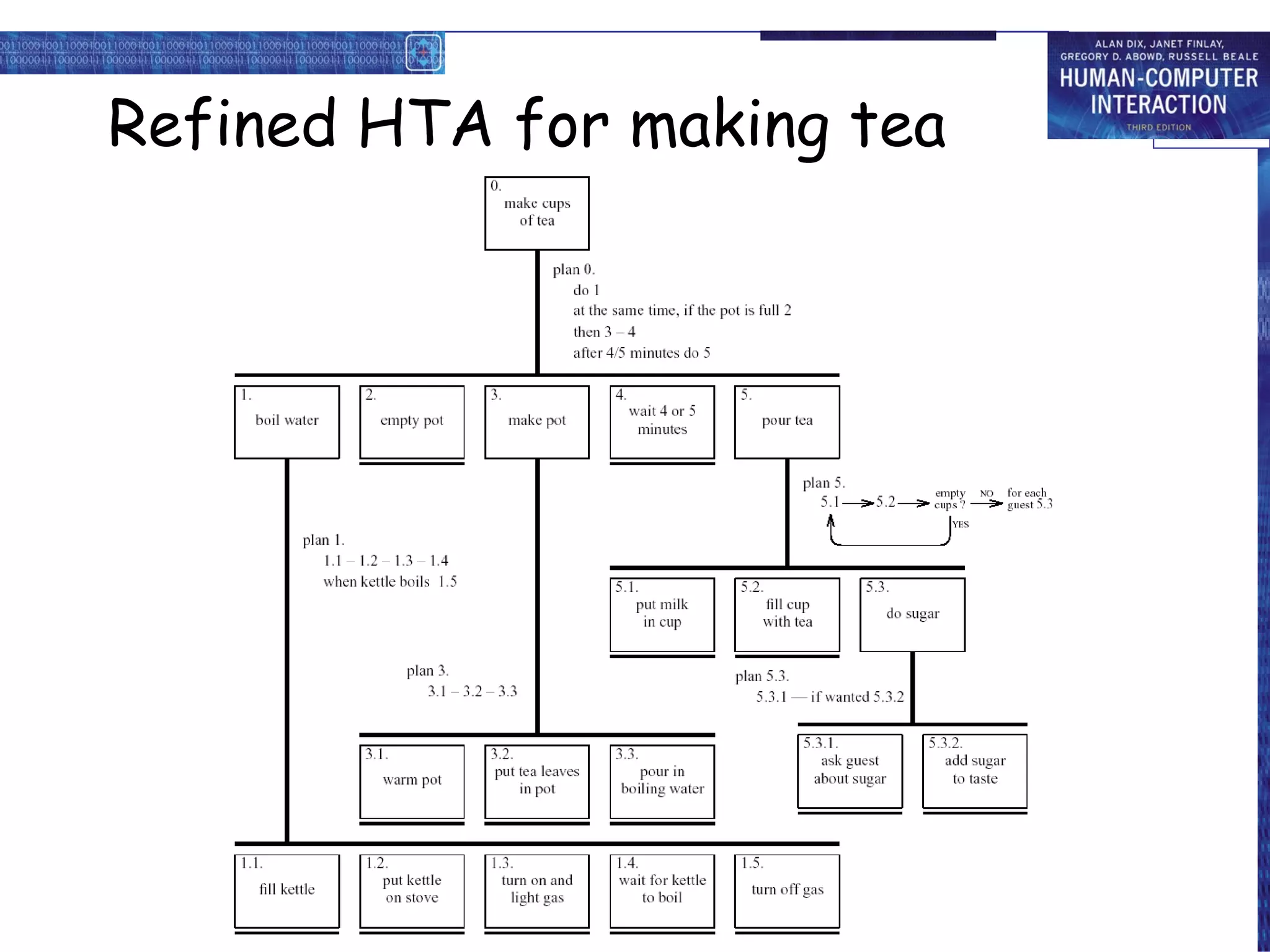
Refining the description Given initial HTA (textual or diagram) How to check / improve it? Some heuristics: paired actions e.g., where is `turn on gas' restructure e.g., generate task `make pot' balance e.g., is `pour tea' simpler than making pot? generalise e.g., make one cup ….. or more
Refined HTA for making tea
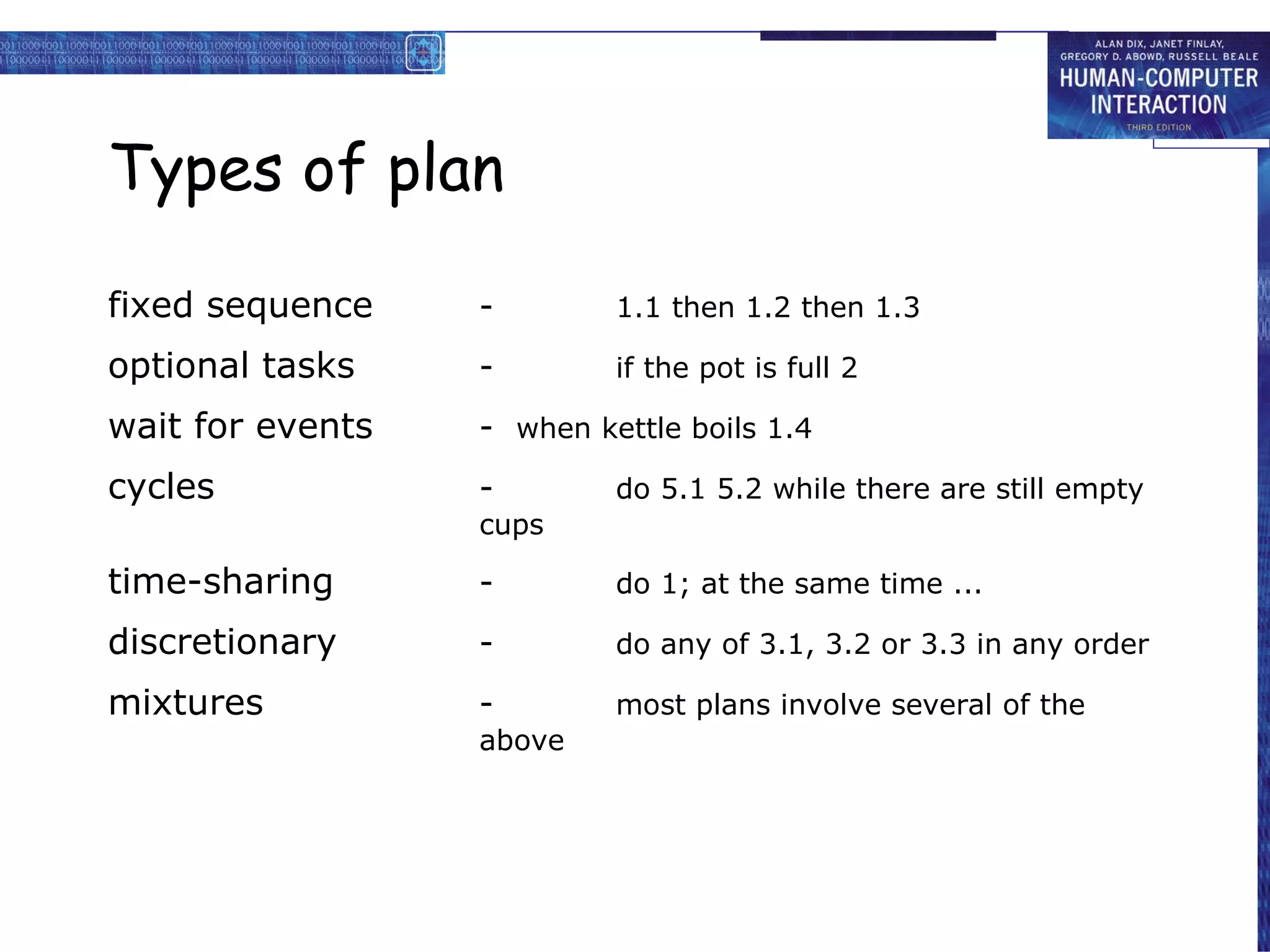
Types of plan fixed sequence - 1.1 then 1.2 then 1.3 optional tasks - if the pot is full 2 wait for events -  when kettle boils 1.4 cycles - do 5.1 5.2 while there are still empty cups time-sharing - do 1; at the same time ... discretionary - do any of 3.1, 3.2 or 3.3 in any order mixtures - most plans involve several of the above
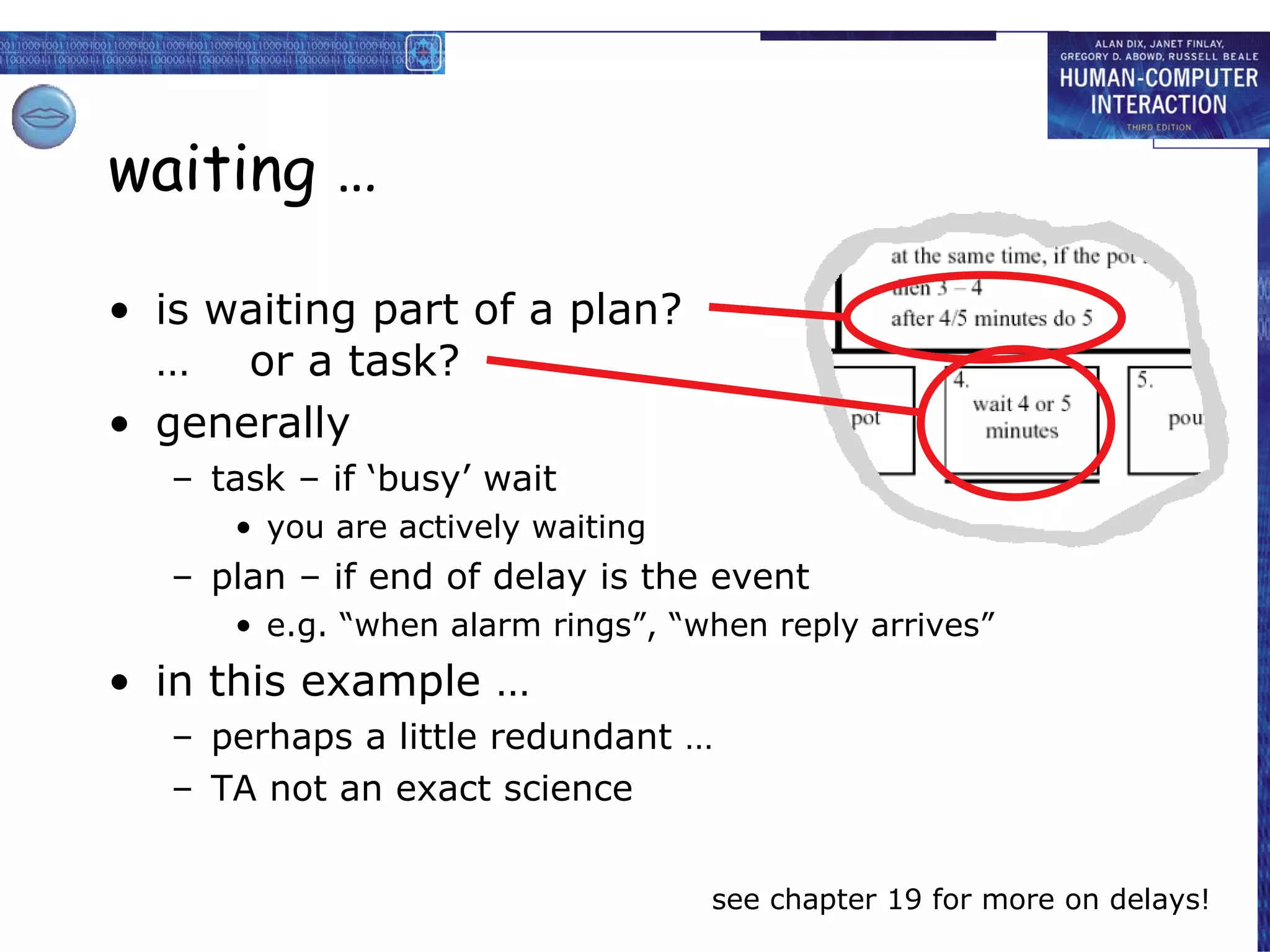
waiting … is waiting part of a plan? …  or a task? generally task – if ‘busy’ wait you are actively waiting plan – if end of delay is the event e.g. “when alarm rings”, “when reply arrives”  in this example … perhaps a little redundant … TA not an exact science see chapter 19 for more on delays!
Knowledge Based Analyses Focus on: Objects –  used in task Actions –  performed + Taxonomies  – represent levels of abstraction
Knowledge–Based Example … motor controls steering  steering wheel, indicators engine/speed direct  ignition, accelerator, foot brake gearing  clutch, gear stick lights external  headlights, hazard lights internal  courtesy light wash/wipe wipers  front wipers, rear wipers washers  front washers, rear washers heating  temperature control, air direction,   fan, rear screen heater parking  hand brake, door lock radio  numerous!
Task Description Hierarchy Three types of branch point in taxonomy: XOR – normal taxonomy object in one and only one branch AND – object must be in both multiple classifications OR – weakest case can be in one, many or none wash/wipe AND function XOR wipe  front wipers, rear wipers wash  front washers, rear washers position XOR front  front wipers, front washers rear  rear wipers, rear washers
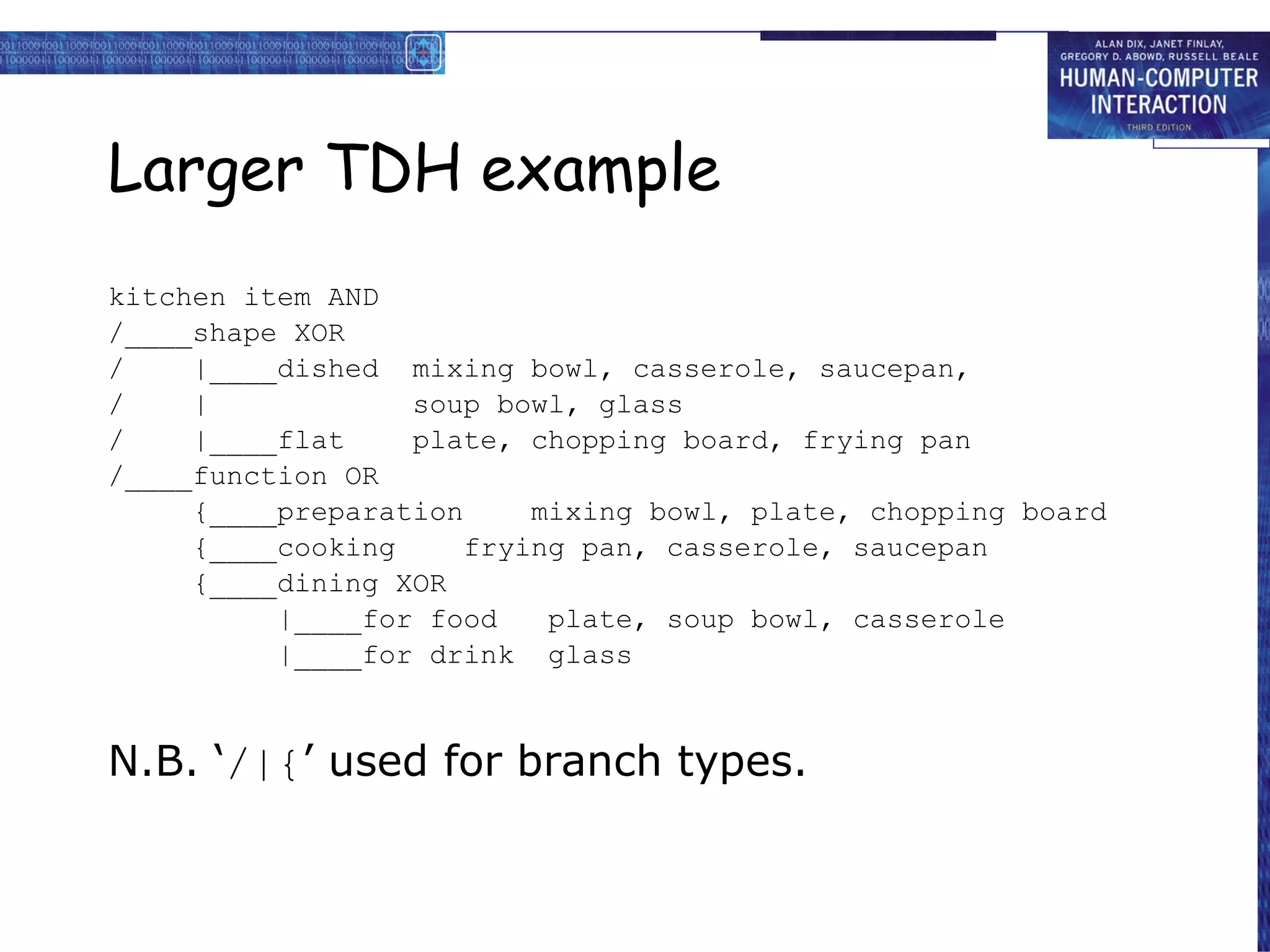
Larger TDH example kitchen item AND /____shape XOR /  |____dished  mixing bowl, casserole, saucepan, /  |  soup bowl, glass /  |____flat  plate, chopping board, frying pan /____function OR {____preparation  mixing bowl, plate, chopping board {____cooking  frying pan, casserole, saucepan {____dining XOR |____for food  plate, soup bowl, casserole |____for drink  glass N.B. ‘ /|{ ’ used for branch types.
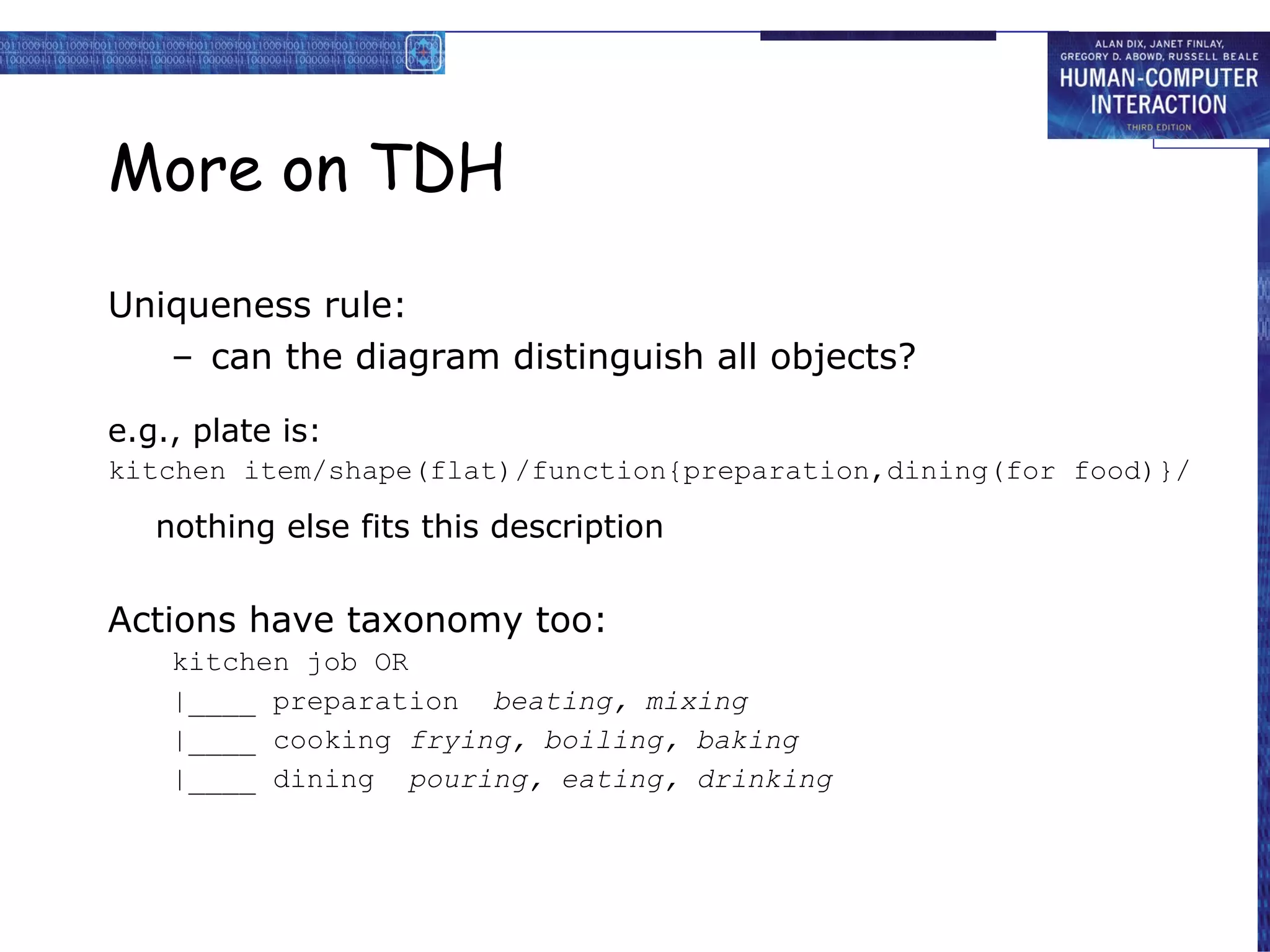
More on TDH Uniqueness rule: can the diagram distinguish all objects? e.g., plate is: kitchen item/shape(flat)/function{preparation,dining(for food)}/ nothing else fits this description Actions have taxonomy too: kitchen job OR |____ preparation  beating, mixing |____ cooking  frying, boiling, baking |____ dining  pouring, eating, drinking
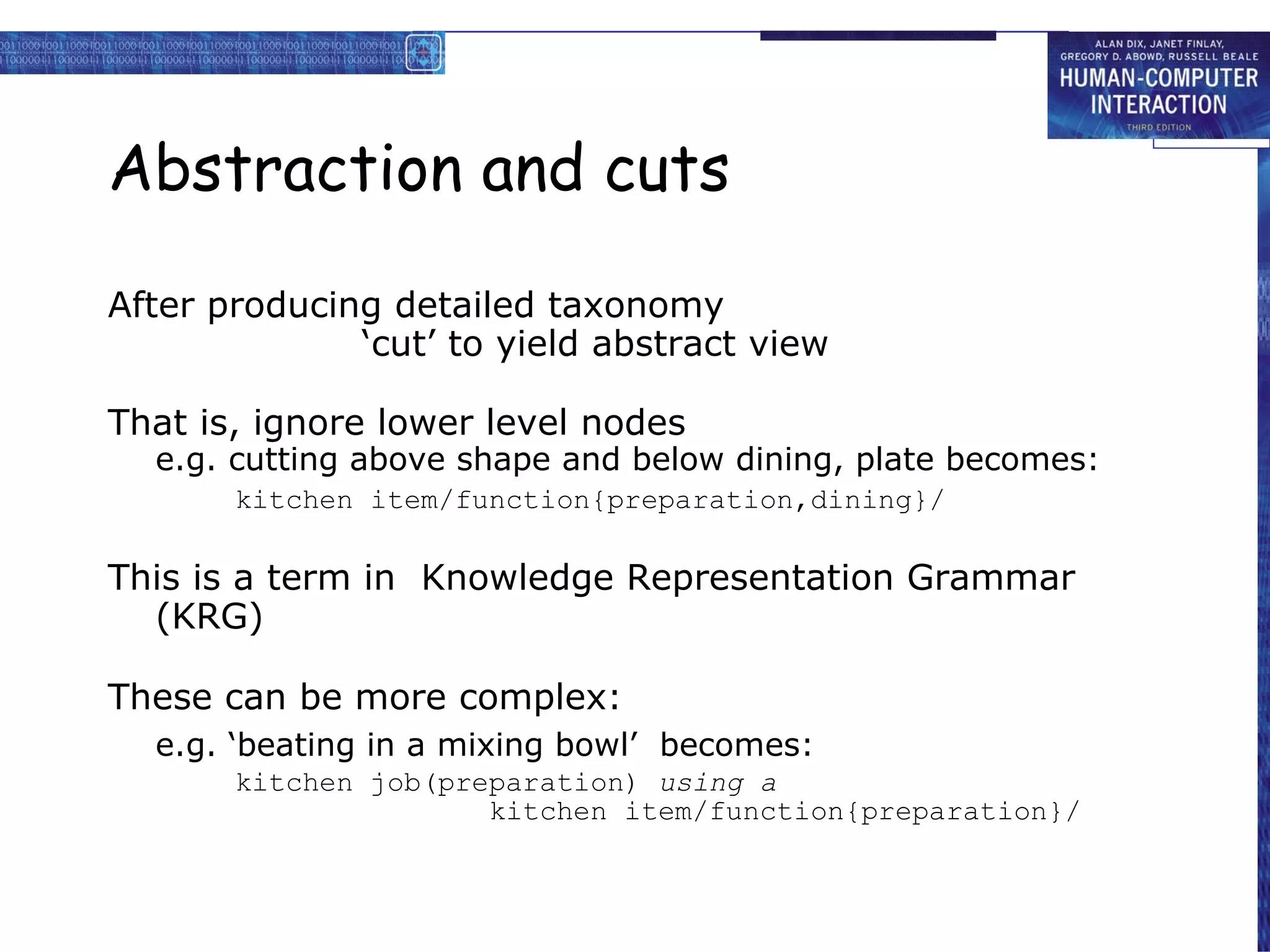
Abstraction and cuts After producing detailed taxonomy ‘cut’ to yield abstract view That is, ignore lower level nodes e.g. cutting above shape and below dining, plate becomes: kitchen item/function{preparation,dining}/ This is a term in  Knowledge Representation Grammar (KRG)  These can be more complex: e.g. ‘beating in a mixing bowl’  becomes: kitchen job(preparation)  using a kitchen item/function{preparation}/
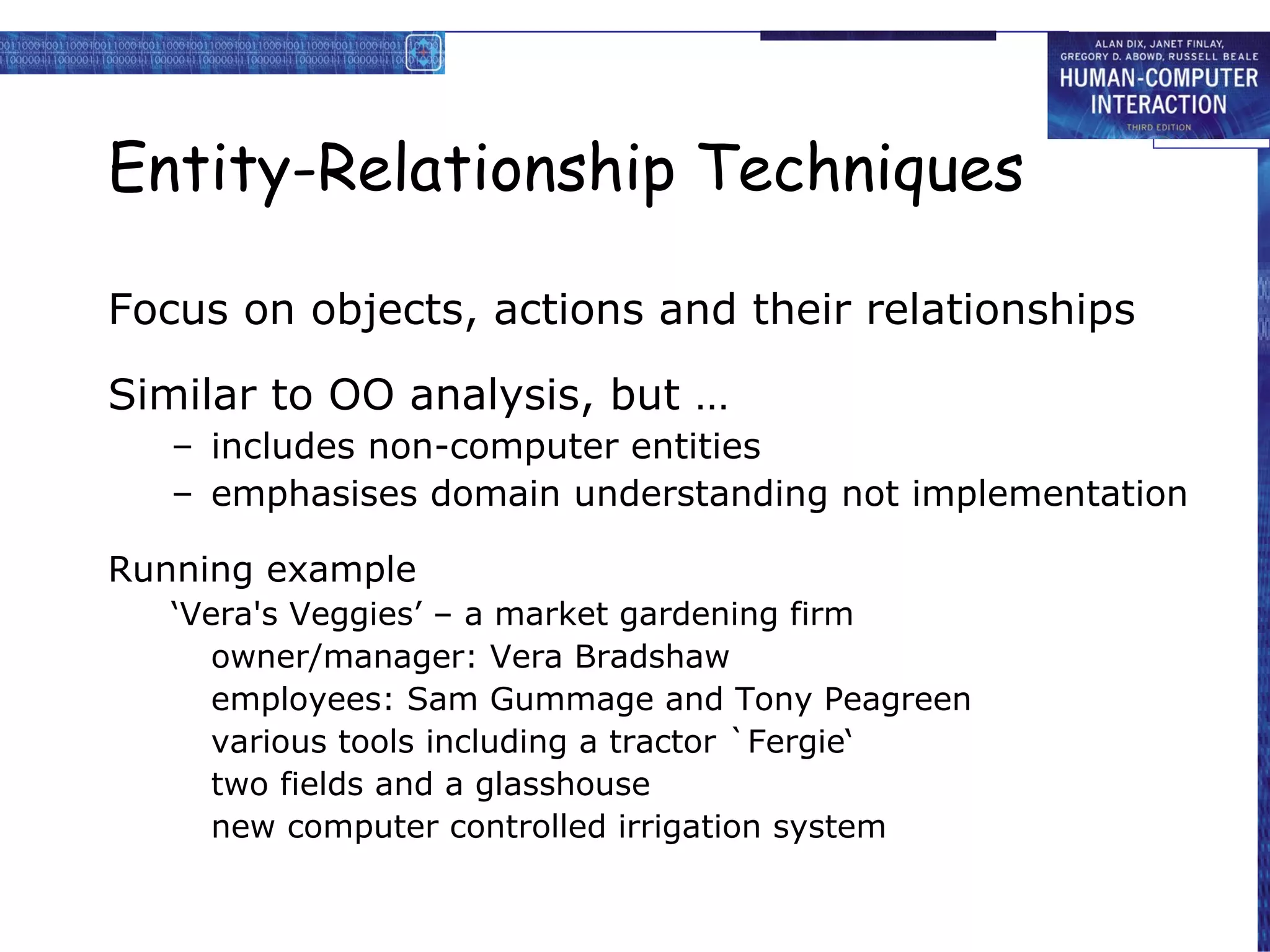
Entity-Relationship Techniques Focus on objects, actions and their relationships Similar to OO analysis, but … includes non-computer entities emphasises domain understanding not implementation Running example ‘ Vera's Veggies’ – a market gardening firm owner/manager: Vera Bradshaw employees: Sam Gummage and Tony Peagreen various tools including a tractor `Fergie‘ two fields and a glasshouse new computer controlled irrigation system
Objects Start with list of objects and classify them: Concrete objects: simple things: spade, plough, glasshouse Actors: human actors :  Vera, Sam, Tony, the customers what about the irrigation controller? Composite objects: sets :  the team = Vera, Sam, Tony tuples :  tractor may be < Fergie, plough >
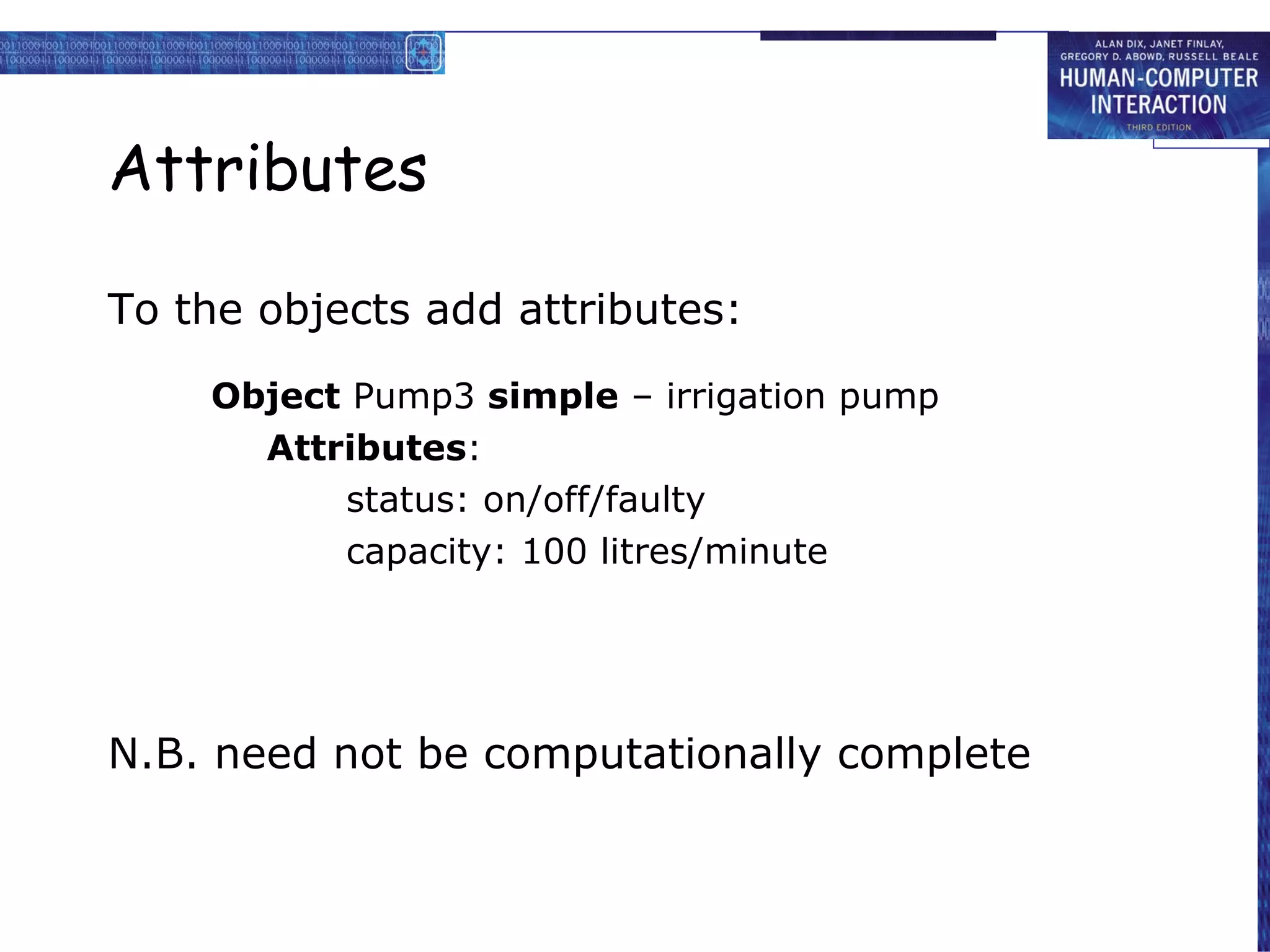
Attributes To the objects add attributes: Object  Pump3  simple  – irrigation pump Attributes : status: on/off/faulty capacity: 100 litres/minute N.B. need not be computationally complete
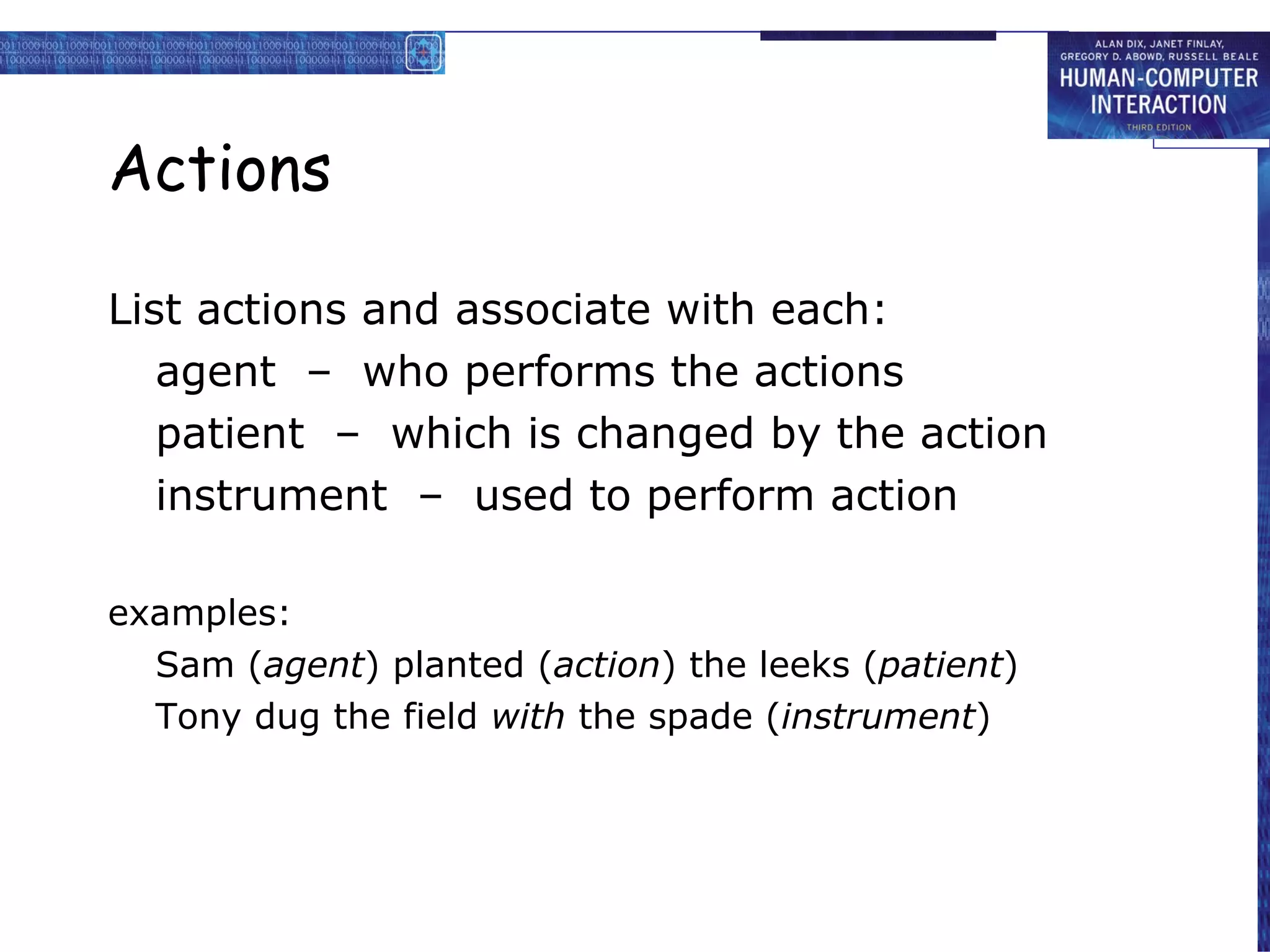
Actions List actions and associate with each: agent  –  who performs the actions patient  –  which is changed by the action instrument  –  used to perform action examples: Sam ( agent ) planted ( action ) the leeks ( patient ) Tony dug the field  with  the spade ( instrument )
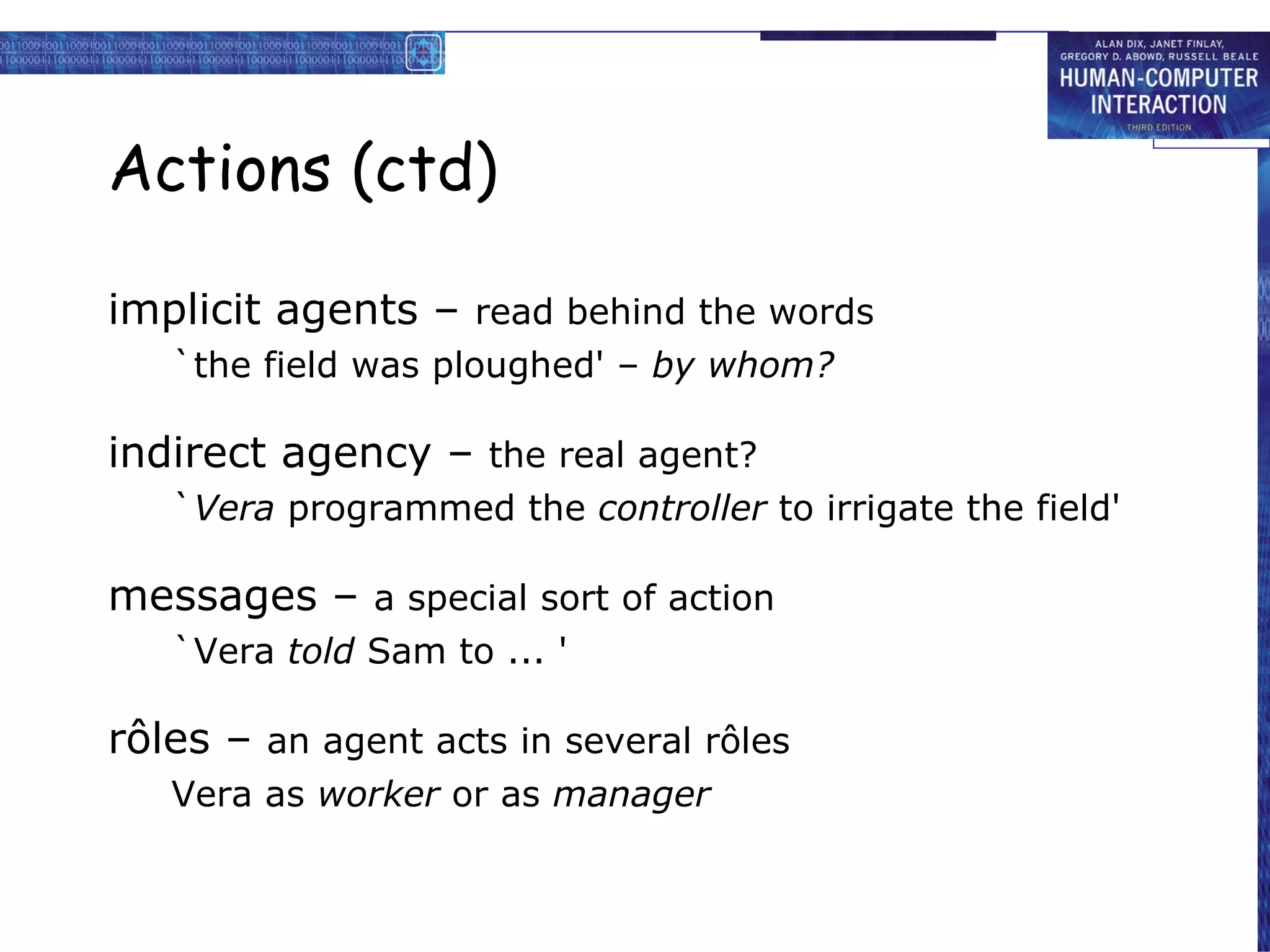
Actions (ctd)  implicit agents –  read behind the words `the field was ploughed' –  by whom? indirect agency –  the real agent? ` Vera  programmed the  controller  to irrigate the field' messages –  a special sort of action `Vera  told  Sam to ... ' rôles –  an agent acts in several rôles Vera as  worker  or as  manager
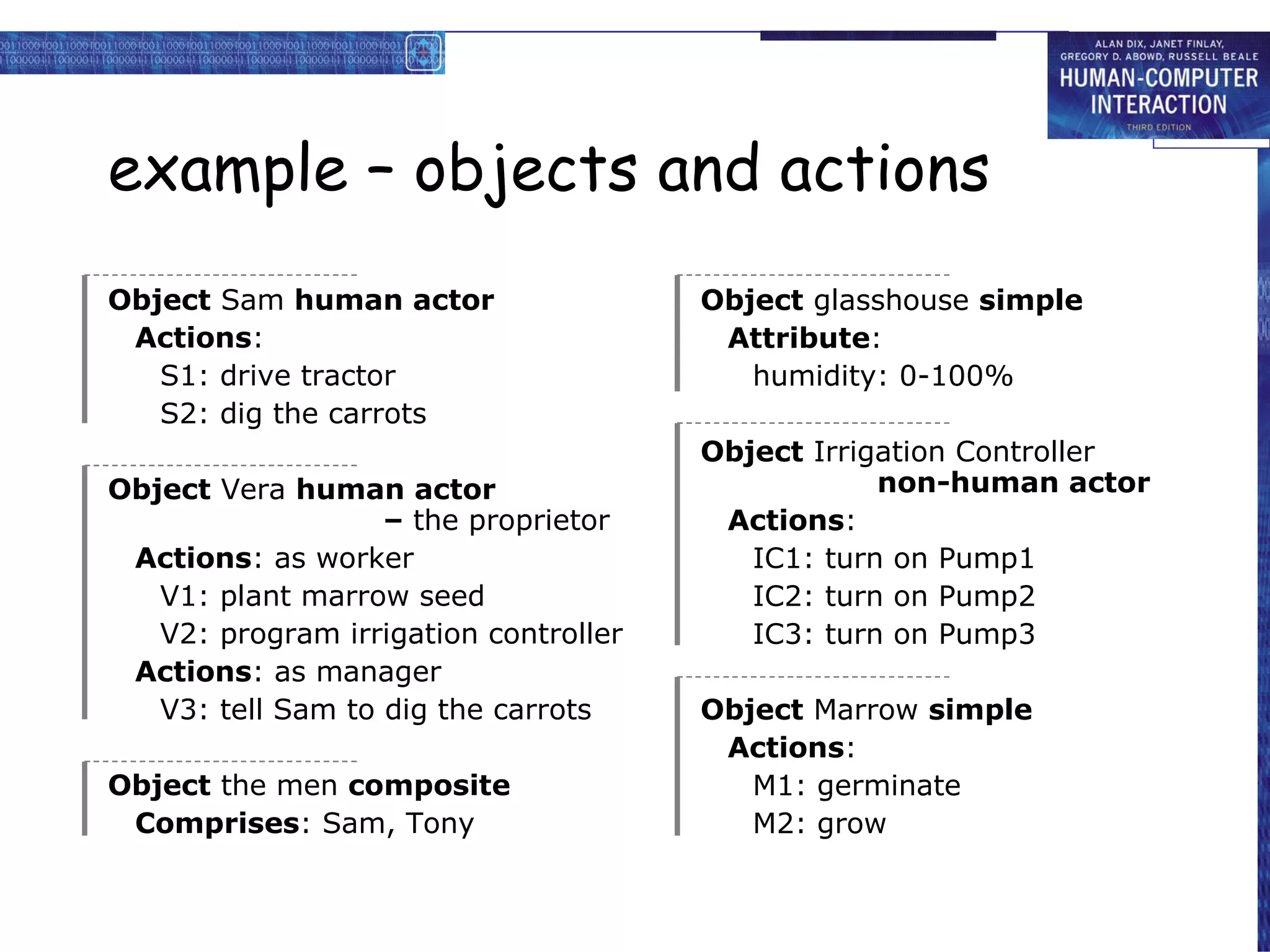
example – objects and actions Object  Sam  human actor Actions : S1: drive tractor S2: dig the carrots Object  Vera  human actor –  the proprietor Actions : as worker V1: plant marrow seed V2: program irrigation controller Actions : as manager V3: tell Sam to dig the carrots Object  the men  composite Comprises : Sam, Tony Object  glasshouse  simple Attribute : humidity: 0-100% Object  Irrigation Controller non-human actor Actions : IC1: turn on Pump1 IC2: turn on Pump2 IC3: turn on Pump3 Object  Marrow  simple Actions : M1: germinate M2: grow
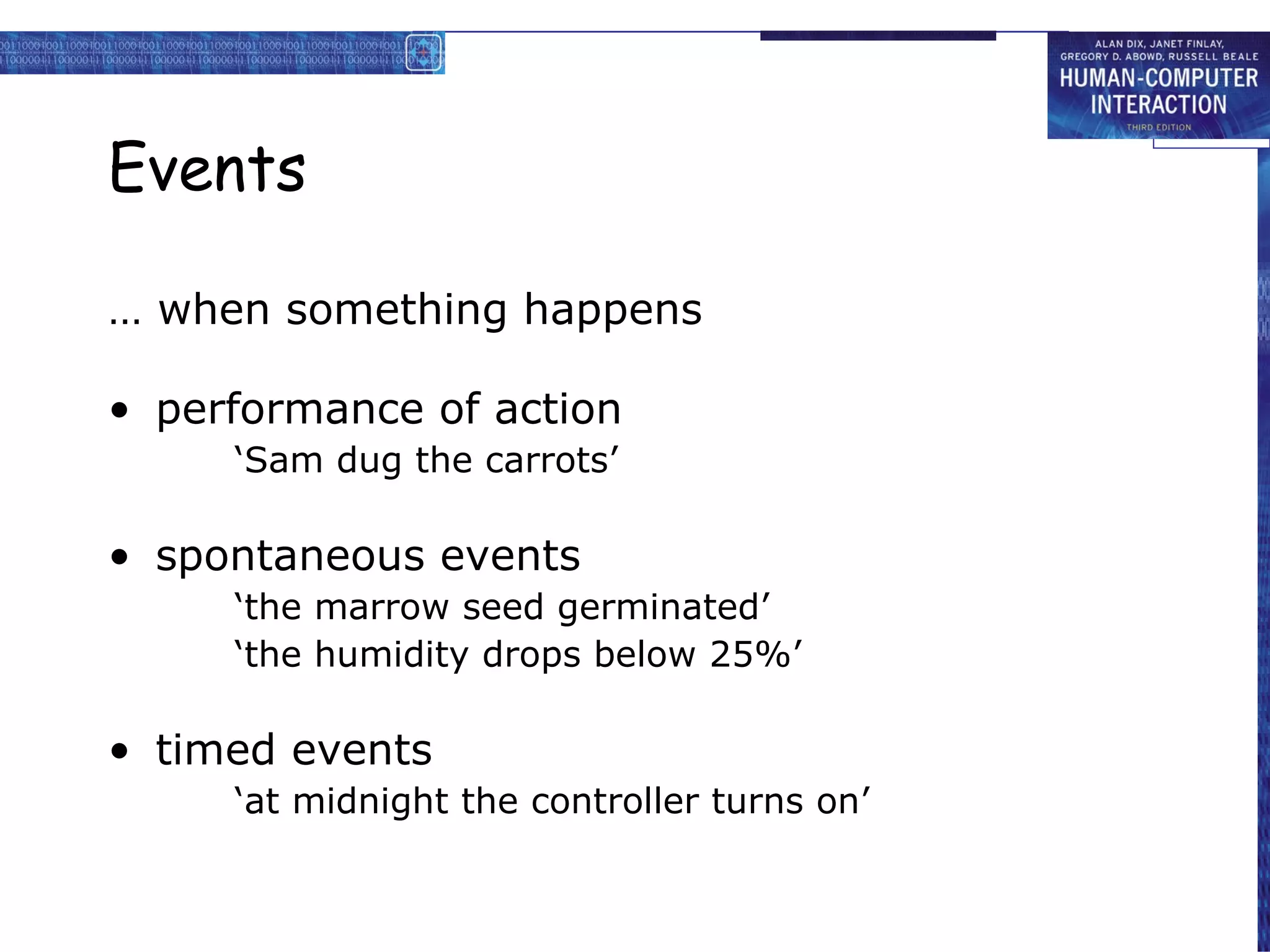
Events …  when something happens performance of action ‘ Sam dug the carrots’ spontaneous events ‘ the marrow seed germinated’ ‘ the humidity drops below 25%’ timed events ‘ at midnight the controller turns on’
Relationships object-object social - Sam is subordinate to Vera spatial - pump 3 is in the glasshouse action-object agent  (listed with object) patient and instrument actions and events temporal and causal ‘ Sam digs the carrots because Vera told him’ temporal relations use HTA or dialogue notations. show task sequence (normal HTA) show object lifecycle
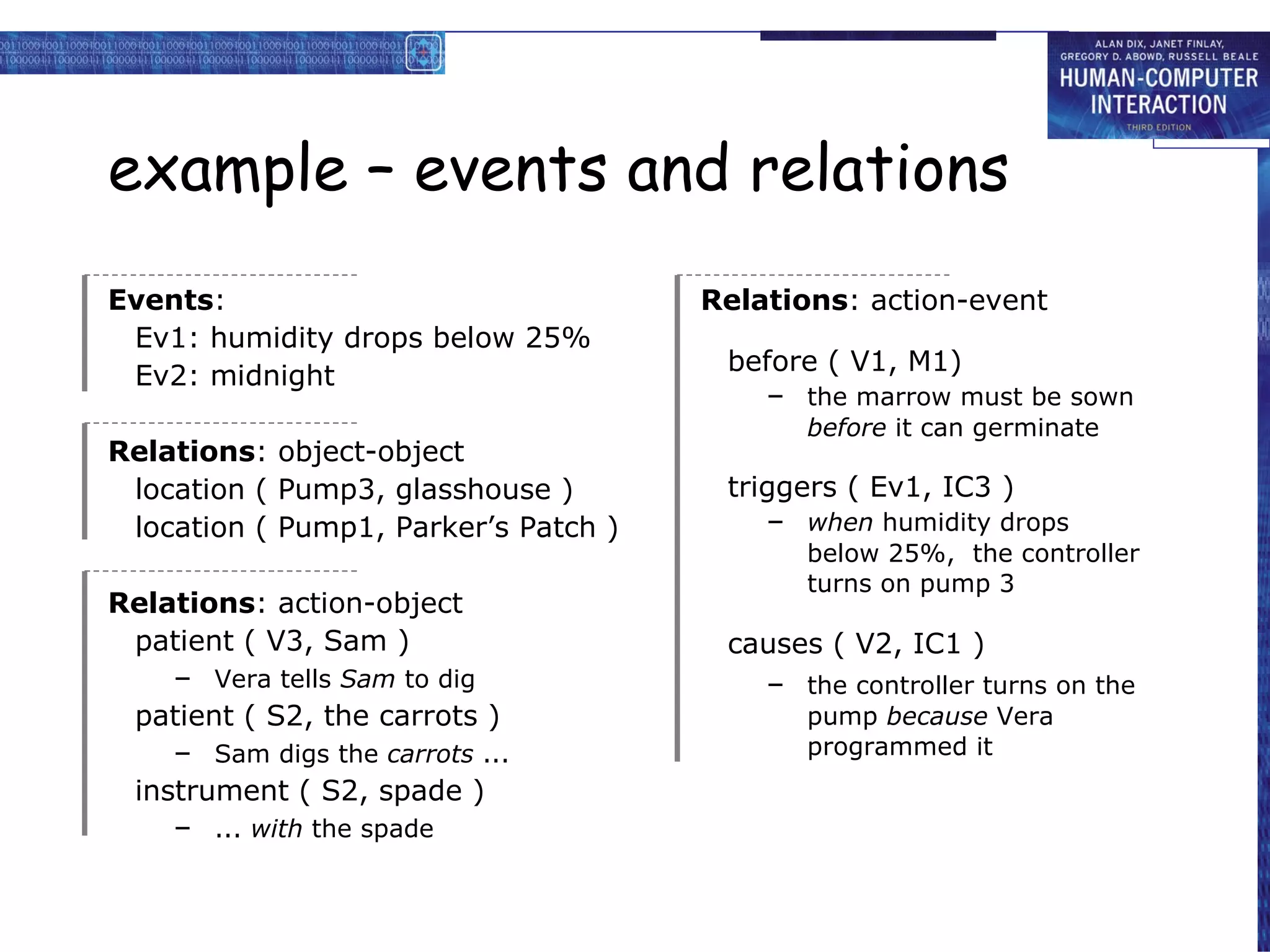
example – events and relations Events : Ev1: humidity drops below 25% Ev2: midnight Relations : object-object location ( Pump3, glasshouse ) location ( Pump1, Parker’s Patch ) Relations : action-object patient ( V3, Sam ) – Vera tells  Sam  to dig patient ( S2, the carrots ) – Sam digs the  carrots  ... instrument ( S2, spade ) – ...  with  the spade Relations : action-event before ( V1, M1) – the marrow must be sown before  it can germinate triggers ( Ev1, IC3 ) – when  humidity drops below 25%,  the controller turns on pump 3 causes ( V2, IC1 ) – the controller turns on the pump  because  Vera programmed it
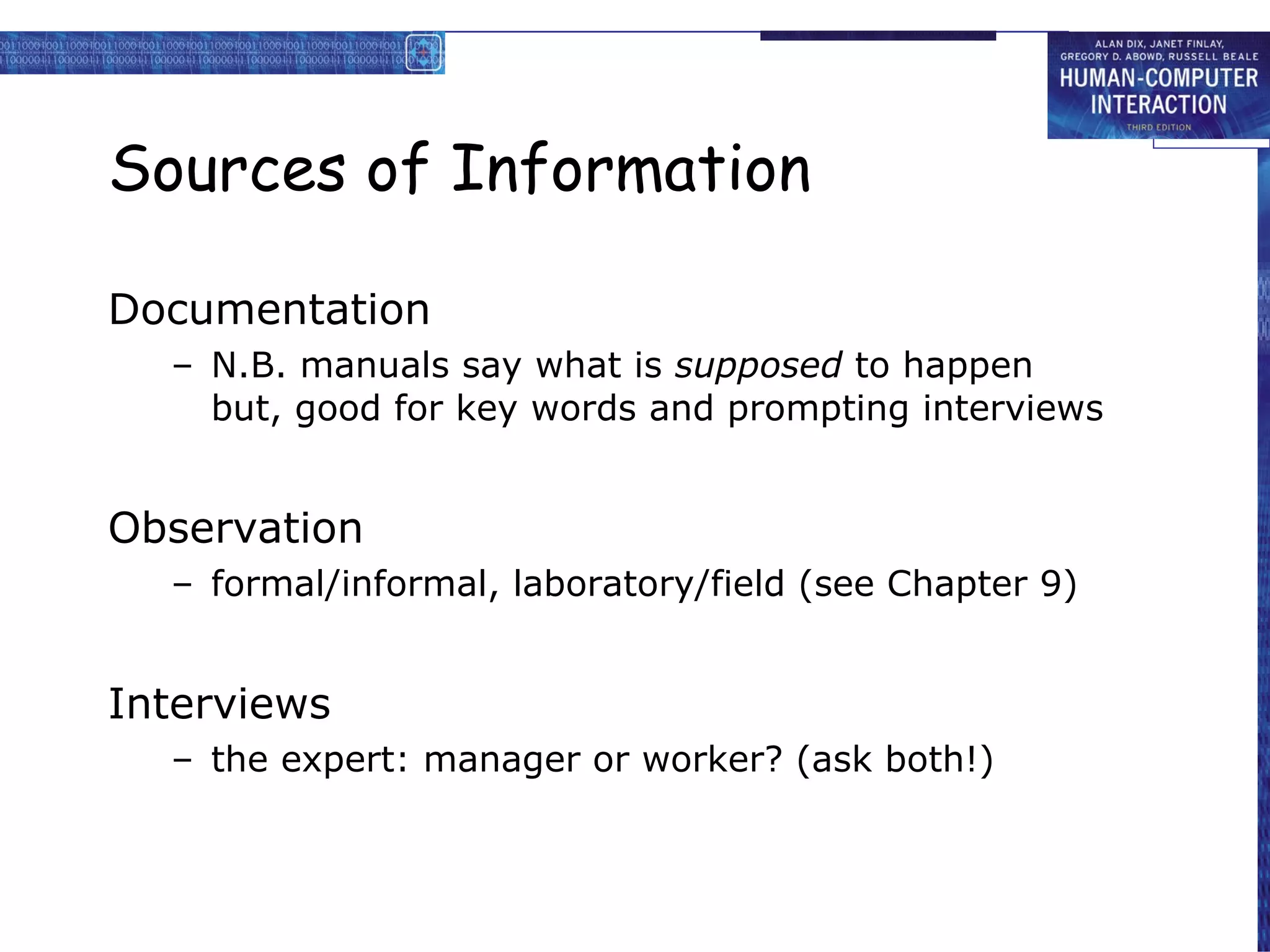
Sources of Information Documentation N.B. manuals say what is  supposed  to happen but, good for key words and prompting interviews Observation formal/informal, laboratory/field (see Chapter 9) Interviews the expert: manager or worker? (ask both!)
Early analysis Extraction from transcripts list nouns (objects) and verbs (actions) beware technical language and context: `the rain poured’  vs.  `I poured the tea’ Sorting and classifying grouping or arranging words on cards ranking objects/actions for task relevance (see ch. 9) use commercial outliner Iterative process: data sources     analysis but costly, so use cheap sources where available
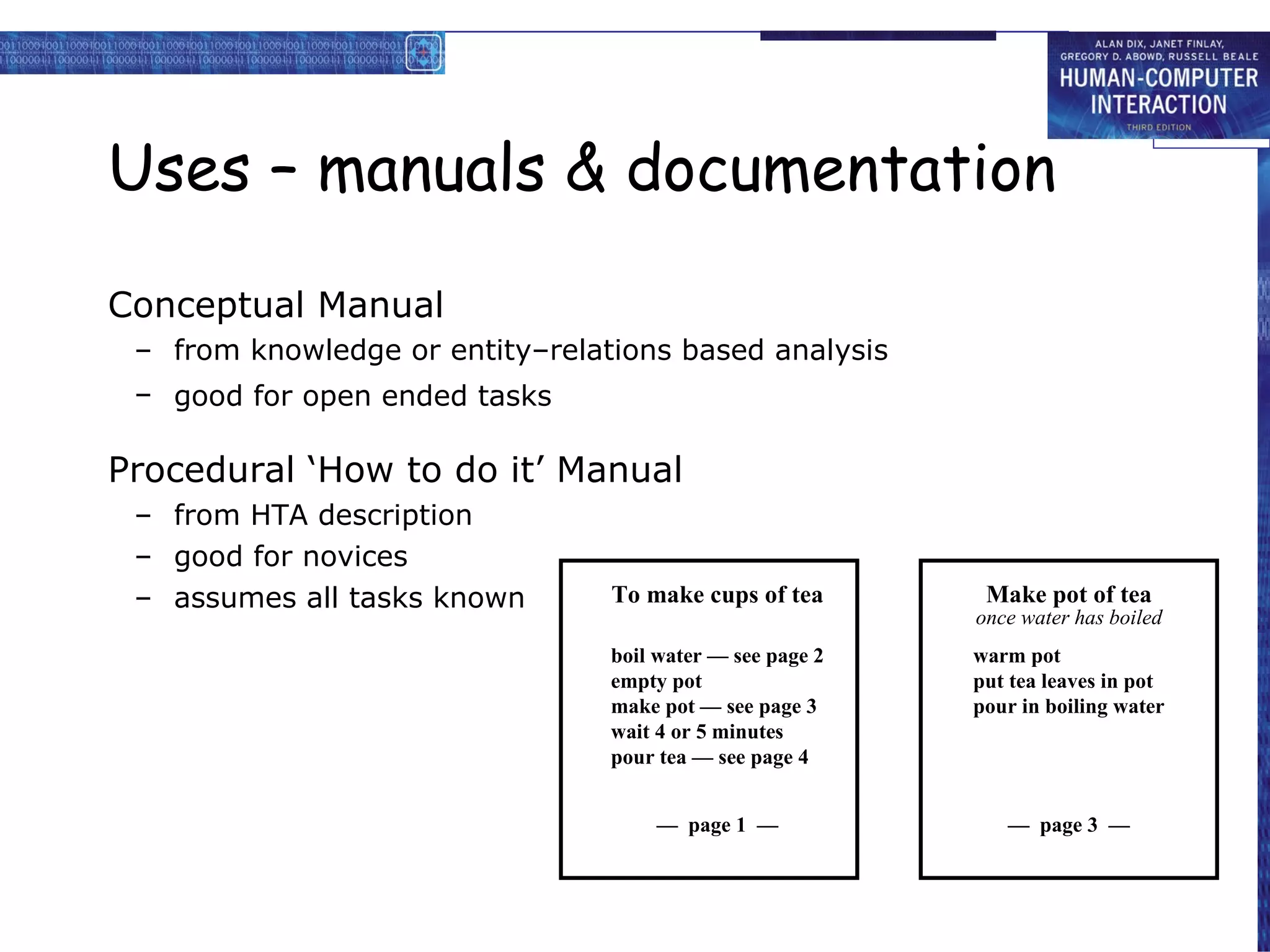
Uses – manuals & documentation Conceptual Manual from knowledge or entity–relations based analysis good for open ended tasks   Procedural ‘How to do it’ Manual from HTA description good for novices assumes all tasks known To make cups of tea boil water –– see page 2 empty pot make pot –– see page 3 wait 4 or 5 minutes pour tea –– see page 4 ––  page 1  –– Make pot of tea warm pot put tea leaves in pot pour in boiling water ––  page 3  –– once water has boiled
Uses – requirements & design Requirements capture and systems design lifts focus from system to use suggests candidates for automation uncovers user's conceptual model Detailed interface design taxonomies suggest menu layout object/action lists suggest interface objects task frequency guides default choices existing task sequences guide dialogue design NOTE. task analysis is never complete  rigid task based design    inflexible system

HCI 3e - Ch 15: Task analysis

  • 1.
  • 2.
    What is TaskAnalysis? Methods to analyse people's jobs: what people do what things they work with what they must know
  • 3.
    An Example inorder to clean the house get the vacuum cleaner out fix the appropriate attachments clean the rooms when the dust bag gets full, empty it put the vacuum cleaner and tools away must know about: vacuum cleaners, their attachments, dust bags, cupboards, rooms etc.
  • 4.
    Approaches to taskanalysi s Task decomposition splitting task into (ordered) subtasks Knowledge based techniques what the user knows about the task and how it is organised Entity/object based analysis relationships between objects, actions and the people who perform them lots of different notations/techniques
  • 5.
    general method observecollect unstructured lists of words and actions organize using notation or diagrams
  • 6.
    Di ffe rencesfrom other techniques Systems analysis vs. Task analysis system design - focus - the user Cognitive models vs. Task analysis internal mental state - focus - external actions practiced `unit' task - focus - whole job
  • 7.
    Task Decomposition Aims:describe the actions people do structure them within task subtask h ierarchy describe order of subtasks Variants: Hierarchical Task Analysis (HTA) most common CTT (CNUCE, Pisa) uses LOTOS temporal operators
  • 8.
    Textual HTA descriptionHierarchy description ... 0. in order to clean the house 1. get the vacuum cleaner out 2. get the appropriate attachment 3. clean the rooms 3.1. clean the hall 3.2. clean the living rooms 3.3. clean the bedrooms 4. empty the dust bag 5. put vacuum cleaner and attachments away ... and plans Plan 0: do 1 - 2 - 3 - 5 in that order. when the dust bag gets full do 4 Plan 3: do any of 3.1, 3.2 or 3.3 in any order depending on which rooms need cleaning N.B. only the plans denote order
  • 9.
    Generating the hierarchy1 get list of tasks 2 group tasks into higher level tasks 3 decompose lowest level tasks further Stopping rules How do we know when to stop? Is “empty the dust bag” simple enough? Purpose: expand only relevant tasks Motor actions: lowest sensible level
  • 10.
    Tasks as explanationimagine asking the user the question: what are you doing now? for the same action the answer may be: typing ctrl-B making a word bold emphasising a word editing a document writing a letter preparing a legal case
  • 11.
    HTA as grammarcan parse sentence into letters, nouns, noun phrase, etc. The cat sat on the mat. letter noun det noun phrase . . . . . . . . . . . . lexical syntax
  • 12.
    parse scenario usingHTA 0. in order to clean the house 1. get the vacuum cleaner out 2. get the appropriate attachment 3. clean the rooms 3.1. clean the hall 3.2. clean the living rooms 3.3. clean the bedrooms 4. empty the dust bag 5. put vacuum cleaner and attachments away get out cleaner fix carpet head clean dinning room clean main bedroom empty dustbag clean sitting room put cleaner away 1. 2. 3.2. 3.3. 3.2. 3. 4. 5. 0.
  • 13.
  • 14.
    Refining the descriptionGiven initial HTA (textual or diagram) How to check / improve it? Some heuristics: paired actions e.g., where is `turn on gas' restructure e.g., generate task `make pot' balance e.g., is `pour tea' simpler than making pot? generalise e.g., make one cup ….. or more
  • 15.
    Refined HTA formaking tea
  • 16.
    Types of planfixed sequence - 1.1 then 1.2 then 1.3 optional tasks - if the pot is full 2 wait for events - when kettle boils 1.4 cycles - do 5.1 5.2 while there are still empty cups time-sharing - do 1; at the same time ... discretionary - do any of 3.1, 3.2 or 3.3 in any order mixtures - most plans involve several of the above
  • 17.
    waiting … iswaiting part of a plan? … or a task? generally task – if ‘busy’ wait you are actively waiting plan – if end of delay is the event e.g. “when alarm rings”, “when reply arrives” in this example … perhaps a little redundant … TA not an exact science see chapter 19 for more on delays!
  • 18.
    Knowledge Based AnalysesFocus on: Objects – used in task Actions – performed + Taxonomies – represent levels of abstraction
  • 19.
    Knowledge–Based Example …motor controls steering steering wheel, indicators engine/speed direct ignition, accelerator, foot brake gearing clutch, gear stick lights external headlights, hazard lights internal courtesy light wash/wipe wipers front wipers, rear wipers washers front washers, rear washers heating temperature control, air direction, fan, rear screen heater parking hand brake, door lock radio numerous!
  • 20.
    Task Description HierarchyThree types of branch point in taxonomy: XOR – normal taxonomy object in one and only one branch AND – object must be in both multiple classifications OR – weakest case can be in one, many or none wash/wipe AND function XOR wipe front wipers, rear wipers wash front washers, rear washers position XOR front front wipers, front washers rear rear wipers, rear washers
  • 21.
    Larger TDH examplekitchen item AND /____shape XOR / |____dished mixing bowl, casserole, saucepan, / | soup bowl, glass / |____flat plate, chopping board, frying pan /____function OR {____preparation mixing bowl, plate, chopping board {____cooking frying pan, casserole, saucepan {____dining XOR |____for food plate, soup bowl, casserole |____for drink glass N.B. ‘ /|{ ’ used for branch types.
  • 22.
    More on TDHUniqueness rule: can the diagram distinguish all objects? e.g., plate is: kitchen item/shape(flat)/function{preparation,dining(for food)}/ nothing else fits this description Actions have taxonomy too: kitchen job OR |____ preparation beating, mixing |____ cooking frying, boiling, baking |____ dining pouring, eating, drinking
  • 23.
    Abstraction and cutsAfter producing detailed taxonomy ‘cut’ to yield abstract view That is, ignore lower level nodes e.g. cutting above shape and below dining, plate becomes: kitchen item/function{preparation,dining}/ This is a term in Knowledge Representation Grammar (KRG) These can be more complex: e.g. ‘beating in a mixing bowl’ becomes: kitchen job(preparation) using a kitchen item/function{preparation}/
  • 24.
    Entity-Relationship Techniques Focuson objects, actions and their relationships Similar to OO analysis, but … includes non-computer entities emphasises domain understanding not implementation Running example ‘ Vera's Veggies’ – a market gardening firm owner/manager: Vera Bradshaw employees: Sam Gummage and Tony Peagreen various tools including a tractor `Fergie‘ two fields and a glasshouse new computer controlled irrigation system
  • 25.
    Objects Start withlist of objects and classify them: Concrete objects: simple things: spade, plough, glasshouse Actors: human actors : Vera, Sam, Tony, the customers what about the irrigation controller? Composite objects: sets : the team = Vera, Sam, Tony tuples : tractor may be < Fergie, plough >
  • 26.
    Attributes To theobjects add attributes: Object Pump3 simple – irrigation pump Attributes : status: on/off/faulty capacity: 100 litres/minute N.B. need not be computationally complete
  • 27.
    Actions List actionsand associate with each: agent – who performs the actions patient – which is changed by the action instrument – used to perform action examples: Sam ( agent ) planted ( action ) the leeks ( patient ) Tony dug the field with the spade ( instrument )
  • 28.
    Actions (ctd) implicit agents – read behind the words `the field was ploughed' – by whom? indirect agency – the real agent? ` Vera programmed the controller to irrigate the field' messages – a special sort of action `Vera told Sam to ... ' rôles – an agent acts in several rôles Vera as worker or as manager
  • 29.
    example – objectsand actions Object Sam human actor Actions : S1: drive tractor S2: dig the carrots Object Vera human actor – the proprietor Actions : as worker V1: plant marrow seed V2: program irrigation controller Actions : as manager V3: tell Sam to dig the carrots Object the men composite Comprises : Sam, Tony Object glasshouse simple Attribute : humidity: 0-100% Object Irrigation Controller non-human actor Actions : IC1: turn on Pump1 IC2: turn on Pump2 IC3: turn on Pump3 Object Marrow simple Actions : M1: germinate M2: grow
  • 30.
    Events … when something happens performance of action ‘ Sam dug the carrots’ spontaneous events ‘ the marrow seed germinated’ ‘ the humidity drops below 25%’ timed events ‘ at midnight the controller turns on’
  • 31.
    Relationships object-object social- Sam is subordinate to Vera spatial - pump 3 is in the glasshouse action-object agent (listed with object) patient and instrument actions and events temporal and causal ‘ Sam digs the carrots because Vera told him’ temporal relations use HTA or dialogue notations. show task sequence (normal HTA) show object lifecycle
  • 32.
    example – eventsand relations Events : Ev1: humidity drops below 25% Ev2: midnight Relations : object-object location ( Pump3, glasshouse ) location ( Pump1, Parker’s Patch ) Relations : action-object patient ( V3, Sam ) – Vera tells Sam to dig patient ( S2, the carrots ) – Sam digs the carrots ... instrument ( S2, spade ) – ... with the spade Relations : action-event before ( V1, M1) – the marrow must be sown before it can germinate triggers ( Ev1, IC3 ) – when humidity drops below 25%, the controller turns on pump 3 causes ( V2, IC1 ) – the controller turns on the pump because Vera programmed it
  • 33.
    Sources of InformationDocumentation N.B. manuals say what is supposed to happen but, good for key words and prompting interviews Observation formal/informal, laboratory/field (see Chapter 9) Interviews the expert: manager or worker? (ask both!)
  • 34.
    Early analysis Extractionfrom transcripts list nouns (objects) and verbs (actions) beware technical language and context: `the rain poured’ vs. `I poured the tea’ Sorting and classifying grouping or arranging words on cards ranking objects/actions for task relevance (see ch. 9) use commercial outliner Iterative process: data sources  analysis but costly, so use cheap sources where available
  • 35.
    Uses – manuals& documentation Conceptual Manual from knowledge or entity–relations based analysis good for open ended tasks Procedural ‘How to do it’ Manual from HTA description good for novices assumes all tasks known To make cups of tea boil water –– see page 2 empty pot make pot –– see page 3 wait 4 or 5 minutes pour tea –– see page 4 –– page 1 –– Make pot of tea warm pot put tea leaves in pot pour in boiling water –– page 3 –– once water has boiled
  • 36.
    Uses – requirements& design Requirements capture and systems design lifts focus from system to use suggests candidates for automation uncovers user's conceptual model Detailed interface design taxonomies suggest menu layout object/action lists suggest interface objects task frequency guides default choices existing task sequences guide dialogue design NOTE. task analysis is never complete rigid task based design  inflexible system