The Semi-In
nite TASEP: Large Deviations via 
Matrix Products 
H. G. Duhart, P. Morters, J. Zimmer 
University of Bath 
21 November 2014
The TASEP 
The totally asymmetric simple exclusion process is one of the 
simplest interacting particle systems. It was introduced by Liggett 
in 1975. 
Horacio Gonzalez Duhart TASEP: LDP via MPA
The TASEP 
The totally asymmetric simple exclusion process is one of the 
simplest interacting particle systems. It was introduced by Liggett 
in 1975. 
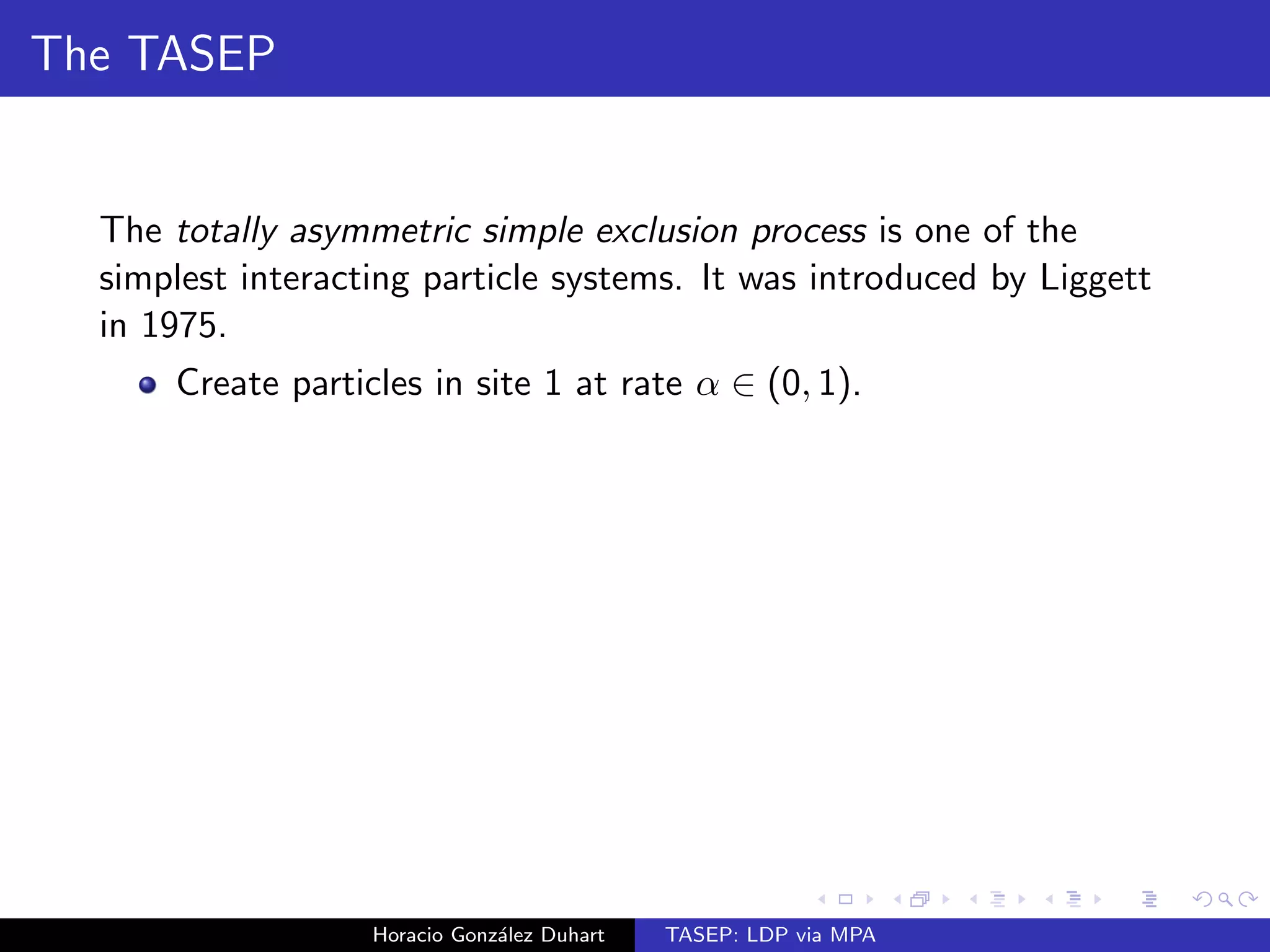
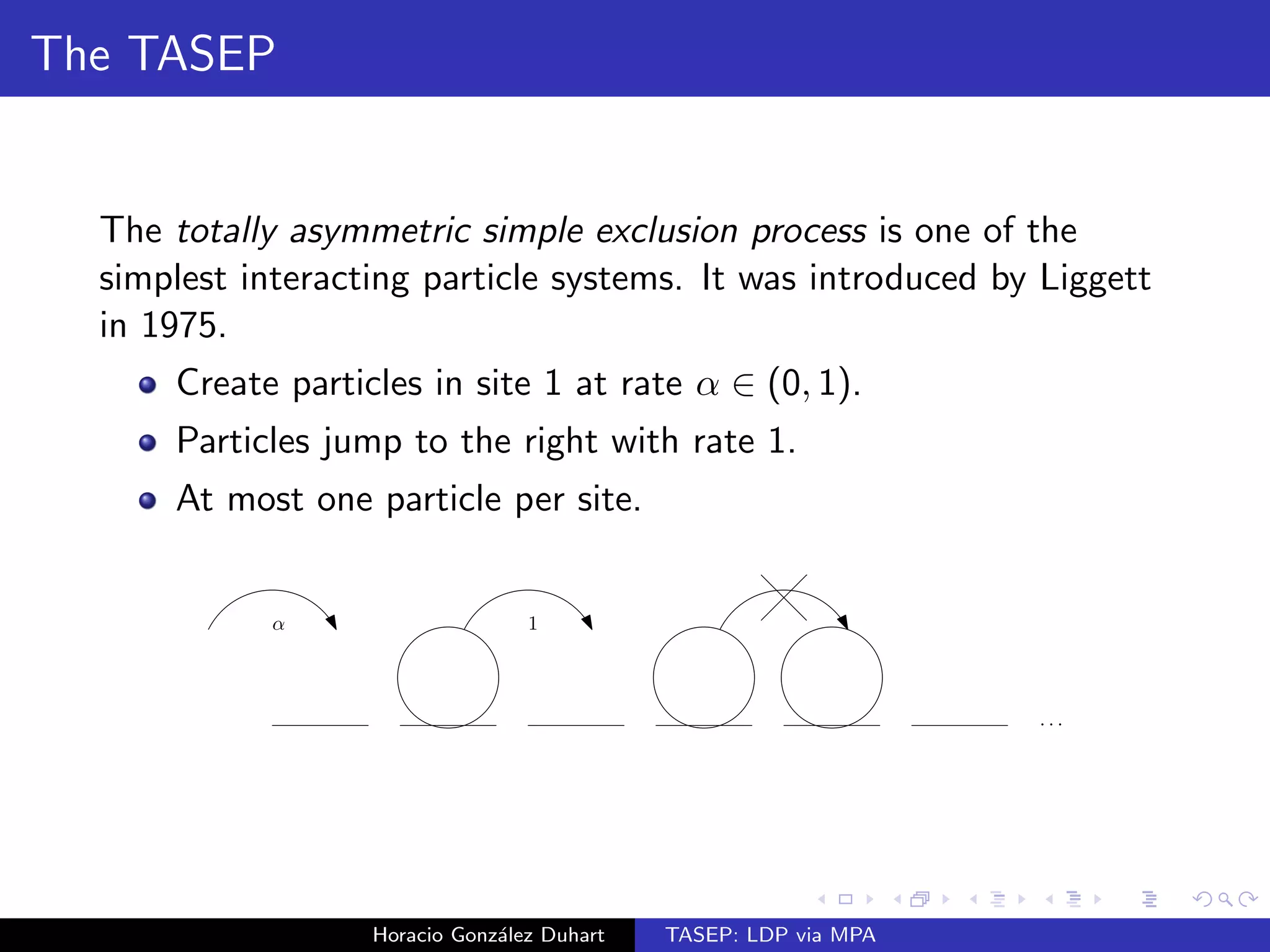
Create particles in site 1 at rate  2 (0; 1). 
Horacio Gonzalez Duhart TASEP: LDP via MPA
The TASEP 
The totally asymmetric simple exclusion process is one of the 
simplest interacting particle systems. It was introduced by Liggett 
in 1975. 
Create particles in site 1 at rate  2 (0; 1). 
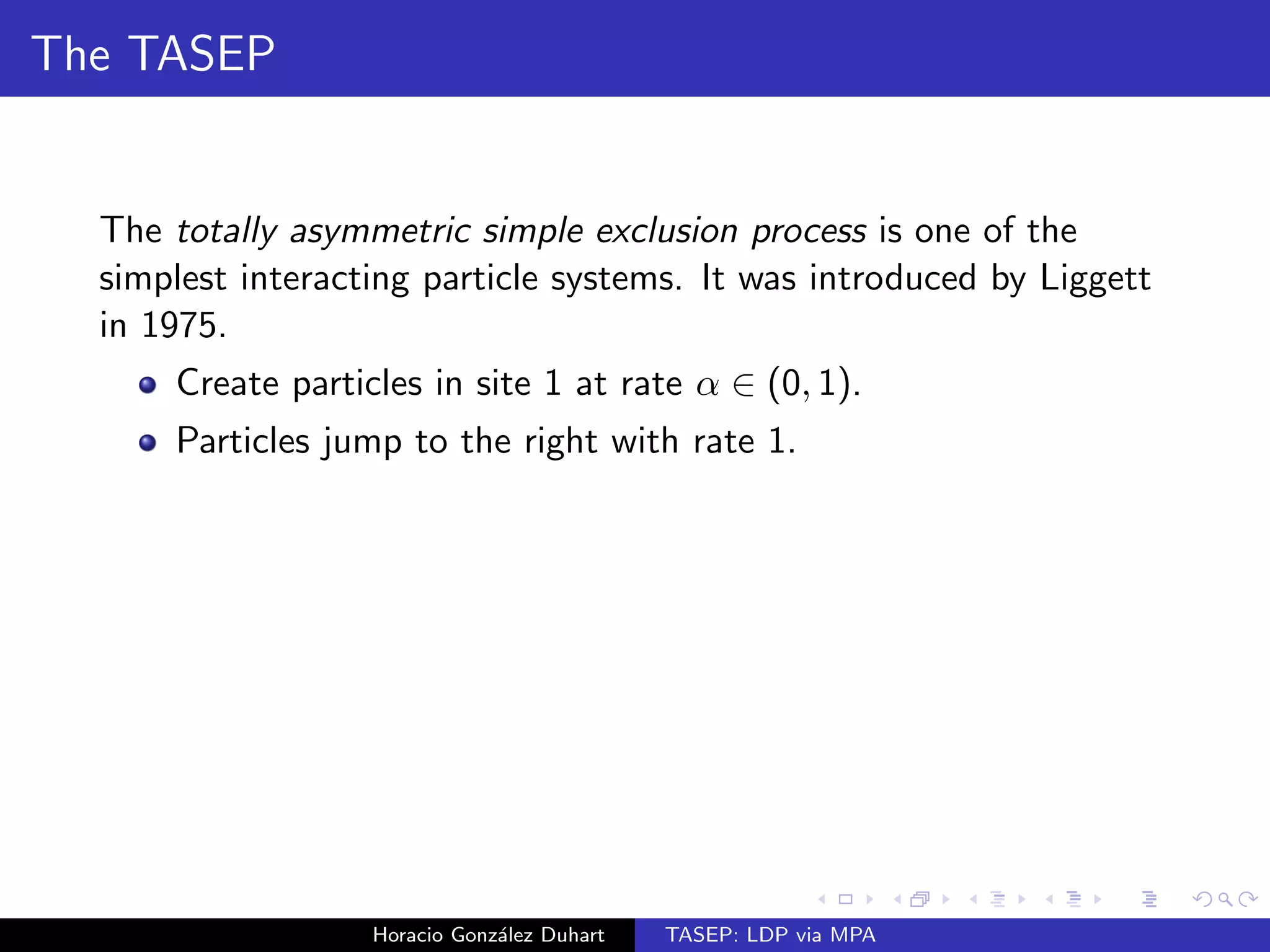
Particles jump to the right with rate 1. 
Horacio Gonzalez Duhart TASEP: LDP via MPA
The TASEP 
The totally asymmetric simple exclusion process is one of the 
simplest interacting particle systems. It was introduced by Liggett 
in 1975. 
Create particles in site 1 at rate  2 (0; 1). 
Particles jump to the right with rate 1. 
At most one particle per site. 
Horacio Gonzalez Duhart TASEP: LDP via MPA
The TASEP 
The totally asymmetric simple exclusion process is one of the 
simplest interacting particle systems. It was introduced by Liggett 
in 1975. 
Create particles in site 1 at rate  2 (0; 1). 
Particles jump to the right with rate 1. 
At most one particle per site. 
 1 
. . . 
Horacio Gonzalez Duhart TASEP: LDP via MPA
The TASEP 
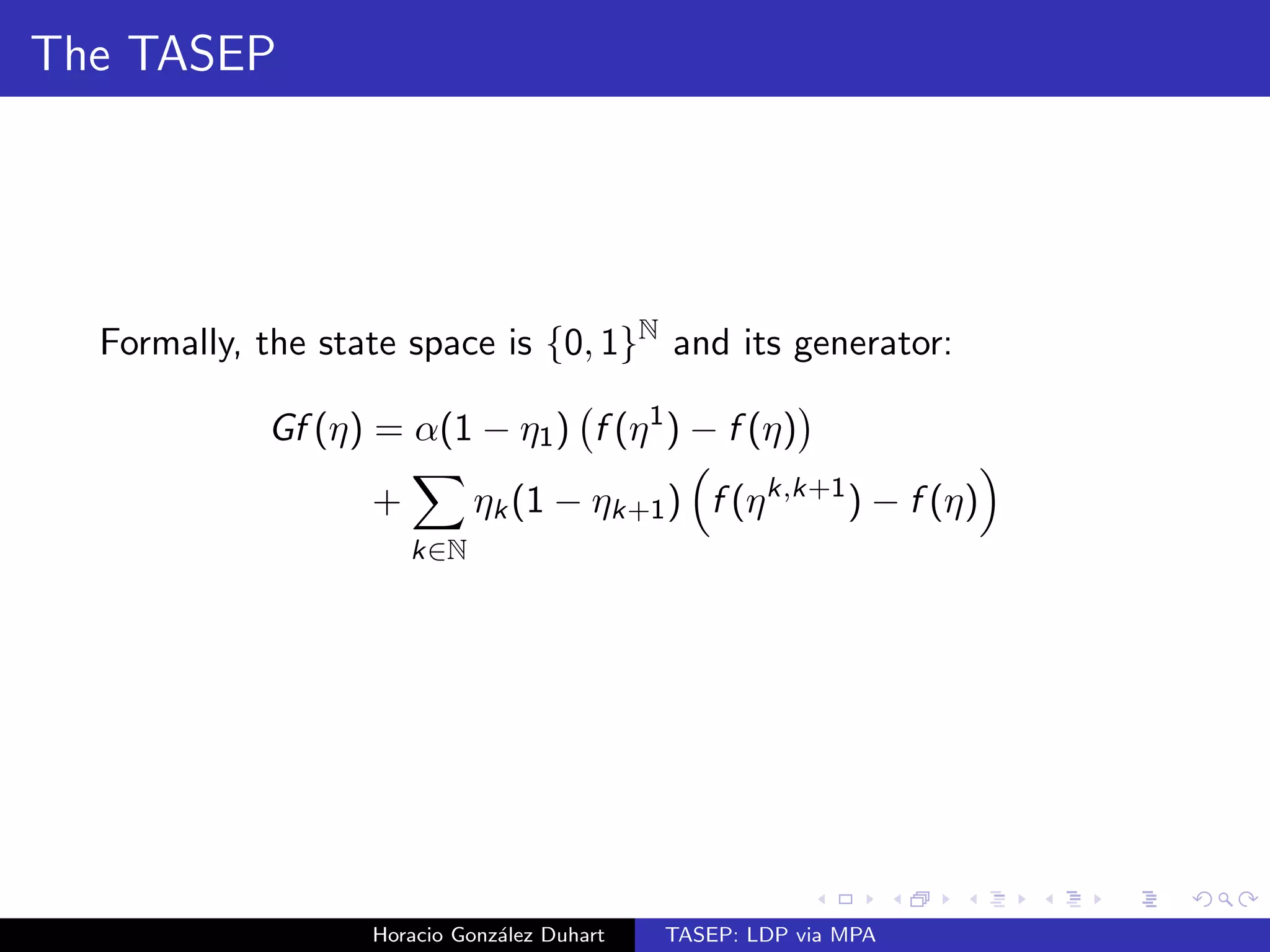
Formally, the state space is f0; 1gN and its generator: 
Gf () = (1  1) 
 
f (1)  f () 
 
+ 
X 
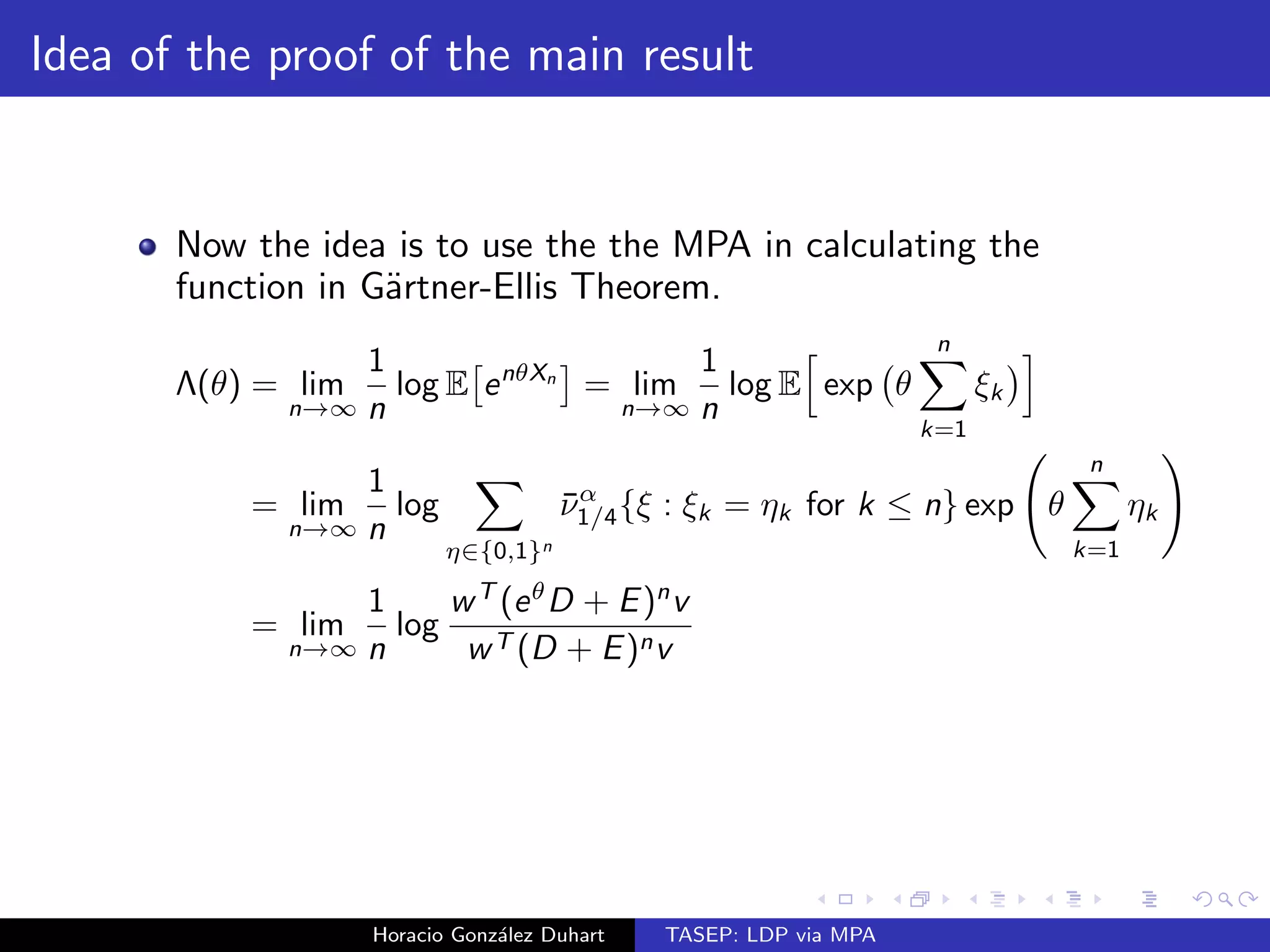
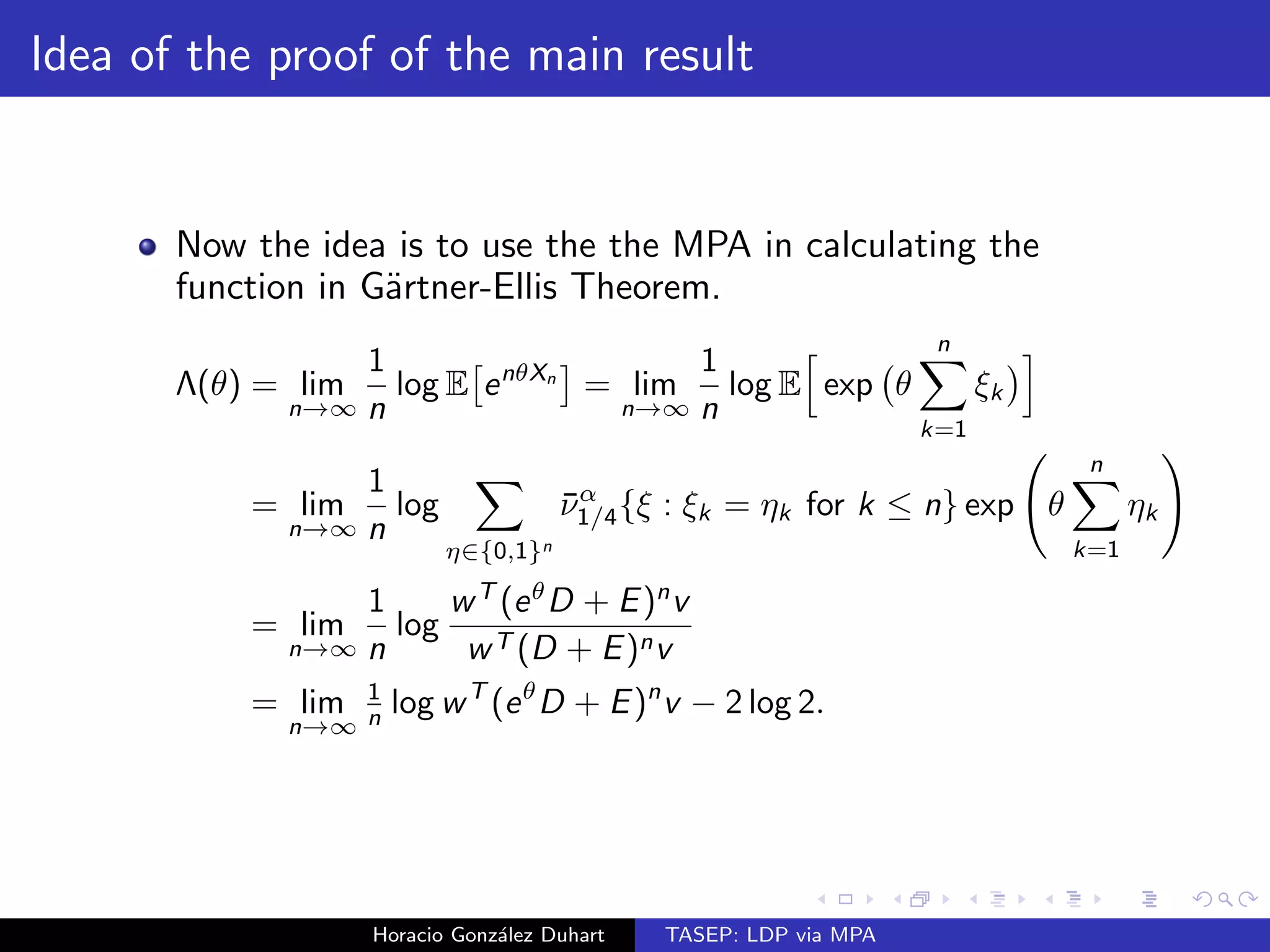
k2N 
k(1  k+1) 
 
f (k;k+1)  f () 
 
Horacio Gonzalez Duhart TASEP: LDP via MPA
The TASEP 
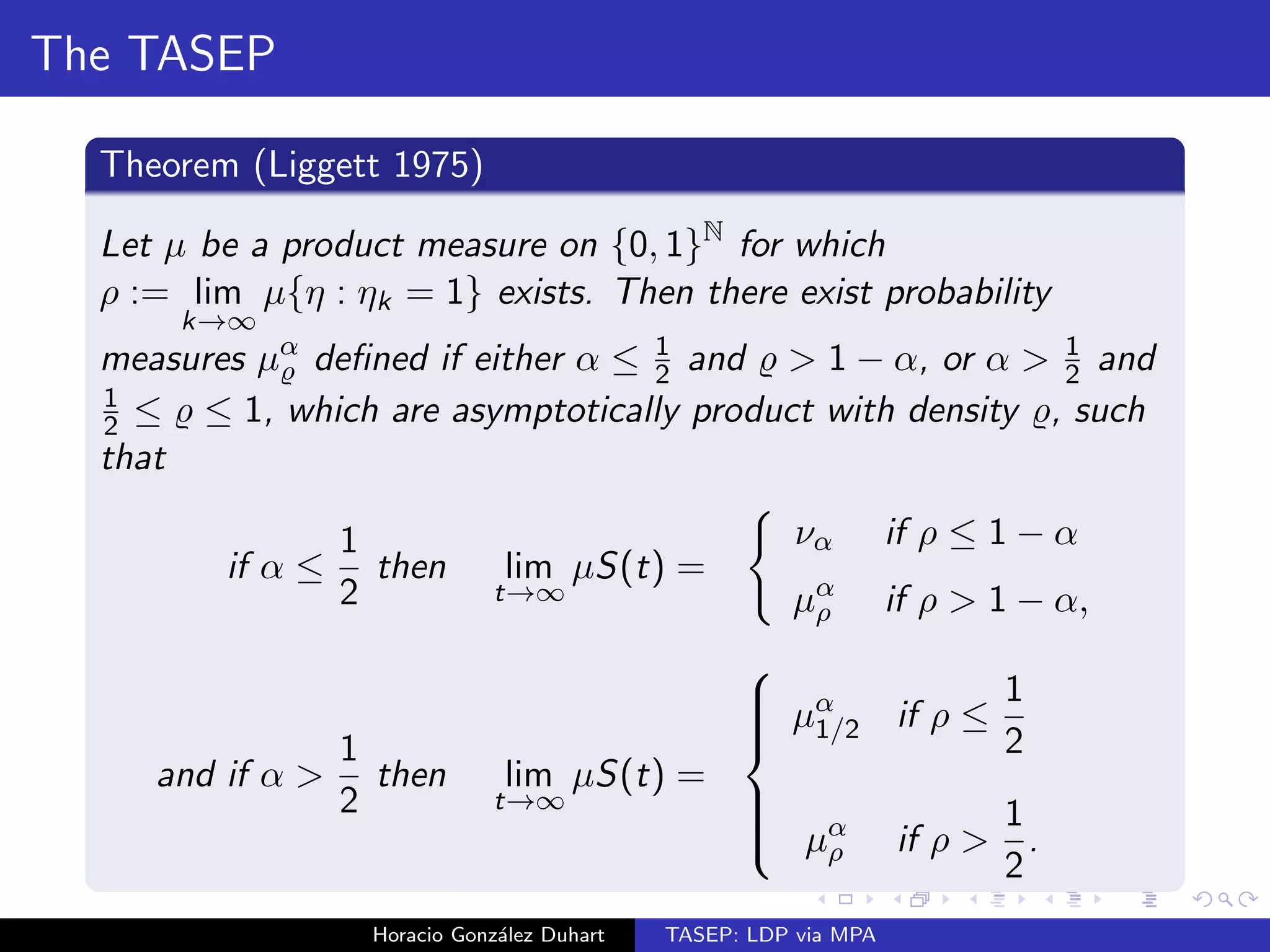
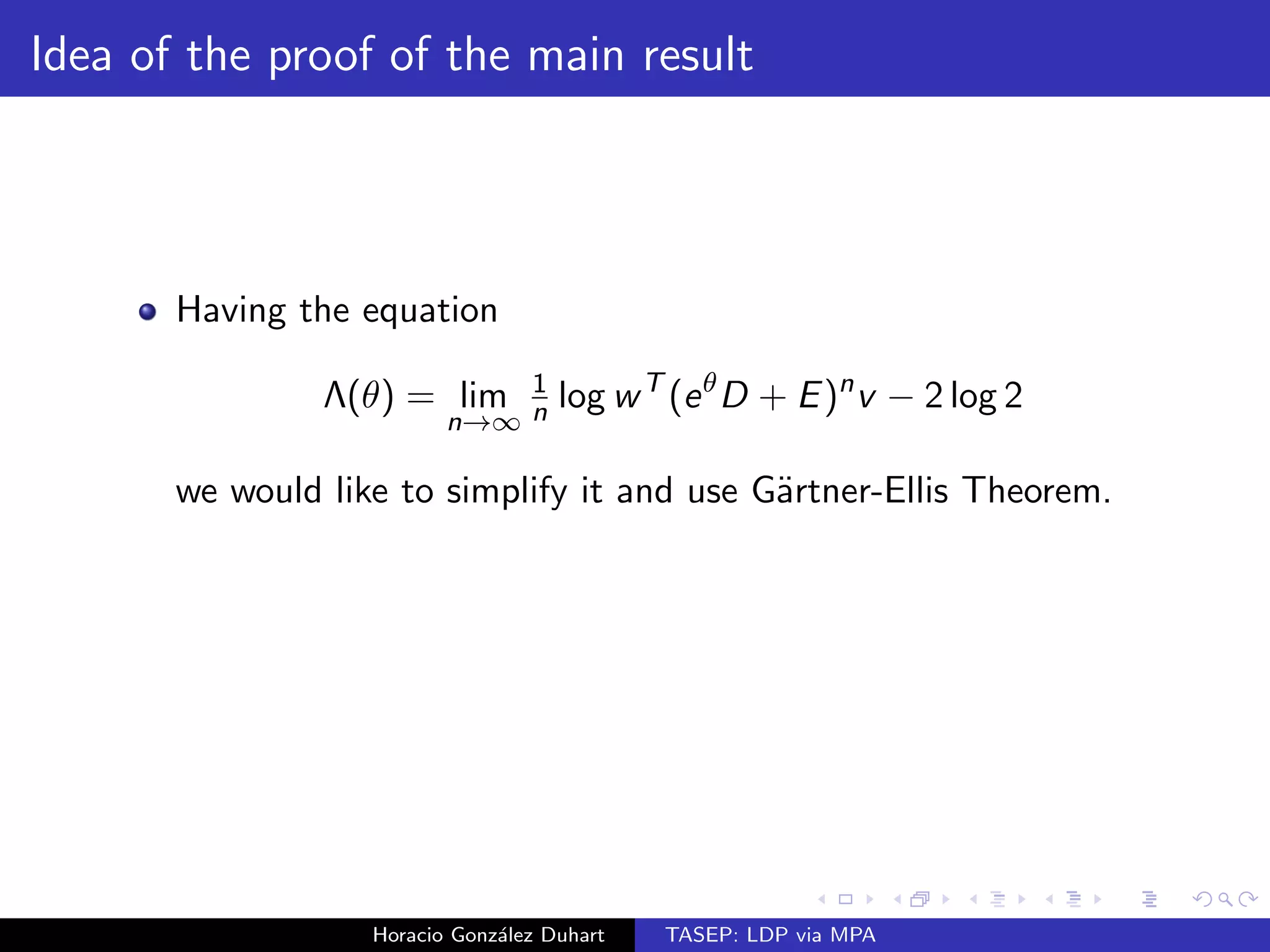
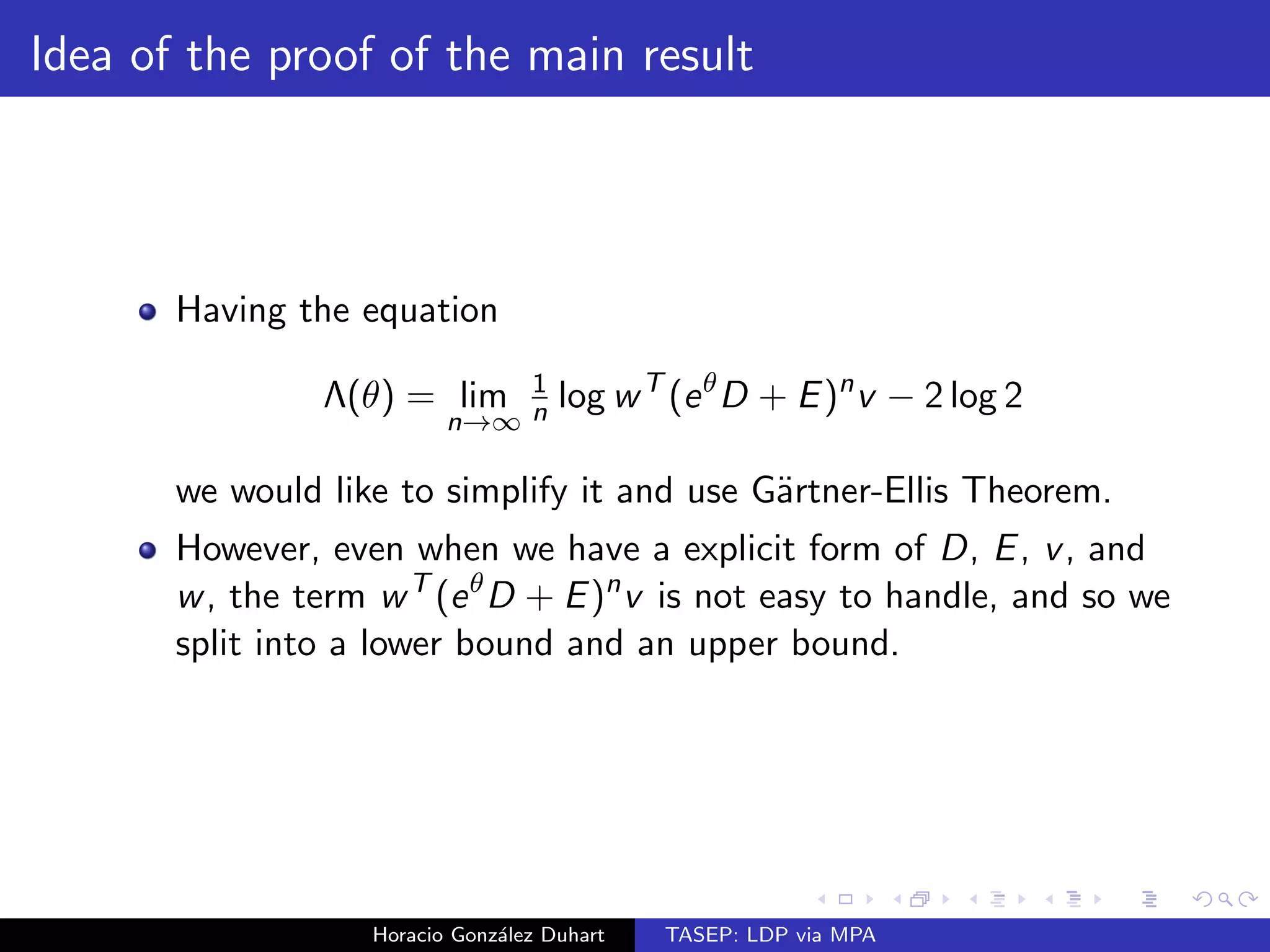
Theorem (Liggett 1975) 
Let  be a product measure on f0; 1gN for which 
 := lim 
k!1 
f : k = 1g exists. Then there exist probability 
measures % 
de
ned if either   1 
2 and %  1  , or   1 
2 and 
12 
 %  1, which are asymptotically product with density %, such 
that 
if   
1 
2 
then lim 
t!1 
S(t) = 
( 
 if   1   
 
if   1  ; 
and if   
1 
2 
then lim 
t!1 
S(t) = 
8 
: 
 1=2 if   
1 
2 
 
if   
1 
2 
. 
Horacio Gonzalez Duhart TASEP: LDP via MPA
Main result 
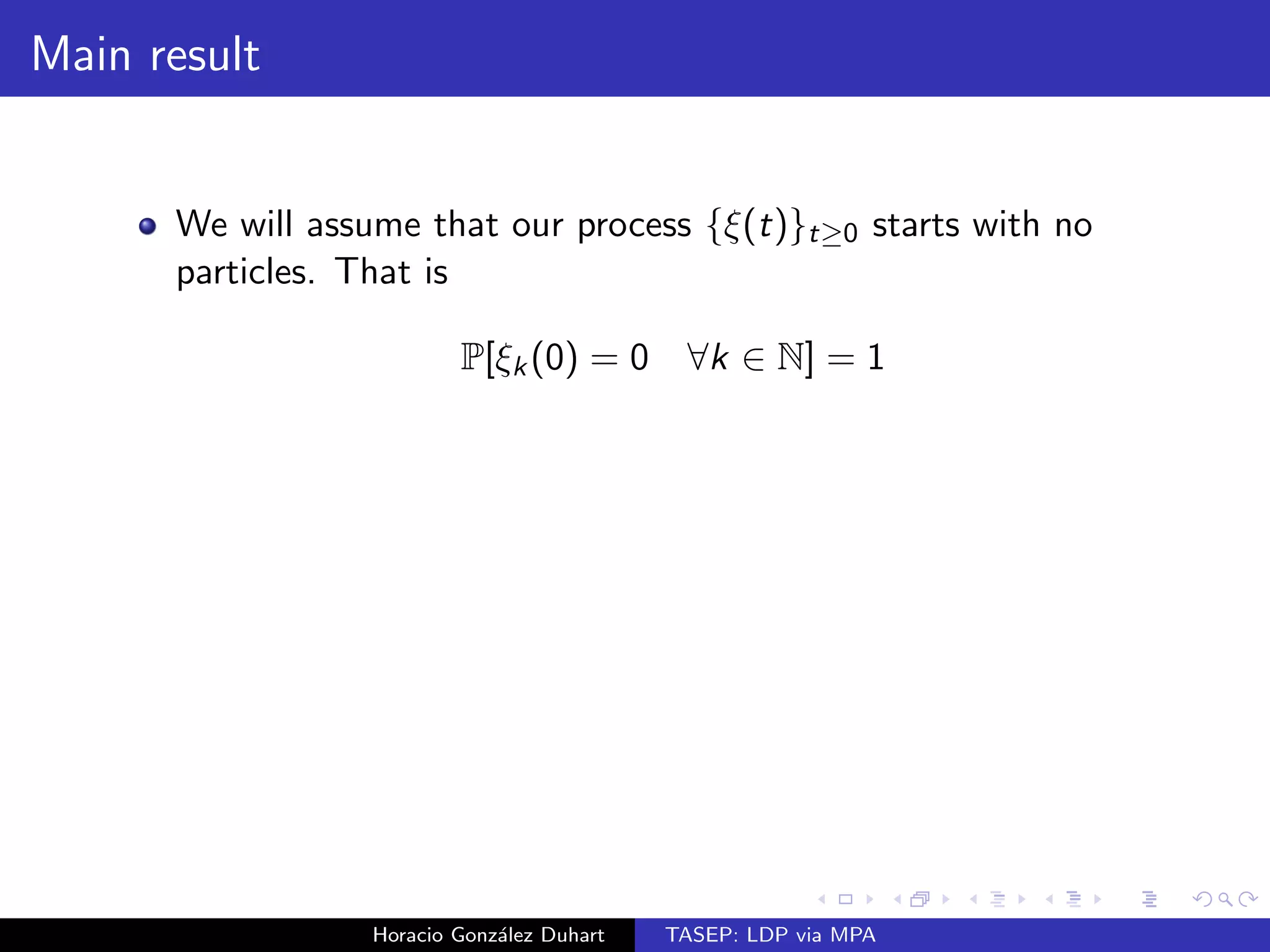
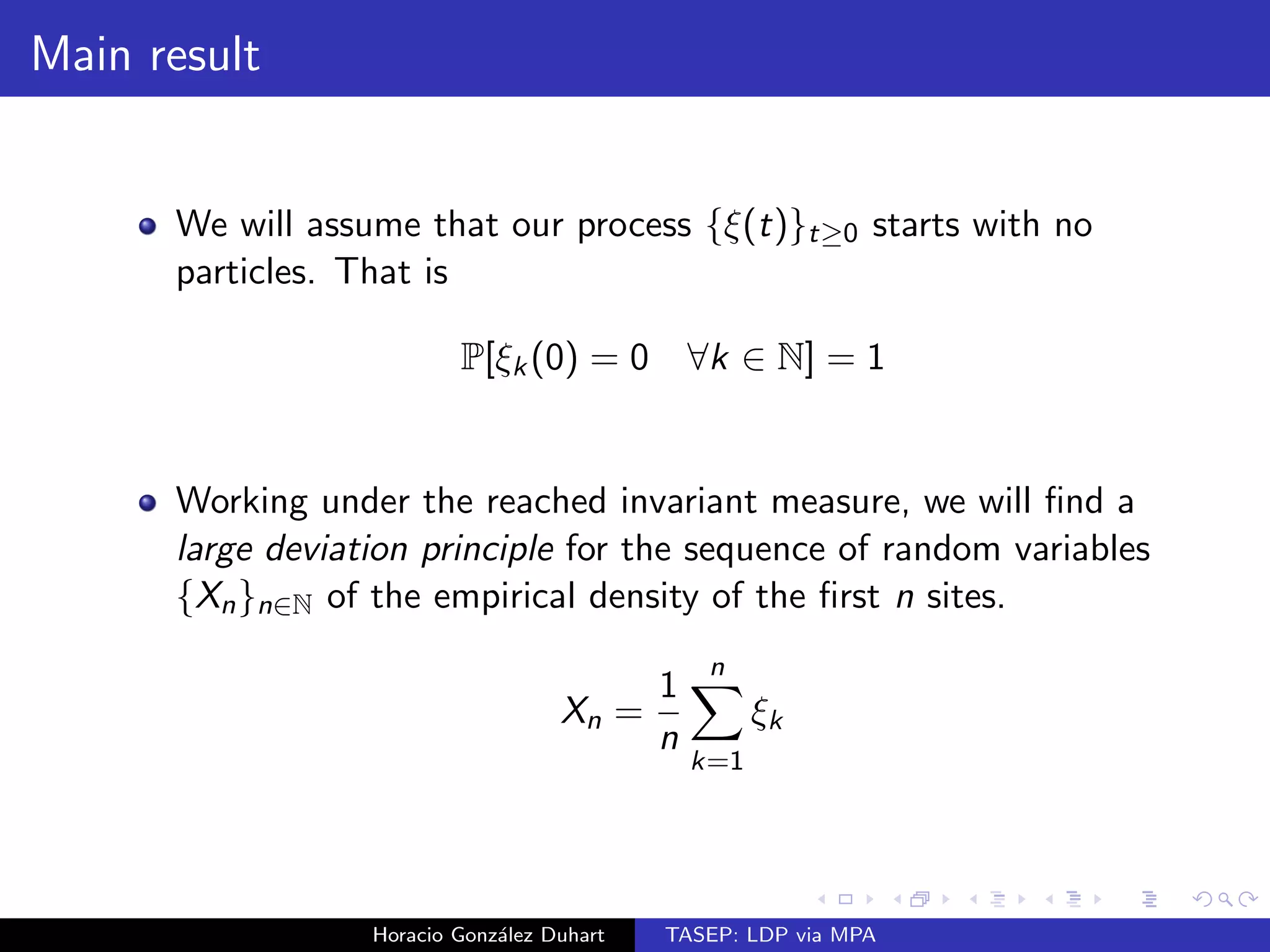
We will assume that our process f(t)gt0 starts with no 
particles. That is 
P[k(0) = 0 8k 2 N] = 1 
Horacio Gonzalez Duhart TASEP: LDP via MPA
Main result 
We will assume that our process f(t)gt0 starts with no 
particles. That is 
P[k(0) = 0 8k 2 N] = 1 
Working under the reached invariant measure, we will
nd a 
large deviation principle for the sequence of random variables 
fXngn2N of the empirical density of the
rst n sites. 
Xn = 
1 
n 
Xn 
k=1 
k 
Horacio Gonzalez Duhart TASEP: LDP via MPA
Main result 
Theorem 
Let Xn be the empirical density of a semi-in
nite TASEP with 
injection rate  2 (0; 1) starting with an empty lattice. Then, 
under the invariant probability measure given by Theorem 1, 
fXngn2N satis
es a large deviation principle with convex rate 
function I : [0; 1] ! [0;1] given as follows: 
(a) If   
1 
2 
, then I (x) = x log 
x 
 
+ (1  x) log 
1  x 
1   
. 
(b) If   
1 
2 
, then 
I (x) = 
8 
: 
x log 
x 
 
+ (1  x) log 
1  x 
1   
+ log (4(1  )) if 0  x  1  ; 
2 [x log x + (1  x) log(1  x) + log 2] if 1    x  
1 
2 
; 
x log x + (1  x) log(1  x) + log 2 if 
1 
2 
 x  1: 
Horacio Gonzalez Duhart TASEP: LDP via MPA
Main result 
Horacio Gonzalez Duhart TASEP: LDP via MPA
The MPA 
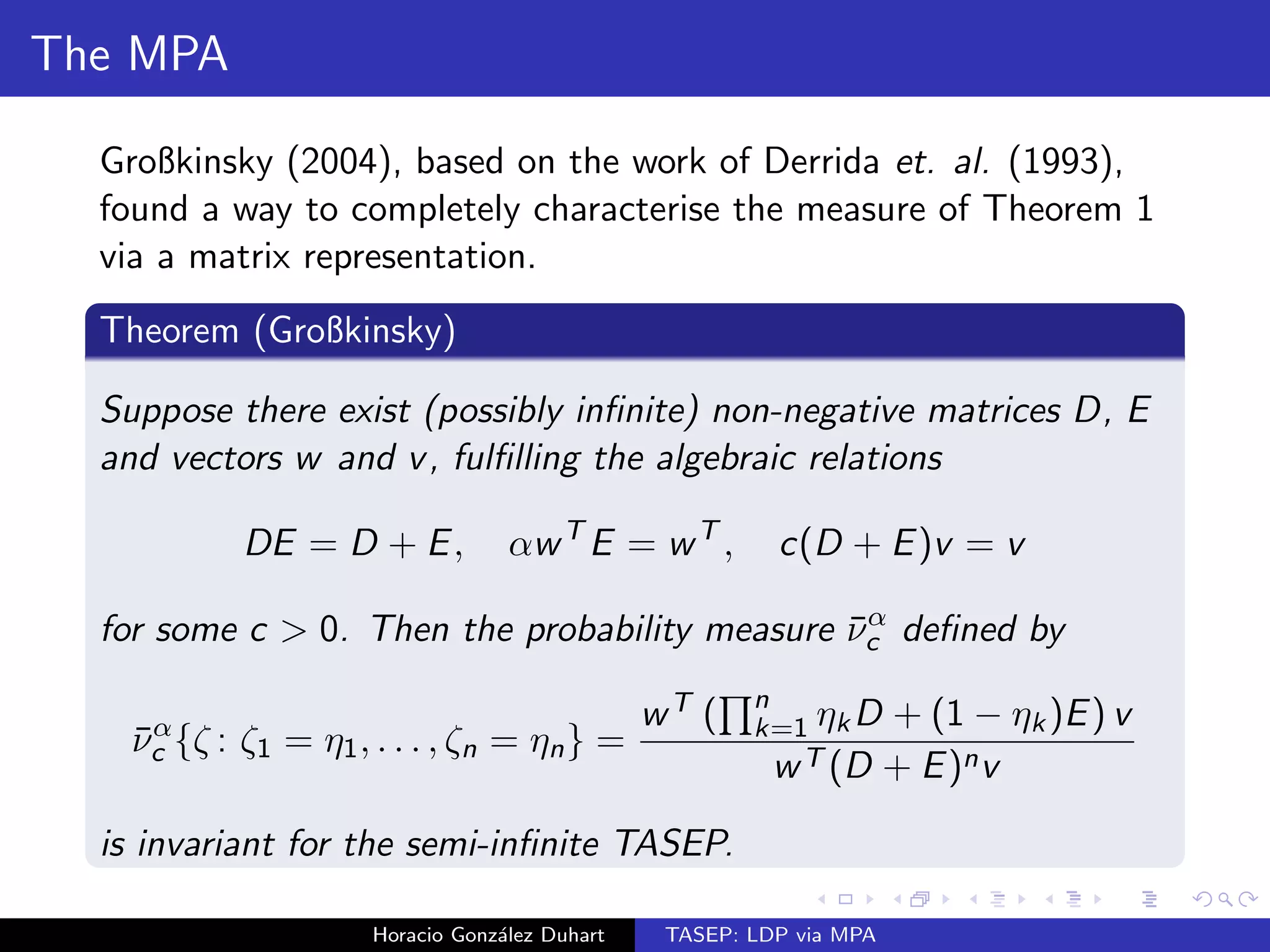
Grokinsky (2004), based on the work of Derrida et. al. (1993), 
found a way to completely characterise the measure of Theorem 1 
via a matrix representation. 
Theorem (Grokinsky) 
Suppose there exist (possibly in
nite) non-negative matrices D, E 
and vectors w and v, ful
lling the algebraic relations 
DE = D + E; wTE = wT ; c(D + E)v = v 
for some c  0. Then the probability measure  
c de
ned by 
 
c f : 1 = 1; : : : ; n = ng = 
wT ( 
Qn 
k=1 kD + (1  k )E) v 
wT (D + E)nv 
is invariant for the semi-in
nite TASEP. 
Horacio Gonzalez Duhart TASEP: LDP via MPA
The MPA 
The invariant measure given by Liggett is the same as the one 
given by Grokinsky. 
Horacio Gonzalez Duhart TASEP: LDP via MPA
The MPA 
The invariant measure given by Liggett is the same as the one 
given by Grokinsky. 
We will focus on the case when we start with an empty lattice. 
Horacio Gonzalez Duhart TASEP: LDP via MPA
The MPA 
12 
The invariant measure given by Liggett is the same as the one 
given by Grokinsky. 
We will focus on the case when we start with an empty lattice. 
When   , sites behave like iid Bernoulli random variables 
with parameter . 
Horacio Gonzalez Duhart TASEP: LDP via MPA
The MPA 
12 
The invariant measure given by Liggett is the same as the one 
given by Grokinsky. 
We will focus on the case when we start with an empty lattice. 
When   , sites behave like iid Bernoulli random variables 
with parameter . 
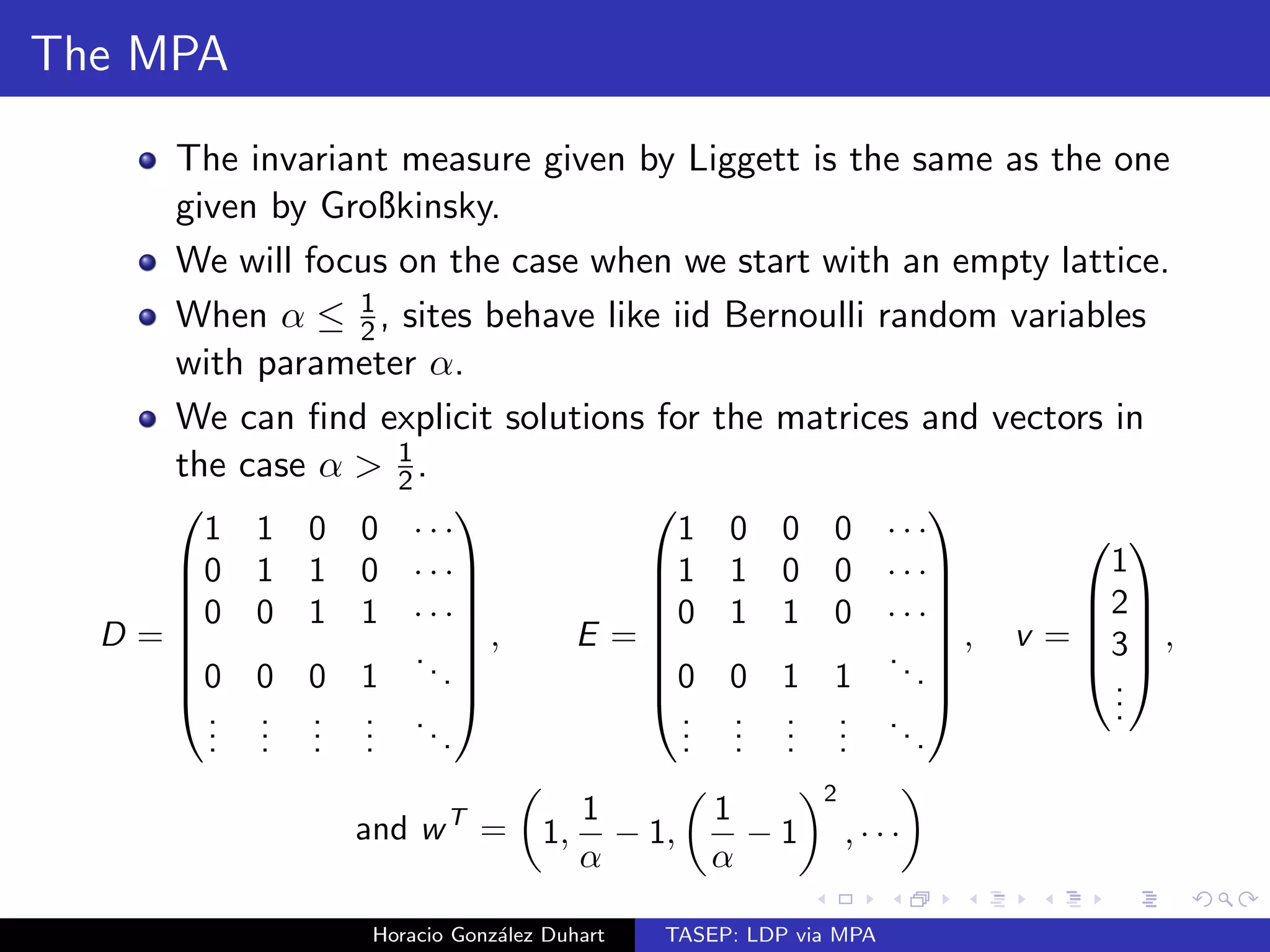
We can
nd explicit solutions for the matrices and vectors in 
the case   1 
2 . 
Horacio Gonzalez Duhart TASEP: LDP via MPA
The MPA 
12 
The invariant measure given by Liggett is the same as the one 
given by Grokinsky. 
We will focus on the case when we start with an empty lattice. 
When   , sites behave like iid Bernoulli random variables 
with parameter . 
We can
nd explicit solutions for the matrices and vectors in 
the case   1 
2 . 
D = 
0 
1 1 0 0    
0 1 1 0    
0 0 1 1    
0 0 0 1 
BBBBBB@ 
. . . 
... 
... 
... 
... 
. . . 
1 
CCCCCCA 
; E = 
0 
1 0 0 0    
1 1 0 0    
0 1 1 0    
0 0 1 1 
BBBBBB@ 
. . . 
... 
... 
... 
... 
. . . 
1 
CCCCCCA 
; v = 
0 
BBB@ 
1 
2 
3 
... 
1 
CCCA 
; 
and wT = 
 
1; 
1 
 
 1; 
 
1 
 
 1 
2 
;    
 
Horacio Gonzalez Duhart TASEP: LDP via MPA
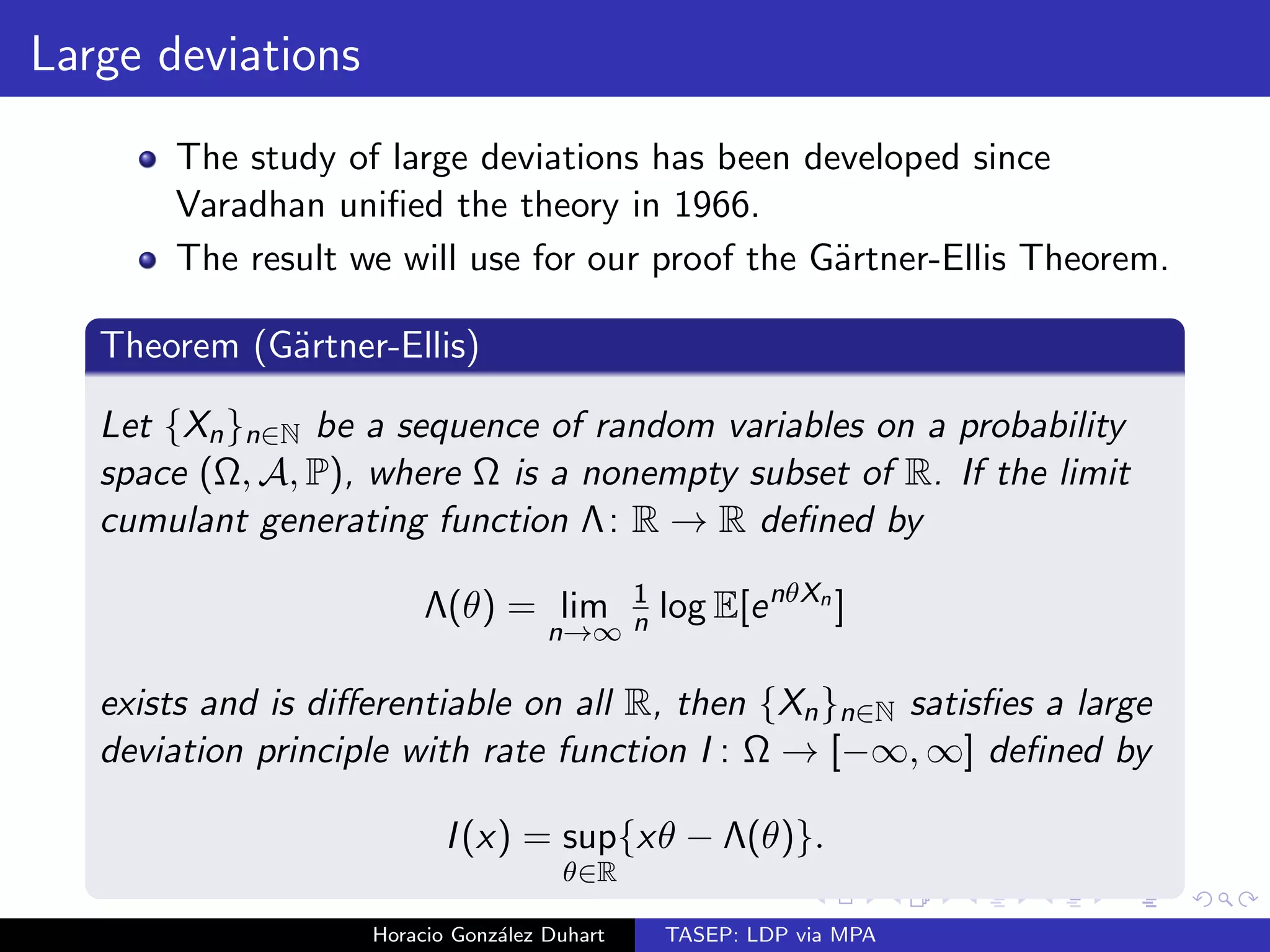
Large deviations 
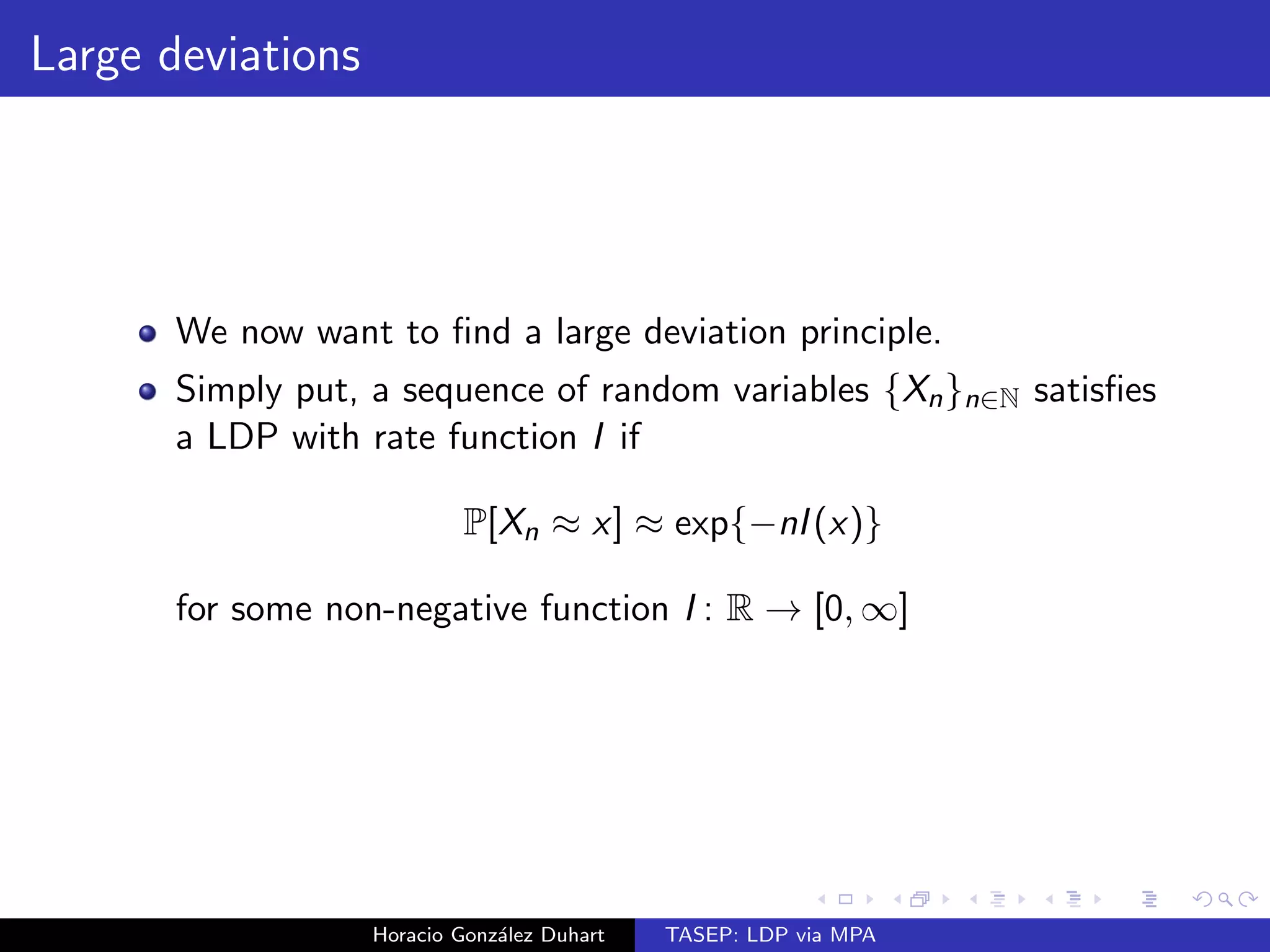
We now want to
nd a large deviation principle. 
Horacio Gonzalez Duhart TASEP: LDP via MPA
Large deviations 
We now want to
nd a large deviation principle. 
Simply put, a sequence of random variables fXngn2N satis
es 
a LDP with rate function I if 
P[Xn  x]  expfnI (x)g 
for some non-negative function I : R ! [0;1] 
Horacio Gonzalez Duhart TASEP: LDP via MPA
Large deviations 
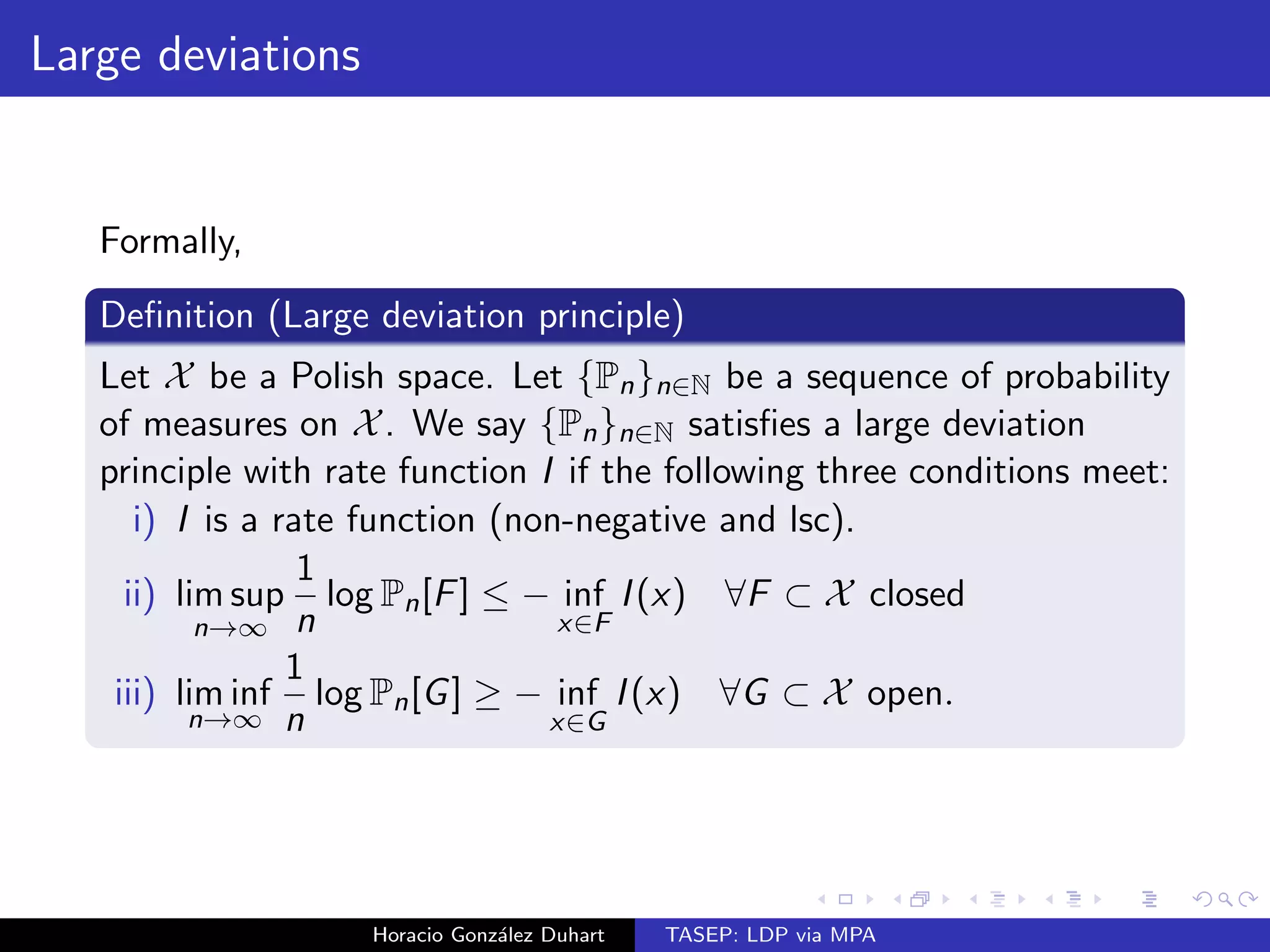
Formally, 
De
nition (Large deviation principle) 
Let X be a Polish space. Let fPngn2N be a sequence of probability 
of measures on X. We say fPngn2N satis
es a large deviation 
principle with rate function I if the following three conditions meet: 
i) I is a rate function (non-negative and lsc). 
ii) lim sup 
n!1 
1 
n 
log Pn[F]   inf 
x2F 
I (x) 8F  X closed 
iii) lim inf 
n!1 
1 
n 
log Pn[G]   inf 
x2G 
I (x) 8G  X open: 
Horacio Gonzalez Duhart TASEP: LDP via MPA
Large deviations 
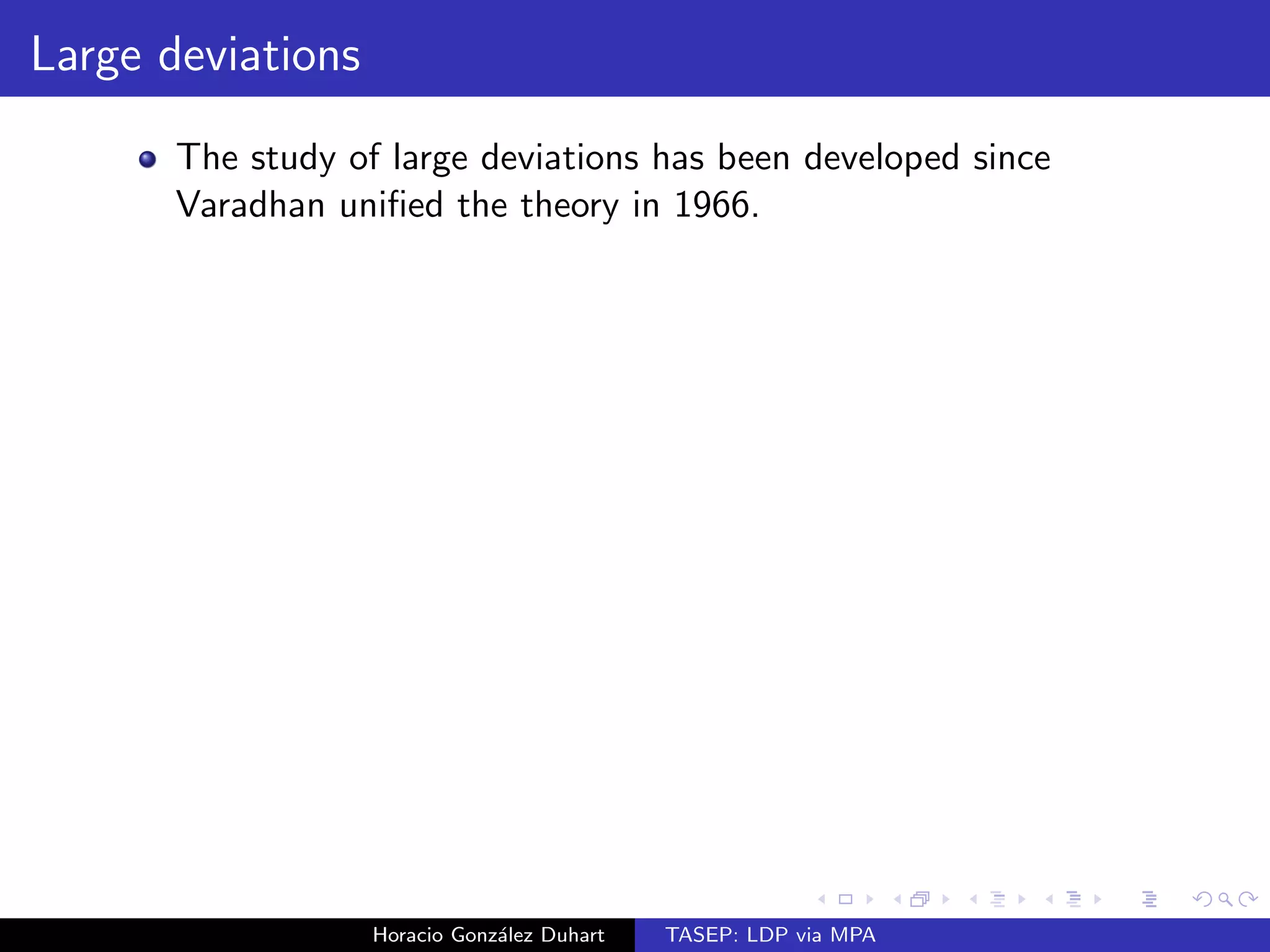
The study of large deviations has been developed since 
Varadhan uni
ed the theory in 1966. 
Horacio Gonzalez Duhart TASEP: LDP via MPA
Large deviations 
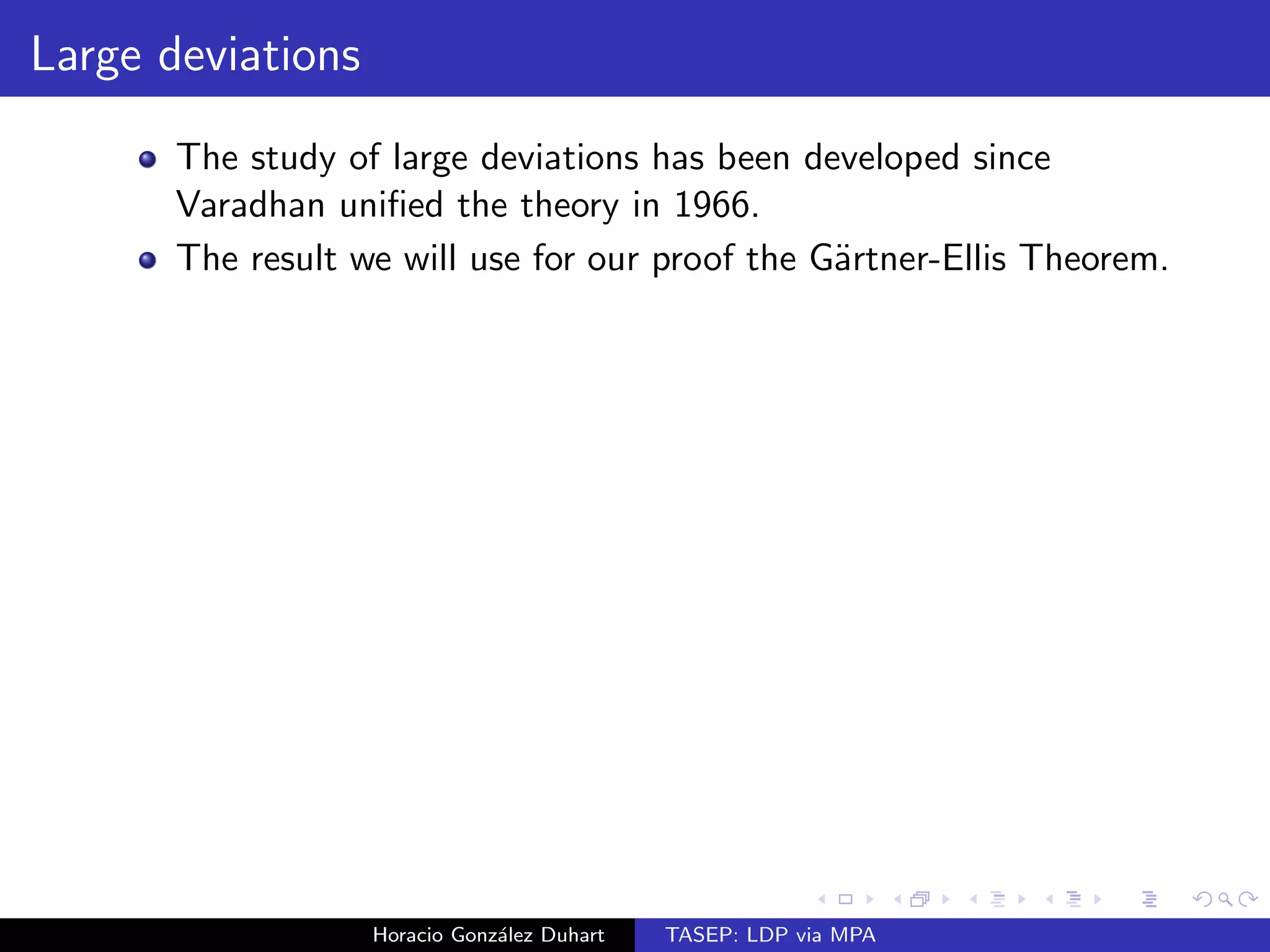
The study of large deviations has been developed since 
Varadhan uni
ed the theory in 1966. 
The result we will use for our proof the Gartner-Ellis Theorem. 
Horacio Gonzalez Duhart TASEP: LDP via MPA
Large deviations 
The study of large deviations has been developed since 
Varadhan uni

TASEP: LDP via MPA

  • 1.
  • 2.
    nite TASEP: LargeDeviations via Matrix Products H. G. Duhart, P. Morters, J. Zimmer University of Bath 21 November 2014
  • 3.
    The TASEP Thetotally asymmetric simple exclusion process is one of the simplest interacting particle systems. It was introduced by Liggett in 1975. Horacio Gonzalez Duhart TASEP: LDP via MPA
  • 4.
    The TASEP Thetotally asymmetric simple exclusion process is one of the simplest interacting particle systems. It was introduced by Liggett in 1975. Create particles in site 1 at rate 2 (0; 1). Horacio Gonzalez Duhart TASEP: LDP via MPA
  • 5.
    The TASEP Thetotally asymmetric simple exclusion process is one of the simplest interacting particle systems. It was introduced by Liggett in 1975. Create particles in site 1 at rate 2 (0; 1). Particles jump to the right with rate 1. Horacio Gonzalez Duhart TASEP: LDP via MPA
  • 6.
    The TASEP Thetotally asymmetric simple exclusion process is one of the simplest interacting particle systems. It was introduced by Liggett in 1975. Create particles in site 1 at rate 2 (0; 1). Particles jump to the right with rate 1. At most one particle per site. Horacio Gonzalez Duhart TASEP: LDP via MPA
  • 7.
    The TASEP Thetotally asymmetric simple exclusion process is one of the simplest interacting particle systems. It was introduced by Liggett in 1975. Create particles in site 1 at rate 2 (0; 1). Particles jump to the right with rate 1. At most one particle per site. 1 . . . Horacio Gonzalez Duhart TASEP: LDP via MPA
  • 8.
    The TASEP Formally,the state space is f0; 1gN and its generator: Gf () = (1 1) f (1) f () + X k2N k(1 k+1) f (k;k+1) f () Horacio Gonzalez Duhart TASEP: LDP via MPA
  • 9.
    The TASEP Theorem(Liggett 1975) Let be a product measure on f0; 1gN for which := lim k!1 f : k = 1g exists. Then there exist probability measures % de
  • 10.
    ned if either 1 2 and % 1 , or 1 2 and 12 % 1, which are asymptotically product with density %, such that if 1 2 then lim t!1 S(t) = ( if 1 if 1 ; and if 1 2 then lim t!1 S(t) = 8 : 1=2 if 1 2 if 1 2 . Horacio Gonzalez Duhart TASEP: LDP via MPA
  • 11.
    Main result Wewill assume that our process f(t)gt0 starts with no particles. That is P[k(0) = 0 8k 2 N] = 1 Horacio Gonzalez Duhart TASEP: LDP via MPA
  • 12.
    Main result Wewill assume that our process f(t)gt0 starts with no particles. That is P[k(0) = 0 8k 2 N] = 1 Working under the reached invariant measure, we will
  • 13.
    nd a largedeviation principle for the sequence of random variables fXngn2N of the empirical density of the
  • 14.
    rst n sites. Xn = 1 n Xn k=1 k Horacio Gonzalez Duhart TASEP: LDP via MPA
  • 15.
    Main result Theorem Let Xn be the empirical density of a semi-in
  • 16.
    nite TASEP with injection rate 2 (0; 1) starting with an empty lattice. Then, under the invariant probability measure given by Theorem 1, fXngn2N satis
  • 17.
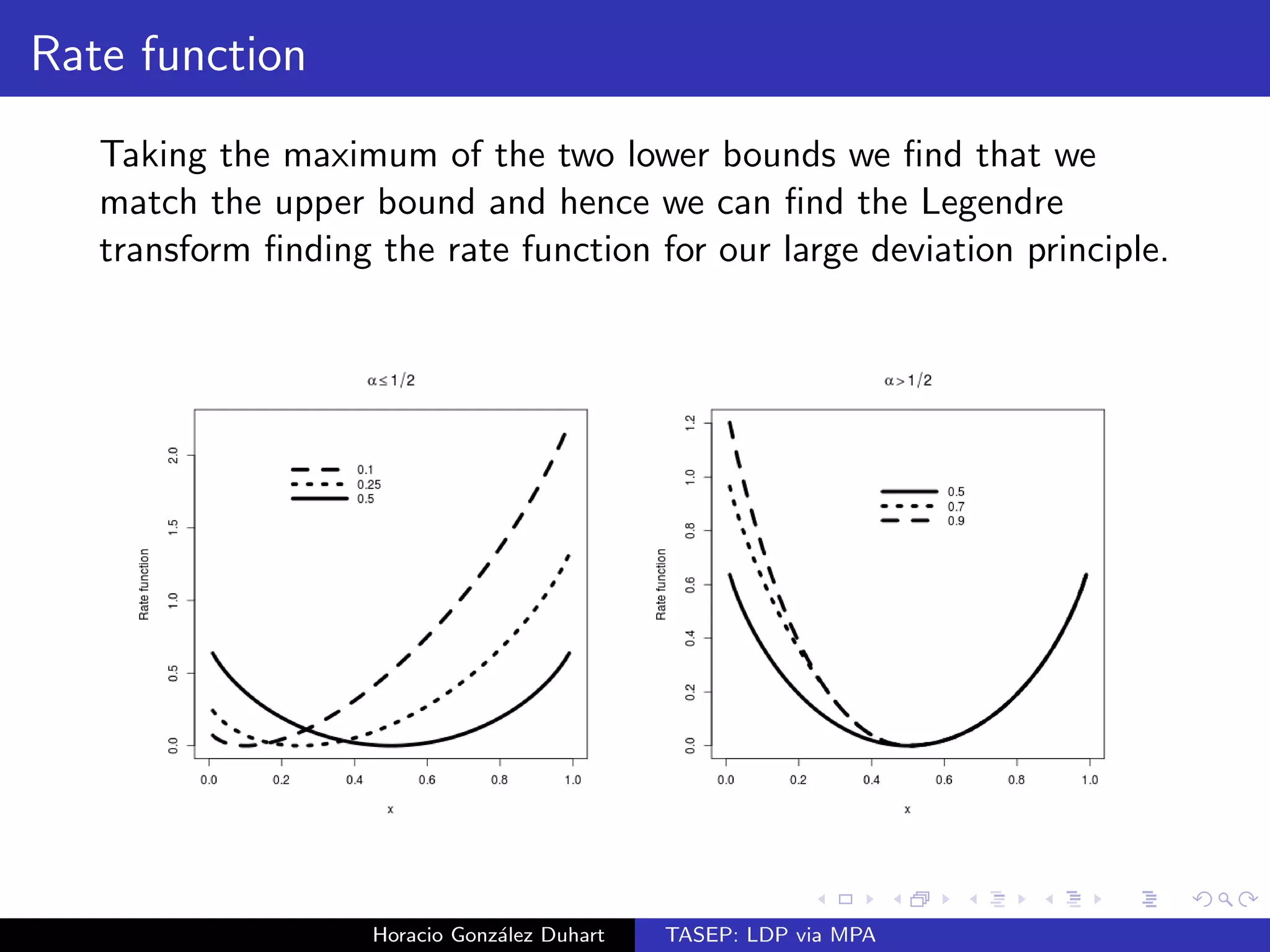
    es a largedeviation principle with convex rate function I : [0; 1] ! [0;1] given as follows: (a) If 1 2 , then I (x) = x log x + (1 x) log 1 x 1 . (b) If 1 2 , then I (x) = 8 : x log x + (1 x) log 1 x 1 + log (4(1 )) if 0 x 1 ; 2 [x log x + (1 x) log(1 x) + log 2] if 1 x 1 2 ; x log x + (1 x) log(1 x) + log 2 if 1 2 x 1: Horacio Gonzalez Duhart TASEP: LDP via MPA
  • 18.
    Main result HoracioGonzalez Duhart TASEP: LDP via MPA
  • 19.
    The MPA Grokinsky(2004), based on the work of Derrida et. al. (1993), found a way to completely characterise the measure of Theorem 1 via a matrix representation. Theorem (Grokinsky) Suppose there exist (possibly in
  • 20.
    nite) non-negative matricesD, E and vectors w and v, ful
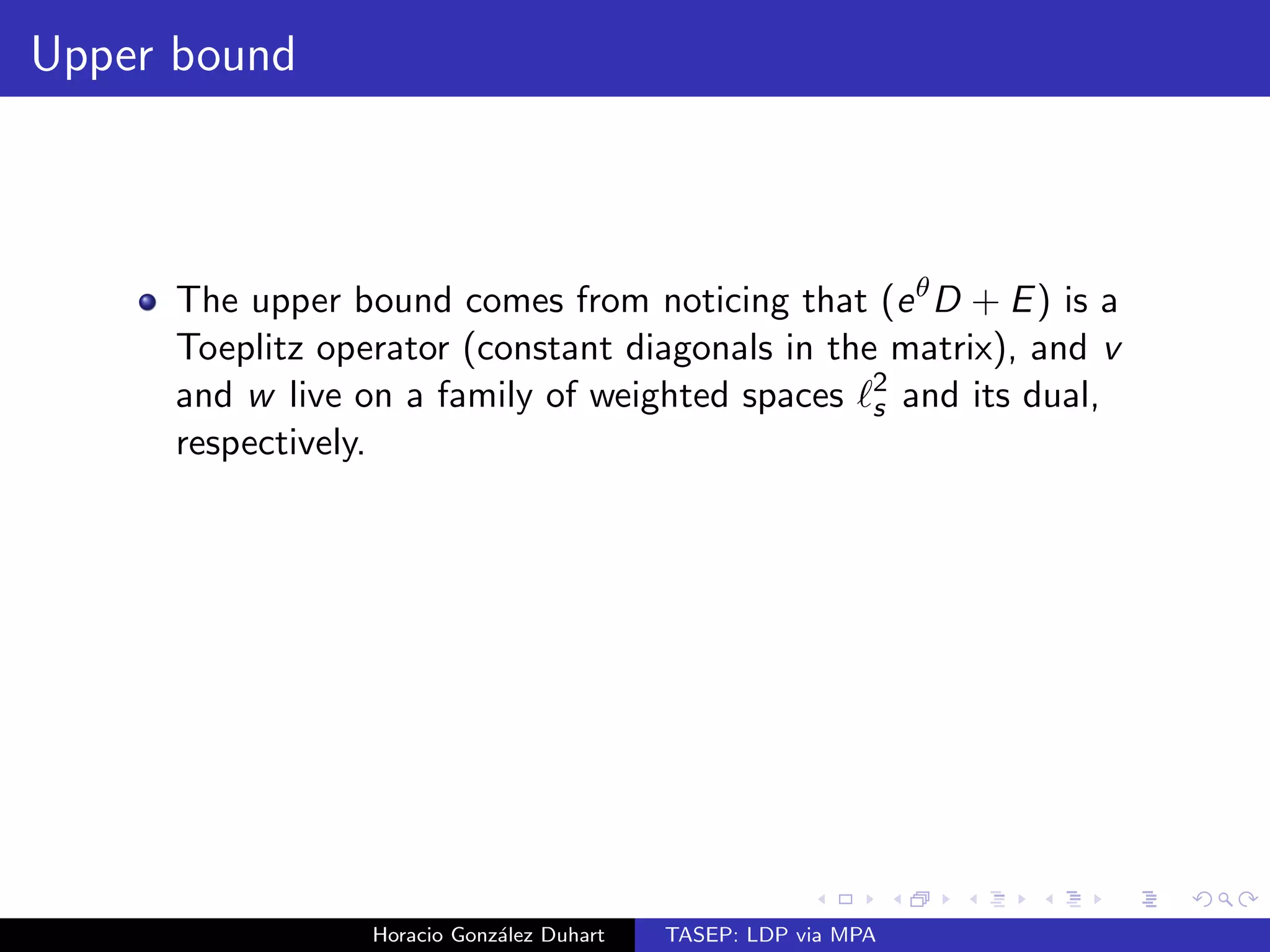
  • 21.
    lling the algebraicrelations DE = D + E; wTE = wT ; c(D + E)v = v for some c 0. Then the probability measure c de
  • 22.
    ned by c f : 1 = 1; : : : ; n = ng = wT ( Qn k=1 kD + (1 k )E) v wT (D + E)nv is invariant for the semi-in
  • 23.
    nite TASEP. HoracioGonzalez Duhart TASEP: LDP via MPA
  • 24.
    The MPA Theinvariant measure given by Liggett is the same as the one given by Grokinsky. Horacio Gonzalez Duhart TASEP: LDP via MPA
  • 25.
    The MPA Theinvariant measure given by Liggett is the same as the one given by Grokinsky. We will focus on the case when we start with an empty lattice. Horacio Gonzalez Duhart TASEP: LDP via MPA
  • 26.
    The MPA 12 The invariant measure given by Liggett is the same as the one given by Grokinsky. We will focus on the case when we start with an empty lattice. When , sites behave like iid Bernoulli random variables with parameter . Horacio Gonzalez Duhart TASEP: LDP via MPA
  • 27.
    The MPA 12 The invariant measure given by Liggett is the same as the one given by Grokinsky. We will focus on the case when we start with an empty lattice. When , sites behave like iid Bernoulli random variables with parameter . We can
  • 28.
    nd explicit solutionsfor the matrices and vectors in the case 1 2 . Horacio Gonzalez Duhart TASEP: LDP via MPA
  • 29.
    The MPA 12 The invariant measure given by Liggett is the same as the one given by Grokinsky. We will focus on the case when we start with an empty lattice. When , sites behave like iid Bernoulli random variables with parameter . We can
  • 30.
    nd explicit solutionsfor the matrices and vectors in the case 1 2 . D = 0 1 1 0 0 0 1 1 0 0 0 1 1 0 0 0 1 BBBBBB@ . . . ... ... ... ... . . . 1 CCCCCCA ; E = 0 1 0 0 0 1 1 0 0 0 1 1 0 0 0 1 1 BBBBBB@ . . . ... ... ... ... . . . 1 CCCCCCA ; v = 0 BBB@ 1 2 3 ... 1 CCCA ; and wT = 1; 1 1; 1 1 2 ; Horacio Gonzalez Duhart TASEP: LDP via MPA
  • 31.
  • 32.
    nd a largedeviation principle. Horacio Gonzalez Duhart TASEP: LDP via MPA
  • 33.
  • 34.
    nd a largedeviation principle. Simply put, a sequence of random variables fXngn2N satis
  • 35.
    es a LDPwith rate function I if P[Xn x] expfnI (x)g for some non-negative function I : R ! [0;1] Horacio Gonzalez Duhart TASEP: LDP via MPA
  • 36.
  • 37.
    nition (Large deviationprinciple) Let X be a Polish space. Let fPngn2N be a sequence of probability of measures on X. We say fPngn2N satis
  • 38.
    es a largedeviation principle with rate function I if the following three conditions meet: i) I is a rate function (non-negative and lsc). ii) lim sup n!1 1 n log Pn[F] inf x2F I (x) 8F X closed iii) lim inf n!1 1 n log Pn[G] inf x2G I (x) 8G X open: Horacio Gonzalez Duhart TASEP: LDP via MPA
  • 39.
    Large deviations Thestudy of large deviations has been developed since Varadhan uni
  • 40.
    ed the theoryin 1966. Horacio Gonzalez Duhart TASEP: LDP via MPA
  • 41.
    Large deviations Thestudy of large deviations has been developed since Varadhan uni
  • 42.
    ed the theoryin 1966. The result we will use for our proof the Gartner-Ellis Theorem. Horacio Gonzalez Duhart TASEP: LDP via MPA
  • 43.
    Large deviations Thestudy of large deviations has been developed since Varadhan uni
  • 44.
    ed the theoryin 1966. The result we will use for our proof the Gartner-Ellis Theorem. Theorem (Gartner-Ellis) Let fXngn2N be a sequence of random variables on a probability space ( ;A; P), where is a nonempty subset of R. If the limit cumulant generating function : R ! R de
  • 45.
    ned by ()= lim n!1 1n log E[enXn ] exists and is dierentiable on all R, then fXngn2N satis
  • 46.
    es a large deviation principle with rate function I : ! [1;1] de
  • 47.
    ned by I(x) = sup fx ()g: 2R Horacio Gonzalez Duhart TASEP: LDP via MPA
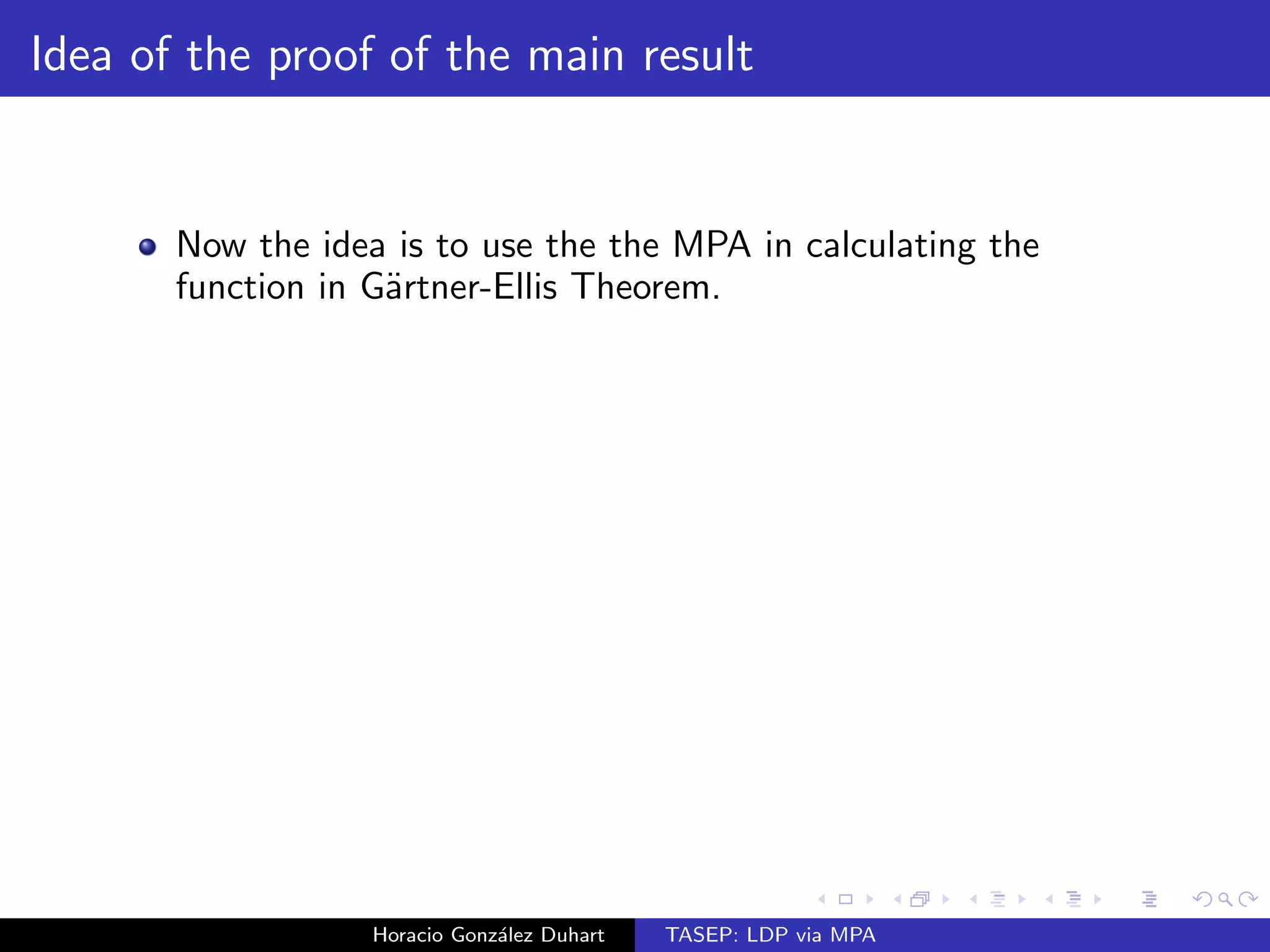
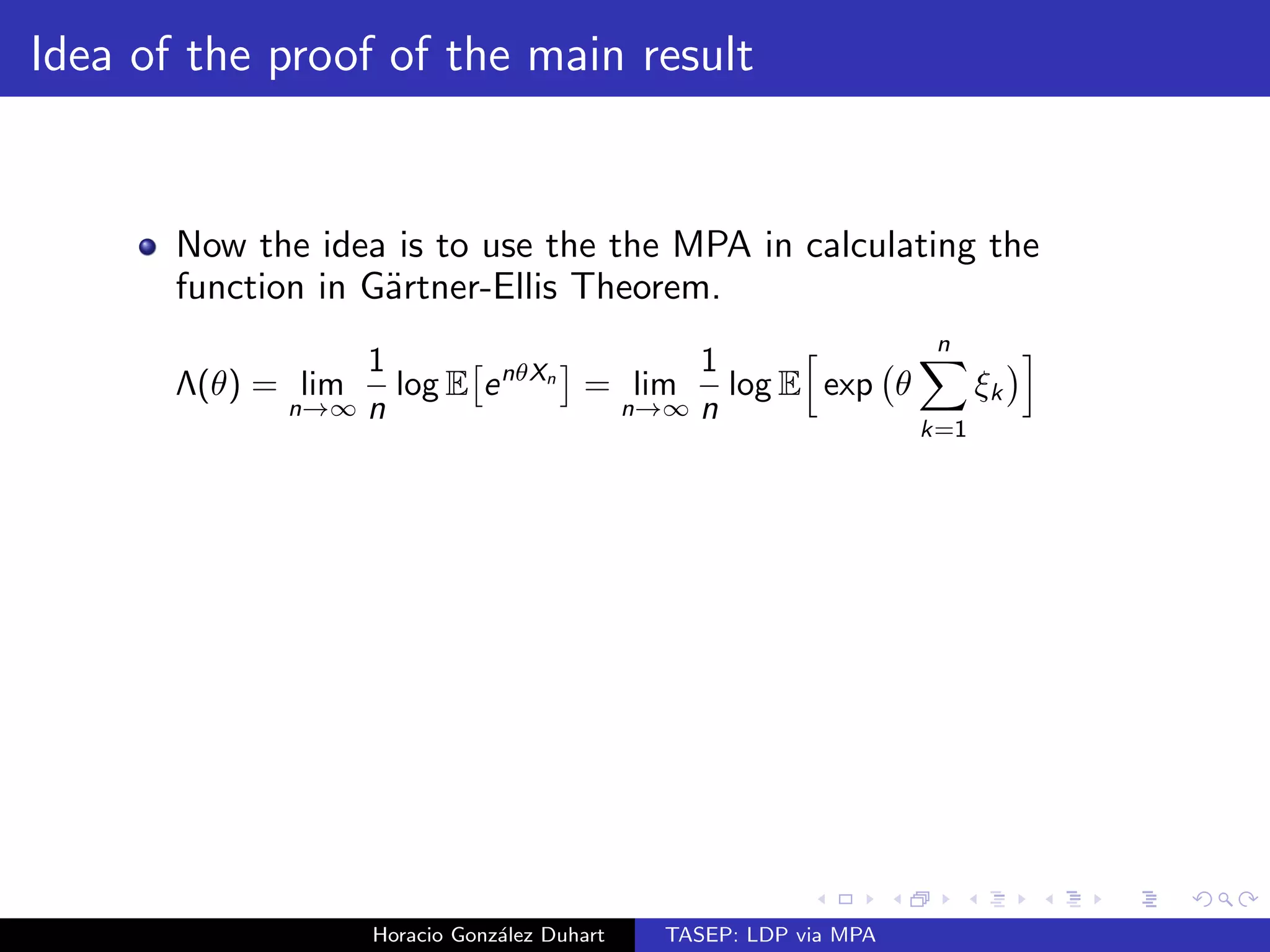
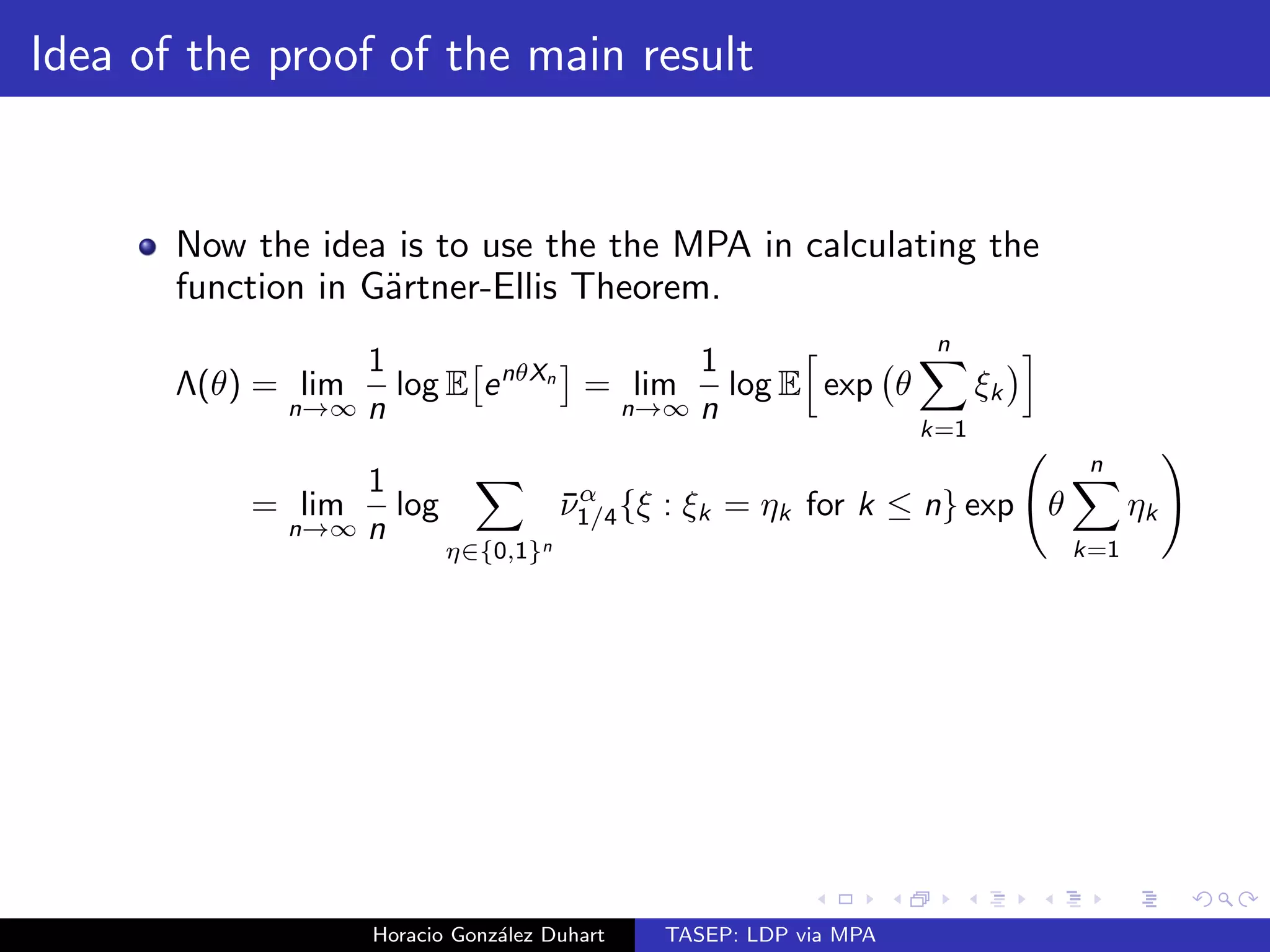
  • 48.
    Idea of theproof of the main result Now the idea is to use the the MPA in calculating the function in Gartner-Ellis Theorem. Horacio Gonzalez Duhart TASEP: LDP via MPA
  • 49.
    Idea of theproof of the main result Now the idea is to use the the MPA in calculating the function in Gartner-Ellis Theorem. () = lim n!1 1 n enXn log E = lim n!1 1 n h exp log E Xn k=1 k i Horacio Gonzalez Duhart TASEP: LDP via MPA
  • 50.
    Idea of theproof of the main result Now the idea is to use the the MPA in calculating the function in Gartner-Ellis Theorem. () = lim n!1 1 n enXn log E = lim n!1 1 n h exp log E Xn k=1 k i = lim n!1 1 n log X 2f0;1gn 1=4f : k = k for k ng exp Xn k=1 k ! Horacio Gonzalez Duhart TASEP: LDP via MPA
  • 51.
    Idea of theproof of the main result Now the idea is to use the the MPA in calculating the function in Gartner-Ellis Theorem. () = lim n!1 1 n enXn log E = lim n!1 1 n h exp log E Xn k=1 k i = lim n!1 1 n log X 2f0;1gn 1=4f : k = k for k ng exp Xn k=1 k ! = lim n!1 1 n log wT (eD + E)nv wT (D + E)nv Horacio Gonzalez Duhart TASEP: LDP via MPA
  • 52.
    Idea of theproof of the main result Now the idea is to use the the MPA in calculating the function in Gartner-Ellis Theorem. () = lim n!1 1 n enXn log E = lim n!1 1 n h exp log E Xn k=1 k i = lim n!1 1 n log X 2f0;1gn 1=4f : k = k for k ng exp Xn k=1 k ! = lim n!1 1 n log wT (eD + E)nv wT (D + E)nv = lim n!1 1 n log wT (eD + E)nv 2 log 2: Horacio Gonzalez Duhart TASEP: LDP via MPA
  • 53.
    Idea of theproof of the main result Having the equation () = lim n!1 1nlog wT (eD + E)nv 2 log 2 we would like to simplify it and use Gartner-Ellis Theorem. Horacio Gonzalez Duhart TASEP: LDP via MPA
  • 54.
    Idea of theproof of the main result Having the equation () = lim n!1 1nlog wT (eD + E)nv 2 log 2 we would like to simplify it and use Gartner-Ellis Theorem. However, even when we have a explicit form of D, E, v, and w, the term wT (eD + E)nv is not easy to handle, and so we split into a lower bound and an upper bound. Horacio Gonzalez Duhart TASEP: LDP via MPA
  • 55.
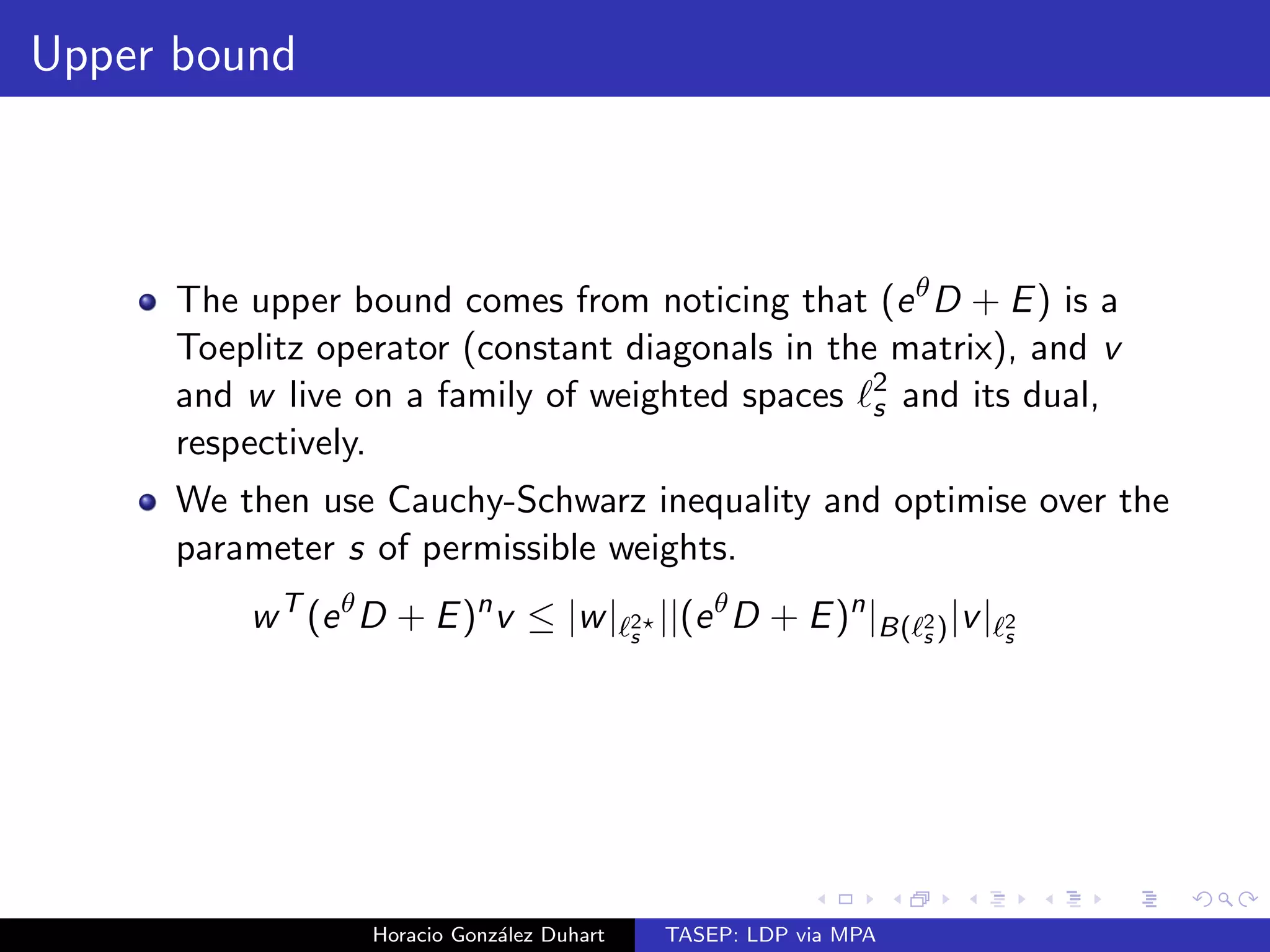
    Upper bound 2s The upper bound comes from noticing that (eD + E) is a Toeplitz operator (constant diagonals in the matrix), and v and w live on a family of weighted spaces `and its dual, respectively. Horacio Gonzalez Duhart TASEP: LDP via MPA
  • 56.
    Upper bound 2s The upper bound comes from noticing that (eD + E) is a Toeplitz operator (constant diagonals in the matrix), and v and w live on a family of weighted spaces `and its dual, respectively. We then use Cauchy-Schwarz inequality and optimise over the parameter s of permissible weights. wT (eD + E)nv jwj`2? s jj(eD + E)njB(`2s )jvj`2s Horacio Gonzalez Duhart TASEP: LDP via MPA
  • 57.
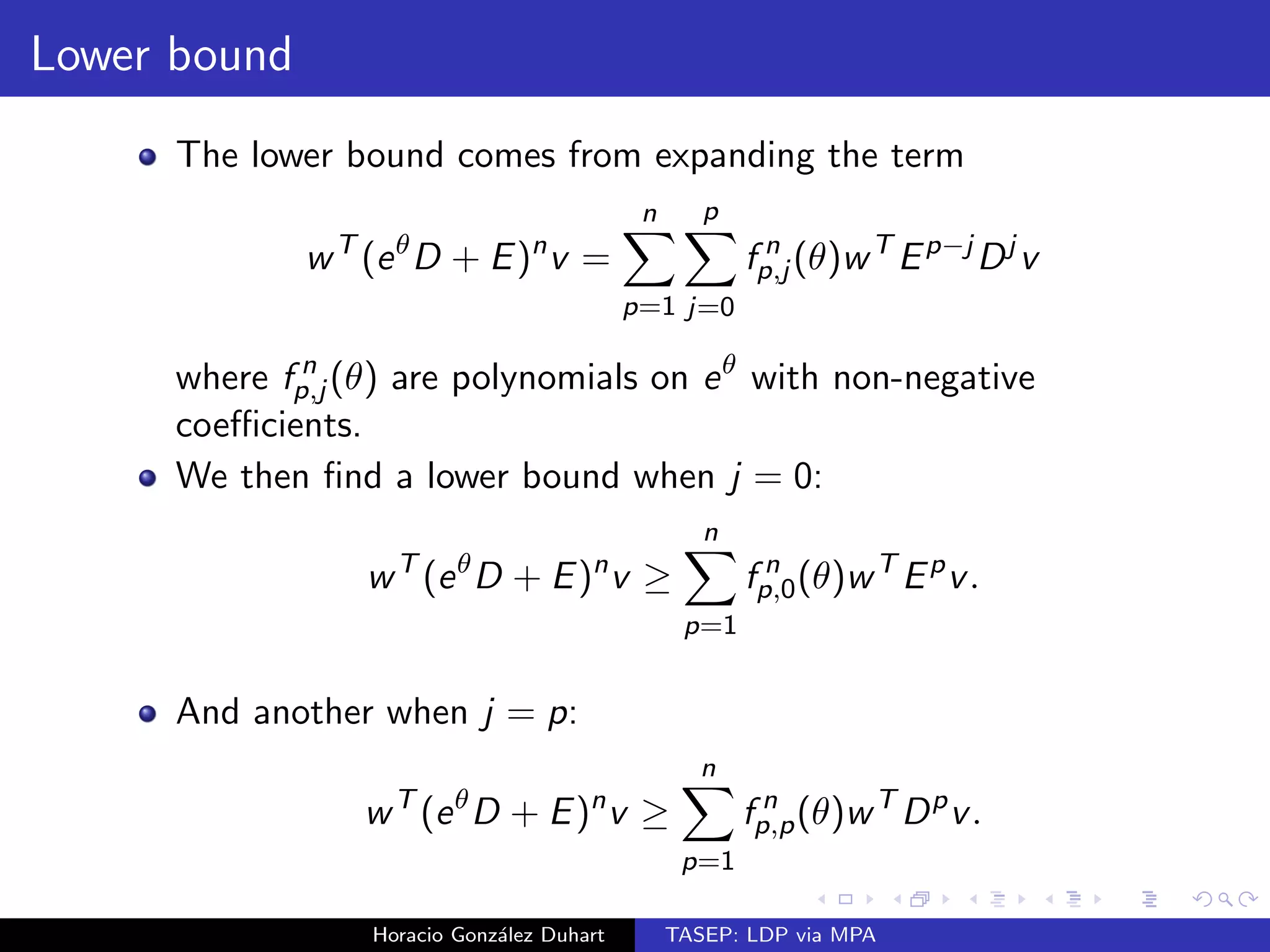
    Lower bound Thelower bound comes from expanding the term wT (eD + E)nv = Xn p=1 Xp j=0 f n p;j ()wTEpjDjv where f n p;j () are polynomials on e with non-negative coecients. Horacio Gonzalez Duhart TASEP: LDP via MPA
  • 58.
    Lower bound Thelower bound comes from expanding the term wT (eD + E)nv = Xn p=1 Xp j=0 f n p;j ()wTEpjDjv where f n p;j () are polynomials on e with non-negative coecients. We then
  • 59.
    nd a lowerbound when j = 0: wT (eD + E)nv Xn p=1 f n p;0()wTEpv: Horacio Gonzalez Duhart TASEP: LDP via MPA
  • 60.
    Lower bound Thelower bound comes from expanding the term wT (eD + E)nv = Xn p=1 Xp j=0 f n p;j ()wTEpjDjv where f n p;j () are polynomials on e with non-negative coecients. We then
  • 61.
    nd a lowerbound when j = 0: wT (eD + E)nv Xn p=1 f n p;0()wTEpv: And another when j = p: wT (eD + E)nv Xn p=1 f n p;p()wTDpv: Horacio Gonzalez Duhart TASEP: LDP via MPA
  • 62.
    Summarising. . . TASEP: Create particles at rate . Move them to the right at rate 1. One particle per site. Horacio Gonzalez Duhart TASEP: LDP via MPA
  • 63.
    Summarising. . . TASEP: Create particles at rate . Move them to the right at rate 1. One particle per site. MPA: Find matrices and vectors satisfying certain condition to
  • 64.
    nd the invariantmeasure. Horacio Gonzalez Duhart TASEP: LDP via MPA
  • 65.
    Summarising. . . TASEP: Create particles at rate . Move them to the right at rate 1. One particle per site. MPA: Find matrices and vectors satisfying certain condition to
  • 66.
    nd the invariantmeasure. LDP: Find the exponential rate of convergence to 0 of unlikely events. Horacio Gonzalez Duhart TASEP: LDP via MPA
  • 67.
    Summarising. . . TASEP: Create particles at rate . Move them to the right at rate 1. One particle per site. MPA: Find matrices and vectors satisfying certain condition to
  • 68.
    nd the invariantmeasure. LDP: Find the exponential rate of convergence to 0 of unlikely events. Our result: Find an LDP of the empirical density of the TASEP via the MPA. Horacio Gonzalez Duhart TASEP: LDP via MPA
  • 69.
    Summarising. . . TASEP: Create particles at rate . Move them to the right at rate 1. One particle per site. MPA: Find matrices and vectors satisfying certain condition to
  • 70.
    nd the invariantmeasure. LDP: Find the exponential rate of convergence to 0 of unlikely events. Our result: Find an LDP of the empirical density of the TASEP via the MPA. Horacio Gonzalez Duhart TASEP: LDP via MPA
  • 71.
    References F. denHollander. Large Deviations, volume 14 of Fields Institute Monographs. American Mathematical Society, Providence, RI, 2000. B. Derrida, M. R. Evans, V. Hakim, and V. Pasquier. Exact solution of a 1D asymmetric exclusion model using a matrix formulation. J. Phys. A, 26(7):1493,1993. S. Grokinsky. Phase transitions in nonequilibrium stochastic particle systems with local conservation laws. PhD thesis, TU Munich, 2004. T. M. Liggett. Ergodic theorems for the asymmetric simple exclusion process. Trans. Amer. Math. Soc., 213:237-261,1975. H. G. Duhart, P. Morters, and J. Zimmer. The Semi-In
  • 72.
    nite Asymmetric ExclusionProcess: Large Deviations via Matrix Products. ArXiv e-prints, arXiv:1411.3270v1, November 2014. Horacio Gonzalez Duhart TASEP: LDP via MPA
  • 73.
    Functional Materials FarFrom Equilibrium 21 November 2014, University of Bristol