See discussions, stats, and author profiles for this publication at: https://www.researchgate.net/publication/342658373
Solve Polynomial and transcendental Equations with use Generalized Theorem
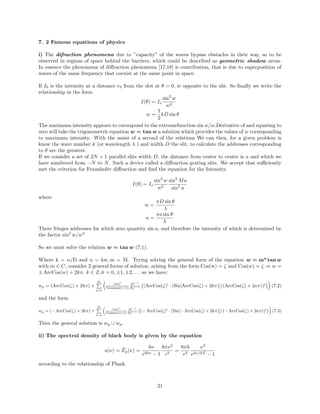
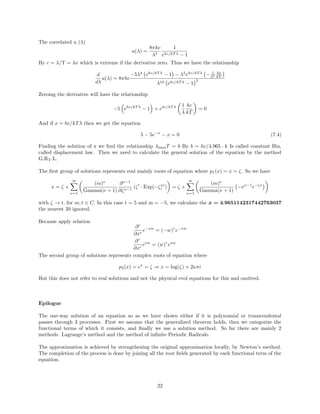
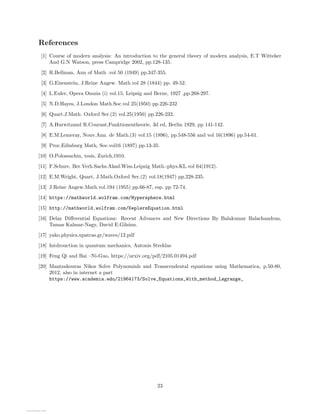
(Method Lagrange)
Research Proposal · July 2020
DOI: 10.13140/RG.2.2.33819.39208
CITATIONS
0
READS
1,451
1 author:
Some of the authors of this publication are also working on these related projects:
Goldbach's conjecture View project
Solve Polynomial-Transcendental Equations View project
Nikos Mantzakouras
National and Kapodistrian University of Athens
21 PUBLICATIONS   1 CITATION   
SEE PROFILE
All content following this page was uploaded by Nikos Mantzakouras on 02 August 2021.
The user has requested enhancement of the downloaded file.
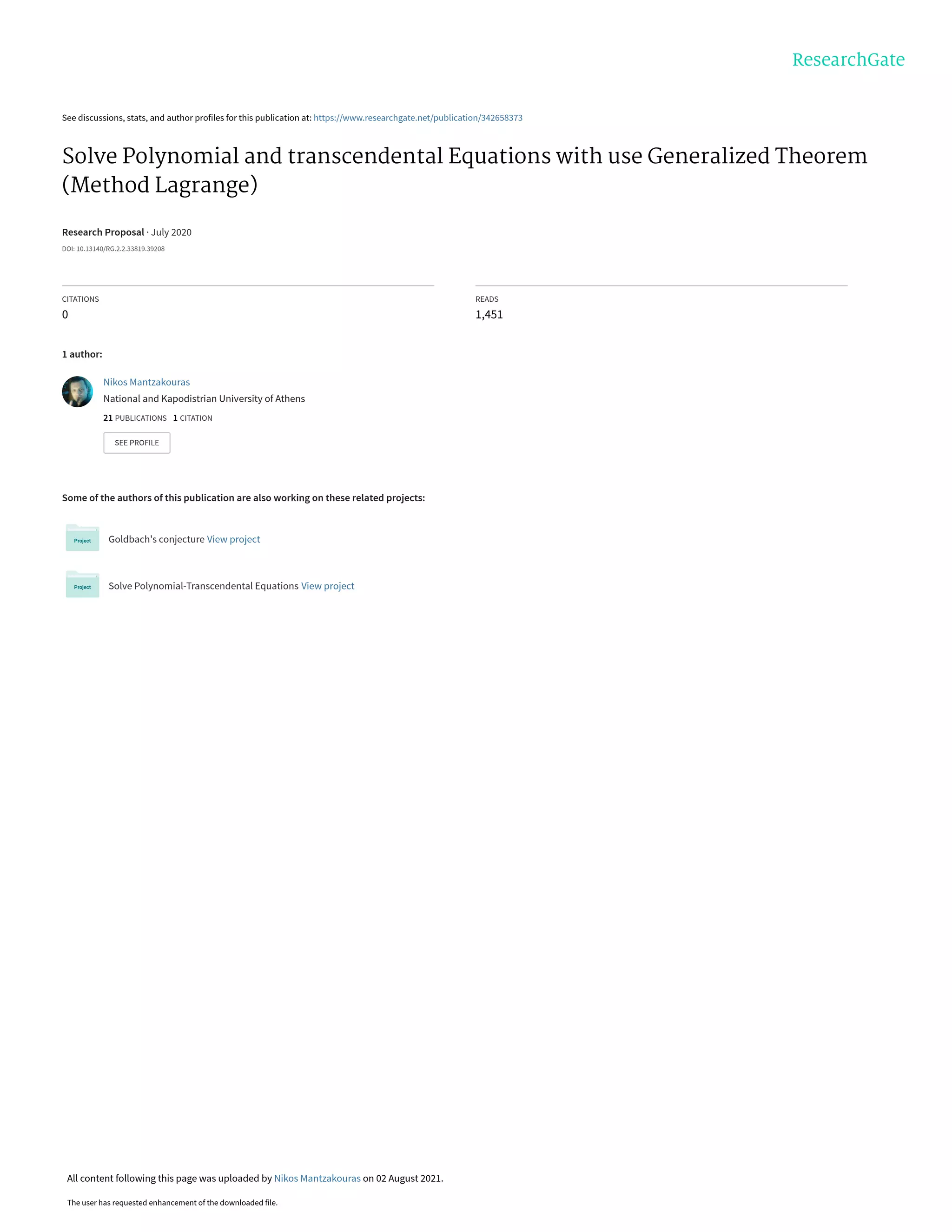
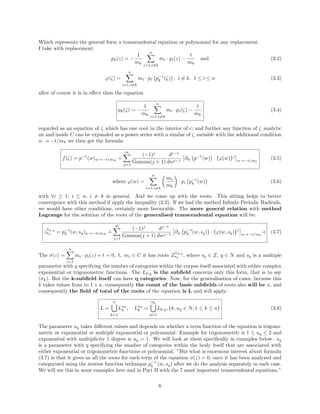
Solve Polynomial and transcendental Equations
with use Generalized Theorem (Method Lagrange)
N.Mantzakouras
e-mail: nikmatza@gmail.com
Athens – Greece
Abstract
While all the approximate methods mentioned or others that exist, give some specific solu-
tions to the generalized transcendental equations or even polynomial, cannot resolve them com-
pletely.”What we ask when we solve a generalized transcendental equation or polynomials, is to
find the total number of roots and not separate sets of roots in some random or specified inter-
vals. Mainly because too many categories of transcendental equations have an infinite number of
solutions in the complex set.” There are some particular equations (with Logarithmic functions,
Trigonometric functions, power function, or any special Functions) that solve particular prob-
lems in Physics, and mostly need the generalized solution. Now coming the this theory, using
the generalized theorem and the Lagrange method, which deals with hypergeometric functions or
interlocking with others functions, to gives a very satisfactory answer by use inverses functions
and give solutions to all this complex problem”.
The great logical innovation of the Generalized Theorem is that is gives us the philosophy to
work out the knowledge that the plurality of roots of any equation depends on the sub-fields of
the functional terms of the equation they produce. Thus the final field of roots of the equation
will be the union of these sub-fields.
keywords: Transcendental equations, solution, Hypergeometric functions,
field-subfield of roots, Polynomial, famus equations.
Part I.
I.1.Indroduction
According to the logic of the Generalized Theory of the Existence of Roots that we need and with which
we will deal after, and we before to prove, we will mention some elements more specifically for a random
general transcendental equation whish apply:
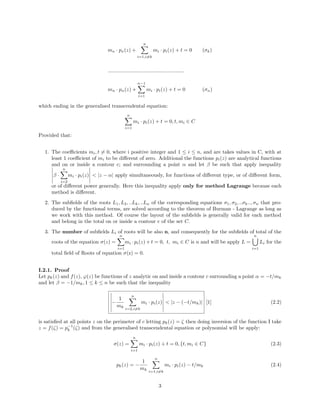
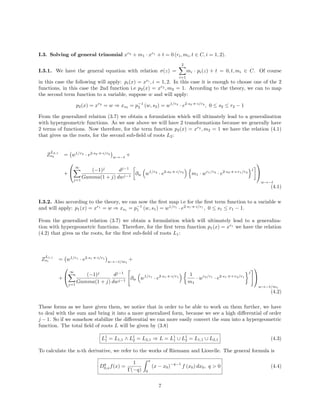
f(z) =
n
X
i=1
mi · pi(z) + t = 0 (1.1)
with pi(z) functions of z in C, Primary simple transcendental equations, will be in effect the two initial
types (1.2, 1.3) with name LMfunction:
ϕk(w) =
n
X
i=1,i6=k
(mi/mk) · pi p−1
k (w)

(1.2)
∀i, k ≥ 1, i 6= k, {i, k ≤ n}
1
arXiv:2107.14595v1
[math.GM]
21
Jul
2021
for polynomials with n terms or transcendental equations in order to achieve a better and more efficient
solution. The general equation now of Lagrange is:
f(ζ) = f(w)w→−t/mk
+
∞
X
n=1
(−1)
n
n!
dn−1
dwn−1
[(f(w))0
{ϕ(w)}n
]w→−t/mk
(1.3)
All cases of equations start from the original function (1.4), with a very important relation:
pk(z) = −
t
mk
, k ≥ 1 ∧ k ≤ n (1.4)
If we assume now that it is apply from initial one pκ(z) = w, in Domain of, then if we apply the corresponding
transformation of the original equation (1.1), will be have,
ζ = z = p−1
κ (w) ⇔ pk(z) = w (1.5)
where after the substitution in the basic relation (1.3) and because here apply the well-known theorem
(Burman-Lagrange) we can calculate the any root of the equation (1.1).
But this previous standing theory is not enough to solving a random equation that will be (transcendental in
general) because it does not explain what is the number of roots and what it depends on. We will therefore
need a generalized theorem that gives us more information about the structure of an equation. We will
call this theorem the ”Generalized existence theorem and global finding of the roots of a random
transcendental or polynomial equation in the complex plane C or more simple Generalised
theorem of roots an equation”
I.2. Generalized roots theorem of an equation.(G.RT.L)
For each random transcendental or polynomial equation, of the form
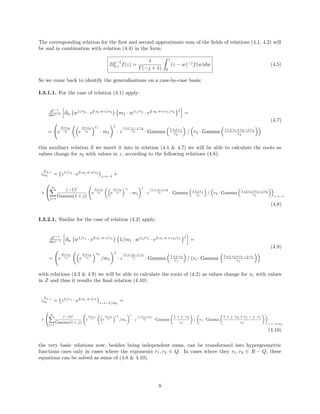
σ(z) =
n
X
i=1
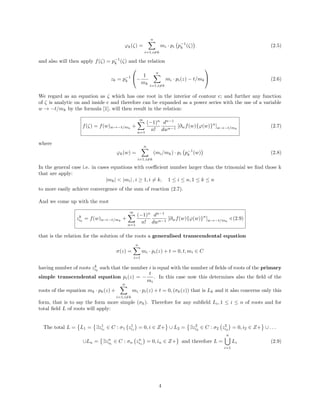
mi · pi(z) + t = 0, t, mi ∈ C (2.1)
it has as its root set the union of the individual fields of the roots, which are generated by the following
functions (of number n) which are at the same time and the terms of
m1 · p1(z) +
n
X
i=2
mi · pi(z) + t = 0 (σ1)
m2 · p2(z) +
n
X
i=1,j6=2
mi · pi(z) + t = 0 (σ2)
.....................................................
.....................................................
2
mκ · px(z) +
n
X
i=1,i6=k
mi · pi(z) + t = 0 (σk)
.....................................................
mn · pn(z) +
n−1
X
i=1
mi · pi(z) + t = 0 (σn)
which ending in the generalised transcendental equation:
n
X
i=1
mi · pi(z) + t = 0, t, mi ∈ C
Provided that:
1. The coefficients mi, t 6= 0, where i positive integer and 1 ≤ i ≤ n, and are takes values in C, with at
least 1 coefficient of mi to be different of zero. Additional the functions pi(z) are analytical functions
and on or inside a contour c; and surrounding a point α and let β be such that apply inequality
β ·
n
X
i=2
mi · pi(z)
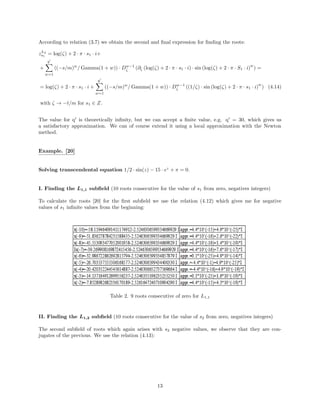
|z − α| apply simultaneously, for functions of different type, or of different form,
or of different power generally. Here this inequality apply only for method Lagrange because each
method is different.
2. The subfields of the roots L1, L2, ..Lk, ..Ln of the corresponding equations σ1, σ2, ..σk.., σn that pro-
duced by the functional terms, are solved according to the theorem of Burman - Lagrange as long as
we work with this method. Of course the layout of the subfields is generally valid for each method
and belong in the total on or inside a contour c of the set C.
3. The number of subfields Li of roots will be also n, and consequently for the subfields of total of the
roots of the equation σ(z) =
n
X
i=1
mi · pi(z) + t = 0, t, mi ∈ C is n and will be apply L =
n
[
i=1
Li for the
total field of Roots of equation σ(z) = 0.
I.2.1. Proof
Let pk(z) and f(z), ϕ(z) be functions of z analytic on and inside a contour c surrounding a point α = −t/mk
and let β = −1/mk, 1 ≤ k ≤ n be such that the inequality
−
1
mk
n
X
i=2,i6=k
mi · pi(z)

Solve Equations

  • 1.
    See discussions, stats,and author profiles for this publication at: https://www.researchgate.net/publication/342658373 Solve Polynomial and transcendental Equations with use Generalized Theorem (Method Lagrange) Research Proposal · July 2020 DOI: 10.13140/RG.2.2.33819.39208 CITATIONS 0 READS 1,451 1 author: Some of the authors of this publication are also working on these related projects: Goldbach's conjecture View project Solve Polynomial-Transcendental Equations View project Nikos Mantzakouras National and Kapodistrian University of Athens 21 PUBLICATIONS   1 CITATION    SEE PROFILE All content following this page was uploaded by Nikos Mantzakouras on 02 August 2021. The user has requested enhancement of the downloaded file.
  • 2.
    Solve Polynomial andtranscendental Equations with use Generalized Theorem (Method Lagrange) N.Mantzakouras e-mail: nikmatza@gmail.com Athens – Greece Abstract While all the approximate methods mentioned or others that exist, give some specific solu- tions to the generalized transcendental equations or even polynomial, cannot resolve them com- pletely.”What we ask when we solve a generalized transcendental equation or polynomials, is to find the total number of roots and not separate sets of roots in some random or specified inter- vals. Mainly because too many categories of transcendental equations have an infinite number of solutions in the complex set.” There are some particular equations (with Logarithmic functions, Trigonometric functions, power function, or any special Functions) that solve particular prob- lems in Physics, and mostly need the generalized solution. Now coming the this theory, using the generalized theorem and the Lagrange method, which deals with hypergeometric functions or interlocking with others functions, to gives a very satisfactory answer by use inverses functions and give solutions to all this complex problem”. The great logical innovation of the Generalized Theorem is that is gives us the philosophy to work out the knowledge that the plurality of roots of any equation depends on the sub-fields of the functional terms of the equation they produce. Thus the final field of roots of the equation will be the union of these sub-fields. keywords: Transcendental equations, solution, Hypergeometric functions, field-subfield of roots, Polynomial, famus equations. Part I. I.1.Indroduction According to the logic of the Generalized Theory of the Existence of Roots that we need and with which we will deal after, and we before to prove, we will mention some elements more specifically for a random general transcendental equation whish apply: f(z) = n X i=1 mi · pi(z) + t = 0 (1.1) with pi(z) functions of z in C, Primary simple transcendental equations, will be in effect the two initial types (1.2, 1.3) with name LMfunction: ϕk(w) = n X i=1,i6=k (mi/mk) · pi p−1 k (w) (1.2) ∀i, k ≥ 1, i 6= k, {i, k ≤ n} 1 arXiv:2107.14595v1 [math.GM] 21 Jul 2021
  • 3.
    for polynomials withn terms or transcendental equations in order to achieve a better and more efficient solution. The general equation now of Lagrange is: f(ζ) = f(w)w→−t/mk + ∞ X n=1 (−1) n n! dn−1 dwn−1 [(f(w))0 {ϕ(w)}n ]w→−t/mk (1.3) All cases of equations start from the original function (1.4), with a very important relation: pk(z) = − t mk , k ≥ 1 ∧ k ≤ n (1.4) If we assume now that it is apply from initial one pκ(z) = w, in Domain of, then if we apply the corresponding transformation of the original equation (1.1), will be have, ζ = z = p−1 κ (w) ⇔ pk(z) = w (1.5) where after the substitution in the basic relation (1.3) and because here apply the well-known theorem (Burman-Lagrange) we can calculate the any root of the equation (1.1). But this previous standing theory is not enough to solving a random equation that will be (transcendental in general) because it does not explain what is the number of roots and what it depends on. We will therefore need a generalized theorem that gives us more information about the structure of an equation. We will call this theorem the ”Generalized existence theorem and global finding of the roots of a random transcendental or polynomial equation in the complex plane C or more simple Generalised theorem of roots an equation” I.2. Generalized roots theorem of an equation.(G.RT.L) For each random transcendental or polynomial equation, of the form σ(z) = n X i=1 mi · pi(z) + t = 0, t, mi ∈ C (2.1) it has as its root set the union of the individual fields of the roots, which are generated by the following functions (of number n) which are at the same time and the terms of m1 · p1(z) + n X i=2 mi · pi(z) + t = 0 (σ1) m2 · p2(z) + n X i=1,j6=2 mi · pi(z) + t = 0 (σ2) ..................................................... ..................................................... 2
  • 4.
    mκ · px(z)+ n X i=1,i6=k mi · pi(z) + t = 0 (σk) ..................................................... mn · pn(z) + n−1 X i=1 mi · pi(z) + t = 0 (σn) which ending in the generalised transcendental equation: n X i=1 mi · pi(z) + t = 0, t, mi ∈ C Provided that: 1. The coefficients mi, t 6= 0, where i positive integer and 1 ≤ i ≤ n, and are takes values in C, with at least 1 coefficient of mi to be different of zero. Additional the functions pi(z) are analytical functions and on or inside a contour c; and surrounding a point α and let β be such that apply inequality
  • 9.
  • 14.
    |z − α|apply simultaneously, for functions of different type, or of different form, or of different power generally. Here this inequality apply only for method Lagrange because each method is different. 2. The subfields of the roots L1, L2, ..Lk, ..Ln of the corresponding equations σ1, σ2, ..σk.., σn that pro- duced by the functional terms, are solved according to the theorem of Burman - Lagrange as long as we work with this method. Of course the layout of the subfields is generally valid for each method and belong in the total on or inside a contour c of the set C. 3. The number of subfields Li of roots will be also n, and consequently for the subfields of total of the roots of the equation σ(z) = n X i=1 mi · pi(z) + t = 0, t, mi ∈ C is n and will be apply L = n [ i=1 Li for the total field of Roots of equation σ(z) = 0. I.2.1. Proof Let pk(z) and f(z), ϕ(z) be functions of z analytic on and inside a contour c surrounding a point α = −t/mk and let β = −1/mk, 1 ≤ k ≤ n be such that the inequality
  • 20.