TARIFF ANALYSIS
Presented by:-
Parth Pratim
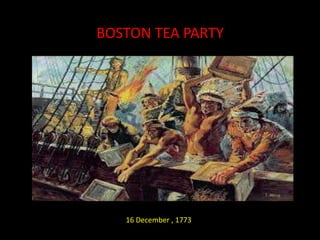
BOSTON TEA PARTY
16 December , 1773
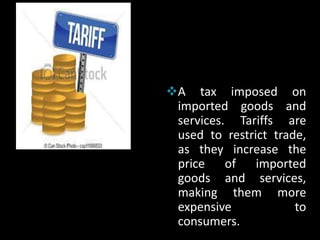
A tax imposed on
imported goods and
services. Tariffs are
used to restrict trade,
as they increase the
price of imported
goods and services,
making them more
expensive to
consumers.
WHY TRADE HAPPENS……………?
WE NEED TO KNOW……………..
MARKET PRICE
PRODUCER SURPLUS
CONSUMER SURPLUS
The current price at which an asset or service
can be bought or sold. Economic theory
contends that the market price converges at a
point where the forces of supply and demand
meet. Shocks to either the supply side or
demand side can cause the market price for a
good or service to be re-evaluated.
MARKET PRICE
CONSUMER’S SURPLUS:-
Consumers always like to feel like they are
getting a good deal on the goods and services
they buy and consumer surplus is simply an
economic measure of this satisfaction.
--::EXAMPLE::--
Assume a consumer goes out shopping for a
CD player and he or she is willing to spend $250.
When this individual finds that the player is
on sale for $150, economists would say that this
person has a consumer surplus of $100.
PRODUCER’S SURPLUS:-
An economic measure of the difference between
the amount that a producer of a good receives and
the minimum amount that he or she would be willing
to accept for the good. The difference, or surplus
amount, is the benefit that the producer receives for
selling the good in the market.
-::EXAMPLE::-
Say a producer is willing to sell 500 widgets at $5 apiece
and consumers are willing to purchase these widgets for $8
per widget.
If the producer sells all of the widgets to consumers for $8,
it will receive $4,000.
To calculate the producer surplus, you subtract the amount
the producer received by the amount it was willing to accept,
(in this case $2,500), and you find a producer surplus of
$1,500 ($4,000 - $2,500).
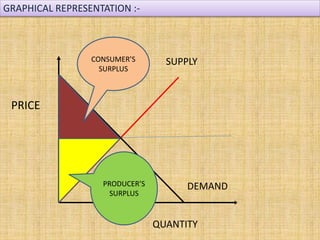
SUPPLY
DEMAND
PRICE
QUANTITY
CONSUMER’S
SURPLUS
PRODUCER’S
SURPLUS
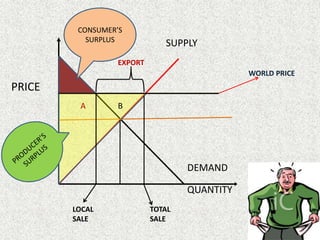
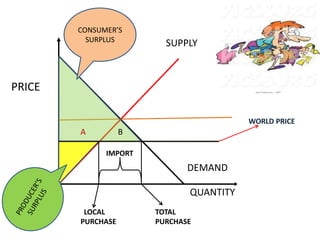
GRAPHICAL REPRESENTATION :-
SUPPLY
DEMAND
PRICE
QUANTITY
WORLD PRICE
A B
CONSUMER’S
SURPLUS
EXPORT
LOCAL
SALE
TOTAL
SALE
SUPPLY
DEMAND
PRICE
QUANTITY
A B
CONSUMER’S
SURPLUS
WORLD PRICE
IMPORT
LLOCAL
PURCHASE
TOTAL
PURCHASE
SUPPLY
DEMAND
PRICE
QUANTITY
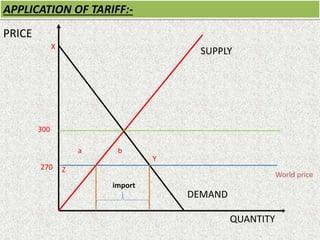
APPLICATION OF TARIFF:-
300
270
a b
X
Y
Z
import
World price
SUPPLY
DEMAND
PRICE
QUANTITY
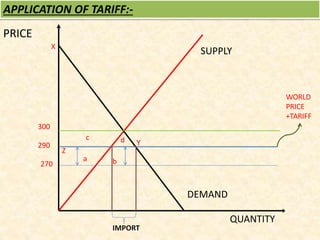
APPLICATION OF TARIFF:-
300
290
270
a b
c d
IMPORT
WORLD
PRICE
+TARIFF
X
Y
Z
Tariff
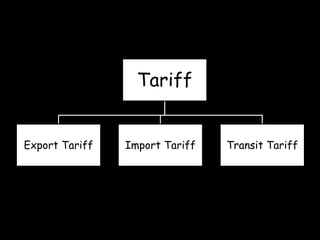
Export Tariff Import Tariff Transit Tariff
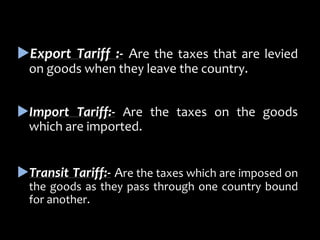
Export Tariff :- Are the taxes that are levied
on goods when they leave the country.
Import Tariff:- Are the taxes on the goods
which are imported.
Transit Tariff:- Are the taxes which are imposed on
the goods as they pass through one country bound
for another.
Non tariff
“ Any government regulation, policy, or
procedure other than a tariff that has a
effect of restricting international trade or
effecting overseas investment
becomes a non tariff barrier.”
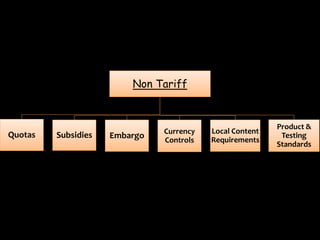
Non Tariff
Quotas Subsidies Embargo Currency
Controls
Local Content
Requirements
Product &
Testing
Standards
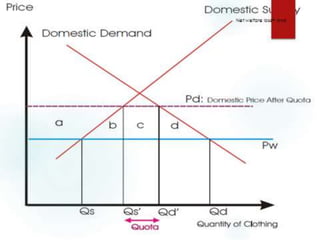
 Quotas refers to numerical limits on the quantity of goods that
may imported or exported by the country.
 A Subsidy is a government payment to a domestic producer.
Subsidies take several forms such as , cash grants , low-interests
rates, tax breaks, and government equity participation in local
firms. By lowering the costs, subsidies help domestic producers
in two ways:- they help them compete low-cost foreign imports
and gain access to export markets.
 EMBARGO refers to a complete ban on trade (import or export)
in one or more products with a particular country. It may be
placed on one or more goods or completely ban trade in all
goods. It is the most restrictive non-tariff trade barrier.(it can
also be termed as absolute quota)
Currency control:-
refers to restrictions on the convertibility of
currency into other currencies.
Local Content Requirements:-
refers to the legal stipulation that a specified amount
of a good or service be supplied by producers in a
domestic market.
PRODUCT & TESTING STANDARDS
This non-tariff barrier requires that foreign goods
meet a country’s domestic product or testing
standards before they can be offered for sale in
that country.
TARIFF ACCORDING TAXATION
Ad Valorem Tariff
Specific Tariff
Compound Tariff
JUSTIFICATION OF TARIFF
To protect domestic jobs. If consumers buy less-
expensive foreign goods, workers who produce
that good domestically might lose their jobs.
To protect infant industries. If a country wants to
develop its own industry producing a particular
good, it will use tariffs to make it more expensive
for consumers to purchase the foreign version of
that good. The hope is that they will buy the
domestic version instead and help that industry
grow. Contd….
To retaliate against a trading partner. If one
country doesn’t play by the trade rules both
countries previously agreed on, the country
that feels jilted might impose tariffs on its
partner’s goods as a punishment. The higher
price caused by the tariff should cause
purchases to fall.
To protect consumers. If a government
thinks a foreign good might be harmful, it
might implement a tariff to discourage
consumers from buying it.
Analysis of a tariff in a "small"
economy
General Equilibrium Analysis
Analysis of a tariff in a "large"
economy
Analysis of a quantitative
restriction-import
quota- in a small economy.
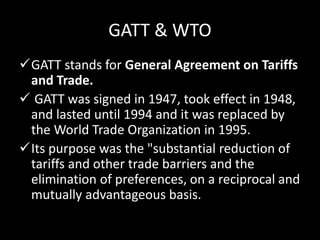
GATT & WTO
GATT stands for General Agreement on Tariffs
and Trade.
 GATT was signed in 1947, took effect in 1948,
and lasted until 1994 and it was replaced by
the World Trade Organization in 1995.
Its purpose was the "substantial reduction of
tariffs and other trade barriers and the
elimination of preferences, on a reciprocal and
mutually advantageous basis.
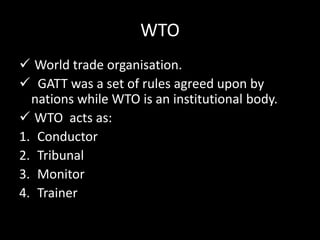
WTO
 World trade organisation.
 GATT was a set of rules agreed upon by
nations while WTO is an institutional body.
 WTO acts as:
1. Conductor
2. Tribunal
3. Monitor
4. Trainer
Case Study
Breathing room.
Political Tool.
Overcapacity.
Cautionary notes.
basic economics-tariff analysis

basic economics-tariff analysis

  • 1.
  • 2.
    BOSTON TEA PARTY 16December , 1773
  • 3.
    A tax imposedon imported goods and services. Tariffs are used to restrict trade, as they increase the price of imported goods and services, making them more expensive to consumers.
  • 4.
  • 5.
    WE NEED TOKNOW…………….. MARKET PRICE PRODUCER SURPLUS CONSUMER SURPLUS
  • 6.
    The current priceat which an asset or service can be bought or sold. Economic theory contends that the market price converges at a point where the forces of supply and demand meet. Shocks to either the supply side or demand side can cause the market price for a good or service to be re-evaluated. MARKET PRICE
  • 7.
    CONSUMER’S SURPLUS:- Consumers alwayslike to feel like they are getting a good deal on the goods and services they buy and consumer surplus is simply an economic measure of this satisfaction.
  • 8.
    --::EXAMPLE::-- Assume a consumergoes out shopping for a CD player and he or she is willing to spend $250. When this individual finds that the player is on sale for $150, economists would say that this person has a consumer surplus of $100.
  • 9.
    PRODUCER’S SURPLUS:- An economicmeasure of the difference between the amount that a producer of a good receives and the minimum amount that he or she would be willing to accept for the good. The difference, or surplus amount, is the benefit that the producer receives for selling the good in the market.
  • 10.
    -::EXAMPLE::- Say a produceris willing to sell 500 widgets at $5 apiece and consumers are willing to purchase these widgets for $8 per widget. If the producer sells all of the widgets to consumers for $8, it will receive $4,000. To calculate the producer surplus, you subtract the amount the producer received by the amount it was willing to accept, (in this case $2,500), and you find a producer surplus of $1,500 ($4,000 - $2,500).
  • 11.
  • 12.
  • 13.
  • 14.
  • 15.
  • 16.
    Tariff Export Tariff ImportTariff Transit Tariff
  • 17.
    Export Tariff :-Are the taxes that are levied on goods when they leave the country. Import Tariff:- Are the taxes on the goods which are imported. Transit Tariff:- Are the taxes which are imposed on the goods as they pass through one country bound for another.
  • 18.
    Non tariff “ Anygovernment regulation, policy, or procedure other than a tariff that has a effect of restricting international trade or effecting overseas investment becomes a non tariff barrier.”
  • 19.
    Non Tariff Quotas SubsidiesEmbargo Currency Controls Local Content Requirements Product & Testing Standards
  • 20.
     Quotas refersto numerical limits on the quantity of goods that may imported or exported by the country.  A Subsidy is a government payment to a domestic producer. Subsidies take several forms such as , cash grants , low-interests rates, tax breaks, and government equity participation in local firms. By lowering the costs, subsidies help domestic producers in two ways:- they help them compete low-cost foreign imports and gain access to export markets.  EMBARGO refers to a complete ban on trade (import or export) in one or more products with a particular country. It may be placed on one or more goods or completely ban trade in all goods. It is the most restrictive non-tariff trade barrier.(it can also be termed as absolute quota)
  • 21.
    Currency control:- refers torestrictions on the convertibility of currency into other currencies. Local Content Requirements:- refers to the legal stipulation that a specified amount of a good or service be supplied by producers in a domestic market. PRODUCT & TESTING STANDARDS This non-tariff barrier requires that foreign goods meet a country’s domestic product or testing standards before they can be offered for sale in that country.
  • 22.
    TARIFF ACCORDING TAXATION AdValorem Tariff Specific Tariff Compound Tariff
  • 23.
    JUSTIFICATION OF TARIFF Toprotect domestic jobs. If consumers buy less- expensive foreign goods, workers who produce that good domestically might lose their jobs. To protect infant industries. If a country wants to develop its own industry producing a particular good, it will use tariffs to make it more expensive for consumers to purchase the foreign version of that good. The hope is that they will buy the domestic version instead and help that industry grow. Contd….
  • 24.
    To retaliate againsta trading partner. If one country doesn’t play by the trade rules both countries previously agreed on, the country that feels jilted might impose tariffs on its partner’s goods as a punishment. The higher price caused by the tariff should cause purchases to fall. To protect consumers. If a government thinks a foreign good might be harmful, it might implement a tariff to discourage consumers from buying it.
  • 25.
    Analysis of atariff in a "small" economy
  • 27.
  • 29.
    Analysis of atariff in a "large" economy
  • 31.
    Analysis of aquantitative restriction-import quota- in a small economy.
  • 33.
    GATT & WTO GATTstands for General Agreement on Tariffs and Trade.  GATT was signed in 1947, took effect in 1948, and lasted until 1994 and it was replaced by the World Trade Organization in 1995. Its purpose was the "substantial reduction of tariffs and other trade barriers and the elimination of preferences, on a reciprocal and mutually advantageous basis.
  • 34.
    WTO  World tradeorganisation.  GATT was a set of rules agreed upon by nations while WTO is an institutional body.  WTO acts as: 1. Conductor 2. Tribunal 3. Monitor 4. Trainer
  • 35.
    Case Study Breathing room. PoliticalTool. Overcapacity. Cautionary notes.

Editor's Notes

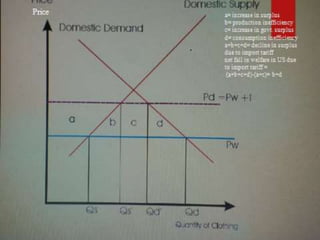
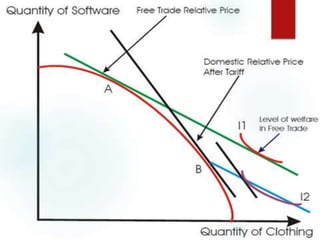
  • #29 A- free trade allocation of resources b/w clothing and software in US I1- difference b/w production and consumption I2- change in choice of consumers The difference between production and consumption under tariff is again the amounts of goods traded, still at the given world price PW.