TARGETED DRUG DELIVERY
SYSTEM
• A special form of drug delivery system where
the pharmacologically active agent or
medicament is selectively targeted or delivered
only to its site of action or absorption and not
to the non-target organs or tissues or cells.
• Targeted drug delivery implies for selective and
effective localization of pharmacologically
active moiety at pre identified (preselected)
target in therapeutic concentration, while
restricting its access to non-target normal
cellular linings, thus minimizing toxic effects
and maximizing therapeutic index.
ADVANTAGES OF DRUG
TARGETING
• Drug quantity may be greatly reduced as
well as the cost of therapy;
• Drug concentration in the required sites
can be sharply increased without negative
effects on non-target compartments.
Disadvantages of drug targeting:
Rapid clearance of targeted systems.
Immune reactions against intravenous administered
carrier systems.
Insufficient localization of targeted systems into
tumour cells.
Requires sophisticated technology for the formulation.
Requires skill for manufacturing storage,
administration.
Common Approaches of Targeted Drug Delivery
The basic approaches for targeting the drug to specific site
based on different research outcomes
I. Controlling the distribution of drug by incorporating it in a
carrier system
II. Altering the structure of the drug at molecular level
III. Controlling the input of the drug into bioenvironment to
ensure a programmed and desirable biodistribution
Properties of ideal targeted drug delivery:
• Nontoxic,biodegradable,biocompatibleand physicochemical
stable invivo and in-vitro
• Capable to deliver the drug to target cells or tissue or organ
and should have uniform capillary distribution.
• Release the dug in a controlled and predictable manner for
a suitable period of time.
• Efficiently maintain the drug concentration at the targeted
site within the therapeutic window for prolong period of
time
• Carrier used should be biodegradable or and
get readily eliminated from the body without
showing any toxic interaction.
• Its preparation should be easy or reasonably
simple, reproductive and cost effective.
• Minimal drug losses due to leakage of the
carrier system should be ensured.
CARRIERS:-
• Most important entity required for successful
transportation of the loaded drug.
• Drug vectors which, retain and transport
drug; deliver it within or in the vicinity of
target.
• Do so through an inherent characteristic or
acquired through structural modification.
PROPERTIES OF AN IDEAL DRUG
CARRIER:
• It must be able to cross anatomical barriers and in
case of tumour chemotherapy tumour vasculature.
• It must be recognized specifically and selectively by
the target cells and must maintain the specificity of
the surface ligands (anything that binds with
specificity can be considered a ligand).
• The linkage of the drug and the directing unit
(ligand) should be stable in plasma, interstitial and
other biofluids.
• Carrier should be non-toxic, non-immunogenic and
biodegradable particulate or macromolecule
•After recognition and internalization, the carrier
system should release the drug moiety inside the
target organs, tissues or cells.
LEVELS OF DRUG TARGETING:
1. Passive targeting
2. Inverse targeting
3. Active targeting
(a) Ligand mediated targeting
(b) Physical targeting
4. Dual targeting
5. Double targeting
6. Combination targeting
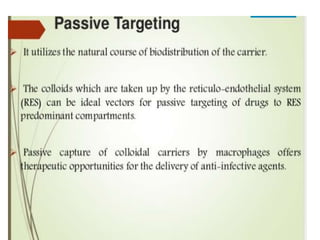
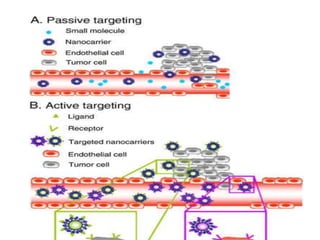
1.Passive targeting:
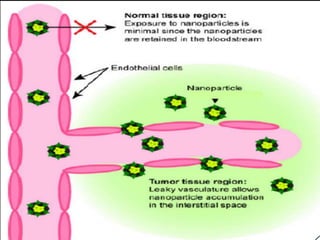
• Systems that target the systemic circulation.
• Devices include- drug bearing bilayer
vesicular systems as well as cellular carriers
of micron or submicron size range.
•
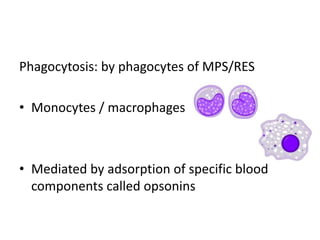
Phagocytosis: by phagocytes of MPS/RES
• Monocytes / macrophages
• Mediated by adsorption of specific blood
components called opsonins
2.Inverse targeting:
• Drug targeting attempts made to
evade the passive uptake of the
colloidal carrier by reticuloendothelial
systems are referred to as inverse
targeting.
Strategy:
• The function of RES is suppressed by a pre-injection
of colloidal carriers or macromolecules like dextran
sulphate leading to RES blockade and resulting in
impairment of host defense system.
• Alternative strategies include: modification of the
size, surface charge, composition, surface
rigidity & hydrophilicity of carriers for
desirable bio fate.
3.Active targeting:
• The facilitation of the binding of the drug
carrier to target cells by the use of ligands
to increase receptor mediated localization
of the drug and target specific delivery of
drug is referred to as active targeting.
3 types
• First order targeting(organ compartmentalization).
• Second order targeting (cellular targeting).
• Third order targeting (intracellular targeting).
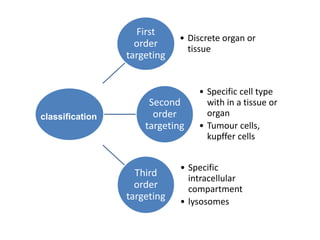
First
order
targeting
• Discrete organ or
tissue
Second
order
targeting
• Specific cell type
with in a tissue or
organ
• Tumour cells,
kupffer cells
Third
order
targeting
• Specific
intracellular
compartment
• lysosomes
classification
First order targeting:
• Restricted distribution of the drug carrier
system to the capillary bed of the
predetermined target site, organ or tissue.
• Compartmental targeting in lymphatics,
peritoneal cavity, plural cavity, cerebral
ventricles, lungs, joints, eyes, etc.
Second order targeting:
• The selective delivery of drugs to a
specific cell type such as tumour cells
(and not to the normal cells) is
referred to as second order targeting.
Third order targeting:
• Drug delivery specifically to the
intracellular site of target cells.
• e.g., receptor based ligand-mediated entry
of a drug complex into a cell by
endocytosis,lysosomal degradation of
carrier followed by release of drug
intracellularly or gene delivery to nucleolus.
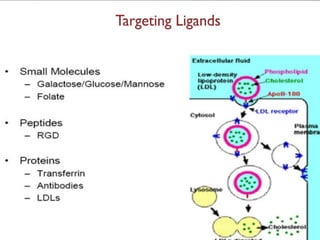
Ligand mediated targeting:
• ligands are used as carrier surface
group(s), which can selectively direct the
carrier to the pre-specified site(s) housing
the appropriate receptor units to serve as
‘homing device’ to the carrier/drug
• Anti bodies, polypeptides
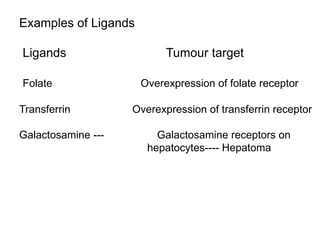
Examples of Ligands
Ligands Tumour target
Folate Overexpression of folate receptor
Transferrin Overexpression of transferrin receptor
Galactosamine --- Galactosamine receptors on
hepatocytes---- Hepatoma
Physical targeting (Triggered Release)
• The drug delivery programmed and
monitored at the external level (ex vivo)
with the help of physical means.
• Temperature sensitive liposomes.
• Characteristics of environment changes
like pH, temperature, light intensity,
electric field, and ionic strength
4.Dual targeting
• In this targeting approach carrier molecule itself
have their own therapeutic activity and thus
increase the therapeutic effect of drug.
• For example, a carrier molecule having its own
antiviral activity can be loaded with antiviral drug
and the net synergistic effect of drug conjugate
was observed.
Advantage
• The virus replication process can be
attacked at multiple points, excluding
the possibilities of resistant viral
strain development.
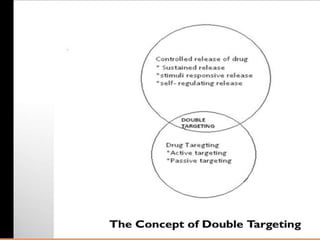
5.Double targeting:
• When temporal and spatial methodologies are
combined to target a carrier system, then
targeting may be called double targeting.
• Spatial placement relates to targeting drugs to
specific organs tissues, cells or even subs
cellular compartment
• whereas temporal delivery refers to controlling
the rate of drug delivery to target site.
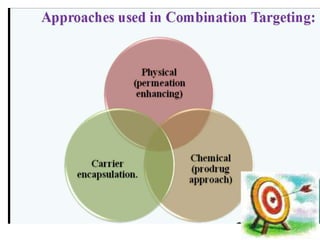
6.Combination targeting:
• Suggested by Petit and Gombtz.
• Site-specific delivery of proteins and
peptides.
CARRIER SYSTEMS USED FOR
TARGETED DRUG DELIVERY
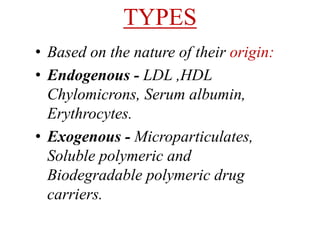
TYPES
• Based on the nature of their origin:
• Endogenous - LDL ,HDL
Chylomicrons, Serum albumin,
Erythrocytes.
• Exogenous - Microparticulates,
Soluble polymeric and
Biodegradable polymeric drug
carriers.
1. Colloidal carriers
2. Cellular carriers
3. Supramolecular delivery systems
4. Polymer based systems
5. Macromolecular carriers

targetting(1).ppt

  • 1.
    TARGETED DRUG DELIVERY SYSTEM •A special form of drug delivery system where the pharmacologically active agent or medicament is selectively targeted or delivered only to its site of action or absorption and not to the non-target organs or tissues or cells.
  • 2.
    • Targeted drugdelivery implies for selective and effective localization of pharmacologically active moiety at pre identified (preselected) target in therapeutic concentration, while restricting its access to non-target normal cellular linings, thus minimizing toxic effects and maximizing therapeutic index.
  • 4.
    ADVANTAGES OF DRUG TARGETING •Drug quantity may be greatly reduced as well as the cost of therapy; • Drug concentration in the required sites can be sharply increased without negative effects on non-target compartments.
  • 5.
    Disadvantages of drugtargeting: Rapid clearance of targeted systems. Immune reactions against intravenous administered carrier systems. Insufficient localization of targeted systems into tumour cells. Requires sophisticated technology for the formulation. Requires skill for manufacturing storage, administration.
  • 6.
    Common Approaches ofTargeted Drug Delivery The basic approaches for targeting the drug to specific site based on different research outcomes I. Controlling the distribution of drug by incorporating it in a carrier system II. Altering the structure of the drug at molecular level III. Controlling the input of the drug into bioenvironment to ensure a programmed and desirable biodistribution
  • 7.
    Properties of idealtargeted drug delivery: • Nontoxic,biodegradable,biocompatibleand physicochemical stable invivo and in-vitro • Capable to deliver the drug to target cells or tissue or organ and should have uniform capillary distribution. • Release the dug in a controlled and predictable manner for a suitable period of time. • Efficiently maintain the drug concentration at the targeted site within the therapeutic window for prolong period of time
  • 8.
    • Carrier usedshould be biodegradable or and get readily eliminated from the body without showing any toxic interaction. • Its preparation should be easy or reasonably simple, reproductive and cost effective. • Minimal drug losses due to leakage of the carrier system should be ensured.
  • 9.
    CARRIERS:- • Most importantentity required for successful transportation of the loaded drug. • Drug vectors which, retain and transport drug; deliver it within or in the vicinity of target. • Do so through an inherent characteristic or acquired through structural modification.
  • 10.
    PROPERTIES OF ANIDEAL DRUG CARRIER: • It must be able to cross anatomical barriers and in case of tumour chemotherapy tumour vasculature. • It must be recognized specifically and selectively by the target cells and must maintain the specificity of the surface ligands (anything that binds with specificity can be considered a ligand).
  • 11.
    • The linkageof the drug and the directing unit (ligand) should be stable in plasma, interstitial and other biofluids. • Carrier should be non-toxic, non-immunogenic and biodegradable particulate or macromolecule •After recognition and internalization, the carrier system should release the drug moiety inside the target organs, tissues or cells.
  • 12.
    LEVELS OF DRUGTARGETING: 1. Passive targeting 2. Inverse targeting 3. Active targeting (a) Ligand mediated targeting (b) Physical targeting 4. Dual targeting 5. Double targeting 6. Combination targeting
  • 13.
    1.Passive targeting: • Systemsthat target the systemic circulation. • Devices include- drug bearing bilayer vesicular systems as well as cellular carriers of micron or submicron size range.
  • 14.
  • 15.
    Phagocytosis: by phagocytesof MPS/RES • Monocytes / macrophages • Mediated by adsorption of specific blood components called opsonins
  • 17.
    2.Inverse targeting: • Drugtargeting attempts made to evade the passive uptake of the colloidal carrier by reticuloendothelial systems are referred to as inverse targeting.
  • 18.
    Strategy: • The functionof RES is suppressed by a pre-injection of colloidal carriers or macromolecules like dextran sulphate leading to RES blockade and resulting in impairment of host defense system. • Alternative strategies include: modification of the size, surface charge, composition, surface rigidity & hydrophilicity of carriers for desirable bio fate.
  • 19.
    3.Active targeting: • Thefacilitation of the binding of the drug carrier to target cells by the use of ligands to increase receptor mediated localization of the drug and target specific delivery of drug is referred to as active targeting.
  • 20.
    3 types • Firstorder targeting(organ compartmentalization). • Second order targeting (cellular targeting). • Third order targeting (intracellular targeting).
  • 21.
    First order targeting • Discrete organor tissue Second order targeting • Specific cell type with in a tissue or organ • Tumour cells, kupffer cells Third order targeting • Specific intracellular compartment • lysosomes classification
  • 22.
    First order targeting: •Restricted distribution of the drug carrier system to the capillary bed of the predetermined target site, organ or tissue. • Compartmental targeting in lymphatics, peritoneal cavity, plural cavity, cerebral ventricles, lungs, joints, eyes, etc.
  • 23.
    Second order targeting: •The selective delivery of drugs to a specific cell type such as tumour cells (and not to the normal cells) is referred to as second order targeting.
  • 24.
    Third order targeting: •Drug delivery specifically to the intracellular site of target cells. • e.g., receptor based ligand-mediated entry of a drug complex into a cell by endocytosis,lysosomal degradation of carrier followed by release of drug intracellularly or gene delivery to nucleolus.
  • 25.
    Ligand mediated targeting: •ligands are used as carrier surface group(s), which can selectively direct the carrier to the pre-specified site(s) housing the appropriate receptor units to serve as ‘homing device’ to the carrier/drug • Anti bodies, polypeptides
  • 26.
    Examples of Ligands LigandsTumour target Folate Overexpression of folate receptor Transferrin Overexpression of transferrin receptor Galactosamine --- Galactosamine receptors on hepatocytes---- Hepatoma
  • 28.
    Physical targeting (TriggeredRelease) • The drug delivery programmed and monitored at the external level (ex vivo) with the help of physical means. • Temperature sensitive liposomes. • Characteristics of environment changes like pH, temperature, light intensity, electric field, and ionic strength
  • 29.
    4.Dual targeting • Inthis targeting approach carrier molecule itself have their own therapeutic activity and thus increase the therapeutic effect of drug. • For example, a carrier molecule having its own antiviral activity can be loaded with antiviral drug and the net synergistic effect of drug conjugate was observed.
  • 30.
    Advantage • The virusreplication process can be attacked at multiple points, excluding the possibilities of resistant viral strain development.
  • 31.
    5.Double targeting: • Whentemporal and spatial methodologies are combined to target a carrier system, then targeting may be called double targeting. • Spatial placement relates to targeting drugs to specific organs tissues, cells or even subs cellular compartment • whereas temporal delivery refers to controlling the rate of drug delivery to target site.
  • 33.
    6.Combination targeting: • Suggestedby Petit and Gombtz. • Site-specific delivery of proteins and peptides.
  • 36.
    CARRIER SYSTEMS USEDFOR TARGETED DRUG DELIVERY
  • 37.
    TYPES • Based onthe nature of their origin: • Endogenous - LDL ,HDL Chylomicrons, Serum albumin, Erythrocytes. • Exogenous - Microparticulates, Soluble polymeric and Biodegradable polymeric drug carriers.
  • 38.
    1. Colloidal carriers 2.Cellular carriers 3. Supramolecular delivery systems 4. Polymer based systems 5. Macromolecular carriers