TARGETED DRUG
DELIVERY SYSTEM
DEPARTMENT OF PHARMACEUTICS
AMRUTVAHINI COLLEGE OF PHARMACY
SANGAMNER MAHARASHTRA
PRESENTED BY;
MR. SHETE SHUBHAM KAILAS
F.Y.M.PHARM
1
CONTENTS
 Introduction
 Concept of drug targeting
Components used for drug targeting
Common approaches for drug targeting
Ideal properties of targeted drug delivery system
Mode of drug targeting
Conclusion
2
INTRODUCTION
 The therapeutic response of a drug depends upon the
interaction of drug molecules with cell on cell membrane
related biological events at receptor sites in concentration
dependent manner.
 It is apparent that most of disease treated by cytotoxic agents
not only demand for controlled drug delivery but also the
pattern of delivery is directed to be specified, precise and
defined at quantitative level.
 Therefore, there was a need of developing such a system to
overcome the limitations related to the conventional dosage
form and improve the therapeutic efficacy of drug.
3
CONCEPT OF DRUG TARGETING
 The concept of designing targeted drug delivery system
(TDDS) was first given by Paul Ehrlich in 1902.
 An event, where a drug – carrier complex delivers a drug
exclusively to the preselected target cells in a specified
manner.
 “Targeted drug delivery implies for selective and effective
localization of pharmacologically active moiety at
preselected targets in therapeutic concentration, while
restricting its access to non-target normal cellular linings,
thus minimizing toxic effects and maximizing therapeutic
index”.
4
5
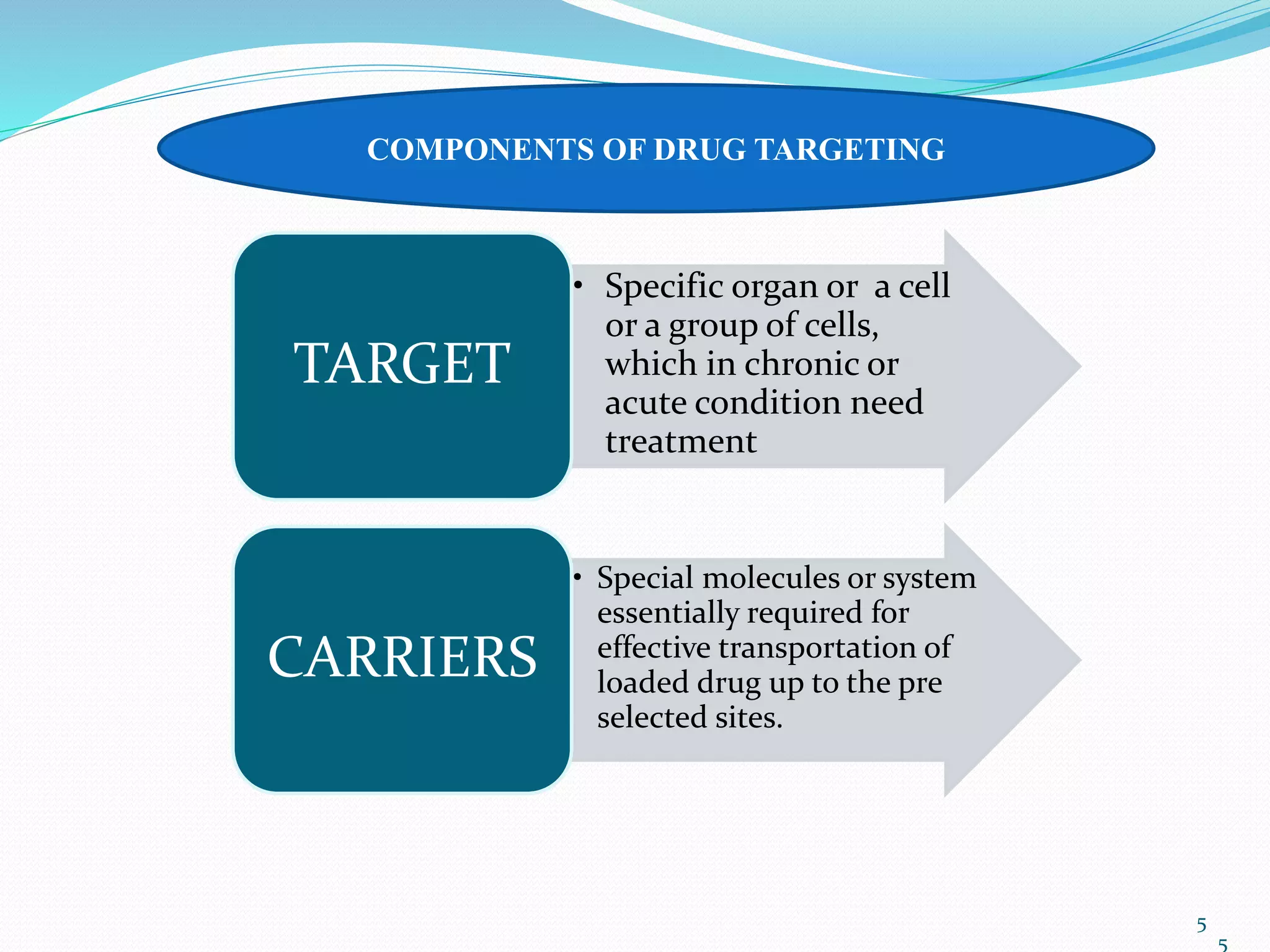
COMPONENTS OF DRUG TARGETING
• Specific organ or a cell
or a group of cells,
which in chronic or
acute condition need
treatment
TARGET
• Special molecules or system
essentially required for
effective transportation of
loaded drug up to the pre
selected sites.
CARRIERS
5
Need of Targeted Drug
Delivery System
Pharmaceutical
Reason
Low solubility
Drug instability
Pharmacokinetic
Reason
Poor absorption
Short half-life
Large Volume of
Distribution
Pharmacodynamic
Reason
Low specificity
Low therapeutic
index
6
APPROACHES FOR DRUG TARGETING
Controlling the distribution of drug by
incorporating it in a carrier
Altering the structure of the drug at molecular
level.
7
IDEAL PROPERTIES OF TDDS
 Nontoxic, biocompatible and physiochemical stable in-vivo
and in-vitro.
Restrict drug distribution to target cells or tissue or organ.
Controllable and predictable rate of drug release.
Minimal drug leakage during transit.
Carrier used must be biodegradable or readily eliminated
from the body without any problem.
Its preparation should be easy or reasonably simple,
reproductive and cost effective.
8
ADVANTAGES
 Reduced toxicity.
 Bypass hepatic first pass metabolism.
 Reduced dose and dosing intervals.
 Enhancement of the absorption of target molecules such
as peptides and particulates.
9
DISADVANTAGES
 Rapid clearance of targeted system.
 Immune reactions against iv administered carrier system.
 Diffusion and redistribution of released drug.
 Drug deposition at the target site may produce toxicity
symptoms.
 Difficult to maintain stability of dosage form.
10
DRUG TARGETING STRATEGIES
Passive
targeting
Active
targeting
Inverse
targeting
Dual
targeting
Combination
targeting
11
PASSIVE TARGETING
•In Passive targeting, we make use of and modify the
physiochemical properties of the drug carrier complex, so
that it escapes body defence system and accumulate in the
target tissue.
•Passive process utilises the natural course of bio distribution
of the carrier system, through which it eventually accumulate
into the organ compartment of body.
•It refers to the system that targets the systemic circulation
i.e., targeting occurs because of body’s natural response to
the physiochemical characteristic of the drug or drug-carrier
system.
12
Few examples of passive targeting
1. The colloids which are taken up by the reticulo-endothelial
system (RES) can be ideal vector for passive targeting of drugs
to RES predominant compartments.
2.In case of cancer treatment the drug carrier complex can be
targeted to the tumour site by employing the Enhanced
permeability retention (EPS) effect.
3.Passive targeting may also be directed to lymphoid organs,
as these organs are finely structured and nanoparticles may
easily penetrate into lymphatic vessels.
13
ACTIVE TARGETING
•This type of targeting exploits modification or manipulation
of drug carrier . Natural distribution pattern of the drug
carrier composites is enhanced using the chemical,
biological and physical means.
•The ease of the binding of the drug-carrier to target cells
through the use of ligands or engineered homing devices
(antibodies, peptides, sugar &vitamins) to increase
localization of the drug and target specific delivery of drug
is referred to as active targeting.
•There are three levels of active targeting –
• first order (organ compartmentalization),
•second order (cellular targeting) and
•third order (intracellular targeting).
14
• Restricted distribution of drug carrier system to the capillary bed of
a predetermined target site, organ.
• Ex- Compartmental targeting in lymphatic, peritoneal cavity plural
cavity, cerebral ventricles etc.
FIRST
ORDER
• When the drug delivery system releases the drug into a
particular cell within an organ or tissue, it is called cellular
targeting.
• Ex- Selective drug delivery to kuppfer cells in the liver.
SECOND
ORDER
• When the delivery system can enter specific cells and leave the
drug intracellular, then it is called third order or sub cellular
targeting process.
• Ex- Receptor based ligand mediated entry of a drug complex into
a cell by endocytosis.
THIRD
ORDER
15
PASSIVE AND ACTIVE TARGETTING
16
INVERSE TARGETING
•It is based on avoiding passive uptake of colloidal carriers by RES.
•It can be achieved by supressing the function of RES by pre-
injection of a large amount of blank colloidal carriers or
macromolecules like dextran sulphate.
•Alternative strategies include modification of size, surface
charges, composition, surface rigidity & hydrophilicity
characteristics of carriers for desirable biofate.
•For example- In 1985, Hansrami, reported that phospholipid
microsphere emulsified with polaxmer 338 (hydrophillic non-
ionic surfactant) showed the lowest RES uptake.
17
DUAL TARGETING
•This approach employs carrier molecules which
have their own intrinsic antiviral effect thus
synergies the antiviral effect of the loaded active
drug.
•Major advantage of the dual targeting is - virus
replication process can be attacked at multiple
points, excluding the possibilities of resistant viral
stain development.
18
COMBINATION TARGETING
The idea of combination targeting was
proposed in 1998, by Petit and Gombtz. It can be
given as site specific targeting for delivery of
protein and peptides.
These targeting systems are equipped with
carriers, polymers and homing devices of
molecular specificity that could provide a direct
approach to target site.
Modification of polymer with natural polymers
may alter their physical characteristics and favour
targeting the specific compartments, organs or
tissue within the vasculature.
19
CONCLUSION
•Targeted delivery assist the drug molecule to reach
preferably to the desired site.
• Reduction in dose and side effects of the drug.
•Particulate drug carriers get accumulated in the liver
cells due to their smaller size than blood capillaries.
•Among particulate drug carriers, liposomes are potential
•mode of delivery for the treatment of intracellular
infections
•Microparticles serve as future mode of delivery for oral
route especially proteins.
20
REFERENCE
“Targeted and Controlled drug delivery (Novel
carrier systems)”, S P Vyas and R K Khar, CBS
Publishers, page no: 40-67.
“Progress in Controlled and Novel drug delivery
Systems”, N K Jain, CBS publishers, page no: 365-
369.
21
22

Targeted drug delivery

  • 1.
    TARGETED DRUG DELIVERY SYSTEM DEPARTMENTOF PHARMACEUTICS AMRUTVAHINI COLLEGE OF PHARMACY SANGAMNER MAHARASHTRA PRESENTED BY; MR. SHETE SHUBHAM KAILAS F.Y.M.PHARM 1
  • 2.
    CONTENTS  Introduction  Conceptof drug targeting Components used for drug targeting Common approaches for drug targeting Ideal properties of targeted drug delivery system Mode of drug targeting Conclusion 2
  • 3.
    INTRODUCTION  The therapeuticresponse of a drug depends upon the interaction of drug molecules with cell on cell membrane related biological events at receptor sites in concentration dependent manner.  It is apparent that most of disease treated by cytotoxic agents not only demand for controlled drug delivery but also the pattern of delivery is directed to be specified, precise and defined at quantitative level.  Therefore, there was a need of developing such a system to overcome the limitations related to the conventional dosage form and improve the therapeutic efficacy of drug. 3
  • 4.
    CONCEPT OF DRUGTARGETING  The concept of designing targeted drug delivery system (TDDS) was first given by Paul Ehrlich in 1902.  An event, where a drug – carrier complex delivers a drug exclusively to the preselected target cells in a specified manner.  “Targeted drug delivery implies for selective and effective localization of pharmacologically active moiety at preselected targets in therapeutic concentration, while restricting its access to non-target normal cellular linings, thus minimizing toxic effects and maximizing therapeutic index”. 4
  • 5.
    5 COMPONENTS OF DRUGTARGETING • Specific organ or a cell or a group of cells, which in chronic or acute condition need treatment TARGET • Special molecules or system essentially required for effective transportation of loaded drug up to the pre selected sites. CARRIERS 5
  • 6.
    Need of TargetedDrug Delivery System Pharmaceutical Reason Low solubility Drug instability Pharmacokinetic Reason Poor absorption Short half-life Large Volume of Distribution Pharmacodynamic Reason Low specificity Low therapeutic index 6
  • 7.
    APPROACHES FOR DRUGTARGETING Controlling the distribution of drug by incorporating it in a carrier Altering the structure of the drug at molecular level. 7
  • 8.
    IDEAL PROPERTIES OFTDDS  Nontoxic, biocompatible and physiochemical stable in-vivo and in-vitro. Restrict drug distribution to target cells or tissue or organ. Controllable and predictable rate of drug release. Minimal drug leakage during transit. Carrier used must be biodegradable or readily eliminated from the body without any problem. Its preparation should be easy or reasonably simple, reproductive and cost effective. 8
  • 9.
    ADVANTAGES  Reduced toxicity. Bypass hepatic first pass metabolism.  Reduced dose and dosing intervals.  Enhancement of the absorption of target molecules such as peptides and particulates. 9
  • 10.
    DISADVANTAGES  Rapid clearanceof targeted system.  Immune reactions against iv administered carrier system.  Diffusion and redistribution of released drug.  Drug deposition at the target site may produce toxicity symptoms.  Difficult to maintain stability of dosage form. 10
  • 11.
  • 12.
    PASSIVE TARGETING •In Passivetargeting, we make use of and modify the physiochemical properties of the drug carrier complex, so that it escapes body defence system and accumulate in the target tissue. •Passive process utilises the natural course of bio distribution of the carrier system, through which it eventually accumulate into the organ compartment of body. •It refers to the system that targets the systemic circulation i.e., targeting occurs because of body’s natural response to the physiochemical characteristic of the drug or drug-carrier system. 12
  • 13.
    Few examples ofpassive targeting 1. The colloids which are taken up by the reticulo-endothelial system (RES) can be ideal vector for passive targeting of drugs to RES predominant compartments. 2.In case of cancer treatment the drug carrier complex can be targeted to the tumour site by employing the Enhanced permeability retention (EPS) effect. 3.Passive targeting may also be directed to lymphoid organs, as these organs are finely structured and nanoparticles may easily penetrate into lymphatic vessels. 13
  • 14.
    ACTIVE TARGETING •This typeof targeting exploits modification or manipulation of drug carrier . Natural distribution pattern of the drug carrier composites is enhanced using the chemical, biological and physical means. •The ease of the binding of the drug-carrier to target cells through the use of ligands or engineered homing devices (antibodies, peptides, sugar &vitamins) to increase localization of the drug and target specific delivery of drug is referred to as active targeting. •There are three levels of active targeting – • first order (organ compartmentalization), •second order (cellular targeting) and •third order (intracellular targeting). 14
  • 15.
    • Restricted distributionof drug carrier system to the capillary bed of a predetermined target site, organ. • Ex- Compartmental targeting in lymphatic, peritoneal cavity plural cavity, cerebral ventricles etc. FIRST ORDER • When the drug delivery system releases the drug into a particular cell within an organ or tissue, it is called cellular targeting. • Ex- Selective drug delivery to kuppfer cells in the liver. SECOND ORDER • When the delivery system can enter specific cells and leave the drug intracellular, then it is called third order or sub cellular targeting process. • Ex- Receptor based ligand mediated entry of a drug complex into a cell by endocytosis. THIRD ORDER 15
  • 16.
    PASSIVE AND ACTIVETARGETTING 16
  • 17.
    INVERSE TARGETING •It isbased on avoiding passive uptake of colloidal carriers by RES. •It can be achieved by supressing the function of RES by pre- injection of a large amount of blank colloidal carriers or macromolecules like dextran sulphate. •Alternative strategies include modification of size, surface charges, composition, surface rigidity & hydrophilicity characteristics of carriers for desirable biofate. •For example- In 1985, Hansrami, reported that phospholipid microsphere emulsified with polaxmer 338 (hydrophillic non- ionic surfactant) showed the lowest RES uptake. 17
  • 18.
    DUAL TARGETING •This approachemploys carrier molecules which have their own intrinsic antiviral effect thus synergies the antiviral effect of the loaded active drug. •Major advantage of the dual targeting is - virus replication process can be attacked at multiple points, excluding the possibilities of resistant viral stain development. 18
  • 19.
    COMBINATION TARGETING The ideaof combination targeting was proposed in 1998, by Petit and Gombtz. It can be given as site specific targeting for delivery of protein and peptides. These targeting systems are equipped with carriers, polymers and homing devices of molecular specificity that could provide a direct approach to target site. Modification of polymer with natural polymers may alter their physical characteristics and favour targeting the specific compartments, organs or tissue within the vasculature. 19
  • 20.
    CONCLUSION •Targeted delivery assistthe drug molecule to reach preferably to the desired site. • Reduction in dose and side effects of the drug. •Particulate drug carriers get accumulated in the liver cells due to their smaller size than blood capillaries. •Among particulate drug carriers, liposomes are potential •mode of delivery for the treatment of intracellular infections •Microparticles serve as future mode of delivery for oral route especially proteins. 20
  • 21.
    REFERENCE “Targeted and Controlleddrug delivery (Novel carrier systems)”, S P Vyas and R K Khar, CBS Publishers, page no: 40-67. “Progress in Controlled and Novel drug delivery Systems”, N K Jain, CBS publishers, page no: 365- 369. 21
  • 22.