





Target Market
• A target market is a group of
  customers that the business
  has decided to aim its
  marketing efforts and
  ultimately its merchandise
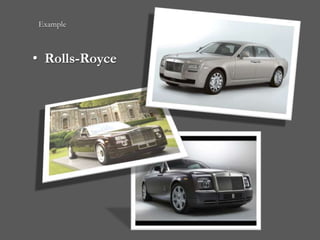
Example


• Rolls-Royce
Commercial
• Market segmentation is the division of A
  market into different groups of customers with
  distinctly similar needs and product/service
  requirements.
• Market segmentation is the division of a mass
  market into identifiable and distinct groups or
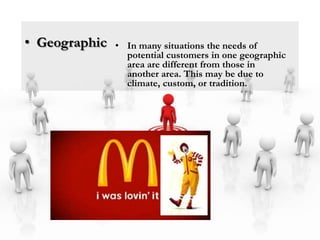
  segments, each of which have common
  characteristics and needs and display similar
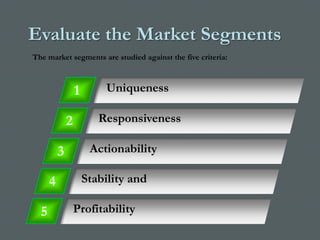
  responses to marketing actions.
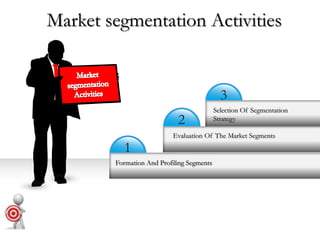
Market segmentation Activities


                                             3
                                           Selection Of Segmentation
                            2              Strategy

                           Evaluation Of The Market Segments
          1
        Formation And Profiling Segments
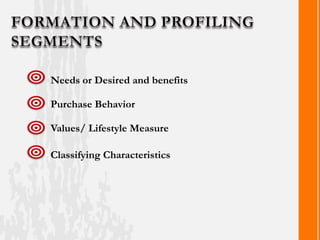
Needs or Desired and benefits

Purchase Behavior

Values/ Lifestyle Measure

Classifying Characteristics
1. Needs/ Benefits Sought
    • Needs and benefits are the characteristics
      or attributes of product that consumer
      seeks or consider important.

    Example:
    • Nokia Mobiles
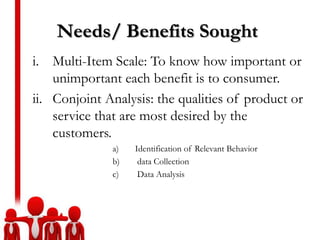
Needs/ Benefits Sought
i. Multi-Item Scale: To know how important or
    unimportant each benefit is to consumer.
ii. Conjoint Analysis: the qualities of product or
    service that are most desired by the
    customers.
              a)   Identification of Relevant Behavior
              b)    data Collection
              c)    Data Analysis
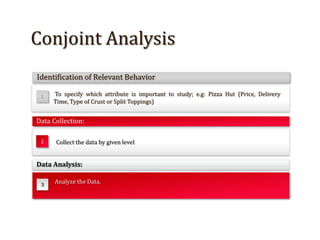
Conjoint Analysis
Identification of Relevant Behavior

 1   To specify which attribute is important to study; e.g: Pizza Hut (Price, Delivery
     Time, Type of Crust or Split Toppings)


Data Collection:

 2    Collect the data by given level


Data Analysis:

 3
      Analyze the Data.
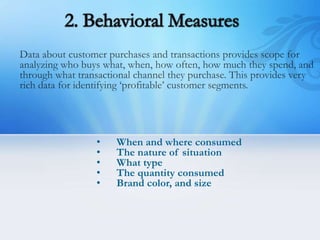
•   When and where consumed
•   The nature of situation
•   What type
•   The quantity consumed
•   Brand color, and size
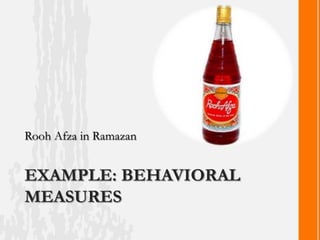
Rooh Afza in Ramazan


EXAMPLE: BEHAVIORAL
MEASURES
3. Values/ Lifestyle Measure

Analyzing consumers’ activities,
interests, and opinions, we can
understand individual lifestyles and
patterns of behavior, which in turn
affect their buying behavior and
decision-making processes. On this
basis, we can also identify similar
product and/or media usage patterns.
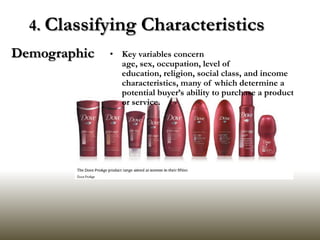
4. Classifying Characteristics
Demographic   • Key variables concern
                age, sex, occupation, level of
                education, religion, social class, and income
                characteristics, many of which determine a
                potential buyer’s ability to purchase a product
                or service.
• Geographic   • In many situations the needs of
                 potential customers in one geographic
                 area are different from those in
                 another area. This may be due to
                 climate, custom, or tradition.
Commercial
Evaluate the Market Segments
The market segments are studied against the five criteria:


                  1       Uniqueness

              2          Responsiveness

          3            Actionability

      4               Stability and

  5               Profitability
Uniqueness
 • Uniqueness refers to large between-
   group differences in the segments.
 • The best basis for forming market
   segments is to creates segments that
   are more unique.
 • The objective is to achieve competitive
   power.
 • The more unique the segments are, the
   easier It is to translate the
   segmentation result into strategic and
   tactical actions.
Responsiveness
  • If specific strategies and tactical
     actions are made for the specific
     segment, it is expected that the
     segment would be more responsive to
     those actions than other segments.
  • For example
   Pleasure travelers may respond to price
  change whereas business travelers may
  not.
Actionability
 • Actionability is the extent to which the
   manager can take action on the results
   of the segmentation analysis.
 • Actionability expresses the notion that
   the segment targeted must be of an
   appropriate size for the company.
   For Example
 • A need-based segment is made to cater
   a particular group of patients.
Stability
• The segment should be stable over
  time with respect to desired end
  benefits and classification factors.
• It is not necessary that same people
  remain in the segment.
• People with the needs identified by the
  segment should have same
  classification characteristics.
Profitability
 • The segment should have enough
   potential to contribute towards the
   organization’s objective and purpose of
   existence.
Segment Strategy
• The last step in segmentation is to select a
  segmentation strategy.
• It must be decided whether to take mass
  marketing approach or segmented approach.
• Segmented approach is further divided as
  single segment approach or multiple
  segment approach.
• Single segment: Porsche
• Multiple segment: Chevrolet, Toyota
Examining Competitive
    Market Forces.
Examining Competitive Market Forces.
                           (Emphasis on first three)

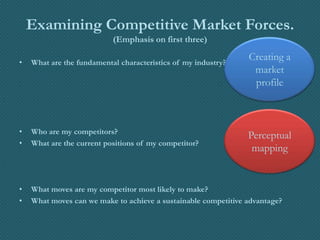
•   What are the fundamental characteristics of my industry?
                                                                Creating a
                                                                 market
                                                                 profile


•   Who are my competitors?
                                                                Perceptual
•   What are the current positions of my competitor?
                                                                 mapping


•   What moves are my competitor most likely to make?
•   What moves can we make to achieve a sustainable competitive advantage?
Examining Competitive Market Forces.

Creating a market Profile: Deals with industry
characteristics such as:
    –   Size and growth rate of the industry
    –   Substitute products
    –   Suppliers to the industry
    –   Principal customers
    –   Manufacturing and distribution
    –   Barriers to entry
    –   Social and economic conditions affecting the industry


Perceptual Mapping: Also known as product positioning
map. Who are my competitors & what are their current positions?
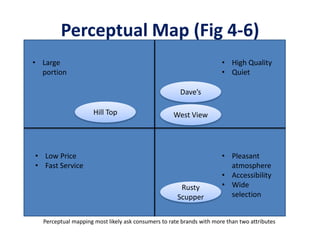
Perceptual Map (Fig 4-6)
• Large                                                               • High Quality
  portion                                                             • Quiet

                                                      Dave’s

                     Hill Top                      West View


• Low Price                                                           • Pleasant
• Fast Service                                                          atmosphere
                                                                      • Accessibility
                                                      Rusty           • Wide
                                                     Scupper            selection


  Perceptual mapping most likely ask consumers to rate brands with more than two attributes
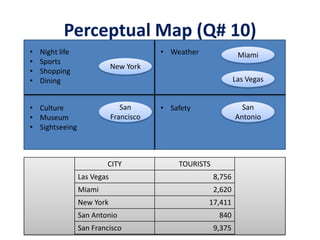
Perceptual Map (Q# 10)
•   Night life                           • Weather               Miami
•   Sports
                             New York
•   Shopping
•   Dining                                                      Las Vegas


• Culture                       San      • Safety                 San
• Museum                     Francisco                          Antonio
• Sightseeing


                         CITY                TOURISTS
                 Las Vegas                              8,756
                 Miami                                  2,620
                 New York                            17,411
                 San Antonio                             840
                 San Francisco                          9,375
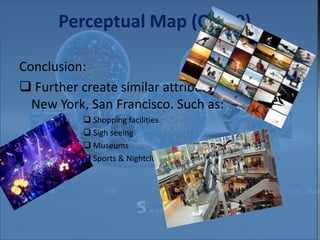
Perceptual Map (Q# 10)

Conclusion:
 Further create similar attributes as in the City
  New York, San Francisco. Such as:
            Shopping facilities
            Sigh seeing
            Museums
            Sports & Nightclubs
THANK YOU!

Target market & Competitive Advantage

  • 2.
    Target Market • Atarget market is a group of customers that the business has decided to aim its marketing efforts and ultimately its merchandise
  • 3.
  • 4.
  • 5.
    • Market segmentationis the division of A market into different groups of customers with distinctly similar needs and product/service requirements. • Market segmentation is the division of a mass market into identifiable and distinct groups or segments, each of which have common characteristics and needs and display similar responses to marketing actions.
  • 6.
    Market segmentation Activities 3 Selection Of Segmentation 2 Strategy Evaluation Of The Market Segments 1 Formation And Profiling Segments
  • 7.
    Needs or Desiredand benefits Purchase Behavior Values/ Lifestyle Measure Classifying Characteristics
  • 8.
    1. Needs/ BenefitsSought • Needs and benefits are the characteristics or attributes of product that consumer seeks or consider important. Example: • Nokia Mobiles
  • 9.
    Needs/ Benefits Sought i.Multi-Item Scale: To know how important or unimportant each benefit is to consumer. ii. Conjoint Analysis: the qualities of product or service that are most desired by the customers. a) Identification of Relevant Behavior b) data Collection c) Data Analysis
  • 10.
    Conjoint Analysis Identification ofRelevant Behavior 1 To specify which attribute is important to study; e.g: Pizza Hut (Price, Delivery Time, Type of Crust or Split Toppings) Data Collection: 2 Collect the data by given level Data Analysis: 3 Analyze the Data.
  • 11.
    When and where consumed • The nature of situation • What type • The quantity consumed • Brand color, and size
  • 12.
    Rooh Afza inRamazan EXAMPLE: BEHAVIORAL MEASURES
  • 13.
    3. Values/ LifestyleMeasure Analyzing consumers’ activities, interests, and opinions, we can understand individual lifestyles and patterns of behavior, which in turn affect their buying behavior and decision-making processes. On this basis, we can also identify similar product and/or media usage patterns.
  • 14.
    4. Classifying Characteristics Demographic • Key variables concern age, sex, occupation, level of education, religion, social class, and income characteristics, many of which determine a potential buyer’s ability to purchase a product or service.
  • 15.
    • Geographic • In many situations the needs of potential customers in one geographic area are different from those in another area. This may be due to climate, custom, or tradition.
  • 16.
  • 17.
    Evaluate the MarketSegments The market segments are studied against the five criteria: 1 Uniqueness 2 Responsiveness 3 Actionability 4 Stability and 5 Profitability
  • 18.
    Uniqueness • Uniquenessrefers to large between- group differences in the segments. • The best basis for forming market segments is to creates segments that are more unique. • The objective is to achieve competitive power. • The more unique the segments are, the easier It is to translate the segmentation result into strategic and tactical actions.
  • 19.
    Responsiveness •If specific strategies and tactical actions are made for the specific segment, it is expected that the segment would be more responsive to those actions than other segments. • For example Pleasure travelers may respond to price change whereas business travelers may not.
  • 20.
    Actionability • Actionabilityis the extent to which the manager can take action on the results of the segmentation analysis. • Actionability expresses the notion that the segment targeted must be of an appropriate size for the company. For Example • A need-based segment is made to cater a particular group of patients.
  • 21.
    Stability • The segmentshould be stable over time with respect to desired end benefits and classification factors. • It is not necessary that same people remain in the segment. • People with the needs identified by the segment should have same classification characteristics.
  • 22.
    Profitability • Thesegment should have enough potential to contribute towards the organization’s objective and purpose of existence.
  • 23.
    Segment Strategy • Thelast step in segmentation is to select a segmentation strategy. • It must be decided whether to take mass marketing approach or segmented approach. • Segmented approach is further divided as single segment approach or multiple segment approach. • Single segment: Porsche • Multiple segment: Chevrolet, Toyota
  • 24.
    Examining Competitive Market Forces.
  • 25.
    Examining Competitive MarketForces. (Emphasis on first three) • What are the fundamental characteristics of my industry? Creating a market profile • Who are my competitors? Perceptual • What are the current positions of my competitor? mapping • What moves are my competitor most likely to make? • What moves can we make to achieve a sustainable competitive advantage?
  • 26.
    Examining Competitive MarketForces. Creating a market Profile: Deals with industry characteristics such as: – Size and growth rate of the industry – Substitute products – Suppliers to the industry – Principal customers – Manufacturing and distribution – Barriers to entry – Social and economic conditions affecting the industry Perceptual Mapping: Also known as product positioning map. Who are my competitors & what are their current positions?
  • 27.
    Perceptual Map (Fig4-6) • Large • High Quality portion • Quiet Dave’s Hill Top West View • Low Price • Pleasant • Fast Service atmosphere • Accessibility Rusty • Wide Scupper selection Perceptual mapping most likely ask consumers to rate brands with more than two attributes
  • 28.
    Perceptual Map (Q#10) • Night life • Weather Miami • Sports New York • Shopping • Dining Las Vegas • Culture San • Safety San • Museum Francisco Antonio • Sightseeing CITY TOURISTS Las Vegas 8,756 Miami 2,620 New York 17,411 San Antonio 840 San Francisco 9,375
  • 29.
    Perceptual Map (Q#10) Conclusion:  Further create similar attributes as in the City New York, San Francisco. Such as:  Shopping facilities  Sigh seeing  Museums  Sports & Nightclubs
  • 30.

Editor's Notes

  • #2 Falling pictures(Intermediate)To reproduce the picture effects on this slide, do the following:On the Home tab, in the Slides group, click Layout, and then click Blank.On the Insert tab, in the Images group, click Picture. In the Insert Picture dialog box, select a picture, and then click Insert. Select the picture. Under Picture Tools, on the Format tab, in the bottom right corner of the Size group, click the Size and Position dialog box launcher. In the Format Picture dialog box, resize or crop the image so that the height is set to 2.93” and the widthis set to 4.41”. To crop the picture, click Crop in the left pane, and in the Crop pane, under Crop position, enter values into the Height, Width, Left, and Top boxes. To resize the picture, click Size in the left pane, and in the right pane, under Size and rotate, enter values into the Height and Width boxes.Under Picture Tools, on the Format tab, in the Picture Styles group, click More, and then click Beveled Matte, White (first row, second option from the left). Under Picture Tools, on the Format tab, in the bottom right corner of the Size group, click the Size and Position dialog box launcher. In the Size and Position dialog box, on the Size tab, under Size and rotate, in the Rotation box, enter 5°.Under Picture Tools, on the Format tab, in the bottom right corner of the Picture Styles group, click the FormatPicture dialog box launcher. In the FormatPicture dialog box, click Shadow in the left pane, and then do the following in the Shadow pane:Click the button next to Presets, and then under Outer click Offset Diagonal Bottom Left (first row, third option from the left).In the Distance box, enter 20 pt. Drag the picture into the top right corner of the slide.Select the picture. On the Home tab, in the Clipboard group, click the arrow to the right of Copy, and then click Duplicate.Drag the second (duplicate) picture to the left middle of the slide.Select the second picture. Under Picture Tools, on the Format tab, in the bottom right corner of the Size group, click the Size and Position dialog box launcher. In the Format Picture dialog box, on the Size tab, under Size and rotate, in the Rotation box, enter 0°.Right-click the second picture and click Change Picture. In the Insert Picture dialog box, select a picture, and then click Insert. Select the second picture. Under Picture Tools, on the Format tab, in the bottom right corner of the Size group, click the Size and Position dialog box launcher. In the Format Picture dialog box, resize or crop the image so that the height is set to 2.93” and the widthis set to 4.41”. To crop the picture, click Crop in the left pane, and in the Crop pane, under Crop position, enter values into the Height, Width, Left, and Top boxes. To resize the picture, click Size in the left pane, and in the right pane, under Size and rotate, enter values into the Height and Width boxes.Under Picture Tools, on the Format tab, in the bottom right corner of the Picture Styles group, click the FormatPicture dialog box launcher. In the FormatPicture dialog box, click 3-D Rotation in the left pane, and then do the following in the 3-D Rotation pane:Click the button next to Presets, and then under Perspective click Perspective Relaxed (second row, third option from the left). In the X box, enter 0°.In the Y box, enter 320°.In the Z box, enter 10°.In the Perspective box, enter 80°. On the Home tab, in the Drawing group, click Arrange, and then click Send to Back. Select the second picture. On the Home tab, in the Clipboard group, click the arrow to the right of Copy, and then click Duplicate.Drag the third picture to the bottom right corner of the slide, under the first picture.Right-click the third picture and click Change Picture. In the Insert Picture dialog box, select a picture, and then click Insert. Select the third picture. Under Picture Tools, on the Format tab, in the bottom right corner of the Size group, click the Size and Position dialog box launcher. In the Format Picture dialog box, on the Size tab, resize or crop the picture as needed so that under Size and rotate, the Height box is set to 2.93” and the Width box is set to 4.41”. Resize the picture under Size and rotate by entering values into the Height and Width boxes. Crop the picture under Crop from by entering values into the Left, Right, Top, and Bottom boxes. Under Picture Tools, on the Format tab, in the bottom right corner of the Picture Styles group, click the FormatShape dialog box launcher. In the FormatPicture dialog box, click 3-D Rotation in the left pane, and then do the following in the 3-D Rotation pane:Click the button next to Presets, and then under Perspective click Perspective Relaxed (second row, third option from the left). In the X box, enter 0°.In the Y box, enter 300°.In the Z box, enter 0°.In the Perspective box, enter 60°.On the Home tab, in the Drawing group, click Arrange, and then click Send to Back. To reproduce the background effects on this slide, do the following:Right-click the slide background area, and then click Format Background. In the Format Background dialog box, click Fill in the left pane, select Gradient fill in the Fill pane, and then do the following:In the Type list, select Linear.Click the button next to Direction, and then click Linear Down (first row, second option from the left). Under Gradient stops, click Add gradient stops or Remove gradient stops until two stops appear in the slider.Also under Gradient stops, customize the gradient stops that you added as follows:Select the first stop in the slider, and then do the following:In the Position box, enter 70%.Click the button next to Color, and then click Black, Text 1, Lighter 5% (sixth row, second option from the left). Select the second stop in the slider, and then do the following: In the Position box, enter 100%.Click the button next to Color, click More Colors, and then in the Colors dialog box, on the Custom tab, enter values for Red: 87, Green: 78, Blue: 51.
  • #14 This template can be used as a starter file for a photo album.
  • #25 This template can be used as a starter file for a photo album.
  • #26 Refer page 92
  • #28 Refer pg # 98
  • #29 Q: You have been hired by the city of San Antonio to recommend strategies to increase foreign tourism.