5-1-29
5
Session
Targeting attractive
market segments
Strategic Marketing
BUS350
Marketing Strategy, Walker et al, Ch. 6
5-2-29
Learning outcomes
1. Define marketing segmentation, targeting and
positioning
2. Identify the four major categories of market
segmentation
3. Determine how to choose attractive market
segments
4. Identify different targeting strategies
5. Understand the importance of global market
segmentation
5-3-29
• Fundamental tools in the marketer’s toolkit are
market segmentation and target marketing
• These tools, along with product positioning,
provide the platform on which most effective
marketing programs are built
Market segmentation, targeting and
positioning defined
Learning
Outcome
1
Coca-Cola Positioning
Refreshing flavour
Optimistic view of life
Contemporary, up-to-date
yet classic, iconic symbolism
and imagery
5-4-29
• Market segmentation
– the process by which a market is divided into
distinct subsets of customers
– with similar needs and characteristics
– that lead them to respond in similar ways to
product offerings and marketing programs
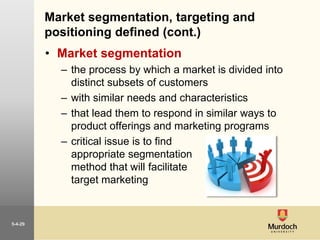
– critical issue is to find
appropriate segmentation
method that will facilitate
target marketing
Market segmentation, targeting and
positioning defined (cont.)
5-5-29
– Market segments tend to be homogeneous
but variation exists in:
 product preferences
 size and growth in demand
 media habits
 competitor activities
– Markets can be
complex and are
segmented in a
variety of ways
Market segmentation, targeting and
positioning defined (cont.)
Who is the target market for Nespresso?
5-7-29
• Key reasons for market segmentation
– Population growth has slowed and many
markets are maturing
– Social and economic forces such as expanding
disposable incomes, employment patterns,
education levels, changing lifestyles
– Shift toward micro-segmentation
– Firms are implementing sharply focused
marketing programs and targeting of their
services
Market segmentation, targeting and
positioning defined (cont.)
5-8-29
Important steps in the market
segmentation process
1. Identify homogeneous segment that differs
from other segments
2. Specify characteristics that define the segment
3. Determine segment size and potential
Telstra mobile phones for seniors
• big buttons
• large numbers on screen
• audible key tones
• quick access switch
• dialling of preferred numbers
Market segmentation, targeting and
positioning defined (cont.)
5-9-29
Target marketing
– requires evaluating the relative attractiveness
of various segments and alignment with the
firm’s mission and capabilities
– to determine what each segment wants
– in order to choose which segments it will
serve
– targeting a profitable market that the firm can
adequately serve
Market segmentation, targeting and
positioning defined (cont.)
5-10-29
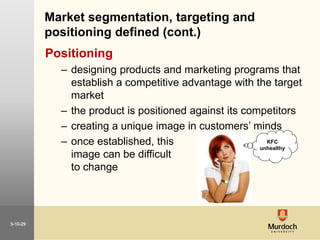
Positioning
– designing products and marketing programs that
establish a competitive advantage with the target
market
– the product is positioned against its competitors
– creating a unique image in customers’ minds
– once established, this
image can be difficult
to change
Market segmentation, targeting and
positioning defined (cont.)
KFC
unhealthy
KFC
unhealthy
5-11-29
Main categories of market segmentation
• Segmentation decisions are
based on:
 who the customers are
 what they do
 where they are
 how they behave
• Marketers divide segmentation
into four major categories:
1. Demographic
2. Geographic
3. Behavioural
4. Psychographic
Learning
Outcome
2
5-12-29
1. Demographic segmentation
– Finding out: who they are and what they do
– Common attributes
 Age
 Gender
 Income
 Occupation
 Education
 Race and ethnic background
– Industrial market segmentation
 Macro segmentation
 Micro segmentation
Main categories of market segmentation (cont.)
5-13-29
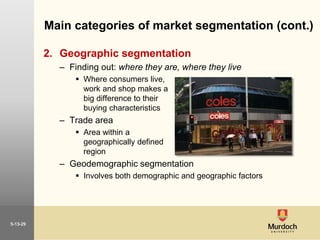
2. Geographic segmentation
– Finding out: where they are, where they live
 Where consumers live,
work and shop makes a
big difference to their
buying characteristics
– Trade area
 Area within a
geographically defined
region
– Geodemographic segmentation
 Involves both demographic and geographic factors
Main categories of market segmentation (cont.)
5-14-29
3. Behavioural segmentation
– Finding out: how they behave
 Behavioural characteristics can relate to how
consumers use products and what is important to
them
– Behaviour descriptors
 Consumer needs
 Product-related
 Social class
 Organisational or
firm behavioural attributes
Main categories of market segmentation (cont.)
5-15-29
4. Psychographic segmentation
– Finding out: what they are interested in
 Psychographic characteristics can relate to how
consumers see products fitting into their lifestyle
– Behaviour descriptors
 Accepts that consumers are inherently different
individuals
 Differences in interests, needs, personality traits
and values
 VALS2 (values and lifestyles – 8 segments)
 AIO’s (attitudes, interests and opinions)
 Gives insights into consumers likes and dislikes
Main categories of market segmentation (cont.)
5-16-29
5-17-29
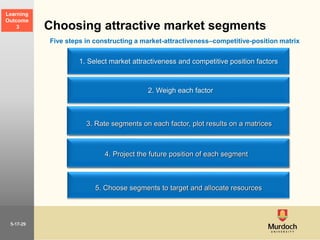
Five steps in constructing a market-attractiveness–competitive-position matrix
3. Rate segments on each factor, plot results on a matrices
4. Project the future position of each segment
1. Select market attractiveness and competitive position factors
2. Weigh each factor
5. Choose segments to target and allocate resources
Learning
Outcome
3 Choosing attractive market segments
5-18-29
Exhibit 6.9
Factors underlying market attractiveness and competitive position
Market-attractiveness factors Competitive-position factors
Customer psychographic needs and behaviour
 Are there unmet or underserved needs we can satisfy?
Opportunity for competitive advantage
 Can we differentiate?
 Can we perform against critical success factors?
 Stage of competing products in product life cycle: Is the
timing right?
Market or market segment size and growth rate
 Market potential in units, revenue, number of
prospective customers
 Growth rate in units, revenue, number of prospective
customers
 Might target segment constitute a platform for later
expansion into related segments in the market as
whole?
Firm and competitor capabilities and resources
 Management strength and depth
 Financial and functional resources: marketing,
distribution, manufacturing, R&D, etc.
 Brand image
 Relative market share
Macro trends: Are they favorable, on balance?
 Demographic
 Socio/cultural and historical
 Economic
 Political/legal
 Technological
 Ecological
Attractiveness of industry in which we would compete
 Threat of new entrants
 Threat of substitutes
 Buyer power
 Supplier power
 Competitive rivalry
 Industry capacity
Choosing attractive market segments (cont.)
5-19-29
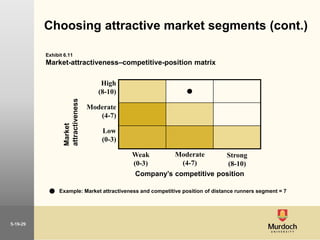
Exhibit 6.11
Market-attractiveness–competitive-position matrix
l
Market
attractiveness
High
(8-10)
Moderate
(4-7)
Low
(0-3)
Strong
(8-10)
Moderate
(4-7)
Weak
(0-3)
Company’s competitive position
l Example: Market attractiveness and competitive position of distance runners segment = 7
Choosing attractive market segments (cont.)
5-20-29
Targeting strategies
• Most successful entrepreneurs target narrowly
defined market segments
– This is not necessarily the best strategy, particularly for
established firms
• Three most common targeting strategies:
1. Niche-market
2. Mass-market
3. Growth-market
Learning
Outcome
4
5-21-29
1. Niche-market strategy
– Focus on single unique markets
– Used to serve segments seeking specialised
benefits e.g. Nespresso for high-end consumers
– Designed to avoid direct competition with
larger firms
– May be smaller segments but can be profitable
– Issues regarding narrowly positioning the
firm’s products
– Appropriate for start up businesses depending
on the product
Targeting strategies (cont.)
Nespresso targeted to high-end consumers
5-23-29
2. Mass-market strategy
– Objective to capture sufficient volume to gain
economies of scale and a cost advantage
– Design separate products and marketing
programs for differing segments
– Requires substantial resources, including
production capacity, and good mass-
marketing capabilities
– Also know as differentiated marketing
e.g. Marriott hotels have different level offerings for
different target markets
Targeting strategies (cont.)
Resort hotel Manila for
conference
accommodation
Courtyard hotel
Florida cheaper
accommodation for
longer stays
5-25-29
3. Growth-market strategy
– Often targets one or more fast-growth
segments to target newly emerging user
segments e.g. often in new technology areas such
as smart watches designed for women
– Favoured by smaller
competitors to avoid
direct confrontations
– Requires strong R&D
and marketing capabilities
Targeting strategies (cont.)
5-26-29
Global market segmentation
• Traditionally, a country or group of countries viewed
as single segment comprising all consumers - but
assumes homogeneity within the country
• Inter-country segmentation develops standardised
programs across several countries for economies of
scale
• Some businesses expand internationally to defend
their home position against global
competitors
• Some B2B’s expand to service
customers who are also expanding
globally
Learning
Outcome
5
http://gfxspeak.com/2013/06/04/global-games-market-expected-to-hit-70-4-billion-in-2013/

Segmenting, Targeting and Positioning

  • 1.
    5-1-29 5 Session Targeting attractive market segments StrategicMarketing BUS350 Marketing Strategy, Walker et al, Ch. 6
  • 2.
    5-2-29 Learning outcomes 1. Definemarketing segmentation, targeting and positioning 2. Identify the four major categories of market segmentation 3. Determine how to choose attractive market segments 4. Identify different targeting strategies 5. Understand the importance of global market segmentation
  • 3.
    5-3-29 • Fundamental toolsin the marketer’s toolkit are market segmentation and target marketing • These tools, along with product positioning, provide the platform on which most effective marketing programs are built Market segmentation, targeting and positioning defined Learning Outcome 1 Coca-Cola Positioning Refreshing flavour Optimistic view of life Contemporary, up-to-date yet classic, iconic symbolism and imagery
  • 4.
    5-4-29 • Market segmentation –the process by which a market is divided into distinct subsets of customers – with similar needs and characteristics – that lead them to respond in similar ways to product offerings and marketing programs – critical issue is to find appropriate segmentation method that will facilitate target marketing Market segmentation, targeting and positioning defined (cont.)
  • 5.
    5-5-29 – Market segmentstend to be homogeneous but variation exists in:  product preferences  size and growth in demand  media habits  competitor activities – Markets can be complex and are segmented in a variety of ways Market segmentation, targeting and positioning defined (cont.)
  • 6.
    Who is thetarget market for Nespresso?
  • 7.
    5-7-29 • Key reasonsfor market segmentation – Population growth has slowed and many markets are maturing – Social and economic forces such as expanding disposable incomes, employment patterns, education levels, changing lifestyles – Shift toward micro-segmentation – Firms are implementing sharply focused marketing programs and targeting of their services Market segmentation, targeting and positioning defined (cont.)
  • 8.
    5-8-29 Important steps inthe market segmentation process 1. Identify homogeneous segment that differs from other segments 2. Specify characteristics that define the segment 3. Determine segment size and potential Telstra mobile phones for seniors • big buttons • large numbers on screen • audible key tones • quick access switch • dialling of preferred numbers Market segmentation, targeting and positioning defined (cont.)
  • 9.
    5-9-29 Target marketing – requiresevaluating the relative attractiveness of various segments and alignment with the firm’s mission and capabilities – to determine what each segment wants – in order to choose which segments it will serve – targeting a profitable market that the firm can adequately serve Market segmentation, targeting and positioning defined (cont.)
  • 10.
    5-10-29 Positioning – designing productsand marketing programs that establish a competitive advantage with the target market – the product is positioned against its competitors – creating a unique image in customers’ minds – once established, this image can be difficult to change Market segmentation, targeting and positioning defined (cont.) KFC unhealthy KFC unhealthy
  • 11.
    5-11-29 Main categories ofmarket segmentation • Segmentation decisions are based on:  who the customers are  what they do  where they are  how they behave • Marketers divide segmentation into four major categories: 1. Demographic 2. Geographic 3. Behavioural 4. Psychographic Learning Outcome 2
  • 12.
    5-12-29 1. Demographic segmentation –Finding out: who they are and what they do – Common attributes  Age  Gender  Income  Occupation  Education  Race and ethnic background – Industrial market segmentation  Macro segmentation  Micro segmentation Main categories of market segmentation (cont.)
  • 13.
    5-13-29 2. Geographic segmentation –Finding out: where they are, where they live  Where consumers live, work and shop makes a big difference to their buying characteristics – Trade area  Area within a geographically defined region – Geodemographic segmentation  Involves both demographic and geographic factors Main categories of market segmentation (cont.)
  • 14.
    5-14-29 3. Behavioural segmentation –Finding out: how they behave  Behavioural characteristics can relate to how consumers use products and what is important to them – Behaviour descriptors  Consumer needs  Product-related  Social class  Organisational or firm behavioural attributes Main categories of market segmentation (cont.)
  • 15.
    5-15-29 4. Psychographic segmentation –Finding out: what they are interested in  Psychographic characteristics can relate to how consumers see products fitting into their lifestyle – Behaviour descriptors  Accepts that consumers are inherently different individuals  Differences in interests, needs, personality traits and values  VALS2 (values and lifestyles – 8 segments)  AIO’s (attitudes, interests and opinions)  Gives insights into consumers likes and dislikes Main categories of market segmentation (cont.)
  • 16.
  • 17.
    5-17-29 Five steps inconstructing a market-attractiveness–competitive-position matrix 3. Rate segments on each factor, plot results on a matrices 4. Project the future position of each segment 1. Select market attractiveness and competitive position factors 2. Weigh each factor 5. Choose segments to target and allocate resources Learning Outcome 3 Choosing attractive market segments
  • 18.
    5-18-29 Exhibit 6.9 Factors underlyingmarket attractiveness and competitive position Market-attractiveness factors Competitive-position factors Customer psychographic needs and behaviour  Are there unmet or underserved needs we can satisfy? Opportunity for competitive advantage  Can we differentiate?  Can we perform against critical success factors?  Stage of competing products in product life cycle: Is the timing right? Market or market segment size and growth rate  Market potential in units, revenue, number of prospective customers  Growth rate in units, revenue, number of prospective customers  Might target segment constitute a platform for later expansion into related segments in the market as whole? Firm and competitor capabilities and resources  Management strength and depth  Financial and functional resources: marketing, distribution, manufacturing, R&D, etc.  Brand image  Relative market share Macro trends: Are they favorable, on balance?  Demographic  Socio/cultural and historical  Economic  Political/legal  Technological  Ecological Attractiveness of industry in which we would compete  Threat of new entrants  Threat of substitutes  Buyer power  Supplier power  Competitive rivalry  Industry capacity Choosing attractive market segments (cont.)
  • 19.
    5-19-29 Exhibit 6.11 Market-attractiveness–competitive-position matrix l Market attractiveness High (8-10) Moderate (4-7) Low (0-3) Strong (8-10) Moderate (4-7) Weak (0-3) Company’scompetitive position l Example: Market attractiveness and competitive position of distance runners segment = 7 Choosing attractive market segments (cont.)
  • 20.
    5-20-29 Targeting strategies • Mostsuccessful entrepreneurs target narrowly defined market segments – This is not necessarily the best strategy, particularly for established firms • Three most common targeting strategies: 1. Niche-market 2. Mass-market 3. Growth-market Learning Outcome 4
  • 21.
    5-21-29 1. Niche-market strategy –Focus on single unique markets – Used to serve segments seeking specialised benefits e.g. Nespresso for high-end consumers – Designed to avoid direct competition with larger firms – May be smaller segments but can be profitable – Issues regarding narrowly positioning the firm’s products – Appropriate for start up businesses depending on the product Targeting strategies (cont.)
  • 22.
    Nespresso targeted tohigh-end consumers
  • 23.
    5-23-29 2. Mass-market strategy –Objective to capture sufficient volume to gain economies of scale and a cost advantage – Design separate products and marketing programs for differing segments – Requires substantial resources, including production capacity, and good mass- marketing capabilities – Also know as differentiated marketing e.g. Marriott hotels have different level offerings for different target markets Targeting strategies (cont.)
  • 24.
    Resort hotel Manilafor conference accommodation Courtyard hotel Florida cheaper accommodation for longer stays
  • 25.
    5-25-29 3. Growth-market strategy –Often targets one or more fast-growth segments to target newly emerging user segments e.g. often in new technology areas such as smart watches designed for women – Favoured by smaller competitors to avoid direct confrontations – Requires strong R&D and marketing capabilities Targeting strategies (cont.)
  • 26.
    5-26-29 Global market segmentation •Traditionally, a country or group of countries viewed as single segment comprising all consumers - but assumes homogeneity within the country • Inter-country segmentation develops standardised programs across several countries for economies of scale • Some businesses expand internationally to defend their home position against global competitors • Some B2B’s expand to service customers who are also expanding globally Learning Outcome 5
  • 27.
  • 28.
  • 29.