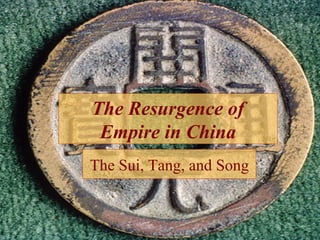
The Resurgence of Empire in China The Sui, Tang, and Song
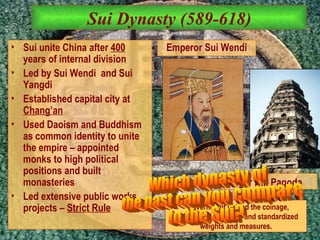
Sui Dynasty (589-618) Sui unite China after  400  years of internal division Led by Sui Wendi  and Sui Yangdi Established capital city at  Chang’an Used Daoism and Buddhism as common identity to unite the empire – appointed monks to high political positions and built monasteries Led extensive public works projects –  Strict Rule Government unified the coinage, nationalized the mints and standardized weights and measures. Tiger Hill Pagoda   Emperor Sui Wendi Which dynasty of  the past can you compare to the Sui?
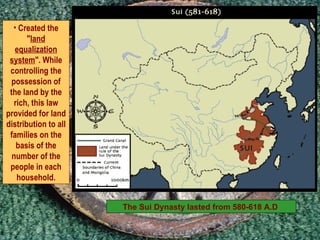
The Sui Dynasty lasted from 580-618 A.D  Created the " land equalization system ". While controlling the possession of the land by the rich, this law provided for land distribution to all families on the basis of the number of the people in each household.
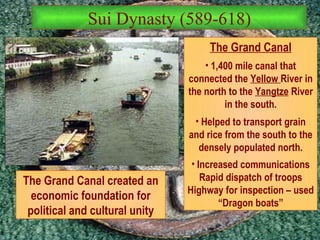
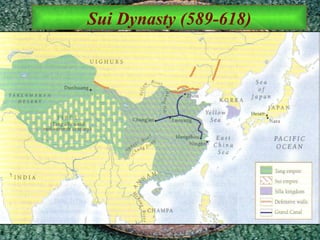
Sui Dynasty (589-618) The Grand Canal 1,400 mile canal that connected the  Yellow  River in the north to the  Yangtze  River in the south. Helped to transport grain and rice from the south to the densely populated north. Increased communications Rapid dispatch of troops Highway for inspection – used “Dragon boats” The Grand Canal created an economic foundation for political and cultural unity
Sui Dynasty (589-618)
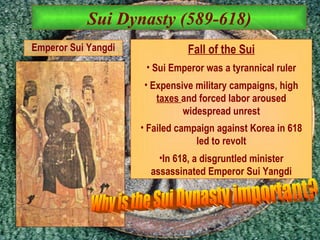
Sui Dynasty (589-618) Fall of the Sui Sui Emperor was a tyrannical ruler Expensive military campaigns, high  taxes  and forced labor aroused widespread unrest Failed campaign against Korea in 618 led to revolt In 618, a disgruntled minister assassinated Emperor Sui Yangdi Emperor Sui Yangdi Why is the Sui Dynasty important?
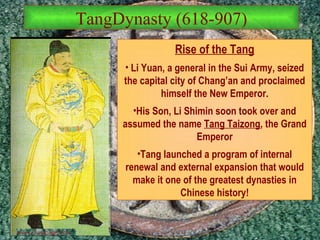
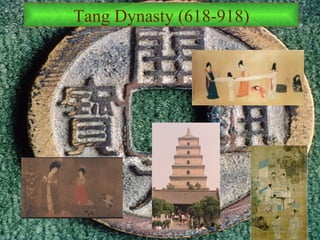
TangDynasty (618-907) Rise of the Tang Li Yuan, a general in the Sui Army, seized the capital city of Chang’an and proclaimed himself the New Emperor. His Son, Li Shimin soon took over and assumed the name  Tang Taizong , the Grand Emperor Tang launched a program of internal renewal and external expansion that would make it one of the greatest dynasties in Chinese history!
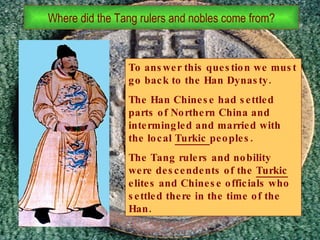
To answer this question we must go back to the Han Dynasty. The Han Chinese had settled parts of Northern China and intermingled and married with the local  Turkic  peoples. The Tang rulers and nobility were descendents of the  Turkic  elites and Chinese officials who settled there in the time of the Han. Where did the Tang rulers and nobles come from?
 
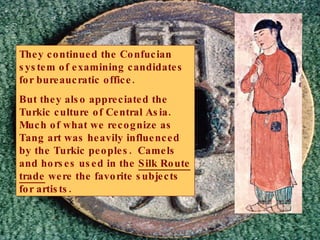
They continued the Confucian system of examining candidates for bureaucratic office. But they also appreciated the Turkic culture of Central Asia.  Much of what we recognize as Tang art was heavily influenced by the Turkic peoples.  Camels and horses used in the  Silk Route trade  were the favorite subjects for artists.
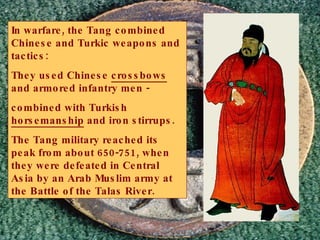
In warfare, the Tang combined Chinese and Turkic weapons and tactics: They used Chinese  crossbows  and armored infantry men -  combined with Turkish  horsemanship  and iron stirrups. The Tang military reached its peak from about 650-751, when they were defeated in Central Asia by an Arab Muslim army at the Battle of the Talas River.
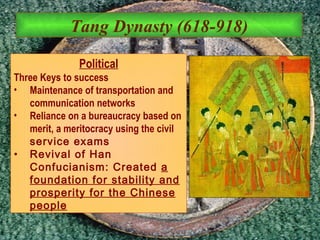
Tang Dynasty (618-918) Political Three Keys to success Maintenance of transportation and communication networks Reliance on a bureaucracy based on merit, a meritocracy using the civil  service exams Revival of Han Confucianism: Created  a foundation for stability and prosperity for the Chinese people
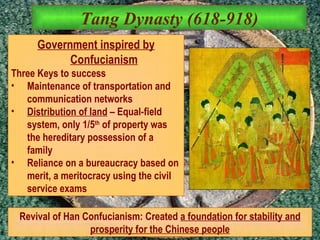
Tang Dynasty (618-918) Government inspired by Confucianism Three Keys to success Maintenance of transportation and communication networks Distribution of land  – Equal-field system, only 1/5 th  of property was the hereditary possession of a family Reliance on a bureaucracy based on merit, a meritocracy using the civil service exams Revival of Han Confucianism: Created  a foundation for stability and prosperity for the Chinese people
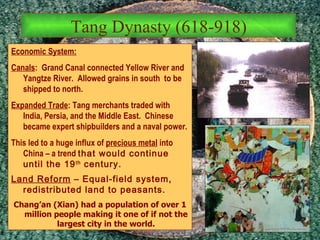
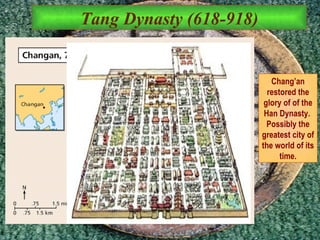
Economic System: Canals :  Grand Canal connected Yellow River and Yangtze River.  Allowed grains in south  to be shipped to north.  Expanded Trade : Tang merchants traded with India, Persia, and the Middle East.  Chinese became expert shipbuilders and a naval power.  This led to a huge influx of  precious metal  into China – a trend  that would continue until the 19 th  century. Land Reform  – Equal-field system, redistributed land to peasants. Chang’an (Xian) had a population of over 1 million people making it one of if not the largest city in the world. Tang Dynasty (618-918)
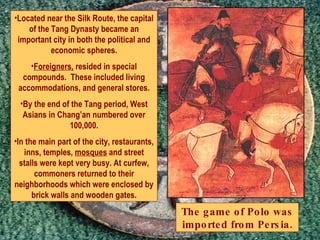
Located near the Silk Route, the capital of the Tang Dynasty became an important city in both the political and economic spheres. Foreigners,  resided in special compounds.  These included living accommodations, and general stores. By the end of the Tang period, West Asians in Chang’an numbered over 100,000. In the main part of the city, restaurants, inns, temples,  mosques  and street stalls were kept very busy. At curfew, commoners returned to their neighborhoods which were enclosed by brick walls and wooden gates. The game of Polo was imported from Persia.
Tang Dynasty (618-918) Chang’an restored the glory of of the Han Dynasty.  Possibly the greatest city of the world of its time.
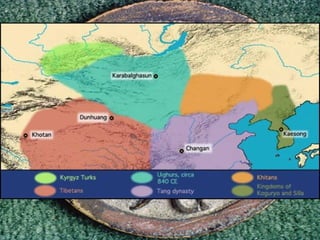
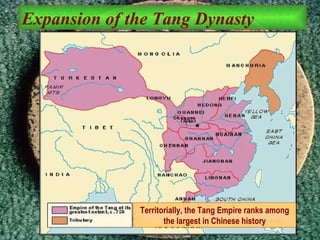
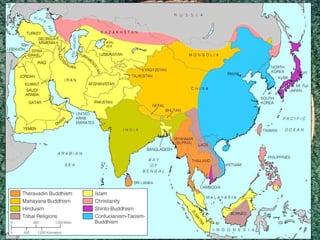
Expansion of the Tang Dynasty Territorially, the Tang Empire ranks among the largest in Chinese history
Because of the Grand Canal and other government projects for shipping grain and other goods, the Tang Dynasty had the strongest economy of the time period.  Even in its decline, Tang exports far outnumbered imports from South Asia, West Asia, Europe and Africa combined.  This led to a huge influx of  precious metal  into China – a trend that would continue until the 19 th  century.
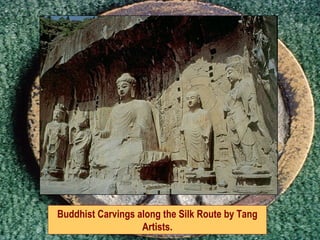
Buddhist Carvings along the Silk Route by Tang Artists.
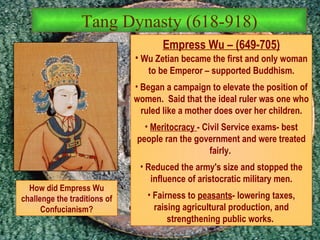
Tang Dynasty (618-918) Empress Wu – (649-705) Wu Zetian became the first and only woman to be Emperor – supported Buddhism. Began a campaign to elevate the position of women.  Said that the ideal ruler was one who ruled like a mother does over her children. Meritocracy  - Civil Service exams- best people ran the government and were treated fairly.  Reduced the army's size and stopped the influence of aristocratic military men. Fairness to  peasants - lowering taxes, raising agricultural production, and strengthening public works.  How did Empress Wu challenge the traditions of Confucianism?
 
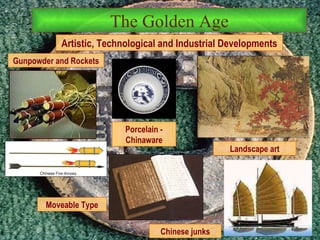
The Golden Age Artistic, Technological and Industrial Developments Gunpowder and Rockets Moveable Type Chinese junks Porcelain - Chinaware Landscape art
 
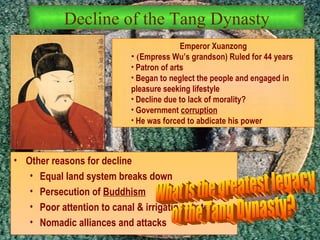
Other reasons for decline Equal land system breaks down Persecution of  Buddhism Poor attention to canal & irrigation systems Nomadic alliances and attacks Decline of the Tang Dynasty Emperor Xuanzong ( Empress Wu’s grandson) Ruled for 44 years Patron of arts Began to neglect the people and engaged in pleasure seeking lifestyle Decline due to lack of morality? Government  corruption He was forced to abdicate his power What is the greatest legacy  of the Tang Dynasty?
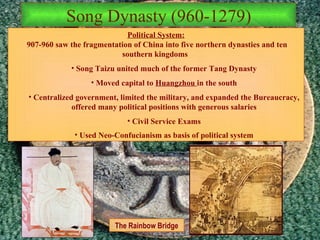
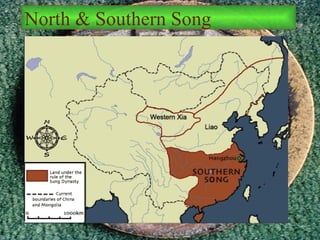
Song Dynasty (960-1279) The Rainbow Bridge Political System: 907-960 saw the fragmentation of China into five northern dynasties and ten southern kingdoms   Song Taizu united much of the former Tang Dynasty Moved capital to  Huangzhou  in the south Centralized government, limited the military, and expanded the Bureaucracy, offered many political positions with generous salaries Civil Service Exams Used Neo-Confucianism as basis of political system
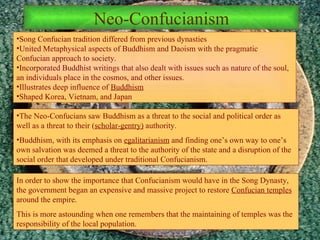
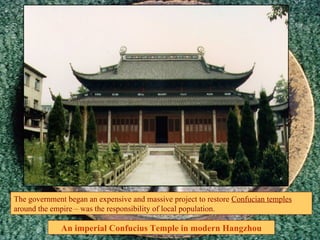
Neo-Confucianism Song Confucian tradition differed from previous dynasties United Metaphysical aspects of Buddhism and Daoism with the pragmatic Confucian approach to society.  Incorporated Buddhist writings that also dealt with issues such as nature of the soul, an individuals place in the cosmos, and other issues. Illustrates deep influence of  Buddhism Shaped Korea, Vietnam, and Japan The Neo-Confucians saw Buddhism as a threat to the social and political order as well as a threat to their ( scholar-gentry)  authority. Buddhism, with its emphasis on  egalitarianism  and finding one’s own way to one’s own salvation was deemed a threat to the authority of the state and a disruption of the social order that developed under traditional Confucianism. In order to show the importance that Confucianism would have in the Song Dynasty, the government began an expensive and massive project to restore  Confucian temples  around the empire. This is more astounding when one remembers that the maintaining of temples was the responsibility of the local population.
An imperial Confucius Temple in modern Hangzhou The government began an expensive and massive project to restore  Confucian temples  around the empire – was the responsibility of local population.
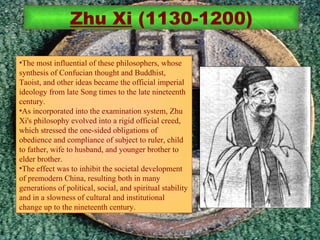
The most influential of these philosophers, whose synthesis of Confucian thought and Buddhist, Taoist, and other ideas became the official imperial ideology from late Song times to the late nineteenth century.  As incorporated into the examination system, Zhu Xi's philosophy evolved into a rigid official creed, which stressed the one-sided obligations of obedience and compliance of subject to ruler, child to father, wife to husband, and younger brother to elder brother.  The effect was to inhibit the societal development of premodern China, resulting both in many generations of political, social, and spiritual stability and in a slowness of cultural and institutional change up to the nineteenth century. Zhu Xi  (1130-1200)
What is Neo-Confucianism and why did it occur? Neo-Confucianism is an attempt to broaden the topics and depth of the philosophy. Traditional Confucianism devoted most of its time to the development of sound governmental theory and state building. Neo-Confucianism  expanded into what the West would call metaphysics, human nature and the world order. This was an attempt to  curtail the growing influence of Daoism and especially  Buddhism .
The Exam System Like previous dynasties, the Song wanted the best people possible for government positions.  They continued and revamped the traditional exam system. They made the recruiting system more egalitarian so they could attract the best and brightest from all segments of the population. The three levels were: the prefectural examination  "department" or metropolitan examination  the last step was the palace examination
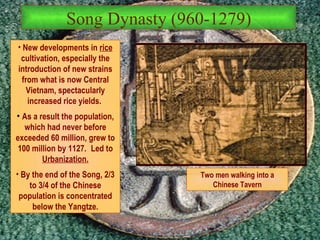
Song Dynasty (960-1279) New developments in  rice  cultivation, especially the introduction of new strains from what is now Central Vietnam, spectacularly increased rice yields.  As a result the population, which had never before exceeded 60 million, grew to 100 million by 1127.   Led to  Urbanization. By the end of the Song, 2/3 to 3/4 of the Chinese population is concentrated below the Yangtze. Two men walking into a Chinese Tavern
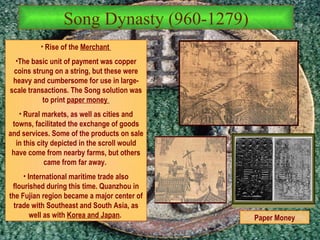
Song Dynasty (960-1279) Rise of the  Merchant  The basic unit of payment was copper coins strung on a string, but these were heavy and cumbersome for use in large-scale transactions. The Song solution was to print  paper money   Rural markets, as well as cities and towns, facilitated the exchange of goods and services. Some of the products on sale in this city depicted in the scroll would have come from nearby farms, but others came from far away.   International maritime trade also flourished during this time. Quanzhou in the Fujian region became a major center of trade with Southeast and South Asia, as well as with  Korea and Japan .   Paper Money
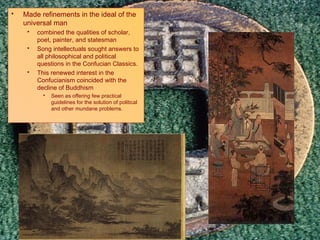
Culture Made refinements in the ideal of the universal man combined the qualities of scholar, poet, painter, and statesman Song intellectuals sought answers to all philosophical and political questions in the Confucian Classics.  This renewed interest in the Confucianism coincided with the decline of Buddhism Seen as offering few practical guidelines for the solution of political and other mundane problems.
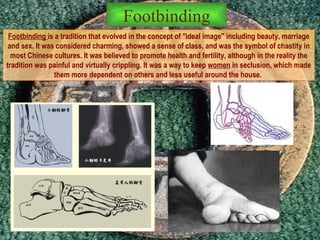
Footbinding  is a tradition that evolved in the concept of "ideal image" including beauty, marriage and sex. It was considered charming, showed a sense of class, and was the symbol of chastity in most Chinese cultures. It was believed to promote health and fertility, although in the reality the tradition was painful and virtually crippling. It was a way to keep  women  in seclusion, which made them more dependent on others and less useful around the house.  Footbinding
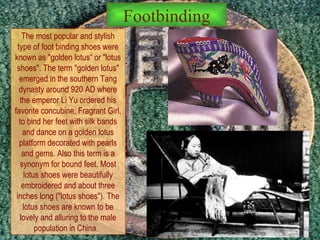
The most popular and stylish type of foot binding shoes were known as "golden lotus“ or "lotus shoes". The term "golden lotus" emerged in the southern Tang dynasty around 920 AD where the emperor Li Yu ordered his favorite concubine, Fragrant Girl, to bind her feet with silk bands and dance on a golden lotus platform decorated with pearls and gems. Also this term is a synonym for bound feet. Most lotus shoes were beautifully embroidered and about three inches long ("lotus shoes"). The lotus shoes are known to be lovely and alluring to the male population in China.  Footbinding
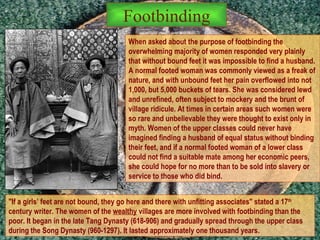
When asked about the purpose of footbinding the overwhelming majority of women responded very plainly that without bound feet it was impossible to find a husband. A normal footed woman was commonly viewed as a freak of nature, and with unbound feet her pain overflowed into not 1,000, but 5,000 buckets of tears. She was considered lewd and unrefined, often subject to mockery and the brunt of village ridicule. At times in certain areas such women were so rare and unbelievable they were thought to exist only in myth. Women of the upper classes could never have imagined finding a husband of equal status without binding their feet, and if a normal footed woman of a lower class could not find a suitable mate among her economic peers, she could hope for no more than to be sold into slavery or service to those who did bind.  "If a girls’ feet are not bound, they go here and there with unfitting associates" stated a 17 th  century writer. The women of the  wealthy  villages are more involved with footbinding than the poor. It began in the late Tang Dynasty (618-906) and gradually spread through the upper class during the Song Dynasty (960-1297). It lasted approximately one thousand years.  Footbinding
North & Southern Song
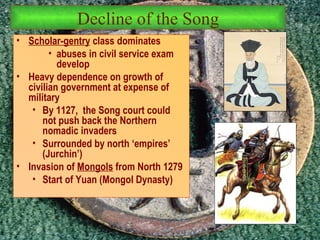
Scholar-gentry  class dominates abuses in civil service exam develop Heavy dependence on growth of civilian government at expense of military By 1127,  the Song court could not push back the Northern nomadic invaders  Surrounded by north ‘empires’ (Jurchin’) Invasion of  Mongols  from North 1279 Start of Yuan (Mongol Dynasty) Decline of the Song
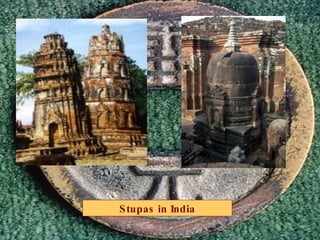
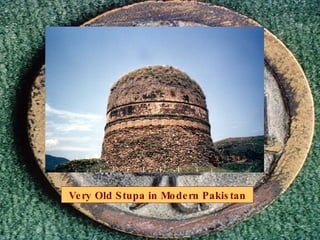
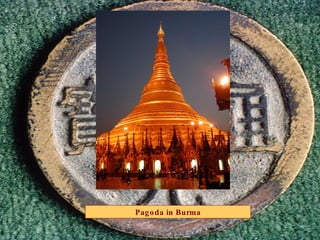
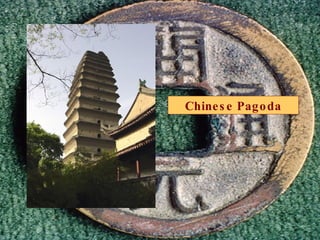
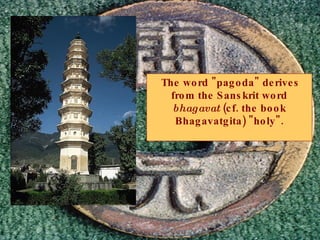
The word "pagoda" derives from the Sanskrit word  bhagavat  (cf. the book Bhagavatgita) "holy".
Stupas in India
Very Old Stupa in Modern Pakistan
Pagoda in Burma
Chinese Pagoda
Tang & Song Influence on East Asia  The influence of Chinese civilization spreads throughout East Asia as neighboring countries study and borrow from Chinese civilization Korea, Japan, and what is today Vietnam  Confucian thought and social and political values Buddhism Literary Chinese and its writing system which becomes the language of government and that used by the elites of these societies to communicate among themselves.
Tang Dynasty (618-918)

Tang&Song

  • 1.
    The Resurgence ofEmpire in China The Sui, Tang, and Song
  • 2.
    Sui Dynasty (589-618)Sui unite China after 400 years of internal division Led by Sui Wendi and Sui Yangdi Established capital city at Chang’an Used Daoism and Buddhism as common identity to unite the empire – appointed monks to high political positions and built monasteries Led extensive public works projects – Strict Rule Government unified the coinage, nationalized the mints and standardized weights and measures. Tiger Hill Pagoda Emperor Sui Wendi Which dynasty of the past can you compare to the Sui?
  • 3.
    The Sui Dynastylasted from 580-618 A.D Created the " land equalization system ". While controlling the possession of the land by the rich, this law provided for land distribution to all families on the basis of the number of the people in each household.
  • 4.
    Sui Dynasty (589-618)The Grand Canal 1,400 mile canal that connected the Yellow River in the north to the Yangtze River in the south. Helped to transport grain and rice from the south to the densely populated north. Increased communications Rapid dispatch of troops Highway for inspection – used “Dragon boats” The Grand Canal created an economic foundation for political and cultural unity
  • 5.
  • 6.
    Sui Dynasty (589-618)Fall of the Sui Sui Emperor was a tyrannical ruler Expensive military campaigns, high taxes and forced labor aroused widespread unrest Failed campaign against Korea in 618 led to revolt In 618, a disgruntled minister assassinated Emperor Sui Yangdi Emperor Sui Yangdi Why is the Sui Dynasty important?
  • 7.
    TangDynasty (618-907) Riseof the Tang Li Yuan, a general in the Sui Army, seized the capital city of Chang’an and proclaimed himself the New Emperor. His Son, Li Shimin soon took over and assumed the name Tang Taizong , the Grand Emperor Tang launched a program of internal renewal and external expansion that would make it one of the greatest dynasties in Chinese history!
  • 8.
    To answer thisquestion we must go back to the Han Dynasty. The Han Chinese had settled parts of Northern China and intermingled and married with the local Turkic peoples. The Tang rulers and nobility were descendents of the Turkic elites and Chinese officials who settled there in the time of the Han. Where did the Tang rulers and nobles come from?
  • 9.
  • 10.
    They continued theConfucian system of examining candidates for bureaucratic office. But they also appreciated the Turkic culture of Central Asia. Much of what we recognize as Tang art was heavily influenced by the Turkic peoples. Camels and horses used in the Silk Route trade were the favorite subjects for artists.
  • 11.
    In warfare, theTang combined Chinese and Turkic weapons and tactics: They used Chinese crossbows and armored infantry men - combined with Turkish horsemanship and iron stirrups. The Tang military reached its peak from about 650-751, when they were defeated in Central Asia by an Arab Muslim army at the Battle of the Talas River.
  • 12.
    Tang Dynasty (618-918)Political Three Keys to success Maintenance of transportation and communication networks Reliance on a bureaucracy based on merit, a meritocracy using the civil service exams Revival of Han Confucianism: Created a foundation for stability and prosperity for the Chinese people
  • 13.
    Tang Dynasty (618-918)Government inspired by Confucianism Three Keys to success Maintenance of transportation and communication networks Distribution of land – Equal-field system, only 1/5 th of property was the hereditary possession of a family Reliance on a bureaucracy based on merit, a meritocracy using the civil service exams Revival of Han Confucianism: Created a foundation for stability and prosperity for the Chinese people
  • 14.
    Economic System: Canals: Grand Canal connected Yellow River and Yangtze River. Allowed grains in south to be shipped to north. Expanded Trade : Tang merchants traded with India, Persia, and the Middle East. Chinese became expert shipbuilders and a naval power. This led to a huge influx of precious metal into China – a trend that would continue until the 19 th century. Land Reform – Equal-field system, redistributed land to peasants. Chang’an (Xian) had a population of over 1 million people making it one of if not the largest city in the world. Tang Dynasty (618-918)
  • 15.
    Located near theSilk Route, the capital of the Tang Dynasty became an important city in both the political and economic spheres. Foreigners, resided in special compounds. These included living accommodations, and general stores. By the end of the Tang period, West Asians in Chang’an numbered over 100,000. In the main part of the city, restaurants, inns, temples, mosques and street stalls were kept very busy. At curfew, commoners returned to their neighborhoods which were enclosed by brick walls and wooden gates. The game of Polo was imported from Persia.
  • 16.
    Tang Dynasty (618-918)Chang’an restored the glory of of the Han Dynasty. Possibly the greatest city of the world of its time.
  • 17.
    Expansion of theTang Dynasty Territorially, the Tang Empire ranks among the largest in Chinese history
  • 18.
    Because of theGrand Canal and other government projects for shipping grain and other goods, the Tang Dynasty had the strongest economy of the time period. Even in its decline, Tang exports far outnumbered imports from South Asia, West Asia, Europe and Africa combined. This led to a huge influx of precious metal into China – a trend that would continue until the 19 th century.
  • 19.
    Buddhist Carvings alongthe Silk Route by Tang Artists.
  • 20.
    Tang Dynasty (618-918)Empress Wu – (649-705) Wu Zetian became the first and only woman to be Emperor – supported Buddhism. Began a campaign to elevate the position of women. Said that the ideal ruler was one who ruled like a mother does over her children. Meritocracy - Civil Service exams- best people ran the government and were treated fairly. Reduced the army's size and stopped the influence of aristocratic military men. Fairness to peasants - lowering taxes, raising agricultural production, and strengthening public works. How did Empress Wu challenge the traditions of Confucianism?
  • 21.
  • 22.
    The Golden AgeArtistic, Technological and Industrial Developments Gunpowder and Rockets Moveable Type Chinese junks Porcelain - Chinaware Landscape art
  • 23.
  • 24.
    Other reasons fordecline Equal land system breaks down Persecution of Buddhism Poor attention to canal & irrigation systems Nomadic alliances and attacks Decline of the Tang Dynasty Emperor Xuanzong ( Empress Wu’s grandson) Ruled for 44 years Patron of arts Began to neglect the people and engaged in pleasure seeking lifestyle Decline due to lack of morality? Government corruption He was forced to abdicate his power What is the greatest legacy of the Tang Dynasty?
  • 25.
    Song Dynasty (960-1279)The Rainbow Bridge Political System: 907-960 saw the fragmentation of China into five northern dynasties and ten southern kingdoms Song Taizu united much of the former Tang Dynasty Moved capital to Huangzhou in the south Centralized government, limited the military, and expanded the Bureaucracy, offered many political positions with generous salaries Civil Service Exams Used Neo-Confucianism as basis of political system
  • 26.
    Neo-Confucianism Song Confuciantradition differed from previous dynasties United Metaphysical aspects of Buddhism and Daoism with the pragmatic Confucian approach to society. Incorporated Buddhist writings that also dealt with issues such as nature of the soul, an individuals place in the cosmos, and other issues. Illustrates deep influence of Buddhism Shaped Korea, Vietnam, and Japan The Neo-Confucians saw Buddhism as a threat to the social and political order as well as a threat to their ( scholar-gentry) authority. Buddhism, with its emphasis on egalitarianism and finding one’s own way to one’s own salvation was deemed a threat to the authority of the state and a disruption of the social order that developed under traditional Confucianism. In order to show the importance that Confucianism would have in the Song Dynasty, the government began an expensive and massive project to restore Confucian temples around the empire. This is more astounding when one remembers that the maintaining of temples was the responsibility of the local population.
  • 27.
    An imperial ConfuciusTemple in modern Hangzhou The government began an expensive and massive project to restore Confucian temples around the empire – was the responsibility of local population.
  • 28.
    The most influentialof these philosophers, whose synthesis of Confucian thought and Buddhist, Taoist, and other ideas became the official imperial ideology from late Song times to the late nineteenth century. As incorporated into the examination system, Zhu Xi's philosophy evolved into a rigid official creed, which stressed the one-sided obligations of obedience and compliance of subject to ruler, child to father, wife to husband, and younger brother to elder brother. The effect was to inhibit the societal development of premodern China, resulting both in many generations of political, social, and spiritual stability and in a slowness of cultural and institutional change up to the nineteenth century. Zhu Xi (1130-1200)
  • 29.
    What is Neo-Confucianismand why did it occur? Neo-Confucianism is an attempt to broaden the topics and depth of the philosophy. Traditional Confucianism devoted most of its time to the development of sound governmental theory and state building. Neo-Confucianism expanded into what the West would call metaphysics, human nature and the world order. This was an attempt to curtail the growing influence of Daoism and especially Buddhism .
  • 30.
    The Exam SystemLike previous dynasties, the Song wanted the best people possible for government positions. They continued and revamped the traditional exam system. They made the recruiting system more egalitarian so they could attract the best and brightest from all segments of the population. The three levels were: the prefectural examination "department" or metropolitan examination the last step was the palace examination
  • 31.
    Song Dynasty (960-1279)New developments in rice cultivation, especially the introduction of new strains from what is now Central Vietnam, spectacularly increased rice yields. As a result the population, which had never before exceeded 60 million, grew to 100 million by 1127. Led to Urbanization. By the end of the Song, 2/3 to 3/4 of the Chinese population is concentrated below the Yangtze. Two men walking into a Chinese Tavern
  • 32.
    Song Dynasty (960-1279)Rise of the Merchant The basic unit of payment was copper coins strung on a string, but these were heavy and cumbersome for use in large-scale transactions. The Song solution was to print paper money Rural markets, as well as cities and towns, facilitated the exchange of goods and services. Some of the products on sale in this city depicted in the scroll would have come from nearby farms, but others came from far away. International maritime trade also flourished during this time. Quanzhou in the Fujian region became a major center of trade with Southeast and South Asia, as well as with Korea and Japan . Paper Money
  • 33.
    Culture Made refinementsin the ideal of the universal man combined the qualities of scholar, poet, painter, and statesman Song intellectuals sought answers to all philosophical and political questions in the Confucian Classics. This renewed interest in the Confucianism coincided with the decline of Buddhism Seen as offering few practical guidelines for the solution of political and other mundane problems.
  • 34.
    Footbinding isa tradition that evolved in the concept of "ideal image" including beauty, marriage and sex. It was considered charming, showed a sense of class, and was the symbol of chastity in most Chinese cultures. It was believed to promote health and fertility, although in the reality the tradition was painful and virtually crippling. It was a way to keep women in seclusion, which made them more dependent on others and less useful around the house. Footbinding
  • 35.
    The most popularand stylish type of foot binding shoes were known as "golden lotus“ or "lotus shoes". The term "golden lotus" emerged in the southern Tang dynasty around 920 AD where the emperor Li Yu ordered his favorite concubine, Fragrant Girl, to bind her feet with silk bands and dance on a golden lotus platform decorated with pearls and gems. Also this term is a synonym for bound feet. Most lotus shoes were beautifully embroidered and about three inches long ("lotus shoes"). The lotus shoes are known to be lovely and alluring to the male population in China. Footbinding
  • 36.
    When asked aboutthe purpose of footbinding the overwhelming majority of women responded very plainly that without bound feet it was impossible to find a husband. A normal footed woman was commonly viewed as a freak of nature, and with unbound feet her pain overflowed into not 1,000, but 5,000 buckets of tears. She was considered lewd and unrefined, often subject to mockery and the brunt of village ridicule. At times in certain areas such women were so rare and unbelievable they were thought to exist only in myth. Women of the upper classes could never have imagined finding a husband of equal status without binding their feet, and if a normal footed woman of a lower class could not find a suitable mate among her economic peers, she could hope for no more than to be sold into slavery or service to those who did bind. "If a girls’ feet are not bound, they go here and there with unfitting associates" stated a 17 th century writer. The women of the wealthy villages are more involved with footbinding than the poor. It began in the late Tang Dynasty (618-906) and gradually spread through the upper class during the Song Dynasty (960-1297). It lasted approximately one thousand years. Footbinding
  • 37.
  • 38.
    Scholar-gentry classdominates abuses in civil service exam develop Heavy dependence on growth of civilian government at expense of military By 1127, the Song court could not push back the Northern nomadic invaders Surrounded by north ‘empires’ (Jurchin’) Invasion of Mongols from North 1279 Start of Yuan (Mongol Dynasty) Decline of the Song
  • 39.
    The word "pagoda"derives from the Sanskrit word bhagavat (cf. the book Bhagavatgita) "holy".
  • 40.
  • 41.
    Very Old Stupain Modern Pakistan
  • 42.
  • 43.
  • 44.
    Tang & SongInfluence on East Asia The influence of Chinese civilization spreads throughout East Asia as neighboring countries study and borrow from Chinese civilization Korea, Japan, and what is today Vietnam Confucian thought and social and political values Buddhism Literary Chinese and its writing system which becomes the language of government and that used by the elites of these societies to communicate among themselves.
  • 45.