The Hospital Information
System
-The Standard Industrial Process used in the
Hospital
Submitted To:
Mr. Supratik Ghatak
Submitted By:
Tanavi Madappa
E-59
SIMS, Pune
What is HIS?
• A part of Health informatics.
• A tool used to assist hospital administration to manage and
maintain processes related to staff, medical, financial or
administrative matters.
• This is for efficient management of the corresponding
processes that are involved in the hospital.
• Incorporated in various multi speciality hospitals and clinics
Purpose of using HIS
Maintain employee database
Crucial part of internal communication
Update daily and time to time notification of routines
Maintain records of patient visit and medical history
Billing, payments, financial budgeting
Feedback system
Inventory management (including publication of requirements)
Resource management
Facility Booking
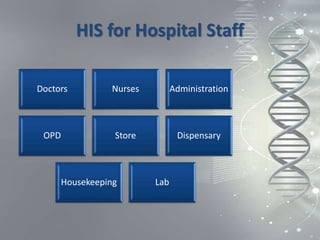
HIS for Hospital Staff
Doctors Nurses Administration
OPD Store Dispensary
Housekeeping Lab
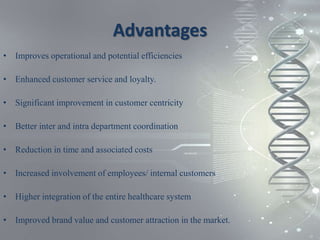
Advantages
• Improves operational and potential efficiencies
• Enhanced customer service and loyalty.
• Significant improvement in customer centricity
• Better inter and intra department coordination
• Reduction in time and associated costs
• Increased involvement of employees/ internal customers
• Higher integration of the entire healthcare system
• Improved brand value and customer attraction in the market.
Recent Changes/Improvements
• Inclusion of facility management where the employees may
book certain facilities in the hospital such as the conference
room.
• Initiated two way communication with selected stakeholers and
external customers.
• Women grievance cell portal.
• Develop separate modules for doctors, nurses, admin,
inventory, OPD and housekeeping
• Attempt to implement new cloud computing techniques
Recommendations
• Organise information system in such a way that there are two
separate customised portals for internal and external customers.
• Introduce a customised section for every external customer
(patient) to know continuous progress.
• Tabs to interact with experts from the hospital for advice or general
communication.
• Provide training for lower level workmen to work on the
information system of the hospital.
• Provision of a scheme such as a “Health plan”.
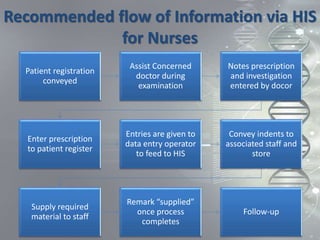
Recommended flow of Information via HIS
for Nurses
Patient registration
conveyed
Assist Concerned
doctor during
examination
Notes prescription
and investigation
entered by docor
Enter prescription
to patient register
Entries are given to
data entry operator
to feed to HIS
Convey indents to
associated staff and
store
Supply required
material to staff
Remark “supplied”
once process
completes
Follow-up
Quote from the interviewee
“Healthcare and Hospitals are nowadays
a commercial business, but
communication is very crucial here as
the commercial angle has to be masked
while communicating all forms of
information to the patients, their family
and the clients/ associates keeping in
mind the depth of the information to be
conveyed.”
Thank You

Hospital Information Systems- Tanavi Madappa

  • 1.
    The Hospital Information System -TheStandard Industrial Process used in the Hospital Submitted To: Mr. Supratik Ghatak Submitted By: Tanavi Madappa E-59 SIMS, Pune
  • 2.
    What is HIS? •A part of Health informatics. • A tool used to assist hospital administration to manage and maintain processes related to staff, medical, financial or administrative matters. • This is for efficient management of the corresponding processes that are involved in the hospital. • Incorporated in various multi speciality hospitals and clinics
  • 3.
    Purpose of usingHIS Maintain employee database Crucial part of internal communication Update daily and time to time notification of routines Maintain records of patient visit and medical history Billing, payments, financial budgeting Feedback system Inventory management (including publication of requirements) Resource management Facility Booking
  • 4.
    HIS for HospitalStaff Doctors Nurses Administration OPD Store Dispensary Housekeeping Lab
  • 5.
    Advantages • Improves operationaland potential efficiencies • Enhanced customer service and loyalty. • Significant improvement in customer centricity • Better inter and intra department coordination • Reduction in time and associated costs • Increased involvement of employees/ internal customers • Higher integration of the entire healthcare system • Improved brand value and customer attraction in the market.
  • 6.
    Recent Changes/Improvements • Inclusionof facility management where the employees may book certain facilities in the hospital such as the conference room. • Initiated two way communication with selected stakeholers and external customers. • Women grievance cell portal. • Develop separate modules for doctors, nurses, admin, inventory, OPD and housekeeping • Attempt to implement new cloud computing techniques
  • 7.
    Recommendations • Organise informationsystem in such a way that there are two separate customised portals for internal and external customers. • Introduce a customised section for every external customer (patient) to know continuous progress. • Tabs to interact with experts from the hospital for advice or general communication. • Provide training for lower level workmen to work on the information system of the hospital. • Provision of a scheme such as a “Health plan”.
  • 8.
    Recommended flow ofInformation via HIS for Nurses Patient registration conveyed Assist Concerned doctor during examination Notes prescription and investigation entered by docor Enter prescription to patient register Entries are given to data entry operator to feed to HIS Convey indents to associated staff and store Supply required material to staff Remark “supplied” once process completes Follow-up
  • 9.
    Quote from theinterviewee “Healthcare and Hospitals are nowadays a commercial business, but communication is very crucial here as the commercial angle has to be masked while communicating all forms of information to the patients, their family and the clients/ associates keeping in mind the depth of the information to be conveyed.”
  • 10.