HOSPITAL MANAGEMENT
INFORMATION SYSTEM
HOSPITAL MANAGEMENT
INFORMATION SYSTEM
PRESENTING BY,
ANJALI KRISHNA.G.R
ATHUL.C.S
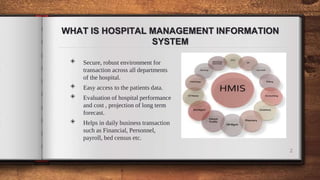
WHAT IS HOSPITAL MANAGEMENT INFORMATION
SYSTEM
2
◈ Secure, robust environment for
transaction across all departments
of the hospital.
◈ Easy access to the patients data.
◈ Evaluation of hospital performance
and cost , projection of long term
forecast.
◈ Helps in daily business transaction
such as Financial, Personnel,
payroll, bed census etc.
1.) PATIENT REGISTRATION
◈Patients demographics are captured
◈At the time of registration, a unique registration
number is generated.
◈Appointments can be generated or scheduled
using the register number.
3
HOSPITAL MANAGEMENT INFORMATION SYSTEM IS
MOSTLY APPLIED IN :
4
2.) APPOINTMENT SCHEDULING
• Any appointments with the physician is scheduled.
3.) ADMISSION DISCHARGE TRANSFER (ADT)
◈ Admission : Patients admission details like the purpose of admission, date of
admission , admission department are captured.
◈ Transfer : It describes the patient’s transfer to some other ward.
◈ Discharge : Once patient leaves the hospital, the discharge details are captured and
maintained.
◈ Patients billing, claims and reimbursements are based on ADT.
5
6
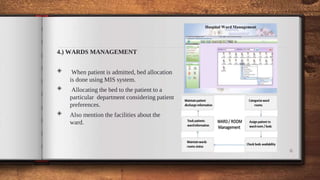
4.) WARDS MANAGEMENT
◈ When patient is admitted, bed allocation
is done using MIS system.
◈ Allocating the bed to the patient to a
particular department considering patient
preferences.
◈ Also mention the facilities about the
ward.
7
5.) ROSTER MANAGEMENT
◈ Roster management is planning of workforce.
◈ MIS helps in scheduling working hours of the nursing staff, who need to work
round-the-clock.
◈ It maintains shit rotation of nurses, analyse their workload and skills.
6.) PHARMACY
◈ Maintains a database all the medicine and expense.
◈ Provides a comprehensive list of available drugs.
◈ E-Prescription from various departments and consulting doctors.
◈ Consumption details for particular medicine.
◈ Auto generation of alerts when minimum stock level are reached.
◈ Deducting the stock depending upon the batch nos, exp date, mfg date.
8
7.) RADIOLOGY SYSTEM
◈ Stores images, scans. And ECG
graphs on the system.
◈ Management workflow of
radiology services and
equipment.
8.) BLOOD BANK
◈ Generates automated reports
keeping track of inventory stock
of bloods of different blood
group and their expiry.
9
9.) OPERATION THEATRE
Booking, confirming appointments,scheduling
investigations.
Online updating of patient bill.
Surgeries tracking
Anaesthesia notes
Records surgery details .
10.) DIETARY
Keeps record of available food and expenses.
Collection of information about the various diet routines
Analysis the consumption patterns helps in better and
efficient management.
11.) ELECTRONIC MEDICAL RECORDS
Heart of hospital management information
system.
EMR contains data only related to patients.
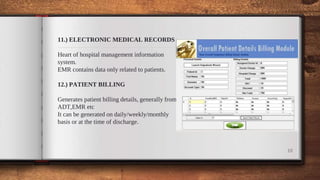
12.) PATIENT BILLING
Generates patient billing details, generally from
ADT,EMR etc
It can be generated on daily/weekly/monthly
basis or at the time of discharge.
10
11
12
ADVANTAGES
• Immediate Access of data.
• Friendly user interface.
• Time saving
• Data can be easily
inserted/updated/deleted
• Saving paper work
• Data’s are easily approachable.
• Outbreak of any disease in a
particular region can be
identified.
14
15
THANKS!

Mis in hospitals

  • 1.
    HOSPITAL MANAGEMENT INFORMATION SYSTEM HOSPITALMANAGEMENT INFORMATION SYSTEM PRESENTING BY, ANJALI KRISHNA.G.R ATHUL.C.S
  • 2.
    WHAT IS HOSPITALMANAGEMENT INFORMATION SYSTEM 2 ◈ Secure, robust environment for transaction across all departments of the hospital. ◈ Easy access to the patients data. ◈ Evaluation of hospital performance and cost , projection of long term forecast. ◈ Helps in daily business transaction such as Financial, Personnel, payroll, bed census etc.
  • 3.
    1.) PATIENT REGISTRATION ◈Patientsdemographics are captured ◈At the time of registration, a unique registration number is generated. ◈Appointments can be generated or scheduled using the register number. 3 HOSPITAL MANAGEMENT INFORMATION SYSTEM IS MOSTLY APPLIED IN :
  • 4.
    4 2.) APPOINTMENT SCHEDULING •Any appointments with the physician is scheduled.
  • 5.
    3.) ADMISSION DISCHARGETRANSFER (ADT) ◈ Admission : Patients admission details like the purpose of admission, date of admission , admission department are captured. ◈ Transfer : It describes the patient’s transfer to some other ward. ◈ Discharge : Once patient leaves the hospital, the discharge details are captured and maintained. ◈ Patients billing, claims and reimbursements are based on ADT. 5
  • 6.
    6 4.) WARDS MANAGEMENT ◈When patient is admitted, bed allocation is done using MIS system. ◈ Allocating the bed to the patient to a particular department considering patient preferences. ◈ Also mention the facilities about the ward.
  • 7.
    7 5.) ROSTER MANAGEMENT ◈Roster management is planning of workforce. ◈ MIS helps in scheduling working hours of the nursing staff, who need to work round-the-clock. ◈ It maintains shit rotation of nurses, analyse their workload and skills. 6.) PHARMACY ◈ Maintains a database all the medicine and expense. ◈ Provides a comprehensive list of available drugs. ◈ E-Prescription from various departments and consulting doctors. ◈ Consumption details for particular medicine. ◈ Auto generation of alerts when minimum stock level are reached. ◈ Deducting the stock depending upon the batch nos, exp date, mfg date.
  • 8.
    8 7.) RADIOLOGY SYSTEM ◈Stores images, scans. And ECG graphs on the system. ◈ Management workflow of radiology services and equipment. 8.) BLOOD BANK ◈ Generates automated reports keeping track of inventory stock of bloods of different blood group and their expiry.
  • 9.
    9 9.) OPERATION THEATRE Booking,confirming appointments,scheduling investigations. Online updating of patient bill. Surgeries tracking Anaesthesia notes Records surgery details . 10.) DIETARY Keeps record of available food and expenses. Collection of information about the various diet routines Analysis the consumption patterns helps in better and efficient management.
  • 10.
    11.) ELECTRONIC MEDICALRECORDS Heart of hospital management information system. EMR contains data only related to patients. 12.) PATIENT BILLING Generates patient billing details, generally from ADT,EMR etc It can be generated on daily/weekly/monthly basis or at the time of discharge. 10
  • 11.
  • 12.
  • 14.
    ADVANTAGES • Immediate Accessof data. • Friendly user interface. • Time saving • Data can be easily inserted/updated/deleted • Saving paper work • Data’s are easily approachable. • Outbreak of any disease in a particular region can be identified. 14
  • 15.