By: Aditya varshneya
What  is HIS?
Cloud computing of HIS in Fortis
Modules of HIS in Fortis
Functioning and Gap Analysis
Recommendations
   A hospital information system (HIS), variously also called clinical
    information system (CIS) is a comprehensive, integrated information
    system designed to manage the administrative, financial and clinical
    aspects of a hospital. This encompasses paper-based information
    processing as well as data processing machines.
 Cloud   computing refers to the delivery of computing and
  storage capacity as a service to a heterogeneous community
  of end-recipients


 These  services are broadly divided into three categories:
  Infrastructure-as-a-Service (IaaS), Platform-as-a-Service
  (PaaS) and Software-as-a-Service (SaaS)
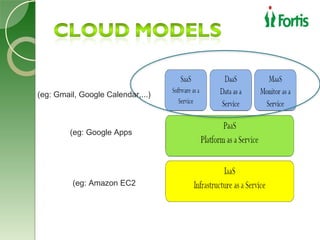
(eg: Gmail, Google Calendar,...)


         (eg: Google Apps


         (eg: Amazon EC2
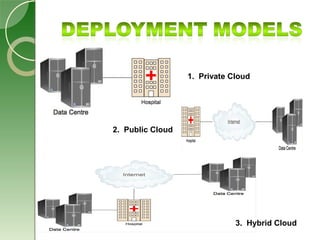
1. Private Cloud


2. Public Cloud


                              3. Hybrid Cloud
 Fortis has private cloud model
 Infrastructure as a Service - A robust  data centre
  providing virtualized hardware and connectivity for all
  Fortis locations with full disaster recovery and backup
  infrastructure 
 Platform as a Service - Fortis IT and Fortis software
  vendors to develop, maintain, deploy and deliver
  software applications for various Fortis functions.
 Software as a Service - As part of the cloud, Fortis has
  centralized its Hospital Information System: Trakcare
  from InterSystems and created a central analytics and
  MIS platform
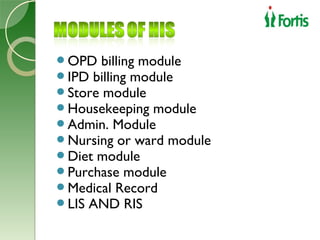
OPD billing module
IPD billing module
Store module
Housekeeping module
Admin. Module
Nursing or ward module
Diet module
Purchase module
Medical Record
LIS AND RIS
   Housekeeping module of Fortis hospital mainly deals with the bed
    status of the ward in which firstly the beds from which patient
    ready to move are shown and then the information through phone
    is being delivered to the floor supervisor about the room that has
    to be cleaned which is also shown in the HIS housekeeping module
    then when the room is cleaned the information is being passed by
    the supervisor to the housekeeping desk that room has been
    cleaned and the person attending the call mark in the HIS that the
    room has been cleaned and vacant and ready to be occupied by
    other patient.

   GAP ANALYSIS
   Bed status to be filled by the nurse when the patient is about to move
   Information of bed to be cleaned should be displayed on the screen which
    is to be installed in the house keeping department. The beds which are to
    be cleaned should be displayed on the screen just like status which is
    shown on the railway station showing train status.
   Then, through phone message is to be send to the concerned floor
    supervisor regarding the cleaning of the room and then the supervisor
    should tell to the nursing station to mark it vacant in the system.
   Housekeeping module should be a part of ward module
   The status of the beds other then the floor wards like (micu, ccu) which is
    being shown on the housekeeping module should not be shown as it is to
    made vacant by the nurse
   The housekeeping module should be designed to forecast the total
    number of housekeepers needed each day in the future based on current
    guests in-house and expected arrivals/departures
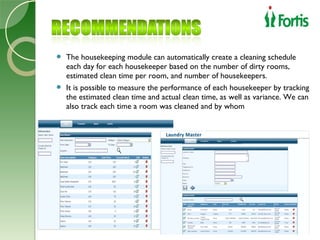
 The housekeeping module can automatically create a cleaning schedule
  each day for each housekeeper based on the number of dirty rooms,
  estimated clean time per room, and number of housekeepers.
 It is possible to measure the performance of each housekeeper by tracking
  the estimated clean time and actual clean time, as well as variance. We can
  also track each time a room was cleaned and by whom
 The other technique which can be used to increase the efficiency and
  effectiveness of the HIS is implementation of the RFID(Radio
  frequency identification) technique to track the location the assets and
  to improve the quality of the hospital services
 Radio Frequency Identification (RFID) is a method for remotely storing
  and retrieving data using devices called RFID tags or transponders.
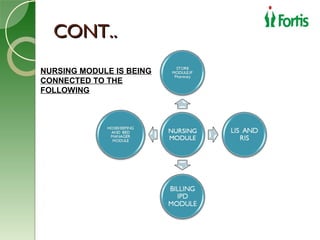
CONT..
NURSING MODULE IS BEING
CONNECTED TO THE
FOLLOWING
 Ist part contain the use of Tablet PC’s by the nurse and medical
  professionals which can be connected to HIS of the hospital. Tablet PC’s
  should be connected with each bed (one tab to one bed or two bed)
  Patient history and other details can be easily shown in the pc and it
  should be PACS and DICOM enabled to see the images of ultrasound, x-
  ray etc. Tablet pc will help in entering correct prescription which should
  be entered by doctor only to reduce medication error and patient activity
  sheet can be prepared. Nursing and doctor notes can also be written in
  the tablet PC’s. Since paper work takes lots of time and chances of error
  are more
 Tablet pc’s will be connected to ward module which can be cut short and
  contains only diet module and discharge intimation process, also we can
  view information about the patient through patient IPID
   PC’s will function as doctor will enter the prescription right from the
  patient bed which will directly go through HIS to store department and
  radiological department
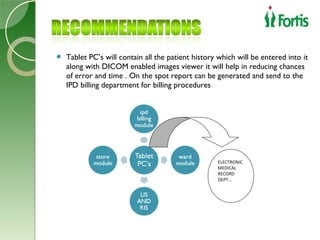
   Tablet PC’s will contain all the patient history which will be entered into it
    along with DICOM enabled images viewer it will help in reducing chances
    of error and time . On the spot report can be generated and send to the
    IPD billing department for billing procedures


                                                    ELECTRONIC
                                                    MEDICAL
                                                    RECORD
                                                    DEPT…
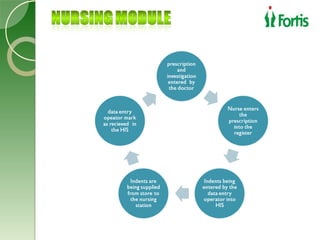
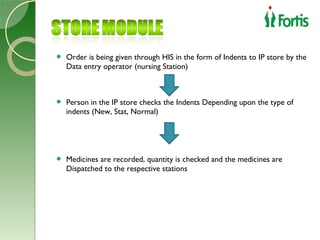
   Order is being given through HIS in the form of Indents to IP store by the
    Data entry operator (nursing Station)


   Person in the IP store checks the Indents Depending upon the type of
    indents (New, Stat, Normal)


   Medicines are recorded, quantity is checked and the medicines are
    Dispatched to the respective stations
 Connected   with PC tablet
 E-prescribing through CPOE (Computerized physician
  order entry)
 RFID technology or bar coding technology should be
  implemented (more emphasis on RFID technology) to
  reduce ambulatory and inpatient medication error and
  the number of adverse drug events.
 RFID technology tracking the assets as medicines are
  one of the important assets in the hospital and it can be
  combined with the existing HIS of the hospital.
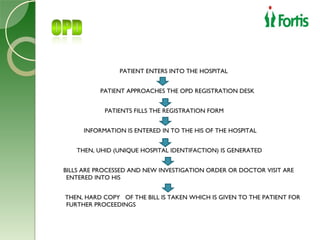
PATIENT ENTERS INTO THE HOSPITAL
 
              PATIENT APPROACHES THE OPD REGISTRATION DESK
 
                PATIENTS FILLS THE REGISTRATION FORM
 
         INFORMATION IS ENTERED IN TO THE HIS OF THE HOSPITAL
 
       THEN, UHID (UNIQUE HOSPITAL IDENTIFACTION) IS GENERATED
 
    BILLS ARE PROCESSED AND NEW INVESTIGATION ORDER OR DOCTOR VISIT ARE
     ENTERED INTO HIS


    THEN, HARD COPY OF THE BILL IS TAKEN WHICH IS GIVEN TO THE PATIENT FOR
    FURTHER PROCEEDINGS
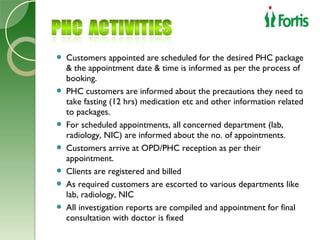
   Customers appointed are scheduled for the desired PHC package
    & the appointment date & time is informed as per the process of
    booking.
   PHC customers are informed about the precautions they need to
    take fasting (12 hrs) medication etc and other information related
    to packages.
   For scheduled appointments, all concerned department (lab,
    radiology, NIC) are informed about the no. of appointments.
   Customers arrive at OPD/PHC reception as per their
    appointment.
   Clients are registered and billed
   As required customers are escorted to various departments like
    lab, radiology, NIC
   All investigation reports are compiled and appointment for final
    consultation with doctor is fixed
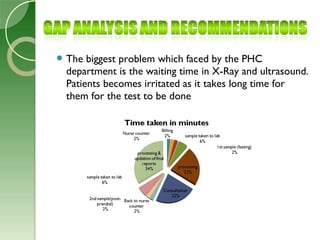
 The biggest problem which faced by the PHC
 department is the waiting time in X-Ray and ultrasound.
 Patients becomes irritated as it takes long time for
 them for the test to be done
 Regarding   the waiting time in ultrasound, it can be
  reduced by redirecting some patients to the other test
  which has to be done with fasting
 Use of PACS and DICOM in the hospital
 If patient want to see the report or want to take the
  report it can be printed at one station or it can be
  directly viewed by the patient on the website through
  the UHID with password given by hospital as happens
  in the lab report.
 With this implementation it will help in reducing the
  cost incurred in the films produced and processing of
  that films and reports thereby reducing the waiting time
 The  last and the foremost thing for improving the
  waiting time is implementation of the RFID technique
  for patient tracking
 These patient tracking systems can provide data which
  have significant effect on improving patient tracking,
  patient flow and provide valuable insight into patient
  flow improvements that can impact patient care:
o Measure patients waiting longer than 15 minutes
o Detail the percentage of patients waiting longer than 15 minutes
o Determine lab turnaround times to hold them accountable
   The module is multidisciplinary and is meant for the administration
   It includes the details of the employees and doctors in specific. The
    revenue details, availability timings, contacts etc. and other relevant
    record of every doctor are mentioned here
   Any person from the top management has the option of looking
    into the personal details of any of the staff.
   Diet module is a part of ward module
   Diet info. Of the patient in being entered into the HIS by data
    entry operator and F &B department delivers the order to the
    patient
   Medical record department should be made electronic
    ( Implementation of the electronic medical record) which will help
    to


    ◦   Improve quality and convenience of patient care
    ◦   Increase patient participation in their care
    ◦   Improve accuracy of diagnoses and health outcomes
    ◦   Improve care coordination
    ◦   Increase practice efficiencies and cost savings
Hospital information system

Hospital information system

  • 1.
  • 2.
    What isHIS? Cloud computing of HIS in Fortis Modules of HIS in Fortis Functioning and Gap Analysis Recommendations
  • 3.
    A hospital information system (HIS), variously also called clinical information system (CIS) is a comprehensive, integrated information system designed to manage the administrative, financial and clinical aspects of a hospital. This encompasses paper-based information processing as well as data processing machines.
  • 4.
     Cloud computing refers to the delivery of computing and storage capacity as a service to a heterogeneous community of end-recipients  These services are broadly divided into three categories: Infrastructure-as-a-Service (IaaS), Platform-as-a-Service (PaaS) and Software-as-a-Service (SaaS)
  • 5.
    (eg: Gmail, GoogleCalendar,...) (eg: Google Apps (eg: Amazon EC2
  • 6.
    1. Private Cloud 2.Public Cloud 3. Hybrid Cloud
  • 7.
     Fortis hasprivate cloud model  Infrastructure as a Service - A robust data centre providing virtualized hardware and connectivity for all Fortis locations with full disaster recovery and backup infrastructure   Platform as a Service - Fortis IT and Fortis software vendors to develop, maintain, deploy and deliver software applications for various Fortis functions.  Software as a Service - As part of the cloud, Fortis has centralized its Hospital Information System: Trakcare from InterSystems and created a central analytics and MIS platform
  • 8.
    OPD billing module IPDbilling module Store module Housekeeping module Admin. Module Nursing or ward module Diet module Purchase module Medical Record LIS AND RIS
  • 9.
    Housekeeping module of Fortis hospital mainly deals with the bed status of the ward in which firstly the beds from which patient ready to move are shown and then the information through phone is being delivered to the floor supervisor about the room that has to be cleaned which is also shown in the HIS housekeeping module then when the room is cleaned the information is being passed by the supervisor to the housekeeping desk that room has been cleaned and the person attending the call mark in the HIS that the room has been cleaned and vacant and ready to be occupied by other patient.  GAP ANALYSIS
  • 10.
    Bed status to be filled by the nurse when the patient is about to move  Information of bed to be cleaned should be displayed on the screen which is to be installed in the house keeping department. The beds which are to be cleaned should be displayed on the screen just like status which is shown on the railway station showing train status.  Then, through phone message is to be send to the concerned floor supervisor regarding the cleaning of the room and then the supervisor should tell to the nursing station to mark it vacant in the system.  Housekeeping module should be a part of ward module  The status of the beds other then the floor wards like (micu, ccu) which is being shown on the housekeeping module should not be shown as it is to made vacant by the nurse  The housekeeping module should be designed to forecast the total number of housekeepers needed each day in the future based on current guests in-house and expected arrivals/departures
  • 11.
     The housekeepingmodule can automatically create a cleaning schedule each day for each housekeeper based on the number of dirty rooms, estimated clean time per room, and number of housekeepers.  It is possible to measure the performance of each housekeeper by tracking the estimated clean time and actual clean time, as well as variance. We can also track each time a room was cleaned and by whom
  • 12.
     The othertechnique which can be used to increase the efficiency and effectiveness of the HIS is implementation of the RFID(Radio frequency identification) technique to track the location the assets and to improve the quality of the hospital services  Radio Frequency Identification (RFID) is a method for remotely storing and retrieving data using devices called RFID tags or transponders.
  • 14.
    CONT.. NURSING MODULE ISBEING CONNECTED TO THE FOLLOWING
  • 15.
     Ist partcontain the use of Tablet PC’s by the nurse and medical professionals which can be connected to HIS of the hospital. Tablet PC’s should be connected with each bed (one tab to one bed or two bed) Patient history and other details can be easily shown in the pc and it should be PACS and DICOM enabled to see the images of ultrasound, x- ray etc. Tablet pc will help in entering correct prescription which should be entered by doctor only to reduce medication error and patient activity sheet can be prepared. Nursing and doctor notes can also be written in the tablet PC’s. Since paper work takes lots of time and chances of error are more  Tablet pc’s will be connected to ward module which can be cut short and contains only diet module and discharge intimation process, also we can view information about the patient through patient IPID    PC’s will function as doctor will enter the prescription right from the patient bed which will directly go through HIS to store department and radiological department
  • 16.
    Tablet PC’s will contain all the patient history which will be entered into it along with DICOM enabled images viewer it will help in reducing chances of error and time . On the spot report can be generated and send to the IPD billing department for billing procedures ELECTRONIC MEDICAL RECORD DEPT…
  • 17.
    Order is being given through HIS in the form of Indents to IP store by the Data entry operator (nursing Station)  Person in the IP store checks the Indents Depending upon the type of indents (New, Stat, Normal)  Medicines are recorded, quantity is checked and the medicines are Dispatched to the respective stations
  • 18.
     Connected with PC tablet  E-prescribing through CPOE (Computerized physician order entry)  RFID technology or bar coding technology should be implemented (more emphasis on RFID technology) to reduce ambulatory and inpatient medication error and the number of adverse drug events.  RFID technology tracking the assets as medicines are one of the important assets in the hospital and it can be combined with the existing HIS of the hospital.
  • 19.
    PATIENT ENTERS INTOTHE HOSPITAL   PATIENT APPROACHES THE OPD REGISTRATION DESK   PATIENTS FILLS THE REGISTRATION FORM   INFORMATION IS ENTERED IN TO THE HIS OF THE HOSPITAL   THEN, UHID (UNIQUE HOSPITAL IDENTIFACTION) IS GENERATED   BILLS ARE PROCESSED AND NEW INVESTIGATION ORDER OR DOCTOR VISIT ARE ENTERED INTO HIS THEN, HARD COPY OF THE BILL IS TAKEN WHICH IS GIVEN TO THE PATIENT FOR FURTHER PROCEEDINGS
  • 20.
    Customers appointed are scheduled for the desired PHC package & the appointment date & time is informed as per the process of booking.  PHC customers are informed about the precautions they need to take fasting (12 hrs) medication etc and other information related to packages.  For scheduled appointments, all concerned department (lab, radiology, NIC) are informed about the no. of appointments.  Customers arrive at OPD/PHC reception as per their appointment.  Clients are registered and billed  As required customers are escorted to various departments like lab, radiology, NIC  All investigation reports are compiled and appointment for final consultation with doctor is fixed
  • 21.
     The biggestproblem which faced by the PHC department is the waiting time in X-Ray and ultrasound. Patients becomes irritated as it takes long time for them for the test to be done
  • 22.
     Regarding the waiting time in ultrasound, it can be reduced by redirecting some patients to the other test which has to be done with fasting  Use of PACS and DICOM in the hospital  If patient want to see the report or want to take the report it can be printed at one station or it can be directly viewed by the patient on the website through the UHID with password given by hospital as happens in the lab report.  With this implementation it will help in reducing the cost incurred in the films produced and processing of that films and reports thereby reducing the waiting time
  • 23.
     The last and the foremost thing for improving the waiting time is implementation of the RFID technique for patient tracking  These patient tracking systems can provide data which have significant effect on improving patient tracking, patient flow and provide valuable insight into patient flow improvements that can impact patient care: o Measure patients waiting longer than 15 minutes o Detail the percentage of patients waiting longer than 15 minutes o Determine lab turnaround times to hold them accountable
  • 24.
    The module is multidisciplinary and is meant for the administration  It includes the details of the employees and doctors in specific. The revenue details, availability timings, contacts etc. and other relevant record of every doctor are mentioned here  Any person from the top management has the option of looking into the personal details of any of the staff.  Diet module is a part of ward module  Diet info. Of the patient in being entered into the HIS by data entry operator and F &B department delivers the order to the patient
  • 25.
    Medical record department should be made electronic ( Implementation of the electronic medical record) which will help to ◦ Improve quality and convenience of patient care ◦ Increase patient participation in their care ◦ Improve accuracy of diagnoses and health outcomes ◦ Improve care coordination ◦ Increase practice efficiencies and cost savings