Tame the Wild Beast:
Managing Your (Inner)
Micromanager
Presentation by
Noelle Rumball
Head of
Information and
Advice, Student
Services
10th April 2017
By the end of this workshop, you should be
able to….
• Identify what brings out micromanaging behaviour in
yourself and colleagues
• Describe the basics of nonviolent communication and
principled negotiation and how they can be applied to
managing micromanagement
• Identify one thing you’re going to change when you go
back to the office
Ground Rules
• Listen actively and respect
what you’re hearing
(especially when you
disagree!)
• We aren’t here to agree, but
to gain deeper
understanding
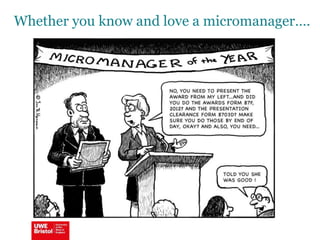
Whether you know and love a micromanager….
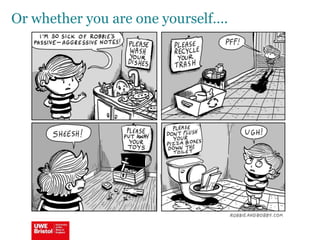
Or whether you are one yourself….
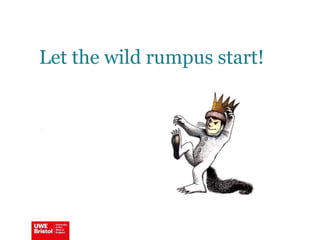
Let the wild rumpus start!
Why micromanage?
1. Fear: of failure or embarrassment
Why micromanage?
1. Fear: of failure or embarrassment
2. Love of the work
Why micromanage?
1. Fear: of failure or embarrassment
2. Love of the work
3. Different interpretations of ‘under control’ and ‘out
of control’
Exercise 1:
1. Draw the micromanaging behaviours you currently
experience that you want to change.
2. Pick (at least) one thing from each table to report
back to the group as your priority to fix.
Principled Negotiation
Principled Negotiation aims for a ‘win-win’
solution, where everyone’s needs are met and
no one has to make sacrifices or compromise.
Ury and Fisher developed this as an alternative
to ‘positional bargaining’, where there is a
winner and a loser.
Roger Fisher and William L. Ury published Getting to Yes: Negotiating Agreement
Without Giving In in 1981; as of 2007, it is still a recurring bestseller.
Principled Negotiation
STEP 1 – Separate the people from the problem
Don’t get caught up in personalities, communication styles,
or past history
STEP 2 – Focus on interests, not positions
Focus on the broadest interpretation of what you need –
i.e. ‘simple food’, rather than ‘a sandwich’
STEP 3 – Invent options for mutual gain
Focus on what you can each give easily and how it can
help, instead of circling the problem
STEP 4 – Insist on using objective criteria
Negotiations don’t have to be contentious or personal –
leave any battles of wills outside the room
Non-Violent Communication
Nonviolent Communication (NVC) begins by
assuming we are all compassionate by nature
and that violent strategies – whether verbal or
physical – are learned behaviours taught and
supported by the prevailing culture. NVC also
assumes that we all share the same, basic,
human needs, and that each of our actions are
a strategy to meet one or more of these needs.
Dr. Marshall B. Rosenberg, a psychologist, was the founder and director of
educational services for The Centre for Nonviolent Communication. Find out more
here: his book, Radio 4’s Great Lives, and some free resources from www.ncv-
uk.com.
Non-Violent Communication
STEP 1 – Observation without evaluation
Focus on the (recent!) behavior, not any qualities of the
person – i.e. ‘the desk is messy’ not ‘you are messy’
STEP 2 – Express Feelings
Make clear how you feel about their behavior – i.e. ‘I
feel edgy and uncomfortable around mess’
STEP 3 – Express Need
Explain what you need – i.e. ‘I need a tidy office
environment’
STEP 4 – Make a request
This should be based on your needs – i.e. ‘Please
tidy your desk’
Exercise 2:
Using the behaviour(s) you chose in the last
exercise:
1. Articulate your problem using the NVC
structure
2. If relevant, use principled negotiation to come
up with something you can offer in return
3. Present back to the group
Thank you!

Tame the Wild Beast

  • 1.
    Tame the WildBeast: Managing Your (Inner) Micromanager Presentation by Noelle Rumball Head of Information and Advice, Student Services 10th April 2017
  • 2.
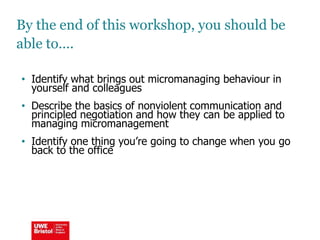
    By the endof this workshop, you should be able to…. • Identify what brings out micromanaging behaviour in yourself and colleagues • Describe the basics of nonviolent communication and principled negotiation and how they can be applied to managing micromanagement • Identify one thing you’re going to change when you go back to the office
  • 3.
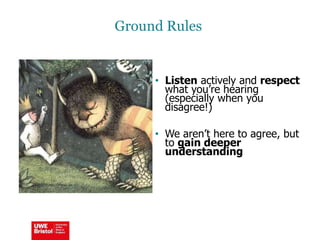
    Ground Rules • Listenactively and respect what you’re hearing (especially when you disagree!) • We aren’t here to agree, but to gain deeper understanding
  • 4.
    Whether you knowand love a micromanager….
  • 5.
    Or whether youare one yourself….
  • 6.
    Let the wildrumpus start!
  • 7.
    Why micromanage? 1. Fear:of failure or embarrassment
  • 8.
    Why micromanage? 1. Fear:of failure or embarrassment 2. Love of the work
  • 9.
    Why micromanage? 1. Fear:of failure or embarrassment 2. Love of the work 3. Different interpretations of ‘under control’ and ‘out of control’
  • 10.
    Exercise 1: 1. Drawthe micromanaging behaviours you currently experience that you want to change. 2. Pick (at least) one thing from each table to report back to the group as your priority to fix.
  • 11.
    Principled Negotiation Principled Negotiationaims for a ‘win-win’ solution, where everyone’s needs are met and no one has to make sacrifices or compromise. Ury and Fisher developed this as an alternative to ‘positional bargaining’, where there is a winner and a loser. Roger Fisher and William L. Ury published Getting to Yes: Negotiating Agreement Without Giving In in 1981; as of 2007, it is still a recurring bestseller.
  • 12.
    Principled Negotiation STEP 1– Separate the people from the problem Don’t get caught up in personalities, communication styles, or past history STEP 2 – Focus on interests, not positions Focus on the broadest interpretation of what you need – i.e. ‘simple food’, rather than ‘a sandwich’ STEP 3 – Invent options for mutual gain Focus on what you can each give easily and how it can help, instead of circling the problem STEP 4 – Insist on using objective criteria Negotiations don’t have to be contentious or personal – leave any battles of wills outside the room
  • 13.
    Non-Violent Communication Nonviolent Communication(NVC) begins by assuming we are all compassionate by nature and that violent strategies – whether verbal or physical – are learned behaviours taught and supported by the prevailing culture. NVC also assumes that we all share the same, basic, human needs, and that each of our actions are a strategy to meet one or more of these needs. Dr. Marshall B. Rosenberg, a psychologist, was the founder and director of educational services for The Centre for Nonviolent Communication. Find out more here: his book, Radio 4’s Great Lives, and some free resources from www.ncv- uk.com.
  • 14.
    Non-Violent Communication STEP 1– Observation without evaluation Focus on the (recent!) behavior, not any qualities of the person – i.e. ‘the desk is messy’ not ‘you are messy’ STEP 2 – Express Feelings Make clear how you feel about their behavior – i.e. ‘I feel edgy and uncomfortable around mess’ STEP 3 – Express Need Explain what you need – i.e. ‘I need a tidy office environment’ STEP 4 – Make a request This should be based on your needs – i.e. ‘Please tidy your desk’
  • 15.
    Exercise 2: Using thebehaviour(s) you chose in the last exercise: 1. Articulate your problem using the NVC structure 2. If relevant, use principled negotiation to come up with something you can offer in return 3. Present back to the group
  • 16.

Editor's Notes

  • #2 The UWE logo is positioned at the bottom, as well as a drawing from the book ‘Where the Wild Things Are’ by Maurice Sendak. It shows five wild things dancing in a line, with Max in his white monster costume sitting on the shoulders of one of the wild things. He is wearing a crown and holding a sceptre. His eyes are shut and he has a proud and pleased expression on his face.
  • #4 The image is of Max from ‘Where the Wild Things Are’ sitting on a small hill and holding his sceptre and wearing his crown. His eyes are shut and his expression is serious. In front of him, a wild thing is bowing solemly with eyes closed.
  • #5 This is a single panel comic. A banner across the top reads, ‘Micromanager of the Year’. A man in a suit with a beard is holding a picture frame – presumably an award certificate – and he is standing next to a woman at a podium. They are on a stage. In front of them, you can see the backs of the heads of four audience members. The woman on the stage is saying, ‘No, you need to present the award from my left… And did you do the awards form 87F, 2012? And the presentation clearance form 8703D? Make sure you do those by end of day, okay? And also, you need….’ One of the audience members is saying, ‘Told you she was good!’
  • #6 This is a four-panel comic. In the first panel, a child in a striped top and shorts looks at a sink full of dirty dishes, above which is a note pinned to the wall that reads, ‘Please wash your dishes’. The child is saying ‘I’m so sick of Robbie’s passive-aggressive notes!’ In the second panel, the child sees a rubbish bin full of recyclables next to a near-empty recycling box. There is a note above it that reads, ‘Please recycle your trash’. The child is saying, ‘Pff!’ In the third panel, there is an open toy box with toys scattered on the floor in front of it. A note above the box reads, ‘Please put away your toys’, and the child is saying, ‘Sheesh!’ In the final panel, there is a toilet with a flat box crammed into it and water on the floow. Above it is a sign that reads, ‘Please don’t flush your pizza boxes down the toilet’, and the child is saying ‘Ugh!’.
  • #7 There is an image of Max from ‘Where the Wild Things Are’ on the right hand side of the page, in his monster costume and crown. He is standing on one leg, with the other one raised. His right arm is upright, and his left arm is straight out in front of him. He is smiling and his brows are furrowed.
  • #8 There is an image of Max from ‘Where the Wild Things Are’ on the right hand side of the page, in his monster costume and crown. He is standing on one leg, with the other one raised. His right arm is upright, and his left arm is straight out in front of him. He is smiling and his brows are furrowed.
  • #9 There is an image of Max from ‘Where the Wild Things Are’ on the right hand side of the page, in his monster costume and crown. He is standing on one leg, with the other one raised. His right arm is upright, and his left arm is straight out in front of him. He is smiling and his brows are furrowed.
  • #10 There is an image of Max from ‘Where the Wild Things Are’ on the right hand side of the page, in his monster costume and crown. He is standing on one leg, with the other one raised. His right arm is upright, and his left arm is straight out in front of him. He is smiling and his brows are furrowed.
  • #11 There is an image of Max from ‘Where the Wild Things Are’ on the right hand side of the page, in his monster costume and crown. He is standing on one leg, with the other one raised. His right arm is upright, and his left arm is straight out in front of him. He is smiling and his brows are furrowed.
  • #16 There is an image of Max from ‘Where the Wild Things Are’ on the right hand side of the page, in his monster costume and crown. He is standing on one leg, with the other one raised. His right arm is upright, and his left arm is straight out in front of him. He is smiling and his brows are furrowed.