Section 1
TRAINING MATERIAL FOR HOST ORGANIZATIONS
UNIT 1
EMOTIONAL MANAGEMENT
Contents
1. Learning objectives and outcomes
2. Key concepts
3. Emotional intelligence and its components
4. Keeping in balance your emotions
5. The power of empathy
6. Activity – active listening with a partner
7. Non-violent communication - components and process
8. Communication styles
9. Anger management – defining the concept; anger management techniques
10. How to foster a positive climate
L E AR N I N G O B J E C T I V E S
• To define emotional intelligence and its
components;
• To provide examples of empathy and
demonstrate ways of becoming more
empathetic;
• To discuss non-violent and empathic
communication;
• To illustrate the four styles of communication in
the workplace;
• To describe the causes and the roots of anger;
• To cover the key factors conductive to a
positive work environment.
LEA R N IN G O U TC O MES
• To better understand the range of emotions
and how to direct them to improve
organizational effectiveness;
• To identify if a situation is a trigger and to be
able to practise active learning in order to
become more empathetic;
• To understand how to properly express
ourselves and hear others to avoid workplace
conflicts;
• To list and define the styles of communication
and what makes it effective;
• To apply anger management/basic conflict
resolutions practices in the workplace.
Key Concepts
1. Emotional intelligence • the ability to understand, use, and manage your own
emotions in positive ways to relieve stress, communicate
effectively, empathize with others, overcome challenges and
defuse conflict.
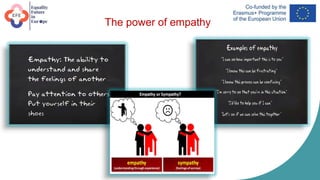
2. Empathy • the ability to sense other people’s emotions, coupled with the
ability to imagine what someone else might be thinking or
feeling.
3. Non-violent communication • a conflict resolution method, a way to communicate in a
respectful, yet powerful way with other people, avoiding
several traps in communication due to clashing ego's and/or
making the other person feel he or she is been treated
unfairly or disrespectfully.
4. Anger management • an approach designed to help you manage the emotional
and physiological arousal that accompanies anger.
5. Organizational effectiveness • measures how successful organizations are in reaching their
goals. An effective organization runs smoothly and functions
well.
6. A positive working environment • a workplace that promotes employee safety, growth and goal
attainment, conducive to a successful workforce as
employees are encouraged to perform to their highest ability
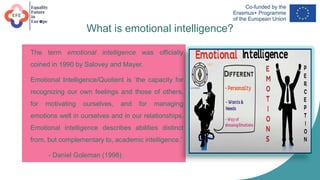
What is emotional intelligence?
• The term emotional intelligence was officially
coined in 1990 by Salovey and Mayer.
• Emotional Intelligence/Quotient is ‘the capacity for
recognizing our own feelings and those of others,
for motivating ourselves, and for managing
emotions well in ourselves and in our relationships.
Emotional intelligence describes abilities distinct
from, but complementary to, academic intelligence.’
- Daniel Goleman (1998)
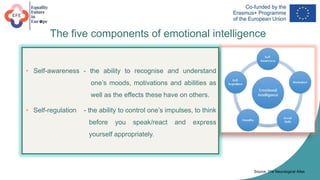
The five components of emotional intelligence
• Self-awareness - the ability to recognise and understand
one’s moods, motivations and abilities as
well as the effects these have on others.
• Self-regulation - the ability to control one’s impulses, to think
before you speak/react and express
yourself appropriately.
Source: The Neurological Atlas
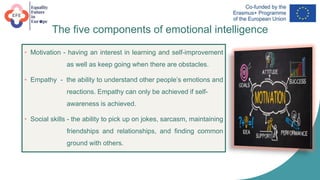
The five components of emotional intelligence
• Motivation - having an interest in learning and self-improvement
as well as keep going when there are obstacles.
• Empathy - the ability to understand other people’s emotions and
reactions. Empathy can only be achieved if self-
awareness is achieved.
• Social skills - the ability to pick up on jokes, sarcasm, maintaining
friendships and relationships, and finding common
ground with others.
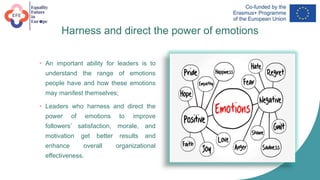
Harness and direct the power of emotions
• An important ability for leaders is to
understand the range of emotions
people have and how these emotions
may manifest themselves;
• Leaders who harness and direct the
power of emotions to improve
followers’ satisfaction, morale, and
motivation get better results and
enhance overall organizational
effectiveness.
Leading emotions – keeping in balance your emotions
and helping others manage theirs (video)
The power of empathy
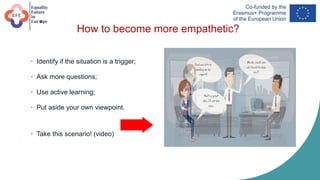
How to become more empathetic?
• Identify if the situation is a trigger;
• Ask more questions;
• Use active learning;
• Put aside your own viewpoint.
• Take this scenario! (video)
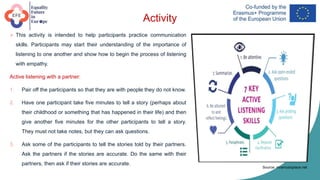
Activity
 This activity is intended to help participants practice communication
skills. Participants may start their understanding of the importance of
listening to one another and show how to begin the process of listening
with empathy.
Active listening with a partner:
1. Pair off the participants so that they are with people they do not know.
2. Have one participant take five minutes to tell a story (perhaps about
their childhood or something that has happened in their life) and then
give another five minutes for the other participants to tell a story.
They must not take notes, but they can ask questions.
3. Ask some of the participants to tell the stories told by their partners.
Ask the partners if the stories are accurate. Do the same with their
partners, then ask if their stories are accurate.
Source: mramusicplace.net
Non-violent and empathic communication
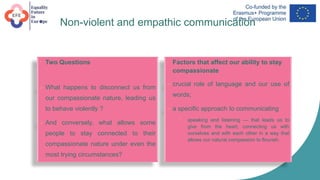
• Two Questions
 What happens to disconnect us from
our compassionate nature, leading us
to behave violently ?
 And conversely, what allows some
people to stay connected to their
compassionate nature under even the
most trying circumstances?
• Factors that affect our ability to stay
compassionate
 crucial role of language and our use of
words;
 a specific approach to communicating
 speaking and listening — that leads us to
give from the heart, connecting us with
ourselves and with each other in a way that
allows our natural compassion to flourish.
A Way To Focus Attention
• NVC is founded on language and
communication skills that strengthen our
ability to remain human, even under
trying conditions.
• NVC guides us in reframing how we
express ourselves and hear others.
• Instead of being habitual, having
automatic reactions, our words become
conscious responses based firmly on an
awareness of what we are perceiving,
feeling, and wanting.
NVC (video)
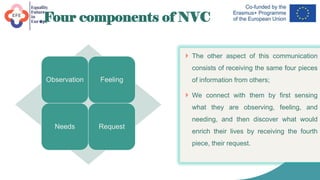
 The other aspect of this communication
consists of receiving the same four pieces
of information from others;
 We connect with them by first sensing
what they are observing, feeling, and
needing, and then discover what would
enrich their lives by receiving the fourth
piece, their request.
Four components of NVC
Observation Feeling
Needs Request
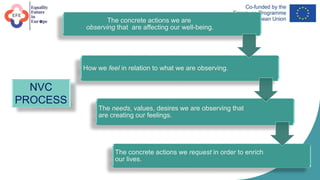
The concrete actions we are
observing that are affecting our well-being.
How we feel in relation to what we are observing.
The needs, values, desires we are observing that
are creating our feelings.
The concrete actions we request in order to enrich
our lives.
NVC
PROCESS
What is Effective Communication?
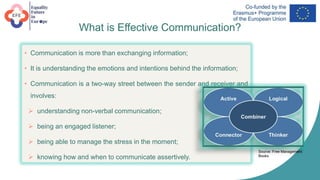
• Communication is more than exchanging information;
• It is understanding the emotions and intentions behind the information;
• Communication is a two-way street between the sender and receiver and
involves:
 understanding non-verbal communication;
 being an engaged listener;
 being able to manage the stress in the moment;
 knowing how and when to communicate assertively.
Source: Free Management
Books
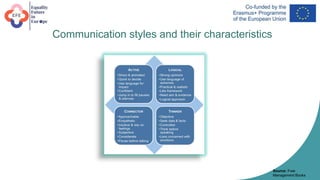
Communication styles and their characteristics
Source: Free
Management Books
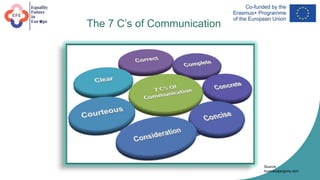
The 7 C’s of Communication
Source:
businessjargons.com
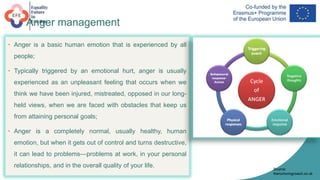
Anger management
• Anger is a basic human emotion that is experienced by all
people;
• Typically triggered by an emotional hurt, anger is usually
experienced as an unpleasant feeling that occurs when we
think we have been injured, mistreated, opposed in our long-
held views, when we are faced with obstacles that keep us
from attaining personal goals;
• Anger is a completely normal, usually healthy, human
emotion, but when it gets out of control and turns destructive,
it can lead to problems—problems at work, in your personal
relationships, and in the overall quality of your life. Source:
thenurturingcoach.co.uk
Causes and Roots of Anger
• External events/stressors
- Major life events: moving, death of
loved ones, divorce etc.
- Routine life pressures: financial
constraints, deadlines, arguments,
family concerns etc.
• Internal events/stressors
- Values and beliefs;
- Self-image;
- Goals;
- Faith;
- Expectations from self and others etc.
The Roots of Anger in the Workplace (video)
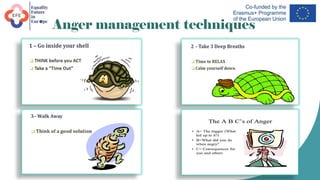
Anger management techniques
The 4 keys to a positive climate (video)
Main references
• https://www.scribd.com/document/431502602/Leadership-Styles
• https://www.youtube.com/watch?v=MZcGj-eMH5o
• Marshall B. Rosenberg PhD (Author), Deepak Chopra (Foreword), Nonviolent Communication: A
Language of Life: Life-Changing Tools for Healthy Relationships (Nonviolent Communication
Guides) Paperback – September 1, 2015
• https://www.youtube.com/watch?v=IQP4qAM3qgE
• https://www.youtube.com/watch?v=PWmhl6rzVpM
• https://www.youtube.com/watch?v=sEzTXTRo9L4
• https://mramusicplace.net/2021/01/10/teaching-success-and-active-listening/
• https://www.ccl.org/articles/leading-effectively-articles/coaching-others-use-active-listening-skills/
• Lucy Leu and Marshall Rosenberg: Nonviolent Communication Companion Workbook
• Stephanie Knox work:
http://twbonline.pbworks.com/w/page/34116915/Effective%20Communication%20Final

Emotional Intelligence

  • 1.
    Section 1 TRAINING MATERIALFOR HOST ORGANIZATIONS UNIT 1 EMOTIONAL MANAGEMENT
  • 2.
    Contents 1. Learning objectivesand outcomes 2. Key concepts 3. Emotional intelligence and its components 4. Keeping in balance your emotions 5. The power of empathy 6. Activity – active listening with a partner 7. Non-violent communication - components and process 8. Communication styles 9. Anger management – defining the concept; anger management techniques 10. How to foster a positive climate
  • 3.
    L E ARN I N G O B J E C T I V E S • To define emotional intelligence and its components; • To provide examples of empathy and demonstrate ways of becoming more empathetic; • To discuss non-violent and empathic communication; • To illustrate the four styles of communication in the workplace; • To describe the causes and the roots of anger; • To cover the key factors conductive to a positive work environment. LEA R N IN G O U TC O MES • To better understand the range of emotions and how to direct them to improve organizational effectiveness; • To identify if a situation is a trigger and to be able to practise active learning in order to become more empathetic; • To understand how to properly express ourselves and hear others to avoid workplace conflicts; • To list and define the styles of communication and what makes it effective; • To apply anger management/basic conflict resolutions practices in the workplace.
  • 4.
    Key Concepts 1. Emotionalintelligence • the ability to understand, use, and manage your own emotions in positive ways to relieve stress, communicate effectively, empathize with others, overcome challenges and defuse conflict. 2. Empathy • the ability to sense other people’s emotions, coupled with the ability to imagine what someone else might be thinking or feeling. 3. Non-violent communication • a conflict resolution method, a way to communicate in a respectful, yet powerful way with other people, avoiding several traps in communication due to clashing ego's and/or making the other person feel he or she is been treated unfairly or disrespectfully. 4. Anger management • an approach designed to help you manage the emotional and physiological arousal that accompanies anger. 5. Organizational effectiveness • measures how successful organizations are in reaching their goals. An effective organization runs smoothly and functions well. 6. A positive working environment • a workplace that promotes employee safety, growth and goal attainment, conducive to a successful workforce as employees are encouraged to perform to their highest ability
  • 5.
    What is emotionalintelligence? • The term emotional intelligence was officially coined in 1990 by Salovey and Mayer. • Emotional Intelligence/Quotient is ‘the capacity for recognizing our own feelings and those of others, for motivating ourselves, and for managing emotions well in ourselves and in our relationships. Emotional intelligence describes abilities distinct from, but complementary to, academic intelligence.’ - Daniel Goleman (1998)
  • 6.
    The five componentsof emotional intelligence • Self-awareness - the ability to recognise and understand one’s moods, motivations and abilities as well as the effects these have on others. • Self-regulation - the ability to control one’s impulses, to think before you speak/react and express yourself appropriately. Source: The Neurological Atlas
  • 7.
    The five componentsof emotional intelligence • Motivation - having an interest in learning and self-improvement as well as keep going when there are obstacles. • Empathy - the ability to understand other people’s emotions and reactions. Empathy can only be achieved if self- awareness is achieved. • Social skills - the ability to pick up on jokes, sarcasm, maintaining friendships and relationships, and finding common ground with others.
  • 8.
    Harness and directthe power of emotions • An important ability for leaders is to understand the range of emotions people have and how these emotions may manifest themselves; • Leaders who harness and direct the power of emotions to improve followers’ satisfaction, morale, and motivation get better results and enhance overall organizational effectiveness.
  • 9.
    Leading emotions –keeping in balance your emotions and helping others manage theirs (video)
  • 10.
    The power ofempathy
  • 11.
    How to becomemore empathetic? • Identify if the situation is a trigger; • Ask more questions; • Use active learning; • Put aside your own viewpoint. • Take this scenario! (video)
  • 12.
    Activity  This activityis intended to help participants practice communication skills. Participants may start their understanding of the importance of listening to one another and show how to begin the process of listening with empathy. Active listening with a partner: 1. Pair off the participants so that they are with people they do not know. 2. Have one participant take five minutes to tell a story (perhaps about their childhood or something that has happened in their life) and then give another five minutes for the other participants to tell a story. They must not take notes, but they can ask questions. 3. Ask some of the participants to tell the stories told by their partners. Ask the partners if the stories are accurate. Do the same with their partners, then ask if their stories are accurate. Source: mramusicplace.net
  • 13.
    Non-violent and empathiccommunication • Two Questions  What happens to disconnect us from our compassionate nature, leading us to behave violently ?  And conversely, what allows some people to stay connected to their compassionate nature under even the most trying circumstances? • Factors that affect our ability to stay compassionate  crucial role of language and our use of words;  a specific approach to communicating  speaking and listening — that leads us to give from the heart, connecting us with ourselves and with each other in a way that allows our natural compassion to flourish.
  • 14.
    A Way ToFocus Attention • NVC is founded on language and communication skills that strengthen our ability to remain human, even under trying conditions. • NVC guides us in reframing how we express ourselves and hear others. • Instead of being habitual, having automatic reactions, our words become conscious responses based firmly on an awareness of what we are perceiving, feeling, and wanting. NVC (video)
  • 15.
     The otheraspect of this communication consists of receiving the same four pieces of information from others;  We connect with them by first sensing what they are observing, feeling, and needing, and then discover what would enrich their lives by receiving the fourth piece, their request. Four components of NVC Observation Feeling Needs Request
  • 16.
    The concrete actionswe are observing that are affecting our well-being. How we feel in relation to what we are observing. The needs, values, desires we are observing that are creating our feelings. The concrete actions we request in order to enrich our lives. NVC PROCESS
  • 17.
    What is EffectiveCommunication? • Communication is more than exchanging information; • It is understanding the emotions and intentions behind the information; • Communication is a two-way street between the sender and receiver and involves:  understanding non-verbal communication;  being an engaged listener;  being able to manage the stress in the moment;  knowing how and when to communicate assertively. Source: Free Management Books
  • 18.
    Communication styles andtheir characteristics Source: Free Management Books
  • 19.
    The 7 C’sof Communication Source: businessjargons.com
  • 20.
    Anger management • Angeris a basic human emotion that is experienced by all people; • Typically triggered by an emotional hurt, anger is usually experienced as an unpleasant feeling that occurs when we think we have been injured, mistreated, opposed in our long- held views, when we are faced with obstacles that keep us from attaining personal goals; • Anger is a completely normal, usually healthy, human emotion, but when it gets out of control and turns destructive, it can lead to problems—problems at work, in your personal relationships, and in the overall quality of your life. Source: thenurturingcoach.co.uk
  • 21.
    Causes and Rootsof Anger • External events/stressors - Major life events: moving, death of loved ones, divorce etc. - Routine life pressures: financial constraints, deadlines, arguments, family concerns etc. • Internal events/stressors - Values and beliefs; - Self-image; - Goals; - Faith; - Expectations from self and others etc.
  • 22.
    The Roots ofAnger in the Workplace (video)
  • 23.
  • 24.
    The 4 keysto a positive climate (video)
  • 25.
    Main references • https://www.scribd.com/document/431502602/Leadership-Styles •https://www.youtube.com/watch?v=MZcGj-eMH5o • Marshall B. Rosenberg PhD (Author), Deepak Chopra (Foreword), Nonviolent Communication: A Language of Life: Life-Changing Tools for Healthy Relationships (Nonviolent Communication Guides) Paperback – September 1, 2015 • https://www.youtube.com/watch?v=IQP4qAM3qgE • https://www.youtube.com/watch?v=PWmhl6rzVpM • https://www.youtube.com/watch?v=sEzTXTRo9L4 • https://mramusicplace.net/2021/01/10/teaching-success-and-active-listening/ • https://www.ccl.org/articles/leading-effectively-articles/coaching-others-use-active-listening-skills/ • Lucy Leu and Marshall Rosenberg: Nonviolent Communication Companion Workbook • Stephanie Knox work: http://twbonline.pbworks.com/w/page/34116915/Effective%20Communication%20Final