Are Retirement Decisions Vulnerable
to Framing Effects?
Empirical Evidence from NL and US

Federica Teppa
(De Nederlandsche Bank & Netspar)
Maarten van Rooij
(De Nederlandsche Bank & Netspar)

Bank of Estonia seminar
Tallinn - September, 2013

Teppa & van Rooij (DNB)

Retirement decisions and framing effects

September, 2013

1 / 29
1. Introduction and Motivation
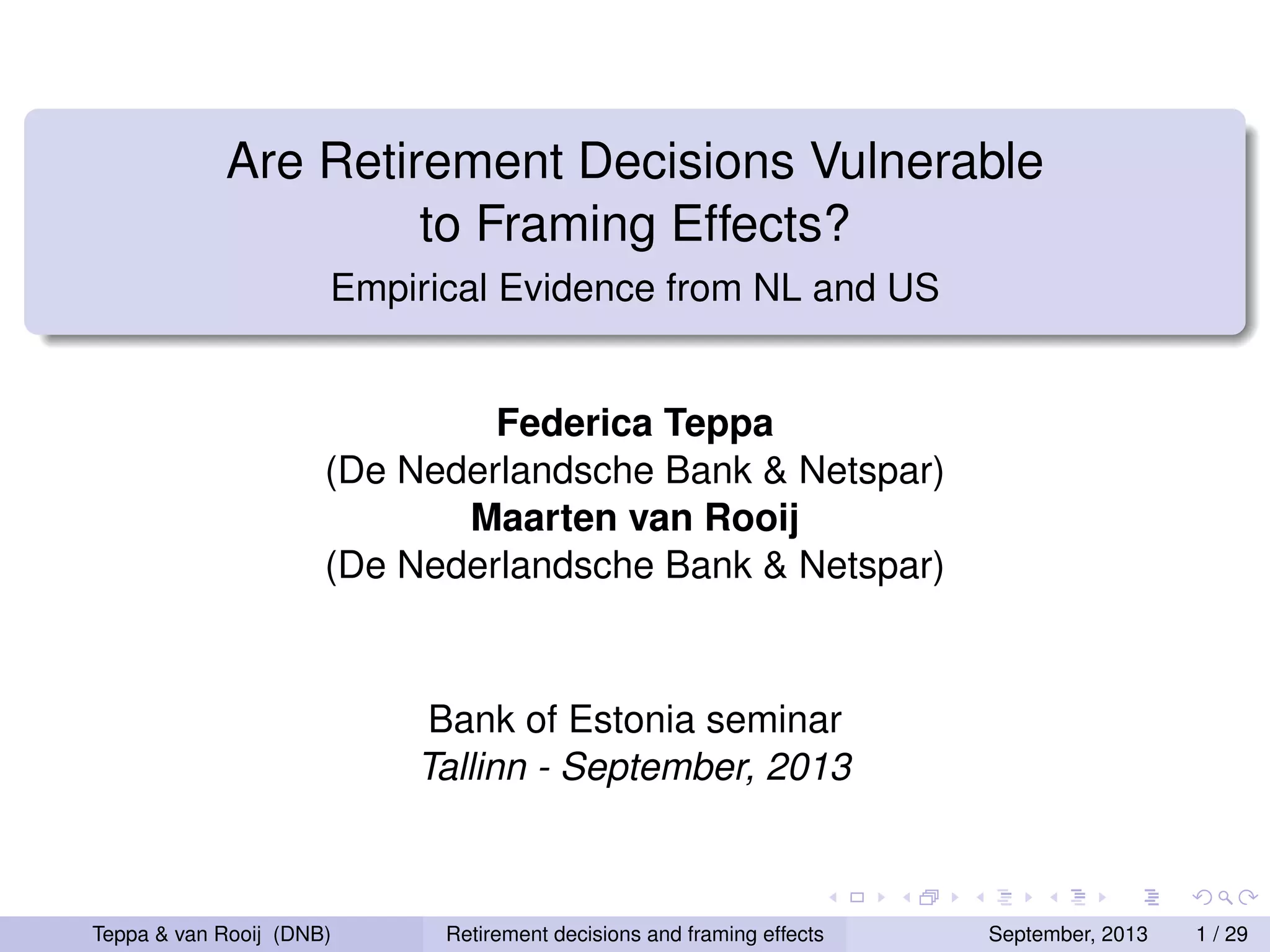
The rapidly ageing trend experienced by the population in all
developed countries in the recent years and in the years to come has
put public finances into severe distress.:
1

OECD : in 2010 the largest proportion of retirement income (some
60 percent) is provided by the state, mostly via PAYG systems
where benefits are paid out of current taxes

The need for cutting the costs of public pension provisions has been at
the basis of a number of pension reforms taking place recently.
1

Governments are no longer going to act as the main (or even the
only) provider of old-age income, but more and more limiting their
goal as to ensure a minimum level of adequate income to the
elderly

2

Shifting risks to the individuals who are becoming increasingly
responsible for the fraction of their retirement income exceeding
the publicly provided component.
Teppa & van Rooij (DNB)

Retirement decisions and framing effects

September, 2013

2 / 29
1. Introduction and Motivation
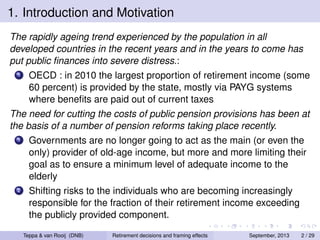
Behavioral aspects of the individual decision making process are being
studied extensively.
1

2

Increasing availability of both administrative records and survey
data on real and hypothetical choices in several countries
Combination of several disciplines
economics (Butler and Teppa, 2007; Agnew et al., 2008; Brown et
¨
al., 2008)
psychology (Kahneman and Miller, 1986; Gonzales et al., 2005),
neurology (Rogers et al., 1999; De Martino et al., 2006)
sociology

3

Final outcomes of any decision making process are very often
contingent upon how alternatives are displayed to the agents

The significant role of this framing effect represents probably the most
striking violation of rationality in standard economic theory.
Teppa & van Rooij (DNB)

Retirement decisions and framing effects

September, 2013

3 / 29
1. Introduction and Motivation

Brown et al. (2011)
RAND American Life Panel (ALP)
Participants were confronted with alternative information formats
about how benefits would be adjusted if they were to claim
retirement benefits early versus later
Individual intentions with regard to Social Security claiming ages
are sensitive to how the early versus late claiming decision is
framed

Teppa & van Rooij (DNB)

Retirement decisions and framing effects

September, 2013

4 / 29
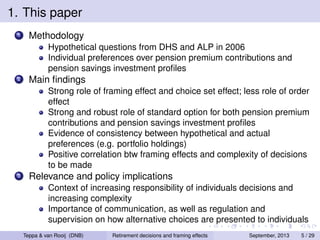
1. This paper
1

Methodology
Hypothetical questions from DHS and ALP in 2006
Individual preferences over pension premium contributions and
pension savings investment profiles

2

Main findings
Strong role of framing effect and choice set effect; less role of order
effect
Strong and robust role of standard option for both pension premium
contributions and pension savings investment profiles
Evidence of consistency between hypothetical and actual
preferences (e.g. portfolio holdings)
Positive correlation btw framing effects and complexity of decisions
to be made

3

Relevance and policy implications
Context of increasing responsibility of individuals decisions and
increasing complexity
Importance of communication, as well as regulation and
supervision on how alternative choices are presented to individuals
Teppa & van Rooij (DNB)

Retirement decisions and framing effects

September, 2013

5 / 29
Outline

1

Introduction and Motivation

2

Data

3

Results

4

Concluding remarks

Teppa & van Rooij (DNB)

Retirement decisions and framing effects

September, 2013

6 / 29
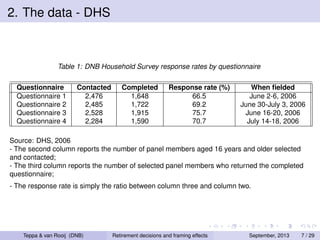
2. The data - DHS

Table 1: DNB Household Survey response rates by questionnaire
Questionnaire
Questionnaire 1
Questionnaire 2
Questionnaire 3
Questionnaire 4

Contacted
2,476
2,485
2,528
2,284

Completed
1,648
1,722
1,915
1,590

Response rate (%)
66.5
69.2
75.7
70.7

When fielded
June 2-6, 2006
June 30-July 3, 2006
June 16-20, 2006
July 14-18, 2006

Source: DHS, 2006
- The second column reports the number of panel members aged 16 years and older selected
and contacted;
- The third column reports the number of selected panel members who returned the completed
questionnaire;
- The response rate is simply the ratio between column three and column two.

Teppa & van Rooij (DNB)

Retirement decisions and framing effects

September, 2013

7 / 29
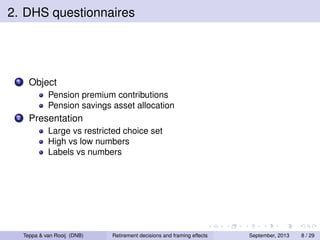
2. DHS questionnaires

1

Object
Pension premium contributions
Pension savings asset allocation

2

Presentation
Large vs restricted choice set
High vs low numbers
Labels vs numbers

Teppa & van Rooij (DNB)

Retirement decisions and framing effects

September, 2013

8 / 29
2. DHS questionnaires
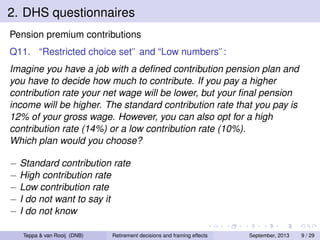
Pension premium contributions
Q11. “Restricted choice set” and “Low numbers”:
Imagine you have a job with a defined contribution pension plan and
you have to decide how much to contribute. If you pay a higher
contribution rate your net wage will be lower, but your final pension
income will be higher. The standard contribution rate that you pay is
12% of your gross wage. However, you can also opt for a high
contribution rate (14%) or a low contribution rate (10%).
Which plan would you choose?
− Standard contribution rate
− High contribution rate
− Low contribution rate
− I do not want to say it
− I do not know
Teppa & van Rooij (DNB)

Retirement decisions and framing effects

September, 2013

9 / 29
2. DHS questionnaires
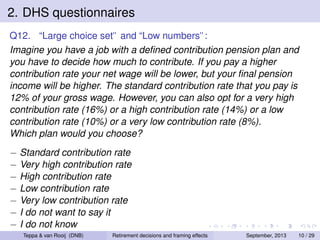
Q12. “Large choice set” and “Low numbers”:
Imagine you have a job with a defined contribution pension plan and
you have to decide how much to contribute. If you pay a higher
contribution rate your net wage will be lower, but your final pension
income will be higher. The standard contribution rate that you pay is
12% of your gross wage. However, you can also opt for a very high
contribution rate (16%) or a high contribution rate (14%) or a low
contribution rate (10%) or a very low contribution rate (8%).
Which plan would you choose?
− Standard contribution rate
− Very high contribution rate
− High contribution rate
− Low contribution rate
− Very low contribution rate
− I do not want to say it
− I do not know
Teppa & van Rooij (DNB)

Retirement decisions and framing effects

September, 2013

10 / 29
2. DHS questionnaires
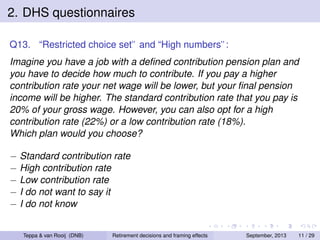
Q13. “Restricted choice set” and “High numbers”:
Imagine you have a job with a defined contribution pension plan and
you have to decide how much to contribute. If you pay a higher
contribution rate your net wage will be lower, but your final pension
income will be higher. The standard contribution rate that you pay is
20% of your gross wage. However, you can also opt for a high
contribution rate (22%) or a low contribution rate (18%).
Which plan would you choose?
− Standard contribution rate
− High contribution rate
− Low contribution rate
− I do not want to say it
− I do not know

Teppa & van Rooij (DNB)

Retirement decisions and framing effects

September, 2013

11 / 29
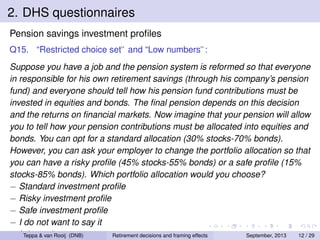
2. DHS questionnaires
Pension savings investment profiles
Q15. “Restricted choice set” and “Low numbers”:
Suppose you have a job and the pension system is reformed so that everyone
in responsible for his own retirement savings (through his company’s pension
fund) and everyone should tell how his pension fund contributions must be
invested in equities and bonds. The final pension depends on this decision
and the returns on financial markets. Now imagine that your pension will allow
you to tell how your pension contributions must be allocated into equities and
bonds. You can opt for a standard allocation (30% stocks-70% bonds).
However, you can ask your employer to change the portfolio allocation so that
you can have a risky profile (45% stocks-55% bonds) or a safe profile (15%
stocks-85% bonds). Which portfolio allocation would you choose?
− Standard investment profile
− Risky investment profile
− Safe investment profile
− I do not want to say it
− I Teppanot know
do & van Rooij (DNB)
Retirement decisions and framing effects
September, 2013
12 / 29
2. DHS questionnaires
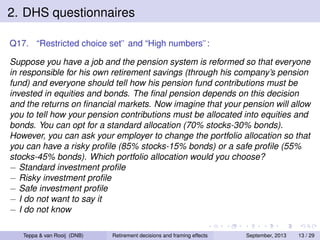
Q17. “Restricted choice set” and “High numbers”:
Suppose you have a job and the pension system is reformed so that everyone
in responsible for his own retirement savings (through his company’s pension
fund) and everyone should tell how his pension fund contributions must be
invested in equities and bonds. The final pension depends on this decision
and the returns on financial markets. Now imagine that your pension will allow
you to tell how your pension contributions must be allocated into equities and
bonds. You can opt for a standard allocation (70% stocks-30% bonds).
However, you can ask your employer to change the portfolio allocation so that
you can have a risky profile (85% stocks-15% bonds) or a safe profile (55%
stocks-45% bonds). Which portfolio allocation would you choose?
− Standard investment profile
− Risky investment profile
− Safe investment profile
− I do not want to say it
− I do not know
Teppa & van Rooij (DNB)

Retirement decisions and framing effects

September, 2013

13 / 29
2. DHS questionnaires
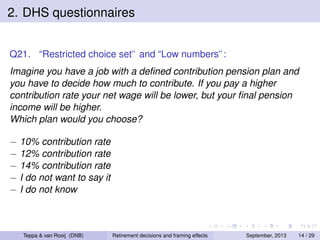
Q21. “Restricted choice set” and “Low numbers”:
Imagine you have a job with a defined contribution pension plan and
you have to decide how much to contribute. If you pay a higher
contribution rate your net wage will be lower, but your final pension
income will be higher.
Which plan would you choose?
− 10% contribution rate
− 12% contribution rate
− 14% contribution rate
− I do not want to say it
− I do not know

Teppa & van Rooij (DNB)

Retirement decisions and framing effects

September, 2013

14 / 29
3. Results
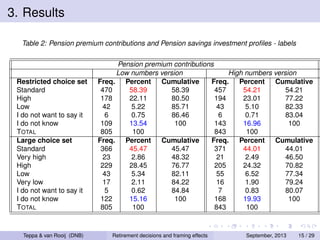
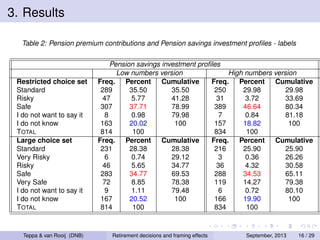
Table 2: Pension premium contributions and Pension savings investment profiles - labels

Restricted choice set
Standard
High
Low
I do not want to say it
I do not know
TOTAL
Large choice set
Standard
Very high
High
Low
Very low
I do not want to say it
I do not know
TOTAL

Teppa & van Rooij (DNB)

Pension premium contributions
Low numbers version
High numbers version
Freq. Percent
Cumulative
Freq. Percent
Cumulative
470
58.39
58.39
457
54.21
54.21
178
22.11
80.50
194
23.01
77.22
42
5.22
85.71
43
5.10
82.33
6
0.75
86.46
6
0.71
83.04
109
13.54
100
143
16.96
100
805
100
843
100
Freq. Percent
Cumulative
Freq. Percent
Cumulative
366
45.47
45.47
371
44.01
44.01
23
2.86
48.32
21
2.49
46.50
229
28.45
76.77
205
24.32
70.82
43
5.34
82.11
55
6.52
77.34
17
2.11
84.22
16
1.90
79.24
5
0.62
84.84
7
0.83
80.07
122
15.16
100
168
19.93
100
805
100
843
100

Retirement decisions and framing effects

September, 2013

15 / 29
3. Results
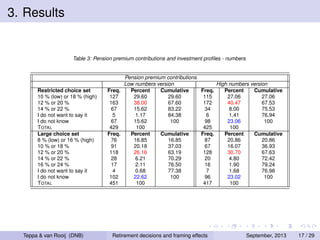
Table 2: Pension premium contributions and Pension savings investment profiles - labels

Restricted choice set
Standard
Risky
Safe
I do not want to say it
I do not know
TOTAL
Large choice set
Standard
Very Risky
Risky
Safe
Very Safe
I do not want to say it
I do not know
TOTAL

Teppa & van Rooij (DNB)

Pension savings investment profiles
Low numbers version
High numbers version
Freq. Percent
Cumulative
Freq. Percent
Cumulative
289
35.50
35.50
250
29.98
29.98
47
5.77
41.28
31
3.72
33.69
307
37.71
78.99
389
46.64
80.34
8
0.98
79.98
7
0.84
81.18
163
20.02
100
157
18.82
100
814
100
834
100
Freq. Percent
Cumulative
Freq. Percent
Cumulative
231
28.38
28.38
216
25.90
25.90
6
0.74
29.12
3
0.36
26.26
46
5.65
34.77
36
4.32
30.58
283
34.77
69.53
288
34.53
65.11
72
8.85
78.38
119
14.27
79.38
9
1.11
79.48
6
0.72
80.10
167
20.52
100
166
19.90
100
814
100
834
100

Retirement decisions and framing effects

September, 2013

16 / 29
3. Results

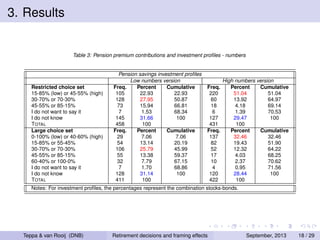
Table 3: Pension premium contributions and investment profiles - numbers

Restricted choice set
10 % (low) or 18 % (high)
12 % or 20 %
14 % or 22 %
I do not want to say it
I do not know
TOTAL
Large choice set
8 % (low) or 16 % (high)
10 % or 18 %
12 % or 20 %
14 % or 22 %
16 % or 24 %
I do not want to say it
I do not know
TOTAL

Teppa & van Rooij (DNB)

Pension premium contributions
Low numbers version
High numbers version
Freq.
Percent
Cumulative
Freq.
Percent
Cumulative
127
29.60
29.60
115
27.06
27.06
163
38.00
67.60
172
40.47
67.53
67
15.62
83.22
34
8.00
75.53
5
1.17
84.38
6
1.41
76.94
67
15.62
100
98
23.06
100
429
100
425
100
Freq.
Percent
Cumulative
Freq.
Percent
Cumulative
76
16.85
16.85
87
20.86
20.86
91
20.18
37.03
67
16.07
36.93
118
26.16
63.19
128
30.70
67.63
28
6.21
70.29
20
4.80
72.42
17
2.11
76.50
16
1.90
79.24
4
0.68
77.38
7
1.68
76.98
102
22.62
100
96
23.02
100
451
100
417
100

Retirement decisions and framing effects

September, 2013

17 / 29
3. Results

Table 3: Pension premium contributions and investment profiles - numbers

Restricted choice set
15-85% (low) or 45-55% (high)
30-70% or 70-30%
45-55% or 85-15%
I do not want to say it
I do not know
TOTAL
Large choice set
0-100% (low) or 40-60% (high)
15-85% or 55-45%
30-70% or 70-30%
45-55% or 85-15%
60-40% or 100-0%
I do not want to say it
I do not know
TOTAL

Pension savings investment profiles
Low numbers version
Freq.
Percent
Cumulative
105
22.93
22.93
128
27.95
50.87
73
15.94
66.81
7
1.53
68.34
145
31.66
100
458
100
Freq.
Percent
Cumulative
29
7.06
7.06
54
13.14
20.19
106
25.79
45.99
55
13.38
59.37
32
7.79
67.15
7
1.70
68.86
128
31.14
100
411
100

Freq.
220
60
18
6
127
431
Freq.
137
82
52
17
10
4
120
422

High numbers version
Percent
Cumulative
51.04
51.04
13.92
64.97
4.18
69.14
1.39
70.53
29.47
100
100
Percent
Cumulative
32.46
32.46
19.43
51.90
12.32
64.22
4.03
68.25
2.37
70.62
0.95
71.56
28.44
100
100

Notes: For investment profiles, the percentages represent the combination stocks-bonds.

Teppa & van Rooij (DNB)

Retirement decisions and framing effects

September, 2013

18 / 29
3. Results
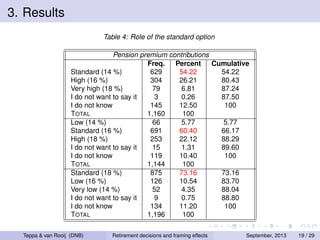
Table 4: Role of the standard option
Pension premium contributions
Freq.
Percent
Cumulative
Standard (14 %)
629
54.22
54.22
High (16 %)
304
26.21
80.43
Very high (18 %)
79
6.81
87.24
I do not want to say it
3
0.26
87.50
I do not know
145
12.50
100
TOTAL
1,160
100
Low (14 %)
66
5.77
5.77
Standard (16 %)
691
60.40
66.17
High (18 %)
253
22.12
88.29
I do not want to say it
15
1.31
89.60
I do not know
119
10.40
100
TOTAL
1,144
100
Standard (18 %)
875
73.16
73.16
Low (16 %)
126
10.54
83.70
Very low (14 %)
52
4.35
88.04
I do not want to say it
9
0.75
88.80
I do not know
134
11.20
100
TOTAL
1,196
100
Teppa & van Rooij (DNB)

Retirement decisions and framing effects

September, 2013

19 / 29
3. Results
Table 4: Role of the standard option
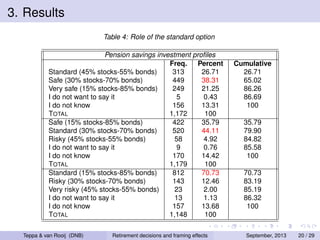
Pension savings investment profiles
Freq.
Percent
Standard (45% stocks-55% bonds)
313
26.71
Safe (30% stocks-70% bonds)
449
38.31
Very safe (15% stocks-85% bonds)
249
21.25
I do not want to say it
5
0.43
I do not know
156
13.31
TOTAL
1,172
100
Safe (15% stocks-85% bonds)
422
35.79
Standard (30% stocks-70% bonds)
520
44.11
Risky (45% stocks-55% bonds)
58
4.92
I do not want to say it
9
0.76
I do not know
170
14.42
TOTAL
1,179
100
Standard (15% stocks-85% bonds)
812
70.73
Risky (30% stocks-70% bonds)
143
12.46
Very risky (45% stocks-55% bonds)
23
2.00
I do not want to say it
13
1.13
I do not know
157
13.68
TOTAL
1,148
100
Teppa & van Rooij (DNB)

Retirement decisions and framing effects

Cumulative
26.71
65.02
86.26
86.69
100
35.79
79.90
84.82
85.58
100
70.73
83.19
85.19
86.32
100

September, 2013

20 / 29
3. Results

Table 5: Order, choice set and framing effects

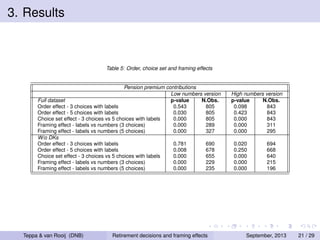
Pension premium contributions
Low numbers version
p-value
N.Obs.
0.543
805
0.030
805
0.000
805
0.000
289
0.000
327

Full dataset
Order effect - 3 choices with labels
Order effect - 5 choices with labels
Choice set effect - 3 choices vs 5 choices with labels
Framing effect - labels vs numbers (3 choices)
Framing effect - labels vs numbers (5 choices)
W/o DKs
Order effect - 3 choices with labels
Order effect - 5 choices with labels
Choice set effect - 3 choices vs 5 choices with labels
Framing effect - labels vs numbers (3 choices)
Framing effect - labels vs numbers (5 choices)

Teppa & van Rooij (DNB)

0.781
0.008
0.000
0.000
0.000

690
678
655
229
235

Retirement decisions and framing effects

High numbers version
p-value
N.Obs.
0.098
843
0.423
843
0.000
843
0.000
311
0.000
295
0.020
0.250
0.000
0.000
0.000

694
668
640
215
196

September, 2013

21 / 29
3. Results

Table 5: Order, choice set and framing effects

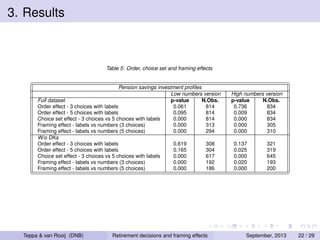
Pension savings investment profiles
Low numbers version
p-value
N.Obs.
0.061
814
0.095
814
0.000
814
0.000
313
0.000
294

Full dataset
Order effect - 3 choices with labels
Order effect - 5 choices with labels
Choice set effect - 3 choices vs 5 choices with labels
Framing effect - labels vs numbers (3 choices)
Framing effect - labels vs numbers (5 choices)
W/o DKs
Order effect - 3 choices with labels
Order effect - 5 choices with labels
Choice set effect - 3 choices vs 5 choices with labels
Framing effect - labels vs numbers (3 choices)
Framing effect - labels vs numbers (5 choices)

Teppa & van Rooij (DNB)

0.619
0.165
0.000
0.000
0.000

308
304
617
192
186

Retirement decisions and framing effects

High numbers version
p-value
N.Obs.
0.736
834
0.009
834
0.000
834
0.000
305
0.000
310
0.137
0.025
0.000
0.020
0.000

321
319
645
193
200

September, 2013

22 / 29
3. Results
Table 6a: Role of standard option - Pension premium contributions - probit estimates
Variable

14 percent
16 percent
Coefficient
Coefficient
[Marg.eff.]
[Marg.eff.]
(Std. Err.)
(Std. Err.)
Labeled standard
1.027 ***
-0.177 *
[0.311]
[-0.069]
(0.125)
(0.099)
SAS financial literacy
0.114
0.025
[0.043]
[0.010]
(0.091)
(0.088)
Female
-0.153 *
0.082
[-0.056]
[0.032]
(0.080)
(0.077)
Age less than 40 years
0.346 **
-0.020
[0.132]
[-0.008]
(0.127)
(0.121)
Age between 40 and 64 years
0.224 **
-0.170 *
[0.083]
[-0.067]
(0.107)
(0.102)
Gross household income (in logs)
0.010
-0.183 **
[0.003]
[-0.072]
(0.088)
(0.086)
Total fin. assets (in logs)
-0.010
-0.016
[-0.003]
[-0.006]
(0.028)
(0.027)
Constant
-0.978
1.422 **
(0.721)
(0.705)
Log-likelihood
-749.708
-816.210
Pseudo R2
0.066
0.028
N.Obs.
1215
1215
Teppa & van Rooij (DNB)
Retirement decisions and framing effects

18 percent
Coefficient
[Marg.eff.]
(Std. Err.)
0.208 **
[0.082]
(0.098)
-0.184 **
[-0.073]
(0.088)
-0.066
[-0.026]
(0.076)
-0.334 **
[-0.132]
(0.121)
-0.196 *
[-0.077]
(0.102)
0.006
[0.002]
(0.085)
0.045 *
[0.018]
(0.027)
-0.428
(0.701)
-817.545
0.024
1215
September, 2013

23 / 29
3. Results
Table 6b: Role of standard option - Pension savings investment profile - probit estimates
Variable

45-55 percent
30-70 percent
Coefficient
Coefficient
[Marg.eff.]
[Marg.eff.]
(Std. Err.)
(Std. Err.)
Labeled standard
0.712 ***
-0.115
[0.158]
[-0.046]
(0.112)
(0.081)
SAS financial literacy
0.339 ***
-0.187 **
[0.094]
[-0.074]
(0.102)
(0.090)
Female
-0.209 **
-0.159 **
[-0.053]
[-0.063]
(0.094)
(0.078)
Age less than 40 years
0.263 *
0.020
[0.072]
[0.008]
(0.147)
(0.122)
Age between 40 and 64 years
0.191
0.024
[0.049]
[0.009]
(0.124)
(0.009)
Gross hh income (in logs)
0.032
0.063
[0.008]
[0.025]
(0.104)
(0.087)
Total fin. assets (in logs)
0.082 **
-0.038
[0.021]
[-0.015]
(0.033)
(0.028)
Constant
-2.118 **
0.205
(0.842)
(0.704)
Log-likelihood
-538.100
-801.155
Pseudo R2
0.092
0.023
N.Obs.
1184
1184
Teppa & van Rooij (DNB)
Retirement decisions and framing effects

15-85 percent
Coefficient
[Marg.eff.]
(Std. Err.)
0.182 **
[0.069]
(0.084)
-0.163 *
[-0.061]
(0.091)
0.262 ***
[0.096]
(0.081)
-0.204
[-0.007]
(0.127)
-0.170
[-0.063]
(0.108)
-0.141
[-0.052]
(0.090)
0.012
[0.004]
(0.028)
1.087
(0.734)
-736.706
0.051
1184
September, 2013

24 / 29
3. Results
Table 7: Role of risk attitudes - Pension savings investment profiles - probit estimates
Variable

Labeled standard

Saving1

Saving2

Saving3

Saving4

Saving5

Saving6

Joint significance test
Log-likelihood
Pseudo R2
N.Obs.
Teppa & van Rooij (DNB)

45-55 percent
Coefficient
[Marg.eff.]
(Std. Err.)
0.720 ***
[0.155]
(0.120)
-0.253 **
[-0.067]
(0.117)
-0.346 ***
[-0.086]
(0.102)
-0.130
[-0.031]
(0.151)
0.056
[0.013]
(0.124)
0.309 **
[0.085]
(0.121)
0.187
[0.050]
(0.141)
0.000
-494.184
0.127
1122

30-70 percent
Coefficient
[Marg.eff.]
(Std. Err.)
-0.125
[-0.050]
(0.085)
0.069
[0.027]
(0.101)
-0.284 ***
[-0.113]
(0.084)
0.259 **
[0.102]
(0.132)
-0.007
[-0.003]
(0.105)
0.065
[0.025]
(0.110)
0.225 *
[0.089]
(0.131)
0.000
-744.214
0.043
1122

Retirement decisions and framing effects

15-85 percent
Coefficient
[Marg.eff.]
(Std. Err.)
0.218 **
[0.082]
(0.089)
0.083
[0.031]
(0.104)
0.440 ***
[0.162]
(0.087)
0.082
[0.030]
(0.135)
0.004
[0.001]
(0.109)
-0.163
[-0.061]
(0.113)
-0.319 **
[-0.122]
(0.132)
0.000
-673.521
0.086
1122
September, 2013

25 / 29
3. Results
Table 8: Pension savings investment profiles and household wealth - probit estimates
Variable

45-55 percent
Coefficient
[Marg.eff.]
(Std. Err.)
0.611 ***
[0.143]
(0.085)
0.040 **
[0.010]
(0.013)
-0.430 ***
(0.083)
-814.520
0.037
1733

Labeled standard

Total hh wealth

Constant
Log-likelihood
Pseudo R2
N.Obs.
Labeled standard

Financial hh wealth

Constant
Log-likelihood
Pseudo R2
N.Obs.

Teppa & van Rooij (DNB)

30-70 percent
Coefficient
[Marg.eff.]
(Std. Err.)
-0.063
[-0.025]
(0.064)
0.008
[0.003]
(0.012)
0.008
(0.061)
-1200.407
0.001
1733

15-85 percent
Coefficient
[Marg.eff.]
(Std. Err.)
0.220 ***
[0.085]
(0.089)
-0.032 *
[-0.012]
(0.012)
0.219 ***
(0.061)
-1147.166
0.001
1733

0.610 ***
[0.143]
(0.085)
0.121 ***
[0.031]
(0.031)
-1.391 ***
(0.077)
-811.476
0.041
1733

-0.062
[-0.024]
(0.085)
-0.005
[-0.002]
(0.101)
0.069
(0.101)
-1200.614
0.001
1733

0.219 ***
[0.084]
(0.065)
-0.066 **
[-0.025]
(0.029)
0.172 **
(0.055)
-1148.061
0.006
1733

Retirement decisions and framing effects

September, 2013

26 / 29
3. Results
Table 9: Pension savings investment profiles and portfolio choice - probit estimates
Variable

45-55 percent
30-70 percent
Coefficient
Coefficient
[Marg.eff.]
[Marg.eff.]
(Std. Err.)
(Std. Err.)
Labeled standard
0.599 ***
-0.069
[0.140]
[-0.027]
(0.086)
(0.065)
No risky assets
0.027
0.012
[0.007]
[0.005]
(0.063)
(0.054)
Bonds and money lent out
0.052
-0.175
[0.013]
[-0.070]
(0.114)
(0.115)
Options, mutual funds and stocks
0.299 ***
0.022
[0.078]
[0.008]
(0.074)
(0.066)
Real estate
-0.007
0.001
[-0.002]
[0.001]
(0.022)
(0.019)
Business equity
0.144
0.133
[0.037]
[0.053]
(0.179)
(0.156)
Mortgages
-0.063
-0.059
[-0.016]
[-0.023]
(0.047)
(0.041)
Financial debt
-0.322
0.115
[-0.084]
[0.046]
(0.256)
(0.248)
Log-likelihood
-805.364
-1197.307
Pseudo R2
0.048
0.003
Teppa & van Rooij (DNB)
Retirement decisions and framing effects
N.Obs.
1733
1733

15-85 percent
Coefficient
[Marg.eff.]
(Std. Err.)
0.237 ***
[0.091]
(0.066)
-0.025
[-0.009]
(0.054)
0.146
[0.056]
(0.112)
-0.262 ***
[-0.100]
(0.080)
-0.008
[-0.003]
(0.019)
0.076
[0.029]
(0.167)
0.078 *
[0.029]
(0.248)
0.072
[0.027]
(0.248)
-1139.747
0.013
September, 2013
1733

27 / 29
3. Results

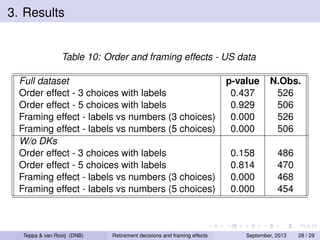
Table 10: Order and framing effects - US data
Full dataset
Order effect - 3 choices with labels
Order effect - 5 choices with labels
Framing effect - labels vs numbers (3 choices)
Framing effect - labels vs numbers (5 choices)
W/o DKs
Order effect - 3 choices with labels
Order effect - 5 choices with labels
Framing effect - labels vs numbers (3 choices)
Framing effect - labels vs numbers (5 choices)

Teppa & van Rooij (DNB)

Retirement decisions and framing effects

p-value
0.437
0.929
0.000
0.000

N.Obs.
526
506
526
506

0.158
0.814
0.000
0.000

486
470
468
454

September, 2013

28 / 29
4. Concluding remarks

1

Main findings
Retirement choices are very sensitive to institutional/plan design
Strong role of framing effect and choice set effect; less role of order
effect
Strong and robust role of standard option for both pension premium
contributions and pension savings investment profiles
Consistency between hypothetical preferences and actual choices

2

Relevance and policy implications
Context of increasing responsibility of individuals decisions and
increasing complexity
Importance of communication, as well as regulation and
supervision on how alternative choices are presented to individuals

Teppa & van Rooij (DNB)

Retirement decisions and framing effects

September, 2013

29 / 29

Federica Teppa, Maarten van Rooij. Are Retirement Decisions Vulnerable to Framing Effects?

  • 1.
    Are Retirement DecisionsVulnerable to Framing Effects? Empirical Evidence from NL and US Federica Teppa (De Nederlandsche Bank & Netspar) Maarten van Rooij (De Nederlandsche Bank & Netspar) Bank of Estonia seminar Tallinn - September, 2013 Teppa & van Rooij (DNB) Retirement decisions and framing effects September, 2013 1 / 29
  • 2.
    1. Introduction andMotivation The rapidly ageing trend experienced by the population in all developed countries in the recent years and in the years to come has put public finances into severe distress.: 1 OECD : in 2010 the largest proportion of retirement income (some 60 percent) is provided by the state, mostly via PAYG systems where benefits are paid out of current taxes The need for cutting the costs of public pension provisions has been at the basis of a number of pension reforms taking place recently. 1 Governments are no longer going to act as the main (or even the only) provider of old-age income, but more and more limiting their goal as to ensure a minimum level of adequate income to the elderly 2 Shifting risks to the individuals who are becoming increasingly responsible for the fraction of their retirement income exceeding the publicly provided component. Teppa & van Rooij (DNB) Retirement decisions and framing effects September, 2013 2 / 29
  • 3.
    1. Introduction andMotivation Behavioral aspects of the individual decision making process are being studied extensively. 1 2 Increasing availability of both administrative records and survey data on real and hypothetical choices in several countries Combination of several disciplines economics (Butler and Teppa, 2007; Agnew et al., 2008; Brown et ¨ al., 2008) psychology (Kahneman and Miller, 1986; Gonzales et al., 2005), neurology (Rogers et al., 1999; De Martino et al., 2006) sociology 3 Final outcomes of any decision making process are very often contingent upon how alternatives are displayed to the agents The significant role of this framing effect represents probably the most striking violation of rationality in standard economic theory. Teppa & van Rooij (DNB) Retirement decisions and framing effects September, 2013 3 / 29
  • 4.
    1. Introduction andMotivation Brown et al. (2011) RAND American Life Panel (ALP) Participants were confronted with alternative information formats about how benefits would be adjusted if they were to claim retirement benefits early versus later Individual intentions with regard to Social Security claiming ages are sensitive to how the early versus late claiming decision is framed Teppa & van Rooij (DNB) Retirement decisions and framing effects September, 2013 4 / 29
  • 5.
    1. This paper 1 Methodology Hypotheticalquestions from DHS and ALP in 2006 Individual preferences over pension premium contributions and pension savings investment profiles 2 Main findings Strong role of framing effect and choice set effect; less role of order effect Strong and robust role of standard option for both pension premium contributions and pension savings investment profiles Evidence of consistency between hypothetical and actual preferences (e.g. portfolio holdings) Positive correlation btw framing effects and complexity of decisions to be made 3 Relevance and policy implications Context of increasing responsibility of individuals decisions and increasing complexity Importance of communication, as well as regulation and supervision on how alternative choices are presented to individuals Teppa & van Rooij (DNB) Retirement decisions and framing effects September, 2013 5 / 29
  • 6.
    Outline 1 Introduction and Motivation 2 Data 3 Results 4 Concludingremarks Teppa & van Rooij (DNB) Retirement decisions and framing effects September, 2013 6 / 29
  • 7.
    2. The data- DHS Table 1: DNB Household Survey response rates by questionnaire Questionnaire Questionnaire 1 Questionnaire 2 Questionnaire 3 Questionnaire 4 Contacted 2,476 2,485 2,528 2,284 Completed 1,648 1,722 1,915 1,590 Response rate (%) 66.5 69.2 75.7 70.7 When fielded June 2-6, 2006 June 30-July 3, 2006 June 16-20, 2006 July 14-18, 2006 Source: DHS, 2006 - The second column reports the number of panel members aged 16 years and older selected and contacted; - The third column reports the number of selected panel members who returned the completed questionnaire; - The response rate is simply the ratio between column three and column two. Teppa & van Rooij (DNB) Retirement decisions and framing effects September, 2013 7 / 29
  • 8.
    2. DHS questionnaires 1 Object Pensionpremium contributions Pension savings asset allocation 2 Presentation Large vs restricted choice set High vs low numbers Labels vs numbers Teppa & van Rooij (DNB) Retirement decisions and framing effects September, 2013 8 / 29
  • 9.
    2. DHS questionnaires Pensionpremium contributions Q11. “Restricted choice set” and “Low numbers”: Imagine you have a job with a defined contribution pension plan and you have to decide how much to contribute. If you pay a higher contribution rate your net wage will be lower, but your final pension income will be higher. The standard contribution rate that you pay is 12% of your gross wage. However, you can also opt for a high contribution rate (14%) or a low contribution rate (10%). Which plan would you choose? − Standard contribution rate − High contribution rate − Low contribution rate − I do not want to say it − I do not know Teppa & van Rooij (DNB) Retirement decisions and framing effects September, 2013 9 / 29
  • 10.
    2. DHS questionnaires Q12.“Large choice set” and “Low numbers”: Imagine you have a job with a defined contribution pension plan and you have to decide how much to contribute. If you pay a higher contribution rate your net wage will be lower, but your final pension income will be higher. The standard contribution rate that you pay is 12% of your gross wage. However, you can also opt for a very high contribution rate (16%) or a high contribution rate (14%) or a low contribution rate (10%) or a very low contribution rate (8%). Which plan would you choose? − Standard contribution rate − Very high contribution rate − High contribution rate − Low contribution rate − Very low contribution rate − I do not want to say it − I do not know Teppa & van Rooij (DNB) Retirement decisions and framing effects September, 2013 10 / 29
  • 11.
    2. DHS questionnaires Q13.“Restricted choice set” and “High numbers”: Imagine you have a job with a defined contribution pension plan and you have to decide how much to contribute. If you pay a higher contribution rate your net wage will be lower, but your final pension income will be higher. The standard contribution rate that you pay is 20% of your gross wage. However, you can also opt for a high contribution rate (22%) or a low contribution rate (18%). Which plan would you choose? − Standard contribution rate − High contribution rate − Low contribution rate − I do not want to say it − I do not know Teppa & van Rooij (DNB) Retirement decisions and framing effects September, 2013 11 / 29
  • 12.
    2. DHS questionnaires Pensionsavings investment profiles Q15. “Restricted choice set” and “Low numbers”: Suppose you have a job and the pension system is reformed so that everyone in responsible for his own retirement savings (through his company’s pension fund) and everyone should tell how his pension fund contributions must be invested in equities and bonds. The final pension depends on this decision and the returns on financial markets. Now imagine that your pension will allow you to tell how your pension contributions must be allocated into equities and bonds. You can opt for a standard allocation (30% stocks-70% bonds). However, you can ask your employer to change the portfolio allocation so that you can have a risky profile (45% stocks-55% bonds) or a safe profile (15% stocks-85% bonds). Which portfolio allocation would you choose? − Standard investment profile − Risky investment profile − Safe investment profile − I do not want to say it − I Teppanot know do & van Rooij (DNB) Retirement decisions and framing effects September, 2013 12 / 29
  • 13.
    2. DHS questionnaires Q17.“Restricted choice set” and “High numbers”: Suppose you have a job and the pension system is reformed so that everyone in responsible for his own retirement savings (through his company’s pension fund) and everyone should tell how his pension fund contributions must be invested in equities and bonds. The final pension depends on this decision and the returns on financial markets. Now imagine that your pension will allow you to tell how your pension contributions must be allocated into equities and bonds. You can opt for a standard allocation (70% stocks-30% bonds). However, you can ask your employer to change the portfolio allocation so that you can have a risky profile (85% stocks-15% bonds) or a safe profile (55% stocks-45% bonds). Which portfolio allocation would you choose? − Standard investment profile − Risky investment profile − Safe investment profile − I do not want to say it − I do not know Teppa & van Rooij (DNB) Retirement decisions and framing effects September, 2013 13 / 29
  • 14.
    2. DHS questionnaires Q21.“Restricted choice set” and “Low numbers”: Imagine you have a job with a defined contribution pension plan and you have to decide how much to contribute. If you pay a higher contribution rate your net wage will be lower, but your final pension income will be higher. Which plan would you choose? − 10% contribution rate − 12% contribution rate − 14% contribution rate − I do not want to say it − I do not know Teppa & van Rooij (DNB) Retirement decisions and framing effects September, 2013 14 / 29
  • 15.
    3. Results Table 2:Pension premium contributions and Pension savings investment profiles - labels Restricted choice set Standard High Low I do not want to say it I do not know TOTAL Large choice set Standard Very high High Low Very low I do not want to say it I do not know TOTAL Teppa & van Rooij (DNB) Pension premium contributions Low numbers version High numbers version Freq. Percent Cumulative Freq. Percent Cumulative 470 58.39 58.39 457 54.21 54.21 178 22.11 80.50 194 23.01 77.22 42 5.22 85.71 43 5.10 82.33 6 0.75 86.46 6 0.71 83.04 109 13.54 100 143 16.96 100 805 100 843 100 Freq. Percent Cumulative Freq. Percent Cumulative 366 45.47 45.47 371 44.01 44.01 23 2.86 48.32 21 2.49 46.50 229 28.45 76.77 205 24.32 70.82 43 5.34 82.11 55 6.52 77.34 17 2.11 84.22 16 1.90 79.24 5 0.62 84.84 7 0.83 80.07 122 15.16 100 168 19.93 100 805 100 843 100 Retirement decisions and framing effects September, 2013 15 / 29
  • 16.
    3. Results Table 2:Pension premium contributions and Pension savings investment profiles - labels Restricted choice set Standard Risky Safe I do not want to say it I do not know TOTAL Large choice set Standard Very Risky Risky Safe Very Safe I do not want to say it I do not know TOTAL Teppa & van Rooij (DNB) Pension savings investment profiles Low numbers version High numbers version Freq. Percent Cumulative Freq. Percent Cumulative 289 35.50 35.50 250 29.98 29.98 47 5.77 41.28 31 3.72 33.69 307 37.71 78.99 389 46.64 80.34 8 0.98 79.98 7 0.84 81.18 163 20.02 100 157 18.82 100 814 100 834 100 Freq. Percent Cumulative Freq. Percent Cumulative 231 28.38 28.38 216 25.90 25.90 6 0.74 29.12 3 0.36 26.26 46 5.65 34.77 36 4.32 30.58 283 34.77 69.53 288 34.53 65.11 72 8.85 78.38 119 14.27 79.38 9 1.11 79.48 6 0.72 80.10 167 20.52 100 166 19.90 100 814 100 834 100 Retirement decisions and framing effects September, 2013 16 / 29
  • 17.
    3. Results Table 3:Pension premium contributions and investment profiles - numbers Restricted choice set 10 % (low) or 18 % (high) 12 % or 20 % 14 % or 22 % I do not want to say it I do not know TOTAL Large choice set 8 % (low) or 16 % (high) 10 % or 18 % 12 % or 20 % 14 % or 22 % 16 % or 24 % I do not want to say it I do not know TOTAL Teppa & van Rooij (DNB) Pension premium contributions Low numbers version High numbers version Freq. Percent Cumulative Freq. Percent Cumulative 127 29.60 29.60 115 27.06 27.06 163 38.00 67.60 172 40.47 67.53 67 15.62 83.22 34 8.00 75.53 5 1.17 84.38 6 1.41 76.94 67 15.62 100 98 23.06 100 429 100 425 100 Freq. Percent Cumulative Freq. Percent Cumulative 76 16.85 16.85 87 20.86 20.86 91 20.18 37.03 67 16.07 36.93 118 26.16 63.19 128 30.70 67.63 28 6.21 70.29 20 4.80 72.42 17 2.11 76.50 16 1.90 79.24 4 0.68 77.38 7 1.68 76.98 102 22.62 100 96 23.02 100 451 100 417 100 Retirement decisions and framing effects September, 2013 17 / 29
  • 18.
    3. Results Table 3:Pension premium contributions and investment profiles - numbers Restricted choice set 15-85% (low) or 45-55% (high) 30-70% or 70-30% 45-55% or 85-15% I do not want to say it I do not know TOTAL Large choice set 0-100% (low) or 40-60% (high) 15-85% or 55-45% 30-70% or 70-30% 45-55% or 85-15% 60-40% or 100-0% I do not want to say it I do not know TOTAL Pension savings investment profiles Low numbers version Freq. Percent Cumulative 105 22.93 22.93 128 27.95 50.87 73 15.94 66.81 7 1.53 68.34 145 31.66 100 458 100 Freq. Percent Cumulative 29 7.06 7.06 54 13.14 20.19 106 25.79 45.99 55 13.38 59.37 32 7.79 67.15 7 1.70 68.86 128 31.14 100 411 100 Freq. 220 60 18 6 127 431 Freq. 137 82 52 17 10 4 120 422 High numbers version Percent Cumulative 51.04 51.04 13.92 64.97 4.18 69.14 1.39 70.53 29.47 100 100 Percent Cumulative 32.46 32.46 19.43 51.90 12.32 64.22 4.03 68.25 2.37 70.62 0.95 71.56 28.44 100 100 Notes: For investment profiles, the percentages represent the combination stocks-bonds. Teppa & van Rooij (DNB) Retirement decisions and framing effects September, 2013 18 / 29
  • 19.
    3. Results Table 4:Role of the standard option Pension premium contributions Freq. Percent Cumulative Standard (14 %) 629 54.22 54.22 High (16 %) 304 26.21 80.43 Very high (18 %) 79 6.81 87.24 I do not want to say it 3 0.26 87.50 I do not know 145 12.50 100 TOTAL 1,160 100 Low (14 %) 66 5.77 5.77 Standard (16 %) 691 60.40 66.17 High (18 %) 253 22.12 88.29 I do not want to say it 15 1.31 89.60 I do not know 119 10.40 100 TOTAL 1,144 100 Standard (18 %) 875 73.16 73.16 Low (16 %) 126 10.54 83.70 Very low (14 %) 52 4.35 88.04 I do not want to say it 9 0.75 88.80 I do not know 134 11.20 100 TOTAL 1,196 100 Teppa & van Rooij (DNB) Retirement decisions and framing effects September, 2013 19 / 29
  • 20.
    3. Results Table 4:Role of the standard option Pension savings investment profiles Freq. Percent Standard (45% stocks-55% bonds) 313 26.71 Safe (30% stocks-70% bonds) 449 38.31 Very safe (15% stocks-85% bonds) 249 21.25 I do not want to say it 5 0.43 I do not know 156 13.31 TOTAL 1,172 100 Safe (15% stocks-85% bonds) 422 35.79 Standard (30% stocks-70% bonds) 520 44.11 Risky (45% stocks-55% bonds) 58 4.92 I do not want to say it 9 0.76 I do not know 170 14.42 TOTAL 1,179 100 Standard (15% stocks-85% bonds) 812 70.73 Risky (30% stocks-70% bonds) 143 12.46 Very risky (45% stocks-55% bonds) 23 2.00 I do not want to say it 13 1.13 I do not know 157 13.68 TOTAL 1,148 100 Teppa & van Rooij (DNB) Retirement decisions and framing effects Cumulative 26.71 65.02 86.26 86.69 100 35.79 79.90 84.82 85.58 100 70.73 83.19 85.19 86.32 100 September, 2013 20 / 29
  • 21.
    3. Results Table 5:Order, choice set and framing effects Pension premium contributions Low numbers version p-value N.Obs. 0.543 805 0.030 805 0.000 805 0.000 289 0.000 327 Full dataset Order effect - 3 choices with labels Order effect - 5 choices with labels Choice set effect - 3 choices vs 5 choices with labels Framing effect - labels vs numbers (3 choices) Framing effect - labels vs numbers (5 choices) W/o DKs Order effect - 3 choices with labels Order effect - 5 choices with labels Choice set effect - 3 choices vs 5 choices with labels Framing effect - labels vs numbers (3 choices) Framing effect - labels vs numbers (5 choices) Teppa & van Rooij (DNB) 0.781 0.008 0.000 0.000 0.000 690 678 655 229 235 Retirement decisions and framing effects High numbers version p-value N.Obs. 0.098 843 0.423 843 0.000 843 0.000 311 0.000 295 0.020 0.250 0.000 0.000 0.000 694 668 640 215 196 September, 2013 21 / 29
  • 22.
    3. Results Table 5:Order, choice set and framing effects Pension savings investment profiles Low numbers version p-value N.Obs. 0.061 814 0.095 814 0.000 814 0.000 313 0.000 294 Full dataset Order effect - 3 choices with labels Order effect - 5 choices with labels Choice set effect - 3 choices vs 5 choices with labels Framing effect - labels vs numbers (3 choices) Framing effect - labels vs numbers (5 choices) W/o DKs Order effect - 3 choices with labels Order effect - 5 choices with labels Choice set effect - 3 choices vs 5 choices with labels Framing effect - labels vs numbers (3 choices) Framing effect - labels vs numbers (5 choices) Teppa & van Rooij (DNB) 0.619 0.165 0.000 0.000 0.000 308 304 617 192 186 Retirement decisions and framing effects High numbers version p-value N.Obs. 0.736 834 0.009 834 0.000 834 0.000 305 0.000 310 0.137 0.025 0.000 0.020 0.000 321 319 645 193 200 September, 2013 22 / 29
  • 23.
    3. Results Table 6a:Role of standard option - Pension premium contributions - probit estimates Variable 14 percent 16 percent Coefficient Coefficient [Marg.eff.] [Marg.eff.] (Std. Err.) (Std. Err.) Labeled standard 1.027 *** -0.177 * [0.311] [-0.069] (0.125) (0.099) SAS financial literacy 0.114 0.025 [0.043] [0.010] (0.091) (0.088) Female -0.153 * 0.082 [-0.056] [0.032] (0.080) (0.077) Age less than 40 years 0.346 ** -0.020 [0.132] [-0.008] (0.127) (0.121) Age between 40 and 64 years 0.224 ** -0.170 * [0.083] [-0.067] (0.107) (0.102) Gross household income (in logs) 0.010 -0.183 ** [0.003] [-0.072] (0.088) (0.086) Total fin. assets (in logs) -0.010 -0.016 [-0.003] [-0.006] (0.028) (0.027) Constant -0.978 1.422 ** (0.721) (0.705) Log-likelihood -749.708 -816.210 Pseudo R2 0.066 0.028 N.Obs. 1215 1215 Teppa & van Rooij (DNB) Retirement decisions and framing effects 18 percent Coefficient [Marg.eff.] (Std. Err.) 0.208 ** [0.082] (0.098) -0.184 ** [-0.073] (0.088) -0.066 [-0.026] (0.076) -0.334 ** [-0.132] (0.121) -0.196 * [-0.077] (0.102) 0.006 [0.002] (0.085) 0.045 * [0.018] (0.027) -0.428 (0.701) -817.545 0.024 1215 September, 2013 23 / 29
  • 24.
    3. Results Table 6b:Role of standard option - Pension savings investment profile - probit estimates Variable 45-55 percent 30-70 percent Coefficient Coefficient [Marg.eff.] [Marg.eff.] (Std. Err.) (Std. Err.) Labeled standard 0.712 *** -0.115 [0.158] [-0.046] (0.112) (0.081) SAS financial literacy 0.339 *** -0.187 ** [0.094] [-0.074] (0.102) (0.090) Female -0.209 ** -0.159 ** [-0.053] [-0.063] (0.094) (0.078) Age less than 40 years 0.263 * 0.020 [0.072] [0.008] (0.147) (0.122) Age between 40 and 64 years 0.191 0.024 [0.049] [0.009] (0.124) (0.009) Gross hh income (in logs) 0.032 0.063 [0.008] [0.025] (0.104) (0.087) Total fin. assets (in logs) 0.082 ** -0.038 [0.021] [-0.015] (0.033) (0.028) Constant -2.118 ** 0.205 (0.842) (0.704) Log-likelihood -538.100 -801.155 Pseudo R2 0.092 0.023 N.Obs. 1184 1184 Teppa & van Rooij (DNB) Retirement decisions and framing effects 15-85 percent Coefficient [Marg.eff.] (Std. Err.) 0.182 ** [0.069] (0.084) -0.163 * [-0.061] (0.091) 0.262 *** [0.096] (0.081) -0.204 [-0.007] (0.127) -0.170 [-0.063] (0.108) -0.141 [-0.052] (0.090) 0.012 [0.004] (0.028) 1.087 (0.734) -736.706 0.051 1184 September, 2013 24 / 29
  • 25.
    3. Results Table 7:Role of risk attitudes - Pension savings investment profiles - probit estimates Variable Labeled standard Saving1 Saving2 Saving3 Saving4 Saving5 Saving6 Joint significance test Log-likelihood Pseudo R2 N.Obs. Teppa & van Rooij (DNB) 45-55 percent Coefficient [Marg.eff.] (Std. Err.) 0.720 *** [0.155] (0.120) -0.253 ** [-0.067] (0.117) -0.346 *** [-0.086] (0.102) -0.130 [-0.031] (0.151) 0.056 [0.013] (0.124) 0.309 ** [0.085] (0.121) 0.187 [0.050] (0.141) 0.000 -494.184 0.127 1122 30-70 percent Coefficient [Marg.eff.] (Std. Err.) -0.125 [-0.050] (0.085) 0.069 [0.027] (0.101) -0.284 *** [-0.113] (0.084) 0.259 ** [0.102] (0.132) -0.007 [-0.003] (0.105) 0.065 [0.025] (0.110) 0.225 * [0.089] (0.131) 0.000 -744.214 0.043 1122 Retirement decisions and framing effects 15-85 percent Coefficient [Marg.eff.] (Std. Err.) 0.218 ** [0.082] (0.089) 0.083 [0.031] (0.104) 0.440 *** [0.162] (0.087) 0.082 [0.030] (0.135) 0.004 [0.001] (0.109) -0.163 [-0.061] (0.113) -0.319 ** [-0.122] (0.132) 0.000 -673.521 0.086 1122 September, 2013 25 / 29
  • 26.
    3. Results Table 8:Pension savings investment profiles and household wealth - probit estimates Variable 45-55 percent Coefficient [Marg.eff.] (Std. Err.) 0.611 *** [0.143] (0.085) 0.040 ** [0.010] (0.013) -0.430 *** (0.083) -814.520 0.037 1733 Labeled standard Total hh wealth Constant Log-likelihood Pseudo R2 N.Obs. Labeled standard Financial hh wealth Constant Log-likelihood Pseudo R2 N.Obs. Teppa & van Rooij (DNB) 30-70 percent Coefficient [Marg.eff.] (Std. Err.) -0.063 [-0.025] (0.064) 0.008 [0.003] (0.012) 0.008 (0.061) -1200.407 0.001 1733 15-85 percent Coefficient [Marg.eff.] (Std. Err.) 0.220 *** [0.085] (0.089) -0.032 * [-0.012] (0.012) 0.219 *** (0.061) -1147.166 0.001 1733 0.610 *** [0.143] (0.085) 0.121 *** [0.031] (0.031) -1.391 *** (0.077) -811.476 0.041 1733 -0.062 [-0.024] (0.085) -0.005 [-0.002] (0.101) 0.069 (0.101) -1200.614 0.001 1733 0.219 *** [0.084] (0.065) -0.066 ** [-0.025] (0.029) 0.172 ** (0.055) -1148.061 0.006 1733 Retirement decisions and framing effects September, 2013 26 / 29
  • 27.
    3. Results Table 9:Pension savings investment profiles and portfolio choice - probit estimates Variable 45-55 percent 30-70 percent Coefficient Coefficient [Marg.eff.] [Marg.eff.] (Std. Err.) (Std. Err.) Labeled standard 0.599 *** -0.069 [0.140] [-0.027] (0.086) (0.065) No risky assets 0.027 0.012 [0.007] [0.005] (0.063) (0.054) Bonds and money lent out 0.052 -0.175 [0.013] [-0.070] (0.114) (0.115) Options, mutual funds and stocks 0.299 *** 0.022 [0.078] [0.008] (0.074) (0.066) Real estate -0.007 0.001 [-0.002] [0.001] (0.022) (0.019) Business equity 0.144 0.133 [0.037] [0.053] (0.179) (0.156) Mortgages -0.063 -0.059 [-0.016] [-0.023] (0.047) (0.041) Financial debt -0.322 0.115 [-0.084] [0.046] (0.256) (0.248) Log-likelihood -805.364 -1197.307 Pseudo R2 0.048 0.003 Teppa & van Rooij (DNB) Retirement decisions and framing effects N.Obs. 1733 1733 15-85 percent Coefficient [Marg.eff.] (Std. Err.) 0.237 *** [0.091] (0.066) -0.025 [-0.009] (0.054) 0.146 [0.056] (0.112) -0.262 *** [-0.100] (0.080) -0.008 [-0.003] (0.019) 0.076 [0.029] (0.167) 0.078 * [0.029] (0.248) 0.072 [0.027] (0.248) -1139.747 0.013 September, 2013 1733 27 / 29
  • 28.
    3. Results Table 10:Order and framing effects - US data Full dataset Order effect - 3 choices with labels Order effect - 5 choices with labels Framing effect - labels vs numbers (3 choices) Framing effect - labels vs numbers (5 choices) W/o DKs Order effect - 3 choices with labels Order effect - 5 choices with labels Framing effect - labels vs numbers (3 choices) Framing effect - labels vs numbers (5 choices) Teppa & van Rooij (DNB) Retirement decisions and framing effects p-value 0.437 0.929 0.000 0.000 N.Obs. 526 506 526 506 0.158 0.814 0.000 0.000 486 470 468 454 September, 2013 28 / 29
  • 29.
    4. Concluding remarks 1 Mainfindings Retirement choices are very sensitive to institutional/plan design Strong role of framing effect and choice set effect; less role of order effect Strong and robust role of standard option for both pension premium contributions and pension savings investment profiles Consistency between hypothetical preferences and actual choices 2 Relevance and policy implications Context of increasing responsibility of individuals decisions and increasing complexity Importance of communication, as well as regulation and supervision on how alternative choices are presented to individuals Teppa & van Rooij (DNB) Retirement decisions and framing effects September, 2013 29 / 29