Monetary Policy and Research Department, Bank of Finland
Persistent misallocation or a necessary
temporary evil?
Micro evidence on zombie demographics from European countries
Juuso Vanhala
* The opinions expressed in this paper are those of the authors, and do not necessarily reflect the views of the Bank of Finland, National Central Banks of the Eurosystem or the Eurosystem. All errors
are our responsibility
| Public
Co-authors
•Juuso Vanhala
•Tibor Lalinský
•Paloma Lopez-Garcia
•Fernando Martins
•Maurice J.G. Bun
•Davide Fantino
•Jaanika Meriküll
•Konstantis Benkovskis
30.3.2023 2
| Public
30.3.2023 3
| Public 4
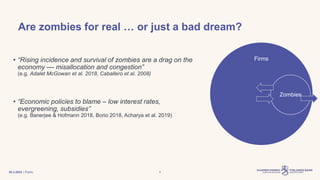
• “Rising incidence and survival of zombies are a drag on the
economy –– misallocation and congestion”
(e.g. Adalet McGowan et al. 2018, Caballero et al. 2008)
• “Economic policies to blame – low interest rates,
evergreening, subsidies”
(e.g. Banerjee & Hofmann 2018, Borio 2018, Acharya et al. 2019)
Are zombies for real … or just a bad dream?
Firms
Zombies
30.3.2023
| Public
This presentation
• Dynamic model to identify zombies
• Evidence from 8 EA countries on zombie demographics
• “False zombies”: growing firms and recoveries
• Zombification is cyclical – no secular rise
• Entries drives zombification – not persistent survival
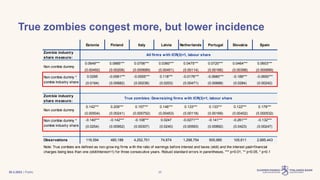
• Zombies and congestion
• True zombies have stronger congestion effects
• But less true zombies that cause congestion
• Accomodative policies have various effects on zombie incidence through entry and exit margins
Builds on Nurmi, Vanhala & Virén (2022), ECB (2021) and current work at ESCB
30.3.2023 5
| Public
Literature
• Zombies and banks in Japan 1990s (Hoshi 2000, 2006, Caballero et al. 2008)
• Interest in “rise of zombies” in aftermath of GFC (e.g. Acharya et al. 2019, Adalet
McGowan et al. 2018, Banerjee & Hoffman 2018)
• Zombies and monetary policy (Duval and Obstfeld 2018, Bindseil and Schaaf 2020,
Demetris and Viegi 2021)
• Zombies and evergreening (Acharya et al. 2019, Andrews & Petrouliakis 2019))
• Zombie demographics and public subsidies (Nurmi, Vanhala & Virén 2022)
30.3.2023 6
| Public
Identifying zombies
1. Hoshi (2006), Caballero et al. (2008): firm-bank relationships in 1990s Japan: firms with
extremely low interest payments given their levels of debt and likely receive financial aid
from their lenders.
• Acharya et al. (2016) and Schivardi et al (2018) study European countries from this perspective
2. Measures of weak firm performance / persistently low interest coverage ratio,
EBIT/interest<1 for three consecutive years, combined with 10-year age threshold (e.g.
Adalet McGowan et al. 2018, OECD)
3. Nurmi, Vanhala & Virén (2022): theory of firm entry and exit , e.g. Hopenhayn 1992,
Syverson 2011, Decker et al. 2016
30.3.2023 7
| Public
Identifying zombies: “static” definition
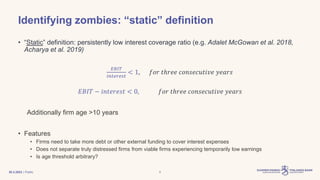
• “Static” definition: persistently low interest coverage ratio (e.g. Adalet McGowan et al. 2018,
Acharya et al. 2019)
𝐸𝐵𝐼𝑇
𝑖𝑛𝑡𝑒𝑟𝑒𝑠𝑡
< 1, 𝑓𝑜𝑟 𝑡ℎ𝑟𝑒𝑒 𝑐𝑜𝑛𝑠𝑒𝑐𝑢𝑡𝑖𝑣𝑒 𝑦𝑒𝑎𝑟𝑠
𝐸𝐵𝐼𝑇 − 𝑖𝑛𝑡𝑒𝑟𝑒𝑠𝑡 < 0, 𝑓𝑜𝑟 𝑡ℎ𝑟𝑒𝑒 𝑐𝑜𝑛𝑠𝑒𝑐𝑢𝑡𝑖𝑣𝑒 𝑦𝑒𝑎𝑟𝑠
Additionally firm age >10 years
• Features
• Firms need to take more debt or other external funding to cover interest expenses
• Does not separate truly distressed firms from viable firms experiencing temporarily low earnings
• Is age threshold arbitrary?
30.3.2023 8
| Public
Identifying zombies in a dynamic model
(Nurmi, Vanhala & Virén 2022 IJIO)
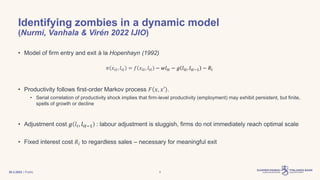
• Model of firm entry and exit à la Hopenhayn (1992)
𝜋 𝑥𝑖𝑡, 𝑙𝑖𝑡 = 𝑓 𝑥𝑖𝑡, 𝑙𝑖𝑡 − 𝑤𝑙𝑖𝑡 − 𝑔 𝑙𝑖𝑡, 𝑙𝑖𝑡−1 − 𝑅𝑖
• Productivity follows first-order Markov process 𝐹 𝑥, 𝑥′ .
• Serial correlation of productivity shock implies that firm-level productivity (employment) may exhibit persistent, but finite,
spells of growth or decline
• Adjustment cost 𝑔 𝑙𝑡, 𝑙𝑖𝑡−1 : labour adjustment is sluggish, firms do not immediately reach optimal scale
• Fixed interest cost 𝑅𝑖 to regardless sales – necessary for meaningful exit
30.3.2023 9
| Public
Identifying zombies in a dynamic model
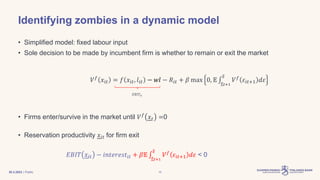
• Simplified model: fixed labour input
• Sole decision to be made by incumbent firm is whether to remain or exit the market
𝑉𝑓 𝑥𝑖𝑡 = 𝑓 𝑥𝑖𝑡, 𝑙𝑖𝑡 − 𝑤𝑙 − 𝑅𝑖𝑡 + 𝛽 max 0, 𝔼 𝜀𝑡+1
𝜀
𝑉𝑓 𝜀𝑖𝑡+1 𝑑𝜀
• Firms enter/survive in the market until 𝑉𝑓 𝑥𝑡 =0
• Reservation productivity 𝑥𝑖𝑡 for firm exit
𝐸𝐵𝐼𝑇 𝑥𝑖𝑡 − 𝑖𝑛𝑡𝑒𝑟𝑒𝑠𝑡𝑖𝑡 + 𝛽𝔼 𝜀𝑡+1
𝜀
𝑉𝑓 𝜀𝑖𝑡+1 𝑑𝜀 < 0
30.3.2023 10
𝐸𝐵𝐼𝑇𝑖𝑡
| Public
Identifying zombies is a dynamic model
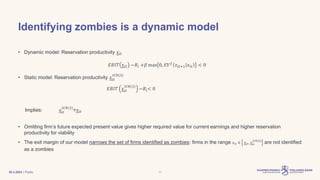
• Dynamic model: Reservation productivity 𝑥𝑖𝑡
𝐸𝐵𝐼𝑇 𝑥𝑖𝑡 −𝑅𝑖 +𝛽 max 0, 𝐸𝑉𝑓
𝑥𝑖𝑡+1 𝑥𝑖𝑡 < 0
• Static model: Reservation productivity 𝑥𝑖𝑡
𝐼𝐶𝑅(3)
𝐸𝐵𝐼𝑇 𝑥𝑖𝑡
𝐼𝐶𝑅(3)
−𝑅𝑖< 0
Implies: 𝑥𝑖𝑡
𝐼𝐶𝑅(3)
>𝑥𝑖𝑡
• Omitting firm’s future expected present value gives higher required value for current earnings and higher reservation
productivity for viability
• The exit margin of our model narrows the set of firms identified as zombies: firms in the range 𝑥𝑖𝑡 ∈ 𝑥𝑖𝑡, 𝑥𝑖𝑡
𝐼𝐶𝑅(3)
are not identified
as a zombies
30.3.2023 11
| Public
General features arising from dynamic model
• Fixed costs
• Each productivity draw changes firm’s profitability relative to fixed costs
• Zombie exit or survival depends on persistence of productivity shock
• Adjustment costs
• Firms adjust their scale to both positive and negative shocks
• Cost of adjustment relative to continuation value more binding for downsizing firms
• Rescaling production is sluggish: firms may be on adjustment path (possibly as zombies)
for an extended time
• Rescaling is instant in the absence of adjustment costs – no zombies?
30.3.2023 12
| Public
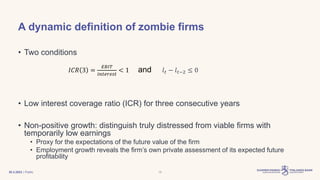
A dynamic definition of zombie firms
• Two conditions
𝐼𝐶𝑅 3 =
𝐸𝐵𝐼𝑇
𝑖𝑛𝑡𝑒𝑟𝑒𝑠𝑡
< 1 and 𝑙𝑡 − 𝑙𝑡−2 ≤ 0
• Low interest coverage ratio (ICR) for three consecutive years
• Non-positive growth: distinguish truly distressed from viable firms with
temporarily low earnings
• Proxy for the expectations of the future value of the firm
• Employment growth reveals the firm’s own private assessment of its expected future
profitability
30.3.2023 13
| Public
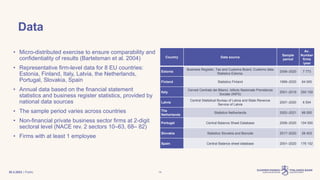
Data
• Micro-distributed exercise to ensure comparability and
confidentiality of results (Bartelsman et al. 2004)
• Representative firm-level data for 8 EU countries:
Estonia, Finland, Italy, Latvia, the Netherlands,
Portugal, Slovakia, Spain
• Annual data based on the financial statement
statistics and business register statistics, provided by
national data sources
• The sample period varies across countries
• Non-financial private business sector firms at 2-digit
sectoral level (NACE rev. 2 sectors 10–63, 68– 82)
• Firms with at least 1 employee
30.3.2023 14
Country Data source
Sample
period
Av.
Number
firms
/year
Estonia
Business Register, Tax and Customs Board, Customs data
Statistics Estonia.
2006–2020 7 773
Finland Statistics Finland 1999–2020 64 000
Italy
Cerved Centrale dei Bilanci, Istituto Nazionale Previdenza
Sociale (INPS)
2001–2019 250 159
Latvia
Central Statistical Bureau of Latvia and State Revenue
Service of Latvia
2007–2020 6 504
The
Netherlands
Statistics Netherlands 2002–2021 66 000
Portugal Central Balance Sheet Database 2006–2020 104 000
Slovakia Statistics Slovakia and Bisnode 2017–2020 26 403
Spain Central Balance sheet database 2001–2020 176 152
| Public
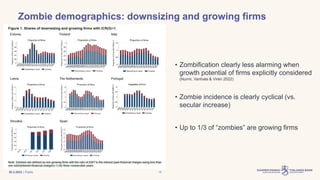
Zombie demographics: downsizing and growing firms
30.3.2023 15
• Zombification clearly less alarming when
growth potential of firms explicitly considered
(Nurmi, Vanhala & Virén 2022)
• Zombie incidence is clearly cyclical (vs.
secular increase)
• Up to 1/3 of “zombies” are growing firms
| Public
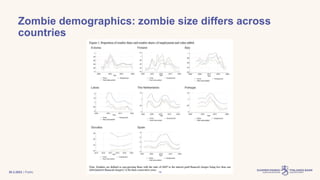
Zombie demographics: zombie size differs across
countries
30.3.2023 16
| Public
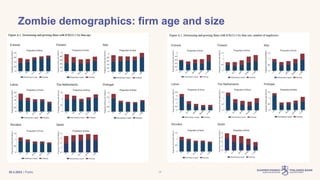
Zombie demographics: firm age and size
30.3.2023 17
| Public
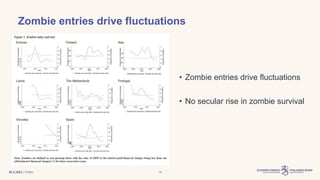
Zombie entries drive fluctuations
30.3.2023 18
• Zombie entries drive fluctuations
• No secular rise in zombie survival
| Public
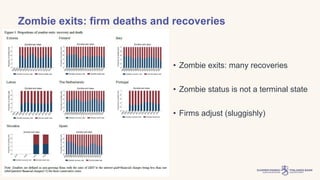
Zombie exits: firm deaths and recoveries
30.3.2023 19
• Zombie exits: many recoveries
• Zombie status is not a terminal state
• Firms adjust (sluggishly)
| Public
Competing risks model
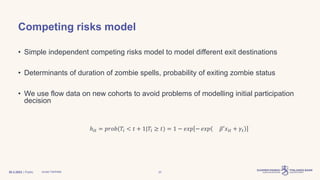
• Simple independent competing risks model to model different exit destinations
• Determinants of duration of zombie spells, probability of exiting zombie status
• We use flow data on new cohorts to avoid problems of modelling initial participation
decision
30.3.2023 Juuso Vanhala 20
ℎ𝑖𝑡 = 𝑝𝑟𝑜𝑏(𝑇𝑖 < 𝑡 + 1|𝑇𝑖 ≥ 𝑡) = 1 − 𝑒𝑥𝑝 )
− 𝑒𝑥𝑝( 𝛽′𝑥𝑖𝑡 + 𝛾𝑡
| Public
Determinants of exit destinations and zombie duration:
competing risks model (FI data)
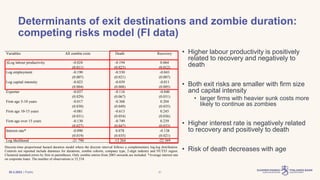
• Higher labour productivity is positively
related to recovery and negatively to
death
• Both exit risks are smaller with firm size
and capital intensity
• larger firms with heavier sunk costs more
likely to continue as zombies
• Higher interest rate is negatively related
to recovery and positively to death
• Risk of death decreases with age
30.3.2023 21
Variables All zombie exits Death Recovery
∆Log labour productivity -0.024 -0.194 0.064
(0.011) (0.023) (0.012)
Log employment -0.190 -0.550 -0.043
(0.007) (0.021) (0.007)
Log capital intensity -0.023 -0.039 -0.011
(0.004) (0.008) (0.005)
Exporter -0.037 -0.116 -0.040
(0.029) (0.067) (0.031)
Firm age 5-10 years -0.017 -0.368 0.204
(0.030) (0.049) (0.035)
Firm age 10-15 years -0.081 -0.613 0.245
(0.031) (0.054) (0.036)
Firm age over 15 years -0.130 -0.749 0.239
(0.027) (0.047) (0.033)
Interest rate* -0.090 0.078 -0.138
(0.019) (0.035) (0.021)
Log likelihood -21 790 -12 264 -22 569
Discrete-time proportional hazard duration model where the discrete interval follows a complementary log-log distribution.
Controls not reported include dummies for durations, zombie cohorts, company type, 2-digit industry and NUTS3 region.
Clustered standard errors by firm in parentheses. Only zombie entries from 2003 onwards are included. *Average interest rate
on corporate loans. The number of observations is 33,534.
| Public
Recap: the data challenges the popular narrative
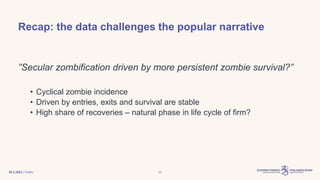
”Secular zombification driven by more persistent zombie survival?”
• Cyclical zombie incidence
• Driven by entries, exits and survival are stable
• High share of recoveries – natural phase in life cycle of firm?
30.3.2023 22
| Public
Zombie congestion
• Zombies are a drag on the economy because resources are allocated to low
performing firms that congest markets of healthy firms
(Adalet McGowan et al. 2018, Caballero et al. 2008)
• Zombies
• compete for the same resources (thus increasing input prices)
• operate in the same market (increasing competition and reducing output prices)
squeeze the profits, job creation and investment of healthy firms
• Specification
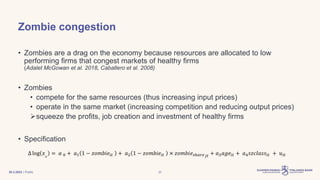
∆ log 𝑥𝑖𝑡
= 𝑎 0 + 𝑎1 1 − 𝑧𝑜𝑚𝑏𝑖𝑒𝑖𝑡 + 𝑎2 1 − 𝑧𝑜𝑚𝑏𝑖𝑒𝑖𝑡 × 𝑧𝑜𝑚𝑏𝑖𝑒𝑠ℎ𝑎𝑟𝑒𝑗𝑡
+ 𝑎3𝑎𝑔𝑒𝑖𝑡 + 𝑎4𝑠𝑧𝑐𝑙𝑎𝑠𝑠𝑖𝑡 + 𝑢𝑖𝑡
30.3.2023 23
| Public
Estonia Finland Italy Latvia Netherlands Portugal Slovakia
Zombie industry
share measure:
0.226*** 0.117*** 0.130*** 0.215*** 0.142*** 0.163*** 0.174***
(0.0105) (0.0037) (0.00119) (0.00904) (0.00196) (0.00347) (0.00823)
-0.107*** -0.110*** -0.0891*** -0.0571*** -0.101*** -0.111*** -0.121***
(0.0393) (0.0123) (0.00320) (0.0216) (0.00676) (0.0113) (0.0439)
Zombie industry
share measure:
0.275*** 0.148*** 0.155*** 0.247*** 0.154*** 0.178*** 0.191***
(0.0114) (0.0046) (0.00135) (0.00995) (0.00213) (0.00374) (0.00906)
-0.354*** -0.148*** -0.113*** -0.121*** -0.112*** -0.163*** -0.148**
(0.0467) (0.0157) (0.00400) (0.0260) (0.00827) (0.0128) (0.0619)
Observations 107,665 467,871 4,198,492 74,674 1,236,657 481,706 95,888
Note: True zombies are defined as non-grow ing firms w ith the ratio of earnings before interest and taxes (ebit) and the interest
paid+financial charges being less than one (ebit/interest<1) for three consecutive years. Robust standard errors in parentheses,
*** p>0.01, ** p<0.05, * p<0.1
Non-zombie dummy *
zombie industry share
All firms with ICR(3)<1, capital share
Non-zombie dummy
Non-zombie dummy *
zombie industry share
True zombies: Downsizing firms with ICR(3)<1, capital share
Non-zombie dummy
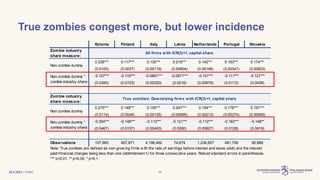
True zombies congest more, but lower incidence
30.3.2023 24
| Public
Estonia Finland Italy Latvia Netherlands Portugal Slovakia Spain
Zombie industry
share measure:
0.0649*** 0.0885*** 0.0756*** 0.0360*** 0.0475*** 0.0720*** 0.0464*** 0.0603***
(0.00492) (0.00208) (0.000689) (0.00451) (0.00114) (0.00166) (0.00398) (0.000689)
0.0295 -0.0581*** -0.0555*** 0.118*** -0.0176*** -0.0680*** -0.189*** -0.0650***
(0.0194) (0.00682) (0.00238) (0.0203) (0.00471) (0.00688) (0.0284) (0.00242)
Zombie industry
share measure:
0.142*** 0.209*** 0.157*** 0.146*** 0.133*** 0.133*** 0.122*** 0.179***
(0.00504) (0.00241) (0.000752) (0.00453) (0.00118) (0.00169) (0.00402) (0.000532)
-0.140*** -0.142*** -0.108*** 0.0247 -0.0271*** -0.141*** -0.261*** -0.132***
(0.0254) (0.00952) (0.00307) (0.0240) (0.00593) (0.00892) (0.0423) (0.00247)
Observations 116,594 480,188 4,252,701 74,674 1,298,754 505,985 105,611 2,685,443
Note: True zombies are defined as non-grow ing firms w ith the ratio of earnings before interest and taxes (ebit) and the interest paid+financial
charges being less than one (ebit/interest<1) for three consecutive years. Robust standard errors in parentheses, *** p>0.01, ** p<0.05, * p<0.1
All firms with ICR(3)<1, labour share
Non-zombie dummy
Non-zombie dummy *
zombie industry share
True zombies: Downsizing firms with ICR(3)<1, labour share
Non-zombie dummy
Non-zombie dummy *
zombie industry share
True zombies congest more, but lower incidence
30.3.2023 25
| Public
Policy: Public subsidies to firms (FI data)
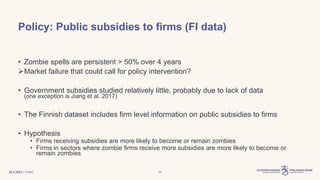
• Zombie spells are persistent > 50% over 4 years
Market failure that could call for policy intervention?
• Government subsidies studied relatively little, probably due to lack of data
(one exception is Jiang et al. 2017)
• The Finnish dataset includes firm level information on public subsidies to firms
• Hypothesis
• Firms receiving subsidies are more likely to become or remain zombies
• Firms in sectors where zombie firms receive more subsidies are more likely to become or
remain zombies
30.3.2023 26
| Public
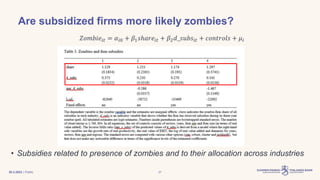
Are subsidized firms more likely zombies?
30.3.2023 27
𝑍𝑜𝑚𝑏𝑖𝑒𝑖𝑡 = 𝛼𝑖0 + 𝛽1𝑠ℎ𝑎𝑟𝑒𝑖𝑡 + 𝛽2𝑑_𝑠𝑢𝑏𝑠𝑖𝑡 + 𝑐𝑜𝑛𝑡𝑟𝑜𝑙𝑠 + 𝜇𝑖
• Subsidies related to presence of zombies and to their allocation across industries
| Public
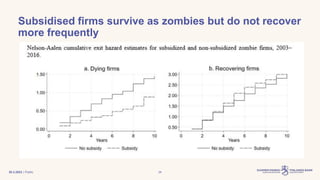
Subsidised firms survive as zombies but do not recover
more frequently
30.3.2023 28
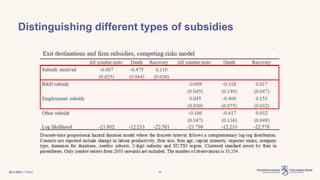
| Public
Distinguishing different types of subsidies
30.3.2023 29
| Public
Public subsidies to firms: recap
• Public subsidies: evidence on relation between zombies and firm subsidies
• Subsidies related to low zombie exits – higher persistence of zombie status
• Subsidies related to lower deaths more than to higher recoveries
30.3.2023 30
| Public
Do low interest rates promote zombification?
• Hypothesis: not necessarily
• Low interest rates have opposite effects through different margins
• Reduce entry from healthy to zombie status
• Increase exit from zombie status to recovery
• Reduce exit from zombie status to firm death
30.3.2023 31
| Public 32
• Zombification may be less of a concern than commonly thought
• Many growing firms misclassified as zombies
• High share of recoveries
• Cyclical entries drives zombification – not persistent survival
• Cyclical rather than secular phenomenon
• Congestion effects are stronger, but fewer firms that cause it
• Policies that support zombie-survival also support recovery – may also reduce entries
• The effects of accommodative policies on zombie firms are more complex than simple
narratives suggest
Concluding remarks

Juuso Vanhala. Persistent misallocation or a necessary temporary evil?

  • 1.
    Monetary Policy andResearch Department, Bank of Finland Persistent misallocation or a necessary temporary evil? Micro evidence on zombie demographics from European countries Juuso Vanhala * The opinions expressed in this paper are those of the authors, and do not necessarily reflect the views of the Bank of Finland, National Central Banks of the Eurosystem or the Eurosystem. All errors are our responsibility
  • 2.
    | Public Co-authors •Juuso Vanhala •TiborLalinský •Paloma Lopez-Garcia •Fernando Martins •Maurice J.G. Bun •Davide Fantino •Jaanika Meriküll •Konstantis Benkovskis 30.3.2023 2
  • 3.
  • 4.
    | Public 4 •“Rising incidence and survival of zombies are a drag on the economy –– misallocation and congestion” (e.g. Adalet McGowan et al. 2018, Caballero et al. 2008) • “Economic policies to blame – low interest rates, evergreening, subsidies” (e.g. Banerjee & Hofmann 2018, Borio 2018, Acharya et al. 2019) Are zombies for real … or just a bad dream? Firms Zombies 30.3.2023
  • 5.
    | Public This presentation •Dynamic model to identify zombies • Evidence from 8 EA countries on zombie demographics • “False zombies”: growing firms and recoveries • Zombification is cyclical – no secular rise • Entries drives zombification – not persistent survival • Zombies and congestion • True zombies have stronger congestion effects • But less true zombies that cause congestion • Accomodative policies have various effects on zombie incidence through entry and exit margins Builds on Nurmi, Vanhala & Virén (2022), ECB (2021) and current work at ESCB 30.3.2023 5
  • 6.
    | Public Literature • Zombiesand banks in Japan 1990s (Hoshi 2000, 2006, Caballero et al. 2008) • Interest in “rise of zombies” in aftermath of GFC (e.g. Acharya et al. 2019, Adalet McGowan et al. 2018, Banerjee & Hoffman 2018) • Zombies and monetary policy (Duval and Obstfeld 2018, Bindseil and Schaaf 2020, Demetris and Viegi 2021) • Zombies and evergreening (Acharya et al. 2019, Andrews & Petrouliakis 2019)) • Zombie demographics and public subsidies (Nurmi, Vanhala & Virén 2022) 30.3.2023 6
  • 7.
    | Public Identifying zombies 1.Hoshi (2006), Caballero et al. (2008): firm-bank relationships in 1990s Japan: firms with extremely low interest payments given their levels of debt and likely receive financial aid from their lenders. • Acharya et al. (2016) and Schivardi et al (2018) study European countries from this perspective 2. Measures of weak firm performance / persistently low interest coverage ratio, EBIT/interest<1 for three consecutive years, combined with 10-year age threshold (e.g. Adalet McGowan et al. 2018, OECD) 3. Nurmi, Vanhala & Virén (2022): theory of firm entry and exit , e.g. Hopenhayn 1992, Syverson 2011, Decker et al. 2016 30.3.2023 7
  • 8.
    | Public Identifying zombies:“static” definition • “Static” definition: persistently low interest coverage ratio (e.g. Adalet McGowan et al. 2018, Acharya et al. 2019) 𝐸𝐵𝐼𝑇 𝑖𝑛𝑡𝑒𝑟𝑒𝑠𝑡 < 1, 𝑓𝑜𝑟 𝑡ℎ𝑟𝑒𝑒 𝑐𝑜𝑛𝑠𝑒𝑐𝑢𝑡𝑖𝑣𝑒 𝑦𝑒𝑎𝑟𝑠 𝐸𝐵𝐼𝑇 − 𝑖𝑛𝑡𝑒𝑟𝑒𝑠𝑡 < 0, 𝑓𝑜𝑟 𝑡ℎ𝑟𝑒𝑒 𝑐𝑜𝑛𝑠𝑒𝑐𝑢𝑡𝑖𝑣𝑒 𝑦𝑒𝑎𝑟𝑠 Additionally firm age >10 years • Features • Firms need to take more debt or other external funding to cover interest expenses • Does not separate truly distressed firms from viable firms experiencing temporarily low earnings • Is age threshold arbitrary? 30.3.2023 8
  • 9.
    | Public Identifying zombiesin a dynamic model (Nurmi, Vanhala & Virén 2022 IJIO) • Model of firm entry and exit à la Hopenhayn (1992) 𝜋 𝑥𝑖𝑡, 𝑙𝑖𝑡 = 𝑓 𝑥𝑖𝑡, 𝑙𝑖𝑡 − 𝑤𝑙𝑖𝑡 − 𝑔 𝑙𝑖𝑡, 𝑙𝑖𝑡−1 − 𝑅𝑖 • Productivity follows first-order Markov process 𝐹 𝑥, 𝑥′ . • Serial correlation of productivity shock implies that firm-level productivity (employment) may exhibit persistent, but finite, spells of growth or decline • Adjustment cost 𝑔 𝑙𝑡, 𝑙𝑖𝑡−1 : labour adjustment is sluggish, firms do not immediately reach optimal scale • Fixed interest cost 𝑅𝑖 to regardless sales – necessary for meaningful exit 30.3.2023 9
  • 10.
    | Public Identifying zombiesin a dynamic model • Simplified model: fixed labour input • Sole decision to be made by incumbent firm is whether to remain or exit the market 𝑉𝑓 𝑥𝑖𝑡 = 𝑓 𝑥𝑖𝑡, 𝑙𝑖𝑡 − 𝑤𝑙 − 𝑅𝑖𝑡 + 𝛽 max 0, 𝔼 𝜀𝑡+1 𝜀 𝑉𝑓 𝜀𝑖𝑡+1 𝑑𝜀 • Firms enter/survive in the market until 𝑉𝑓 𝑥𝑡 =0 • Reservation productivity 𝑥𝑖𝑡 for firm exit 𝐸𝐵𝐼𝑇 𝑥𝑖𝑡 − 𝑖𝑛𝑡𝑒𝑟𝑒𝑠𝑡𝑖𝑡 + 𝛽𝔼 𝜀𝑡+1 𝜀 𝑉𝑓 𝜀𝑖𝑡+1 𝑑𝜀 < 0 30.3.2023 10 𝐸𝐵𝐼𝑇𝑖𝑡
  • 11.
    | Public Identifying zombiesis a dynamic model • Dynamic model: Reservation productivity 𝑥𝑖𝑡 𝐸𝐵𝐼𝑇 𝑥𝑖𝑡 −𝑅𝑖 +𝛽 max 0, 𝐸𝑉𝑓 𝑥𝑖𝑡+1 𝑥𝑖𝑡 < 0 • Static model: Reservation productivity 𝑥𝑖𝑡 𝐼𝐶𝑅(3) 𝐸𝐵𝐼𝑇 𝑥𝑖𝑡 𝐼𝐶𝑅(3) −𝑅𝑖< 0 Implies: 𝑥𝑖𝑡 𝐼𝐶𝑅(3) >𝑥𝑖𝑡 • Omitting firm’s future expected present value gives higher required value for current earnings and higher reservation productivity for viability • The exit margin of our model narrows the set of firms identified as zombies: firms in the range 𝑥𝑖𝑡 ∈ 𝑥𝑖𝑡, 𝑥𝑖𝑡 𝐼𝐶𝑅(3) are not identified as a zombies 30.3.2023 11
  • 12.
    | Public General featuresarising from dynamic model • Fixed costs • Each productivity draw changes firm’s profitability relative to fixed costs • Zombie exit or survival depends on persistence of productivity shock • Adjustment costs • Firms adjust their scale to both positive and negative shocks • Cost of adjustment relative to continuation value more binding for downsizing firms • Rescaling production is sluggish: firms may be on adjustment path (possibly as zombies) for an extended time • Rescaling is instant in the absence of adjustment costs – no zombies? 30.3.2023 12
  • 13.
    | Public A dynamicdefinition of zombie firms • Two conditions 𝐼𝐶𝑅 3 = 𝐸𝐵𝐼𝑇 𝑖𝑛𝑡𝑒𝑟𝑒𝑠𝑡 < 1 and 𝑙𝑡 − 𝑙𝑡−2 ≤ 0 • Low interest coverage ratio (ICR) for three consecutive years • Non-positive growth: distinguish truly distressed from viable firms with temporarily low earnings • Proxy for the expectations of the future value of the firm • Employment growth reveals the firm’s own private assessment of its expected future profitability 30.3.2023 13
  • 14.
    | Public Data • Micro-distributedexercise to ensure comparability and confidentiality of results (Bartelsman et al. 2004) • Representative firm-level data for 8 EU countries: Estonia, Finland, Italy, Latvia, the Netherlands, Portugal, Slovakia, Spain • Annual data based on the financial statement statistics and business register statistics, provided by national data sources • The sample period varies across countries • Non-financial private business sector firms at 2-digit sectoral level (NACE rev. 2 sectors 10–63, 68– 82) • Firms with at least 1 employee 30.3.2023 14 Country Data source Sample period Av. Number firms /year Estonia Business Register, Tax and Customs Board, Customs data Statistics Estonia. 2006–2020 7 773 Finland Statistics Finland 1999–2020 64 000 Italy Cerved Centrale dei Bilanci, Istituto Nazionale Previdenza Sociale (INPS) 2001–2019 250 159 Latvia Central Statistical Bureau of Latvia and State Revenue Service of Latvia 2007–2020 6 504 The Netherlands Statistics Netherlands 2002–2021 66 000 Portugal Central Balance Sheet Database 2006–2020 104 000 Slovakia Statistics Slovakia and Bisnode 2017–2020 26 403 Spain Central Balance sheet database 2001–2020 176 152
  • 15.
    | Public Zombie demographics:downsizing and growing firms 30.3.2023 15 • Zombification clearly less alarming when growth potential of firms explicitly considered (Nurmi, Vanhala & Virén 2022) • Zombie incidence is clearly cyclical (vs. secular increase) • Up to 1/3 of “zombies” are growing firms
  • 16.
    | Public Zombie demographics:zombie size differs across countries 30.3.2023 16
  • 17.
    | Public Zombie demographics:firm age and size 30.3.2023 17
  • 18.
    | Public Zombie entriesdrive fluctuations 30.3.2023 18 • Zombie entries drive fluctuations • No secular rise in zombie survival
  • 19.
    | Public Zombie exits:firm deaths and recoveries 30.3.2023 19 • Zombie exits: many recoveries • Zombie status is not a terminal state • Firms adjust (sluggishly)
  • 20.
    | Public Competing risksmodel • Simple independent competing risks model to model different exit destinations • Determinants of duration of zombie spells, probability of exiting zombie status • We use flow data on new cohorts to avoid problems of modelling initial participation decision 30.3.2023 Juuso Vanhala 20 ℎ𝑖𝑡 = 𝑝𝑟𝑜𝑏(𝑇𝑖 < 𝑡 + 1|𝑇𝑖 ≥ 𝑡) = 1 − 𝑒𝑥𝑝 ) − 𝑒𝑥𝑝( 𝛽′𝑥𝑖𝑡 + 𝛾𝑡
  • 21.
    | Public Determinants ofexit destinations and zombie duration: competing risks model (FI data) • Higher labour productivity is positively related to recovery and negatively to death • Both exit risks are smaller with firm size and capital intensity • larger firms with heavier sunk costs more likely to continue as zombies • Higher interest rate is negatively related to recovery and positively to death • Risk of death decreases with age 30.3.2023 21 Variables All zombie exits Death Recovery ∆Log labour productivity -0.024 -0.194 0.064 (0.011) (0.023) (0.012) Log employment -0.190 -0.550 -0.043 (0.007) (0.021) (0.007) Log capital intensity -0.023 -0.039 -0.011 (0.004) (0.008) (0.005) Exporter -0.037 -0.116 -0.040 (0.029) (0.067) (0.031) Firm age 5-10 years -0.017 -0.368 0.204 (0.030) (0.049) (0.035) Firm age 10-15 years -0.081 -0.613 0.245 (0.031) (0.054) (0.036) Firm age over 15 years -0.130 -0.749 0.239 (0.027) (0.047) (0.033) Interest rate* -0.090 0.078 -0.138 (0.019) (0.035) (0.021) Log likelihood -21 790 -12 264 -22 569 Discrete-time proportional hazard duration model where the discrete interval follows a complementary log-log distribution. Controls not reported include dummies for durations, zombie cohorts, company type, 2-digit industry and NUTS3 region. Clustered standard errors by firm in parentheses. Only zombie entries from 2003 onwards are included. *Average interest rate on corporate loans. The number of observations is 33,534.
  • 22.
    | Public Recap: thedata challenges the popular narrative ”Secular zombification driven by more persistent zombie survival?” • Cyclical zombie incidence • Driven by entries, exits and survival are stable • High share of recoveries – natural phase in life cycle of firm? 30.3.2023 22
  • 23.
    | Public Zombie congestion •Zombies are a drag on the economy because resources are allocated to low performing firms that congest markets of healthy firms (Adalet McGowan et al. 2018, Caballero et al. 2008) • Zombies • compete for the same resources (thus increasing input prices) • operate in the same market (increasing competition and reducing output prices) squeeze the profits, job creation and investment of healthy firms • Specification ∆ log 𝑥𝑖𝑡 = 𝑎 0 + 𝑎1 1 − 𝑧𝑜𝑚𝑏𝑖𝑒𝑖𝑡 + 𝑎2 1 − 𝑧𝑜𝑚𝑏𝑖𝑒𝑖𝑡 × 𝑧𝑜𝑚𝑏𝑖𝑒𝑠ℎ𝑎𝑟𝑒𝑗𝑡 + 𝑎3𝑎𝑔𝑒𝑖𝑡 + 𝑎4𝑠𝑧𝑐𝑙𝑎𝑠𝑠𝑖𝑡 + 𝑢𝑖𝑡 30.3.2023 23
  • 24.
    | Public Estonia FinlandItaly Latvia Netherlands Portugal Slovakia Zombie industry share measure: 0.226*** 0.117*** 0.130*** 0.215*** 0.142*** 0.163*** 0.174*** (0.0105) (0.0037) (0.00119) (0.00904) (0.00196) (0.00347) (0.00823) -0.107*** -0.110*** -0.0891*** -0.0571*** -0.101*** -0.111*** -0.121*** (0.0393) (0.0123) (0.00320) (0.0216) (0.00676) (0.0113) (0.0439) Zombie industry share measure: 0.275*** 0.148*** 0.155*** 0.247*** 0.154*** 0.178*** 0.191*** (0.0114) (0.0046) (0.00135) (0.00995) (0.00213) (0.00374) (0.00906) -0.354*** -0.148*** -0.113*** -0.121*** -0.112*** -0.163*** -0.148** (0.0467) (0.0157) (0.00400) (0.0260) (0.00827) (0.0128) (0.0619) Observations 107,665 467,871 4,198,492 74,674 1,236,657 481,706 95,888 Note: True zombies are defined as non-grow ing firms w ith the ratio of earnings before interest and taxes (ebit) and the interest paid+financial charges being less than one (ebit/interest<1) for three consecutive years. Robust standard errors in parentheses, *** p>0.01, ** p<0.05, * p<0.1 Non-zombie dummy * zombie industry share All firms with ICR(3)<1, capital share Non-zombie dummy Non-zombie dummy * zombie industry share True zombies: Downsizing firms with ICR(3)<1, capital share Non-zombie dummy True zombies congest more, but lower incidence 30.3.2023 24
  • 25.
    | Public Estonia FinlandItaly Latvia Netherlands Portugal Slovakia Spain Zombie industry share measure: 0.0649*** 0.0885*** 0.0756*** 0.0360*** 0.0475*** 0.0720*** 0.0464*** 0.0603*** (0.00492) (0.00208) (0.000689) (0.00451) (0.00114) (0.00166) (0.00398) (0.000689) 0.0295 -0.0581*** -0.0555*** 0.118*** -0.0176*** -0.0680*** -0.189*** -0.0650*** (0.0194) (0.00682) (0.00238) (0.0203) (0.00471) (0.00688) (0.0284) (0.00242) Zombie industry share measure: 0.142*** 0.209*** 0.157*** 0.146*** 0.133*** 0.133*** 0.122*** 0.179*** (0.00504) (0.00241) (0.000752) (0.00453) (0.00118) (0.00169) (0.00402) (0.000532) -0.140*** -0.142*** -0.108*** 0.0247 -0.0271*** -0.141*** -0.261*** -0.132*** (0.0254) (0.00952) (0.00307) (0.0240) (0.00593) (0.00892) (0.0423) (0.00247) Observations 116,594 480,188 4,252,701 74,674 1,298,754 505,985 105,611 2,685,443 Note: True zombies are defined as non-grow ing firms w ith the ratio of earnings before interest and taxes (ebit) and the interest paid+financial charges being less than one (ebit/interest<1) for three consecutive years. Robust standard errors in parentheses, *** p>0.01, ** p<0.05, * p<0.1 All firms with ICR(3)<1, labour share Non-zombie dummy Non-zombie dummy * zombie industry share True zombies: Downsizing firms with ICR(3)<1, labour share Non-zombie dummy Non-zombie dummy * zombie industry share True zombies congest more, but lower incidence 30.3.2023 25
  • 26.
    | Public Policy: Publicsubsidies to firms (FI data) • Zombie spells are persistent > 50% over 4 years Market failure that could call for policy intervention? • Government subsidies studied relatively little, probably due to lack of data (one exception is Jiang et al. 2017) • The Finnish dataset includes firm level information on public subsidies to firms • Hypothesis • Firms receiving subsidies are more likely to become or remain zombies • Firms in sectors where zombie firms receive more subsidies are more likely to become or remain zombies 30.3.2023 26
  • 27.
    | Public Are subsidizedfirms more likely zombies? 30.3.2023 27 𝑍𝑜𝑚𝑏𝑖𝑒𝑖𝑡 = 𝛼𝑖0 + 𝛽1𝑠ℎ𝑎𝑟𝑒𝑖𝑡 + 𝛽2𝑑_𝑠𝑢𝑏𝑠𝑖𝑡 + 𝑐𝑜𝑛𝑡𝑟𝑜𝑙𝑠 + 𝜇𝑖 • Subsidies related to presence of zombies and to their allocation across industries
  • 28.
    | Public Subsidised firmssurvive as zombies but do not recover more frequently 30.3.2023 28
  • 29.
    | Public Distinguishing differenttypes of subsidies 30.3.2023 29
  • 30.
    | Public Public subsidiesto firms: recap • Public subsidies: evidence on relation between zombies and firm subsidies • Subsidies related to low zombie exits – higher persistence of zombie status • Subsidies related to lower deaths more than to higher recoveries 30.3.2023 30
  • 31.
    | Public Do lowinterest rates promote zombification? • Hypothesis: not necessarily • Low interest rates have opposite effects through different margins • Reduce entry from healthy to zombie status • Increase exit from zombie status to recovery • Reduce exit from zombie status to firm death 30.3.2023 31
  • 32.
    | Public 32 •Zombification may be less of a concern than commonly thought • Many growing firms misclassified as zombies • High share of recoveries • Cyclical entries drives zombification – not persistent survival • Cyclical rather than secular phenomenon • Congestion effects are stronger, but fewer firms that cause it • Policies that support zombie-survival also support recovery – may also reduce entries • The effects of accommodative policies on zombie firms are more complex than simple narratives suggest Concluding remarks