Using Reading List data to support and
drive resource strategies
Craig Milne, Manager Scholarly Resource Services and Library Campus Services
c.milne@griffith.edu.au
Some context
 Scholarly Resource Strategy
 Collections
 Selection and procurement
 Discoverability and accessibility
 Financial sustainability
 Ambitious targets
 By 2017- All new required and recommended readings will be in electronic format only (refers to new
courses / programs)
 By 2018 – Greater than 95% of all required and recommended readings will be available online
 By 2020 – Reliance on print and physical collections will have been minimised with the collection
footprint reduced by 50% from the 2016 baseline size.
Library and Learning Services
Policy
 Reading Lists are the source of truth for readings
 Reading Lists are part of a compulsory course profile process
 Policy sits under the authority of the Teaching and Learning Committee
 Learning Resources and Reading Lists policy
 Sets out responsibility
 Establishes definitions for required / recommended readings
 Includes TEQSA guidance that full-text, digital access should be available for required resources as listed in Course
Profiles
 Includes that recommended resources are to be selected from the extensive range of resources already available
through the existing collections
 Includes that The University has an e-preferred policy to maximise the accessibility of resources to students regardless of
the mode of course delivery
Library and Learning Services
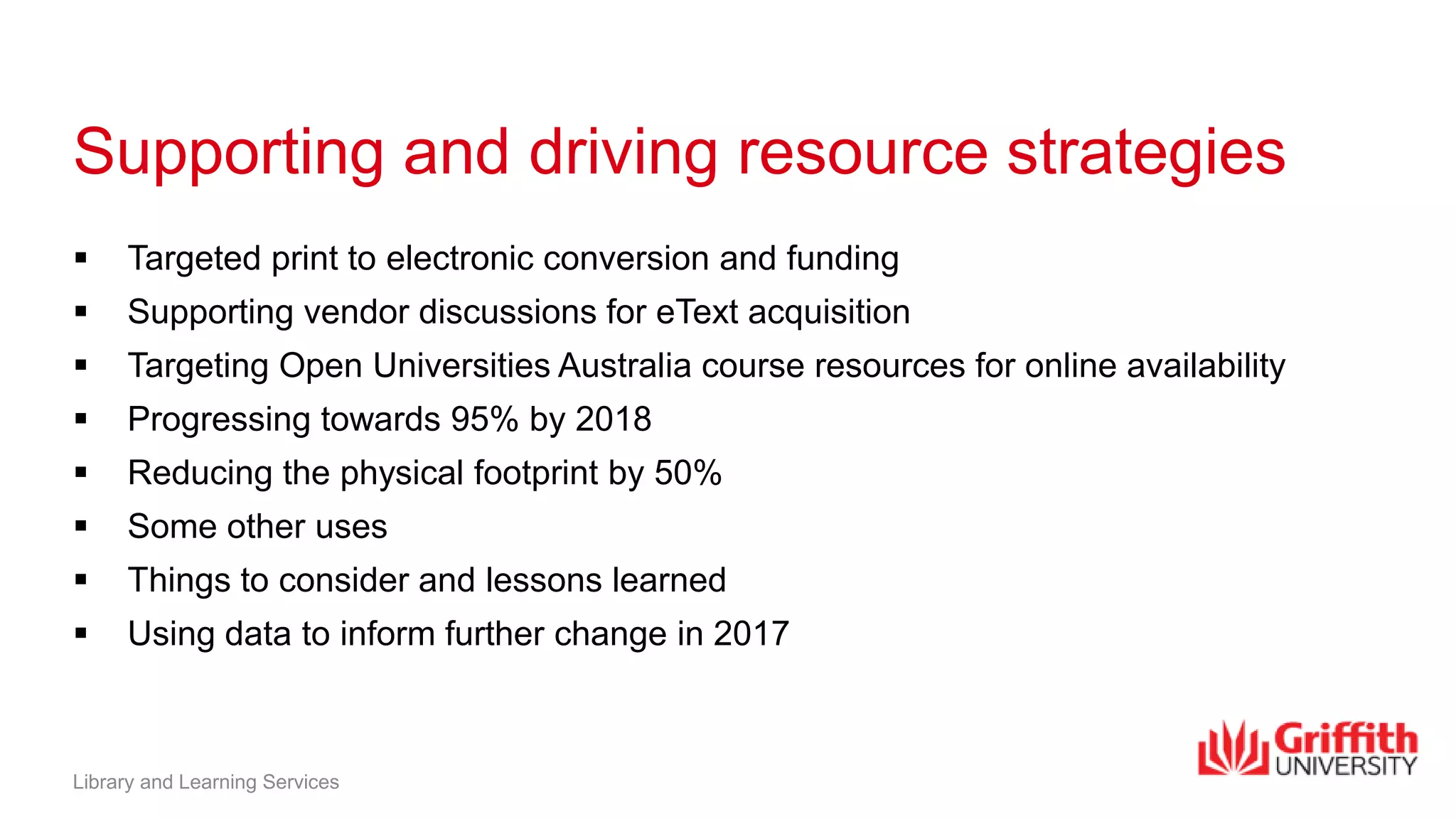
Supporting and driving resource strategies
 Targeted print to electronic conversion and funding
 Supporting vendor discussions for eText acquisition
 Targeting Open Universities Australia course resources for online availability
 Progressing towards 95% by 2018
 Reducing the physical footprint by 50%
 Some other uses
 Things to consider and lessons learned
 Using data to inform further change in 2017
Library and Learning Services
Targeting conversion and funding
 All items report – detailed list for use in ISBN title matching services
 Ability to filter and target by subject area
 Can prioritise by resource importance
 In late 2015 title a list of 7087 resulted in a match of 533 titles
 Benefits
 Possible to target funding with data to build a business case
 Secured funding for 241 titles
 Bulk order and supply of MARC records
 Ability to negotiate on bulk purchases and take advantage of special offers
Library and Learning Services
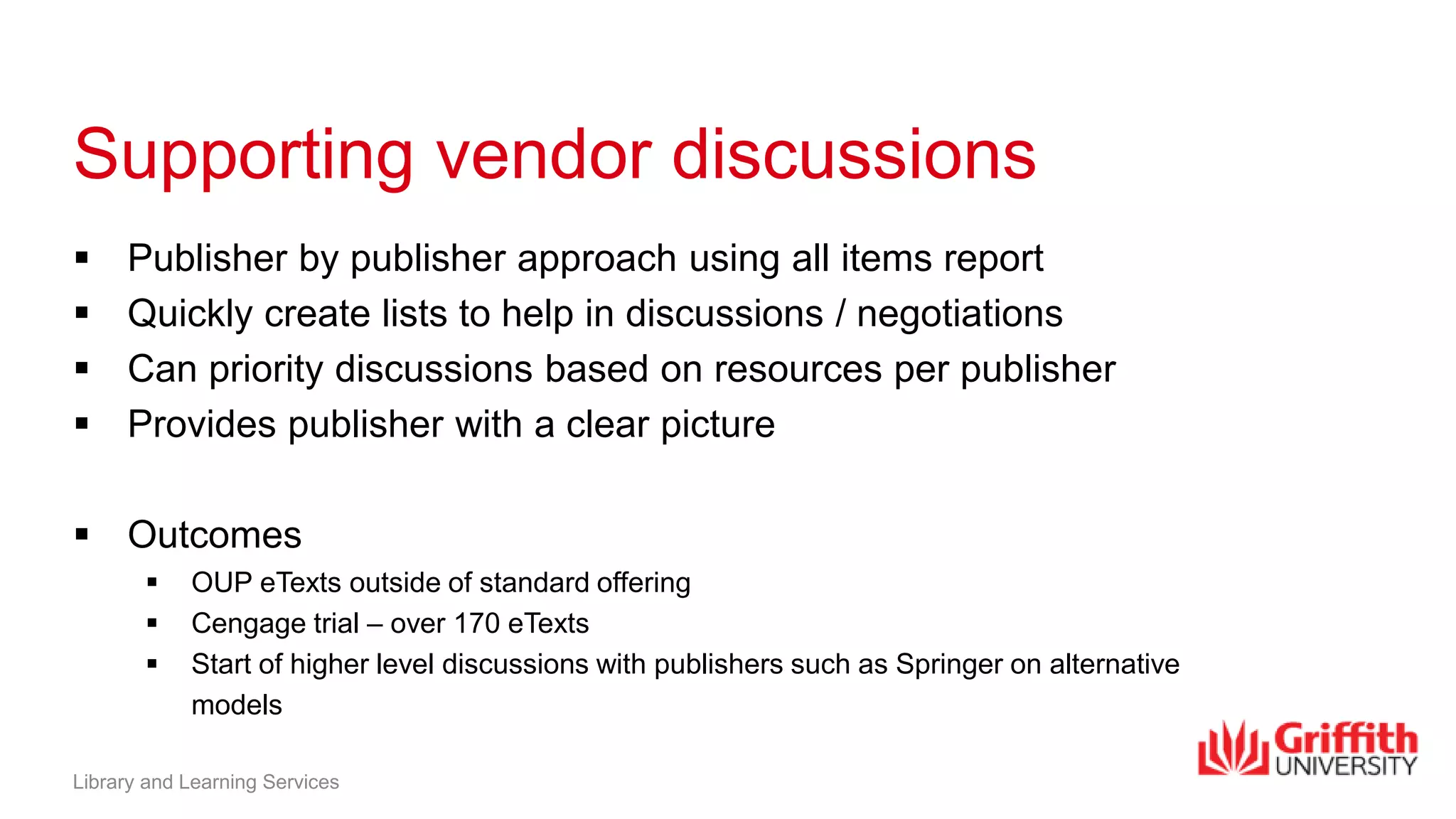
Supporting vendor discussions
 Publisher by publisher approach using all items report
 Quickly create lists to help in discussions / negotiations
 Can priority discussions based on resources per publisher
 Provides publisher with a clear picture
 Outcomes
 OUP eTexts outside of standard offering
 Cengage trial – over 170 eTexts
 Start of higher level discussions with publishers such as Springer on alternative
models
Library and Learning Services
Online availability of OUA resources
 Approx. 220 Open University Courses offered (171 lists identified)
 Requirement for resources to be online
 Large print stock loss connected with OUA
 Targeted communication and approach with support of Academic
Director, Griffith Online
 Able to do a lot of work without involving the academic
 Prioritised OUA eTexts in publisher discussions
 Biggest issue remains literature titles
Library and Learning Services
2591 Required
Resources - 96%
were already
online
990
Recommended
Resources – 87%
were already
online
Progressing towards 95% by 2018
 Expected that Reading List data would be a good way to report on the
targets
 Due to the number of time periods and roll-over practices it is actually
difficult to track and report
 We can keep targeting resources without URL’s
 We do know from our budget figures that eText acquisition now
surpasses print
 Jan 2016 Ratio of print to e was approx. 2:1
 Dec 2016 Ratio of print to e was 0.6 to 1
 First time eText acquisition has surpassed print
Library and Learning Services
Some very
approximate figures
of required texts with
URL’s
Jan 2015 approx. 40%
Jan 2016 approx. 51%
Jan 2017 approx. 57%
(but still working on
2017 lists)
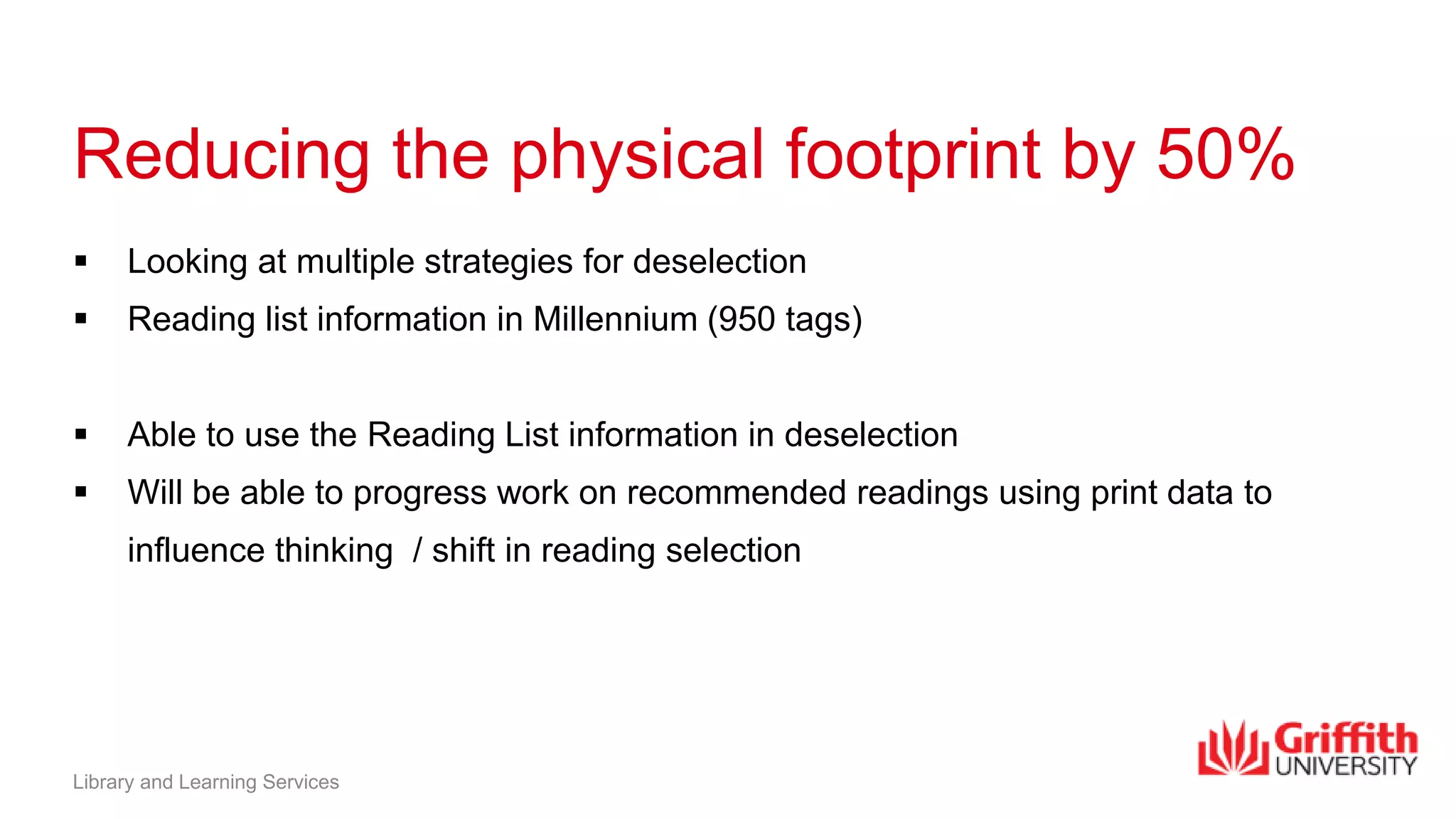
Reducing the physical footprint by 50%
 Looking at multiple strategies for deselection
 Reading list information in Millennium (950 tags)
 Able to use the Reading List information in deselection
 Will be able to progress work on recommended readings using print data to
influence thinking / shift in reading selection
Library and Learning Services
Some other uses
 URL’s useful for identifying potential issues with cancellation of a platform
/ journal
 Useful for identifying courses impacted by items being withdrawn from
aggregated collections
 Quickly assess purchase requirements against eText offers that
publishers are putting out
 Pivot tables – look at trends / behavior across courses and disciplines
 No items in a list, types of items in lists, required v recommended
Library and Learning Services
Things to consider and lessons learned
 Know your data – map it out
 Is the time taken to derive a metric / baseline worthwhile?
 Need skills in Excel (pivot tables in particular) and Access for quick table joins
 What would help – improvements in all items report
 Item analytics that are in the dashboard being available in the all items report
 A flag to indicate clearly if a resource is online or not (or was)
 A link in the all items report to the TADC data for the item (for data and to know that I was a
digitised item)
Library and Learning Services
Using data to inform further change in 2017
 Look at continuing the work on eTexts
 Look at not just converting from p to e but also influencing behavior based on
reading list / circ data
 Continue with a bottom up / top down and in the background approach
 Provide more data to key stakeholder groups
Library and Learning Services
Talis Insight Asia-Pacific 2017: Craig Milne, Griffith University

Talis Insight Asia-Pacific 2017: Craig Milne, Griffith University

  • 2.
    Using Reading Listdata to support and drive resource strategies Craig Milne, Manager Scholarly Resource Services and Library Campus Services c.milne@griffith.edu.au
  • 3.
    Some context  ScholarlyResource Strategy  Collections  Selection and procurement  Discoverability and accessibility  Financial sustainability  Ambitious targets  By 2017- All new required and recommended readings will be in electronic format only (refers to new courses / programs)  By 2018 – Greater than 95% of all required and recommended readings will be available online  By 2020 – Reliance on print and physical collections will have been minimised with the collection footprint reduced by 50% from the 2016 baseline size. Library and Learning Services
  • 4.
    Policy  Reading Listsare the source of truth for readings  Reading Lists are part of a compulsory course profile process  Policy sits under the authority of the Teaching and Learning Committee  Learning Resources and Reading Lists policy  Sets out responsibility  Establishes definitions for required / recommended readings  Includes TEQSA guidance that full-text, digital access should be available for required resources as listed in Course Profiles  Includes that recommended resources are to be selected from the extensive range of resources already available through the existing collections  Includes that The University has an e-preferred policy to maximise the accessibility of resources to students regardless of the mode of course delivery Library and Learning Services
  • 5.
    Supporting and drivingresource strategies  Targeted print to electronic conversion and funding  Supporting vendor discussions for eText acquisition  Targeting Open Universities Australia course resources for online availability  Progressing towards 95% by 2018  Reducing the physical footprint by 50%  Some other uses  Things to consider and lessons learned  Using data to inform further change in 2017 Library and Learning Services
  • 6.
    Targeting conversion andfunding  All items report – detailed list for use in ISBN title matching services  Ability to filter and target by subject area  Can prioritise by resource importance  In late 2015 title a list of 7087 resulted in a match of 533 titles  Benefits  Possible to target funding with data to build a business case  Secured funding for 241 titles  Bulk order and supply of MARC records  Ability to negotiate on bulk purchases and take advantage of special offers Library and Learning Services
  • 7.
    Supporting vendor discussions Publisher by publisher approach using all items report  Quickly create lists to help in discussions / negotiations  Can priority discussions based on resources per publisher  Provides publisher with a clear picture  Outcomes  OUP eTexts outside of standard offering  Cengage trial – over 170 eTexts  Start of higher level discussions with publishers such as Springer on alternative models Library and Learning Services
  • 8.
    Online availability ofOUA resources  Approx. 220 Open University Courses offered (171 lists identified)  Requirement for resources to be online  Large print stock loss connected with OUA  Targeted communication and approach with support of Academic Director, Griffith Online  Able to do a lot of work without involving the academic  Prioritised OUA eTexts in publisher discussions  Biggest issue remains literature titles Library and Learning Services 2591 Required Resources - 96% were already online 990 Recommended Resources – 87% were already online
  • 9.
    Progressing towards 95%by 2018  Expected that Reading List data would be a good way to report on the targets  Due to the number of time periods and roll-over practices it is actually difficult to track and report  We can keep targeting resources without URL’s  We do know from our budget figures that eText acquisition now surpasses print  Jan 2016 Ratio of print to e was approx. 2:1  Dec 2016 Ratio of print to e was 0.6 to 1  First time eText acquisition has surpassed print Library and Learning Services Some very approximate figures of required texts with URL’s Jan 2015 approx. 40% Jan 2016 approx. 51% Jan 2017 approx. 57% (but still working on 2017 lists)
  • 10.
    Reducing the physicalfootprint by 50%  Looking at multiple strategies for deselection  Reading list information in Millennium (950 tags)  Able to use the Reading List information in deselection  Will be able to progress work on recommended readings using print data to influence thinking / shift in reading selection Library and Learning Services
  • 11.
    Some other uses URL’s useful for identifying potential issues with cancellation of a platform / journal  Useful for identifying courses impacted by items being withdrawn from aggregated collections  Quickly assess purchase requirements against eText offers that publishers are putting out  Pivot tables – look at trends / behavior across courses and disciplines  No items in a list, types of items in lists, required v recommended Library and Learning Services
  • 12.
    Things to considerand lessons learned  Know your data – map it out  Is the time taken to derive a metric / baseline worthwhile?  Need skills in Excel (pivot tables in particular) and Access for quick table joins  What would help – improvements in all items report  Item analytics that are in the dashboard being available in the all items report  A flag to indicate clearly if a resource is online or not (or was)  A link in the all items report to the TADC data for the item (for data and to know that I was a digitised item) Library and Learning Services
  • 13.
    Using data toinform further change in 2017  Look at continuing the work on eTexts  Look at not just converting from p to e but also influencing behavior based on reading list / circ data  Continue with a bottom up / top down and in the background approach  Provide more data to key stakeholder groups Library and Learning Services