INTEGRATING LIBRARY SERVICES AND
INFORMATION RESOURCES INTO OPEN AND
DISTANCE LEARNING (ODL) PLATFORM
Presented
By
Dr. OKIKI, Olatokunbo C, CLN,
Head, Automation Unit
University of Lagos Library
cokiki@unilag.edu.ng
Being A Two Days Partnership Workshop with University of
Lagos ODL Team and Delta State University, Abraka, Nigeria
On Open and Distance Learning Mode
10th – 11th November, 2021
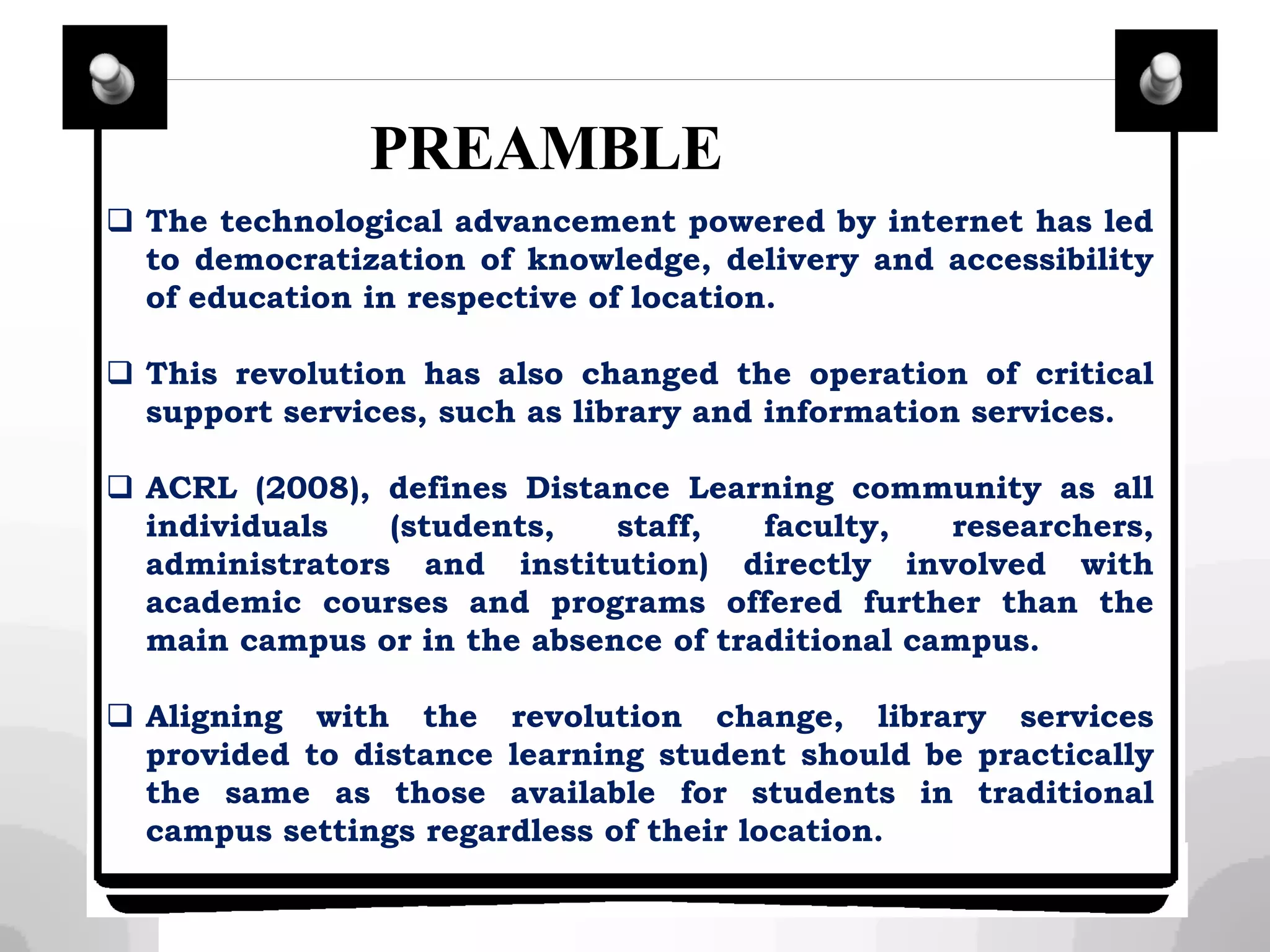
Taking Library Services And
Resources Online
 The technological advancement powered by internet has led
to democratization of knowledge, delivery and accessibility
of education in respective of location.
 This revolution has also changed the operation of critical
support services, such as library and information services.
 ACRL (2008), defines Distance Learning community as all
individuals (students, staff, faculty, researchers,
administrators and institution) directly involved with
academic courses and programs offered further than the
main campus or in the absence of traditional campus.
 Aligning with the revolution change, library services
provided to distance learning student should be practically
the same as those available for students in traditional
campus settings regardless of their location.
PREAMBLE
 Distance learning student should be able to have access to
library print materials, library electronic resources and other
database such as Emerald, JSTOR, Science Direct and OERs
among others.
 You will all agreed with me that an LMS is a powerful tool
that can help facilitate learning and provide an opportunity
for students for collaboration, interaction and participation.
 In this part of digital global, the gap between eLearning
platforms and the library has become widening; in order to
bridge that gap integration of library with LMS is needed.
 With effective policy, librarians role is to integrate library
resources into courseware, creating visibility and increasing
the relevance and impact of the library resources to students
and faculty.
THE CRUX
NEEDS FOR INTEGRATION
 Integration of library in the eLearning/LMS portal become
necessary in order to:
 promote the library resources that are relevant to individual
courses and faculty members,
 maximize the usages of database (EBSCOHOST, Emerald,
Proquest, Science Direct, Research4Life etc.) and other
resources procured by the library as well as relevant Open
Education Resources,
 many of the databases have full text of articles that the
instructor wants students to read. The persistent URL of the
article can be integrated in Moodle or on ODL portal, and
lastly
 embrace inclusiveness (equal access).
MODELS FOR LIBRARY INTEGRATION INTO AN LMS
 Shank and Dewald (2003) outlined two models for library
resources integration into an LMS:
 Macro-Level Library Courseware Involvement (MaLLCI)
“entails working with the developers and programmers of
courseware to integrate a generic, global library presence into the
software”; and
 Micro-Level Library Courseware Involvement (MiLLCI)
“involves individual librarians teaming up with faculty as
consultants to participate in developing a customized library
instruction and resource component for the courseware”
ADAPTATION
 For effectiveness and democratization of learning, Macro-
Level Library Courseware Involvement (MaLLCI) is the most
appropriate method due to its dual benefits (ease to
maintain and increase the visibility of the library resources).
 In the macro method, library resources are integrated into
eLearning platform, and this will be prorated to all course
sites.
 In a normal academic library, the standard library resources
include: library website, OPAC, link to databases, Inter
Library Loan (ILL), virtual reference desk, guide to write
thesis and dissertations and avoid plagiarism
STEPS IN INTEGRATING LIBRARY SERVICES INTO AN
LMS PLATFORM
 George, (2004) proposed seven basics steps that may be
followed when integrating library resources or services into
the Moodle LMS platform and these are:
 Working with the LMS administrator
 Brainstorming about content
 Networking with faculty
 Integrating resources
 Teaching the sessions
 Evaluating integration and
 Seek other opportunities
LIBRARY SERVICES FOR ODL
 Dedicated Distance Learner Web Site
 Developing a robots library portal
 Access to E-resources using a University Proxy server
Account
 Full text journal articles and electronic books (e-
books)
 Document Delivery Service for documents that are not
available electronically
 ILL Service
 Information Skills Support
 Recommended online tutorials to develop academic
skills
LIBRARY RESOURCES TO BE DEPLOYED INTO ODL
PLATFORM
 Procurement of Fee-Based Databases subscription
 Procurement of both print books and journals
 Intentional and relevant harvesting of OERs
DATABASES SUBSCRIPTION PROCESS
 Budget
 Library Director should be able to review funds and
budget lines available for subscription databases/online
reference platforms for each fiscal year
 Trials and Selection
 Find out whether the database you intend to procure has
remote access facility(ies)
 User friendly interface
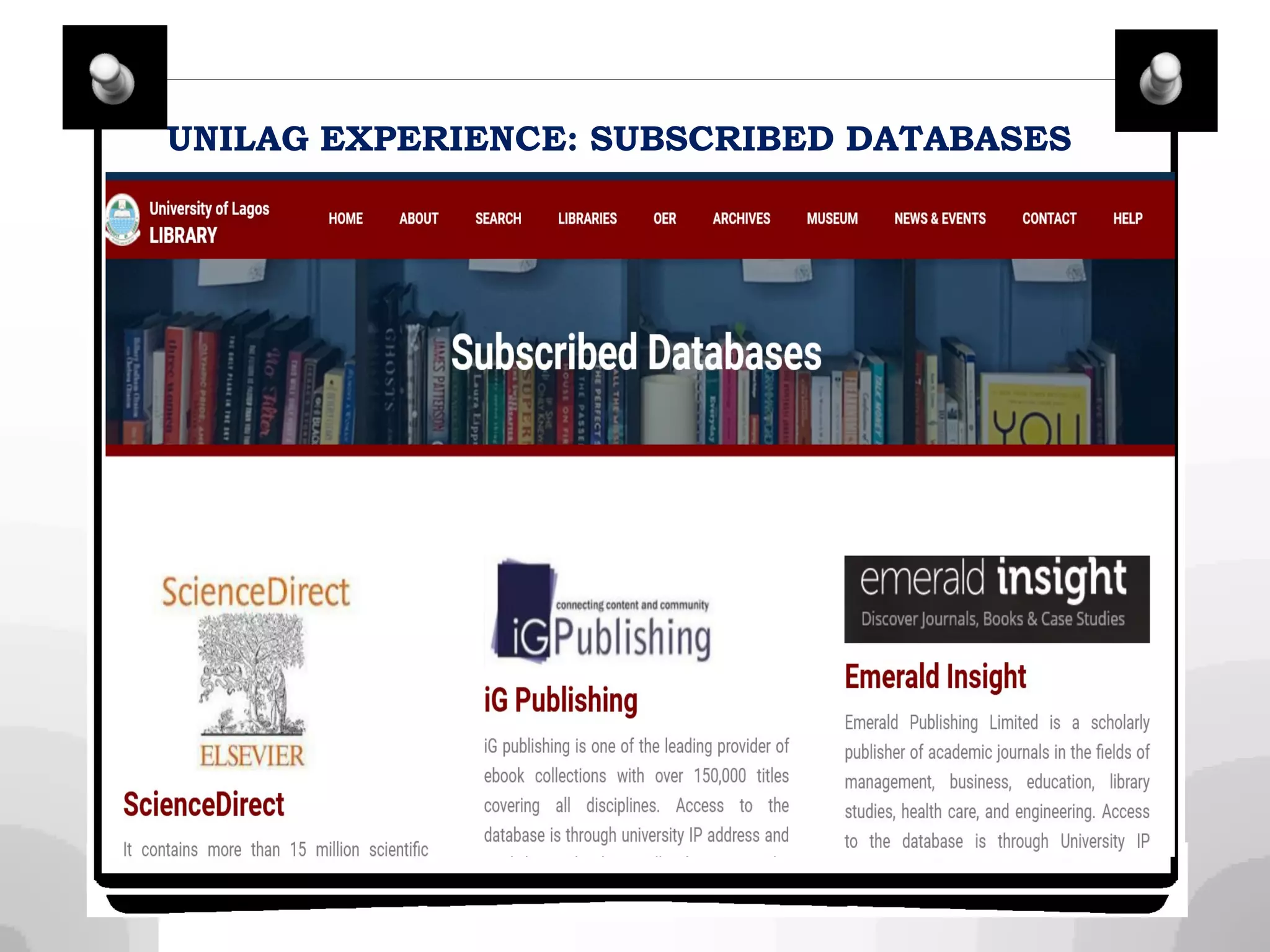
UNILAG EXPERIENCE: SUBSCRIBED DATABASES
ALIGNING OERS ON THE ODL PLATFORM: WHAT IT
ENTAIL?
 The need for using OER around the world has provoked
many global initiatives for OER.
 Open Educational Resources (OERs) are licensed open
source materials freely available for teaching, learning and
research, and allow teachers, students and self-learners to
re-use and adapt to their needs and goals. (Lumen, 2014).
 Open educational resources are not only free but also easy
to access, long-lasting and usable.
WHY INTEGRATE RESOURCES WITH ODL PLATFORM?
 All courses (traditional and virtual) require
supporting resources
 Campus based students have ready access to the
Library and all its services
 Remote users may not appreciate library services
available
 Need to ease and integrate access to knowledge
resources for all students.
 Accrediting agencies require adequate collections (including
electronic resources), services that include good access to
materials and orientation/instruction.
TYPES OF OPEN EDUCATIONAL RESOURCES
 Open Courseware.
 Learning Modules.
 Open Textbooks.
 Streaming Videos.
 Open Access Journals.
 Online Tutorials.
 Digital Learning Objects
OPEN EDUCATIONAL RESOURCES: COPYRIGHT
 Open Educational Resources (OER) are any type of
educational material that are freely available for teachers
and students to use, adapt, share, and reuse
 Creative Commons licensing is at the heart of the OER
movement. CC allows creators to specify more flexible forms
of copyright that allows "others to copy, distribute, and
make some uses of their work."
 Look for copyright information (often at the bottom of
webpages). Creative Commons licensed material sometimes
display clickable icons that indicate the specifics of
licensing.
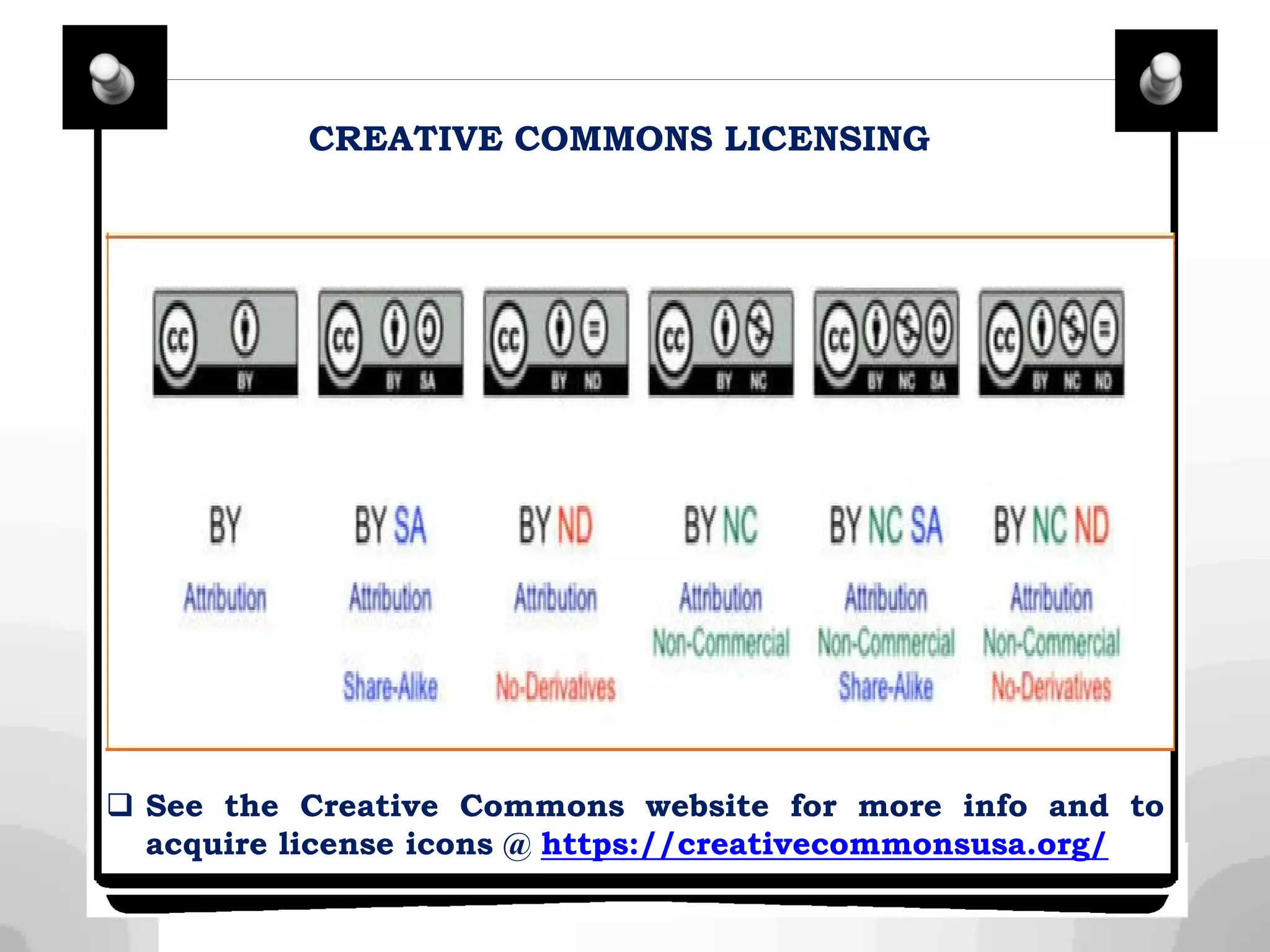
CREATIVE COMMONS LICENSING
 See the Creative Commons website for more info and to
acquire license icons @ https://creativecommonsusa.org/
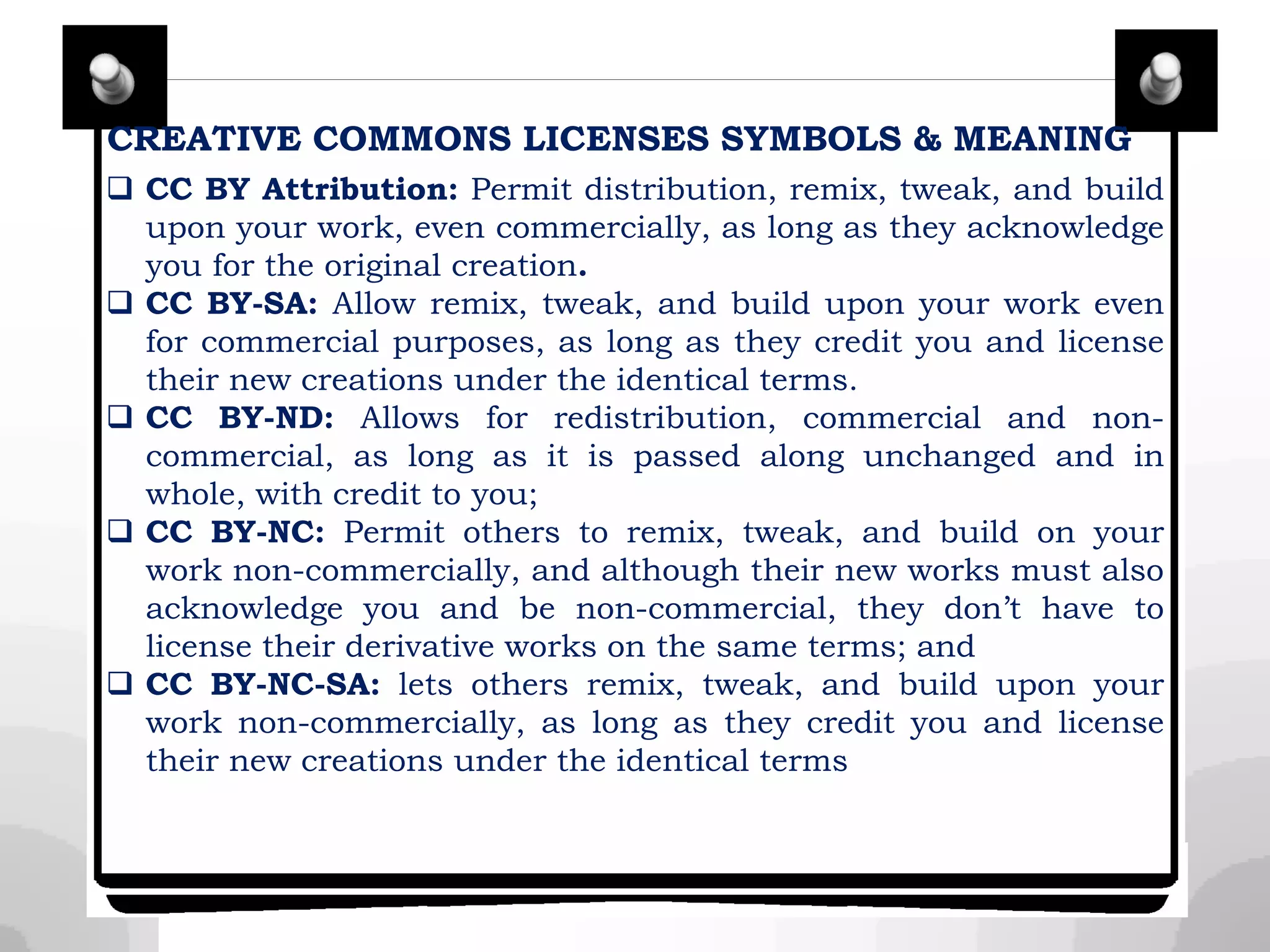
CREATIVE COMMONS LICENSES SYMBOLS & MEANING
 CC BY Attribution: Permit distribution, remix, tweak, and build
upon your work, even commercially, as long as they acknowledge
you for the original creation.
 CC BY-SA: Allow remix, tweak, and build upon your work even
for commercial purposes, as long as they credit you and license
their new creations under the identical terms.
 CC BY-ND: Allows for redistribution, commercial and non-
commercial, as long as it is passed along unchanged and in
whole, with credit to you;
 CC BY-NC: Permit others to remix, tweak, and build on your
work non-commercially, and although their new works must also
acknowledge you and be non-commercial, they don’t have to
license their derivative works on the same terms; and
 CC BY-NC-SA: lets others remix, tweak, and build upon your
work non-commercially, as long as they credit you and license
their new creations under the identical terms
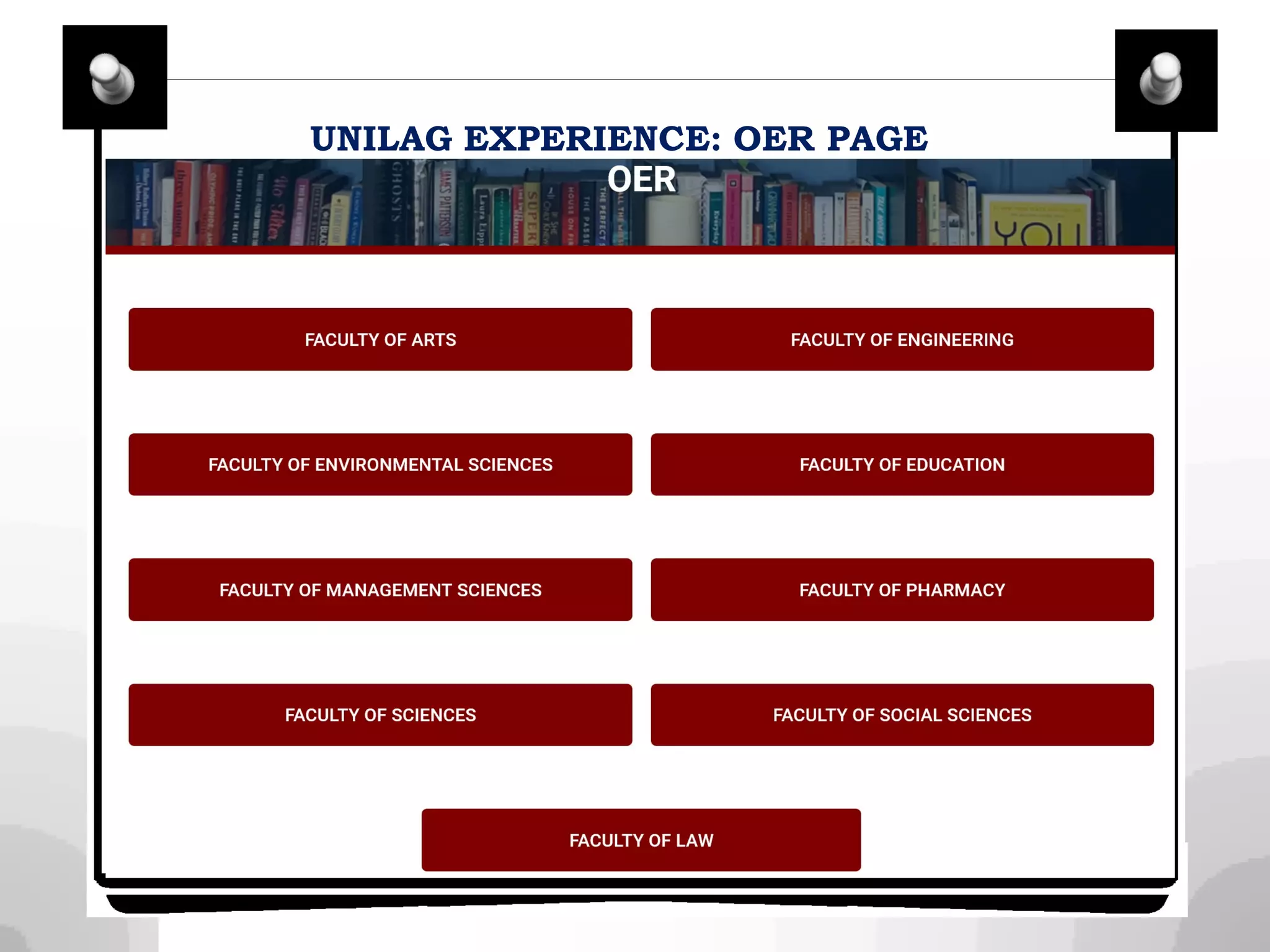
UNILAG EXPERIENCE: OER PAGE
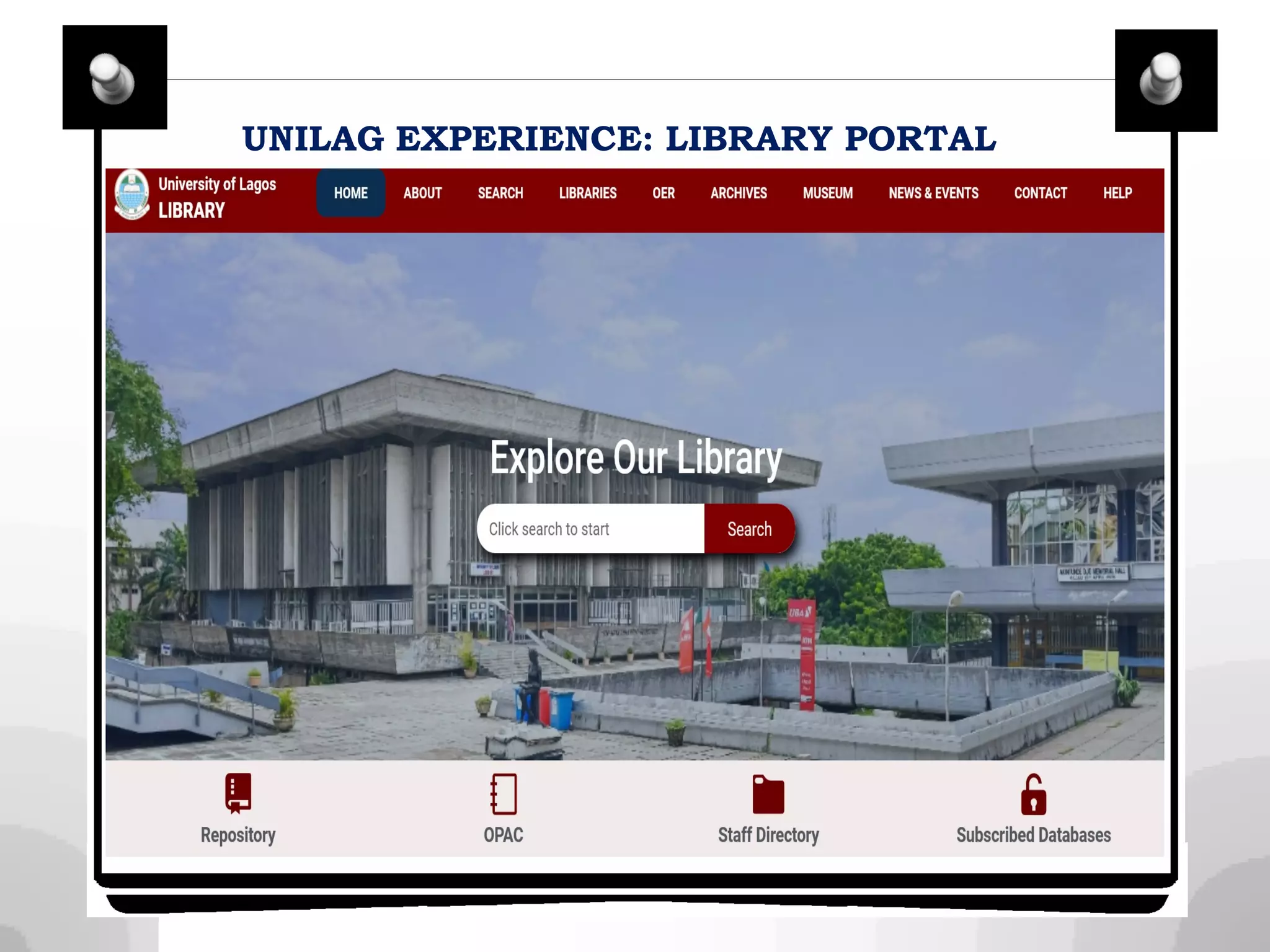
UNILAG EXPERIENCE: LIBRARY PORTAL
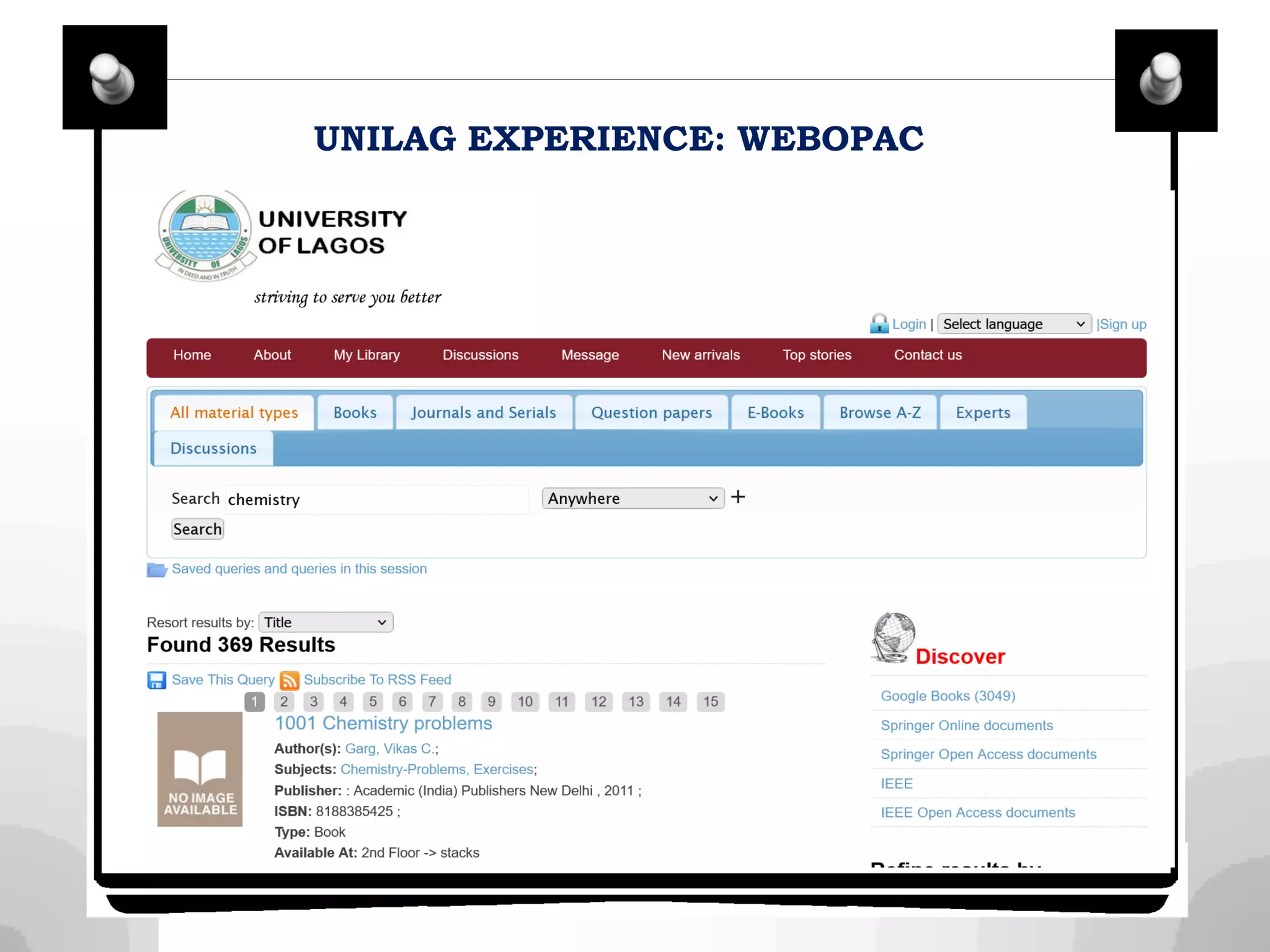
UNILAG EXPERIENCE: WEBOPAC
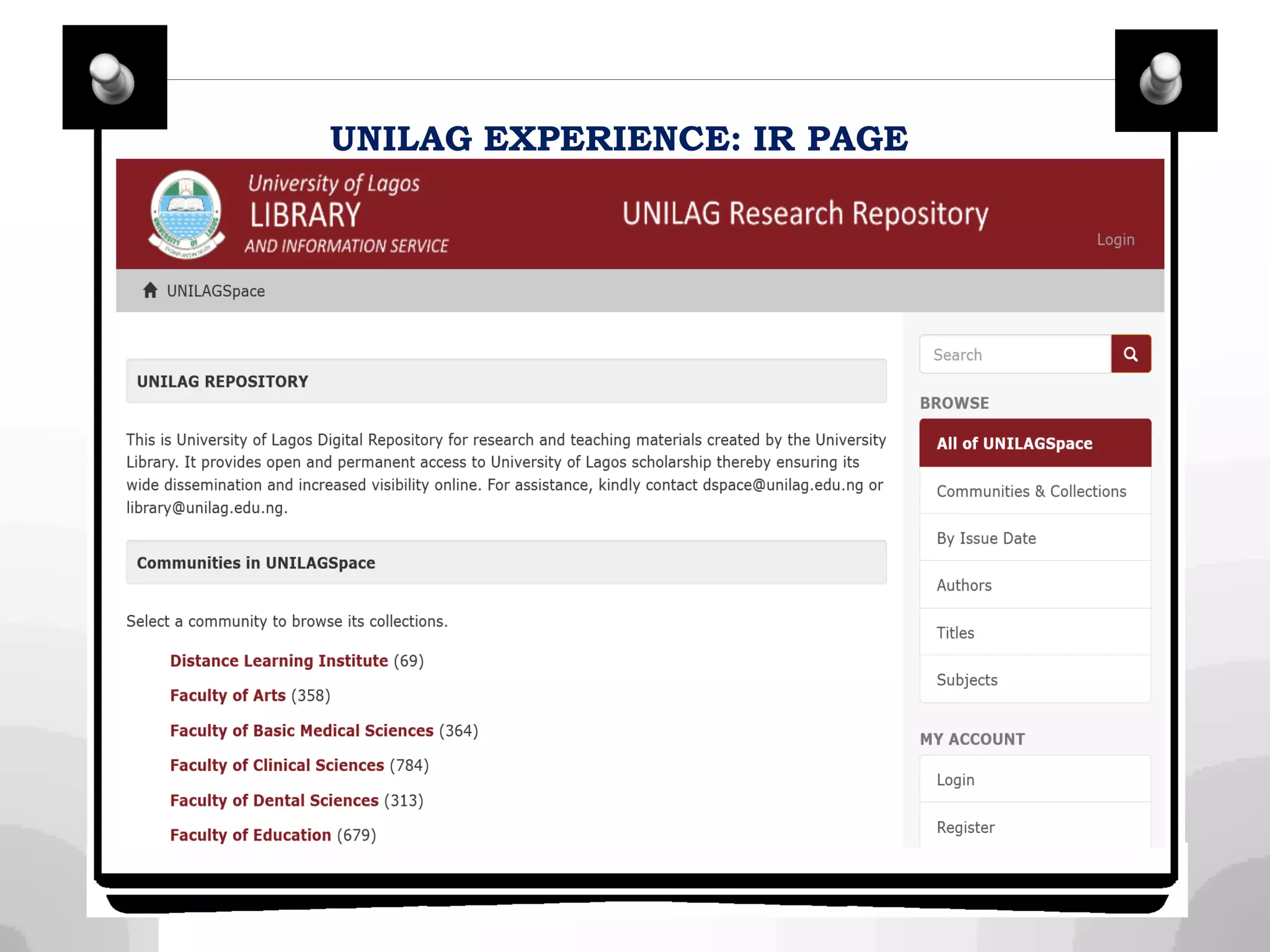
UNILAG EXPERIENCE: IR PAGE
RECOMMENDATIONS
 Mandate support
 According to ACRL (2008), institutions must make available
funds and appropriately meet up the information needs of its
distance learning programs in order to support teaching,
learning and research..
 Technical accessibility
 Every institution needs to provide technical support with full
technical equipment so that teachers and students can easily
use e-resources and have free access to OERs via ODL platform.
 Information literacy
 Libraries must provide information literacy programs such as
user education and IT skills to the user learning community
RECOMMENDED OERs LIST
 OER Commons (https://www.oercommons.org/ )
 A dynamic digital center that contains up to 73,000 types of open
educational resources.
 Open Text Book Store (http://www.opentextbookstore.com/ )
 Useful for mathematics, simple, efficient, high quality and freely
available mathematical textbooks.
 Lumen Learning (https://lumenlearning.com/ )
 This website offers free use of electronic textbooks fully supported
by OERs.
 MIT Open Courseware Online Textbooks
(https://ocw.mit.edu/courses/online-textbooks/ )
 This site is the real one. It offers advanced level materials in the
field of construction, aeronautics, etc.
OTHERS….
 Projects
 Carnegie Mellon Open Learning Initiative {http://oli.cmu.edu/}
 Curriki [ https://www.curriki.org/]
 edX [ https://www.edx.org/]
 Khan Academy [ https://www.khanacademy.org/ ]
 MITx [ https://www.edx.org/school/mitx/ ]
 OER Commons [ https://www.oercommons.org/ ]
 Online Education Database [ https://oedb.org/open/ ]
 Open Education Consortium [ https://www.oeconsortium.org/ ]
 Open Education Consortium Search Engine [ https://www.oeconsortium.org/courses/
 Open Yale Courses [ https://oyc.yale.edu/ ]
 Standard Engineering Everywhere [ https://see.stanford.edu/ ]
 Ted Talks [ https://www.ted.com/ ]
 The Encyclopedia of Life [ https://eol.org/ ]
 UK’s OpenLearn Project [ https://www.open.edu/openlearn/ ]
 Utah State OpenCourseWare [ https://digitalcommons.usu.edu/ocw/ ]
 Wikieducator’s Learning4Content Project [ https://wikieducator.org/Learning4Content
]
OTHERS….
 Digital Repositories:
 Hippocampus [ http://www.hippocampus.org/ ]
 Merlot [ https://www.merlot.org/merlot/index.htm ]
 Unilag (https://ir.unilag.edu.ng/ )
 Open Textbooks:
 Bookboon [ http://bookboon.com/en ]
 College Open Textbooks [
http://www.collegeopentextbooks.org/ ]
 Community College Consortium for Open Educational
Resources [ http://oerconsortium.org/discipline-specific/ ]
 Flat World Knowledge [
http://www1.flatworldknowledge.com/ ]
 Textbook Revolution
http://textbookrevolution.org/index.php/Main_Page ]
OkikiOlatokunboChristopher
Ph.D. (Ibadan) MLIS (Ibadan), BA (Ibadan)
Certified Librarian of Nigeria (CLN)
Head, Automation Unit
University of Lagos Library
University of Lagos Akoka
Lagos, Nigeria
+2348026381337
cokiki69@gmail.com |
cokiki@unilag.edu.ng
Q&A

Integrating library services and oer into distance learning

  • 1.
    INTEGRATING LIBRARY SERVICESAND INFORMATION RESOURCES INTO OPEN AND DISTANCE LEARNING (ODL) PLATFORM Presented By Dr. OKIKI, Olatokunbo C, CLN, Head, Automation Unit University of Lagos Library cokiki@unilag.edu.ng Being A Two Days Partnership Workshop with University of Lagos ODL Team and Delta State University, Abraka, Nigeria On Open and Distance Learning Mode 10th – 11th November, 2021
  • 2.
    Taking Library ServicesAnd Resources Online
  • 3.
     The technologicaladvancement powered by internet has led to democratization of knowledge, delivery and accessibility of education in respective of location.  This revolution has also changed the operation of critical support services, such as library and information services.  ACRL (2008), defines Distance Learning community as all individuals (students, staff, faculty, researchers, administrators and institution) directly involved with academic courses and programs offered further than the main campus or in the absence of traditional campus.  Aligning with the revolution change, library services provided to distance learning student should be practically the same as those available for students in traditional campus settings regardless of their location. PREAMBLE
  • 4.
     Distance learningstudent should be able to have access to library print materials, library electronic resources and other database such as Emerald, JSTOR, Science Direct and OERs among others.  You will all agreed with me that an LMS is a powerful tool that can help facilitate learning and provide an opportunity for students for collaboration, interaction and participation.  In this part of digital global, the gap between eLearning platforms and the library has become widening; in order to bridge that gap integration of library with LMS is needed.  With effective policy, librarians role is to integrate library resources into courseware, creating visibility and increasing the relevance and impact of the library resources to students and faculty. THE CRUX
  • 5.
    NEEDS FOR INTEGRATION Integration of library in the eLearning/LMS portal become necessary in order to:  promote the library resources that are relevant to individual courses and faculty members,  maximize the usages of database (EBSCOHOST, Emerald, Proquest, Science Direct, Research4Life etc.) and other resources procured by the library as well as relevant Open Education Resources,  many of the databases have full text of articles that the instructor wants students to read. The persistent URL of the article can be integrated in Moodle or on ODL portal, and lastly  embrace inclusiveness (equal access).
  • 6.
    MODELS FOR LIBRARYINTEGRATION INTO AN LMS  Shank and Dewald (2003) outlined two models for library resources integration into an LMS:  Macro-Level Library Courseware Involvement (MaLLCI) “entails working with the developers and programmers of courseware to integrate a generic, global library presence into the software”; and  Micro-Level Library Courseware Involvement (MiLLCI) “involves individual librarians teaming up with faculty as consultants to participate in developing a customized library instruction and resource component for the courseware”
  • 7.
    ADAPTATION  For effectivenessand democratization of learning, Macro- Level Library Courseware Involvement (MaLLCI) is the most appropriate method due to its dual benefits (ease to maintain and increase the visibility of the library resources).  In the macro method, library resources are integrated into eLearning platform, and this will be prorated to all course sites.  In a normal academic library, the standard library resources include: library website, OPAC, link to databases, Inter Library Loan (ILL), virtual reference desk, guide to write thesis and dissertations and avoid plagiarism
  • 8.
    STEPS IN INTEGRATINGLIBRARY SERVICES INTO AN LMS PLATFORM  George, (2004) proposed seven basics steps that may be followed when integrating library resources or services into the Moodle LMS platform and these are:  Working with the LMS administrator  Brainstorming about content  Networking with faculty  Integrating resources  Teaching the sessions  Evaluating integration and  Seek other opportunities
  • 9.
    LIBRARY SERVICES FORODL  Dedicated Distance Learner Web Site  Developing a robots library portal  Access to E-resources using a University Proxy server Account  Full text journal articles and electronic books (e- books)  Document Delivery Service for documents that are not available electronically  ILL Service  Information Skills Support  Recommended online tutorials to develop academic skills
  • 10.
    LIBRARY RESOURCES TOBE DEPLOYED INTO ODL PLATFORM  Procurement of Fee-Based Databases subscription  Procurement of both print books and journals  Intentional and relevant harvesting of OERs
  • 11.
    DATABASES SUBSCRIPTION PROCESS Budget  Library Director should be able to review funds and budget lines available for subscription databases/online reference platforms for each fiscal year  Trials and Selection  Find out whether the database you intend to procure has remote access facility(ies)  User friendly interface
  • 12.
  • 13.
    ALIGNING OERS ONTHE ODL PLATFORM: WHAT IT ENTAIL?  The need for using OER around the world has provoked many global initiatives for OER.  Open Educational Resources (OERs) are licensed open source materials freely available for teaching, learning and research, and allow teachers, students and self-learners to re-use and adapt to their needs and goals. (Lumen, 2014).  Open educational resources are not only free but also easy to access, long-lasting and usable.
  • 14.
    WHY INTEGRATE RESOURCESWITH ODL PLATFORM?  All courses (traditional and virtual) require supporting resources  Campus based students have ready access to the Library and all its services  Remote users may not appreciate library services available  Need to ease and integrate access to knowledge resources for all students.  Accrediting agencies require adequate collections (including electronic resources), services that include good access to materials and orientation/instruction.
  • 15.
    TYPES OF OPENEDUCATIONAL RESOURCES  Open Courseware.  Learning Modules.  Open Textbooks.  Streaming Videos.  Open Access Journals.  Online Tutorials.  Digital Learning Objects
  • 16.
    OPEN EDUCATIONAL RESOURCES:COPYRIGHT  Open Educational Resources (OER) are any type of educational material that are freely available for teachers and students to use, adapt, share, and reuse  Creative Commons licensing is at the heart of the OER movement. CC allows creators to specify more flexible forms of copyright that allows "others to copy, distribute, and make some uses of their work."  Look for copyright information (often at the bottom of webpages). Creative Commons licensed material sometimes display clickable icons that indicate the specifics of licensing.
  • 17.
    CREATIVE COMMONS LICENSING See the Creative Commons website for more info and to acquire license icons @ https://creativecommonsusa.org/
  • 18.
    CREATIVE COMMONS LICENSESSYMBOLS & MEANING  CC BY Attribution: Permit distribution, remix, tweak, and build upon your work, even commercially, as long as they acknowledge you for the original creation.  CC BY-SA: Allow remix, tweak, and build upon your work even for commercial purposes, as long as they credit you and license their new creations under the identical terms.  CC BY-ND: Allows for redistribution, commercial and non- commercial, as long as it is passed along unchanged and in whole, with credit to you;  CC BY-NC: Permit others to remix, tweak, and build on your work non-commercially, and although their new works must also acknowledge you and be non-commercial, they don’t have to license their derivative works on the same terms; and  CC BY-NC-SA: lets others remix, tweak, and build upon your work non-commercially, as long as they credit you and license their new creations under the identical terms
  • 19.
  • 20.
  • 21.
  • 22.
  • 23.
    RECOMMENDATIONS  Mandate support According to ACRL (2008), institutions must make available funds and appropriately meet up the information needs of its distance learning programs in order to support teaching, learning and research..  Technical accessibility  Every institution needs to provide technical support with full technical equipment so that teachers and students can easily use e-resources and have free access to OERs via ODL platform.  Information literacy  Libraries must provide information literacy programs such as user education and IT skills to the user learning community
  • 24.
    RECOMMENDED OERs LIST OER Commons (https://www.oercommons.org/ )  A dynamic digital center that contains up to 73,000 types of open educational resources.  Open Text Book Store (http://www.opentextbookstore.com/ )  Useful for mathematics, simple, efficient, high quality and freely available mathematical textbooks.  Lumen Learning (https://lumenlearning.com/ )  This website offers free use of electronic textbooks fully supported by OERs.  MIT Open Courseware Online Textbooks (https://ocw.mit.edu/courses/online-textbooks/ )  This site is the real one. It offers advanced level materials in the field of construction, aeronautics, etc.
  • 25.
    OTHERS….  Projects  CarnegieMellon Open Learning Initiative {http://oli.cmu.edu/}  Curriki [ https://www.curriki.org/]  edX [ https://www.edx.org/]  Khan Academy [ https://www.khanacademy.org/ ]  MITx [ https://www.edx.org/school/mitx/ ]  OER Commons [ https://www.oercommons.org/ ]  Online Education Database [ https://oedb.org/open/ ]  Open Education Consortium [ https://www.oeconsortium.org/ ]  Open Education Consortium Search Engine [ https://www.oeconsortium.org/courses/  Open Yale Courses [ https://oyc.yale.edu/ ]  Standard Engineering Everywhere [ https://see.stanford.edu/ ]  Ted Talks [ https://www.ted.com/ ]  The Encyclopedia of Life [ https://eol.org/ ]  UK’s OpenLearn Project [ https://www.open.edu/openlearn/ ]  Utah State OpenCourseWare [ https://digitalcommons.usu.edu/ocw/ ]  Wikieducator’s Learning4Content Project [ https://wikieducator.org/Learning4Content ]
  • 26.
    OTHERS….  Digital Repositories: Hippocampus [ http://www.hippocampus.org/ ]  Merlot [ https://www.merlot.org/merlot/index.htm ]  Unilag (https://ir.unilag.edu.ng/ )  Open Textbooks:  Bookboon [ http://bookboon.com/en ]  College Open Textbooks [ http://www.collegeopentextbooks.org/ ]  Community College Consortium for Open Educational Resources [ http://oerconsortium.org/discipline-specific/ ]  Flat World Knowledge [ http://www1.flatworldknowledge.com/ ]  Textbook Revolution http://textbookrevolution.org/index.php/Main_Page ]
  • 27.
    OkikiOlatokunboChristopher Ph.D. (Ibadan) MLIS(Ibadan), BA (Ibadan) Certified Librarian of Nigeria (CLN) Head, Automation Unit University of Lagos Library University of Lagos Akoka Lagos, Nigeria +2348026381337 cokiki69@gmail.com | cokiki@unilag.edu.ng
  • 28.